retail sales, mtg purchase apps, global highlights

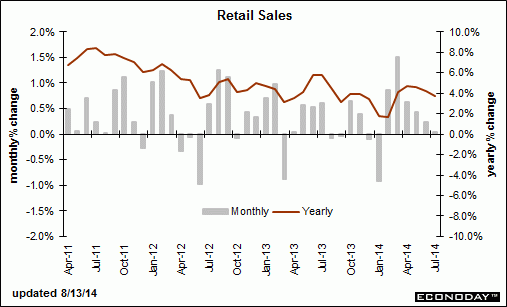
Growth decelerating for 3 consecutive months:


Highlights
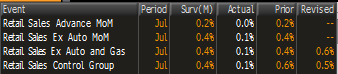
Retail sales disappointed for a second month in a row. Retail sales were flat in July, following a 0.2 percent gain the month before (originally up 0.2 percent). Analysts forecast for a 0.2 percent rise in July.

Motor vehicles slipped 0.2 percent, following a decrease of 0.3 percent in June. Excluding motor vehicles, sales edged up 0.1 percent, following an increase of 0.4 percent in June. Forecasts were for 0.4 percent. Excluding motor vehicles and gasoline, sales nudged up 0.1 percent in July after jumping 0.6 percent the prior month. The median market forecast for July was for 0.3 percent.

While consumer spending was healthy in the second quarter, that does not appear to be the case for the third quarter based on July data.


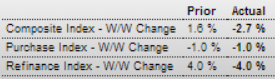
Mtg purchase apps down for the week and down 10% year over year:

MBA Purchase Applications


Demand for purchase applications remained flat in the August 8 week, down 1.0 percent for the second straight week. Year-on-year, purchase applications are down 10.0 percent. Demand for refinancing is also weak, down 4.0 percent in the week. The declines come despite a dip in mortgage rates where the average 30-year mortgage rate for conforming loans ($417,500 or higher) fell 2 basis points to 4.24 percent.

Home Price Growth Slowdown a Mixed Trend for Economy (WSJ) Single-family housing prices rose 4.4% in the year that ended in the second quarter, the slowest annual pace since 2012, according to a report released Tuesday by National Association of Realtors. The association found that median prices for existing single-family homes grew year-over-year in 122 of 173 metropolitan areas it tracked, while prices declined in 47 metro areas. Only 19 areas showed double-digit year-over-year price increases, a substantial drop from the 37 cities that showed such increases in the first quarter.While the median existing single-family home price between the second quarters of 2013 and 2014 rose 7.3% in the West to $297,400, home prices in the Northeast fell 0.9% to $255,500, the report said.

Japan GDP shrinks sharper than after 1997 tax hike (Nikkei) The Cabinet Office said in a preliminary report Wednesday that real gross domestic product for April-June contracted at an annualized rate of 6.8% from the previous quarter. The decline was steeper than in the same quarter of 1997, after sales tax was raised from 3% to 5%. At that time, the economy shrank 3.5%. Economic and Fiscal Policy Minister Akira Amari was unfazed by the big contraction. “The backlash will ease down the road,” he said at a news conference after the GDP results were announced. He said the economy will return to a mild recovery path after summer. “Production shifts to overseas are well underway,” said Amari, indicating that the export decline this time is a long-term structural trend.

China July property investment slows, sales drop sharply (Reuters) Property investment grew 13.7 percent in the first seven months from a year ago, down from an annual rise of 14.1 percent in the first half. Newly started property construction dropped 12.8 percent in the January to July period from the same time a year ago, though the decline easing from an annual drop of 16.4 percent in the first six months. Meanwhile, property sales dropped 16.3 percent in July in terms of floor space, according to Reuters calculations based on official data. That compared with a 0.2 annual drop in June. The NBS data showed mortgage loans fell 3.7 percent in the first seven months of 2014, unchanged from the first half.


Surprisingly weak China July money data cast doubts on recovery’s durability (Reuters) China’s total social financing (TSF) aggregate fell to 273.1 billion yuan ($44.34 billion) in July, about one seventh of that in June. The People’s Bank of China took the unusual step of issuing a statement immediately after the data, reassuring markets that credit and financing growth was still reasonable and that it had not changed its monetary policy. Non-performing loans have now risen for 11 straight quarters, the central bank’s statement said. Chinese banks made 385.2 billion yuan ($62.53 billion) worth of new yuan loans in July, down sharply from 1.08 trillion yuan in June and well below expectations of 727.5 billion yuan, central bank data showed on Wednesday.–

Overly tight fiscal globally continues to put the squeeze on output and employment.

This email is going to pmc donors in advance of being posted on my website.
If you wish to be removed from this list just let me know thanks!

IMF’s Lagarde hints at world growth forecast cut – Reuters

And remains ‘part of the problem’ vs ‘part of the solution’

Reuters noted comments from IMF chief Christine Lagarde, who said that global economic activity should strengthen in the second half of the year and accelerate through 2015, although momentum could be weaker than expected.

She said that central banks’ accommodative policies may only have limited impact on demand and that countries should boost growth by investing in infrastructure, education and health, provided their debt is sustainable.

She highlighted that the IMF’s update of its global economic outlook, expected later this month, will be “very slightly different” from the forecasts published in April. In addition, she noted that the US economy was rebounding after a disappointing first quarter, while it did not anticipate a brutal slowdown in China but rather a slight slowdown in output.

Professor Andrea Terzi quoted on CNBC

Well done!!!!

You’d think he’d turn to Brits like Charles Goodhart who wrote volumes on it for the last 50 years!
;)

How QE may be doing more harm than good

By Paul Gambles

May 7 (CNBC) — I’ve spent the last few weeks talking almost entirely about the Bank of England’s (BoE) latest research findings – and that we’re headed toward what could be the most almighty economic and market meltdown ever seen unless we embark on drastic changes in economic policy.

The default reaction to this has tended to be a mixture of incredulity and confusion, with most people wondering “What’s Gambles going on about now?” This piece is an attempt at proclaiming a pivotal moment in economic understanding at a key time for the global economy.

The findings in question are contained in the BoE’s Quarterly Bulletin. The paper’s introduction states that a “common misconception is that the central bank determines the quantity of loans and deposits in the economy by controlling the quantity of central bank money — the so-called ‘money multiplier’ approach.”

This “misconception” is obviously shared by the world’s policymakers, including the U.S. Federal Reserve, the Bank of Japan and the People’s Bank of China, not to mention the Bank of England itself, who have persisted with a policy of quantitative easing (QE).

QE is seen by its adherents, such as former U.S. Federal Reserve Chairman Ben Bernanke, as both the panacea to heal the post-global financial crisis world and also the factor whose absence was the main cause of the Great Depression. This is in line with their view that central banks create currency for commercial banks to then lend on to borrowers and that this stimulates both asset values and also consumption, which then underpin and fuel the various stages of the expected recovery, encouraging banks to create even more money by lending to both businesses and individuals as a virtuous cycle of expansion unfolds.

The theory sounds great.

However it has one tiny flaw. It’s nonsense.

Back in June 2011, when CNBC’s Karen Tso asked me why I was so critical of Ben Bernanke, an acknowledged academic expert on The Great Depression, I explained that I couldn’t justify the leap of blind faith demanded by Bernanke’s neo-classical monetarist theories.

Professor Hyman Minsky was one of the first to recognize the flaw in those theories. He realized that in practise, in a credit-driven economy, the process is the other way round. The credit which underpins economic activity isn’t created by a supply of large deposits which then enables banks to lend; instead it is the demand for credit by borrowers that creates loans from banks which are then paid to recipients who then deposit them into banks. Loans create deposits, not the other way round.

In the BoE’s latest quarterly bulletin, they conceded this point, recognizing that QE is indeed tantamount to pushing on a piece of string. The article tries to salvage some central banker dignity by claiming somewhat hopefully that the artificially lower interest rates caused by QE might have stimulated some loan demand.

However the elasticity or price sensitivity of demand for credit has long been understood to vary at different points in the economic cycle or, as Minsky recognized, people and businesses are not inclined to borrow money during a downturn purely because it is made cheaper to do so. Consumers also need a feeling of job security and confidence in the economy before taking on additional borrowing commitments.

It may even be that QE has actually had a negative effect on employment, recovery and economic activity.

This is because the only notable effect QE is having is to raise asset prices. If the so-called wealth effect — of higher stock indices and property markets combined with lower interest rates — has failed to generate a sustained rebound in demand for private borrowing, then the higher asset values can start to depress economic activity. Just think of a property market where unclear job or income prospects make consumers nervous about borrowing but house prices keep going up. The higher prices may act as either a deterrent or a bar to market entry, such as when first time buyers are unable to afford to step onto the property ladder.

Dr Andrea Terzi, Professor of Economics at Franklin University, also suggests that many in the banking and finance industry, who often have trouble with the way academics teach and discuss monetary policy, will find the new view much closer to their operational experience. “The few economists who have long rejected the ‘state-of-the-art’ in their models, and refused to teach it in their classrooms, will feel vindicated,” he adds.

Foremost among those economists is Prof Steve Keen: a long-time proponent of the alternative view, endogenous money. Having co-presented with Prof. Keen, I’ve been taken with the way that his endogenous money beliefs stand up to ‘the common sense test.’ The proverbial ‘man on the Clapham omnibus’ knows that borrowing your way out of debt while your returns are dwindling makes no sense. Friedman and Bernanke couldn’t see that.

Ben Bernanke positioned himself as a student of history who had learned from the mistakes of the past. Dr. Terzi questions this, “This view that interest rates trigger an effective ‘transmission mechanism’ is one of the Great Faults in monetary management committed during the Great Recession.”

“The reality is that the level of interest rates affects the economy mildly and in an ambiguous way. To state that monetary policy is powerful is an unsubstantiated claim.”

For a central bank to recognize that its economic understanding is flawed is a major admission. However, unless it takes the opportunity to correct its policy in line with this new understanding then it will repeat the same old mistakes.

The world’s central banks are steering a course unwittingly directly towards a repeat of the 1930s but on a far greater scale. It’s not yet clear that there is any commitment to change this course or indeed whether there is still time to do so. Either way, it will be very interesting to see what future economic historians make of Ben Bernanke’s contribution to economic policy.

PBOC Yuan comments

Reads more and more like they are paving the way for it to go down to ‘rejoin’ the rest of the EM’s and Japan etc?

The reason they give for it not going down is their fx reserves which could be used as a buffer. That implies it goes down otherwise?

“There is no basis for big appreciation of the renminbi,” the PBOC said, noting that China’s trade surplus now represents only 2.1% of its gross domestic product. At the same time, “there is no basis for big depreciation of renminbi,” the central bank added, saying that risks in China’s financial system are “under control” and the country’s big foreign-exchange reserves can serve as a big buffer against any external shocks. While pledging to give the market a bigger role in setting the yuan’s exchange rate, the PBOC said it would still implement “necessary adjustments” to prevent big, abnormal fluctuations in the yuan’s exchange rate.

Yuan weakness

May be a fundamental shift in trade flows?

They don’t want to spend fx to defend?

Looking to let it go to get back to where it was vs yen at 80/$ as other EM’s seem to be doing?

China Weakens Yuan by Largest Degree Since 2012

By Anjani Trivedi

March 10 (WSJ) — The People’s Bank of China set the daily reference rate Monday at 6.1312 to the dollar, compared with 6.1201 to the dollar on Friday. The 0.18% change represented the largest one-day move in the rate since July 2012. The central bank determines the rate each day, and then allows the currency to trade as much as 1% higher or lower. Since 2005, it has gradually moved the rate up, allowing the yuan to strengthen 33%, but in the last month has pushed it lower, seeking to discourage speculators who have channeled money into the economy in hopes of benefiting from the currency’s rise. On Monday, the yuan touched 6.1458 against the dollar, compared with 6.1260 late Friday in New York. The offshore yuan, which is freely traded outside China, weakened as far as 6.1309 from a closing level of 6.1095 on Friday. Premier Li Keqiang said last week at the National People’s Congress, China’s annual legislative session, that Beijing would expand the currency-trading band.

A few comments on overnight news

The threshold may be high but there is one somewhere up there:

Fed should be ‘very patient’ in cutting stimulus: Rosengren (Reuters) The high number of part-time workers who would rather work full-time, the still-high unemployment rate, and very low inflation suggest significant “slack” in labor markets and “call for a very patient approach to removing monetary policy accommodation, particularly given the softness in recent economic data,” Boston Federal Reserve Bank President Eric Rosengren said. Rosengren said that it has been difficult for economists to determine whether weak employment reports for the past two months have been influenced bad weather or if they reflect an economic slowdown, and predicted that harsh winter weather will make the February jobs report similarly difficult to interpret. “In my view, this uncertainty provides an additional strong rationale for taking a patient approach to removing the monetary policy accommodation that the Federal Reserve has been deploying.”

These are closings from contracts signed months earlier:

New home sales hit five-and-a-half year high in January (Reuters) Sales of new U.S. single-family homes jumped 9.6 percent to a seasonally adjusted annual rate of 468,000 units. December’s sales were revised up to a 427,000-unit pace from the previously reported 414,000-unit rate. Sales in the Northeast soared 73.7 percent to a seven-month high, while the South recorded a 10.4 percent rise in transactions to a more than five-year high. Sales tumbled 17.2 percent in the Midwest last month, while rising 11 percent in the West. New home sales rose 2.2 percent compared with January 2013. For all of 2013. Last month, the supply of new houses on the market was unchanged at 184,000 units. The median price of a new home last month rose 3.4 percent to $260,100 from January 2013. At January’s sales pace it would take 4.7 months to clear the supply of houses on the market.

I still suspect some of the q4 activity was ahead of expiring tax credits:

Hope on Horizon for Home-Supply Crunch: Builder Borrowing Picks Up (WSJ) Data released Wednesday by the Federal Deposit Insurance Corp. show that the outstanding balance on loans for land acquisition, development and construction rose in the fourth quarter to $209.9 billion, compared with $206 billion in the third quarter. Last year, the average price of a new U.S. home was $322,100, up 10.2% from 2012. The latest increase in construction lending “is an encouraging signal,” said David Crowe, chief economist for the National Association of Home Builders. But lending remains far from peak, as outstanding land and construction loans topped out at $631.8 billion in the first quarter of 2008. According to the FDIC, outstanding loans solely for construction of homesexcluding development, land acquisition and commercial projectsincreased to $43.7 billion in the fourth quarter, up from a recent low of $40.7 billion in last year’s first quarter.

This helps support prices but doesn’t directly add much to GDP apart from commissions etc. unless it’s new construction:

Foreign appetite for US properties remains strong (FT) Last year the US maintained its position as the top destination for direct commercial property investment by foreigners with $38.7bn pouring into the country, according to a report from brokerage Jones Lang LaSalle. The total was up 44 per cent on 2012. Canadian, Chinese and Australian investors led the charge, with investors targeting top-tier areas such as Manhattan, Los Angeles and Chicago as well as secondary markets including Houston, Dallas and Seattle. Almost half all investments were in office buildings, 16 per cent in apartment blocks, 15 per cent in retail, while hotels, industrial properties and land development made up the rest. Foreign money comprises about 10 per cent of all capital for commercial property investment in the US, which JLL has said could accelerate if international investors expand beyond core assets to riskier deals that deliver higher returns.

The lack of domestic credit expansion and only very modest export growth leaves only govt. to spend more than its income and they keep pressing the wrong way on that as well:

Euro zone lending contraction compounds ECB headache (Reuters) Loans to the private sector fell by 2.2 percent in January from the same month a year earlier, ECB data released on Thursday showed. That compared to a contraction of 2.3 percent in December. Euro zone M3 money supply grew at an annual pace of 1.2 percent, picking up slightly from 1.0 percent in December. The ECB has set out two scenarios that could trigger fresh policy action: a deterioration in the medium-term inflation outlook and an “unwarranted” tightening of short-term money markets. Before the ECB gets to quantitative easing a cut in interest rates is one option for dealing with low euro zone inflation, or tight money markets. Another option the ECB has discussed is to suspend operations to soak up the money it spent buying sovereign bonds under its now-terminated Securities Markets Programme (SMP) during the euro zone’s debt crisis.

6.8% unemployment considered a successful economy?
whatever…

Lowest number of Germans out of work in Feb since Sept 2012 (Reuters) The number of people out of work in Europe’s largest economy decreased by 14,000 to 2.914 million, data from the Labour Office showed. That meant there were fewer unemployed people in Germany than at any time since September 2012. It was the third consecutive monthly drop in joblessness. Separate data from the Federal Statistics Office on Thursday showed employment climbing to a record high of almost 42 million. Berlin expects private consumption, which boosted growth in 2013, to increase by 1.4 percent as workers benefit from an increase in employment to an expected record of 42.1 million this year and a nominal 2.7 percent jump in earnings. The jobless rate held steady at 6.8 percent, its lowest level since German reunification more than two decades ago.

Germany’s wealth distribution most unequal in euro zone (Reuters) Private wealth is more unevenly distributed in Germany than in any other euro zone state. While the richest one percent of people in Germany have personal wealth of at least 800,000 euros ($1.09 million), over a quarter of adults have either no wealth or negative wealth because of debt, the study by Germany’s DIW think tank showed. According to the study, Germany’s Gini coefficient, a measure of income inequality, was 0.78 in 2012. That compared with 0.68 in France, 0.61 in Italy and 0.45 in Slovakia. A score of 0 indicates minimal inequality and 1.0 maximal inequality. Germans have total net assets worth 6.3 trillion euros, with land and real estate accounting for 5.1 trillion euros, and the average German adult has net assets worth around 83,000 euros, according to DIW. In the study, private wealth includes owned real estate, financial assets, valuables and debt.

French jobless total rises to record in January (Reuters) The number of people out of work in France rose by 8,900 in January to reach a record, as President Francois Hollande’s goal of taming unemployment eluded him yet again. Labour Ministry data showed on Wednesday that the number of people registered as out of work reached 3,316,200 in mainland France, up 0.3 percent over a month and 4.4 percent over a year. Hollande’s popularity has plummeted to record lows. He struggled and ultimately failed to live up to a pledge to get unemployment falling by the end of last year. With that promise in tatters despite at least 2 billion euros ($2.73 billion) spent on subsidized jobs, Labour Minister Michel Sapin said earlier on Wednesday that the jobless total should fall this year. Hollande offered last month to phase out 30 billion euros in payroll charges that companies have to pay, in exchange for committing to targets to create jobs.

Spanish Economic Growth Slower Than Expected (WSJ) Gross domestic product grew by 0.2% in the fourth quarter compared with the third, the country’s national statistics institute INE said Thursday. The figure was lower than the INE’s and the government’s preliminary reading, which had pegged quarterly growth at 0.3%. Public spending fell 3.9% compared with the third quarter. Household consumption was up 0.5% in the same period. Strong export growth helped Spain’s economy emerge from a nine-quarter recession in the second half of 2013, but the recovery has so far been anemic, because households remain highly indebted, unemployment still stands around 26% and the government can’t raise public spending because it is struggling to lower its budget deficit. According to the INE, economic output shrunk by 0.2% in the fourth quarter of 2013 compared with the fourth quarter of a year earlier.

Private rental surge hits benefits bill (FT) Englands housing market is seeing a seismic shift towards private rented property and away from home ownership. Figures from the official English housing survey published on Wednesday show the number of households living in the private rented sector overtook those in social housing for the first time last year. Almost 4m households now live in privately rented homes, and a quarter of the tenants are now subsidised by housing benefit, according to the annual survey. Private renting is now the second-largest tenure in England, behind home ownership. Under two-thirds of households now own their own home down from 71 per cent a decade ago. The number of households in the private rented sector receiving the benefit has risen by two-thirds in the past five years, with 390,000 more households in this category beginning to claim, the English housing survey found.

Does China want their currency to adjust to the yen the way other EM currencies have done?

China dismisses concern over sudden renminbi fall (FT) The recent movement of the renminbi exchange rate is the result of market players adjusting their near-term renminbi trading strategies, the State Administration of Foreign Exchange, an agency under the central bank, said. It added that the currencys movement was nothing unusual: The degree of exchange rate volatility is normal by the standards of developed and emerging markets. There is no need to over-interpret it. China faced immense capital inflows at the start of this year, according to data published on Tuesday by the central bank. Banks bought a net $73bn of foreign currency in the onshore market from their clients who wanted renminbi in January, the biggest monthly amount on record. Inflows have been accelerating since the middle of last year when Chinas mountain of foreign exchange reserves grew $500bn to $3.8tn.

China’s Central Bank Engineered Yuan’s Decline (WSJ) China’s central bank engineered the recent decline in the country’s currency to shake out speculators as it prepares to allow a wider trading range for the tightly tethered yuan, according to people familiar with the central bank’s thinking. In the past week, the People’s Bank of China has been guiding the yuan lower against the dollar. It has done so by setting a weaker benchmark against which the yuan can trade. It has also intervened in the currency market by directing state-owned Chinese banks to buy dollars, according to traders. China’s central bank and commercial banks purchased nearly $45 billion worth of foreign exchange in December, the fifth consecutive month of net purchases. The PBOC decided to tamp down expectations for one-way appreciation in the yuan and curb speculative trading during two-day currency-policy meeting that ended on Feb. 18, the people said.

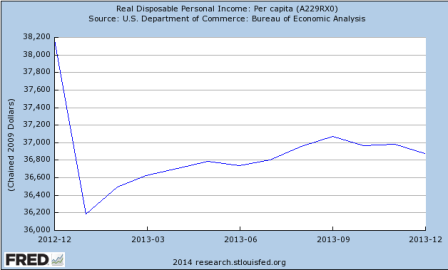
no income growth=no spending growth

CFOs signal fears of consumer spending slump

By Matt Clinch

February 20 (CNBC) — With wage rises failing to match the flickering signs of an upturn in the global economy, chief financial officers have told CNBC that a lack of consumer spending is a major fear for their companies.

CNBC asked 51 chief financial officers (CFO) from Europe and Asia who make up the CNBC CFO council to give their insight on the state of the world economy and conditions for doing business. Nearly half of the respondents ranked weakening consumer demand as their strongest concern for their business. No other risk factor even came close, with fears of a China slowdown receiving 16 percent for their highest ranked concern.

The results match a similar signal from CFOs in the America. In December, the U.S.-based members of the exclusive Global CFO Council ranked weakening consumer demand as one of biggest issues keeping them up at night.\

China hands death sentence to solar cell makers

With public banking, for better or for worse, lending is politicized:

China hands ‘death sentence’ to 75% of solar cell makers

By Toru Sugawara

December 24 (Nikkei) — The Chinese government is pushing for a drastic shakeout of the country’s overcrowded solar cell industry, supporting only a quarter of players and practically telling the rest to get out of the business.

The Ministry of Industry and Information Technology has announced a list of 134 producers of silicon materials, solar panels and other components of photovoltaic systems as meeting certain conditions, as measured by 2012 production, capacity utilization and technical standards.

In a sector said to have more than 500 companies, the ministry’s move means that three-quarters didn’t make the cut — including the core subsidiary of Suntech Power, which went bankrupt in March, and Jiangsu Shungfeng Photovoltaic Technology, Suntech’s startup rescuer.

These firms will not be able to get credit lines from financial institutions and thus will have a tough time borrowing, according to industry insiders. They will also no longer be eligible for refunds of export tariffs, a huge blow to companies that depend on overseas business. On the home front, it will be difficult for them to participate in state-run utilities’ auctions, sharply curtailing their opportunities to win orders.

China going western

Warren,

The following article seems to confirm your views expressed here:

Meet Liu He, Xi Jinping’s Choice to Fix a Faltering Chinese Economy

China prepares to liberalise finance as hedge funds and estate agents salivate

“bit by bit, China’s economy – if not its political structure – is being reshaped along the lines sought by Wall Street and by American-owned transnational corporations.

Back in the late 1990s, US multinationals demanded that China accept more stringent conditions than had been imposed on other developing countries in order to secure WTO membership. Beijing accepted. Now America wants two things: China’s financial sector to be opened up to US banks and the country’s savings to boost western capital markets. More than likely, Washington will get its way, perhaps not immediately but with profound effects.”

Barack Obama mounts big push to bolster FDI in US

FDI is a function of employment. Note how high it was when unemployment was lowest. It’s about being able to make money here and not that we actually need fdi for anything, as we can instead relax fiscal

Barack Obama mounts big push to bolster FDI in US

By James Politi

October 27 (FT) — President Barack Obama wants to attract more foreign investment in the US

President Barack Obama and his senior cabinet officials are mounting a big push to bolster foreign investment in the US – amid evidence that America is falling behind other countries in the race for global capital.

The move by Mr Obama to pitch America as open for business is more aggressive than usual from the White House, reflecting a growing realisation in Washington that the case for investing in the world’s biggest economy is no longer self-evident.

In 2000, the US held 37 per cent of the worldwide inward stock of foreign investment but by 2012, that share had dwindled to just 17 per cent. The US attracted $166bn in foreign direct investment in 2012, a 28 per cent decline compared with 2011 and slightly below 2010 levels.

This year’s performance could be even weaker, since in the first six months of 2013, the US brought in $66bn in foreign investment, well behind the $84bn of the first half of 2012.

The FDI push comes after this month’s fiscal crisis – involving a 16 day government shutdown and a brush with debt default – that has raised eyebrows around the world about the US ability to manage its economy and caused nervousness in global markets.

Mr Obama and senior figures in his administration will ask foreign investors to shrug off the country’s political paralysis and weak economic recovery this week, when they speak at a conference in Washington, the first of its kind by the commerce department, uniting foreign investors with US economic development agencies and state and local officials.

Jack Lew, the Treasury secretary, John Kerry, the secretary of state, Mike Froman, the US trade representative, and Penny Pritzker, the commerce secretary hosting the event, are poised to speak at the event on Thursday and Friday.

“On the heels of the manufactured crises in Washington, it’s time for folks to come together and focus on doing everything we can to spur growth and create new high-quality jobs,” the White House said on Friday.

The US federal government has generally shied away from any big initiatives to promote foreign investment, leaving that task to states competing with each other for business.

Indeed, the high-profile effort by the Obama administration to lay out a welcome mat for foreign capital marks a reversal after years when Washington took for granted that any investors or companies seeking a global presence could not avoid putting money into the US.

But that reality has changed, with the growth of emerging markets from China to India to Brazil, which has dramatically heightened the competition.

Foreign investment inflows have fallen across many of the countries in the OECD, the Paris based group that aims to promote sustainable growth, but in the US that drop has been more pronounced than the average of advanced economies.

“The administration is focusing on FDI as an economic priority because the US has been losing ground,” says Nancy McLernon, president of the Organization for International Investment, which represents US subsidiaries of foreign companies.

The hard case to make is that the US political act is in order. The way that the US has handled things – on fiscal policy and, frankly, monetary policy – has not exactly been confidence-inspiring – Clay Lowery, Former senior US Treasury official

“I think there is a positive political environment to encourage foreign investment of the likes I have not seen over the past two decades”, she adds

The argument for investing in the US has traditionally been that it enjoys a huge and wealthy consumer market, large and liquid capital markets, and a predictable legal system. The domestic energy boom, driven by shale gas, has added to the country’s attractions.

But otherwise, the country’s competitiveness appears to have taken steps backwards. Its corporate tax system remains a morass, with a top rate of 35 per cent that can be scary to prospective investors, even if they might end up paying less by taking advantage of tax breaks.

The country’s infrastructure is in desperate need of retooling and there are growing fears about the education system’s capacity to develop a well-trained workforce. Moreover, political dysfunction in Washington, laid bare by the 16-day government shutdown and close brush with default , have damaged the case for investment in the US.

“The hard case to make is that the US political act is in order. The way that the US has handled things – on fiscal policy and, frankly, monetary policy – has not exactly been confidence-inspiring,” says Clay Lowery, vice-president at Rock Creek Global Advisers, and a senior US Treasury official under George W Bush.

“If you’re an overseas investor, one of the best things about the US was you always knew what the rules of the road are and we have taken away some of that policy stability,” he says.

Moreover, the country’s desire for foreign investors has been called into question after severe political backlashes to high-profile foreign acquisitions, especially from China and the Middle East.

Typically, foreign investment into America has come mostly from European countries, whose sluggish economies have led to weaker flows into the US. This means another objective for the US is to diversify its sources of foreign investment and attract more from emerging markets.