Fed Labor Indicator, NY Fed Consumer Expectations, Lumber Prices, China Trade

This Fed indicator, whatever it means, just went down some:

Labor Market Conditions Index
er-8-10-2

Highlights
If the Fed relied exclusively on its labor market conditions index, no one would be in much hurry for the rate hike. The index for July came in slightly below expectations at 1.1 vs a revised 1.4 in June. The index, based on a broad set of 19 components, has been hovering near zero all year, well off its 5.4 average of last year. Unemployment may be down but hiring has been soft and the 2015 trend for this index is the weakest of the recovery.

er-8-10-1

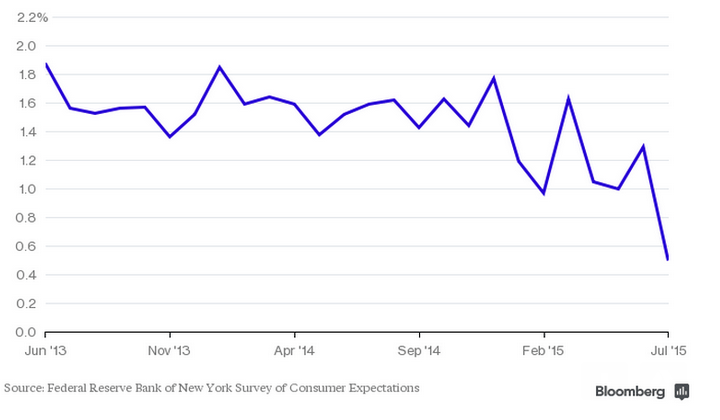
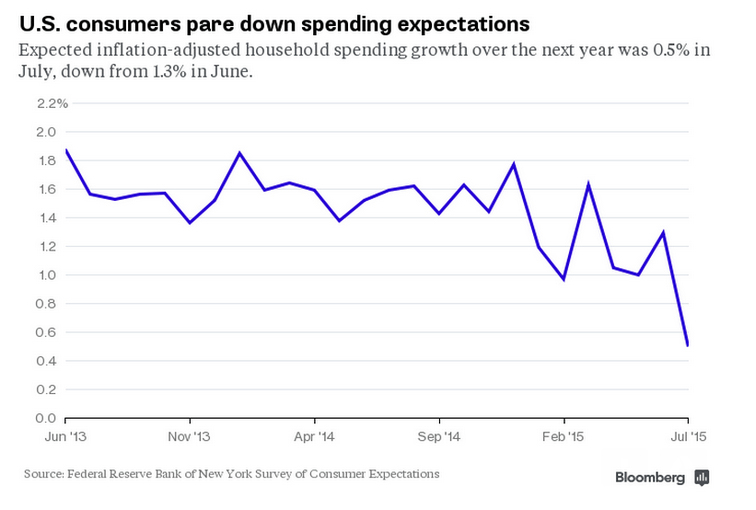
Remember when this was taken as an indication of falling demand for housing?
er-8-10-6

Another indication of a weaker global economy, and a good reason for China to allocate more reserves to Euro:

China : Merchandise Trade Balance
er-8-10-5

Highlights
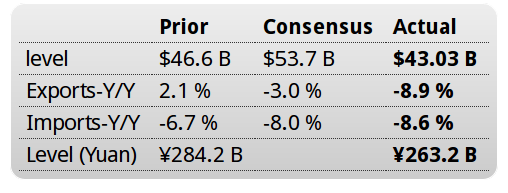
China’s trade figures shocked analysts. July’s unadjusted merchandise trade surplus was $43.0 billion, down from $45.7 billion in June. Exports plunged 8.3 percent against expectations of a 3.0 percent drop. Imports sank 8.1 percent against expectations of a 8 percent drop. The year to date trade balance was $305.2 billion compared with $212.9 billion in the same period a year ago. For the seven months through July, exports were down 0.8 percent on the year while imports dropped 14.6 percent. On a seasonally adjusted basis, exports slid 3.4 percent on the month after increasing 1.5 percent in June while imports declined 3.8 percent after jumping 6.9 percent in June. On the year, seasonally adjusted exports dropped 7.9 percent while imports were 8.4 percent lower.

China’s top government body, the State Council, said last month that it would give high priority to the nation’s trade sector, providing tax breaks and cutting red tape while reducing import duties. The government has also accelerated a range of infrastructure projects to boost demand at home. Meanwhile, the central bank has cut interest rates four times since November in an effort to help struggling domestic companies.

Adding to the problems for exporters is the relatively strong Chinese currency, which has held steady against a buoyant dollar. That has carried the yuan more than 10% higher against the Euro, providing a drag on exports to some key European markets.
Challenger Layoffs, Claims, Trade Comments, Saudi Price Setting, Construction Detail

Not to worry, just the army announcing layoffs:

Challenger Job-Cut Report
er-8-6-1

Highlights
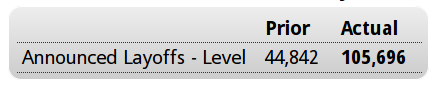
A major Army cutback made for an outsized 105,696 layoff count in July. The Army said it is cutting 57,000 jobs over the next two years (note that Challenger counts layoffs at the time of announcement, not when layoffs actually occur). Heavy layoffs, at 18,891, were also announced in computer & electronics.

These remain at historically low levels:

US weekly jobless claims total 270,000 vs 273,000 estimate

By Robert Galbraith

August 6 (Reuters)

U.S. Trade Gap Expands 7% in June

By Josh Mitchell

July 1 (Wall Street Journal)

The U.S. trade gap with other countries grew 7% in June to $43.8 billion, as imports climbed steadily while exports continued to slip. The U.S. trade gap with the European Union reached an all-time high in June as imports from Europe rose. The trade gap with Mexico also set a record. The U.S. trade deficit with China grew 9.8% in the first six months of 2015 compared with the same period last year,Wednesday’s report showed. The deficit with Japan grew 4.1%. The rise in U.S. imports was due to higher demand for consumer goods, particularly pharmaceutical items, and industrial supplies, including crude oil. Auto imports were the highest on record.

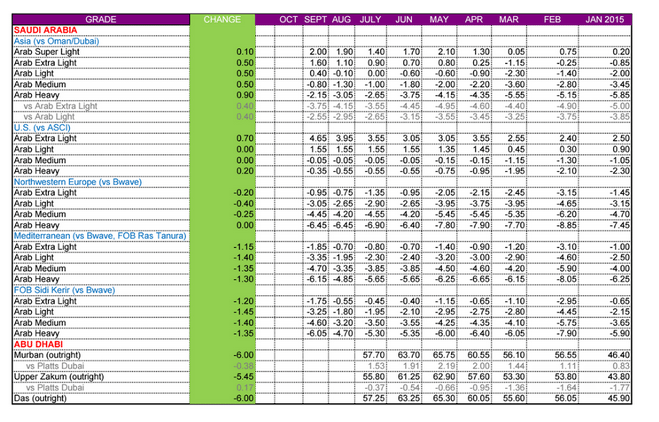
This is how the Saudis set price via altering their posted spreads to various benchmarks:

er-8-6-2


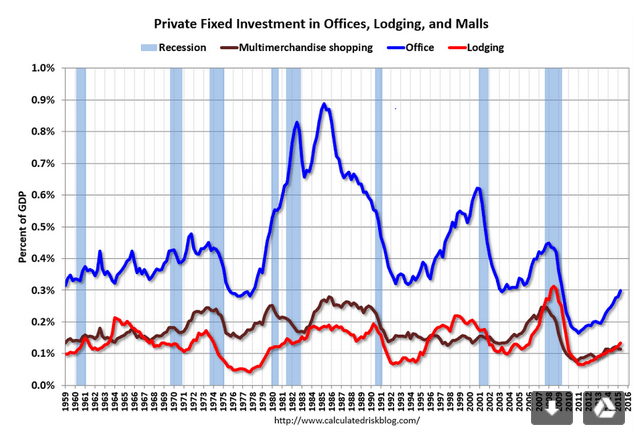
Historically low levels and still growing at lower rates than prior cycles, so adding a lot less to GDP.
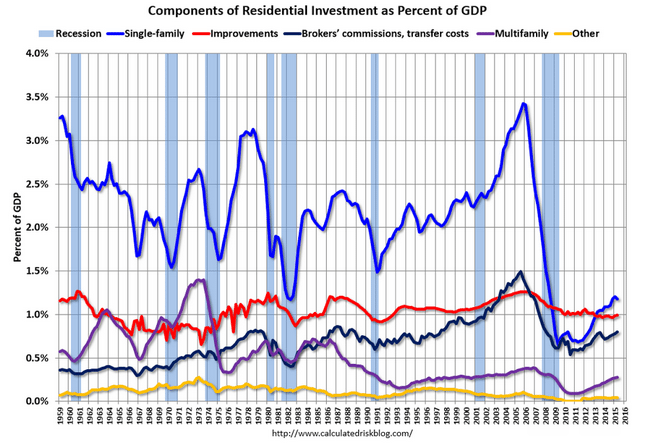
My narrative is that it’s all about a lack of income from a shortfall of private and/or public deficit spending:

er-8-6-3

er-8-6-4

Redbook Retail Sales, Case-Shiller House Prices, PMI Services, Consumer Confidence, Richmond Fed, Oil Capex, Truck Tonnage

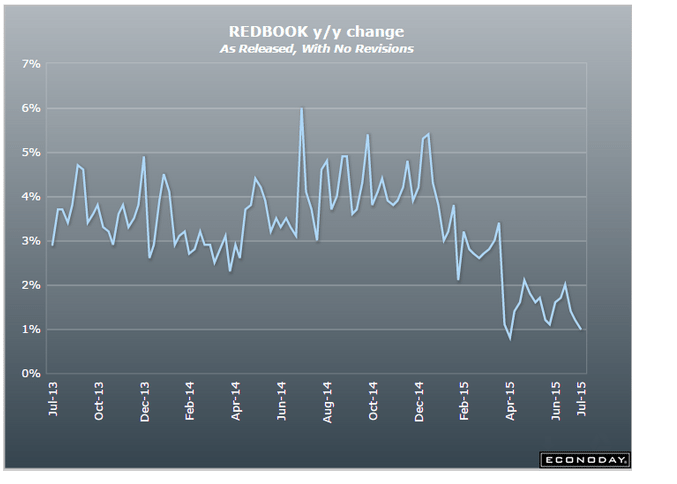
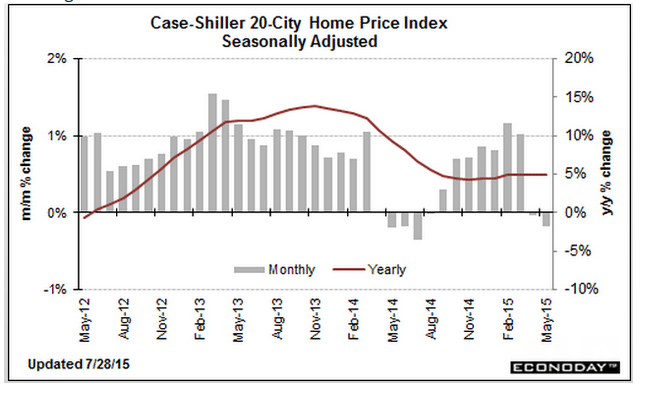
Still bad:

source: Econoday.com
er-7-28-1

Softening:

source: Econoday.com
er-7-28-2

I don’t put much weight on Markit surveys, but the optimism comment is interesting:


source: Econoday.com
er-7-28-3

Highlights

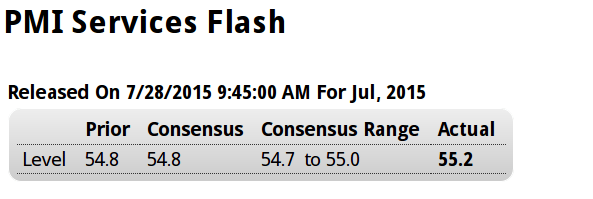
Service sector growth is strengthening slightly this month based on Markit’s July flash index which is up 4 tenths to a very solid 55.2. New orders are at a 3-month high and are getting a boost from both consumer spending and from business customers, the latter a welcome signal of strength for business investment. Backlogs are up and so is hiring. But optimism in the 12-month outlook, perhaps shaken by the outlook for the global economy, is the softest it’s been in three years. Input prices continue to rise but final prices are flat. This report is mostly upbeat and, despite the easing in the outlook, points to solid contribution from the service sector.

This kind of drop is concerning, and I’ve been watching for employment, a lagging indicator, to take a dive:

source: Econoday.com
er-7-28-4

Highlights

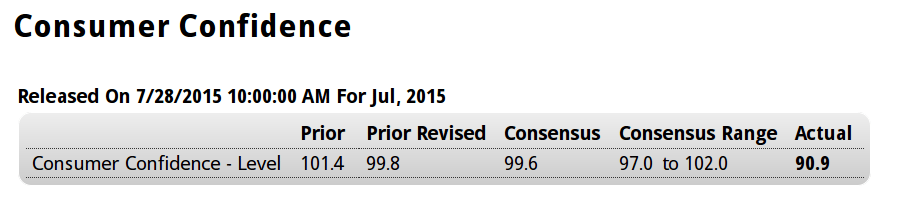
Consumer confidence has weakened substantially this month, to 90.9 which is more than 6 points below Econoday’s low estimate. Weakness is centered in the expectations component which is down nearly 13 points to 79.9 and reflects sudden pessimism in the jobs outlook where an unusually large percentage, at 20 percent even, see fewer jobs opening up six months from now.

Less severe is weakness in the present situation component which is down nearly 3 points to 107.4. Here, slightly more, at 26.7 percent, say jobs are hard to get but this is still low for this reading.

A striking negative in the report is a drop in buying plans for autos which confirms weakness elsewhere in the report. Inflation expectations are steady at 5.1 percent which is soft for this reading.

This report is citing problems in Greece and China as possible factors for the decline in expectations, but US consumers are typically insulated from international events. The decline in expectations, mirrored earlier this morning by a similar decline in the service-sector outlook, may be sending early hints of second-half slowing, slowing that could push back of course the Fed’s expected rate hike.

A bit better, but another reference to softening employment. And note the volatility of this series, with moves up often followed quickly with moves down:

source: Econoday.com
er-7-28-5

Highlights

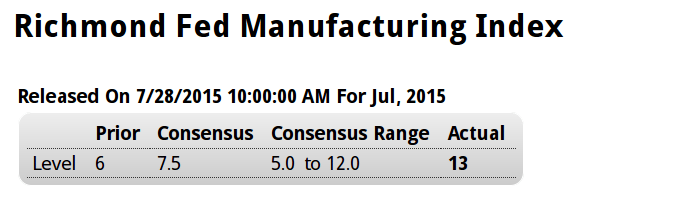
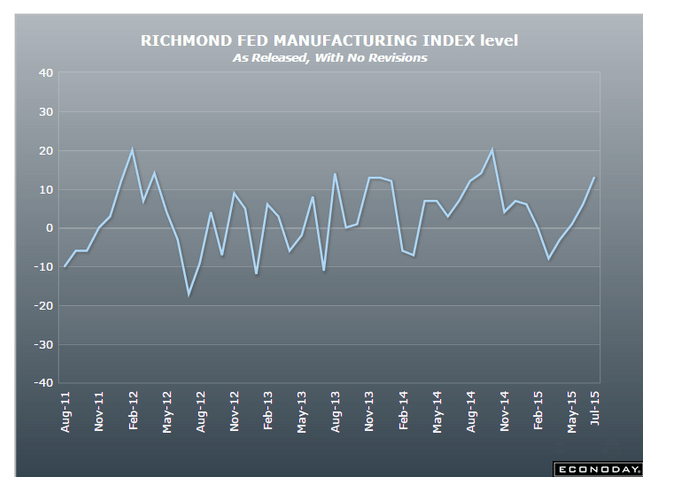
The Richmond Fed is reporting the best strength of any manufacturing region this month, at 13 which is above the Econoday top-end estimate. New orders are especially strong, up 7 points to 17, with backlog orders also rising, up 7 points to 10. Shipments are strong, capacity utilization is up and inventories, because of the activity, are being drawn down. Hiring, however, is slowing. Price data show slight pressure for inputs but no pressure for finished goods.

This report contrasts with much slower rates of growth in the New York and Philadelphia Fed regions and sharply contrasts with recent data from the Dallas and Kansas City Feds where manufacturing, due to the energy sector, is in deep contraction. But today’s result is a welcome positive, suggesting that manufacturing may yet pick up this year and a reminder of strength in yesterday’s durable goods report.

er-7-28-6


This had been estimated at $100 billion:

source: Financial Times
er-7-28-7

Chicago Fed, KC Fed, Japan Exports

Note the details and the conclusion:

source: Econoday

er-7-23-1

Highlights

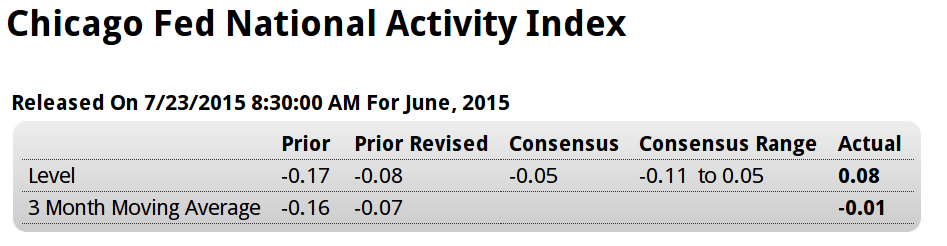
June proved to be a slightly stronger month for the economy than expected, based on the national activity index which came in at plus 0.08 vs Econoday expectations for a 0.05 dip. The 3-month average is still in the negative column though just barely at minus 0.01.

Production indicators showed the most improvement in June, at minus 0.01 vs minus 0.08 in May. The gain here reflects strength in the utilities and mining components of the industrial production report where, however, manufacturing remained flat. Employment also improved, to plus 0.12 from May’s plus 0.06, here reflecting the 2 tenth downtick in the unemployment rate to 5.3 percent. This dip, however, was tied to a decrease in those looking for work which is not a sign of job strength. Personal consumption & housing, at minus 0.07, was little changed as was the sales/orders/inventories component at plus 0.03.

This report is a bit of a head fake, not reflecting the weakness in manufacturing and the special factor behind the decline in the unemployment rate. In sum, growth in the economy is no better than the historical average which is a disappointment, showing little bounce from the weak first quarter.

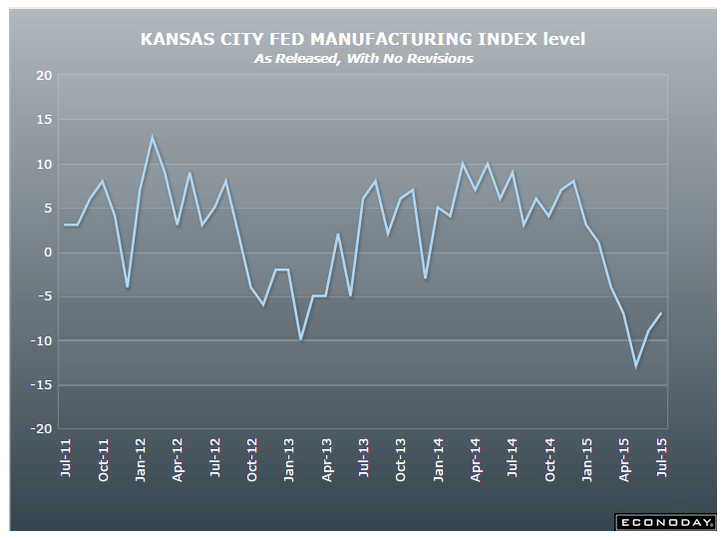
Unambiguously negative, again:


source: Econoday
er-7-23-2

Highlights

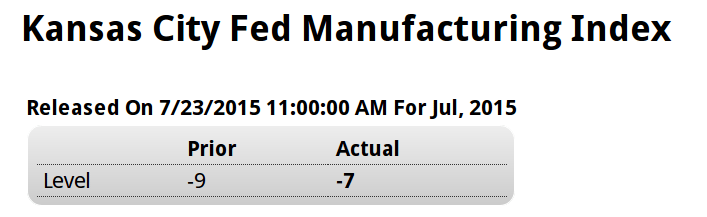
Deep continuing contraction is the score for the Kansas City manufacturing report where the headline index is little changed at minus 7. Order readings point to more trouble ahead with new orders at minus 6 and backlog orders at minus 14. Weakness in export orders, at minus 10, is a central negative for the report, as is hiring, at minus 19 and the workweek at minus 18. Price readings are steady and mute. This region’s manufacturing sector, hurt by both exports and the energy sector, is badly depressed as is the Dallas manufacturing sector. Regional July reports from Dallas and Richmond will be posted early next week to round out the view for what looks to be another weak month for manufacturing.

er-7-23-3

More signs the US trade deficit will be larger for Q2.
From Japan:

Exports to Asia were up 10.1 percent on the year while those to China were 5.9 percent higher. Exports to the European Union added 10.8 percent. It was the seventh consecutive increase. Exports to the U.S. climbed for the tenth straight month, this time by 17.6 percent.

LA Port Traffic, Greek Banks, Recession Without Financial Crisis

Another weak export report. No mention of the drop in oil prices reduced foreign incomes.

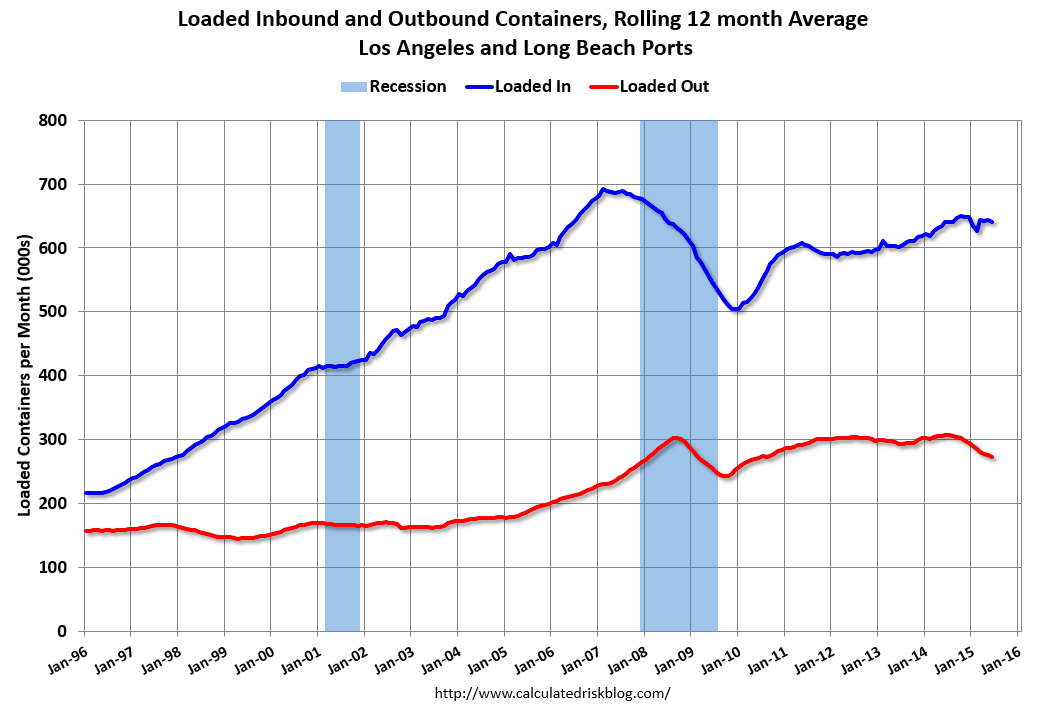
LA area Port Traffic: Weakness in June

by Bill McBride on 7/20/2015 09:57:00 AM

Note: There were some large swings in LA area port traffic earlier this year due to labor issues that were settled on February 21st. Port traffic surged in March as the waiting ships were unloaded (the trade deficit increased in March too), and port traffic declined in April. Perhaps traffic in June is closer to normal.

Container traffic gives us an idea about the volume of goods being exported and imported – and usually some hints about the trade report since LA area ports handle about 40% of the nation’s container port traffic.

The following graphs are for inbound and outbound traffic at the ports of Los Angeles and Long Beach in TEUs (TEUs: 20-foot equivalent units or 20-foot-long cargo container).

To remove the strong seasonal component for inbound traffic, the first graph shows the rolling 12 month average.

er 7-20-1

On a rolling 12 month basis, inbound traffic was down 0.4% compared to the rolling 12 months ending in May. Outbound traffic was down 0.9% compared to 12 months ending in May.

The recent downturn in exports might be due to the strong dollar and weakness in China.

Read more at Calculated Risk Blog

Reads like they still don’t have a clue about how banking works:

The Greek government ordered banks to open on Monday, three weeks after they were shut down to prevent the system collapsing under a flood of withdrawals,

That doesn’t cause collapse. Depositors might have to wait for their Euro. That’s all. No reason for the govt. to close the banks. Reads to me like the govt. thinks that Euro needed to run the economy, pay taxes, etc. would leave the country, or something like that. Makes no sense.

As Prime Minister Alexis Tsipras looked to the start of new bailout talks next week.

The first action of the new cabinet was to sign off on a decree to reopen banks on Monday with slightly more flexible withdrawal limits that allow a maximum of 420 euros a week in place of the strict limit of 60 euros a day currently in place.

But restrictions on transfers abroad and other capital controls remain in place.

It’s up to the banks to set their limits based on how much liquidity they have available.

Also:

Three week shutdown of Greece banks cost the economy an estimated €3B, not counting lost tourism revenue – press – Athens Chamber of Commerce and Industry (EBEA) says some 4,500 containers with raw materials and finished products are blocked at customs.

Additionally, €6B in business transactions were frozen by the bank shutdown.- Retailers lost about €600M in business, with apparel taking the main blow. Exporters lost €240M.

Source: TradeTheNews.com

Yes, negative growth and recession sometimes happens without a domestic financial
crisis, and without any financial crisis globally as well.

Lots of things can cause deficit spending- both non government (private sector) and government together- from being insufficient to offset agents desiring to spend less than their incomes.

Sometimes it’s a sudden obstruction to lending and sometimes it’s not.

Sometimes the agents spending more than their incomes just fade away. For a government allowing the deficit to get too small is a political choice, sometimes well informed but most often misguided.

For the private sector it could be insufficient income, or any reason it simply doesn’t want to borrow to spend or spend from savings.

And the private sector tends to be pro cyclical. That is, should GDP growth decline, private sector borrowing to spend tends to taper as well, as credit worthiness deteriorates, causing the slowdown to get worse. This downward process continues until some agent starts spending more than its income, which historically is government, as tax revenues fall and transfer payments increase with rising unemployment from the downward spiral.

So looks to me like it was the oil capex that was keeping up with the demand leakages, and when that collapsed as prices fell the demand leakages got the upper hand. And so far no sign of anything else stepping up its spending enough to move the GDP needle.

Fed Testimony

Semiannual Monetary Policy Report to the Congress

By Janet Yellen

Looking forward, prospects are favorable for further improvement in the U.S. labor market and the economy more broadly. Low oil prices

Still seems to leave out the fact that a dollar saved by the buyer of oil is a dollar lost by the seller.

And ongoing employment gains should continue to bolster consumer spending, financial conditions generally remain supportive of growth,

Yes, but the growth rate of lending has only been relatively modest and stable

And the highly accommodative monetary policies abroad should work to strengthen global growth.

Low and negative rates and quantitative easing now have a very long history of not resulting in increased aggregate demand.

In addition, some of the headwinds restraining economic growth, including the effects of dollar appreciation on net exports and the effect of lower oil prices on capital spending, should diminish over time.

Yes, but the question is what will replace the lost capital spending? Without that incremental capital expenditure, growth, at best, stagnates and likely goes negative as the ‘demand leakages’ continue to grow.

Also, the weakness in U.S. exports is partially the consequence of lower oil prices as reduced U.S. expense for imported oil = reduced income available to non residents to import U.S. goods and services. And the decline in global oil capital expenditures works against global growth and U.S. exports as well.

As a result, the FOMC expects U.S. GDP growth to strengthen over the remainder of this year and the unemployment rate to decline gradually. As always, however, there are some uncertainties in the economic outlook. Foreign developments, in particular, pose some risks to U.S. growth. Most notably, although the recovery in the Euro area appears to have gained a firmer footing,

That’s due to the weak Euro helping their exports. You can’t have it both ways- if the dollar becomes less of a headwind for the U.S., the Euro will become less of a tailwind for the EU.

The situation in Greece remains difficult. And China continues to grapple with the challenges posed by high debt, weak property markets, and volatile financial conditions. But economic growth abroad could also pick up more quickly than observers generally anticipate, providing additional support for U.S. economic activity.

This again assumes lower rates and quantitative easing are accommodative, particularly in the EU and China

The U.S. economy also might snap back more quickly as the transitory influences holding down first-half growth fade and the boost to consumer spending from low oil prices shows through more definitively.

Again, still assumes lower oil prices are a net positive.

China trade, Greece comment

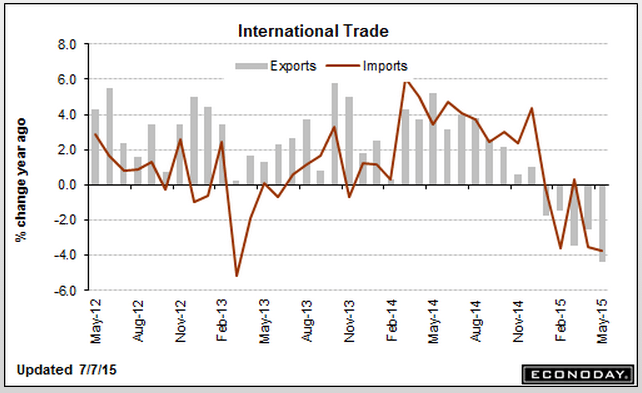
More reason to suspect US exports will disappoint and US imports will exceed expectations:
er-7-13-1

Highlights
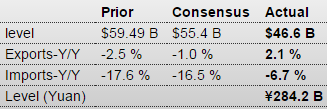
China’s June merchandise trade surplus was $46.6 billion against expectations of a $55.3 billion surplus. In Yuan terms, exports were up 2.1 percent on the year while imports tumbled 6.7 percent. The first half of 2015 trade balance was CNY1.61 trillion or $263.9 billion. On a seasonally adjusted basis, exports were up 1.1 percent on the year after sliding 1.4 percent in May. Seasonally adjusted imports dropped 9.9 percent after a 14.1 percent plunge.

According to Chinese Customs, expectations are for export growth to rebound in the second half of the year. It noted that the Greek crisis will have some impact on China’s trade – it is hard to quantify just how big an impact there will be.

China sees exports increase 2% in June, imports decline

By Chen Jia and Zhong Nan

July 13 (ChinaDaily)
er-7-13-2
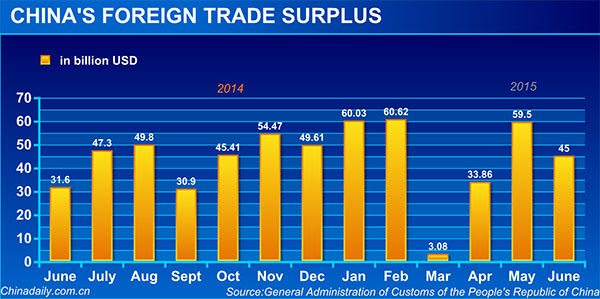
China’s export rose by 2.1 percent year-on-year to 1.17 trillion yuan($188.5 billion) in June, a better-than-expected increase after the 6.4 percent decline in April, according to data from Customs released on Monday.

However, the import figure fell by by 6.7 percent to 890.67 billion yuan last month, leading to an accelerated growth of monthly trade surplus to 45 percent year-on-year.

In the first six months, the country’s total foreign trade value was 11.53 trillion yuan, down by 6.9 percent from a year earlier. Exports increased by 0.9 percent to 6.57 trillion yuan while imports decreased by 15.5 percent to 4.96 trillion yuan.

Trade surplus in the first half rose by 1.5 times from a year earlier to 1.61 trillion yuan, the data revealed.

The structure of trade modes continued to improve when exports of general trade showed marked growth, and strong momentum was spotted in exports to emerging markets and some countries along the “Belt and Road”, said Huang Songping, a spokesman from the Customs department, at a press conference.

China’s bilateral trade with the European Union declined by 6.8 percent during the January-to-June period to 1.67 trillion yuan and trade with Japan fell by 10.6 percent to 832.02 billion yuan, said Hong.

“The Greek debt crisis is likely to influence China’s export, but it is difficult to predict the exact effects,” added Huang.

Varoufakis’ interview in the New Statesman:

Exclusive: Yanis Varoufakis opens up about his five month battle to save Greece

“He said he spent the past month warning the Greek cabinet that the ECB would close Greece’s banks to force a deal. When they did, he was prepared to do three things: issue euro-denominated IOUs; apply a “haircut” to the bonds Greek issued to the ECB in 2012, reducing Greece’s debt; and seize control of the Bank of Greece from the ECB.”

As suspected, he’s was in it over his head.

My response would be to let the banks remain open with circumstances limiting withdrawals to available liquidity. Liquidity might come from earnings on assets, asset sales, and new deposits. The banks would be free, by mutual agreement, to issue IOU’s to depositors who didn’t want to wait for actual euro. The govt might issue IOU’s if it ran out of cash for operating expenses. To ‘seize control of the Bank of Greece from the ECB’ is nonsensical, as there’s nothing there but a computer with a spreadsheet. It would not give Greece the ability to clear funds outside of Greek member banks that are on that spreadsheet. Haircuts to bonds issued to the ECB and reducing Greek debt would also be meaningless in this context.

Trade, Atlanta Fed, Redbook sales

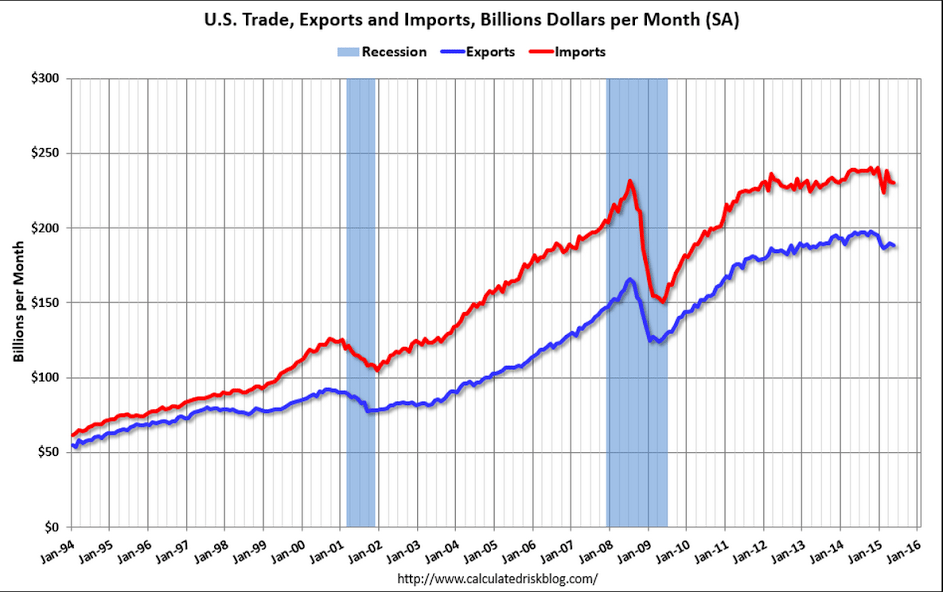
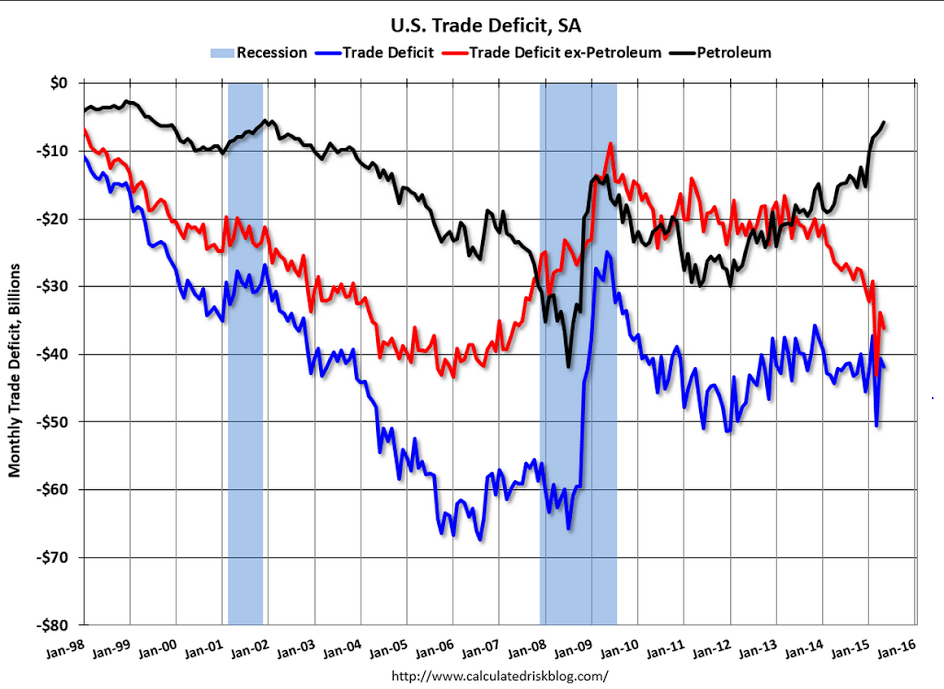
Trade deficit a bit higher but looks to me like more to come, including revisions. The petroleum gap is set to widen as US production begins to decline and is replaced by imports. And to my prior point, auto imports were up. And further note that global reductions in trade are associated with recessions:

International Trade
er-7-7-1
Highlights
The nation’s trade gap came in near expectations in May at $41.9 billion, wider than April’s revised gap of $40.7 billion. The goods gap rose by a net $1.2 billion to $61.5 billion, offset in part by a fractionally wider services surplus of $19.6 billion. The petroleum gap narrowed $1.0 billion to $5.8 billion which, reflecting rising domestic oil output together with rising exports of refined products, is the lowest since February 2002.

Exports, which have been pressured by strength in the dollar, fell $1.5 billion to $188.6 billion in May reflecting a $2.4 billion downswing for capital goods and, within this reading, a $1.2 billion downswing in aircraft exports. Exports of nonmonetary gold fell $0.5 billion in the month.

Imports were also down, $0.3 billion lower to $230.5 billion including a $0.8 billion decline in capital goods. Imports of industrial supplies fell $0.6 billion within which imports of crude oil fell $0.4 billion. The decline in crude imports comes despite a more than $4 rise in prices to $50.76 per barrel. Imports of autos rose $0.9 billion in the month.

By country, the gap with China rose $4.0 billion to $30.5 billion with the EU gap down $0.8 billion to $12.5 billion. The gap with Japan narrowed $1.8 billion to $5.2 billion while the gap with Mexico widened slightly to $4.6 billion in the month. And for the first time since 1990, the nation posted a monthly surplus with Canada, at $0.6 billion.

The decline in goods exports is a major concern for the manufacturing sector which is struggling right now with weak foreign demand. The May gap is in line with trend and is not likely to affect GDP estimates.
er-7-7-2
er-7-7-3
er-7-7-4

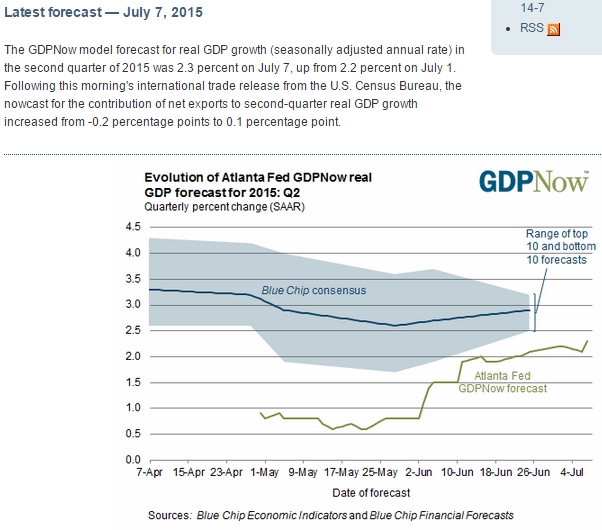
An uptick to 2.3% based on today’s trade report for May. The first Q2 GDP estimate will be out later this month, and will include an estimate for June trade which won’t come out until the first revision for Q2 GDP comes out:
er-7-7-5
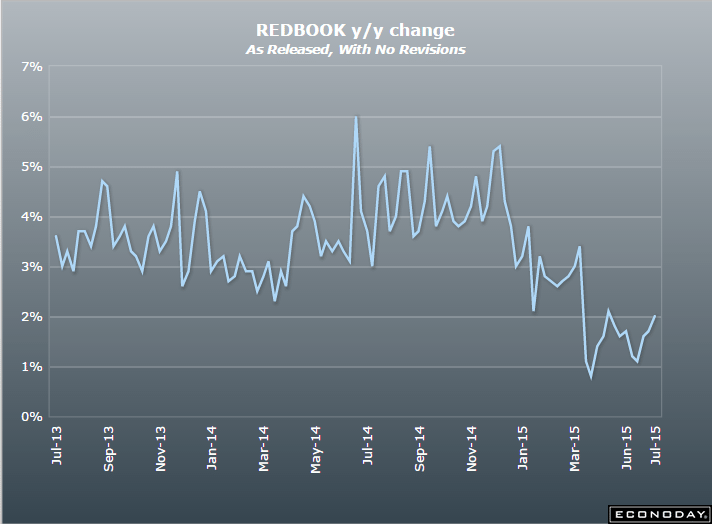
This minor indicator remains depressed, as do other retail sales indicators:

Redbook
er-7-7-6
Highlights
Hot weather triggered demand for seasonal goods in the July 4 week, helping to boost Redbook’s same-store year-on-year sales index by 3 tenths to plus 2.0 percent. But the reading is still soft and does not point to strength for the government’s core retail sales reading (ex-auto ex-gas). May was a very strong month for retail sales which, however, appear to have edged lower since.
er-7-7-7
er-7-7-8

existing home sales, Greece and China comments

So after cheering the big jump last month to 112.4, it gets revised down to only 111.6, so the lower than expected print of 112.6 vs 113 expected is now hailed as a larger than expected increase from last month, as the shameless cheer leading continues:

United States : Pending Home Sales Index
er-6-29-1
Highlights
Solid momentum is building inside the housing market based on the ongoing run of very strong data including today’s pending home sales index which is up a better-than-expected 0.9 percent in the May report which tops Econoday expectations for a 0.6 percent gain. The index level, at 112.6, is as high as it’s been since the bubble days of 2006.

Sales have been very strong in the West where pending sales rose 2.2 percent in May for a 13.0 percent year-on-year gain. Pending sales in the South, up 10.6 percent year-on-year, have also been strong though the region did dip 0.8 percent in the latest month. Sales also dipped in the Midwest, down 0.6 percent for a year-on-year plus 7.8 percent, but they rose sharply in the Northeast where housing after a heavy winter is bouncing back strongly, up 6.3 percent in this report for a year-on-year again of 10.6 percent.

Today’s report points to further strength for the existing home sales report which surged in data posted last week. Housing is getting a boost from the strong jobs market together perhaps with the prospect of rising mortgage rates which may be pushing buyers into the market. Watch for Case-Shiller home price data on tomorrow’s calendar.

Year over year % change, as the absolute number remains depressed:
er-6-29-2
Pending home sales index- only back to previous highs of what was also a depressed market:
er-6-29-3

NAR: Pending Home Sales Index increased 0.9% in May, up 10% year-over-year

By Bill McBride

So after reading this and a few other articles it seems they think a ‘run on the banks’ somehow removes euro that could otherwise be used to pay creditors. This implies either some kind of plan to tax bank deposits to pay creditors or just the continued evidence of gross ignorance of their own monetary system. In any case seems the most likely outcome is a yes vote for the troika plan which gives the leadership the desired political cover to go ahead and sign it and move on and remain the European citizens in good standing they’ve always been…

And this would also be yet another victory for the ongoing deflationary policies, this time being spun as explicit support from the people, proving once again that populations dislike inflation even more than they dislike unemployment. This means the focused pursuit of a trade surplus is intact, and I’ve yet to see a currency with a persistent trade surplus and a weak currency:
er-6-29-4

Greece Bailout: Eurozone Ministers to Explore ‘Plan B’ (WSJ) The first step in what has commonly been referred to as “Plan B” among Greece’s creditors would likely be the introduction of capital controls to avoid a run on the country’s banks. But in comparison to Cyprus, which implemented capital controls as part of a €10 billion bailout package from the eurozone and the International Monetary Fund, the financial situation of the Greek government is much more precarious. The eurozone portion of Greece’s €245 billion rescue package runs out on Tuesday, the same day the government has to pay €1.55 billion to the IMF.

Doing the same thing over and over again and expecting different results…

China cuts reserve ratio, interest rates to bolster growth (Xinhua) The central bank cut the RRR for commercial banks serving rural areas, agriculture and small businesses by 50 basis points (bps). The RRR for finance companies, or non-bank financial institutions, will be lowered by 300 bps, the PBOC announced. Benchmark interest rates have also been cut. Interest rates for one-year lending and deposits are cut by 25 bps to 4.85 percent and 2 percent respectively. Lending of other terms and kinds will also be lowered by the same margin, the announcement said. It is the third RRR reduction in nearly five months, while the fourth round of interest cuts in nearly seven months.

China cuts rates, Atlanta Fed, car sale comment, Greek PM comments

As the carpenter said about his piece of wood, ‘no matter how much I cut off it’s still too short’:

China’s central bank cut its benchmark lending rates by 25 basis points to 4.85 percent on Saturday, the fourth reduction since November, as it gears up to lower borrowing costs and support a slowing economy.

The People’s Bank of China (PBOC) also reduced one-year benchmark deposit rates by 25 basis points to 2 percent, it said in a statement on its website, adding that the reductions would take effect on Sunday.

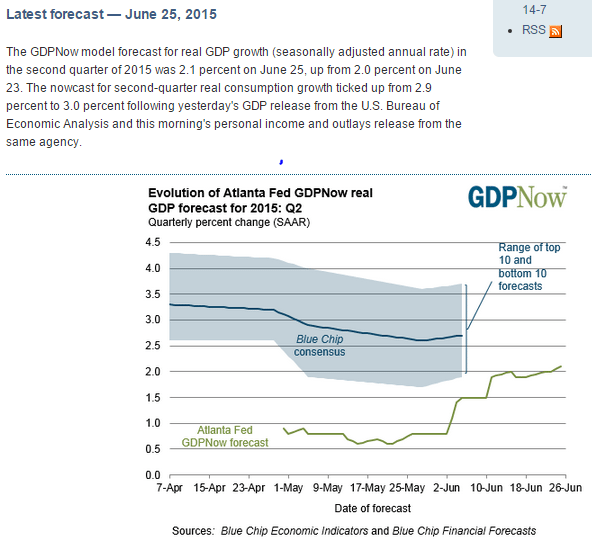
atl-nowcast-6-29
Yes, car sales are up a bit, but seems import content is growing so it’s working against US GDP and employment?

Number of ‘American-made’ autos drops to new low

By Phil LeBeau

So why would the Prime Minister do this?

The Greek banks are ECB members, regulated and supervised by the ECB, with liquidity provided by the ECB. Should liquidity end, the ECB via the Bank of Greece simply stops making payments on that bank’s behalf. And why close the banks and prevent them from performing ongoing bank services that don’t require ECB liquidity, should it not be available as needed? Just more evidence that the Greek leaders aren’t playing with a full deck, so to speak…

Greek PM calls for bank closures, capital controls

By Phillip Tutt

June 29 (CNBC) —Despite a tweet from Greek Finance Minister Yanis Varoufakis that his government “opposed the very concept” of any controls, Greek Prime Minister Alexis Tsipras said later Sunday that he had forced the country’s central bank to recommend a bank holiday and capital controls.