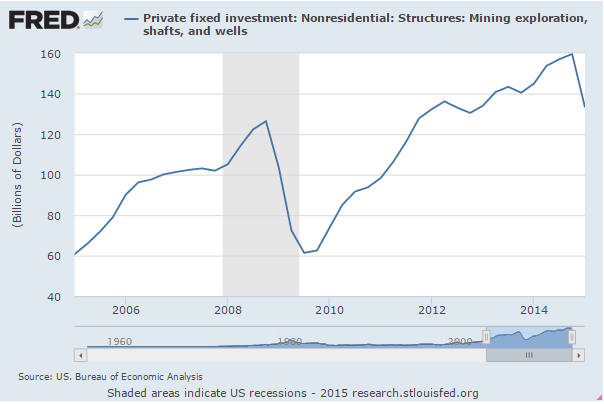
Restaurant Index, credit check, personal rental income, oil investment

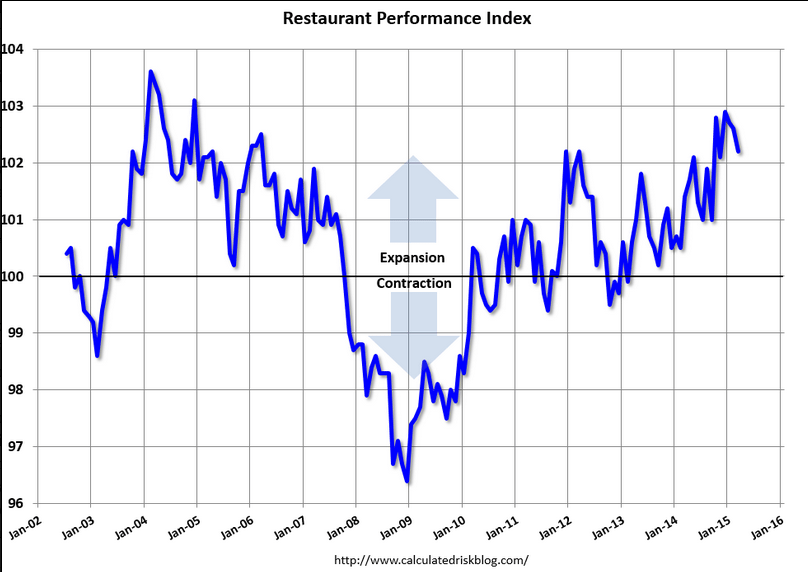
Although a majority of restaurant operators reported higher same-store sales in March, customer traffic levels were somewhat dampened,” said Hudson Riehle, senior vice president of the Research and Knowledge Group for the Association. “Looking forward, restaurant operators remain solidly optimistic about future business conditions, with six in 10 expecting to have higher sales in six months.
er-5-2-1

No lift off here:
er-5-2-2
er-5-2-3
er-5-2-4
er-5-2-5
er-5-2-6

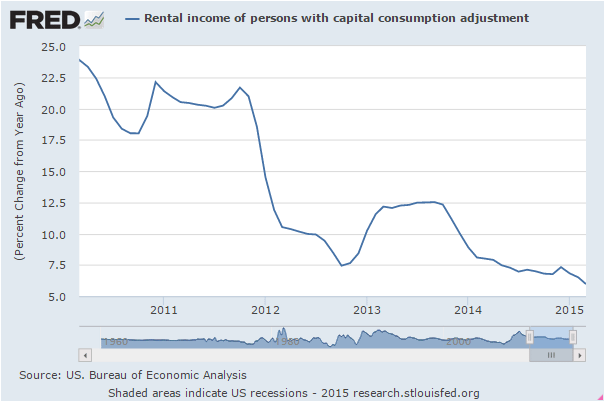
Growth of rental income slowing:
er-5-2-7
er-5-2-8

Posted in Oil

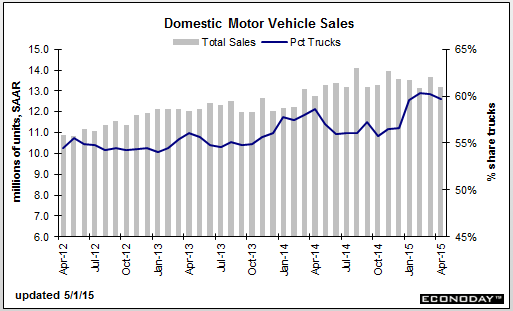
Car sales

Big letdown here. More Q2 downgrades on the way.
Still waiting for the burst of consumer spending from the drop in oil prices…

United States : Motor Vehicle Sales
er-5-1-16
Highlights
The early indications from April have mostly been weak including the first hard consumer data on the month which are vehicle sales. Vehicle sales fell 4.1 percent to a 16.5 million annual rate. This is a very solid rate but the comparison with March points unfortunately to a downtick for the motor vehicle component of the retail sales report. This is a key component of the report which has been bouncing up and down in recent months, unable to find traction as have retail sales in general.
er-5-1-17

ISM, PMI, Consumer Sentiment, Construction Spending

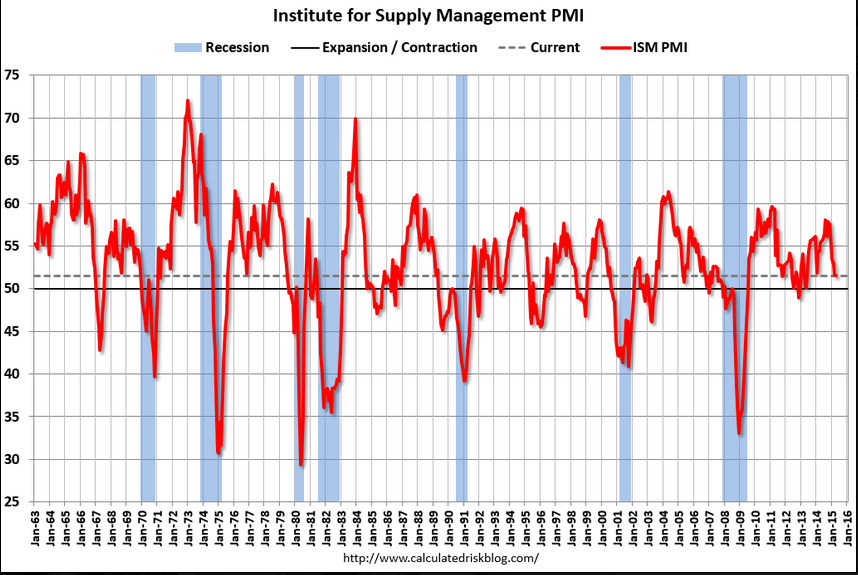
Slow start for April Manufacturing:

ISM Mfg Index

er-5-1-5
Highlights
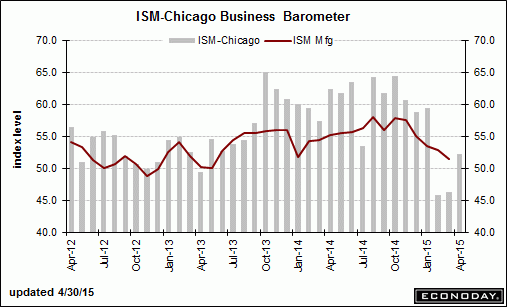
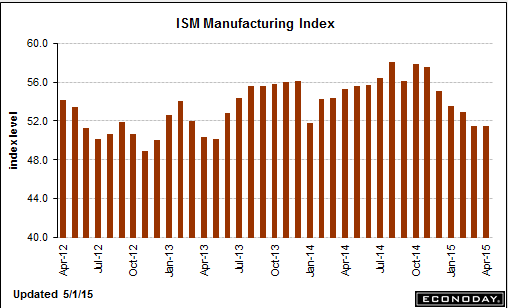
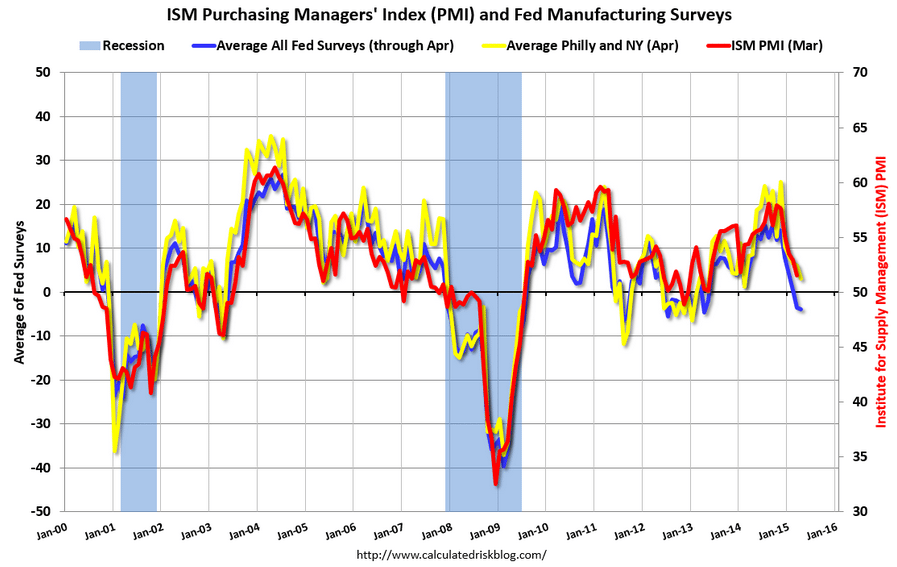
There’s a new unwanted wrinkle in the ISM report and that’s weakness in employment, holding down the headline index to 51.5 in April, unchanged from March. Employment has been holding strong in other reports — but not in the ISM report where the index is down nearly 2 points to a sub-50 level of 48.3 to indicate month-to-month contraction. This is the first time this reading is in contraction since May 2013 and it’s the lowest reading since all the way back in September 2009.

Other indications, however, are positive. New orders actually rose in the month, up 1.7 points to 53.5, and export orders are above 50 for the first time this year, at 51.5 for a 4.0 point gain. Production, at 56.0, is especially strong as are import orders at 54.0 for a 1.5 point gain. Prices, as in other reports, remain in contraction, little changed at 40.5.

And there’s solid breadth in the report with 15 of 18 industries showing composite growth in the month with strength in the auto industry specifically cited. This report is mixed though the decline in employment won’t be raising expectations for next week’s employment report for April.
er-5-1-6
er-5-1-7

Goldman Analyst’s index:
er-5-1-8

PMI Manufacturing Index
er-5-1-9

Highlights
Markit’s sample has been reporting some of the strongest activity of any manufacturing sample, making its otherwise respectable showing at 54.1 in April, down from 55.7 in March, yet another indication of weakness in the sector. Weakness, as in other samples, is centered in exports where orders, for the first time since November, are in outright contraction, the result of the strong dollar’s depressing impact on foreign demand.

Production is the softest it’s been all year, and that of course includes the winter months which, in most data, were hit hard by heavy weather. Deliveries continue to be delayed, the result not of strong demand but, interestingly, of continued issues tied to the long resolved port slowdown on the West Coast.

This is one man one vote, not one dollar one vote, which squares this series with soft consumer spending reports:

Consumer Sentiment

er-5-1-10

Highlights
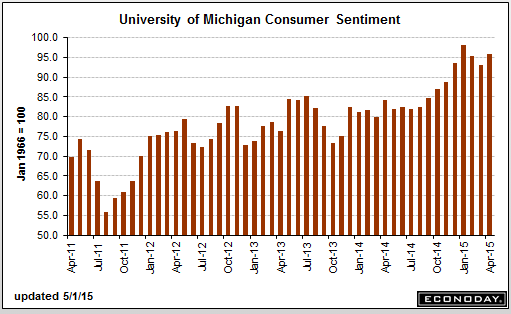
The Federal Reserve in Wednesday’s FOMC statement described consumer confidence as strong, confirmed by today’s consumer sentiment index which came in at 95.9 for final April, unchanged from mid-month April and noticeably higher from 93.0 in final March.

The headline’s two components both show gains with current conditions at 107.0, up 2.0 points from March, and with expectations at 88.8, up 3.5 points. The former points to month-to-month strength for consumer activity while the latter points to confidence in the income outlook, specifically the jobs market.

Inflation readings are very weak in this report, reflecting no doubt the low level of gas prices which however have been on the rise in recent weeks. The 1-year outlook is at 2.6 percent, down from 3.0 percent in March, with the 5-year outlook also at 2.6 percent, down from 2.8 percent.

Fed policy makers are keeping a close eye on inflation expectations and today’s report won’t offer anything to the hawks who want to begin raising rates. And despite the strength in the overall reading, strength in sentiment has yet to translate to strength in spending.
er-5-1-14

This is just plain bad and a downward reduction to Q1 GDP. And weaker GDP=weaker sales and incomes=that much less spending power going into Q2:

Construction Spending

er-5-1-12
Highlights
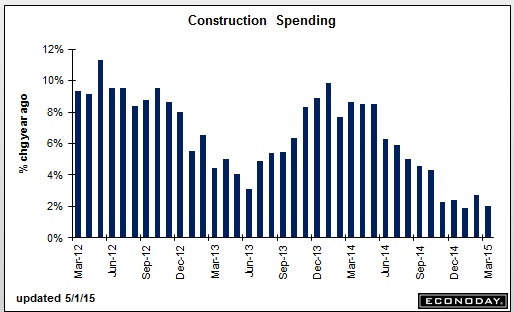
Construction spending once again defied expectations. March construction spending dropped 0.6 percent against expectations of an increase of 0.4 percent. On the year, construction spending was up 2.0 percent, down from February’s annual increase of 2.7 percent. Both residential and public building declined. While weather can still be blamed for some of the decline, a basic weakness in the building sector was apparent.

Private residential spending dropped 1.6 percent on the month with both single family and multi-family homes declined. In addition, residential construction excluding new homes, which captures home remodeling, also declined after gains in the previous two months. Nonresidential private construction provided a ray of sunshine — it advanced 1.0 percent on gains in the office, manufacturing, and health care sectors.

Public construction was down for a third straight month to its lowest level since February 2014. State and local government spending, the much larger portion of public construction, dropped in both February and March while Federal Government construction retreated after an 8.6 percent surge in the previous month.
er-5-1-13

Atlanta Fed, Japan and China, rail car traffic, Saudi output

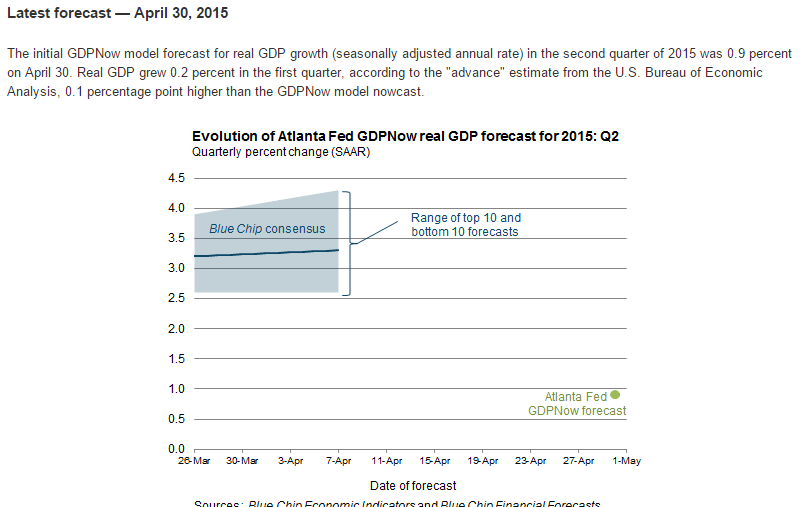
Currently a .9 forecast for Q2, well below other estimates again:
er-5-1-1
More global deceleration:

Japan : Household Spending
er-5-1-2
Highlights
Household spending declined for a twelfth straight month in March. On the year, spending was down 10.6 percent after sliding 2.9 percent in January. Consumption has been weak since last April when Japan raised its consumption tax by 3 percentage points to 8 percent. Spending in the most of the subcategories declined. The biggest drops were in furniture & household utensils (down 39.6 percent) and transportation (down 16.1 percent). Only education advanced, this time by 3.1 percent on the year.

Japan : PMI Manufacturing Index
er-5-1-3
Highlights
April final manufacturing PMI slipped the below the breakeven 50 level with a reading of 49.9. The data indicated worsening operating conditions in the Japanese manufacturing sector. Manufacturing production contracted for the first time since July 2014 in April. This was underpinned by a further decline in new orders, with the rate of decline the fastest since when the higher sales tax increase was implemented in April last year. Panelists reported a fall in demand from both domestic and international clients and challenging economic conditions as the main factors behind the decline in new work.

Production contracted for the first time since July 2014, underpinned by a further decline in new orders. Meanwhile, growth in new export orders slowed to the weakest in the current 10-month sequence of expansion. On the price front, input price inflation eased to the slowest in over two years.

At 49.9 in April, the headline PMI signaled a fractional deterioration in operating conditions in the Japanese manufacturing sector for the first time in almost a year. Furthermore, the headline PMI has only posted below the 50.0 no-change mark three times in the past two years.

China : CFLP Manufacturing PMI
er-5-1-4
Highlights
April CFLP manufacturing PMI inched up to a reading of 50.1 — barely over the 50-point level that separates growth from contraction. The result was better than expectations, with economists predicting that the reading would be a breakeven 50. The March reading was also 50.1.

Four of ten sectors recorded readings over the 50 breakeven level. They were production (52.6), new orders (50.2), supplier delivery times (50.4) and business expectations (59.5). However, new export orders, finished goods inventories, imports, input prices, raw materials inventories and employment continued to contract.

China’s economy, which has enjoyed some of the fastest growth rates in the world in the past two decades, is now slowing and policymakers recently said it will target economic growth of “around 7 percent” this year, the slowest expansion in a quarter century.

Rail Week Ending 25 April 2015: Another Bad Data Week

Econintersect: Week 16 of 2015 shows same week total rail traffic (from same week one year ago) declined according to the Association of American Railroads (AAR) traffic data. Intermodal traffic improved, which accounts for half of movements – but weekly railcar counts remain in contraction.

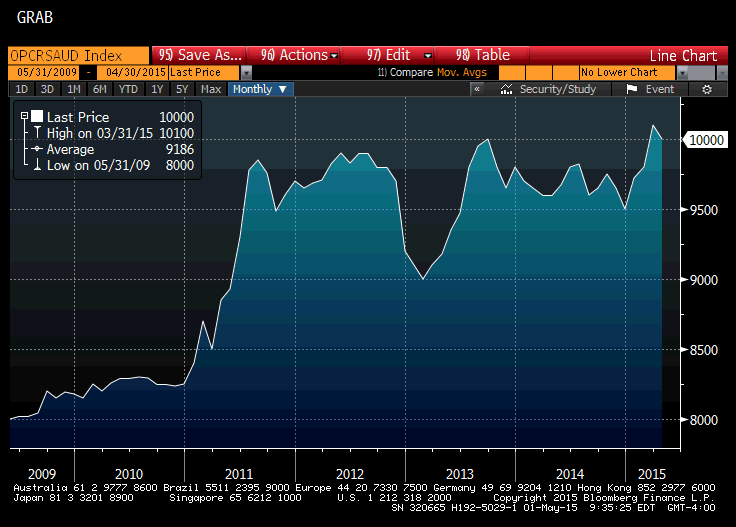
Saudi output remained reasonably steady indicating little change in net demand at their posted prices:
sg2015050134525

GDP detail, EU unemployment, personal income, ECI, Jobless Claims, chicago pmi, Bloomberg consumer comfort

Note the inventory build:
er-4-30-1
er-4-30-2
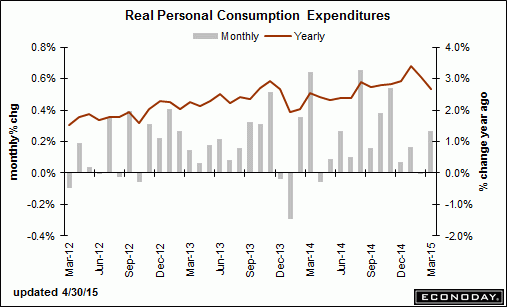
Note the ‘bending of the curve’ for nominal spending that almost never happens:
er-4-30-3
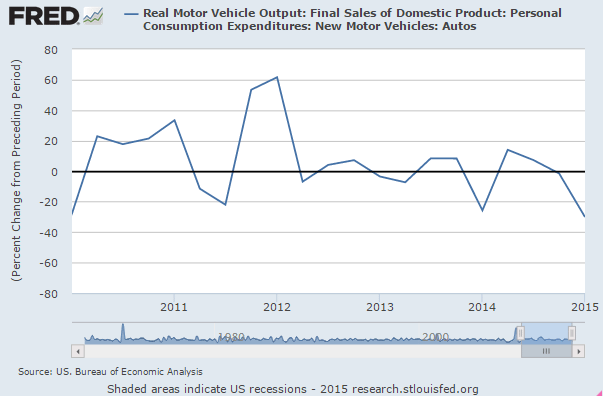
A bit of a disconnect between headline car sales and car sales’ contribution to GDP?
er-4-30-4
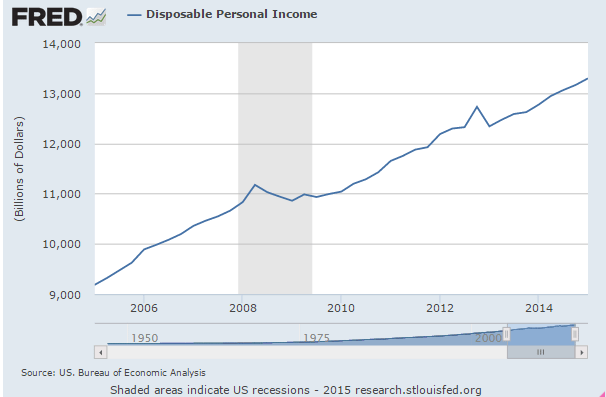
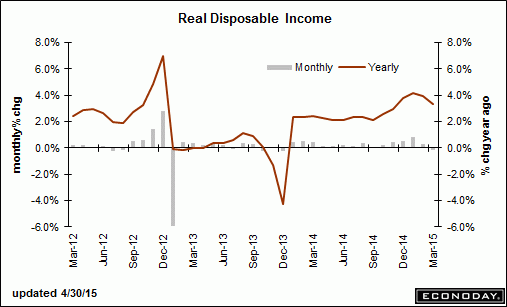
Disposable income has ratched down twice recently- once from the recession and jump in unemployment, and again with the tax hikes:
er-4-30-5

European Union : Unemployment Rate
er-4-30-6
Highlights
The Eurozone labour market made limited progress in March. Joblessness fell a further 36,000 to 18.105 million but the unemployment rate held steady at 11.3 percent, a tick above market expectations.

Amongst the larger member states the national jobless rate was unchanged in France (10.6 percent) and Germany (4.7 percent) and declined another tick to 23.0 percent in Spain. However, Italy saw its rate jump 0.3 percentage points to 13.0 percent, just a couple of ticks short of last November’s record high. Top of the pile was again Greece (25.7 percent in January) while Germany remained at the bottom.

Youth unemployment was also unchanged at 22.7 percent following a downward revision to the February rate.

The income lost due to falling oil revenues might be starting to show and the growth rate remains near stall speed:

Personal Income and Outlays
er-4-30-7
Highlights
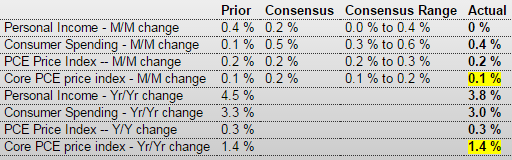
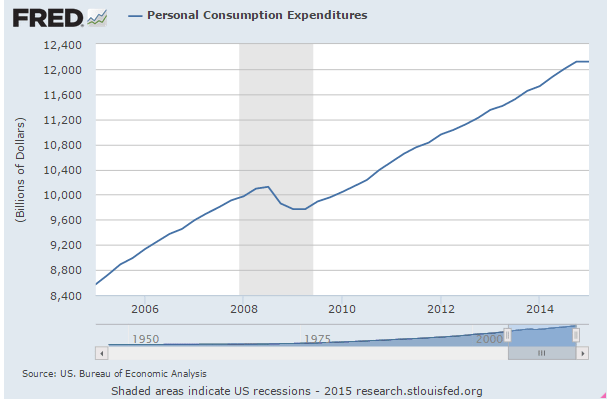
March consumer spending rebounded 0.4 percent (and was up 3.0 percent from a year ago) from a revised increase of 0.2 percent in February. But the data suggest that people remain somewhat cautious in their spending despite months of cheaper gasoline and rising confidence. Consumer spending generates more than two thirds of GDP and is a key driver of growth. Spending on services increased 0.2 percent from the prior month. Spending on goods added 1.0 percent after three consecutive monthly declines, including a 1.8 percent increase in purchases of durable goods like trucks and washing machines that are designed to last at least three years.

Personal income was flat on the month the weakest reading since December 2013. On the year, income was up 3.8 percent.

The Federal Reserve acknowledged that the economy slowed during the winter months, but they blamed the weakness on “transitory factors.” Officials said in a statement they “continue to expect that, with appropriate policy accommodation, economic activity will expand at a moderate pace.”

Personal consumption expenditures price index undershot the Fed’s 2 percent target increasing 0.3 percent in March from a year earlier, the same increase as the previous month. Excluding the volatile food and energy categories, prices climbed 1.3 percent in March from a year earlier for the fourth consecutive month.

er-4-30-8
er-4-30-9

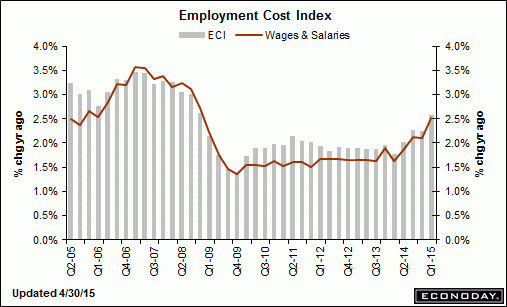
A bit higher than expected but I attribute this to hiring getting ahead of itself as reported employment gains have been outrunning growth of output:

Employment Cost Index
er-4-30-10
er-4-30-11
In the 12 months through March, labor costs jumped 2.6 percent, the largest rise since the fourth quarter of 2008. That is still below the 3 percent threshold that economists say is needed to bring inflation closer to the Fed’s 2 percent target.

Lower than expected and the Fed knows it shows separations and not new hires, though it has correlated to hiring historically:

Jobless Claims
er-4-30-12
Highlights
The Fed is ready now to pull the trigger at anytime and today’s jobless claims data may have their finger a little itchy. Initial claims, not skewed by special factors, plunged 34,000 in the April 25 week to 262,000 which is the lowest level since all the way back to April 2000. The 4-week average is down 1,250 to a 283,750 level which is just below a month-ago and is also a 15-year low.
er-4-30-13
Bloomberg Consumer Comfort Index
er-4-30-14
Highlights
Bloomberg’s consumer confidence index declined for a third consecutive week to a six-week low of 44.7 as Americans took a less favorable view of their finances and the slowdowns at factories and oilfields soured attitudes among men. Sentiment among men showed one of the biggest decreases in the past four years, while confidence in the Midwest slumped by the most in more than a decade. While the Bloomberg comfort gauge cooled from an almost eight-year high reached earlier this month, it remains well above last year’s average of 36.7, which was the best since 2007.

global glympse

Germany : Retail Sales
gg-1
Highlights
Retail sales followed a smaller revised 0.1 percent dip in February with a surprisingly hefty 2.3 percent monthly slump in March. The drop was the steepest since December 2013 but friendly base effects were enough to ensure that the first back-to-back decline since April/May 2014 still boosted unadjusted annual growth from 2.5 percent to 3.2 percent. Nonetheless, the level of sales at quarter-end was the weakest since last October.

March’s setback means that first quarter purchases were up only 0.5 percent versus the fourth quarter when they rose a solid 1.2 percent. This looks odd in the context of a raft of strong consumer surveys. In particular, at 53.0 the retail sector PMI last month posted its highest reading since last June.

France : Consumer Mfgd Goods Consumption
gg-2
Japan : Industrial Production
gg-3
Highlights
March industrial production dropped a much less than anticipated 0.3 percent on the month – analysts were expecting a drop of 2.2 percent. It was the second consecutive decline. On the year, output was down 2.9 percent. The monthly reading showed great fluctuations, but Thursday’s reading means it has been in negative territory for seven of the previous twelve months.

gg-4

Exactly as I’ve discussed. Q1 was positive only because of the inventory build, which is likely normalize in Q2:

WSJ’s Hilsenrath says the sharp slowdown in Q1 growth has clouded the timing for rate liftoff. The piece argues the dollar’s strength, cautious consumer spending and a downturn in oil-related investment may limit the extent of a rebound in growth.
Highlighting a pattern of weak Q1 growth, the article notes that since 2010 first-quarter GDP growth has averaged 0.6%, compared to average growth of 2.9% in other quarters. It adds that the uneven nature of growth could mean the Fed takes a longer time to assess whether the economy is on track before raising rates.

The paper cites analysts who now anticipate liftoff in September or later. In offering a more guarded economic outlook, the article notes the job market hasn’t improved since the last Fed meeting and that after providing a 74 bp tailwind to Q1 growth, an inventory run down in Q2 could act as a new drag on growth.
Index/survey review, mtg purch. apps, GDP
er-4-29-1
er-4-29-2

MBA Mortgage Applications
er-4-29-3
Highlights
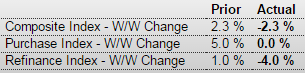
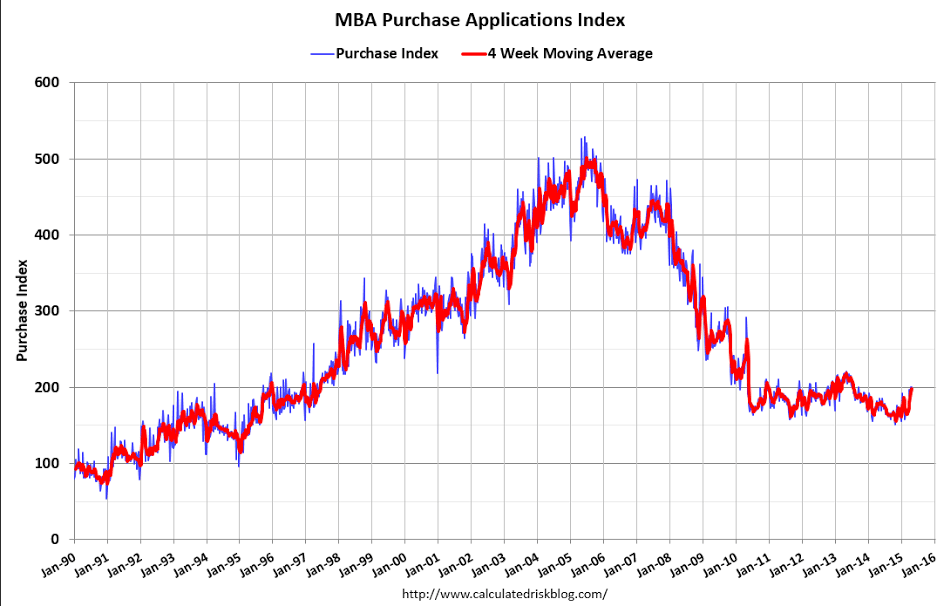
Up 4 of the prior 5 weeks, the purchase index was unable to add new ground in the April 24 week and was unchanged. The refinance index remains soft, down 4.0 percent. Rates are very low but mostly ticked higher in the week with the average 30-year fixed mortgage for conforming balances ($417,000 or less) up 2 basis points to 3.85 percent.
er-4-29-4

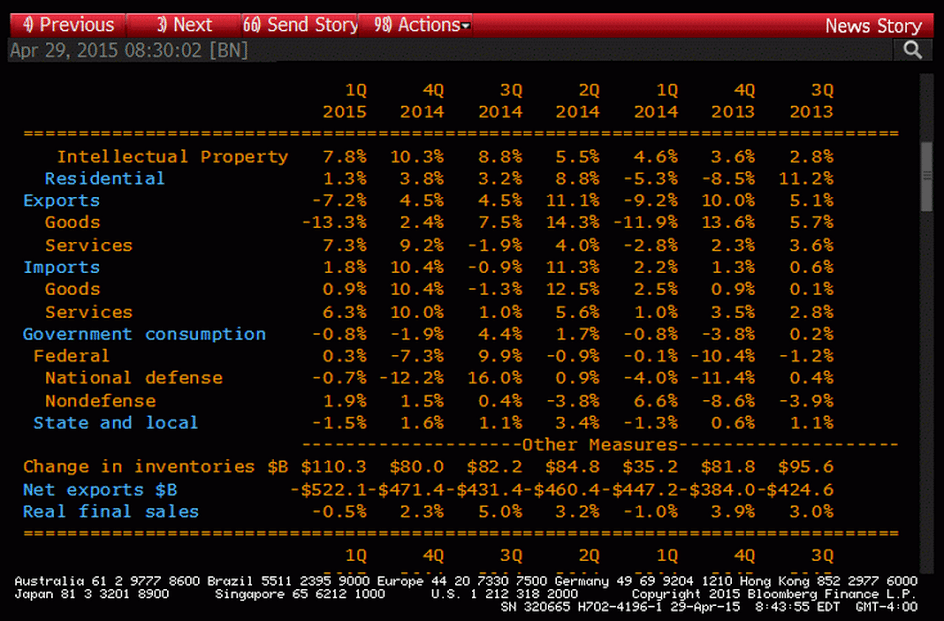
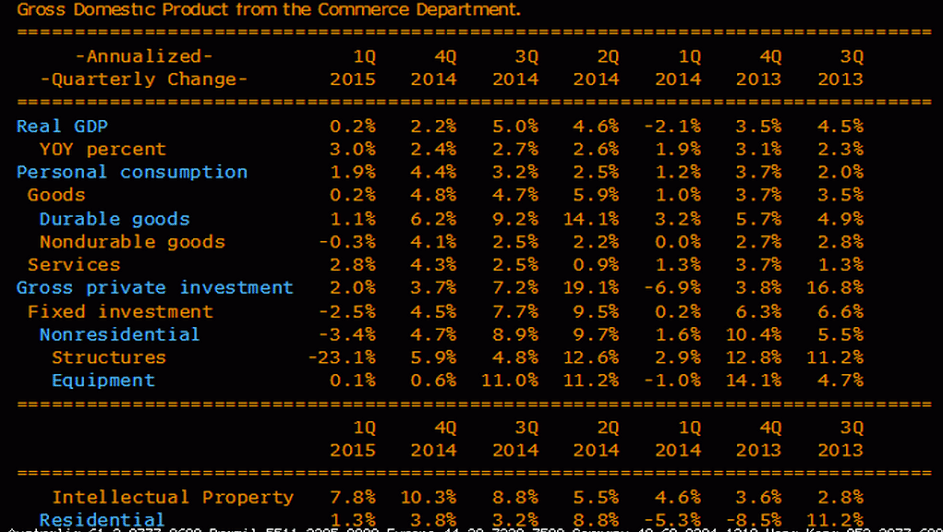
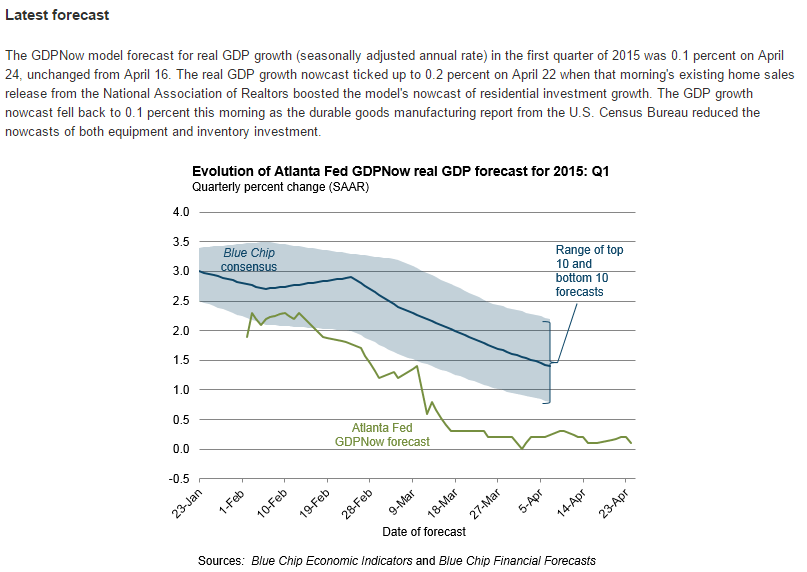
Almost 0 and below expectations even with the low deflator, also below expectations which tends to help GDP near term. This is not good, and it’s inline with the Atlanta Fed’s forecast which has been largely ignored by the cheerleaders. And surprise, looks like the drop in the price of oil was an unambiguous negative:

GDP
er-4-29-5

BEA Release

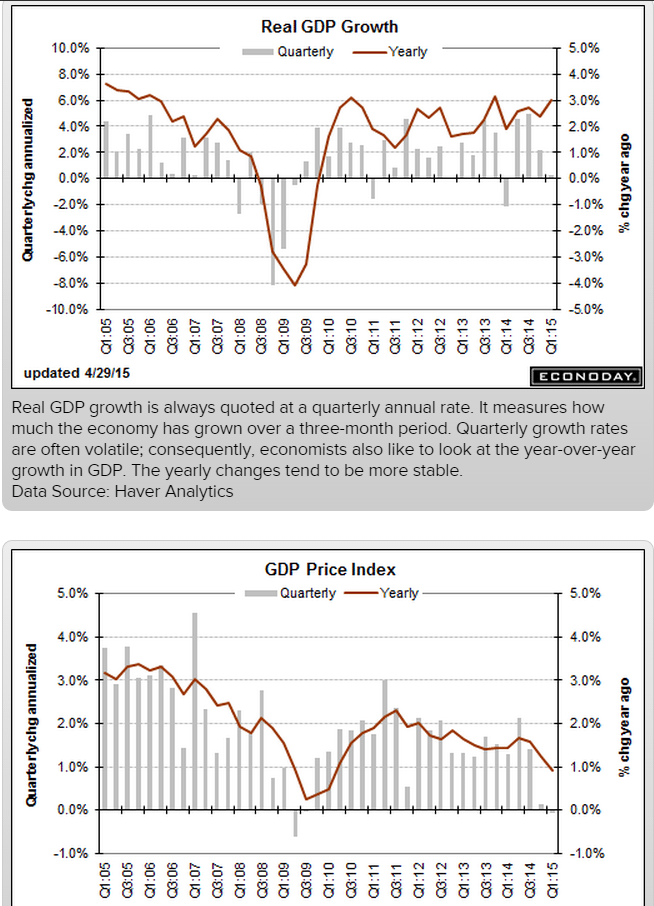
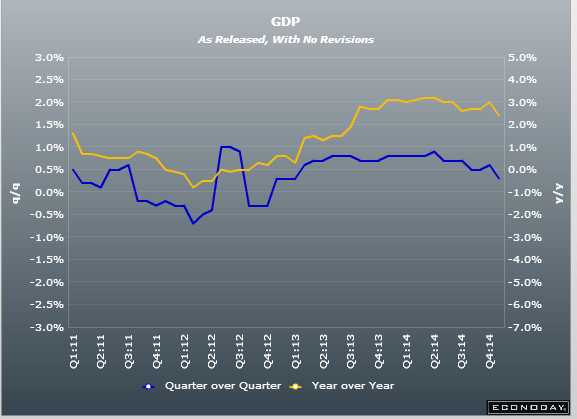
Real gross domestic product — the value of the production of goods and services in the United States, adjusted for price changes — increased at an annual rate of 0.2 percent in the first quarter of 2015, according to the “advance” estimate released by the Bureau of Economic Analysis. In the fourth quarter, real GDP increased 2.2 percent.

The increase in real GDP in the first quarter primarily reflected positive contributions from personal consumption expenditures (PCE) and private inventory investment that were partly offset by negative contributions from exports, nonresidential fixed investment, and state and local government spending. Imports, which are a subtraction in the calculation of GDP, increased.

The deceleration in real GDP growth in the first quarter reflected a deceleration in PCE, downturns in exports, in nonresidential fixed investment, and in state and local government spending, and a deceleration in residential fixed investment that were partly offset by a deceleration in imports and upturns in private inventory investment and in federal government spending.

The price index for gross domestic purchases, which measures prices paid by U.S. residents, decreased 1.5 percent in the first quarter, compared with a decrease of 0.1 percent in the fourth. Excluding food and energy prices, the price index for gross domestic purchases increased 0.3 percent, compared with an increase of 0.7 percent.

Real personal consumption expenditures increased 1.9 percent in the first quarter, compared with an increase of 4.4 percent in the fourth.

The easy comp. with last year’s weather dip helps the year over year increase:
er-4-29-6
er-4-29-7

euro update

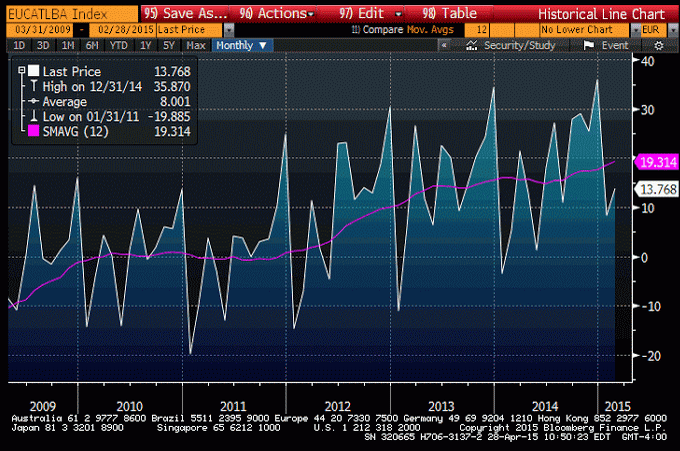
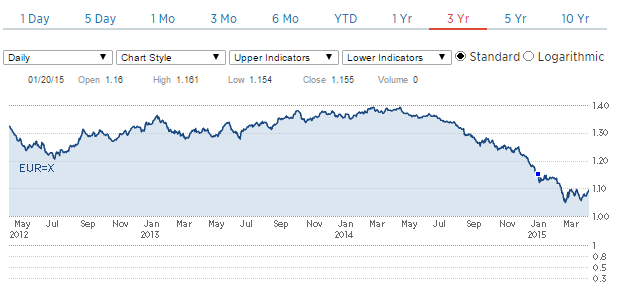
So today, for example, US tsy secs were up in yield yet the dollar went down vs the euro instead of up as it had been doing when US rates went up. So perhaps the CB’s who were selling euro have backed off? Maybe their exporters notices their euro reserves were falling and expressed their concerns? Meanwhile the EU current account surplus continues to increase and ‘drain’ ever more euro from importers of EU goods and services, and the last thing the EU needs now is a strong euro taking away it’s net exports:

EU current account:
eu-1

eu-2

eu-3

Posted in EU

Redbook retail sales, consumer confidence, Richmond Fed

Not good again.
Looks like more than a ‘soft spot’ as so far no improvement for Q2:

Redbook
er-4-28-7
Highlights
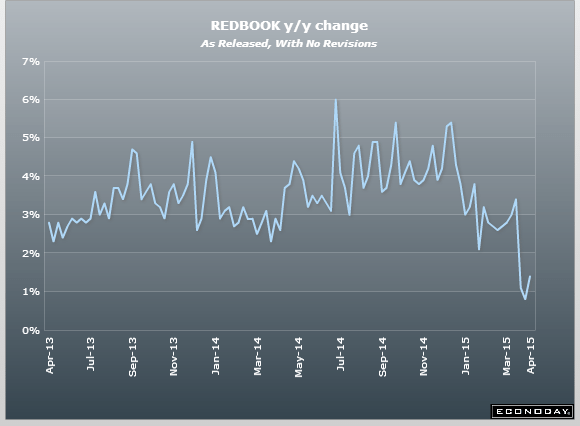
It’s hard to make heads or tails of weekly retail sales data surrounding Easter and its shifting comparisons. Redbook’s same-store year-on-year sales tally came in at a very weak plus 1.4 percent in the April 25 week which however is up from plus 0.8 percent in the prior week but well down from the plus 3.0 to 3.5 percent underlying trend. This trend, or somewhere close to it, is likely to re-emerge in next week’s report when Easter calendar distortions are no longer in play. Behind the distortions, however, Redbook does note that the overall performance is below plan though warmer weather did help seasonal sales in the latest week.
er-4-28-8

United States : Consumer Confidence
er-4-28-9
Highlights
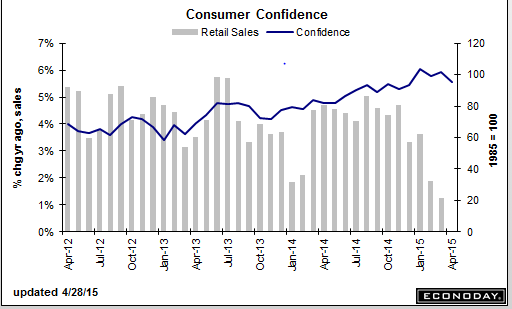
Consumer confidence has fallen back noticeably this month, down more than 6 points to a much lower-than-expected 95.2. This compares very poorly with the Econoday consensus for 103.0 and is even far below the Econoday low estimate of 100.5. The weakness, ominously, is the result of falling assessments of the jobs market, both the current jobs market and expectations for the future jobs market. The second quarter, which is expected to be much stronger than the weather-depressed first quarter, isn’t likely to get off to a fast start, at least as far as this report goes.
er-4-28-10

Richmond Fed Manufacturing Index
er-4-28-11

Recent History Of This Indicator
The Richmond Fed manufacturing index in March fell into contraction, to minus 8 vs zero in February. Order readings, both for new orders and backlogs, were down substantially as were shipments and the workweek. Hiring, however, remained respectable, at least for now. Price readings showed only the most marginal pressure.

Japan retail sales, UK GDP, small business lending, Steven Hansen May forecast, Dallas Fed

In case anyone thinks currency depreciation and tax hikes were the path to domestic bliss:

Japan : Retail Sales
er-4-28-1
Highlights
Retail sales plummeted a greater than expected 9.7 percent from a year ago. This was the third consecutive month sales declined. March’s result marks a fresh historic low in the data. The data do not bode well for first quarter consumer spending, a major portion of GDP. For the fiscal year, sales retreated 1.2 percent after rising 2.9 percent in fiscal year 2013.

All the subcategories were lower on the year. Auto sales dropped for a sixth consecutive month, this time by 4.1 percent on the year after sliding 2.6 percent the month before. Fuel sales sank 20 percent after 17.9 percent, no doubt partially attributable to the decline in crude oil. Retail machinery sales dropped for a twelfth month, this time by 27.9 percent after sliding 9.6 percent the month before. Apparel sales were down 6.2 percent after increasing 2.0 percent in February.

Japanese consumers have cut back spending since April 2014 when the country’s sales tax was raised from 5 to 8 percent.

So the weakness is pretty much global now:

UK GDP disappoints, below forecasts

By Holly Ellyatt

April 28 (CNBC) — UK gross domestic product (GDP) grew slower than expected in the first quarter at 0.3 percent, in the last major economic indicator before the country’s general election in nine days’ time.

A first estimate from the Office of National Statistics (ONS), showed GDP had grown 0.3 percent quarter on quarter, below a forecast of 0.5 percent according to a poll of analysts by Reuters.

The data will not be welcomed by U.K. Prime Minister David Cameron, who has made the strength of the economy a key part of his campaign ahead of a general election on May 7. Sterling fell to $1.5185 after the data.
er-4-28-2

This isn’t going anywhere either:
er-4-28-3
Economists are now seeing weakness but no chance of recession:

May 2015 Economic Forecast: Slower Growth Continues With Confirming Evidence of Economic Weakness

By Steven Hansen

April 28 — Econintersect’s Economic Index is indicating growth will continue to be soft in May. The tracked sectors of the economy are relatively soft with most expanding but some contracting. The effects of the recently solved West Coast Port slowdown (a labor dispute which had been going on for months) and weather related issues are no longer evident in the raw data. Therefore, the economic slowdown forecast last month is cyclic and not resulting from transient causes.

There is NO evidence of recessionary dynamics in the data – just moderate weakness throughout most data sets. Our employment six month forecast discussed below continues to forecast relatively strong employment growth (even after last month’s rather poor jobs report) but economic pressures are now indicating a weakening of employment growth beginning in June.

United States : Dallas Fed Mfg Survey
er-4-28-4
Highlights
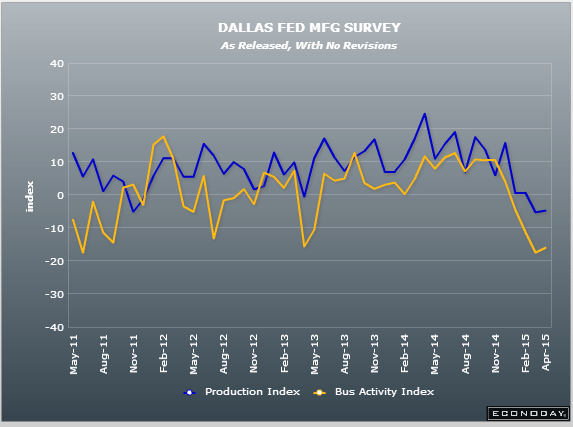
There have been two key factors holding down US manufacturing this year: weak export demand and weakness in the oil & gas sector. The latter is a special focus of the Dallas Fed manufacturing survey where readings have been severely depressed including today’s minus 16.0 reading for business activity and minus 4.7 reading on production.

New orders, arguably the most important reading of all, are at minus 14.0 with the related growth rate at minus 15.5 for its 6th straight negative reading. Companies in the sample are not upbeat about the outlook with this score coming in at a nearly 2-1/2 year low of minus 7.8. The workweek is down and capacity utilization is at a 6-year low of minus 10.4.

Looking at commentary, a few stand out: “Our oil & gas customers have come to a complete stop,” “Lower energy prices have adversely impacted our business in the energy sector,” and “It is going to be a tough summer.”

Yet, despite all the order and production weakness, employment moved from minus 1.8 in March to plus 1.8 in April, which is far from sizzling but is surprisingly in positive ground.
er-4-28-5

Lots of cheerleading in this commentary for a release that was below expectations:

PMI Services Flash
er-4-28-6
Highlights
The service sector is a key driver for the US economy right now given the export-related struggles facing the factory sector. And the latest news is good with the PMI services flash coming in at a very strong 57.8. This indicates faster-than-average monthly growth vs the long-term average for this reading of 55.9. Growth in new orders remains strong and job hiring is described as robust, the latter offering a positive indication for April’s employment report.

Another very positive indication is how upbeat the survey sample is about the business outlook in what is a further indication that general economic weakness early in the year was only temporary. Cost pressures remain subdued though prices have ticked higher this month due likely to the increase underway for fuel costs which however remain low.

The domestic economy right now is healthy, a factor that should boost the housing market this spring and hopefully the jobs sector as well.