Link: WRKO Interview
Monthly Archives: May 2013
Thinking Caps On – Grab a Coffee – Sales/Trading Commentary
From: JJ LANDO
At: May 14 2013 07:41:14
Consider the following thought experiment. These are the scenarios:
A. The Treasury decides that it will fund itself 30% more in Overnight Bills and reduce issuance across the curve.
B. The Fed announces it will increase QE by 30% (it will remit the net income of this activity back to the Treasury like taxes)
C. Congress announces a new tax on all passive income from USTs, to holders both at home and abroad (ie Central Banks), for all new-issue USTs
D. Lew pre-announces that we will ‘selectively default’ and apply a haircut of on all future Treasury coupon payments of new issues.
Here’s what’s funny. Most intelligent market participants will say things like:
A. Stocks down a few percent on fear of downgrade. Economy slightly weaker or unchanged.
B. Stocks up 5-10% and economy grows another 1% for 1-2yrs; monetary stimulus.
C. Stocks down 5-10% on tax hike (like last year) that maybe corrects. Economy slows 1-2% for a year or so because it’s a tax hike (ie fiscal consolidation).
D. Stocks down 80% and we go into a great depression on steroids. All investment dollars flee the US. I can’t tell you what happens next because my Bloomberg account gets shut down. They might even declare an Internet Holiday.
Here’s what’s craziest: THESE ARE ALL THE SAME THING. The name and the process is different, the OPTICS is different, but the net is the same. There’s the government and there’s everyone else. The government either pays more out – in interest payments or transfer payments or vendor payments, or it takes back more in taxes or default or interest ‘savings.’ Everything the government net gets in ‘revenue’ the rest of the world loses in income. Everything the government dissaves (deficits) the rest of the world saves. Equal and opposite.
[You need to further get around the idea that reserves are overnight bills and there’s no such thing as ‘monetary base’ – just interest rates; that lower discount rates are lower no matter how you get there; that rate cuts are taxes are austerity, even considering the benefit to risk assets from ‘lower riskfree discount rates’… it’s all basically true if you think abt it long and hard].
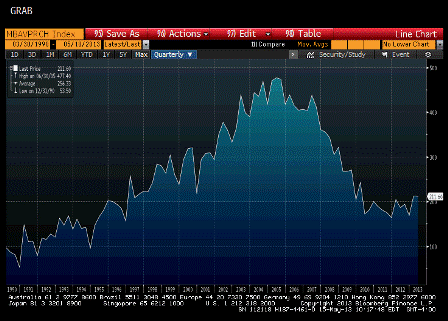
Here we are, almost 550 rate cuts into this thing, and inflation everywhere with QE is basically falling (see chart), and incomes are falling everywhere but in the top brackets (see page 9 here for a TRULY SOBERING CHART)… let us never forget that the goal is TO IMPROVE PEOPLE’S QUALITY OF LIFE NOT TO JUICE GDP . Thus economics as a whole also has some major shortcomings. Exporting your way to prosperity is the same as turning your entire population into servants to foreign masters. Disinflation due to lower input costs or better goods or technological gains are good things. HOWEVER if suddenly 20-somethings find social currency in free online friend status rather than cars and houses and weddings – if it makes them happy that’s great but it is also a downward shift in the demand curve that if isn’t replaced leads to someone somewhere being unemployed. These are different issues that shouldn’t all be swept under the ‘disinflation’ rug.
But I digress. Where am I going with all this?
Let’s pretend risk is now in the last 6m-18m phase where everything rallies, everyone in the pool, everyone chases any risk premium to sell, and the underlying income trends are irrelevant. Since I also will posit the Fed isn’t hiking in the next 18 months, I now believe the Fed will entirely miss this risk cycle. Which means they are on hold beyond any trading horizon. So what triggers the end of the cycle? Most would argue – the fear that they ‘tighten’ or ‘hike’ or ‘aren’t on hold anymore.’
To that I disagree…the income and earnings just isn’t there and QE is hurting…in fact the reason the consumer is now tracking +3-4% has been due to a decline in the savings rate (1-handle in q1 as tax hikes hit) that is prone to reverse…it’s MUCH more likely is what triggers the end is that the world starts to understand that QE is a lot like a tax (+ some ‘Richfare’) rather than a stimulus…and that lower rates do raise asset prices for the asset rich but lower incomes and the net to the median person is not what it appears…I see progress on this day every front…TBAC is starting to get it…the inflation markets are starting to get it… we’ll get there … low rates forever…buy blues..
Obama double talk on jobs
Note the flip flop.
Obama Says Job Market May ‘Stall’ as Result of Budget Cuts
By Hans Nichols
May 19 (Bloomberg) — President Barack Obama told a group of Democratic donors in Atlanta that the economy and job market could falter as a result of the automatic spending cuts that went into effect March 1.
“Because of some policies in Washington, like the sequester, growth may end up slowing,” Obama said at a luncheon for the Democratic Senatorial Campaign Committee. “We may see once again the job market stall.”
The president was in Atlanta to give the commencement address at Morehouse College and he told the donors that while he was energized by the spirit of the graduates “they are entering into a job market that is still challenging.”
Earlier, at the commencement ceremony, Obama gave the labor market a more positive rendering. He told the graduates “you’re graduating into a job market that’s improving.”
American employers added more workers than forecast in April, sending the unemployment rate down to a four-year low of 7.5 percent. More Americans than projected filed claims for jobless benefits last week and manufacturing in the Philadelphia region unexpectedly shrank in May, signs that a slowdown in growth is rippling through the U.S. economy.
Obama administration approved wider exports of liquefied natural gas
Interesting!
US Energy Revolution Gathers Pace
By Ed Crooks, Jonathan Soble and Guy Chazan
May 18 (FT) — The growing role of the U.S. in world energy markets was underlined on Friday as the Obama administration approved wider exports of liquefied natural gas and international companies committed billions of dollars for new infrastructure.
The developments were both consequences of the shale revolution in the U.S., in which improvements in the techniques of horizontal drilling and hydraulic fracturing, or “fracking,” have unlocked new supplies of oil and gas, and raised the prospect that the US will be an increasingly important supplier of energy to the rest of the world.
The Department of Energy on Friday authorized the Freeport LNG project in Texas to export to countries that do not have a trade agreement with the US, including Japan and the members of the EU. It was the first such approval to be granted for two years and only the second ever.
President Barack Obama had been expected to approve worldwide sales from the Freeport project, as the administration sees rising energy exports as providing economic benefits and strengthening the global influence of the U.S.
However, a vocal lobby of companies in industries such as chemicals and steel has urged restrictions on gas exports to ensure U.S. manufacturers continue to derive a competitive advantage from cheap energy.
Freeport has signed deals to sell its gas to Osaka Gas and Chubu Electric of Japan, and BP of the U.K. The export project is owned by a consortium including Osaka Gas and Michael Smith, Freeport’s founder and chief executive.
Separately, Japanese and European companies said they would invest billions of dollars in another proposed gas export project, the $10 billion Cameron LNG plant in Louisiana.
Italy tour
MEMMT tour
uh oh…
>
> (email exchange)
>
> On May 16, 2013 8:31 AM, wrote:
>
> Weak data and lower CPI, bond positive
>
Yes
Very bad news
Confirming my fears
>
> PHILLY FED AWFUL -5.2 VS +2 EXPECTED
>
:(
Credit accelerator going into reverse?
Too small deficit to get larger the ugly way?
NY Fed: How Are American Workers Dealing with the Payroll Tax Hike? – Liberty Street Economics
My Two (Per)cents: How Are American Workers Dealing with the Payroll Tax Hike?
By Basit Zafar, Max Livingston, and Wilbert van der Klaauw
Overall, our analysis suggests that the payroll tax cut during 2011-12 led to a substantial increase in consumer spending and facilitated the consumer deleveraging process. Based on consumers responses to our recent survey, expiration of the tax cuts is likely to lead to a substantial reduction in spending as well as contribute to a slowdown or possibly a reversal in the paydown of consumer debt. These effects are also likely to be heterogeneous, with groups that are more credit and liquidity constrained more likely to be adversely affected. Such nuances may be lost in the aggregate macroeconomic statistics, but theyre important for policymakers to consider as they debate fiscal policy.
Homebuilder Confidence in U.S. Climbs as Outlook Improves
April revised lower and still well under 50:
Homebuilder Confidence in U.S. Climbs as Outlook Improves