
Rising Interest Rates Cool Demand For Mortgage Apps
Monthly Archives: May 2013
CBO Updated Budget Projections: Fiscal Years 2013 to 2023
Updated Budget Projections: Fiscal Years 2013 to 2023
Karim writes:
Deficit projected 200bn less than 3mths ago for current fiscal year. Projected at 2.1% of GDP for 2014-15, or 600bn less than 3mtgs ago.
No more grand bargain talk?
Maybe, but this is still being said:
For the 20142023 period, deficits in CBOs baseline projections total $6.3 trillion. With such deficits, federal debt held by the public is projected to remain above 70 percent of GDPfar higher than the 39 percent average seen over the past four decades. (As recently as the end of 2007, federal debt equaled 36 percent of GDP.) Under current law, the debt is projected to decline from about 76 percent of GDP in 2014 to slightly below 71 percent in 2018 but then to start rising again; by 2023, if current laws remain in place, debt will equal 74 percent of GDP and continue to be on an upward path (see figure below).
And it all begs the question of whether the proactive tax hikes and spending cuts will through the credit accelerators into reverse, as nominal GDP growth continues to decelerate.
I sat next to Al Gore at dinner at Monty Friedkin’s house in Boca for 45 minutes in front of that election. Cliff was there as well. Al asked me how we should spend the $5.6 trillion surplus projected for the next 10 years. I told him there wasn’t going to be a $5.6 trillion surplus as that implied a reduction of that much of net global $US financial assets, to the penny. Instead, a $5.6 trillion deficit was more likely to bring deficit spending back in line with ‘savings desires’ which I also described. He’s a pretty good student, went through the numbers, and agreed with the logic. He then said something like ‘You know I can’t get up and say any of this’ as he got up and explained how he was going to spend the $5.6 trillion surplus.
Point is, the CBO makes assumptions about growth that don’t recognize that growth can be a function of fiscal balance.
In other words the tax hikes and spending cuts (aka ‘austerity’) initially cause the deficit to fall, but if the deficit is proactively brought down too much then undermines private sector credit expansion/spending causing sales/output/employment to slow sufficiently for the deficit to rise to where it ‘needs to be’ from suddenly falling revenues and rising transfer payments. As demonstrated by proactive fiscal tightening in the UK, Europe, and Japan, for example.
This is not to say the tax hikes and spending cuts in the US have crossed that line.
Nor is it to say they haven’t.
For me the jury is still out.
Today’s Tepper rally apparently was based on the idea that the ‘QE money has to be invested somewhere’ which is of course total nonsense.
(See if you can spot any sign of QE in the attached nominal GDP chart)
But it moved the market nonetheless.
MEMMT activist tour June 10-23

Full size image
Google Translate:
Paul Barnard and Warren Mosler meet the activists of local groups on a tour that will begin on June 10 in Montalto Uffugo (Cosenza) and will end on 22 June in Cant (Como).
In this route there will be public meetings of which we will detail shortly.
It will also be available in the next few days, the material event disclosure.
It is a unique event: the economist who says “The eurozone is a crime against humanity, because unemployment creates social horrors and is kept on purpose” will be in Italy alongside Paul Barnard and activists ME-MMT .
The local groups are already working to organize the individual stages: contribute to the organization by donating a contribution.

Full size image
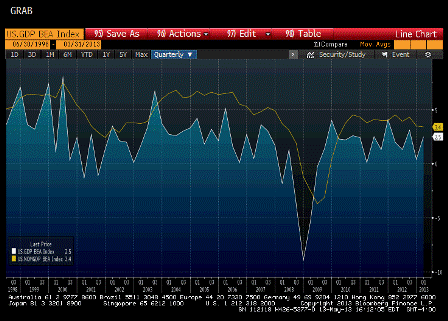
GDP nominal and real, year over year
You can see on the chart that year over year the growth in nominal GDP- actual dollars spent- slowed in Q1 2013 from Q4 2012, while ‘real’, price adjusted spending went up.
That is, dollars spent grew at a slower rate while the goods and services purchased grew at a higher rate, all because of year over year changes in prices.
And note that the rate of nominal growth seems to have been modestly decelerating for the last several years as well.
No sign of any ‘run away money printing’ here…
;)
Karim writes:
Lower commodity prices unequivocally positive for U.S. consumers.
Yes, agreed, lower prices in fact help consumers offset the lower rate of nominal income growth.
And yes, the Fed is concerned about the output gap which is real GDP.
And also price stability, as a secondary policy mandate…
;)
Full size image
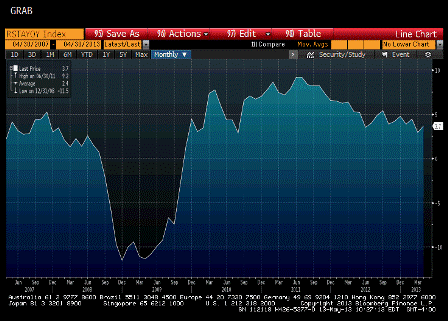
Retail Sales year over year
I know it was better than expected, but sure doesn’t look like anything that would cause a Fed member to ‘taper’? In fact, the slope still looks negative to me?
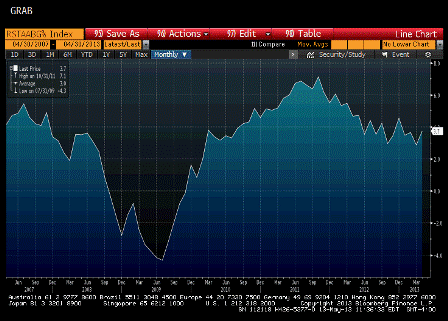
Yes, it looks a little better if you exclude autos, gasoline and building materials, but autos are leveraged purchases, representing purchases that exceed income, and weekly Redbook retail sales still looking deceleration as well.
To sustain GDP growth, private sector credit expansion plus govt spending more than its income need to ‘overcome’ the demand leakages of contributions and earnings of pension funds, the trade deficit/foreign central bank dollar accumulation, unspent corporate income, etc. etc. Cars and housing have been the drivers behind the private sector credit expansion that’s gotten us this far, overcoming the retreating govt deficit.
The question remains whether the private sector credit expansion can survive the austerity measures of the year end tax hikes and the sequesters.
Still looks like a ‘maybe not’ to me?
Retail Sales Y/Y:
Full size image
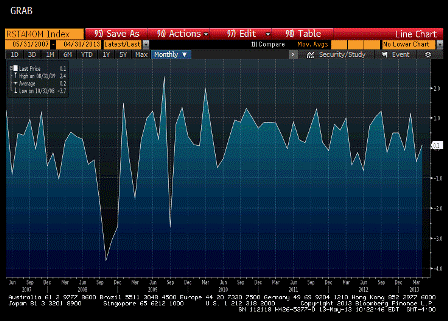
Retail Sales M/M:
Full size image
Core Retail Sales Y/Y:
Full size image
Annualized Auto Sales:
Full size image
REINHART: Regarding Hilsenrath//+ Retail Sales
A number of people have inquired about this morning’s front page article in the WSJ by Jon Hilsenrath, “Fed Maps Exit from Stimulus.”
This seems constructed by Jon in a way that is very much reminiscent of the three-day inflation scare and talk of early exit he created last year. Note four points:
1. Jon does not have access to policy makers in the way the WSJ beat reporter once had. The days of Wessel and Ip are over. Bernanke was very reluctant to provide informal guidance to begin with, and the practice virtually ceased with the report of the Subcommittee on Communications at the beginning of last year. Essentially, they decided to speak authoritatively in FOMC statements and everyone was free to offer their own view in the public record after that, but not off camera.
2. The first two paragraphs are an extended, bloated, version of the single sentence in the statement that said “The Committee is prepared to increase or reduce the pace of its purchases to maintain appropriate policy accommodation as the outlook for the labor market or inflation changes.” Those paragraphs don’t say anything more than the Fed has a plan to do its job. This reminds me of the CNBC banner yesterday morning while Bernanke was giving his speech on financial stability. It said “BREAKING NEWS: THE FED IS MONITORING FINANCIAL STABILITY.” It would have been just as informative to run the banner “BREAKING NEWS: THE FED IS STILL IN BUSINESS.”
3. Note that the only two on-the-record, active voices are Charlie Plosser and Richard Fisher. Those two are probably last on the list of reliable co-conspirators for the core of the Committee that makes policy. But those quotes, plus the older Williams’ one, allows Jon to write “Fed officials” to make it sound like he has access to the second floor of the Board. It also lets him bring out the stale dealers survey.
4. Note the inconsistencies in the story. Fed officials want to put more volatility in the market by conveying that QE is a flexible, smoothly adjusting instrument. The problem is that this makes more sense if the effect of QE was on flows, not stocks, which they have studiously denied for four years. By the way, if those conspiring officials want to make clear it won’t be a slow, steady retreat of accommodation, than they better tell Janet Yellen to stop showing the optimal policy path. Good luck to that.
I believe the central message, which is what I have described in earlier notes: Fed officials want to put as much volatility as possible back into the market before starting to raise rates, provided financial conditions otherwise remain supportive to sustained expansion. They’ll take opportunities to do so on the back of an equity market rally. But Jon Hilsenrath is not the means they will do so.
Vincent
Karim writes:
RETAIL SALES
- April retail Sales were strong both in terms of the actual advance and composition. Moreover upward revisions to the control group for Feb and March imply an upward revision to Q1 GDP from 2.5% to 2.8%.
- The 0.5% advance in the control group for April was more impressive due to the breadth and composition of the gains. In particular, all the major discretionary spending categories were quite strong: electronics 0.8%, clothing/accessories 1.2%, sporting goods 0.5% and restaurants 0.8%.
- As the chief economist of the ISCS commented the other day on chain store sales for April: It is most likely being boosted by a stronger household wealth effect from higher home and stock market prices. Although it was an improvement of recent months, the pace was still dampened by adverse seasonal weather,
- With fiscal drag peaking this quarter, and private sector growth maintaining the momentum it has shown since Q4 of last year, its making 3-3.5% growth more plausible in the second half. Most dealer forecasts are still in the 2-2.25% area.
HILSENRATH
- Technically, Reinhart is correct: Hilsenrath is not the mouthpiece for the Fed and this is not all new news.
- But, he is piecing together a story that the Fed wants out there. That the last hiking cycle was too predictable in terms of both pace and size (25bps/meeting). So, the idea that they can taper a bit and skip a meeting; or taper a bit and taper at a greater pace at the next meeting, are ideas they probably want out there.
- My guess is Bernanke outlines these concepts in greater detail next week at his JEC testimony (May 22) and that if we get another 175k or greater in private payroll growth plus another strong month in retail sales for May, we could see some tapering at the June meeting.
- Also notable was Bernanke’s comment on Friday that the Fed is ‘looking closely for signs of excessive risk taking”.
Nice article by a serious investment manager
No Need to Ever Fear Default, Only Inflation
By Gary Carmell
Gross market move
Data point- with a couple of trillion under management your tweet moves bonds 10 basis points:

Sydney Morning Herald
Mosler lays down tablets on the economy, stupid
By Peter McAllister
May 11 (Sydney Morning Herald) — Ask US economist Warren Mosler whether the national disability insurance scheme should be paid for by a new levy or by spending cuts, and you’ll get a jarring answer – neither.
He’ll also tell you the question shows both the government and the opposition don’t really understand how public services are funded in a modern economy.
”Julia Gillard’s DisabilityCare does not require a tax at all,” Mosler says. ”Despite what most of us think, no modern capitalist government ever taxes to raise money to spend. Their real motive, even if they don’t know it, is to reduce aggregate demand and slow the economy.”
That means Tony Abbott’s insistence on spending cuts to return the budget to surplus is wrong too. ”When the economy is at less than full employment, spending cuts can only make matters worse.”
What’s really needed, Mosler adds, is both a simultaneous cut in taxes and an increase in spending to cover NDIS costs. That will restore what ought to be an essential fixture of Australian, and world, economies: good, healthy, productivity-enhancing deficits.
Welcome to the strange world of Warren Mosler, creator of Modern Monetary Theory.
The fact that Mosler – a tall, spare and super-rich Connecticut Yankee – dresses in nondescript slacks and T-shirts, and speaks in soft, matter-of-fact tones, only adds to the mind trip. He was recently in Australia to lay that trip on Northern Territory Treasury officials at a seminar organised by Charles Darwin University’s Centre for Full Employment and Equity, COFFEE for short. What they made of his message that deficits, like their $867 million budget hole, should be bigger, not smaller, is anybody’s guess.
”Budget deficit” is still the phrase that dare not speak its name in Australian politics. Mosler, however, says this will change. The world economic crisis, which is highlighting the bankruptcy of austerity economics and our obsession with surpluses, will force a rethink on deficit financing in Australia too. ”Current economic thought has it exactly backwards,” he explains. ”Government surpluses are not an economic plus – they’re a drag on performance because they always represent monetary savings withdrawn from the economy.” Mosler claims that, in fact, most financial crises in the modern era were caused by a preceding run of surpluses.
If that seems hard to absorb, you’re not alone. The longer Mosler talks, the longer the list of big-name economists and public officials who he says are wallowing in similar economic confusion. The chairman of the US Federal Reserve, Ben Bernanke, for example ”didn’t understand how the Fed worked in the US economic crisis; he disrupted recovery for six months by failing to realise he could lend freely to US banks on an unsecured basis”. Similarly, Paul Krugman, Nobel prizewinning economist, ”still hasn’t realised that regulating the economy through interest rates doesn’t work because cheaper credit is inevitably cancelled out by lower interest income”.
Their real error, however – and one shared by RBA governor Glenn Stevens – is the exaggerated importance they place on government debt.
”They don’t fully understand that where a government issues its own currency it doesn’t matter how large its debt grows, it can always pay it.” By extension, Mosler says, that guarantees future generations can pay it too, meaning our fears of passing a debt burden to our children are misplaced.
”We’re all still behaving as if our currency were linked to the gold standard, as it was before 1971,” Mosler complains. ”We’ve yet to adjust to the government’s new role as the economy’s scorekeeper, with money as nothing more than the points.”
Yet the game, he points out, really has changed. ”Not only can the government no longer run out of money, it also can’t drive up interest rates through higher levels of debt because its own central bank necessarily sets those rates, not market forces,” he says.
Likewise, Mosler adds, there is nothing to fear from the legendary ”bond vigilantes”, who supposedly police rising government debt through refusal to buy it. ”Since the government doesn’t, in reality, ever borrow to obtain funds, but rather to support interest rates, private refusal to buy securities actually results in a benefit to the treasury.” No issuer of currency, Mosler insists, is ever at risk from bond vigilantes; only users of currency, such as state governments, are.
These are certainly radical views – the question is should the world accept them? What separates Mosler from the myriad crackpot bloggers filling the digital airwaves with wacked-out and ruinous economics prescriptions?
Well, the evidence, possibly.
Some empirical support for Mosler’s radical views is surfacing. The controversy over the Reinhart-Rogoff analysis of growth rates in high debt-to-GDP ratio countries, for example, has established that there is, apparently, no growth penalty for high government debt. (Where there is, says Mosler, it is not from the debt itself but from the misguided contractionary measures governments take to reduce it). Then there is Mosler’s 2006 prediction that the current euro crisis would be the certain result of the PIGS countries’ surrender of their ability to issue currency and finance through government deficit.
There is also the small matter of the multibillion-dollar Bush tax cuts and spending increases, the second tranche of which, Mosler casually reveals, were inspired by his 2003 meeting with Andy Card, White House chief of staff to then president George W. Bush.
Most persuasive, however, is the man himself. If only three people actually understand global finance, Mosler might well be the only one to also understand international bond markets. He has, after all, traded in them for more than 40 years, managing billions in funds and making millions in profit. It was during his most profitable trades – on Italian government bonds in the 1990s – Mosler says, that he had his epiphany.
”We made a lot of money by betting the Italian government wouldn’t default even though their debt-to GDP ratio had exceeded 110 per cent,” Mosler recalls. ”I knew no country that issued its own currency ever had defaulted, nor had they ever had to ‘print money’ to pay, but I didn’t know why. Eventually it hit me: buying securities from a country’s central bank or its treasury are both functionally the same.”
They’re supposed to be different, Mosler points out: central banks sell securities in order to drain reserves, while treasuries supposedly do it to raise expenditure. ”But the end result is exactly the same – a pile of money sitting in securities accounts at the country’s central bank,” he says. ”The inescapable conclusion is that treasury sales of government debt don’t actually raise funds: they too simply drain reserves. That means that it is government spending and taxing that actually impacts the economy, not managing the debt.”
To paraphrase Dick Cheney, deficits do matter, says Mosler. ”And your persistent unemployment in Australia is telling you yours are far too small and need to be much larger.”
Large enough, perchance, for the NDIS, Gonski and Abbott’s parental leave scheme combined? Now that would be the end of politics as we know it.
Dr Peter McAllister is a journalism lecturer on the Gold Coast campus of Griffith University.
Fitch: Why Sovereigns Default on Local Currency Debt
Seems like subversive propoganda to me.
They deliberately ignore the obvious fixed vs floating fx distinction, for example.
A few comments below:
Fitch: Why Sovereigns Default on Local Currency Debt
May 10 (Fitch) — Fitch Ratings says in a newly-published report that the popular perception that sovereigns cannot default on debt denominated in their own currency because of their power to print money is a myth. They can and do.
Local currency defaults in the recent era include: Venezuela (1998), Russia (1998), Ukraine (1998), Ecuador (1999), Argentina (2001) and Jamaica (2010 and 2013). Nonetheless, we recognise that local currency defaults are less frequent than foreign currency defaults and are unlikely for countries with debt mainly denominated in local currency at long maturity.
Russia and Argentina, for example, had headline, well publicized fixed exchange rate policies, where they fixed the value of their currency to the $US. Failing to recognize that in this report is intellectually dishonest.
To assess the capacity which sovereigns have to inflate away their debt, this report uses our debt dynamics model to illustrate how much surprise inflation might be required for three hypothetical scenarios. For a country with a large primary budget deficit, gains to the debt to GDP ratio from even quite high inflation would be short-lived. While for a country with a debt to GDP ratio of 100%, primary deficit of 1%, real growth equal to the real interest rate and a 10-year average debt maturity, it would take a jump to 30% inflation (from our 2% baseline) for three years and 10% thereafter to bring the debt ratio below the 60% Maastricht threshold.
There is no such thing as ‘inflate away their debt’ as govt debt represents the global net savings of financial assets of that currency. So all that can be said in this context is that ‘savings desires’ are, for all practical purposes, always going to be there as some % of GDP.
Undoubtedly, higher inflation can be used to raise seigniorage (the difference between the value of money and the cost to print it)
This is nonsensical with floating exchange rate policy ( non convertible currency) as, for example, all US govt spending can be called ‘printing’ as it’s just a matter of the Fed crediting a member bank account. Likewise, taxing is ‘unprinting’ as it’s just a matter of debiting a member bank account. With fixed fx policy, it’s the ratio of convertible currency outstanding vs the actual fx reserves at the CB, a very different matter.
and remittance of central bank profits to the government, up to a point. Nevertheless, in the long run, the ratio of government debt/GDP will rise if the government is running a primary budget deficit (excluding interest payments and including seigniorage), assuming the real growth rate does not exceed the real interest rate, irrespective of the inflation rate.
An unanticipated burst of inflation can reduce the real value of government debt as long as the debt is not of short maturity (as higher inflation is quickly reflected in the marginal cost of funding), index linked or denominated in foreign currency (as the exchange rate would depreciate). Thus countries with such characteristics – which give them ‘monetary sovereignty’ – do have some capacity to inflate away their debt.
Linking govt payments to an index is a form of fixed exchange rate policy and yes, govts can and do default on these types of fixed exchange rate ‘promises.’
Inflation is economically and politically costly.
Politically costly, yes, but economically, there are no studies that show real costs to the economy from inflation.
Thus, even if a sovereign has a capacity to inflate away its debt, it might choose not to. It is also far from clear how much money would need to be printed to deliver the ‘right’ inflation rate, as the current debate over quantitative easing highlights. Instead a sovereign might view a Distressed Debt Exchange (DDE) as a less bad policy option. Fitch classifies a DDE as a default.
This is a confused rhetoric and a display of total ignorance of actual monetary operations.
The myth that sovereigns that can print money cannot default on debt in their own currency has also fed the proposition that such local currency ratings are irrelevant.
Fitch is again refusing to distinguish convertible and non convertible currency policy.
Fitch disagrees that default is inconceivable or impossible. The agency agrees that countries with strong monetary sovereignty and financing flexibility are unlikely to default and these are important factors in Fitch’s sovereign rating methodology that affect both local and foreign currency ratings.
A sovereign’s local currency rating is closely linked to its foreign currency rating. It is typically one or two notches higher, owing to the sovereign’s somewhat greater capacity to pay debt in local currency, as taxes are usually paid in local currency and it may have better access to a stable domestic capital market, as well as some capacity to print money. It may also be more willing to service local currency debt if more of it is held by local banks and other residents.