Reinhart got it right


[Skip to the end]

I hadn’t noticed this back then, but Vince got it right: The Fed purchased the $30 billion of securities from JPM/Bear Stearns, with JPM agreeing that if there were any net losses it would be responsible for the first $1 billion.

It’s very odd that the Fed would call this a non-recourse loan, as they cut a better deal than that.

Unlike a non-recourse loan, if the securities turn out to be profitable, the Fed gets those funds.

So why would the Fed use language that implies the transaction was worse for the Fed than it actually was?

Perhaps there was a legal or some other restriction that prevented the Fed from purchasing the securities?

Seem there is a lot more to the story than has been revealed?

Press Release
Summary of Terms and Conditions Regarding the JPMorgan Chase Facility


March 24, 2008

The Federal Reserve Bank of New York (“New York Fed”) has agreed to lend $29 billion in connection with the acquisition of The Bear Stearns Companies Inc. by JPMorgan Chase & Co.

The loan will be against a portfolio of $30 billion in assets of Bear Stearns, based on the value of the portfolio as marked to market by Bear Stearns on March 14, 2008.

JPMorgan Chase has agreed to provide $1 billion in funding in the form of a note that will be subordinated to the Federal Reserve note. The JPMorgan Chase note will be the first to absorb losses, if any, on the liquidation of the portfolio of assets.

The New York Fed loan and the JPMorgan Chase subordinated note will be made to a Delaware limited liability company (“LLC”) established for the purpose of holding the Bear Stearns assets. Using a single entity (the LLC) will ease administration of the portfolio and will remove constraints on the money manager that might arise from retaining the assets on the books of Bear Stearns.

The loan from the New York Fed and the subordinated note from JPMorgan Chase will each be for a term of 10 years, renewable by the New York Fed.

The rate due on the loan from the New York Fed is the primary credit rate, which currently is 2.5 percent and fluctuates with the discount rate. The rate on the subordinated note from JPMorgan Chase is the primary credit rate plus 450* basis points (currently, a total of 7 percent).

BlackRock Financial Management Inc. has been retained by the New York Fed to manage and liquidate the assets.

The Federal Reserve loan is being provided under the authority granted by section 13(3) of the Federal Reserve Act. The Board authorized the New York Fed to enter into this loan and made the findings required by section 13(3) at a meeting on Sunday, March 16, 2008.

Repayment of the loans will begin on the second anniversary of the loan, unless the Reserve Bank determines to begin payments earlier. Payments from the liquidation of the assets in the LLC will be made in the following order (each category must be fully paid before proceeding to the next lower category):

  • to pay the necessary operating expenses of the LLC incurred in managing and liquidating the assets as of the repayment date;
  • to repay the entire $29 billion principal due to the New York Fed;
  • to pay all interest due to the New York Fed on its loan;
  • to repay the entire $1 billion subordinated note due to JPMorgan Chase;
  • to pay all interest due to JPMorgan Chase on its subordinated note;
  • to pay any other non-operating expenses of the LLC, if any.

Any remaining funds resulting from the liquidation of the assets will be paid to the New York Fed.

Where No Fed Has Gone Before

Why the Federal Reserve’s ‘loan’ for the Bear Stearns deal looks like an investment—and faces serious scrutiny


March 26, 2008

by Peter Coy

The Federal Reserve has stretched its mandate up, down, and sideways to prevent a financial market deluge. Now it appears to be stretching the English language a bit as well. What the Fed is calling a $29 billion “loan” to help finance JPMorgan Chase’s (JPM) purchase of Bear Stearns (BSC) looks much more like a $29 billion investment in securities owned by Bear. Although the Fed insists that it isn’t technically buying any assets, in practical terms it’s doing exactly that. All this adds up to a big and unacknowledged step up in the central bank’s financial intervention with Wall Street investment banks.

The Fed, of course, is the only part of government with the speed, power, and flexibility to arrest a bout of market panic. By rapidly intervening in mid-March to keep Bear from filing for bankruptcy, it may well have prevented a series of cascading failures that could have severely damaged the financial system and the economy. Many economists and analysts are happy that the Fed stepped into the breach. Nevertheless, now that things have quieted down a bit, the Fed is likely to face some tough questions about the precise nature of its actions as well as the legal justification for them.

The second-guessing has already begun. On Mar. 26, Senate Banking, Housing, and Urban Affairs Chairman Christopher Dodd (D-Conn.) announced an Apr. 3 hearing to explore the “unprecedented arrangement” between the Fed, JPMorgan, and Bear. Top officials from the Fed and other regulators, as well as Bear Stearns CEO Alan Schwartz and JPMorgan CEO Jamie Dimon, will likely be grilled about the details.

“That Looks Like Equity”
Meanwhile, Treasury Secretary Henry Paulson gave the Fed a gentle prod on Mar. 26 in a speech to the Chamber of Commerce. While saying he fully supported the Fed’s recent actions, Paulson stressed that “the process for obtaining funds by nonbanks must continue to be as transparent as possible.” He also urged the Fed to continue to work with other agencies to get the information necessary for “making informed lending decisions.”

So far, few people have focused on what exactly the Fed is getting in exchange for supplying $29 billion to JPMorgan Chase. That’s a bit surprising because whatever the deal is, it’s far from a standard loan. The strangest twist is that even though the money goes to JPMorgan, that firm isn’t the borrower. So the Fed can’t demand repayment from JPMorgan if the Bear assets turn out to be worth less than promised.

What’s also odd is that if there’s money left after loans are paid off, the Fed gets to keep the residual value for itself. That’s what one would expect if the Fed were buying the assets, not just treating them as collateral for a loan. Vincent R. Reinhart, a former director of the Fed’s Division of Monetary Affairs and now a resident scholar at the American Enterprise Institute, said in an interview on Mar. 26: “The New York Fed is the residual claimant. That doesn’t look to me like a loan. That looks like equity.”


[top]
PI: Pension bill regarding commodities watered down


[Skip to the end]

Looks like they buckled quickly to get the rest of the bill through ASAP.

Pension fund provisions out of House bill

by Doug Halonen

A bill in the House Agriculture Committee that would deal with commodity speculation was dramatically revised today to delete provisions in a previous draft that would have barred pension funds from investing in agricultural and energy commodities and engaging in equity and interest rate swaps, a committee aide said.

“(The) pension provisions are out of the bill,” the aide, who asked not to be identified, wrote in an e-mail response to a P&I Daily inquiry. The aide could not say why the provisions were removed.

Pension industry advocates said that the threat of the bans — included in the draft bill that was being circulated Wednesday — was met by significant opposition from pension fund representatives.

The draft and the revised bill were both sponsored by Rep. Collin Peterson, D-Minn. The committee will vote on the bill this afternoon, according to the committee.

“It’s going to be a pretty innocuous bill,” said one pension industry lobbyist, who asked not to be identified by name. “We’re not sweating it for sure.”


[top]
2008-07-25 US Economic Releases


[Skip to the end]


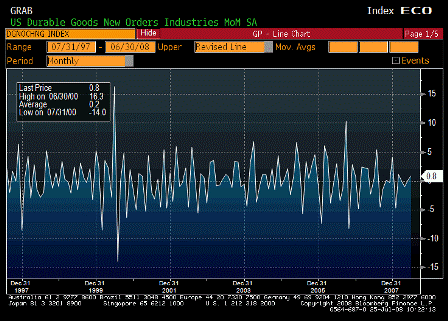
Durable Goods Orders MoM (Jun)

Survey -0.3%
Actual 0.8%
Prior 0.0%
Revised 0.1%

Better than expected, partially because fiscal and government is kicking in harder than expected.

[top][end]

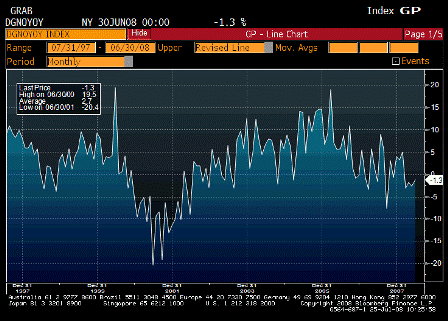
Durable Goods Orders YoY (Jun)

Survey n/a
Actual -1.3%
Prior -2.7%
Revised n/a

Still has turned up in a meaningful way, but moving away from recession levels.

When car sales normalize we’ll see a further boost.

[top][end]

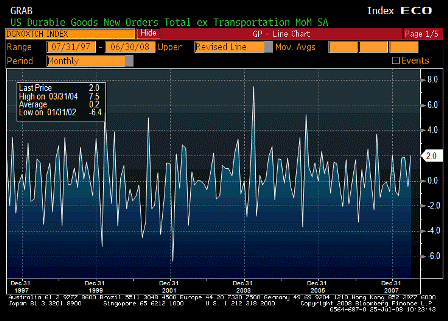
Durables Ex Transportation (Jun)

Survey -0.2%
Actual 2.0%
Prior -0.8%
Revised -0.5%

Headline numbers being held down by car sales.

[top][end]

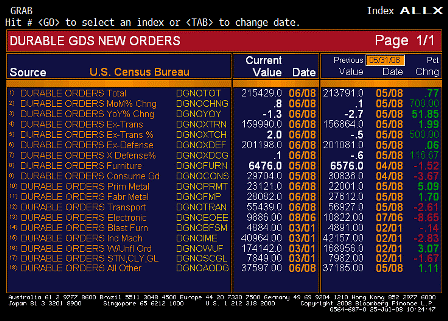
Durable Goods Orders ALLX (Jun)

Durables better than expected, likely due to companies taking advantage of new accelerated depreciation allowance

  • Capital goods orders ex-defense and aircraft up 1.4%
  • Defense orders up 30% in past 2mths, so production/shipments likely to improve for some manufacturers in coming months
  • Small appliances up as well. Seems some rebate checks went for down payments on appliances and home improvements.

    Electronics and consumer goods down.

    [top][end]


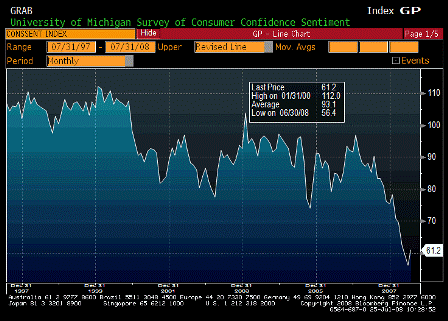
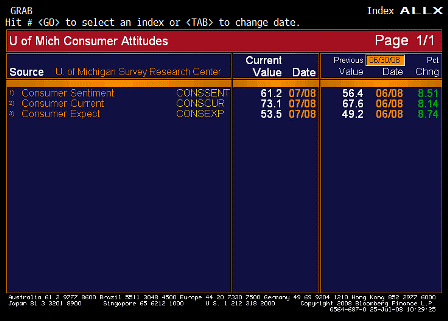
    U of Michigan Confidence (Jul F)

    Survey 56.4
    Actual 61.2
    Prior 56.6
    Revised n/a

    Better than expected and a possible bottom from a very low level.

    [top][end]

    U of Michigan Confidence ALLX (Jul F)

    Gas prices ‘stabilizing’ likely lead to the modest improvement in the Michigan survey and the ebbing of inflation expectations:

    • Headline confidence rose from 56.6 to 61.2

    Don’t underestimate the fiscal package!

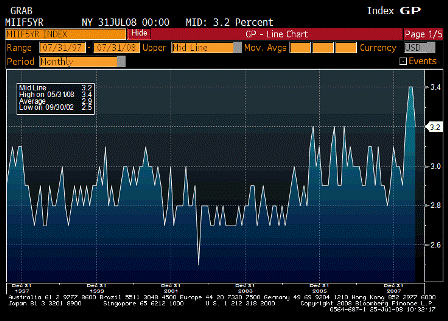
    • 5-10yr inflation expectations fell from 3.4% to 3.2%

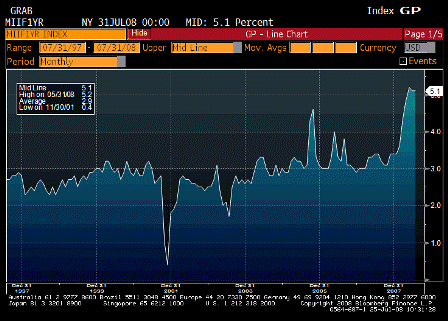
    One year steady at 5.1%.

    [top][end]

    Inflation Expectations 1yr Forward (Jul F)

    Survey n/a
    Actual 5.1%
    Prior 5.1%
    Revised n/a

    Two months over 5% is very troubling for the Fed. They see this as a direct cause of inflation.

    [top][end]

    Inflation Expectations 5yr Forward (Jul F)

    Survey n/a
    Actual 3.2%
    Prior 3.4%
    Revised n/a

    Down some but still way too high.

    The Fed wants this back to their long term target of something under 2.5%.

    [top][end]


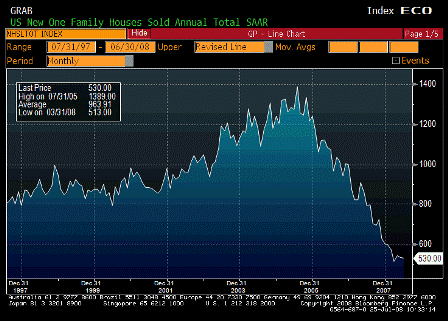
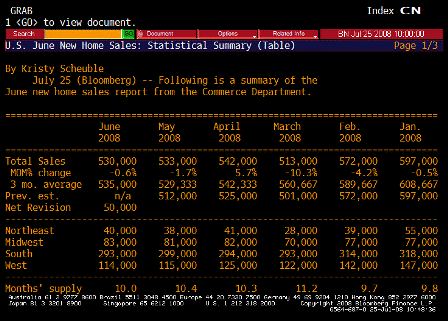
    New Home Sales (Jun)

    Survey 503K
    Actual 530K
    Prior 512K
    Revised 533K

    Better than expected and last month revised up as well.

    [top][end]

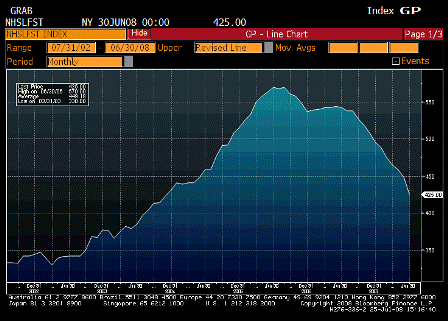
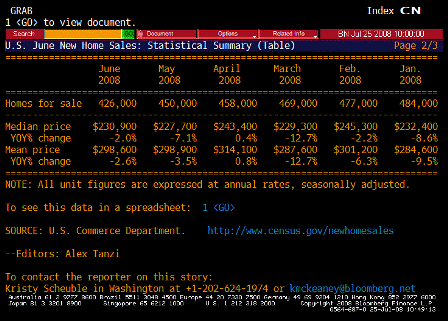
    New Home Sales – Total for Sale (Jun)

    Survey n/a
    Actual 425K
    Prior 448K
    Revised n/a

    Sales can quickly be stifled by dwindling actual inventories.

    [top][end]

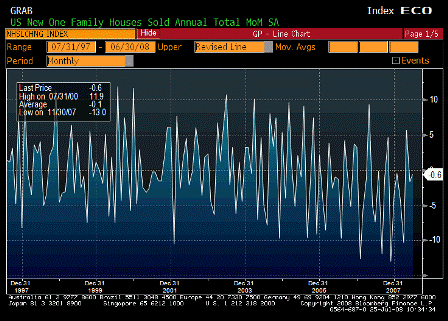
    New Home Sales MoM (Jun)

    Survey -1.8%
    Actual -0.6%
    Prior -2.5%
    Revised -1.7%

    Better than expected and from an upwardly revised May number.

    [top][end]

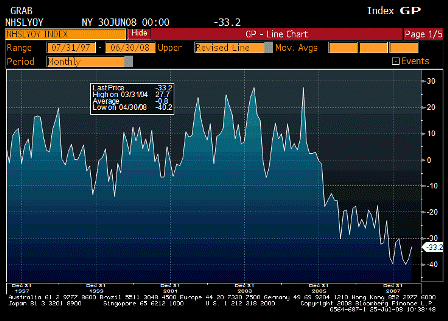
    New Home Sales YoY (Jun)

    Survey n/a
    Actual -33.2%
    Prior -37.8%
    Revised n/a

    [top][end]

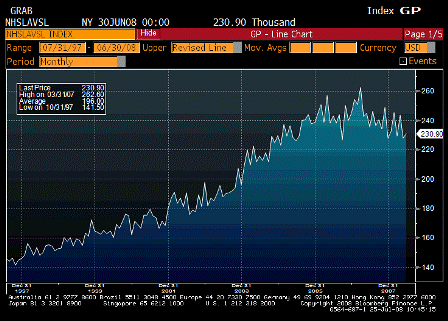
    New Home Sales Median Price (Jun)

    Survey n/a
    Actual 230.9
    Prior 227.7
    Revised n/a

    The decline may be about over.

    Median prices are already rising from the lows.

    Watch for a shortage of new homes.

    [top][end]

    New Home Sales TABLE 1 (Jun)

    The three month average has turned higher.

    [top][end]

    New Home Sales TABLE 2 (Jun)

    • New home sales down 0.6% m/m and prices down 2% y/y

    But higher than expected at 530,000, and down from May because May was revised up to 533,000 from 512,000.

    Also, inventories down and prices up, and prices getting very close to being up year over year:

    New home sales fall but stronger than expected

    by Mark Felsenthal

    Sales of newly constructed U.S. single-family homes were stronger than expected in June, falling 0.6 percent to a 530,000 annual pace, a government report showed on Friday, providing a glimmer of hope for the beaten-down housing market.

    Economists polled by Reuters were expecting sales to slow to a 500,000 seasonally adjusted annual sales rate from a previously reported 512,000 pace in May. May’s sales rate was revised up to 533,000, the Commerce Department said.

    The inventory of homes available for sale shrank 5.3 percent to 426,000, the lowest since December 2004. The June sales pace put the supply of homes available for sale at 10 months’ worth.

    The median sales price rose to $230,900 from $227,700 from May, but was down 2 percent from a year earlier, the government said.


    [top]
Reuters: SemGroup


[Skip to the end]

Looks like it was a likely substantial contributor to the last run up and the subsequent quick sell off. ‘Demand destruction’ isn’t yet anywhere near enough to dislodge the Saudis from setting price as swing producer:

REFILE-SemGroup a small factor in oil price drop -experts

by Matthew Robinson and Robert Campbell

(Reuters) SemGroup’s collapse from the 12th biggest U.S. private firm into bankruptcy was only a small factor in the $23 per barrel drop from oil’s record high over the past two weeks, energy experts said on Thursday.

The Tulsa-based company declared bankruptcy this week after racking up $2.4 billion in losses shorting crude oil futures on the New York Mercantile Exchange, including a $290 million loss owed to SemGroup by a trading firm affiliated with former Chief Executive and co-founder Thomas Kivisto.


[top]
Reuters: House rejects selling 10% of SPR


[Skip to the end]

Just saw that the house just rejected this.

Looks like it was one more reason for technical weakness in crude, along with the vote to limit speculation and the oil storage company’s futures and cash market issues and bankruptcy.

White House threatens veto on bill to sell govt oil

by Tabassum Zakaria

(Reuters) The White House on Thursday threatened to veto legislation that would require the government to sell 10 percent of the oil in the nation’s emergency petroleum stockpile.

The House of Representatives was expected to vote on the bill later on Thursday. Democrats hope the legislation will lower oil prices by putting on the market more of the Strategic Petroleum Reserve’s light, sweet crude that is sought by refiners.

“Drawing down our emergency oil reserve in the absence of a severe energy disruption is counter to the purpose of the SPR, and offers the nation a quick fix instead of much needed long-term, responsible energy solutions,” the White House said in a statement.

The bill would require the government to sell 10 percent of the emergency stockpile’s oil, or 70 million barrels, in the open market. About 40 percent of the stockpile’s oil is light sweet crude.


[top]
2008-07-24 US Economic Releases


[Skip to the end]


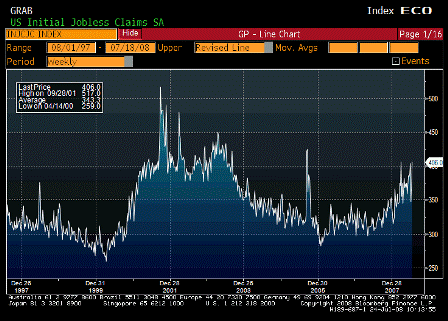
Initial Jobless Claims (Jul 19)

Survey 380K
Actual 406K
Prior 366K
Revised 372K

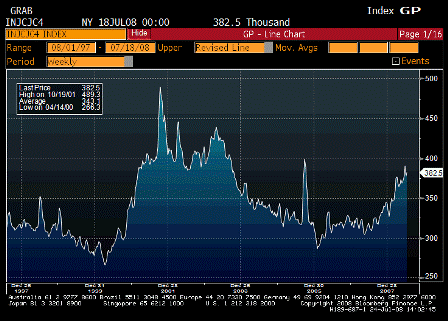
4 week moving average up a few thousand and drifting higher.

[top][end]

Initial Jobless Claims – 4 Week Moving Average (Jul 18)

Survey n/a
Actual 382.5
Prior 378.0
Revised n/a

[top][end]

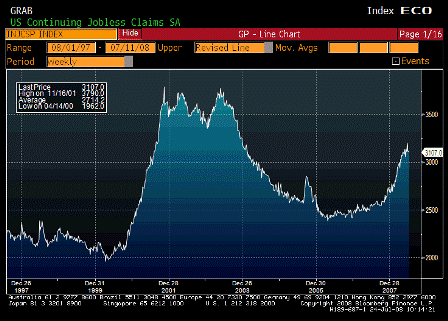
Continuing Jobless Claims (Jul 12)

Survey 3160K
Actual 3107K
Prior 3122K
Revised 3116K

But these are now coming down some.

[top][end]


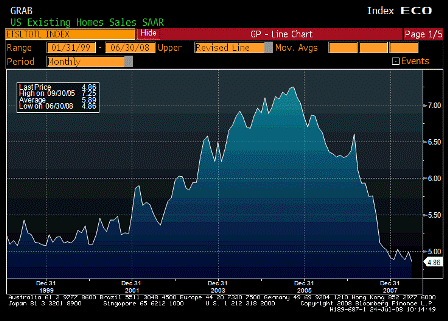
Existing Home Sales (Jun)

Survey 4.94M
Actual 4.86M
Prior 4.99M
Revised n/a

Less than expected, and bumping along the bottom as foreclosures dominate.

[top][end]

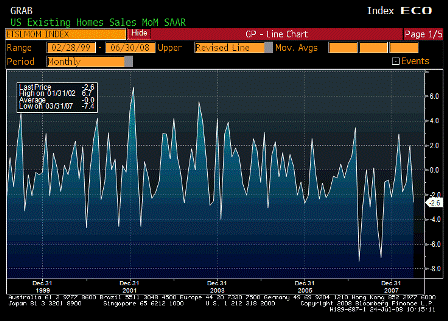
Existing Home Sales MoM (Jun)

Survey -1.0%
Actual -2.6%
Prior 2.0%
Revised n/a

[top][end]

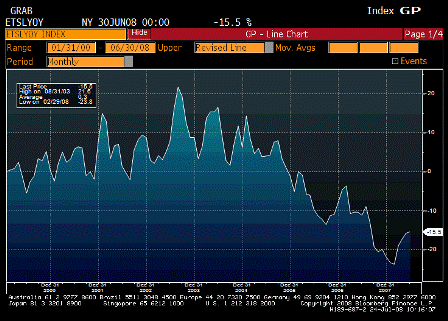
Existing Home Sales YoY (Jun)

Survey n/a
Actual -15.9%
Prior -17.5%
Revised n/a

Still falling but not quite as fast.

[top][end]

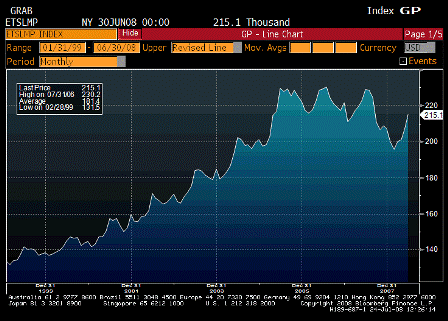
Existing Home Sales – Median Price (Jun)

Survey n/a
Actual 215.1
Prior 207.9
Revised n/a

[top][end]

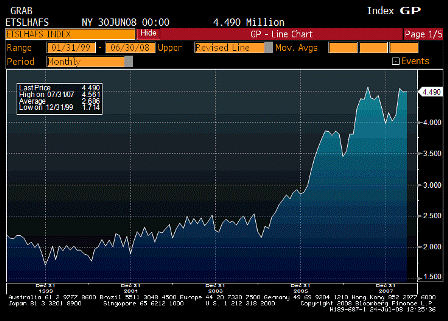
Existing Home Sales – Inventory (Jun)

Survey n/a
Actual 4.490
Prior 4.482
Revised n/a

Foreclosers addind to inventories.

[top][end]

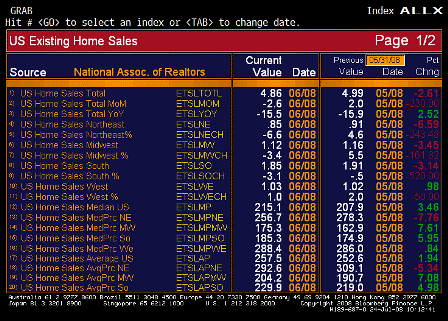
Existing Home Sales ALLX (Jun)

Median prices up in all regions.

[top][end]

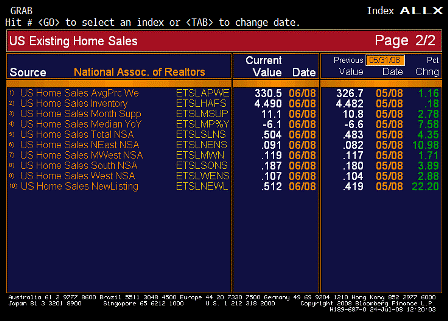
Existing Home Sales ALLX cont (Jun)


[top]

Buy this book!


[Skip to the end]

Full Employment Abandoned

Shifting Sands and Policy Failures


by William Mitchell, Professor of Economics, Centre of Full Employment and Equity, University of Newcastle, Australia and Joan Muysken, Professor of Economics, CofFEE-Europe, University of Maastricht, The Netherlands

My review:

There are only 2 books that I know of that are ‘in paradigm’ and the other is Wray’s ‘Understanding Modern Money’ which I also highly recommend.

This new book by Bill Mitchell is also solidly ‘in paradigm’ and for those of you not all that interested in the details of unemployment per se I suggest beginning with ‘Part III’ which does an outstanding job of outlining the imperatives of non convertible currency which will serve you well in analyzing today’s markets. From monetary operations to fiscal measures, the mainstream economists and media continue to get it wrong. Bill lays down the fundamentals that can help you understand where the mainstream goes astray, and hopefully translate into you getting it right.

Regarding unemployment (aka the ‘output gap’ by today’s central bankers), it is readily acknowledge that inflation isn’t all that sensitive to changes in unemployment. In their words, “The good news is that the Phillips curve is flat. And the bad news is that the Phillips curve is flat.” The essence of what Bill proposes is that an employed labor bufferstock is a far superior price anchor than today’s labor bufferstock of unemployed. And this is one of those things that seems obvious and indeed is absolutely correct, yet entirely overlooked as a policy option.

So click and order a copy or two, jump to Part III, and then start at the beginning to get a leg up on where we are, how we got here, and what policy options are open- particularly a form of full employment that further supports output, growth, and price stability.

Then pass it around your office and send copies to your favorite members of Congress, thanks!

Order now: http://www.e-elgar.co.uk/Bookentry_Main.lasso?id=1188
 
 
Warren Mosler


[top][end]


Publisher’s Spiel:

“This book by William Mitchell and Joan Muysken is both important and timely. It deals with the issue of the abandonment of full employment as an objective of economic policy in the OECD countries. It argues persuasively that macroeconomic policy has been restrictive over the recent, and not so recent past, and has produced substantial open and disguised unemployment. But the authors show how a job guarantee policy can enable workers, who would otherwise be unemployed, to earn a wage and not depend on welfare support. If such a policy is fully supported by appropriate fiscal and monetary programmes, it can create a full employment with price stability, and which the authors label as a
Non-Accelerating-Inflation-Buffer Employment Ratio (NAIBER). This book is essential reading for any one wishing to understand how we can return to full employment as the normal state of affairs.”
-Philip Arestis, University of Cambridge, UK

Contents:

Part I: Full Employment: Changing Views and Policies

  1. The Full Employment Framework and its Demise
  2. Early Views on Unemployment and the Phillips Curve
  3. The Phillips Curve and Shifting Views on Unemployment
  4. The Troublesome NAIRU: The Hoax that Undermined Full Employment

Part II: Full Employment Abandoned: Shifting Sands and Policy Failures

  1. The Shift to Full Employability
  2. Inflation First: The New Mantra of Macroeconomics
  3. The Neglected Role of Aggregate Demand

Part III: The Urgency of Full Employment: Foundations for an Active Policy

  1. A Monetary Framework for Fiscal Policy Activism
  2. Buffer Stocks and Price Stability
  3. Conclusion: The Urgency of Full Employment References Index


[top]

( Commercial Paper + C&I ) * Outstanding


[Skip to the end]

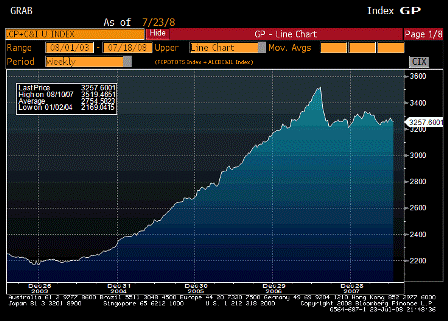
Summation of Commercial Paper Outstanding AND Combined Commercial and Industrial Loans Outstanding

Combined commercial and industrial loans and commercial paper show a leveling off after the initial drop.

Back in mid 2006, I remember commenting that I thought the government deficit was no longer high enough (given everything else that was going on) to support the credit structure.

The last push up was largely a product of fraudulently obtained sub prime and Alt-A loans.


[top]

Reuters: Lehman cuts oil demand forecast


[Skip to the end]

Lehman cuts oil demand forecast

by Richard Valdmanis

(Reuters) Investment bank Lehman Brothers (LEH.N: Quote, Profile, Research, Stock Buzz) said Wednesday it slashed its forecast for 2008 world oil demand growth due to a steeper-than-expected slowdown in energy consumption in the United States and other OECD countries.

Lehman added it believes the oil market is “approaching a tipping point” with prices expected to decline to an average of $90 a barrel in the first quarter of 2009.

“We now forecast annual oil demand for 2008 at 86.3 million barrels per day, a growth of 790,000 bpd from 2007. The growth has been revised down from projections of 1.5 million bpd in December,” Lehman said in a research note titled ‘Demand Demolition’.

If true, and non-Saudi supply remains about flat, Saudi production might fall to about 9 million bpd and the price would still remain wherever the Saudis set it.

There has been some talk that the Saudis may have agreed to lower prices after the last round of meetings with US officials. Could be, but with their output running within a million or two bpd of their total capacity, it seems doubtful they would do anything to increase demand before they have the excess capacity to meet it. But there could be other factors (including the US 7th fleet and concerns about a united Iran/Iraq threatening them) that might be influencing their decision. Only time and prices will tell. Should be more clear in a week or so.


[top]

2008-07-23 US Economic Releases


[Skip to the end]


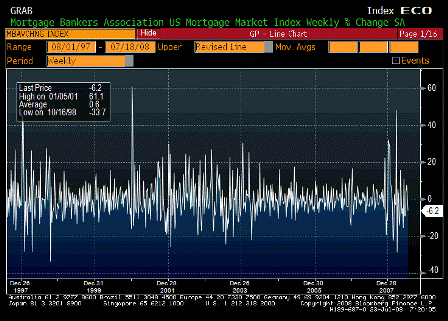
MBA Mortgage Applications (Jul 18)

Survey n/a
Actual -6.2%
Prior 1.7%
Revised n/a

[top][end]

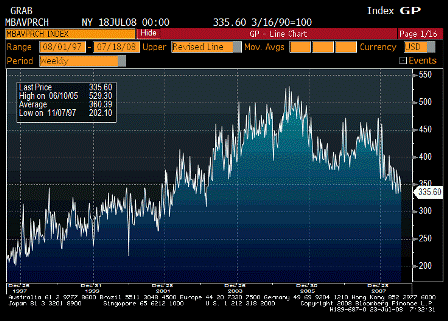
MBA Purchasing Index (Jul 18)

Survey n/a
Actual 335.6
Prior 359.7
Revised n/a

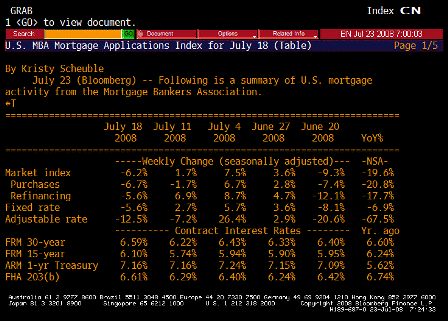
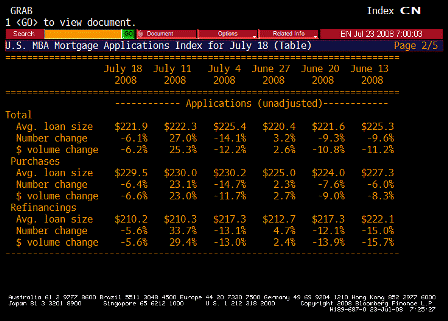
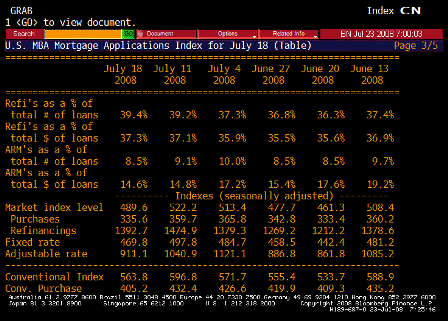
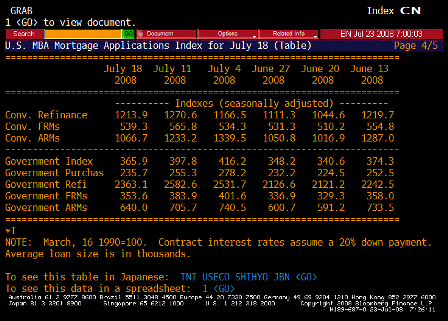
A zig down and looking soft. Tables below show largest drops are in applications for adjustable rate mortgages, particularly government mortgages.

Also, I recall JPM’s recent earnings report showed a substantial increase in consumer mortgage lending, which could be taking volume from the mortgage bankers surveyed in this report.

Housing may be leveling off and moving up some, but no signs of actual strength yet.

[top][end]

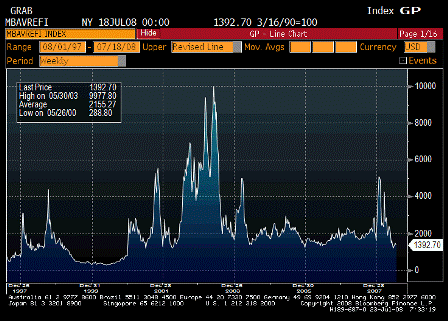
MBA Refinancing Index (Jul 18)

Survey n/a
Actual 1392.7
Prior 1474.9
Revised n/a

[top][end]

MBA TABLE 1 (Jul 18)

[top][end]

MBA TABLE 2 (Jul 18)

[top][end]

MBA TABLE 3 (Jul 18)

[top][end]

MBA TABLE 4 (Jul 18)


[top]