2008-08-12 US Economic Releases


[Skip to the end]


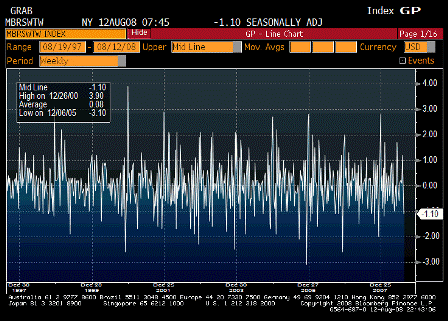
ICSC-UBS Store Sales WoW (Aug 12)

Survey n/a
Actual -1.1%
Prior 0.0%
Revised n/a

[top][end]

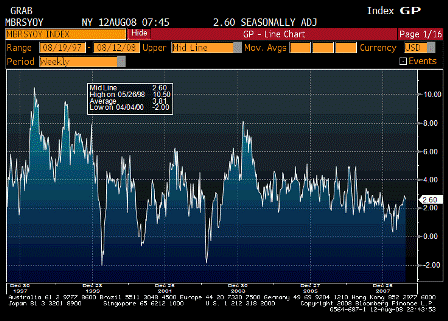
ICSC-UBS Store Sales YoY (Aug 12)

Survey n/a
Actual 2.6%
Prior 2.9%
Revised n/a

Year over year looking fine.

[top][end]

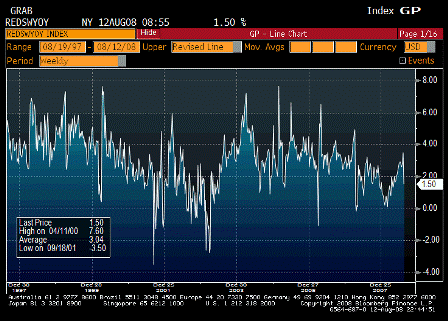
Redbook Store Sales Weekly YoY (Aug 12)

Survey n/a
Actual 1.5%
Prior 3.5%
Revised n/a

Softer but no collapse.

[top][end]

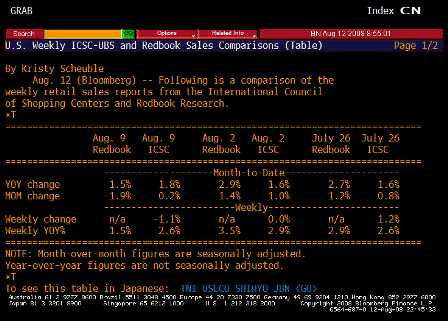
ICSC-UBS Redbook Comparisson TABLE (Aug 12)
[top][end]


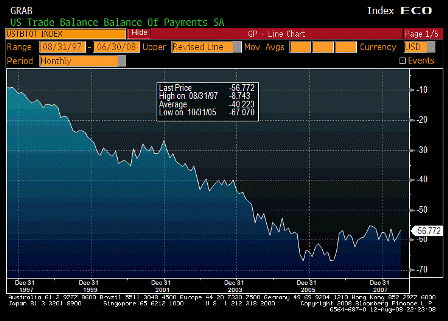
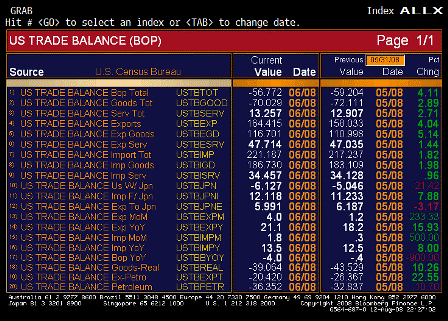
Trade Balance (Jun)

Survey -$62.0B
Actual -$56.8B
Prior -$59.8B
Revised -$59.2B

Lower than expected and moving lower even with crude prices up in June.

I still think last months number was too high which is part of the reason for the June drop.
[top][end]

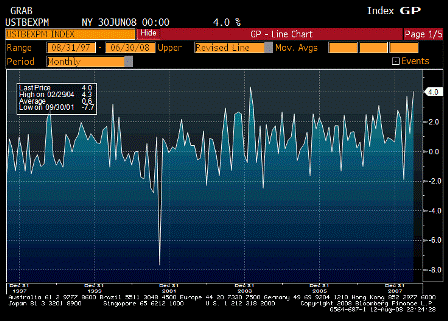
Exports MoM (Jun)

Survey n/a
Actual 4.0%
Prior 1.2%
Revised n/a

Government and exports continue to support GDP.

Q2 now looking to be revised to maybe north of 3%.
[top][end]

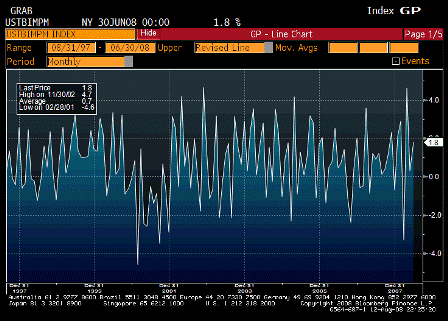
Imports MoM (Jun)

Survey n/a
Actual 1.8%
Prior 0.3%
Revised n/a

Up due to crude and gasoline prices.

[top][end]

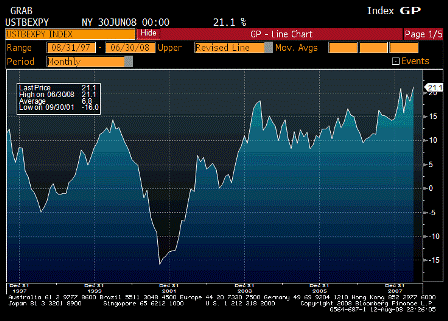
Exports YoY (Jun)

Survey n/a
Actual 21.1%
Prior 18.2%
Revised n/a

Looking more like an export economy every day. Weak domestic consumption and ok employment.

Workers earn enough to drive to work and eat, and the rest of their output gets exported to someone else.
[top][end]

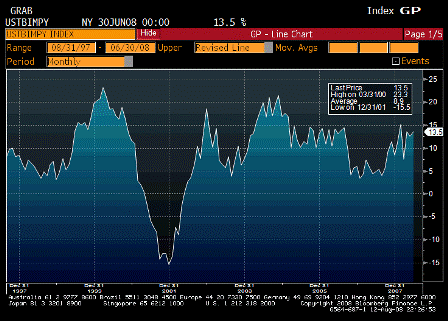
Imports YoY (Jun)

Survey n/a
Actual 13.5%
Prior 12.5%
Revised n/a

Mostly petro and product prices.

Other imports are down.
[top][end]

Trade Balance ALLX (Jun)

Ex petro down to about 20 billion.
[top][end]


IBD-TIPP Economic Optimism (Aug)

Survey 39.0
Actual 42.8
Prior 37.4
Revised n/a

Up some, but less than expected.

[top][end]


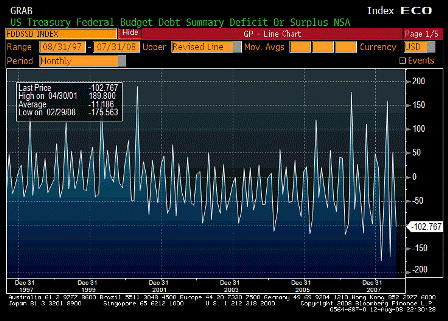
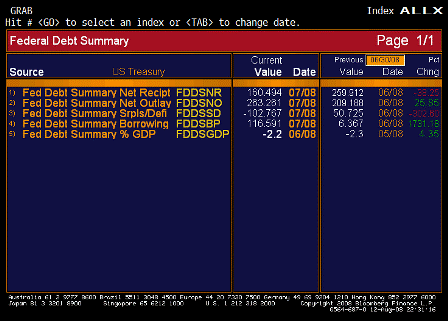
Monthly Budget Statement (Jul)

Survey -$95.0B
Actual -$102.8B
Prior -$36.4B
Revised n/a

Government spending and exports supporting GDP more than most anticipate.
[top][end]

Monthly Budget Statement ALLX (Jul)

[top][end]


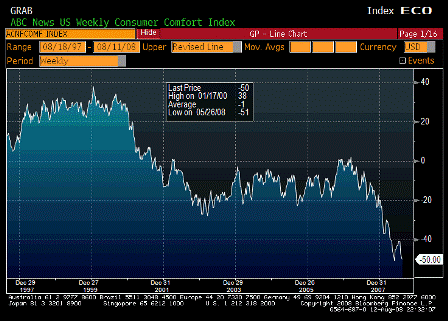
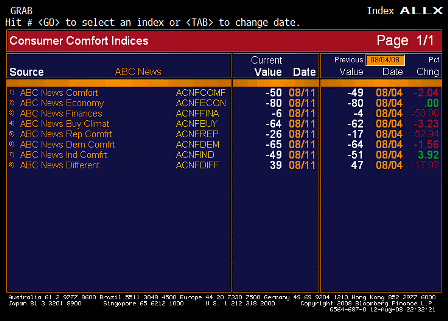
ABC Consumer Confidence (Aug 10)

Survey n/a
Actual -50
Prior -49
Revised n/a

Bumping along the bottom.

Inflation hurting confidence as wages remain ‘well contained’.
[top][end]

ABC Consumer Confidence ALLX (Aug 10)


[top]
Fed senior loan officer survey charts


[Skip to the end]

On Mon, Aug 11, 2008 at 1:25 PM, Karim writes:

  • Both lending standards and spds move up from cycle highs; appears defining aspect of the current episode may be the duration of tighter lending conditions (prior episodes approached current levels of tightness but were relatively short-lived).
  • Also of concern to Fed is chart on page 3 showing significant tightening of standards for prime residential mortgage loans (though all types of loans showed a deterioration)

http://www.federalreserve.gov/boarddocs/SnLoanSurvey/200808/charts.pdf

Yes, and note how housing showing strong signs of bottoming and GDP moving up at the same time.

Interesting to watch the blood flowing around the clot, as it necessarily does.

Though not without difficulty.


[top]

2008-08-11 Weekly Credit Graph Packet


[Skip to the end]


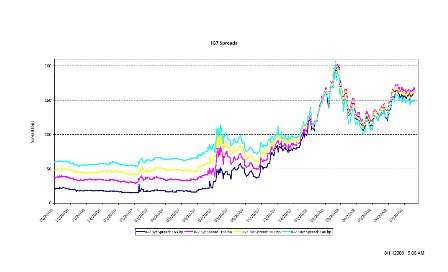
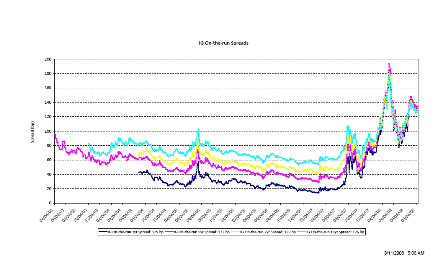
IG On-the-run Spreads (Aug 11)

[top][end]

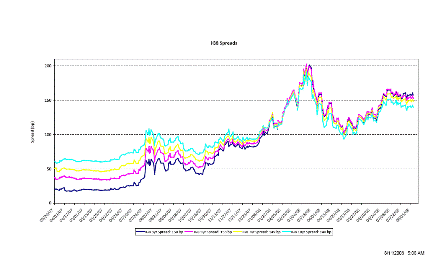
IG6 Spreads (Aug 11)

[top][end]

IG7 Spreads (Aug 11)

[top][end]

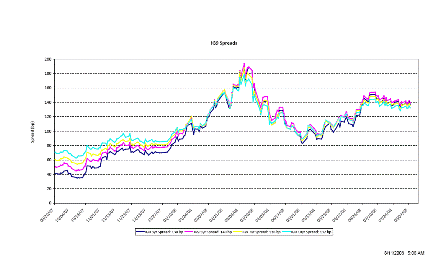
IG8 Spreads (Aug 11)

[top][end]

IG9 Spreads (Aug 11)


[top]

NYPost: Lost Sovereignity – There’s a new land grab


[Skip to the end]

Hope they don’t dig it up and take it home!

Lost Sovereignity

Oil-rich Fund Eyeing Foreclosed US Homes


By Teri Buhl

There’s a new land grab starting in America.

Foreign money, which up to now has focused its attention on investing in iconic commercial real estate – like Barneys New York and the Chrysler Building – is now moving to scoop up tens of thousands of discounted foreclosed homes across the country.

One sovereign fund, said to have earmarked $29 billion to purchase foreclosed residential real estate, recently hired a West Coast mortgage broker and is starting to search for bargains, The Post has learned.

The search, which is being carried out, in part, by Field Check Group mortgage consultant Mark Hanson, who was retained by the broker, Steve Iversen, is concentrating on single- and multi-family REO (real estate owned) homes, or homes that have already been taken over by the mortgagee.

Neither Iversen nor Hanson would disclose the name of the client, but sources told The Post it’s a sovereign fund.

The unidentified fund joins individual US investors, hedge funds and Wall Street banks in kicking the tires of REO homes, which have fallen in value so much that they are now tempting investments.

A sovereign fund would have two distinct advantages over other investors – the depressed value of the US dollar makes the homes a bargain, and sovereign funds have deeper pockets.

The sovereign fund of Abu Dhabi, for example, has a reported $875 billion in assets, while Norway has $391 billion, Singapore has $303 billion and Kuwait has $264 billion in their sovereign funds, which are funded by proceeds from oil sales.

The Abu Dhabi Investment Authority is expected to announce next month what type of US distressed assets they will be investing in and real estate is at the top of the list, according to a report in Financial Times last week.

ADIA did not respond to an e-mail question about REO investments.

So far, prices on bulk sales of REO properties vary based on location and are selling from 60 cents to 80 cents on the dollar. Hanson started out offering 40 cents on the dollar for about $2.5 billion worth of California properties owned by IndyMac and Washington Mutual but was turned down. The banks refused to comment.

Hanson is now willing to pay 50 cents to 60 cents on the dollar for a collection of California REOs worth at least $500 million.

In fact, this week Hanson’s team negotiated a $2 billion package mixed with homes across the country for 31 cents on the dollar. While progress seems slow, Hanson reminds us this is only a nine-month old industry.

Some market experts think such deeply discounted REOs, like the deal Hanson just closed, are more fiction than fact.

“The size and discount of that type of deal isn’t the norm yet,” said Robert Pardes, with Recourse Recovery Management Services, a provider of mortgage advisory services.

“The critical mass of bulk REO is in well-capitalized institutions that don’t need to sell yet in bulk at a deep discount because they are better off not taking substantial hits to the capital just to get the assets off their books,”

This may change, should the market become more crowded with bank failures and distressed institutions, he said.

Enoch Lawrence, senior vice president of CB Richard Ellis, says “This type of bulk buy would make an impact on the market. They are in a unique position because they have a long time horizon to invest and a cheap cost of capital. It’s actually a perfect time for them to acquire these REO assets.”


[top]

Crude and the USD


[Skip to the end]

My current assessment is that the crude sell-off has caused the USD’s strength.

Lower crude prices make the USD ‘harder to get’ as oil producers get fewer USD for the same volume of crude (and product) exports to the US.

Likewise, this also brings down the US trade gap which is about half directly related to oil prices, so nonresidents have fewer USD to meet their USD financial asset savings desires.

Crude has been brought down by technical selling, which also brought with it technical buying of USD as trend following trading positions were unwound.

The crude market has gone into contango as would be expected with a futures sell off and tight inventories.

Tighter US credit conditions made the USD ‘harder to get’ while increased deficit spending makes the USD ‘easier to get’ resulting in GDP muddling through at modest rates of growth.

The Russian invasion probably helped the USD today.

Eurozone credit quality erosion with the onset of intensified economic weakness may be triggering an exit from the euro. The lowest risk euro financial assets are the national governments which carry similar risk to US States, and are vulnerable in a slowdown that forces increasing national budget deficits that are already in what looks like ‘ponzi’ for credit sensitive agents.

Eurozone bank deposit insurance is not credible and therefore the payment system itself vulnerable to an economic slowdown.

With the Russian army on the move, public and private portfolios may not want to hold the debt of the eurozone national governments that they accumulated when diversifying reserves from the USD.

I expect the Saudis to resume hiking crude prices once the selling wave has passed. I don’t think there has been an increase in net supply sufficient to dislodge them from acting as swing producer. And I also expect them to continue to spend their elevated revenues on real goods and services to keep the west muddling through at positive but sub-trend growth.

And the Russian invasion will linger on and help support the USD as a safe haven in the near-term

[top][end]


Comments about this post from email:

MIKE:

Again, its very likely you have permanently damaged demand at prices that are still over 100-

It’s possible the growth of crude consumption has slowed, but I still think it’s doubtful if consumption had declined enough to dislodge Saudi price control. July numbers still not out yet.

in addition asset alligators around the world are actually or synthetically short the dollar after 8 years of dollar selling…

Agreed. The question is the balance of the technicals, and if the CBs no longer buying USD has been absorbed by others.

For now, yes, short covering has mopped up the extra USD sloshing around from our trade gap, but it’s still maybe $50 billion per month that has to get placed. Not impossible for non-government entities to take it but it’s a tall order.

The Russian invasion helps a lot as well. That could be a much more important force than markets realize. Looks like a move to further control world energy supplies. A middle-eastern nation could be on the bear’s menu. I doubt the US could do anything about a Russian takeover of another neighbor. Certainly not go to war with Russia. and they know it.


[top]

2008-08-08 EU News Highlights

Looks like a demand leakage if it goes through:

Highlights:

German Net Pay May Shrink on Social Insurance Changes, FAZ Says


Article snip:

German Net Pay May Shrink on Social Insurance Changes, FAZ Says (Bloomberg) – Germany’s top wage earners may take home less pay next year because a larger portion of their wage may be subjected to social insurance contributions, the Frankfurter Allgemeine Zeitung said on its Internet site. A pension insurance panel has suggested in its regular annual review to raise the amount of gross monthly pay on which contributions have to be paid by 100 euros ($152) to 5,400 euros in western Germany and by 50 euros to 4,550 euros in the eastern half of the country, the newspaper said. Employees whose pay is above these thresholds will pay an extra 11.60 euros per month into pension and unemployment insurance coffers from the start of next year, the newspaper said. The panel’s proposals are generally approved, it said. Thresholds for health and nursing insurance contributions will also be raised, the FAZ said, without providing figures.

2008-08-08 US Economic Releases


[Skip to the end]


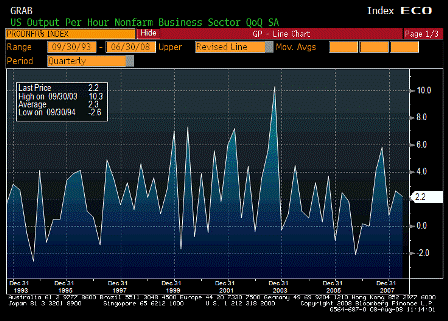
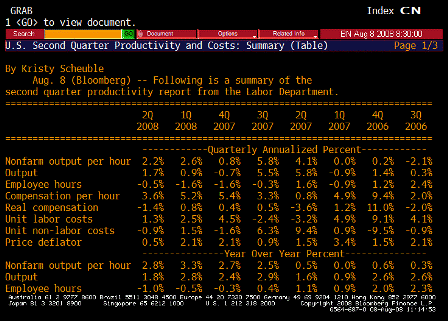
Nonfarm Productivity QoQ (2Q P)

Survey 2.5%
Actual 2.2%
Prior 2.6%
Revised n/a

GDP gains are coming from productivity as hours worked decline.

[top][end]

Nonfarm Productivity TABLE 1 (2Q P)

[top][end]

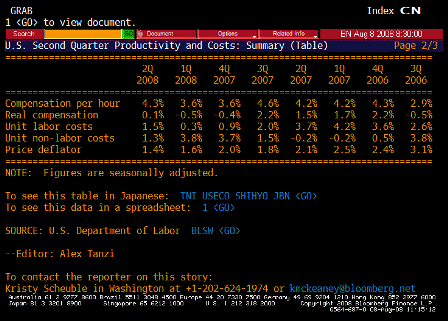
Nonfarm Productivity TABLE 2 (2Q P)

[top][end]


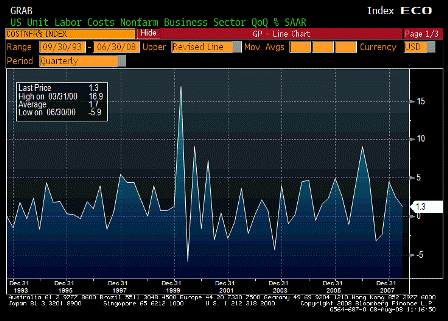
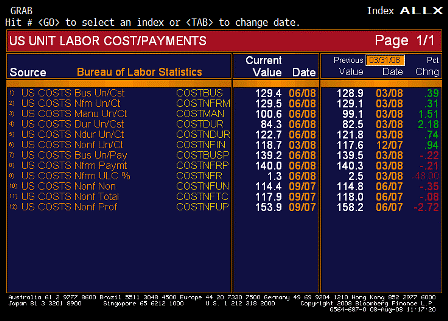
Unit Labor Costs QoQ (2Q P)

Survey 1.4%
Actual 1.3%
Prior 2.2%
Revised 2.5%

Better than expected due to productivity increases.

If the USD stays strong, it could help import prices moderate as well.

[top][end]

Unit Labor Costs ALLX (2Q P)

Karim writes:

Productivity based on hours, not employment; so we should see productivity in q2 of about 3.5% vs gdp of 1.9%.

Right, makes sense. More output from fewer workers and fewer hours is keeping GDP positive (and that much demand, which includes demand for exports, is supporting prices) even as labor markets soften.

Same as in prior 2 qtrs as hours were cut more aggressively than employment>Q4 gdp was -0.2% and productivity was +0.9%: Q1 GDP of 0.9% and productivity of 2.4%

[top][end]


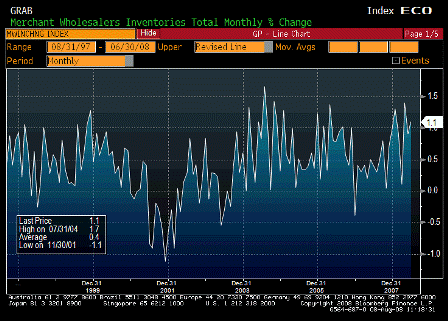
Wholesale Inventories MoM (Jun)

Survey 0.6%
Actual 1.1%
Prior 0.8%
Revised 0.9%

Higher than expected. Might mean upward Q2 GDP revision.

[top][end]

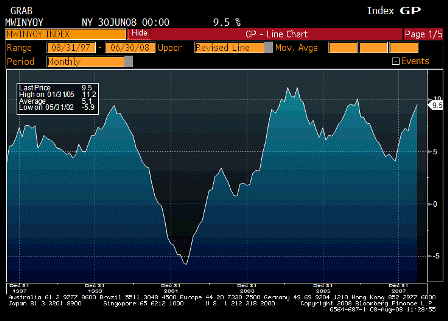
Wholesale Inventories YoY (Jun)

Survey n/a
Actual 9.5%
Prior 8.8%
Revised n/a

With all the talk of weakness, increased inventories are most likely due to increased order flow.

[top][end]

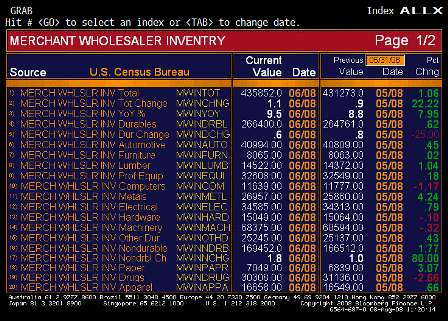
Wholesale Inventories ALLX 1 (Jun)

[top][end]

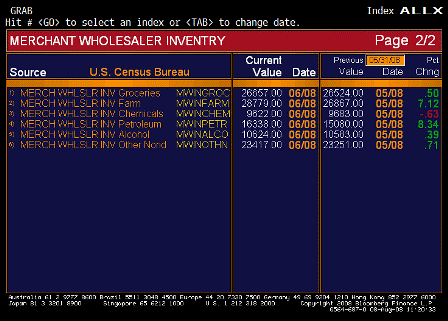
Wholesale Inventories ALLX 2 (Jun)


[top]

Bloomberg: Fed can’t reduce LIBOR

I could fix this in twenty minutes…

Money Market `Plagued’ by Libor That Fed Can’t Reduce

by Gavin Finch

(Bloomberg) A year after central banks started to pump trillions of dollars into the financial system to end a seizure in credit markets caused by subprime mortgages, cash is about as tight as it’s ever been.

The U.S. market for commercial paper, or short-term IOUs, backed by assets such as mortgages has shrunk 40 percent from its peak in July 2007. The amount borrowed in pounds between banks in the U.K. fell by 70 percent in June from a record in February 2007. The European Central Bank received $100 billion of bids for the $25 billion it offered to financial institutions on July 29, the most since the sales began in December.

Efforts by the Federal Reserve, ECB and Swiss National Bank to shore up the world’s biggest banks and promote lending have had limited success.

Re: Crude oil pricing


[Skip to the end]

(an email exchange)

>   
>   On Thu, Aug 7, 2008 at 7:15 AM, Scott wrote:
>   
>   crude moves further in backwardation.
>   

Right, indicating futures buying subsiding and inventories not above desired levels for commerce.

>   
>   CL vs brent now 160 over vs 120 under 2 weeks ago!
>   

Also indicating any excess inventory is gone, thanks!

Might be near the end of the second Master’s sell off.


[top]