Japan’s MOF land sales faltering


[Skip to the end]

This selling of land is a directly deflationary/contractionary policy, and all because they think the government needs the funds.

Japan’s MOF land sales faltering

May 17 (Nikkei) — The Ministry of Finance is having trouble selling public land, even in metropolitan Tokyo, amid deterioration of Japan’s real estate market in the wake of the global financial crisis.

Market sluggishness is complicating MOF plans to raise funds for fiscal rehabilitation through sale of such land, including properties acquired as in-kind tax payments, with a series of auctions drawing no bidders.

Last December, the ministry planned to sell a huge parcel of 7.7 hectares in a coastal area of Chiba. Some condominium developers had expressed interest in the property during a pre-auction briefing.

But the MOF, which manages public land, called off the auction at the last moment, realizing that no bid would be made.

The Chiba lot holds some 1,300 abandoned apartments which previously housed government workers, but have remained vacant since March 2006.

As recently as 2007, real estate developers flocked to build condos on available land in a competitive wave extending to Chiba. At that time, the vast coastal property, a rare offering, could have sold “on the spot,” said an official involved in the canceled auction.

Government-own plots often sell well because their titles are usually free of unsettled claims. This is especially the case in big cities and their surrounding areas, which contain active real estate markets.

But there remains a scarcity of buyers because the global economic downturn has forced many financial institutions to curtail financing of real estate deals.

In recent MOF auctions, the ratio of successful offers in Tokyo’s 23 wards plunged to just above 50% in the second half of fiscal 2007 from 100% in the first half. And the ratio fell to nearly 30% in the first half of fiscal 2008 and 24% in the second half.

A plan worked out by the ministry in 2007 envisions raising 2.1 trillion yen by the end of fiscal 2015 through the sale of public assets, such as vacant land like the lot in coastal Chiba. The proceeds would be used to finance fiscal rehabilitation.

But a substantial delay in implementation appears unavoidable due to the weakness of the property market.
Private-sector auctions often resort to “bulk sales” to stimulate demand for unpopular parcels of land by combining them with lots expected to draw strong demand. The ministry does not have this option, as government-owned lots must be sold at “fair prices” under the public finance law.

Another reason for the difficulty in attracting buyers is that the ministry is eager for higher-priced deals and often “lacks flexibility,” says a real-estate appraiser.

Prolonged vacancies of public land may not only depress the local real estate market, but also cause security problems in some cases. In addition, the government’s cost of managing unused properties continues to escalate.

When an advisory panel to the finance minister convened in late February to discuss the sale of public land, MOF officials complained they are caught in a catch-22 — raising sorely needed funds through property sales is a thorny process amid real estate market conditions that continue to deteriorate.

(The Nikkei May 15 morning edition)


[top]

Roubini on Chinese Reserve Currency


[Skip to the end]

(email exchange)

>   On Fri, May 15, 2009 at 9:22 AM, wrote:

>   Hi Warren. Roubini (the contemporary Dr. Doom) is suggesting this morning that
>   the Chinese currency should be the new global reserve currency.
>   
>   Don’t you need a country that runs an external payments deficit (or at least not a
>   surplus)?

Helps a lot! Unless someone out there wants to get short your currency so everyone else can get long!

>   that also has deep and unrestricted capital markets?

At least not restricted to the point no one else can hold financial assets denominated in your currency.

The other big thing that helps is that they all want to export to you.

The word ‘reserve currency’ has come to mean others use it as their fx reserves?

If so, they first must want to have fx reserves, and the usual reason for that is to support their exporters to the region of the ‘reserve currency.’

So he’s saying China is scheming to be a major net importer? Doubt it, though that’s what I would do if I were them.


[top]

Obama Again Sides with the Deficit Terrorists


[Skip to the end]

It’s for real – Obama’s in the deficit terrorist camp, using the communication skills he learned in his rhetoric 101 class.

Obama Says U.S. Long-Term Debt Load ‘Unsustainable’

by Roger Runningen and Hans Nichols

May 14 (Bloomberg) — President Barack Obama, calling current deficitspending “unsustainable,” warned of skyrocketing interest rates for consumers if the U.S. continues to finance government by borrowing from other countries.

  1. It’s domestic budget surpluses that are unsustainable- they remove savings.
     
  2. Interest rates are set by the Fed, not the market or the deficit. Japan’s deficits have been triple ours and their rates lower for decades, for just one (unnecessary) example.
     
  3. The US government is not dependent on borrowing from other countries in order to spend.
     
  4. “We can’t keep on just borrowing from China,” Obama said at a town-hall meeting in Rio Rancho, New Mexico, outside Albuquerque. “We have to pay interest on that debt, and that means we are mortgaging our children’s future with more and more debt.”

    That’s a load of inapplicable rhetoric for the purpose of terrorizing uninformed Americans.

    Holders of U.S. debt will eventually “get tired” of buying it, causing interest rates on everything from auto loans to home mortgages to increase, Obama said. “It will have a dampening effect on our economy.”

    Interest rates are set by the Fed, not by those who elect to buy Treasury securities.

    The president pledged to work with Congress to shore up entitlement programs such as Social Security and Medicare and said he was confident that the House and Senate would pass health-care overhaul bills by August.

    “Most of what is driving us into debt is health care, so we have to drive down costs,” he said.

    Whatever costs he’s got in mind (insurance, drug company markups, etc.) should be minimized in any case.

    It’s not about the ‘debt’.

    The biggest risk to our economy is the risk of Obama succeeding in enacting measures to reduce the deficit.


    [top]

USER 5-14-2009


[Skip to the end]


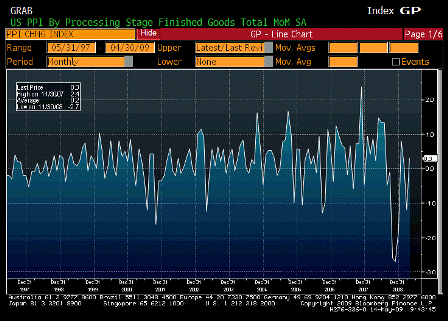
Producer Price Index MoM (Mar)

Survey 0.2%
Actual 0.3%
Prior -1.2%
Revised n/a

Karim writes:

PPI

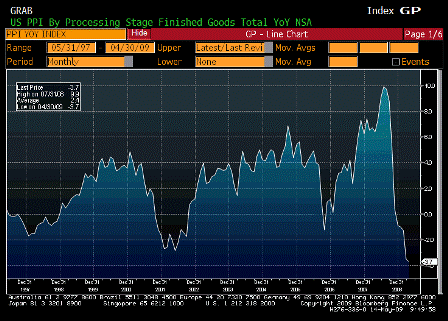
  • 0.2% m/m; -3.7% y/y
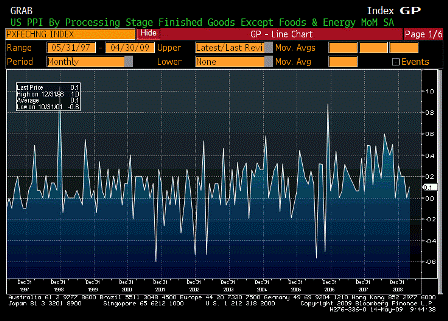
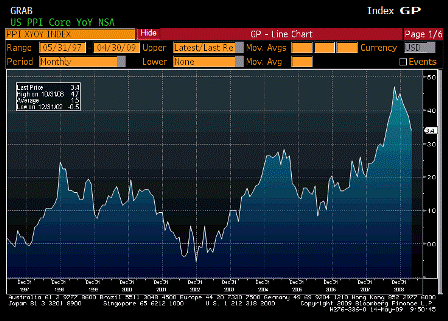
  • Core PPI 0.1% m/m and 3.4% y/y
  • Intermediate stage -0.5% m/m and -10.5% y/y; core intermediate -0.9% m/m and -3.8% y/y
  • Crude stage 3.0% m/m and -40% y/y; core crude -0.6% m/m and -39.9% y/y
  • Pipeline pressures continue to collapse

[top][end]

Producer Price Index YoY (Mar)

Survey -3.7%
Actual -3.7%
Prior -3.5%
Revised n/a

[top][end]

PPI Ex Food & Energy MoM (Mar)

Survey 0.1%
Actual 0.1%
Prior 0.0%
Revised n/a

[top][end]

PPI Ex Food & Energy YoY (Mar)

Survey 3.4%
Actual 3.4%
Prior 3.8%
Revised n/a

[top][end]

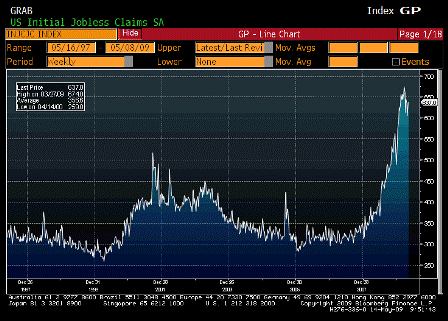
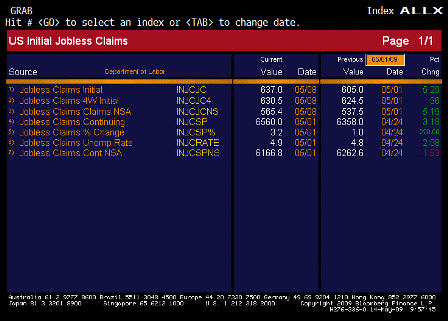
Initial Jobless Claims (May 1)

Survey 610K
Actual 637K
Prior 601K
Revised 605K

Karim writes:

  • IJC up 32k to 637k, Labor Dept states ‘good part’ of rise due to Chrysler plant shutdowns
  • Continuing up another whopping 202k to 6560k
  • The continuing claims data reflect lack of hiring and correlates to further rises in the unemployment rate and drop in personal income (assuming your job paid more than unemployment benefits)

[top][end]

Continuing Claims (May 1)

Survey 6400K
Actual 6560K
Prior 6351K
Revised 6358K

[top][end]

Jobless Claims ALLX (May 1)


[top]

America’s Triple A Rating at Risk


[Skip to the end]

He’s public enemy #1 and senior spokesman for all the deficit terrorists.

He’s also an intellectually dishonest, paid propagandist.

I’ve got the recording posted on my website from the Mike Norman show where he agrees government solvency is not a risk.

If anyone has his email address feel free to email this to him.

The ratings agencies, however, don’t understand the monetary system, and it is indeed possible they will downgrade the US much like they have downgraded Japan.

While this did no harm to Japan and won’t hurt the US, it could be damaging for eurozone nations who are institutionally dependent on funding. However, even in Europe, the ECB has already stretched the limits of the Treaty and would likely go further as needed (though that is not a certainty.)

America’s Triple A Rating is at Risk

by David Walker

May 12 (FT) — Long before the current financial crisis, nearly two years ago, a little-noticed cloud darkened the horizon for the US government. It was ignored. But now that shadow, in the form of a warning from a top credit rating agency that the nation risked losing its triple A rating if it did not start putting its finances in order, is coming back to haunt us.

That warning from Moodys focused on the exploding healthcare and Social Security costs that threaten to engulf the federal government in debt over coming decades. The facts show we are in even worse shape now, and there are signs that confidence in America’s ability to control its finances is eroding.

Prices have risen on credit default insurance on US government bonds, meaning it costs investors more to protect their investment in Treasury bonds against default than before the crisis hit. It even, briefly, cost more to buy protection on US government debt than on debt issued by McDonald’s. Another warning sign has come from across the Pacific, where the Chinese premier and the head of the People’s Bank of China have expressed concern about America’s longer-term credit worthiness and the value of the dollar.

The US, despite the downturn, has the resources, expertise and resilience to restore its economy and meet its obligations. Moreover, many of the trillions of dollars recently funneled into the financial system will hopefully rescue it and stimulate our economy.

The US government has had a triple A credit rating since 1917, but it is unclear how long this will continue to be the case. In my view, either one of two developments could be enough to cause us to lose our top rating.

First, while comprehensive healthcare reform is needed, it must not further harm our nation’s financial condition. Doing so would send a signal that fiscal prudence is being ignored in the drive to meet societal wants, further mortgaging the country’s future.

Second, failure by the federal government to create a process that would enable tough spending, tax and budget control choices to be made after we turn the corner on the economy would send a signal that our political system is not up to the task of addressing the large, known and growing structural imbalances confronting us.

For too long, the US has delayed making the tough but necessary choices needed to reverse its deteriorating financial condition. One could even argue that our government does not deserve a triple A credit rating based on our current financial condition, structural fiscal imbalances and political stalemate. The credit rating agencies have been wildly wrong before, not least with mortgage-backed securities.

How can one justify bestowing a triple A rating on an entity with an accumulated negative net worth of more than $11,000bn (€8,000bn, £7,000bn) and additional off-balance sheet obligations of $45,000bn? An entity that is set to run a $1,800bn-plus deficit for the current year and trillion dollar-plus deficits for years to come?

He knows as per the recording on my website that the US government spending in USD is not constrained by revenues, and that any default would be due to a political decision not to pay, and not financial circumstances per se.

James Galbraith and I recently testified at the gao/fasb hearings on sustainability immediately following Walker.

Our presentation is on my website.

The panel agreed with us and reportedly has changed their report, including the elimination of the concern over intergenerational transfers.

I have fought on the front lines of the war for fiscal responsibility for almost six years. We should have been more wary of tax cuts in 2001 without matching spending cuts that would have prevented the budget going deeply into deficit. That mistake was compounded in 2003, when President George W. Bush proposed expanding Medicare to include a prescription drug benefit. We must learn from past mistakes.

Fiscal irresponsibility comes in two primary forms – acts of commission and of omission. Both are in danger of undermining our future.

First, Washington is about to embark on another major healthcare reform debate, this time over the need for comprehensive healthcare reform. The debate is driven, in large part, by the recognition that healthcare costs are the single largest contributor to our nation’s fiscal imbalance. It also recognises that the US is the only large industrialised nation without some level of guaranteed health coverage.

There is no question that this nation needs to pursue comprehensive healthcare reform that should address the important dimensions of coverage, cost, quality and personal responsibility. But while comprehensive reform is called for and some basic level of universal coverage is appropriate, it is critically important that we not shoot ourselves again. Comprehensive healthcare reform should significantly reduce the huge unfunded healthcare promises we already have (over $36,000bn for Medicare alone as of last September), as well as the large and growing structural deficits that threaten our future.

One way out of these problems is for the president and Congress to create a “fiscal future commission” where everything is on the table, including budget controls, entitlement programme reforms and tax increases. This commission should venture beyond Washington’s Beltway to engage the American people, using digital technologies in an unparalleled manner. If it can achieve a predetermined super-majority vote on a package of recommendations, they should be guaranteed a vote in Congress.

Recent research conducted for the Peterson Foundation shows that 90 per cent of Americans want the federal government to put its own financial house in order. It also shows that the public supports the creation of a fiscal commission by a two-to-one margin. Yet Washington still sleeps, and it is clear that we cannot count on politicians to make tough transformational changes on multiple fronts using the regular legislative process. We have to act before we face a much larger economic crisis. Let’s not wait until a credit rating downgrade. The time for Washington to wake up is now.

David Walker is chief executive of the Peter G. Peterson Foundation and former comptroller general of the US


[top]

German Bad Bank Plan


[Skip to the end]

(email exchange)

The ‘short cut’ would be to allow banks to mark to model aggressively and then write off the losses over 20 years so the losses don’t alter capital ratios.

And while it does drive down their ‘economic net worth’ and reveals ‘actual shareholder equity’ immediately, as long as they can fund themselves with insured deposits and central bank funding operations, they are not affected.

They may even be allowed to pay dividends based on reported (though arguably overstated) earnings.

And they can still raise new capital if the new investors can get in at levels that give sufficient returns on investment.

Also, as is the case in the various US plans, the price the assets are sold at is critical.

The government does not want to overpay and subsidize bank shareholders, and there is no advantage for a bank to sell too low.

This plan also adds to the ‘financial stress’ of the German national government and weakens its creditworthiness as their economy continues to deteriorate and deficit funding needs grow.

While more support from the ECB has been discussed, it is not a certainty.

>   
>   On Wed, May 13, 2009 at 7:07 AM, wrote:
>   
>   Original Message 5/13 7:02:27
>   The German government today approved a “bad bank” plan to take
>   toxic assets off the balance sheet of banks. The plan will likely be
>   passed by parliament within six weeks.
>   
>   The key idea of the plan is to give banks up to 20 years to cover their
>   losses from toxic structured assets without putting much taxpayer >   money at risk.
>   
>   
>   Judging by the initial draft, the key elements of the plan are:
>   
>   Banks can deposit toxic structured assets at 90% of the book
>   value in an in-house special purpose vehicle (“bad bank”).
>   
>   In return, the banks receive bonds that are guaranteed by the
>   government’s bank support agency (SoFFin) against a fee. The
>   banks thus swap bad assets against good assets.
>   
>   Independent auditors will determine the “true” value of the toxic
>   structured assets.
>   
>   The banks than have up to 20 years to build up reserves in equal
>   annual instalments to cover the difference between the face value
>   (minus the 10% haircut) and the “true” value. In the end, the banks
>   will also have to make up for any difference between the “supposed
>   ”true” value of the toxic assets and the amount that their “bad
>   banks” realise upon winding down the bad assets.
>   
>   
>   The problems of the Landesbanken, which go well beyond toxic structured
>   assets, will be dealt with by a separate procedure to be unveiled within a
>   few weeks.
>   
>   We haven’t seen all details of the law yet, and it may well be changed
>   in parliament.
>   
>   For banks, participation in the scheme is voluntary. The basic idea, namely
>   to ease bank balance sheets constraints up-front and to give them up to 20
>   years time to build up reserves against losses from toxic structured assets,
>   looks sound. As usual, the devil could be in the detail. So far, German banks
>   have accepted government support only late and reluctantly because they
>   consider the conditions attached as too harsh. If few banks participate, the
>   ”bad bank” plan may not much impact on lending behaviour of banks.


[top]

2009-05-13 USER


[Skip to the end]

Karim writes:

Falling wage and salary income and rising savings rate continuing to take a toll on consumer spending.

Recent pick-up in gas prices also likely hurting discretionary spending.

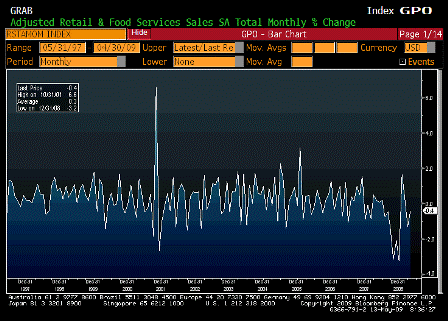
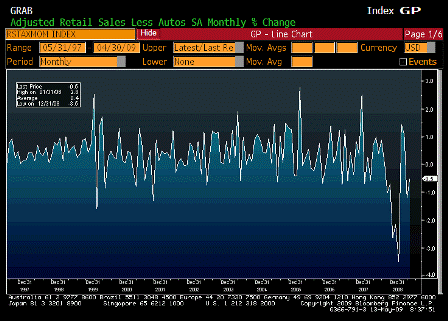
  • April retail sales -0.4% and -0.5% ex-autos (expectations +0.2%)
  • March ex-autos revised from -0.9% to -1.2%
  • April, Ex-gas, -0.2%
  • April, Control group (feeds into PCE component of GDP), -0.3%
  • Need a very sharp rebound in May/June to prevent Q2 PCE from being negative due to combined March/April weakness.
  • Downside risks to Q2 GDP now as low as -5%

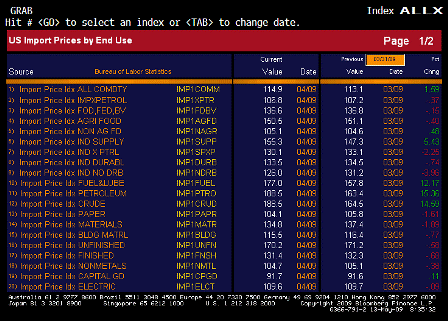
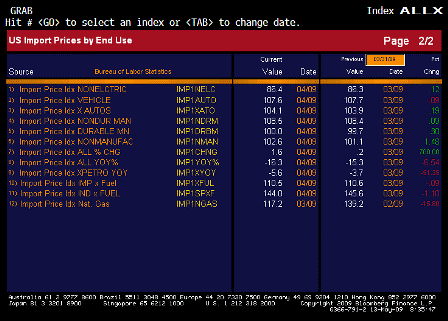
Import prices up 1.6%, -0.4% ex-petroleum and -0.5% from China


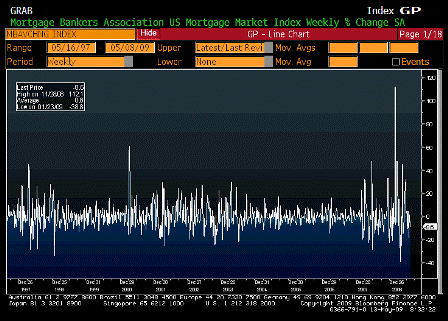
MBA Mortgage Applications (May 8)

Survey n/a
Actual -8.6%
Prior 2.0%
Revised n/a

[top][end]

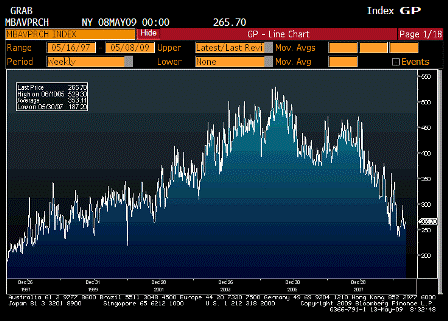
MBA Purchasing Applications (May 8)

Survey n/a
Actual 265.70
Prior 264.30
Revised n/a

[top][end]

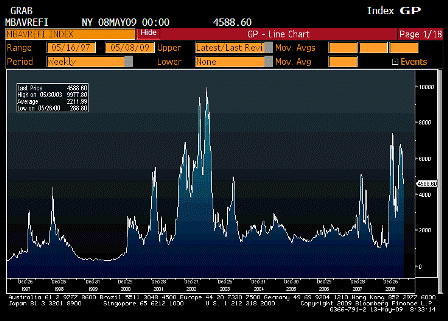
MBA Refinancing Applications (May 8)

Survey n/a
Actual 4588.60
Prior 5169.30
Revised n/a

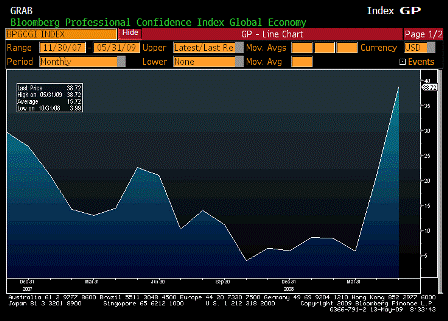
[top][end]


Bloomberg Global Confidence (May)

Survey n/a
Actual 38.72
Prior 21.20
Revised n/a

[top][end]


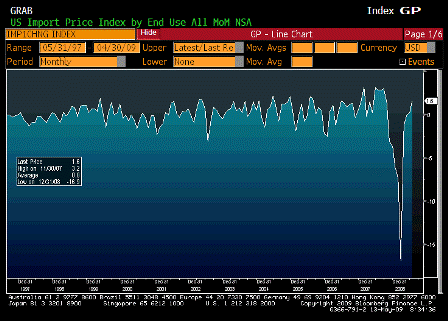
Import Price Index MoM (Apr)

Survey 0.6%
Actual 1.6%
Prior 0.5%
Revised 0.2%

[top][end]

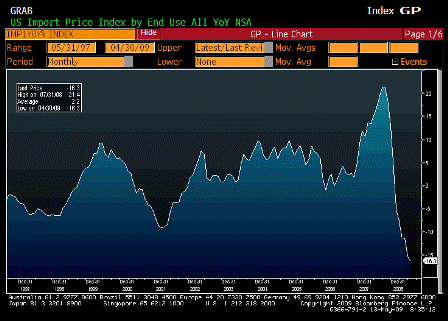
Import Price Index YoY (Apr)

Survey -16.8%
Actual -16.3%
Prior -14.9%
Revised -15.3%

[top][end]

Import Price Index ALLX 1 (Apr)

[top][end]

Import Price Index ALLX 2 (Apr)

[top][end]


Advance Retail Sales MoM (Apr)

Survey 0.0%
Actual -0.4%
Prior -1.1%
Revised -1.3%

[top][end]

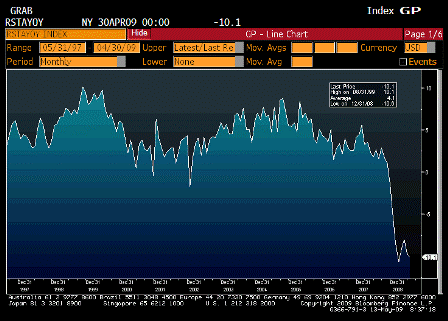
Advance Retail Sales YoY (Apr)

Survey n/a
Actual -10.1%
Prior -9.6%
Revised n/a

[top][end]

Retail Sales Less Autos (Apr)

Survey 0.2%
Actual -0.5%
Prior -0.9%
Revised -1.2%

[top][end]


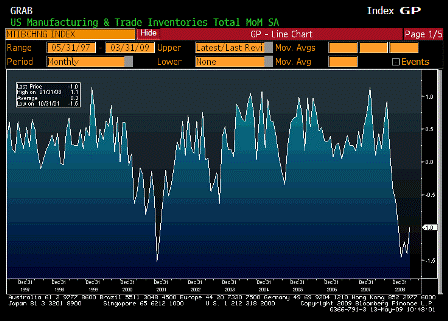
Business Inventories MoM (Mar)

Survey -1.1%
Actual -1.0%
Prior -1.3%
Revised -1.4%

[top][end]

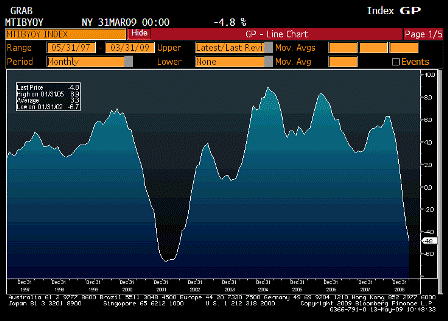
Business Inventories YoY (Mar)

Survey n/a
Actual -4.8%
Prior -3.6%
Revised n/a


[top]

Niall Ferguson


[Skip to the end]

Someone needs to tell this guy the deficit spending IS the private savings. If any of you know him, please forward this, thanks.

Niall Ferguson jumped in with both feet. Calling the government’s growth forecasts ‘crazily optimistic’ he predicted federal debt would soon reach 140% of GDP and that private savings could not possibly absorb it all. “I hate to teach arithmetic to a Nobel laureate but it doesn’t quite add up,” he said.


[top]