
Tax Receipts Rebound as 15 Biggest States See Gain

>   
>   (email exchange)
>   
>   On Tue, Mar 30, 2010 at 2:27 PM, Jason wrote:
>   
>   State tax receipts are reportedly up…
>   

Yes, federal looking like they’ve bottomed as well.

Definitely looks like activity has bottomed.

And still feels like we are going the way of Japan, but too early to tell.

>   
>   Granted we are still well below 2008 peak revenue levels
>   
>   and the budget crisis is far from over.
>   
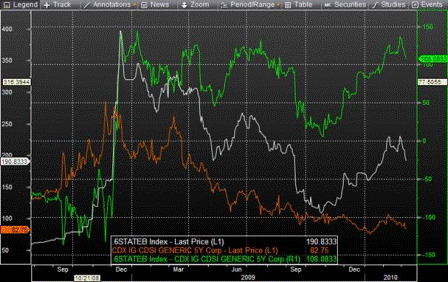
>   But Muni CDS remains near the wide end of the range when compared with
>   Corporate IG:
>   
>   Still looks like a great trade to me…
>   
Tax Receipts Rebound as 15 Biggest States See Gain


By Dunstan McNichol


March 30 (Bloomberg) — The two-year slide in tax

collections that opened a $196 billion gap in U.S. state budgets

has stopped, easing pressure on credit ratings and giving leeway

to lawmakers as they craft spending plans for next year.

The 15 largest states by population forecast a 3.9 percent

gain in tax revenue in fiscal 2011, budget documents show. The

50 states on average may increase collections by about 3.5

percent, the first time in two years the figure is expected to

grow, said Mark Zandi, chief economist at Moody’s Economy.com,

California took in 3.9 percent more since December than

projected in January, Controller John Chiang said this month.

New York got $129 million above forecasts in its budget year

through February, according to a report from Comptroller Thomas

DiNapoli. In New Jersey, the second-wealthiest state per capita,

January sales-tax collections were 1.9 percent higher than a

year earlier, the first annual increase in 19 months,

forecasters said in a report last month.

“This time last year, we were sliding down a mountain,”

said David Rosen, chief budget officer for the New Jersey

Legislature. “I don’t think we are now; it’s stabilized.”

States collected about $79 billion less in sales, income

and corporate taxes in 2009 than in 2008, the U.S. Census Bureau

said today in a report, as the economy struggled through its

deepest slump since the Great Depression. Emergency spending

cuts and tax increases became routine during the recession that

began in December 2007.

‘Panic Mode’

The end of the collections crash will ease fiscal strains

that led New York-based Moody’s Investors Service to lower the

ratings of five states last year, after no downgrades in 2008.

It will also enable governors and legislators to draw up budgets

for fiscal 2011, which starts July 1 for most states, with more

confidence that money they plan to spend will arrive.

“As long as revenues were sliding, budgeters were in a

panic mode,” said Zandi, whose West Chester, Pennsylvania-based

company provides economic analysis to businesses, government and

investors. “It’s not as scary when revenues are rising.”

States’ combined budget gaps will still total $180 billion

in fiscal 2011 and $120 billion in fiscal 2012, the Washington-

based Center on Budget and Policy Priorities estimates.

Economic Growth

This fiscal year, the 15 largest states expect to collect

11 percent less taxes than in fiscal 2008, budget proposals

show. It won’t be until 2013 that revenue returns to 2008

levels, said New Jersey’s Rosen and Barry Boardman, the North

Carolina General Assembly’s chief economist.

Collections of personal income and sales taxes, the two

largest components of state revenue, fell by 17 percent and 7

percent, respectively, last year compared with 2008, according

to the Census Bureau. Declines were less steep in the fourth

quarter than earlier in the year, with income taxes dropping by

4.7 percent to $59.9 billion and sales taxes sliding by 2.8

percent to $71.7 billion.

Corporate taxes increased 3.4 percent to $9.1 billion in

the fourth quarter, the Census Bureau said, after declining in

seven of the previous nine quarters.

Combined state and local tax collections climbed to $360.1

billion during the final three months of 2009, the first year-

over-year gain in five quarters and an almost 1 percent boost

from the same period in 2008, according to the agency.

State coffers are beginning to get a boost from an economy

that expanded at a 5.6 percent annual rate in the fourth quarter

of 2009, the most in six years. That’s stopped the drop in sales

tax collections, which generated $23 billion less last year than

in 2008, according to the Census Bureau.

Predictability a ‘Positive’

Arizona, which sold state buildings and canceled health

insurance for 47,000 children as collections this fiscal year

fell 34 percent below 2007 levels, said its January revenue was

$14.2 million above projections, the first time since March 2007

that collections exceeded forecasts.

Virginia recorded a 31.6 percent increase in corporate

taxes through February, it said on March 11. Governor Robert

McDonnell, a Republican who took office in January, increased

this year’s revenue projections by $82.5 million last month.

Improved revenues may help states replenish reserves, curb

borrowing for expenses and strengthen their debt ratings, said

Robin Prunty, credit analyst for Standard & Poor’s in New York.

“Just having predictability is a positive from a credit

standpoint,” Prunty said.

“We’ve seen the worst,” said Philip Condon, who oversees

about $9.4 billion in municipal bonds for DWS Investments in

Boston. “While it may not be great, it’s getting better.”

California Sale

DWS was among the buyers of last week’s $3.4 billion

issuance of taxable California bonds, its first such sale since

November. A scarcity of municipal debt, coupled with indications

that California’s revenue decline may have reached bottom,

attracted investors and drove down bond yields, Condon said.

“The recent uptick in revenue collections certainly didn’t

hurt us,” said Tom Dresslar, a spokesman for Treasurer Bill

Lockyer in Sacramento.

Forty-five states reduced outlays for health care, the

elderly and disabled and primary and higher education in 2008

and 2009, the Center on Budget and Policy Priorities said.

Lawmakers now may be able to restore spending or avoid

further reductions. California’s Chiang this month scrapped a

plan to delay tax refunds after revenue exceeded projections for

three months. In January, an impasse over the state’s $20

billion budget imbalance led S&P to cut its credit rating to A-,

the lowest of any state.

“The fact that revenues are performing better I think is

certainly the first bit of good news we’ve heard in a long

time,” said Amy Doppelt, a San Francisco-based managing

director at Fitch Ratings who follows California. Fitch last

year downgraded more than 200 municipal issuers, the most ever,

according to a March 25 report from the rating company.

Negative Outlook

S&P lowered its rating on California, Illinois and Arizona

last year and has a negative outlook on those and four other

states. Moody’s cut those three plus Nevada and Ohio, its first

state downgrades since Michigan in 2007. It’s negative on 15,

including five of the 10 largest: Florida, Illinois,

Pennsylvania, Ohio and Michigan.

Jobless rates in 18 states including Florida and Rhode

Island exceeded the national average of 9.7 percent in February.

Unemployment in most states is about double pre-recession

levels, according to the Labor Department.

Michigan, with the nation’s highest unemployment rate at

14.1 percent in February, is in its 10th year of job losses and

expects to end fiscal 2011 with the fewest jobs in 24 years.

“As the employment situation continues to be weak, income

tax revenues will continue to lag,” the Center on Budget and

Policy Priorities said in a Feb. 25 report.

Pension Expenses

As workers lose income, states face rising expenses for

Medicaid and other social services. Through March, they had

borrowed $37 billion from the federal government to cover

unemployment benefits, the Treasury Department said.

States face a $1 trillion gap between assets in public

pension plans and their obligations to retirees, a Feb. 18 study

by the Washington-based Pew Center on the States said. Illinois

borrowed $3.5 billion in January to finance its pension

contribution, which led Moody’s and S&P to cut their ratings to

the second-lowest of any state.

More Jobs

“You can’t exclude the expense side,” said Howard Cure,

New York-based director of municipal research for Evercore

Wealth Management LLC, which oversees $1.7 billion, half in

fixed-income municipals. “What really would alleviate that

situation is more jobs.”

States also have to prepare for the June 2011 end of help

from the American Recovery and Reinvestment Act, which will

provide them with about $140 billion of aid since its inception

in February 2009.

“States may have reached the end of the beginning of a

multiyear fiscal crisis,” the Nelson A. Rockefeller Institute

of Government in Albany, said in a January report. “The best to

be hoped for in 2010 may be the beginning of the end.”

ECB rate hike discussion will compound funding issues

ECB’s Liikanen Says Interest Rates Won’t Stay Low

By Diana ben-Aaron

March 29 (Bloomberg) — European Central Bank Governing Council member Erkki Liikanen said interest rates won’t stay at the current level indefinitely, Maaseudun Tulevaisuus reported, citing an interview.

While low rates have eased the economic slowdown, households and businesses shouldn’t count on them forever, Liikanen was quoted as saying by the Helsinki-based newspaper. He declined to say when or by how much rates would increase.

“We decide the key central bank rate in the ECB council according to the requirements of the economic situation,” Liikanen said.

Rasmussen polls

65% Now Hold Populist, or Mainstream, Views

55% Favor Repeal of Health Care Bill

I find his polls as good as any. He shows 54% favor repeal of the new health care law, with 70% of seniors against the Medicare cuts.

The lack of understanding of the monetary system is taking an increasing both economically, politically and socially.

With almost 20% of the workforce unable to find full time work, and near record low capacity utilization in general, our leaders saw fit to raise taxes and cut spending which will lower demand and undermine their political careers to ‘pay for’ a very modest spending increase of about $100 billion a year, and with delays, of the perhaps additional $1 trillion of fiscal adjustment needed to get us back to full employment in a reasonable time frame.

Also, part of the rise in costs goes to insurance reserves which are a demand leakage.

The politics get uglier by the day, and from watching the news over the weekend the loudest health care protest seems to be over the expense and how it will add to the size of the deficit. Seems this means more ‘fiscal responsibility’ is on the way, including letting the tax cuts expire next year and maybe even a VAT which is an absurdity under any circumstances, apart from a desire to cut consumption.

Add to that the reality of the eurozone actually offering Greece nothing of value, opening the way for wider credit spreads spreading to the entire eurozone.
It also looks like their combined deficits are now large enough for the added non govt financial assets to now be driving down the euro independent of the credit issues. This continues until exports increase sufficiently for the automatic stabilizers to tighten fiscal balances. They aren’t anywhere near there yet.
Additionally, the dollar index chart is beginning to pick up a bid from commodities traders as well.

US Taxes

From the articles of Confederation, March 1st, 1781.
We had the right tax, but the wrong way to implement it:

VIII.

All charges of war, and all other expenses that shall be incurred for the common defense or general welfare, and allowed by the United States in Congress assembled, shall be defrayed out of a common treasury, which shall be supplied by the several States in proportion to the value of all land within each State, granted or surveyed for any person, as such land and the buildings and improvements thereon shall be estimated according to such mode as the United States in Congress assembled, shall from time to time direct and appoint.

The taxes for paying that proportion shall be laid and levied by the authority and direction of the legislatures of the several States within the time agreed upon by the United States in Congress assembled.

Text of Greek Deal

As before, this is in fact another statement that indicates no checks are to be written.

The purpose is probably the hope that it be read as a statement of support which will facilitate continued funding of Greek debt.

It is a clear statement that no funding is available until Greece fails to find funding elsewhere. However, understood but unstated, is that the process of finding funding is necessarily that of price discovery. Greece, like all borrowers, simply offers securities at ever higher rates until it finds the needed buyers. Failure, in theory, is defined as the rate reaching infinity with no buyers. At that time, the euro members would step in with a loan offer at a non concessional rate which would then presumably be infinity.

This makes no sense at all, of course. The statement is in fact a statement that Greece must first drive rates to infinity before euro zone member loans are available. In other words, it’s a statement that says Greece is on its own, and that they will stand by without taking action as observers of the standard market default process of Greek funding rates going into double and then triple digits as happens to all failed borrowers of externally managed currencies, including nations with fixed exchange rates.

“In this context, Euro area member states reaffirm their
willingness to take determined and coordinated action, if
needed,
to safeguard financial stability in the euro area as a
whole, as decided the 11th of February.

As part of a package involving substantial International
Monetary Fund financing and a majority of European financing,
Euro area member states, are ready to contribute to coordinated
bilateral loans.

This mechanism, complementing International Monetary Fund
financing, has to be considered ultima ratio, meaning in
particular that market financing is insufficient.
Any
disbursement on the bilateral loans would be decided by the euro
area member states by unanimity subject to strong conditionality
and based on an assessment by the European Commission and the
European Central Bank. We expect Euro-Member states to
participate on the basis of their respective ECB capital key.

The objective of this mechanism will not be to provide
financing at average euro area interest rates, but to set
incentives to return to market financing as soon as possible by
risk adequate pricing. Interest rates will be non-concessional,
i.e. not contain any subsidy element. Decisions under this
mechanism will be taken in full consistency with the Treaty
framework and national laws.”

Claims/Bernanke on asset sales


Karim writes:

Initial claims fall 14k to 442k; with downward revisions to past few weeks allowing 4wk avg of initial claims to move to 453.8k; the lowest since 9/08.

This is the part that Bernanke omitted in today’s testimony that was included in his Feb 10 testimony.

“I currently do not anticipate that the Federal Reserve will sell any of its security holdings in the near term, at least until after policy tightening has gotten under way and the economy is clearly in a sustainable recovery. ”

Now just has sequencing more open-ended:

“In any case, the sequencing of steps and the combination of tools that the Federal Reserve uses as it exits from its currently very accommodative policy stance will depend on economic and financial developments and on our best judgments about how to meet the Federal Reserve’s dual mandate of maximum employment and price stability.”

DGO/Home Sales


Karim writes:

Durables data was firm.

  • Shipments ex-aircraft and defense (proxy for current qtr business capex) up 0.8%; stands 2.2% above Q4 avg; implication is real capex up 5-6% in q1 after 13.3% gain in q4
  • Orders ex-aircraft and defense (proxy for future capex) up 1.1%

New home sales down 2.2% (prior mth revised to -8.7% from -11.2%); level of new home sales of 308k (annualized) makes new all-time low for 2nd straight month. As a % of the overall economy, hard to see housing go much lower!

yet more on greece

Gets stranger by the day:

Broke? Buy a few warships, France tells Greece

March 23 (Economic Times) — In a bizarre twist to the Greek debt crisis, France and Germany are pressing Greece to buy their gunboats and warplanes, even as they urge it to
cut public spending and curb its deficit.


Indeed, some Greek officials privately say Paris and Berlin are using the crisis as leverage to advance arms contracts or settle payment disputes, just when the Greeks are trying to reduce defense spending.

“No one is saying ‘Buy our warships or we won’t bail you out’, but the clear implication is that they will be more supportive if we do what they want on the armaments front,” said an adviser to Prime Minister George Papandreou, speaking on condition of anonymity because of the diplomatic sensitivity.

Greece spends more of its gross domestic product on the military than any other European Union country, largely due to long-standing tension with its neighbour, historic rival and NATO ally, Turkey.

“The Germans and the French have them over a barrel now,” said Nick Witney, a former head of the European Defense Agency.

“If you are trying to repair Greek public finances, it’s a ludicrous way to go about things.”

France is pushing to sell six frigates, 15 helicopters and up to 40 top-of-the-range Rafale fighter aircraft.

Greek and French officials said President Nicolas Sarkozy was personally involved and had broached the matter when Papandreou visited France last month to seek support in the financial crisis.

FRIGATE PURCHASE

The Greeks were so sensitive to Sarkozy’s concerns that they announced on the day Papandreou went to Paris that they would go ahead with buying six Fremm frigates worth 2.5 billion euros ($3.38 billion), despite their budget woes.

The ships are made by the state-controlled shipyard DCNS, which is a quarter owned by defense electronics group Thales and may have to lay workers off in the downturn.

Greece is also in talks buy 15 French Super Puma search-and-rescue helicopters made by aerospace giant EADS for an estimated 400 million euros.

The Rafale, made by Dassault Aviation, is a more distant and vastly dearer prospect. There is no published price, but each costs over $100 million, plus weapons.

Germany is meanwhile pressing Athens to pay for a diesel-electric submarine from ThyssenKrupp, of which it refused to take delivery in 2006 because the craft listed during sea trials following a disputed refurbishment in Kiel.

Payment would clear the way for ThyssenKrupp to sell its loss-making Greek unit Hellenic Shipyards, the biggest shipbuilder in the eastern Mediterranean, to Abu Dhabi MAR, industry sources said.

ThyssenKrupp Marine Systems last year canceled a Greek order for four other submarines over the dispute, in which it said Athens’ arrears exceeded 520 million euros.

Witney, now at the European Council on Foreign Relations, said German officials were embittered by Greek behavior in the long-running dispute, as well as previous payment problems over the purchase of German Leopard II tanks.

Greek Deputy Defense Minister Panos Beglitis told Reuters the dispute was on the brink of settlement but denied the timing had anything to do with Athens’ bid to clinch German backing this week for a financial safety net for Greek debt.

“(The submarine) Papanicolis has been carefully inspected by German and Greek experts. It has been greatly improved and declared seaworthy. We will take it, sell it and make a profit,” he said in an interview.

“We are paying 300 million (euros) and we will sell it for 350 million,” Beglitis said. Witney questioned Greece’s chances of turning a profit on a second-hand submarine.

NO LINKAGE?

Asked whether big European suppliers were using the crisis to press arms sales on Athens, he said: “This has always been the case with these countries. It is not because of the crisis, there is no link.”

Beglitis said this year’s defense budget was set at 2.8 per cent of GDP, down from 3.1 per cent in 2009. Non-government sources say the real level of military spending may be higher.

“Our strategy is continuously and steadily to reduce spending. This is also in line with the Greek stability and growth program,” Beglitis said. The program, submitted to the EU, pledges to reduce the budget deficit from 12.9 per cent last year to below 3 per cent by the end of 2012.

Western officials and economists have advocated a radical reduction of the armed forces as a long-term way of reducing structural spending, but Greek officials say that would require a real improvement in relations with Turkey.

Despite warmer ties, the two countries remain in dispute over Cyprus and maritime boundaries and have sporadic aerial incidents over the Aegean Sea.

French economist Jacques Delpla said Greece could reap big savings if it moved jointly with Turkey and Cyprus to settle disputes in the Aegean and Eastern Mediterranean and engaged in mutual disarmament.

“Unlike Portugal or Ireland, Greece could benefit from significant peace dividends to reduce its titanic fiscal deficits,” he said.

>   
>   On Mon, Mar 22, 2010 at 10:18 AM, wrote:
>   
>   Warren, don’t know if you saw this analysis from David Kelly.
>   

Thanks,

My current take is very similar:

Looks to me like this is about health care insurance and not health care per se.

Most all that seems to have happened is that government is now helping/funding up to 30 million more people to purchase private health insurance.

It’s a health care insurance bill, not a health care bill. It uses taxes and medicare cuts to ‘pay for’ private sector insurance company premiums.

So most of the funding goes to insurance companies, a portion of which will then be paid to providers and pharma.

The underlying health care system, with all it’s problems, remains largely unchanged.

It requires insurance companies to accept high risks, extend coverages, etc. and therefore raises costs for the insurance companies. This would raise premiums, however there are some controls on that, which would narrow margins.

This is a very odd mixture- using public funds to subsidize private sector insurance premiums.

After reviewing the timing of expenses and taxes and cuts I agree it doesn’t look like there’s much of an immediate macro issue. Maybe a very small negative bias upfront if some expenses go up.

The Investment Implications of Health Care Reform

By David Kelly

This morning, after almost a year of heated debate, the President has achieved his goal of a major reform to the health care system. Yesterday, the House voted to approve the 2409 page Senate Bill passed in December along with 153 pages worth of amendments, on the understanding that the Democratic majority in the Senate would accept these amendments without alteration. Presuming that Senate Democrats do not renege on their pledge, the combined bills will shortly become law.

So what does all of this mean for investors?

First, we need to recognize that in discussing this issue, like any other issue in investing, it is critical to leave politics and emotion to one side. People have very strong opinions on all sides of the health care debate – they are entitled to those opinions. These comments are solely focused on the investment implications of the combined bills.

So passing over the generally recognized positive of expanding coverage to roughly 30 million of the 50 million U.S. residents who don’t currently have insurance, what does it all mean for the economy and markets?

Taxes: The most obvious quantifiable impact of the bill is an increase in taxes for upper income Americans, particularly on investment income. Starting in 2013, the Medicare tax rate on households with income over $250,000 will be increased from 1.45% to 2.35%. In addition, a new 3.8% Medicare tax will be introduced for the same group on investment income.

Currently, the tax rate on dividends and long-term capital gains is 15%. In 2011, those rates are expected to rise to 20% for households earning over $250,000 and with the new Medicare tax, these rates will rise to 23.8% for the same group. Under current tax law, investors get to keep 85% of the income stream from taxable stock market investments. Under this new law this will be cut by 8.8% to 76.2%, reducing the value of the income stream by 10.4% (that is 8.8% of 85%). This is obviously a significant number. However, it is worth noting three things about this:

* First, roughly half of U.S. stocks are owned by households with income under $250,000 and roughly half are held in non-taxable accounts. Thus, using a number of broad assumptions, the value of the average stock should be reduced by one quarter of 10.4% or 2.6% – not good obviously, but also not an overwhelming reason to avoid stocks after 12 month period in which they rose by over 70% and still appear undervalued.

* Second, this bill does not put stocks at a further disadvantage relative to fixed income. The maximum federal tax rate on bonds and cash accounts is currently 35% and with tax changes coming in 2011 combined with these changes, that maximum rate will rise to 43.4% for households with income over $250,000 in 2013.

* And, third, it’s not like we haven’t been here before. On average over the past 40 years the maximum federal tax on capital gains was 24.7% and the maximum tax rate on dividends was 44.6%.

For the Medical Care Industry, this bill will expand demand without much effort to reign in costs. A combination of federal subsidies and mandates will increase the pool of insured, and while there many constraints preventing insurance companies from limiting coverage there are few which limit how much they can charge for it.

The pharmaceutical industry will benefit for this as well as a plan to remove the donut hole from the Medicare prescription drug benefit program by 2020. Early in the debate on health care, the White House negotiated deals with pharmaceutical, insurance and medical device companies to dissuade them from fighting the reform effort. Under these deals, they appear to retain autonomy on price setting. However, they will pay cumulative taxes of $107 billion between 2011 and 2019. To the extent that they are able to pass these costs on to consumers they may all do OK in this reform, although they may still be a target for future reform efforts.

The American Medical Association and American Hospital Association have both endorsed the health reform effort with a number of reservations. For the most part, the legislation does not interfere with patient-doctor relationships and, by expanding the pool of the insured, will reduce the number of hours which doctors are forced to devote to charity cases. Most doctors are naturally happy to see patients not lose their coverage due to pre-existing conditions clauses, annual caps or non-renewal of existing insurance due to illnesses.

For the Federal Deficit: According to the Congressional Budget Office, the passage of this legislation would reduce federal deficits by a cumulative $143 billion between 2010 and 2019 and by greater amounts in the following decade. However, these estimates should be taken with more than a grain of salt. It is obviously very hard to estimate what total federal health care spending will be over the next decade. However, whatever else is said about this bill there is nothing in it to suggest a reduction in either the quantity or prices of health care services consumed.

* There is no meaningful malpractice reform.
* There is no reduction in drug patent lives.
* There is no compulsion to force insurance companies to compete across state lines.
* There is no effort to limit health care procedures in the last year of life.
* There is no movement in the direction of forcing consumers to confront the cost of services at the point of purchase, and,
* There are no meaningful incentives to force the insured to take better care of their own health.

In fact, for the most part this bill moves away from, rather than towards, the principles of market economics. In 2007, the U.S. devoted 16% of its GDP to health care spending compared to 11% in the country with the second highest spending which was France. Despite this it ranks 38th in the world in life expectancy at birth. Sadly, this bill isn’t likely to change either of these numbers for the better.

For the economy: Despite dire predictions, it’s not clear that health care reform will really slow economic growth that much. Most of the tax provisions don’t kick in until 2013 and the mandates on businesses and individuals don’t kick in in a big way until 2016. Between now and then, the economy is quite capable of staging a full cyclical recovery. It may be that businesses will, in the end, be forced to pay more for the health care of their workers – however, overall, American business is quite capable of limiting wage increases to add to benefit costs. It may be that America as a society ends up spending more on health care. However, if we spend more on health care and less on housing or education or hamburgers, that is our choice. The jobs created in the health care field are American jobs and still some the highest skilled and best paid jobs out there. It should be noted, however, that to the extent that the government incurs more debt to pay for higher health care costs, it probably does mean higher long-term interest rates.

Finally, for politics: The passage of health care reform is a huge victory for the President and it may ultimately work out better for him politically than many Republicans had hoped or Democrats had feared. The economy is improving, and if it continues to do so, many may feel that their fears about health care reform were unfounded. The reality is more complicated. Health care reform wasn’t about to stop the economy in its tracks anyway and the President will be the beneficiary of a cyclical bounce-back which, on its face, appears to owe much more to pent-up demand than government stimulus. Either way the Democrats will lose seats in the mid-term election. However, the end-game for health care reform may well mean less of a swing to the Republicans in November than many had thought.

All in all, a lot to consider but also, more importantly, a lot to keep in proper perspective.

backsliding on Greece

Merkel says aid for Greece not issue at EU summit

March. 21 (CNBC) —German Chancellor Angela Merkel says Greece does not need any financial help and that EU leaders should not make aid for the indebted country an issue at their summit in Brussels next week

Doesn’t get any clearer than that.

The moral hazard test is on.

If the eurozone uses uses its banks to buy each other’s debt behind the scenes or makes some other arrangements where financing ceases to be an issue, it may trigger a race to the bottom with regards to deficits and the euro, as the game will be ‘the national govt with the largest deficit wins.’ This is not a desired outcome.

But if they don’t move to ease financing imbalances, defaults will have the opposite, deflationary effects, and probably cause a freeze in the entire payments system.