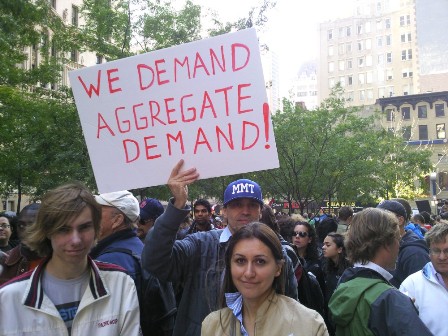
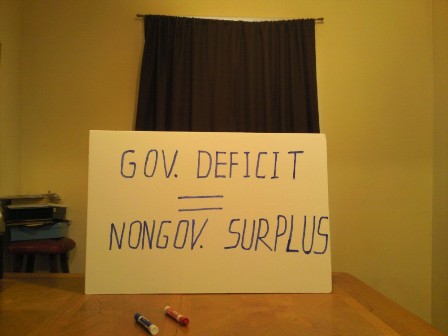
Well stated MMT based narrative.
The Problem With The Deficit? It’s Not Big Enough

Top Economists to Advise Sanders on Fed Reform
October 20, 2011
WASHINGTON, Oct. 20 – Nobel Prize-winning economist Joseph Stiglitz and other nationally-renowned economists agreed today to serve on a panel of experts to help Sen. Bernie Sanders (I-Vt.) draft legislation to reform the Federal Reserve.
Sanders announced formation of his expert advisory panel in the wake of a damning report that faulted apparent conflicts of interest by bank-picked board members at the 12 regional Fed banks.
Top executives from Goldman Sachs, J.P. Morgan Chase, General Electric and other firms sat on the boards of regional Federal Reserve banks while their firms benefited from the central bank’s policies during the financial crisis, the Government Accountability Office investigation found. The dual roles created an appearance of a conflict of interest, according to the GAO.
After the report was issued Wednesday, Sanders said he would work with top economists to develop legislation to restructure the Fed and tighten rules on conflicts of interest, ensure that the Fed fulfills its full-employment mandate, increase transparency, protect consumers and reduce income inequality.
Sanders’ panel of experts includes:
Joseph Stiglitz, the 2001 winner of the Nobel Prize. The economics professor at Columbia University is a former chief economist for the World Bank.
Jeffrey Sachs, director of The Earth Institute and an economics professor at Columbia University. He also is special advisor to United Nations Secretary-General Ban Ki-moon.
Lawrence Mishel, president of the Economic Policy Institute, the premier research organization focused on U.S. living standards and labor markets.
William Black, associate professor of economics and law at the University of Missouri, Kansas City. He worked with the Federal Home Loan Bank Board, the Federal Savings and Loan Insurance Corporation and the Office of Thrift Supervision.
Nomi Prins, a senior fellow at Demos, was a managing director at Goldman Sachs, a senior manager at Bear Stearns in London, a senior strategist at Lehman Brothers, and an analyst at the Chase Manhattan Bank (now JPM Chase)
Jane D’Arista, an Economic Policy Institute research associate, has written on the history of U.S. monetary policy and financial regulation, The former Boston University School of Law professor previously served as a staff economist for Congress.
Tim Canova, professor of economics and law and co-director of the Center for Global Law & Development at the Chapman University School of Law in Orange, Calif. He was an early critic of financial deregulation and warned of the dangers of the bubble economy.
Robert Johnson, senior fellow and director of the Project on Global Finance at the Roosevelt Institute. He was chief economist of the Senate Banking Committee and a senior economist for the Senate Budget Committee.
Dean Baker, co-director of the Center for Economic and Policy Research in Washington, D.C. He was a senior economist at the Economic Policy Institute, a consultant for the World Bank and the Joint Economic Committee of the U.S. Congress.
Gerald Epstein, chair of the economics department at the University of Massachusetts at Amherst. Epstein also is the co-director of the Political Economy Research Institute.
Robert Pollin, co-director of the Political Economy Research Institute and economics professor at the University of Massachusetts-Amherst. He has worked with the Joint Economic Committee and the U.S. Competitiveness Policy Council.
Stephanie Kelton, assistant professor at the University of Missouri, Kansas City and a research scholar at the Center for Full Employment and Price Stability.
James K. Galbraith, professor of government at the Lyndon B. Johnson School of Public Affairs. He served in several positions on the staff of the U.S. Congress, including Executive Director of the Joint Economic Committee.
The need for major reforms at the Federal Reserve was driven home by the GAO findings announced Wednesday and in an earlier report issued on July 21. Both unprecedented audits of the Federal Reserve were required by a Sanders’ amendment to last year’s Wall Street reform law.
Merkel Cancels EFSF Speech to German Parliament, Lawmakers Say
By Brian Parkin
October 20 (Bloomberg) — German Chancellor Angela Merkel has canceled her planned speech to parliament in Berlin tomorrow because of a deadlock over proposals to leverage the European Financial Stability Facility to give it more firepower, three German lawmakers said.
The lawmakers are Norbert Barthle from Merkel’s Christian Democratic Union and opposition lawmakers Carsten Schneider and Priska Hinz.
(To download PDF, right click link and select save link as)
Highlights
US – Core CPI eases
EU – EU CPI at three year high; Greek austerity plan to be voted on tomorrow
JN – Data softens, gov’t cuts economic view
UK – BoC sees Q4 growth close to zero
CA – Mfg continues to support the economy
AU – RBA ready to cut rates?
NZ – RBNZ signals a likely need to hike
“The problem is that in Europe you have 2% of people, acting in bad faith, that pursue the agenda that Alain Parguez has denounced several times and who are also unfortunately in top decision making positions. Then there is the 0.001% of people who understand the problems and try to solve them, but in general they have limited influence. Finally the 98% majority, composed of perfect idiots, is mostly influenced by the first group and thinks the second group is made of marginal people and dangerous side-liners.”
The news out of Europe has turned from mixed for the last week or so to troubling.
On the one hand they seem to realize that the answer is the ECB writing the check, and on the other they seem to be saying they don’t want to do that. And on the one hand they say Greece won’t default, and on the other is a serious discussion of the ramifications of default. And as the haircut talk on private holders of Greek debt has gone from 21% to 50% and maybe more, the ECB says they will keep their Greek bonds which will presumably mature at par, but at the same time additional ECB capital calls are under consideration due to what they call increased risk of loss.
The idea that the EFSF alone writing checks to support Portugal, Spain, and Italy would weaken the credit worthiness of the core has also been discussed, which is why talk of ECB support had materialized.
Meanwhile, even as the austerity continues to bite, perhaps to the point where the austerity is now causing deficits to be larger, additional austerity measures continue to be demanded and imposed.
And where the banks stand with regard to solvency is anyone’s guess as well.
In other words, it’s all moving further away from any sense of resolution, with uncertainty about as high now as it’s ever been, as is the potential for a catastrophic financial event.
I’ve been reading up some on ECB capital.
Seems a minimum capital level for the ECB is not specified.
However, the ECB distributes profits ultimately to the national govts.
And that ECB losses are ultimately the responsibility of the national govts.
That’s why, faced with potential losses, the ECB has required the national central banks to advance additional capital to the ECB.
However, in the event of losses, the ECB is not required to call for capital from its members, but as a matter of policy the ECB has called for capital from its members when it deemed the risk of losses had risen.
So while the ECB, like the Fed, can, operationally, allow its capital to go negative without operational consequence. The ECB, unlike the Fed, looks to keep it’s capital positive by requiring contributions from its members.
This therefore means, for example, that should the ECB realize losses on its Greek bonds, it will demand additional capital from the national central banks/national govs. which will further erode their solvency.
The reason for this seems to be the notion that ECB losses left as negative capital would otherwise be inflationary.