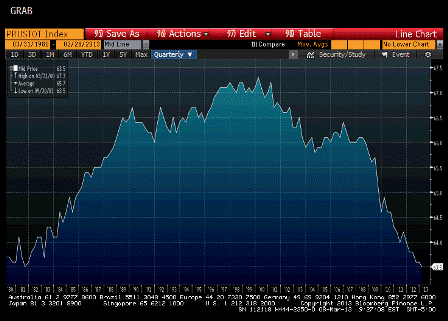
Down a tenth from still very low levels
:(
Full size image

So how about just letting the ECB fund them all at 0%???
Transactions taxes reduce transactions by making them costly,
which is exactly what this one will do.
So if that’s the outcome they want they should go ahead and do it.
And if they want deficit reduction, well, if they were working for me I’d replace them.
But they’re not, so expect more of same.
French and Italian debt chiefs warn on EU Tobin Tax
By Ambrose Evans-Pritchard
March 6 (Telegraph) — Both France and Italy have been keen advocates of the new Financial Transaction Tax (FTT) proposed by Brussels last month, claiming that it will raise money and curb speculation. But they may have overlooked the unintended effect on their own borrowing costs.
Maya Atig, acting chief of French debt agency, said the European Commission’s internal documents acknowledge that the FTT could drain liquidity in the bond markets by 15pc, an effect that would push up yield spreads and raise debt costs.
Brussels estimates that the tax will raise €30bn to €35bn each year for the eleven EU states taking part, but Mrs Atig told a Euromoney conference in London that any revenue would offset “the extra costs that we might have to pay”.
She said the French government is searching for ways to ensure that the tax does not “perturb” the bond market. “This something still to be discussed.”
Maria Cannata, director of Italy’s debt agency, said her country already has a version of the Tobin Tax but has been careful to exempt sovereign debt, adding that policy-makers must bear in mindful the “importance of not damaging the government bond markets”.
The proposal – now in the hands of working groups – is to come into force in early 2014. It will raise a fee of 0.1pc for shares and bonds, and 0.01pc for derivatives.
These rates are far higher than the Swedish tax in 1989 that led to an 85pc crash in bond sales, a 98pc fall in bond futures, and shut-down of options trading, before the experiment was abandoned.
Gabriele Frediani, head of the electronic fixed income market MTS, said the tax would cause repurchase or Repo trades to plunge by 99pc. “The Repo market would disappear overnight,” he said.
The Repo market serves as a vast pawn shop allowing banks to raise funds on money markets by pledging assets. It is a key source of short-term finance for firms, but by its nature it involves fast turn-over.
Brussels said it had changed the text after listening to concerns. Repo trades will be treated as a single transaction instead of two, halving the tax. Short-term loans with collateral will be exempted.
It said the FTT will cover the secondary market for bonds only, insisting that good yield on long-term debt will “still leave enough room for profit after the tax is applied”.
Markus Beyrer, head of the pan-EU industry lobby BusinessEurope, said he was “very disappointed” by the draft text, calling it a threat to growth and jobs.
The text includes an “issuance principle”, meaning that the tax will cover bonds and other assets issued in the eleven countries taking part, even if they are traded in London. This may breach “extra-territoriality” codes.
The Chancellor, George Osborne, said the FTT scheme would amount to a tax on pensioners and cost up to 1m jobs across the EU “without costing bankers a penny”. The traders would migrate to the US or Asia, taking the financial industry with them.
He’s been calling recession for a while.
The ‘stall speed’ thing is the pro cyclical nature of the private sector I recently discussed.
Achuthan on how he defines stall speed:
“That is a concept we do not use that often. The Fed uses it because they are using models. We do not use models. We use leading indicators. The Federal Reserve board in 2011 came out with a study examining the idea of stall speed, you look at GDP and gross domestic income, the counterpart, which should statistically be actually the exact same thing. When they looked at all the different measures, they found that the two quarter annualized GDI growth rates going below 2% was a signal of an economy slipping into recession. When you look at that measure now, what you see is that in the second quarter of 2012 it fell below 2%. It went to 1.5% and then in the third quarter, it fell further to 0.4%. By last fall, when the unemployment rate was plunging and people did not believe it was plunging and then the Fed came out and said, hey, we will give you q-ternity… It kind of makes sense in the context of their own recessionary stall speed.”
On whether the U.S. is in a recession now:
“I think that a recession began around the middle of last year. The reason I think that is because number one, the stall speed and GDI last year, and also when you look at the weakness in the indicators that define a recession — output and income and sales — initial jobless claims are not used to define recession. You actually use overall employment payroll or household employment, and there, if you simply look at year-over-year growth rates, what you see is they are falling. Right now on the Bloomberg I think the consensus is 160-170 for tomorrow. Even if that is true, you are going to see year-over-year payroll jobs growth go to a 16-month low. It’s going the wrong direction. The headlines say jobs are improving but they are actually going down.”
On what it would take to admit that he is wrong about the U.S. being in a recession:
“I think some facts, right? I am pointing out that the GDP number that you have from Q4 is recessionary. Central banks are now going to be targeting nominal GDP fairly soon, right, because in theory, they could impact the cash economy. You see nominal GDP growth by Q4 year-over-year at 3.5%, even with your marginally higher revision. Any time in the 65-year history of GDP growth it has been below 3.7, you have been inside a recession… The other thing is, you are not in a 2% economy. Everybody keeps saying it, but just because you are saying it does not mean it is true. You’re in weaker than a 2% economy.”
On whether a recession can exist with 0.5% GDP growth:
“Economies do not hang out at 0.5% or 1%. They do not get this low growth steady state muddle through recession-free kind of growth at 1%, which everybody seems to think might be possible. It is not possible. Free markets have economic cycles. they accelerate and they decelerate. if you are doing it at a very low growth rate, the odds of a slowdown going into recession are very high.”
On whether he’s going to move to London:
“No, I’m not, but the entire West is in the yo-yo years. They have all been having growth stair stepping down. It is very weak growth with higher cycle volatility which will give you more frequent recessions. Did anyone notice that in q4, it’s the G6, Canada did not report. They all contracted? This is after $11 trillion worth of stimulus.”
On how to explain the housing recovery:
“How do we explain it? We called it. We called it back April 2012. We said there was a home price upturn. But that does not preclude a recession. In 2001 you had a home price upturn and we actually had a recession.”
On whether his critics are wrong to strictly associate him with recession:
“I think, no. Look, when we call a recession we will be associated with recession. That is fine. That is what we do. We don’t call the market. We call the business cycle. I think people forget it is not easy to recognize it recession when it is happening.”
On equities going to record highs right now:
“Here’s the thing. In 80% of the last 15 recessions you have had an associated bear market. That is why if you hear the word recession, you say, oh my gosh, we have to run to the hills in the equity market. But in three out of those 15 recessions, we had stock prices rise through the recession. You did not have an associated bear market. That is 1980, a pretty short recession, 1945, coming out of World War II, and 1926-27, which was smack dab in the middle of the Roaring 20s. Avery different economy, a very different market, but to say that stock prices cannot rise during a recession is actually not true.”
On what his weekly indicators say that most indicate the vectors toward recession:
“All the growth rates are coming down in our broad indicators. Look, let’s be clear — the Fed told you they are targeting financial assets as part of their monetary policy. They have specifically called out people’s 401k’s as something that they are looking to target. So, I submit perhaps some of the market prices, as they pertain to economic fundamentals, may be a little wacky, which is why when we look at leading indicators, we do not have all eggs in one basket.”
Press Release
Oct 22 2010
Senate Candidate Bets Congress $100 Million That the U.S. Government Cannot Run out of Money
Warren Mosler Offers $100 Million of His Own Money to Pay Down the Federal Deficit If Any Lawmaker Can Prove Him Wrong
WATERBURY, Conn.–(BUSINESS WIRE)–Warren Mosler, Connecticut’s Independent candidate for U.S. Senate today announced that it is an indisputable fact that U.S. Government spending is not operationally constrained by revenue and will give $100 million of his own money to pay down the Federal deficit if any Congressman or Senator can prove him wrong. “I am running for U.S. Senate to see my policies implemented to create the 20 million jobs we need. And to do this it must be understood that there is simply no such thing as the U.S. Federal government running out of money, nor is the Federal government operationally dependent on borrowing from China or anyone else. U.S. states, individuals, and companies can indeed become insolvent, but U.S. government checks will never bounce,” states Mosler. “Yes, large Federal deficits that push the economy beyond the point of full employment can lead to inflation or currency devaluation, but not bankruptcy and not bounced checks. If lawmakers today understood this fact, they would not be looking to cut Social Security and we would not still be mired in this disastrous recession.”
With 37 years of experience as an ‘insider’ in monetary operations, Mosler knows that President Obama is wrong when he says that the U.S. government has ‘run out of money’ and is dependent on borrowing from China in order to spend. As Fed Chairman Bernanke publicly stated in March of 2009, the Fed makes payments by simply marking up numbers in bank accounts with its computer. Mosler explains further; “The Government doesn’t get anything ‘real’ when it taxes and doesn’t give up anything ‘real’ when it spends. There is no gold coin that goes into a bucket at the Fed when you are taxed and the government doesn’t hammer a gold coin into its computer when it spends. It just changes numbers in our bank accounts.” Mosler likens this scenario to a football game; when a touchdown is scored, the number on the scoreboard changes from 0 to 6. No one wonders where the stadium got the 6 points, no one demands that stadiums keep a reserve of points in a “lockbox” and no one is worried about using up all the points and thereby denying our children the chance to play.
Warren Mosler urges his opponents, Linda McMahon and Richard Blumenthal, and the entirety of Congress to recognize how the monetary system actually works and implement a full payroll tax (FICA) holiday and his other proposals to restore full employment and prosperity while not cutting Social Security benefits or eligibility.
About Warren Mosler
Warren Mosler is running as an Independent. His populist economic message features: 1) A full payroll tax (FICA) holiday so that people working for a living can afford to buy the goods and services they produce. 2) $500 per capita Federal revenue distribution for the states 3) An $8/hr federally funded job to anyone willing and able to work to facilitate the transition from unemployment to private sector employment. He has also pledged never to vote for cuts in Social Security payments or benefits. Warren is a native of Manchester, Conn., where his father worked in a small insurance office and his mother was a night-shift nurse. After graduating from the University of Connecticut (BA Economics, 1971), and working on financial trading desks in NYC and Chicago, Warren started his current investment firm in 1982. For the last twenty years, Warren has also been involved in the academic community, publishing numerous journal articles, and giving conference presentations around the globe. Mosler’s new book “The 7 Deadly Innocent Frauds of Economic Policy” is a non-technical guide to the actual workings of the monetary system and exposes the most commonly held misconceptions. He also founded Mosler Automotive, which builds the Mosler MT900, the world’s top performance car that also gets 30 mpg at 55 mph.
Total consumer credit up 16.1 billion, fed student loans up 25.9 billion.
Note that the student loan dollars get spend and add to demand/gdp/etc as well.
>
> (email exchange)
>
> From: Jacob
>
> The $16.1b pop in Jan consumer credit is once again a function of the relentless
> increase in student loan debt. On an NSA basis, student loans backed by the
> federal government jumped $25.9b on the month. On the revolving side (credit card
> debt), lending was flat in seasonally adjusted terms and actually sank -$19.5b
> unadjusted. This story is a familiar one.
>
> That being said, the March Beige Book had the best characterization of consumer
> lending demand since the recession ended (“steady or increased across ALL the
> Districts”) and banks’ willingness to lend has continued to look constructive.
> This suggests the credit space could begin to open up at the margin later this
> year.
>
The 2% FICA hike was just over $3 billion per week and the sequesters just over 1 billion per week, for a total of about $5 billion per week.
This is not a sudden catastrophic event, but a permanent reduction in about that much demand over time. Initially consumers may borrow a bit more to sustain consumption, make their payments, etc. but that much less income and savings than otherwise does take it’s toll on sales, output, and employment.
The attached chart is only meant to show how we weren’t doing all that great to begin with, and how dips below current levels tend to deteriorate into something worse when the budget deficit becomes too small to support the credit structure and private sector pro cyclical forces come to ‘bear’.
And while still relatively large by historical standards, the federal deficit is no longer nearly as large as it has been, and is rapidly declining, helped of course by the pro active tax hikes and spending cuts, which means we are that much more dependent on private sector credit expansion to sustain growth and employment.
To that point, it’s said that ‘housing is kicking in’ etc. which is true. But note that it’s the private sector credit expansion aspect of housing ‘replacing’ the decline in govt deficit spending that supports additional growth. That is, it’s not a shift from income spent on one thing shifting to housing, but the additional spending from the ‘borrowing to spend’ aspect of housing that does the trick. And this time around I suspect there won’t be a housing credit expansion like the one that turned out to be sub prime fraud, or the one in the 80’s that turned out to be the savings and loan fraud, etc. And without that kind of ‘bubble’ of some sort we never have had a robust economy that I can recall.
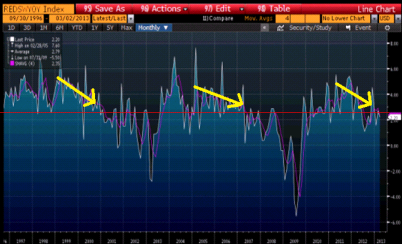
Not a good sign.
German Car Sales Risk Fall Below 3m, Bloomberg Industries Says
March 6 (Bloomberg) — German Jan.-Feb. new car registrations, already 9.6% lower ytd, may plunge below 3m this year for only second time since 1990, says Bloomberg Industries analyst Kevin Tynan.
The elders must have overruled the western educated kids…
;)
Note on China deficit spending:
The headline deficit spending is relatively low at 2% of GDP. The heavy lifting is done by state sponsored lending which is maybe 20%+ of GDP. Don’t know what level that is at currently.
China to Raise Budget Deficit by 50 Percent to Boost Demand
March 5 (Bloomberg) — China plans to raise its budget deficit by 50 percent this year as the central government cuts taxes and boosts measures to support consumer demand in the world’s second-biggest economy.
The gap will widen to 1.2 trillion yuan ($193 billion) in 2013 from 800 billion yuan last year, amounting to about 2 percent of gross domestic product, the Ministry of Finance said in its budget report to the National People’s Congress in Beijing today. Local governments will run a combined deficit of 350 billion yuan and the Ministry of Finance will issue bonds to cover their shortfall, according to the report.
The larger fiscal deficit indicates China’s incoming leaders may step up efforts to support expansion and address income inequality, with growth forecast to fall below the annual average of 10.5 percent the country reported under President Hu Jintao and Premier Wen Jiabao. Officials have pledged to make expansion more sustainable, emphasizing quality over speed and Wen said today he’s targeting 7.5 percent economic growth this year.
“The higher fiscal gap and improved consumption will be positive for the economy,” Dariusz Kowalczyk, senior economist and strategist at Credit Agricole CIB in Hong Kong, said before the report. Boosting spending on the social safety net and education subsidies would reduce inequality and “help reverse the rising trend in the savings rate,” he said.
Except the deficit adds to non govt. savings, yuan for yuan.
Cooler Heads: The Rebuttal to Kyle Bass’s Japan Market Meltdown Scenario from JPMorgan’s Jesper Koll and Masaaki Kanno
By Stephen Harner
Bass comments:
At 24 times central government tax revenues, cumulative Japanese government debt has reached a level which ensures financial collapse.
Not, just a reserve drain.
With the Abe/Aso government setting a 2% inflation target, the collapse will occur sooner—probably within the next 18 to 24 months.
Not, inflation targets are meaningless. Inflation expectations theory is a myth.
The revelation will be that interest on the debt—currently 25% of national tax revenue—will double under higher interest rates.
Could be. But deficits generally come down as well during an expansion, of course posing a risk to that expansion, etc.
The result will be massive JGB selling, a collapsing yen, and systematic financial crisis resulting from a collapse in yen asset prices.
Yes, when rates go up bond prices go down. There are both winners and losers when/if prices change.
Koll suggests:
Rising interest rates would of course raise debt service costs for all borrowers, and especially the hugely indebted government. But they would enable lenders–including household depositors–to charge higher rates on new debt and raise returns on non-fixed rate debt. Since net stock of private savings is larger than the net stock of public sector liabilities, Koll reckons that the overall effect on the economy would be positive.
Agreed! Rate hikes are expansionary, cuts contractionary due to interest income channels.
Rising interest rates would not spell large losses for Japanese financial institutions because these institutions’ bond–and especially JGB–portfolios are largely held to maturity, avoiding the requirement to be marked to market. The institutions would have no incentive to sell, and ample incentive to hold the JGBs [the weighted average duration of which they have in any event been shortening to well under five years–Harner].
They represent at least lost income, and if implied costs of funds rise implied losses. Etc. Again, winners and losers with change.
As to who is or would buy JGBs, the answer for the present and foreseeable near term future is: the Bank of Japan. BOJ is already committed to buying the entire debt out to a maturity of three years and a new governing board to be installed in April may extend the range to three to five years. Interest rates will rise only as much as BOJ will allow. This is why foreigners and domestic institutions are still buying the bonds.
Note that functionally the BOJ buying is the same as the MOF not issuing.
Whether or not significant inflation develops in Japan depends on productivity. Significant increases in productivity could fully mitigate inflationary pressures.
I’d guess most ‘inflation’ comes through the ‘cost channels’ as low aggregate demand tends to keep ‘monetary inflation’ in check.
There is plenty of room in Japan’s economy for raising productivity. Agriculture, in particular, has abysmal productivity that could easily be raised through deregulation. Land policy that affects housing is another. Health care is another. Indeed, deregulation is needed throughout the economy. “The Abe administration must implement real deregulation, so that private investors put their savings and capital to work, by building new factories, new hospitals, and so forth.” [This is a point I emphasized in my post a week ago on Abe’s “Three Arrows” program.–Harner]
Deregulation could be deflationary as suggested.
The proposed BOJ policies won’t do anything, the fiscal could move the needle some. And relighting the nukes will firm the yen.
The only measures that would work have been left out:
> MORE: Kuroda Says BOJ Easing Isn’t Aimed at Weakening the Yen
> *KURODA: DIFFICULT FOR BOJ TO BUY FOREIGN BONDS
> *KURODA: LAW STATES CURRENCY INTERVENTION NOT BOJ’S JOB
> *KURODA: FOREX INTERVENTION IS FINANCE MINISTRY’S RESPONSIBILITY
> *KURODA: CURRENCY RATE SHOULD BE DETERMINED BY MARKET
> *KURODA SAYS BOJ EASING ISN’T AIMED AT WEAKENING THE YEN
Full comments:
>*MORE: Kuroda to Consider Every Possible Measure to End Deflation
>*MORE: Kuroda Says More Easing Needed in Both Quality, Quantity
>*MORE: Kuroda Says Need to Consider Effects of Buying Risk Assets
>*MORE: Kuroda Says Up to Govt Whether BOJ Law Needs to Change
>*MORE: Kuroda Says BOJ Easing Isn’t Aimed at Weakening the Yen
>*MORE: Kuroda Vows ‘Even Bolder’ Steps to Approach 2% Target
>*KURODA: DIFFICULT FOR BOJ TO BUY FOREIGN BONDS
>*KURODA WILL TAKE EVERY POSSIBLE MEASURE UNTIL 2% TARGET IS MET
>*KURODA: BOJ’S JOB IS TO KEEP FINANCIAL SYSTEM, PRICES STABLE
>*KURODA WILL CONSIDER EVERY POSSIBLE MEASURE TO END DEFLATION
>*KURODA NOT CONSIDERING WHAT HE’D DO IF BOJ FAILS TO MEET TARGET
>*KURODA: STABLE CURRENCY IS GOVT’S RESPONSIBILITY
>*KURODA: LAW STATES CURRENCY INTERVENTION NOT BOJ’S JOB
>*KURODA: FOREX INTERVENTION IS FINANCE MINISTRY’S RESPONSIBILITY
>*KURODA SAYS INFLATION EXPECTATIONS CAN BOOST IMPACT OF EASING
>*KURODA SAYS MONETARY EASING TENDS TO WEAKEN OWN CURRENCY
>*KURODA SAYS MORE EASING NEEDED IN BOTH QUALITY AND QUANTITY
>*KURODA SAYS MID-TERM ECONOMIC GROWTH STRATEGY NEEDED
>*KURODA SAYS 2% TARGET IS WAY TO LIMIT INFLATION, BEAT DEFLATION
>*KURODA: NO PLAN TO FINANCE GOVERNMENT IF BECOME BOJ GOVERNOR
>*KURODA SAYS JUST EXPANDING MONETARY BASE WON’T BE EFFECTIVE
>*KURODA: BOLDER EASING COULD HAVE AVOIDED YEARS OF DEFLATION
>*KURODA WILL CONSIDER STARTING OPEN-ENDED ASSET BUYS EARLIER
>*KURODA: CURRENCY RATE SHOULD BE DETERMINED BY MARKET
>*KURODA: BOJ SHOULD BUY LONGER-TERM BONDS
>*KURODA: NO NEED TO LIMIT BOJ BOND BUYS TO 3 YEAR MATURITIES
>*KURODA: NEED BALANCED GROWTH FOR SUSTAINABLE ECONOMY
>*KURODA: SPECIFIC POLICIES TO BE DECIDED AT BOJ MEETINGS
>*KURODA: WIDE VARIETY OF ASSET PURCHASES SHOULD BE CONSIDERED
>*KURODA: MORE PURCHASES OF ASSETS NEEDED
>*KURODA: MORE EASING NEEDED TO BEAT DEFLATION
>*KURODA: EXISTING POLICIES NOT ENOUGH TO BEAT DEFLATION
>*KURODA: HAD DOUBTS OVER BOJ’S EXIT FROM EASING IN 2006
>*KURODA: END OF ZERO INTEREST RATE POLICY IN 2000 WAS A MISTAKE
>*KURODA SAYS BOJ SHOULD REGRET LACK OF COMMUNICATION WITH GOVT
>*KURODA: BOJ SHOULD NOT MONETIZE GOVT DEBT OR BUY BONDS DIRECTLY
>*KURODA SAYS HE KNOWS BERNANKE, DRAGHI AND BOE’S KING WELL
>*KURODA: WILL DO UTMOST VS DEFLATION EVEN IF BOJ LAW IS CHANGED
>*KURODA: MUST CONSIDER EASING EXIT, BUT DEFLATION IS MAIN ISSUE
>*KURODA SAYS MONETARY POLICY NOT DECIDED BY BOJ GOVERNOR ALONE
>*KURODA VOWS EVEN BOLDER MONETARY STEPS TO APPROACH 2% TARGET
>*KURODA SAYS ENDING 15 YEARS OF DEFLATION WON’T BE EASY
>*KURODA: MEETING INFLATION TARGET IN 2 YEARS IS GLOBAL STANDARD
>*KURODA: WOULD BE GOOD TO ACHIEVE 2% TARGET WITHIN TWO YEARS
>*KURODA WILL DECIDE POLICIES IN LINE WITH ECONOMIC DEVELOPMENTS
>*KURODA: NATURAL TO BUY LONGER TERM BONDS
>*KURODA: NEED TO CONSIDER EFFECTS OF BUYING RISK ASSETS
>*KURODA: VARIOUS WAYS TO ACHIEVE 2 PERCENT INFLATION
>*KURODA AIMS TO ACHIEVE 2 PERCENT INFLATION AS SOON AS POSSIBLE
>*KURODA SAYS NO COUNTRY AIMS TO ACHIEVE 2% INFLATION EVERY MONTH
>*KURODA SAYS BOJ IS RESPONSIBLE FOR STABLE PRICES
>*KURODA SAYS BOJ SHOULD NOT STEP INTO MONETIZATION
>*KURODA: UP TO GOVT WHETHER BOJ LAW NEEDS TO CHANGE
>*KURODA: UP TO GOVT WHETHER BOJ LAW NEEDS TO CHANGE
>*KURODA SAYS WAGE GROWTH NEEDED TO END DEFLATION
>*KURODA SAYS WAGE GROWTH NEEDED TO END DEFLATION
>*KURODA WILL COOPERATE CLOSELY WITH GOVERNMENT
>*KURODA SAYS WAGES AND EMPLOYMENT CRUCIAL FOR ENDING DEFLATION
>*KURODA SAYS BOJ INDEPENDENCE IS SECURED BY LAW
>*KURODA SAYS 2% INFLATION TARGET WON’T HARM BOJ INDEPENDENCE
>*KURODA SAYS BOJ INDEPENDENCE IS SECURED BY LAW
>*KURODA CONFIDENT THAT BOJ CAN MEET INFLATION TARGET
>*KURODA SAYS WON’T BE EASY TO MEET INFLATION TARGET
>*KURODA SAYS ACHIEVING INFLATION TARGET IS BOJ’S JOB
>*KURODA SAYS 2% INFLATION TARGET IS GLOBAL STANDARD
>*KURODA SAYS ACHIEVING INFLATION TARGET IS BOJ’S JOB
>*KURODA SAYS POSSIBLE TO ACHIEVE INFLATION TARGET
>*KURODA SAYS ENDING DEFLATION GOOD FOR GLOBAL ECONOMY
>*KURODA SAYS CAN’T DENY MONETARY POLICY AFFECTS CURRENCY MARKET
>*KURODA SAYS BOJ EASING ISN’T AIMED AT WEAKENING THE YEN
>*KURODA SAYS CAN’T DENY MONETARY POLICY AFFECTS CURRENCY MARKET
>*KURODA SEES POSSIBLE EFFECT ON YEN AMID BOJ EASING
>*KURODA SAYS BOJ’S PRIORITY IS CONQUERING DEFLATION
>*KURODA SAYS BOJ EASING ISN’T AIMED AT WEAKENING THE YEN
>*KURODA SAYS ABE’S ECONOMIC PLANS ARE RIGHT APPROACH
>*KURODA SAYS HE HAS WIDE INTERNATIONAL NETWORK