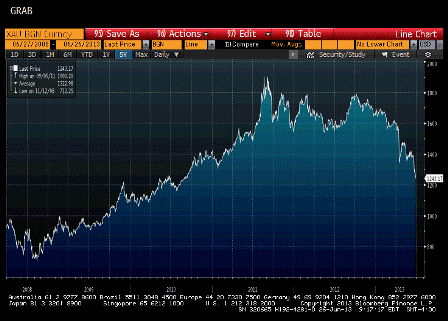
I don’t see any credit expansion from mtg debt here yet?
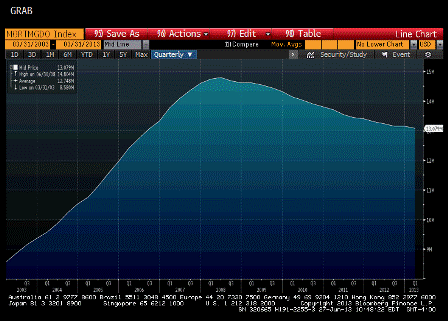
Full size image

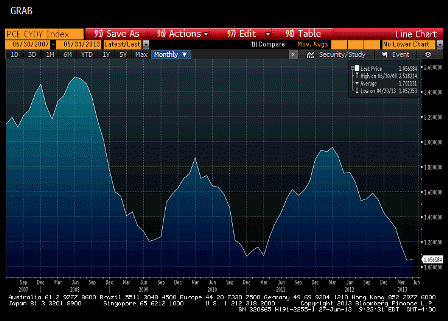
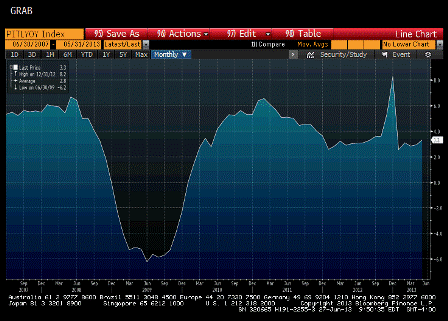
Maybe it’s just me but to me this looks like it’s still decelerating, as it was before the tax hikes and spending cuts, which are still ongoing.
So I still see downside risk here?
But, of course, bad news for the economy is good news for stock prices for as long as markets think QE supports equity prices.
PCE Y/Y:
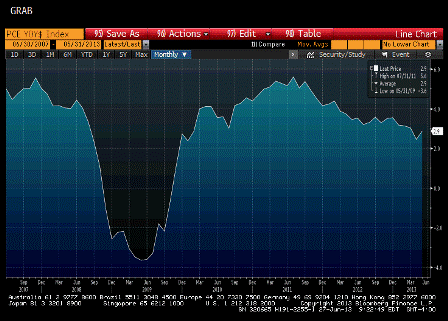
Core PCE Y/Y:
Personal Income Y/Y:
Until markets recognize QE for the tax that it actually is, the QE policy is stabilizing for stocks, destabilizing for bonds.
For example, good economic news is fundamentally good for stocks, but means QE may end, so the effects are offsetting.
Same with bad economic news. Fundamentally bad, but means QE continues, so offsetting.
Bonds are different. Good econ news is fundamentally bad for bonds and means QE may end, both negatives. And bad econ news is fundamentally good for bonds, and means QE continues, also good.
The Real Reason 1Q GDP Took a Hit
By John Carney
June 26 (CNBC) — The economy grew more sluggishly in the first three months of the year than the government first reported, as higher taxes on payrolls dampened consumer spending and held overall growth down to just a 1.8 percent annual rate.
Make no mistake about it: this is really grim. And to make matters worse, it’s something we did to ourselves.
The Commerce Department had earlier estimated growth at 2.4 percent. Most economists expected that number to remain when the final revision came out Wednesday.
This follows an expansion of just 0.4 percent in the fourth quarter of last year.
The biggest source of the downward revision came from consumer spending. Government economists had estimated that consumer services consumption (excluding housing and utilities) would grow by 2.5 percent, instead it grew at just 0.7 percent.
That’s stall speed for consumers. Far worse, in fact, than the 2.4 percent growth seen in the fourth quarter.
There were also downward revisions to nonresidential structures investment, equipment and software spending, and the change in inventories. Government spending shrunk by slightly less than expected, so the sequester spending cuts weren’t as big of a deal as some predicted. Residential investment was up by far more than expected, 14.0 percent.
The main culprit behind the consumer pullback seems to be what Fed Chairman Ben Bernanke calls “fiscal headwinds.” Specifically, the end of the payroll tax holiday left less money in the hands of consumers to spend. We taxed ourselves out of growth.
“The lower consumption estimate provides some indication that the impact from fiscal austerity may have been more than previously thought, and that the economy started the year on weaker footing than previous estimated,” TD Securities analyst Millan Mulraine wrote in a note.
But don’t entirely discount the federal spending cuts known as “sequester,” which kicked in on March 1. Even though the sequester did not directly diminish government spending by as much as possible, its anticipated effects may have dampened investments.
Gross private investment was revised down to 7.4 percent growth from the estimate of 9.0 percent. Commercial investment fell 8.3 percent, compared with an estimated fall of just 3.5 percent. Business investment was revised down slightly lower to 4.1 percent from 4.6 percent. Those drops likely reflect a projected weakness in the economy going forward.
That growth could fall so low in a quarter in which the Federal Reserve was engaging in a new round of quantitative easing, buying $85 billion of bonds each month, might cast doubt on the effectiveness of the program. That would be bad news for stocks, which rose for the first four months of the year on the idea that QE could prop up a weak economy. (And have recently fallen after the Fed began to explain when it would pare back the program.)
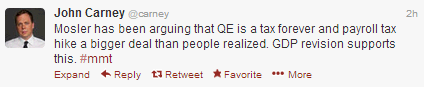
“‘QE on’ was a misguided speculative bubble in any case, as QE is, at best, a placebo, and in fact somewhat of a tax as it removes a bit of interest income,” bond investor Warren Mosler said.
Mosler is a long-term critic of QE. He believes that because the interest paid on bonds the Fed buys under the program gets paid to the Fed instead of private bond holders, it acts as a tax on the private sector. The economic benefits are illusory, according to Mosler.
On the other hand, sluggishness in the economy could mean that expectations about the Fed tapering QE and raising rates get pushed back. Bernanke has stressed that decisions about policy changes would be dependent on economic data.
Wednesday’s news about the first quarter, while backward looking, certainly casts doubt on whether the economy is strong enough to justify lower levels of bond purchases.
Not everyone buys that way of thinking, however. Some doubt that Wednesday’s news will have any effect on the Fed’s plan to reduce the bond-buying program.
“The Fed will presumably continue to maintain its primary focus on labor market data, so while this revision obviously will impact their thoughts at the margin, I highly doubt that it will be a game changer, especially since I am skeptical that policymakers are as data-dependent as they want to believe,” Stephen Stanley of Pierpont Securities wrote in a note Wednesday morning.
Someone else sees deceleration…
>
> (email exchange)
>
> Worst since early 2010. Includes all the S&P / Euro crisis corrections since then.
>
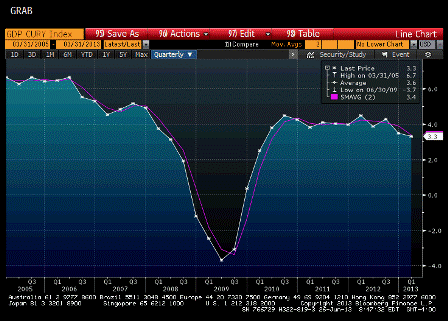
And Q1 was the bounce back from the 0.4% Q4 print?
So now seems the govt deficit reduction happened in the face of even lower levels than previously thought?
And so the question remains of which agents are going to step up and fill that spending gap, as the ‘demand leakages’ are continuous?
Karim writes:
From SMR:
We wonder whether the downward revision to the PCE for Housing Services was in the “imputed services rendered by owner occupied housing”. If so such may speak to Chairman Bernanke’s comment during the Q&A following the FOMC meeting wherein he said that the deflator for the imputed portions of the PCE may be too low. We will have a better handle on this tomorrow.
Away from the PCE for Services, there were only minor offsetting revisions, not really worthy of comment
What does the downward revision to Q1 GDP and Q1 PCE for Services imply for Q2 GDP?
With floating fx, it’s necessarily about price (interest rate) and not quantity.
That includes China’s ‘dirty float’, a currency not convertible on demand at the CB, but with periodic CB market intervention.
Loans necessarily create deposits at lending institutions, and they also create any required reserves as a reserve requirement is functionally, in the first instance, an overdraft at the CB, which *is* a loan from the CB.
So from inception the assets and liabilities are necessarily ‘there’ for the CB to price.
Liquidity is needed to shift liabilities from one agent to another.
For example, if a depositor wants to shift his funds to another bank, the first bank must somehow ‘replace’ that liability by borrowing from some other agent, even as total liabilities in the system remain unchanged.
That ‘shifting around’ of liabilities is called ‘liquidity’
But in any case at any point in time assets and liabilities are ‘in balance.’
It’s when an agent can’t honor the demand of a liability holder to shift his liability to another agent that liquidity matters.
And if a bank fails to honor a depositor’s request to shift his deposit to another institution, the deposit remains where it is. Yes, the bank may be in violation of its agreements, but it is ‘fully funded.’
The problem is that to honor its agreements to allow depositors to shift their deposits to other banks, the bank will attempt to replace the liability by borrowing elsewhere, which may entail driving up rates.
Likewise, banks will attempt to borrow elsewhere, which can drive up rates, to avoid overdrafts at the CB when the CB makes it clear they don’t want the banks to sustain overdrafts.
The problem is that only the CB can alter the total reserve balances in the banking system, as those are merely balances on the CB’s own spread sheet. Banks can shift balances from one to another, but not change the total.
So when the total quantity of reserve balances on a CB’s spreadsheet increases via overdraft, that overdraft can only shift from bank to bank, unless the CB acts to add the ‘needed’ reserves.
Or when one bank has excess reserves which forces another into overdraft, and the surplus bank won’t lend to the deficit bank.
This is all routinely addressed by the CB purchasing securities either outright or via repurchase agreements. It’s called ‘offsetting operating factors’, which also include other ‘adds and leakages’ including changes in tsy balances at the fed, float, cash demands, etc.
And when the CB does this they also, directly or indirectly, set the interest rate as they do, directly or indirectly, what I call ‘pricing the overdraft.’
So to restate, one way or another the CB sets the interest rate, while quantity remains as it is.
And those spikes you are seeing in China are from the CB setting rates indirectly.
The evidence from China is telling me that the western educated new kids on the block flat out don’t get it, probably because they were never told the fixed fx ‘monetarism’ they learned in school isn’t applicable to non convertible currency???
In any case the CB is the monopoly supplier of net reserves to its banking system and therefore ‘price setter’ and not ‘price taker’, and surely they learned about monopoly in school, but apparently/unfortunately have yet to recognize their currency itself is a simple public monopoly?
Thinking back, this is exactly the blunder of tall Paul back some 33 years ago. He made the same rookie mistake, for which he got credit for saving the US, and the world, from the great inflation of his day.
However, the fact that he made it worse, vs curing anything is of no consequence.
What matters is how the western elite institutions of higher learning spin it all…
:(
I agree with a lot of this
‘Mortgage originations have plummeted by 39% since early May.’
The Fed’s financial obligations ratios have turned up as well.
But it’s not about QE in any case
It takes private credit expansion or net exports to overcome fiscal drag.
Bill Gross: Fed tapering plan may be hasty
By William H. Gross
June 25 (Bloomberg) — “June Gloom,” as the fog and clouds that often linger over the Southern California coast this time of year are known, appears to have spread to the Federal Reserve. At his press conference last week, Fed Chairman Ben Bernanke said the central bank may begin to let up on the gas pedal of monetary stimulus by tapering its asset purchases later this year and ending them in 2014.
We agree that QE must end. It has distorted incentives and inflated asset prices to artificial levels. But we think the Fed’s plan may be too hasty.
Fog may be obscuring the Fed’s view of the economy—in particular, the structural impediments that will inhibit its ability to achieve higher growth and inflation. Bernanke said the Fed expects the unemployment rate to fall to about 7% by the middle of next year. However, we think this is a long shot.
Bernanke’s remarks indicated that the Fed is taking a cyclical view of the economy. He blamed lower growth on fiscal austerity, for example, suggesting that should it be removed from the equation the economy would suddenly be growing at 3%. He similarly attributed rising housing prices to homeowners who simply like or anticipate higher home prices, as opposed to emphasizing the mortgage rate, which is really what provided the lift in the first place.
Our view of the economy places greater emphasis on structural factors. Wages continue to be dampened by globalization. Demographic trends, notably the aging of our society and the retirement of the Baby Boomers, will lead to a lower level of consumer demand. And then there’s the race against the machine; technology continues to eliminate jobs as opposed to provide them.
Bernanke made no mention of these factors, which we think are significant forces that will prevent unemployment from reaching the 7% threshold during the next year. Falling below “NAIRU” (the non-accelerating inflation rate of unemployment—usually estimated between 5% and 6%) is an even more distant goal.
Indeed, the Fed’s views on inflation may be the foggiest of all. Bernanke said the Fed sees inflation progressing toward its 2% objective “over time.” At the moment, we’re nowhere near that.
The Fed’s plan strikes us as a bit ironic, in fact, because Bernanke has long-standing and deep concerns about deflation. We’ve witnessed this in speeches going back five or 10 years—the “helicopter speech,” the references not only to the Depression but to the lost decades in Japan. He badly wants to avoid the mistake of premature tightening, as occurred disastrously in the 1930s. Indeed, on several occasions during his press conference, Bernanke conditioned his expectations of tapering on inflation moving back toward the Fed’s 2% objective.
The chairman, of course, may be equally concerned about the market effects of tapering and determined to signal its moves early. However, as the spike in interest rates shows, this path is fraught with danger, too.
We’re in a highly levered economy where households can’t afford to pay much more in interest expense. Monthly payments for a 30-year mortgage have jumped 20% to 25% since January. Mortgage originations have plummeted by 39% since early May.
High levels of leverage, both here and abroad, have made the global economy far more sensitive to interest rates. Whereas a decade or two ago the Fed could raise the fed funds rate by 500 basis points and expect the economy to slow, today if the Fed were to hike rates or taper suddenly, the economy couldn’t handle it.
All this suggests that investors who are selling Treasurys in anticipation that the Fed will ease out of the market might be disappointed. If inflation meanders back and forth around the 1% level, Bernanke may guide the Committee towards achieving not only an unemployment rate but also a higher inflation target.
It’s reasonable, of course, for Bernanke to try to prepare markets for the inevitable and necessary wind down of QE. But if he has to wave a white flag three months from now and say, “Sorry, we miscalculated,” the trust of markets and dampened volatility that has driven markets over the past two or three years could probably never be fully regained. It would take even longer for the fog over the economy to lift.