Might be more early evidence of FICA hike biting.
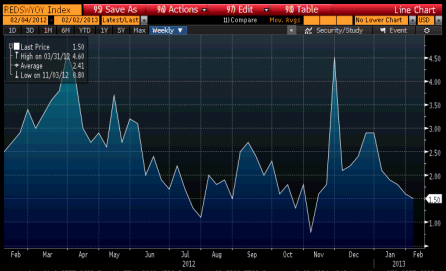

Agreed with Karim. So far no signs of actual damage from the FICA hike. Even bonds now indicating same.
The problem is personal- it’s hard for me to fathom FICA going up that much without some meaningful damage to GDP.
So I remain on the sidelines pending more Jan data.
ICSC 3% Retail Sales Growth Maintained for January, Fiscal Year (ICSC) January sales growth is tracking above ICSC’s 3% estimate for the month, even with a slight moderation of yoy sales growth as the month has progressed. All Super Bowl shopping will fall in January this year, so sales should gain momentum as the month closes. January U.S. store traffic growth continued to slow in the third week of the month, rising 3.1%, as stores transition from post-holiday clearance to more everyday merchandise. Traffic at enclosed malls remained unchanged yoy and apparel stores declined by low-single digits for the first time since the lull in early December. The 12% month-to-date traffic gain stems from large increases in early January. U.S. same store sales excluding Wal-Mart rose 2.7 percent in Dec. from a year earlier.
ICSC index drops every January but this year higher than last, as Karim indicated.
January auto sales seen continuing 2012’s strong pace (Reuters) Auto sales in January are expected to continue the torrid pace set at the end of last year, with sales rising as much as 15 percent. J.D. Power and LMC Automotive, in a joint press release, said they expect U.S. retail sales in January to reach the highest rate in five years. Including fleet sales to commercial customers, the research firms expect an annual sales rate for the month of 15 million vehicles. That would follow the strong showings in November and December, when the rate topped 15 million. “The year is off to a fast start, which bodes well for the remainder of 2013,” J.D. Power Senior Vice President John Humphrey said.
Strongest manufacturing expansion since March 2011 (Markit) The Markit Flash U.S. Manufacturing PMI rose to 56.1 in January from 54.0 in December. The output index rose to 57.2 from 54.5, the new orders index rose to 57.7 from 54.7, the new export orders index fell to 51.3 from 52.6, and the backlog of orders index fell to 49.5 from 50.3. Manufacturers reported a further rise in production levels during January. Companies attributed faster output growth to an increase in new orders. Overall incoming new work rose at the fastest rate since May 2010, largely reflecting higher demand in the domestic market. New export orders continued to increase, up for the third month running, albeit at a slower rate than in December. Asia was mentioned by survey respondents as a key source of new business.
Deficit finally large enough for a bit of stability and growth?
U.K. Economy Surges 1% as Britain Exits Double-Dip Recession
By Scott Hamilton and Jennifer Ryan
October 25 (Bloomberg) — Britain exited a double-dip recession in the third quarter with the strongest growth in five years as Olympic ticket sales and a surge in services helped boost the rebound.
Gross domestic product rose 1 percent from the three months through June, the fastest growth since 2007, the Office for National Statistics said in London today. That exceeded the highest estimate in a Bloomberg News survey for growth of 0.8 percent. The median forecast of 33 economists was 0.6 percent. The pound rose after the data were published.
The growth surge reflects a boost from the Olympics and a rebound from the second quarter, when GDP was affected by an extra public holiday. While the data may give some short-term relief to Prime Minister David Cameron’s struggling government, Bank of England Governor Mervyn King said this week that the recovery is “slow and uncertain.” That suggests the figures mask underlying weakness that could warrant further stimulus from the central bank.
“We’re still concerned the U.K. economy is going to be pretty much flat throughout next year,” James Shugg, an economist at Westpac Banking Corp. (WBC) in London, said on Bloomberg Television’s “The Pulse” with Maryam Nemazee. “It all depends how rigidly determined the government is to stick to its deficit reduction plan.”
Ticket Sales
Services, which make up about three quarters of GDP, surged 1.3 percent in the third quarter from the previous three months, the most in five years, the ONS said. Olympic ticket sales are estimated to have added 0.2 percentage points to GDP. Production rose 1.1 percent, the most in more than two years, while manufacturing increased 1 percent. Construction output fell 2.5 percent, a third straight quarterly decline.
The pound extended its gain against the dollar after the report and was trading at $1.6134 as of 10:52 a.m. in London, up 0.6 percent on the day. Bonds declined, pushing the yield on the 10-year government bond up 8 basis points to 1.93 percent.
From a year earlier, GDP was unchanged in the third quarter, the ONS said. That compared with a decline of 0.5 percent forecast by economists in a separate Bloomberg survey.
While today’s data confirm Britain exited its first double- dip recession since 1975, GDP is still 3.1 percent below its peak in the first quarter of 2008. The report also showed that the economy has grown 0.6 percent since the third quarter of 2010, just after Cameron’s coalition government came to power.
Economy ‘Healing’
Cameron urged caution on the GDP data, saying there is “still much to do.” The opposition Labour Party has accused his government of exacerbating the economic slump by sticking to its fiscal squeeze. Ed Balls, Labour’s finance spokesman, said today the economy “remains weak” and “is only just back to the size it was a year ago.”
“There are always one-off figures in all of these announcements but they do show an underlying picture of good and positive growth,” Cameron said. “We’ve got to stick with the program.”
The data today are an initial estimate and the figures are subject to revision when the ONS gets more information. In the second quarter, the decline in GDP was revised up to 0.4 percent from an initially reported 0.7 percent.
Britain is the first of the Group of Seven nations to report GDP data for the third quarter. U.S. growth probably accelerated to a 1.9 percent annual rate after expanding at a 1.3 percent pace the prior quarter, according to a Bloomberg survey before a Commerce Department report tomorrow. It would be the first back-to-back readings lower than 2 percent since the U.S. was emerging from the recession in 2009.
Deficit Reduction
The U.K. data come two weeks before the Bank of England’s Monetary Policy Committee must decide whether to end its stimulus program or extend it beyond 375 billion pounds ($605 billion). Governor Mervyn King said this week that a “zig-zag” pattern of recovery is likely to persist.
Debenhams Plc (DEB), Britain’s second-largest department-store chain, said today that the U.K. experienced “challenging trading conditions during 2012.” Whitbread Plc (WTB) Chief Executive Officer Andy Harrison said the consumer market is “pretty flat” and generating any growth is “jolly difficult.”
Stripping out one-time distortions, the National Institute of Economic and Social Research said on Oct. 9 that third- quarter growth was closer to between 0.2 percent and 0.3 percent.
Inflation Cools
Still, recent data have shown pressure on consumers easing. Inflation cooled to the slowest in almost three years in September, while retail sales increased more than forecast. Payrolls rose to a record in the quarter through August, pushing the unemployment rate down to 7.9 percent from 8.1 percent.
“At this stage, it is difficult to know whether some of the recent more positive signs will persist,” King said on Oct. 23. “The MPC will think long and hard before it decides whether or not to make further asset purchases. But should those signs fade, the MPC does stand ready.”
Elsewhere in Europe, Sweden’s Riksbank kept benchmark interest rates unchanged at their lowest level since early 2011 and said further easing has become more probable as growth slows in the largest Nordic economy.
Headlines:
U.K. House Prices Rise for a Second Month in June, Halifax Says
U.K. Pay Growth Accelerates to 10-Month High, VocaLink Says
German Factory Orders Unexpectedly Rose on Euro-Area Demand
Eurozone PMI rises in June but still signals steep rate of contraction
Euro-Region Retail Sales Unexpectedly Increased in May on France
Italy First-Quarter Deficit Rises to Highest in Three Years
Italy Plans More Than 8 Billion Euros of Spending Cuts This Year
As suspected, signs that UK deficit spending is looking large enough to support a bit of growth. Now watch for the proclamations about how austerity works…
UK Headlines:
U.K. Manufacturing Demand Strengthened in June, CBI Report ShowsCML Says U.K. Gross Mortgage Lending Rose 24% in May From April
U.K. Retail Sales Rise More Than Forecast After April Slump
Some hints the deficit may be large enough to sustain some growth.
No doubt this will be spun as ‘see, austerity works’, when the same deficit could have been achieved proactively with a tax cut and/or spending increase before the austerity increased the deficit the ugly way, via depressing GDP and elevating unemployment.
Headlines:
U.K. House Prices Rise as Halifax Sees Stagnation in Second Half
U.K. Retail Sales Increased in May on Warm Weather, BRC Says
U.K. Services Unexpectedly Sustains Pace of Expansion in May
As previously discussed, GDP looks to be growing sequentially, and should do fine next year if fiscal policy doesn’t tighten.
But still not so good for people working for a living, pretty good for corporate earnings.
And risks remain- Europe, China, Super Committee, etc. etc.
And look for a relief rally if Europe all agrees the ECB writes the check,
followed by a sell off due to the austerity that accompanies it.
Karim writes:
Data confirms Q4 GDP growth tracking 3.25%.; slight boost to Q1 estimate; more like 2.75% vs 2.5% previously.
RETAIL SALES
EMPIRE
PPI
EVANS AND BULLARD
(To download PDF, right click link and select save link as)
Highlights
US – Consumer Confidence contrasting moderate growth
EU – Data and inadequate political solutions presenting a scary picture
JN – Jobless Data improves, Industrial Production & Retail Sales decline
UK – Uncertain Q3 GDP Estimate
CA – GDP continues to expand
AU – RBA finally eased
NZ – RBNZ not clear about tightening
Agreed.
Fundamentally, the 8%+ US federal budget deficit continues to support sufficient aggregate demand for modest GDP growth. Market participants don’t seem to understand this and were discounting a far higher probability of a recession than otherwise.
The strong euro/weak dollar strong stock dynamic continues, with the ECB continuing it’s strong euro policy of forced austerity in exchange for funding. However, this policy also slows growth in the euro zone, which tends to push deficits higher through softer tax revenues and higher transfer payments. At some point this means the ECB has to reconsider a policy designed to bring deficits down that is instead causing them to rise. The problem is they have no such alternative policy, and instead are looking for tight fiscal policy to drive exports. The problem with that is that without a policy of buying $US (the old German model), instead of exports rising, the euro rises to the point where trade stays relatively balanced, as has been the case since the inception of the euro.
Meanwhile, they seem to have responded adequately to the solvency issue with the ECB writing the check as needed. But with a slowing economy the checks the ECB must write get geometrically larger, which, while not an operational constraint, are a daunting political challenge that can quickly throw it all into even more disarray.
Karim writes:
(To download PDF, right click link and select save link as)
Highlights
US – Political battles on both sides of the Atlantic overshadowing data
EU – Markets slightly more optimistic resolution will be reached
JN – Light week of data
UK – The IMF lowered its 2011 growth projections
CA – Retail Sales worse than expected
NZ – Economy nearly stalled in Q2