Retail sales, Redbook retail sales, Housing index, Business inventories and sales, Empire manufacturing, MEW, Atlanta Fed

Just plain bad. Including last month’s downward revision.

And, again, sales = income, and lower income means less to spend in the next period:

Retail Sales
er-3-15-1
Highlights
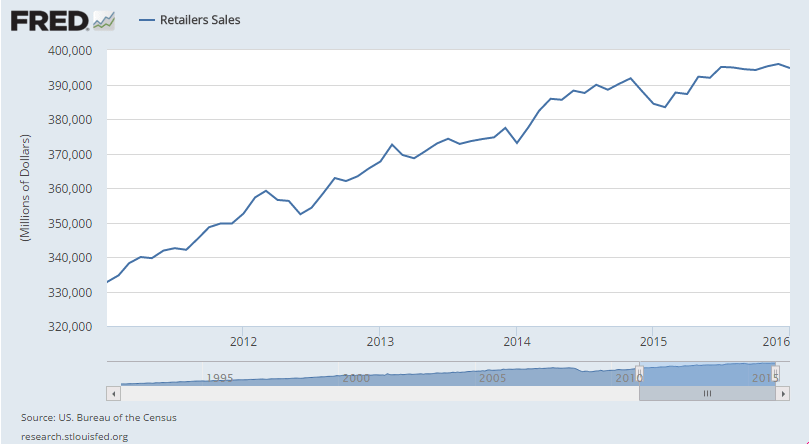
Consumer spending did not get off to a good start after all in 2016 as big downward revisions to January retail sales badly upstage respectable strength in February. January retail sales are now at minus 0.4 percent vs an initial gain of 0.2 percent. The two major sub-readings also show major downward revisions with ex-auto sales now down 0.4 percent vs an initial gain of 0.1 percent and ex-auto ex-gas sales now at minus 0.1 percent from plus 0.4 percent. The latest for this latter core rate is really the main positive in today’s report, up a solid 0.3 percent in February. Total sales for February are weak at minus 0.1 percent as is the ex-auto reading, also at minus 0.1 percent.

But even in the core readings, details are not great with strength so far this year mixed across nearly all categories. Still, year-on-year strength is evident in two key discretionary components which are vehicles, up 6.8 percent, and restaurants which are up 6.4 percent. Non-store retailers, benefiting from growth in ecommerce, are up 6.3 percent. Sporting goods, a smaller discretionary category, are up 6.7 percent. And building materials & garden equipment, in a sign of strength for residential investment, are up 12.2 percent. The downside includes electronics & appliances which are at minus 3.2 percent and department stores down 2.2 percent. The weakest of all of course are gasoline stations, down 15.6 percent on the year as low fuel prices depress dollar sales.

Given the skewing effect of gasoline, the ex-gas total is important to look at it and it’s up 0.2 percent in the month for very respectable yearly growth of 4.8 percent. This reading underscores the silver lining in the report, that retail sales, despite all the negatives, are moving in the right direction. January and February are the lowest sales months of the year, a fact that magnifies adjustment effects and can cause volatility in the readings. But that aside, consumer spending, despite high employment, is struggling to break out of a flat run that included a very soft holiday season.

er-3-15-2
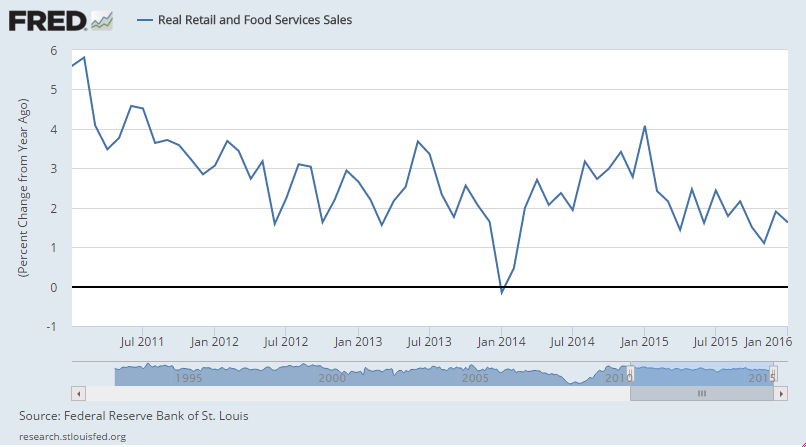
This is year over year change, adjusted for inflation:
er-3-15-3
er-3-15-4

While U.S. retail sales fell less than expected in February, the sharp downward revision to January’s sales could be “devastating” for investors, CNBC’s Jim Cramer said Tuesday.

“I’m just kind of flummoxed. A number comes out that makes us feel great, and then that number is taken away,” Cramer said on “Squawk on the Street.”

;)

Another bad one:

Housing Market Index
er-3-15-5
Highlights
Demand for new homes is solid but lack of available lots and shortages in construction labor are holding back growth. The housing market index came in unchanged in March at a 58 level which however remains well above breakeven 50. Present sales, unchanged at a strong 65, lead the March report followed by future sales which are down 3 points to 61. A plus, however, is a 4 point gain to 43 for buyer traffic which has been weak this whole cycle.

The gain in traffic hints at the drawing power of low mortgage rates and speaks to the strength of the labor market. But there hasn’t been much acceleration in housing nor is any expected in tomorrow’s permits data. The housing sector, which was billed as a strength for 2016, has yet to build any momentum this year.

Also bad:

Business Inventories
er-3-15-6
Highlights
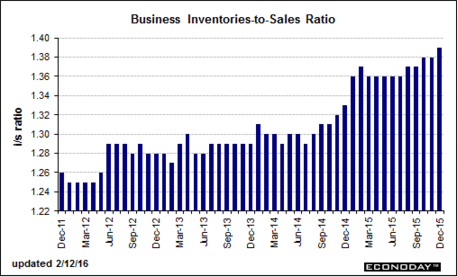
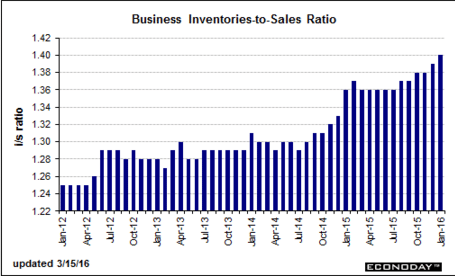
It’s been a weak morning for U.S. economic data and business inventories are no exception. Inventories rose an unwanted 0.1 percent in December against a 0.4 percent decline for sales in a mismatch that drives the stock-to-sales ratio from 1.39 to 1.40 for the fattest reading of the whole cycle, since May 2009. Inventories fell for factories but rose for wholesalers and also for retailers. Sales, however, fell for both retailers and especially for wholesalers. Heavy inventories are a negative for future production and future employment and today’s report points to slowing for both during the first quarter.

er-3-15-7
Better than expected but still weak:

Empire State Mfg Survey
er-3-15-8
Highlights
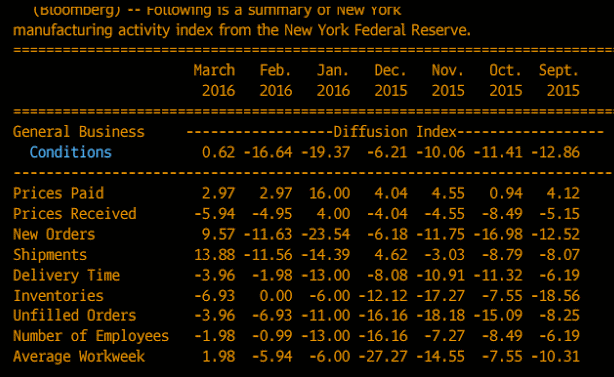
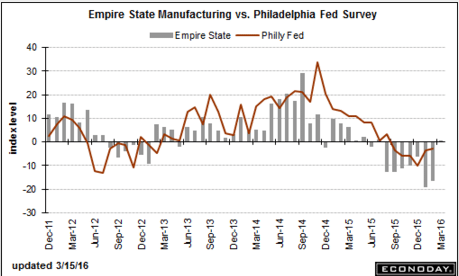
After seven straight months of contraction, the general conditions index of the Empire State report is back in the plus column, though just barely at 0.62 in a reading that signals fractional strength for factory activity during March. New orders are the report’s most convincing headline, at plus 9.57 to end nine straight months of contraction. Unfilled orders, however, remain in contraction, but only slightly at minus 3.96, as does employment at minus 1.98. Inventories are in contraction as are selling prices. Yet still, the 6-month outlook is picking up, to plus 25.53 for a more than 10 point gain. Shipments are also positive, at 13.88 in what points to strength for the manufacturing component of the March industrial production report, the February edition of which will be posted tomorrow and is expected to be flat. Flat is really the theme of this report which, compared to the deep contraction of prior reports, is relatively good news for a factory sector that has been getting hit by weakness in exports and energy equipment.

er-3-15-9
er-3-15-10
No sign of credit expansion here:

er-3-15-11
er-3-15-12

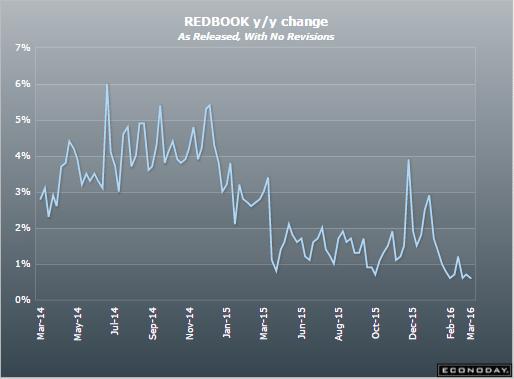
NFIB index, Redbook retail sales

Tough to give this a positive spin…

And note the downward slope of the chart, as weakness continues to spread from oil capex to the rest of the economy:

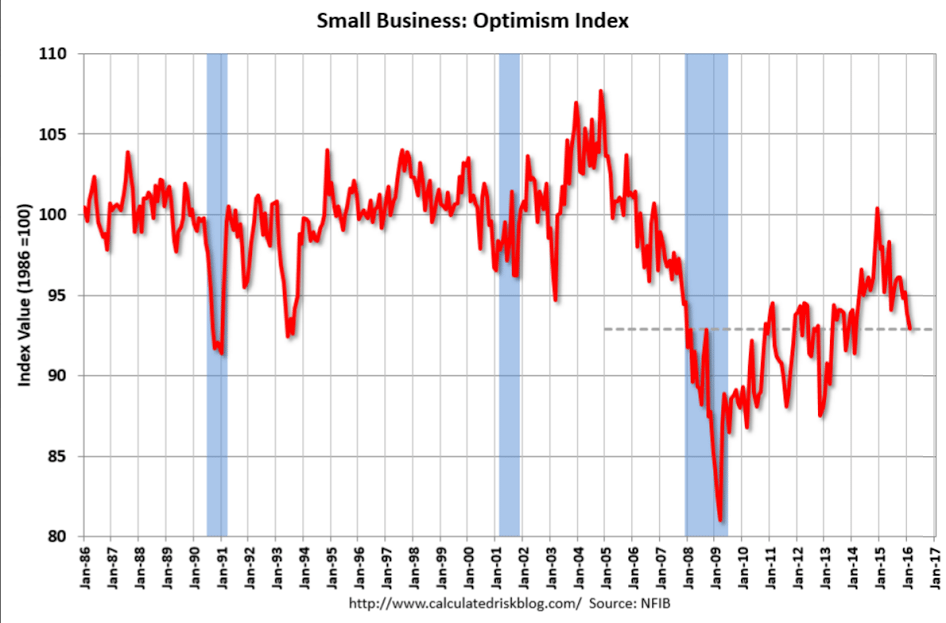
NFIB Small Business Optimism Index
er-3-8-1
Highlights
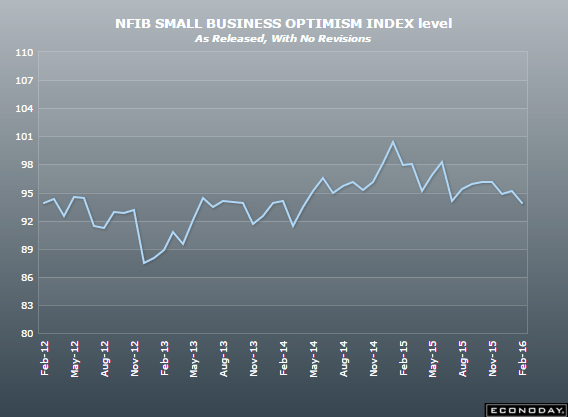
The small business optimism index slipped 1 point in February to 92.9, a 2-year low that reflects incremental declines across six of 10 components. The report’s two employment components both inched 1 point lower with plans to increase employment still at a positive reading of 10 and job openings hard to fill still at a very strong 28 which leads all components. Earnings trends, however, are very weak, down 3 points to minus 21 and reflecting what the report cites as higher labor costs that are not being passed through to selling prices. Sales expectations also fell 3 points but are doing better than earnings which are at the zero level. Weak earnings and sales are negatives for business investment with plans for capital outlays and expansion intentions both down 2 points but with both readings still strongly positive at 23 and 8 respectively. Underlying strength for business investment and employment, however, is not likely to hold up for very long given weakness in earnings and sales.

Below levels of the prior recession:
er-3-8-2
er-3-8-3

Vehicle sales

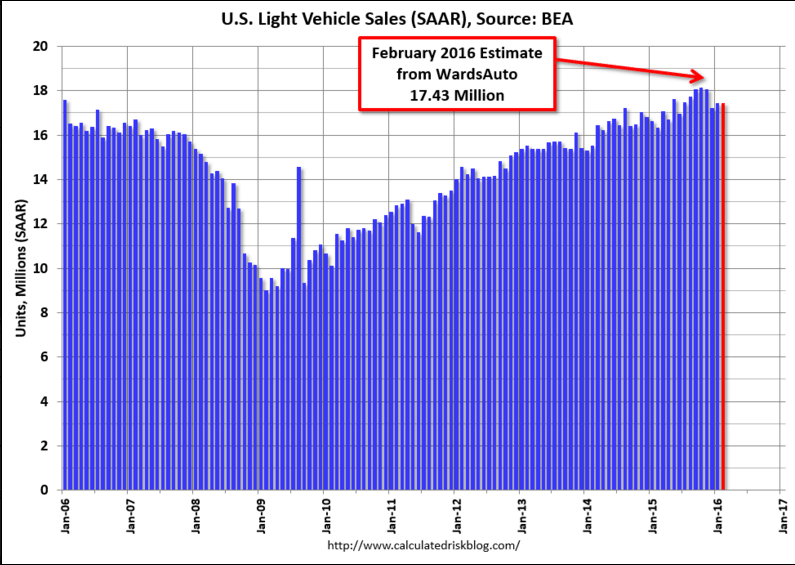
Whoops, less than expected, and as the chart shows the seasonally adjusted rate of sales continues to decelerate from the prior peak months as weakness that began with the collapse of oil capex continues to spread to the rest of the economy:
er-3-1-10
From another source that spins flat to down sales as a positive for continued growth. Seems to me that if any of the ‘pieces’ grow at a lower rate than last year, some other ‘piece’ has to grow at a faster rate than it grew at last year to make up for it. This level of car sales will not be at all supportive of growth to the retail or factory sector:

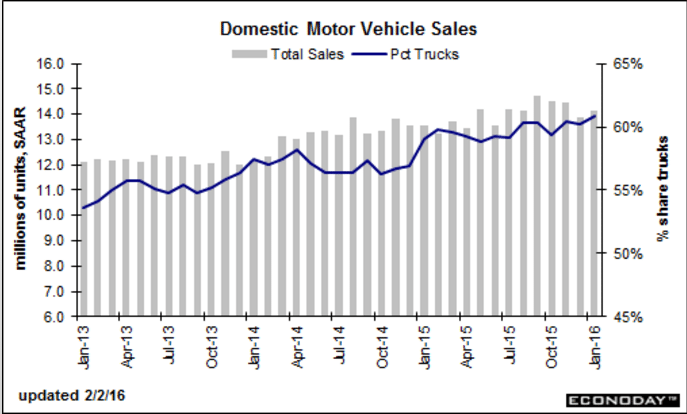
Motor Vehicle Sales
er-3-1-11
Highlights
Vehicle sales held at strong levels in February, at a 17.5 million annualized pace for total sales and at a 14.1 million pace for North-American models. Both rates are only fractionally lower than January and offer a sign of continued strength, though not accelerating strength, for the motor vehicle component of the government’s retail sales report. All readings show only the smallest fractional change with light trucks at a 10.1 million rate and cars at a 7.4 rate. Vehicle sales remain a central strength for the economy, boosting both the retail sector and helping to support the factory sector as well.

Redbook retail sales, PMI manufacturing, ISM manufacturing, Construction spending, Draghi comment

er-3-1-9

PMI Manufacturing Index
er-3-1-2
Highlights
Growth in Markit Economics’ manufacturing sample is slowing to a crawl, at 51.3 for final February which is, next only to February’s flash of 51.0, the second lowest reading since October 2012. January, at 52.4, was a good month for the manufacturing sector with industrial production up and durable orders up, but the early indications on February are uniformly negative.

Production in this report slowed as did new orders where growth is at a 3-1/2 year low. Export orders fell the most since April last year. Backlog orders are also down and employment growth moderated for a second straight month. Respondents in the sample are citing caution among their customers as a key negative. In a convincing kicker, selling prices are down the most in more than 3-1/2 years.

This report, which runs hot compared to other manufacturing reports, is sitting near recovery lows and is offering its own signal of renewed trouble for manufacturing, a sector that continues to get hit by weak exports and weak energy-related demand.

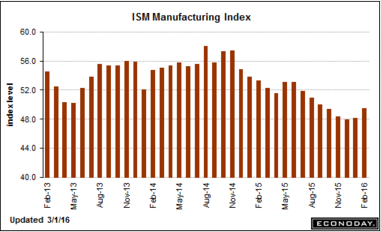
And this continues to be in contraction mode:

ISM Mfg Index
er-3-1-3
Highlights
Early indications on the February factory sector are all negative but the most closely watched one, ISM’s manufacturing index, perhaps shows the least weakness. The index rose 1.3 points to a 49.5 level that is nearly at 50.0, the breakeven level between positive and negative monthly change. This index hit 50.0 back in September and has since been underwater.

Not underwater, however, are new orders which held unchanged at a respectable enough level of 51.5. This index had been below 50 going into last year. Contraction in backlog orders slowed which is another plus though contraction in new orders for exports deepened slightly to 46.5 for the weakest reading since September. Employment has been very weak in this report but here to there’s improvement, up 2.6 points to 48.5. Production is also a positive in the report, up 2.6 points to 52.8 for the best reading since August last year.

This report should help limit concern that February was a breakdown month for what is still, however, a fragile factory sector.

er-3-1-4
The headline number looks ok, but note the details. And you can see from the charts that growth has been decelerating and will likely continue to do so as the collapse of oil related capital expenditures spreads to the rest of the economy:
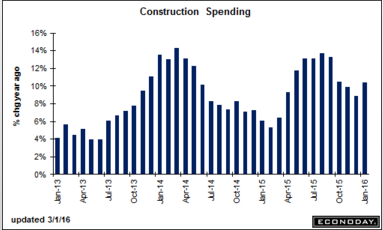
Construction Spending
er-3-1-5
Highlights
Construction spending rose a strong 1.5 percent in January in strength, however, that does not include housing. A one-month surge in highway & street spending skewed the headline higher as did gains for manufacturing and on Federal construction projects.

The residential component was unchanged in the month as a 0.2 percent slip in single-family homes offset another jump in the much smaller multi-family subcomponent which rose 2.6 percent in the month. Demand on the multi-family side, reflecting strength in rental prices, has been very strong with year-on-year spending up 30.4 percent vs 6.6 percent for single-family homes. Together, residential spending is up a year-on-year 7.7 percent.

Other year-on-year rates include an impressive 33.9 percent gain for highways & streets which is a big category. Federal, a far smaller category, is up 9.9 percent. Turning to the private nonresidential components, offices lead at a 24.8 percent year-on-year gain.

The median-to-high single digit year-on-year gain for residential spending is roughly in line with gains in both sales and prices. Historically, these are moderate rates of growth for the housing sector but, right now, are among the very highest for the economy as a whole. On the non-residential side, today’s gains are a very good start for first-quarter business investment.

er-3-1-6
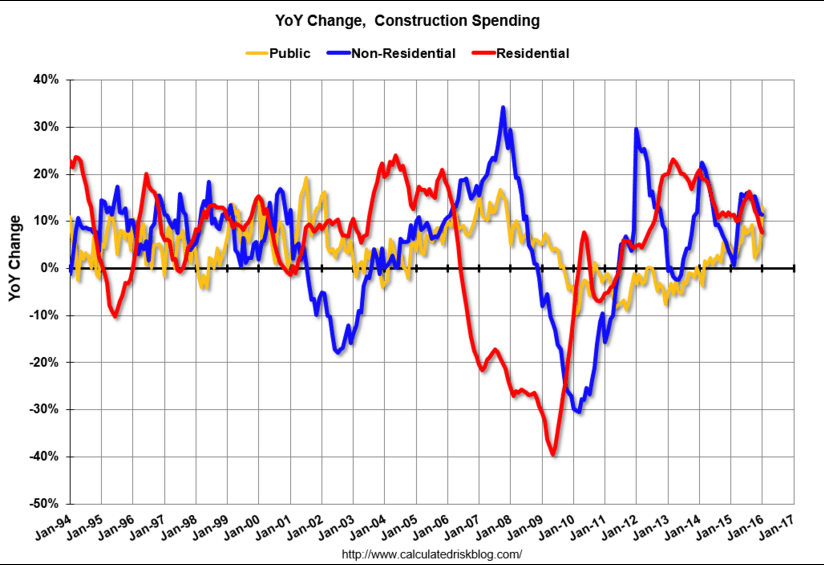
Note the surge in public sector spending referenced above, while the private sector spending continues to decelerate.
Recall that NY tax benefits expired in June with roughly coincides with the peak in growth seen in both charts:
er-3-1-7
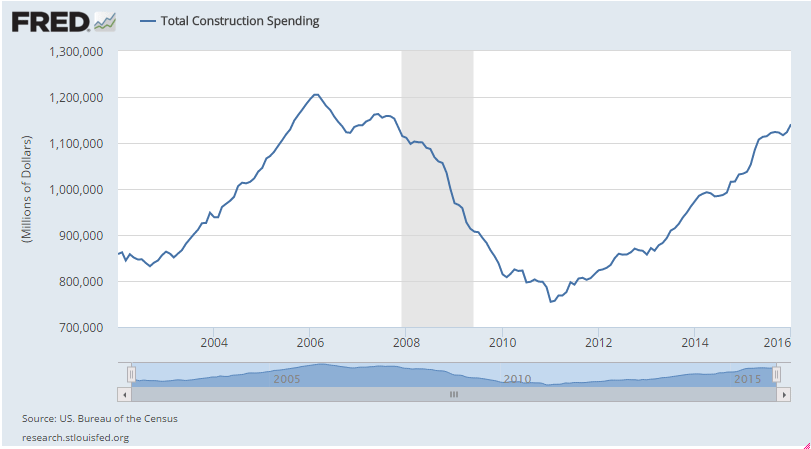
This chart is not adjusted for inflation, so construction spending in real terms has yet to reach pre recession levels and it’s growing at lower rate than before as well:
er-3-1-8
As the carpenter said about his piece of wood, “No matter how much I cut off it’s still too short”:

DRAGHI SAYS EURO AREA INFLATION DYNAMICS CONTINUE TO BE WEAKER THAN EXPECTED

DRAGHI SAYS THERE ARE NO LIMITS TO HOW FAR WE ARE WILLING TO DEPLOY OUR INSTRUMENTS WITHIN OUR MANDATE TO ACHIEVE OUR OBJECTIVE OF INFLATION RATES BELOW, BUT CLOSE TO, 2% OVER THE MEDIUM TERM

Mtg purchase apps, Housing starts, Redbook retail sales, Industrial production, E commerce retail sales

Purchase apps down again:

MBA Mortgage Applications
er-2-17-1
Highlights
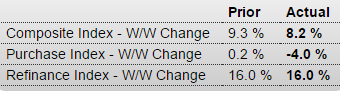
Falling mortgage rates continue to drive refinancing applications sharply higher, up 16 percent for a second straight week. Purchase applications, up 30 percent year-on-year, are also being driven higher though they declined 4 percent in the latest week. The average rate for 30-year conforming loans ($417,000 or less) fell 8 basis points in the week to 3.83 percent.

Again, so much for what’s been forecast to be the ‘driver’ of the 2016 economy.

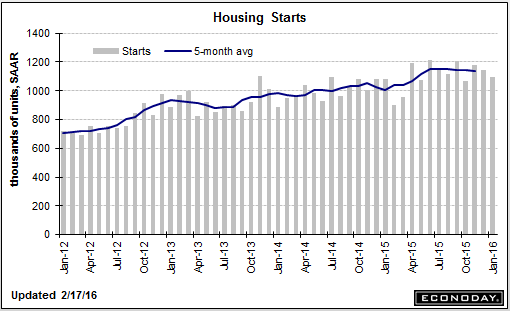
Note how the chart shows starts have been working their way lower for a substantial period of time:

Housing Starts
er-2-17-2
Highlights
Housing starts and permits proved softer-than-expected in January, down 3.8 percent to an annual rate of 1.099 million for starts with permits down 0.2 percent to 1.202 million. Starts show roughly equal weakness between single-family homes, down 3.9 percent to a 731,000 rate, and multi-family homes, down 3.7 percent to 368,000. Permits for single-family homes fell 1.6 percent to 720,000 while multi-family permits, in the strongest reading of the report, rose 2.1 percent to 482,000.

Multi-family homes remain the center of strength for the housing sector with year-on-year permits up 19.9 percent, surpassing a very solid 9.6 percent gain for single-family homes. Starts are lagging far behind, at a year-on-year plus 1.8 percent overall and reflecting supply constraints in the construction sector, including for labor, as well as January’s heavy weather that hit the East Coast at mid-month.

The housing sector isn’t on fire but trends in permits do point to strength. Watch for existing home sales on Tuesday next week followed by new home sales on Wednesday.

er-2-17-3
er-2-17-4
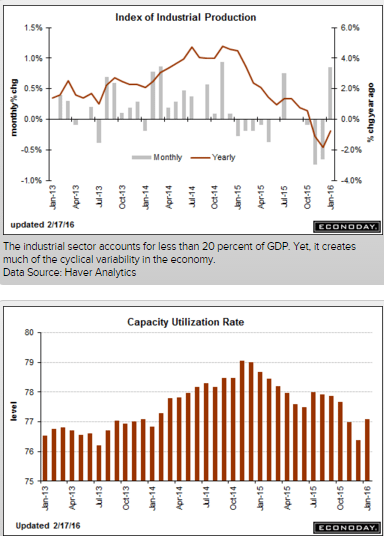
Not good, year over year negative, and the blip up in auto production will likely reverse as auto sales have declined:

Industrial Production
er-2-17-5
Highlights
A sharp gain in motor vehicle production underpins a very strong industrial production report where the headline surged 0.9 percent in January which is far above Econoday’s plus 0.4 percent consensus and 0.6 percent high-end estimate. The gain lifts capacity utilization to 77.1 percent for a strong 7 tenths gain from a downward revised December.

Vehicle production surged 2.8 percent in the month and drove the manufacturing component up by 0.5 percent, a gain that compares with a plus 0.2 percent consensus and a high-end estimate of 0.4 percent. But manufacturing was also supported by capital goods, an area that has been weak but which did gain 0.3 percent in the month.

The utilities component, up a monthly 5.4 percent and reflecting a temperature swing from a warm December to a more seasonably cold January, is the major factor behind the headline gain. Mining, hit by low energy and commodity prices, continues to lag, coming in unchanged in the month for a year-on-year decline of 9.8 percent.

Total year-on-year industrial production also remains in the negative column, at minus 0.7 percent, a disappointment but a contrast to manufacturing where the year-on-year rate is modest but accelerating, at plus 1.2 percent.

A negative in the report is a downward revision to December, to minus 0.7 percent from minus 0.4 percent. But the revision doesn’t take much away from the January surprise where strength, based in manufacturing and underscoring January’s rise in retail auto sales, should help ease concern over the economy’s first-quarter performance.

er-2-17-6
Deceleration here as well:

E-Commerce Retail Sales
er-2-17-7
Highlights
Strength in non-store retail sales and reports of strength for holiday online shopping are only modestly confirmed by the e-commerce report where sales rose only 2.1 percent in the fourth quarter vs a downward revised plus 3.8 percent in the third quarter. Still, compared to the no-change quarterly reading for total fourth-quarter retail sales, the gain does point to relative strength. And year-on-year, e-commerce sales were up 14.7 percent which is far above the 1.3 percent year-on-year rate for total sales. E-commerce as a percentage of total retail sales edged 1 tenth higher in the quarter to 7.5 percent.

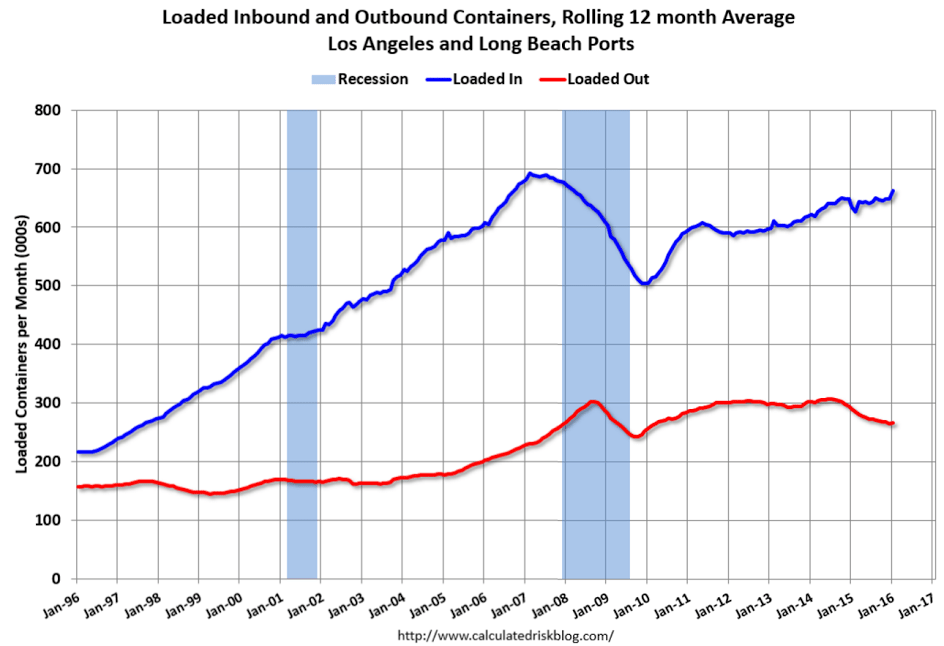
Atlanta Fed, Japan GDP, Consumer comment. LA port traffic

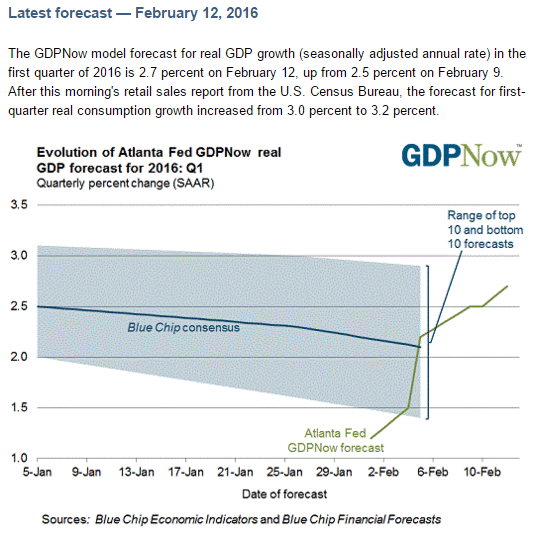
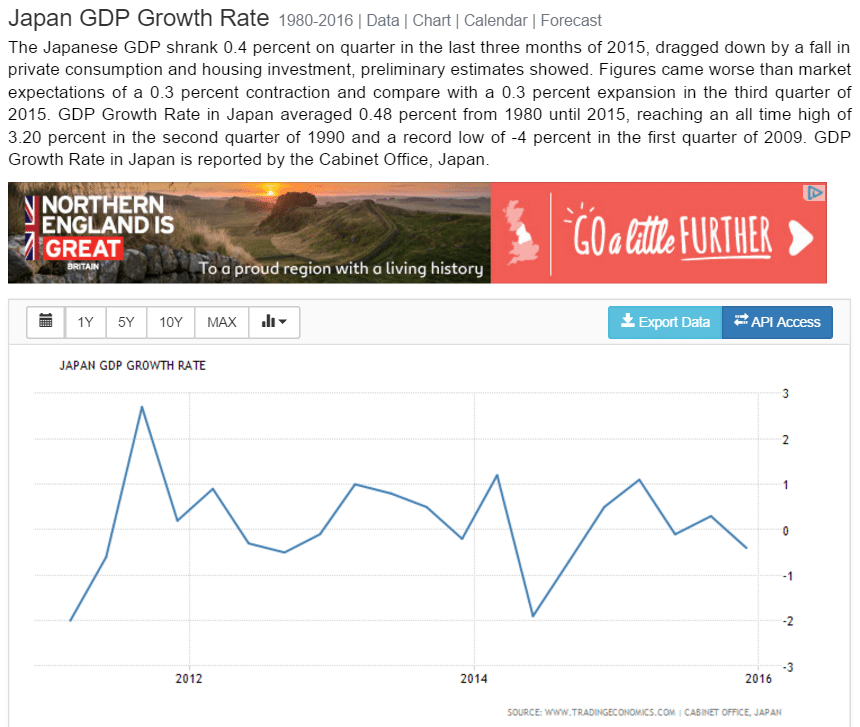
This is supported by increases in inventories that were already too high and likely to either be revised down or followed buy large declines for the rest of Q1. The retail sales number is also suspect and likely to revert to lower numbers:
er-2-15-1
er-2-15-2

The Myth Of The Resilient Consumer

By Lakshman Achuthan

The premise of incomes powering a consumer-driven pickup in U.S. economic growth is demonstrably false. And for people renting their homes the squeeze is even greater.

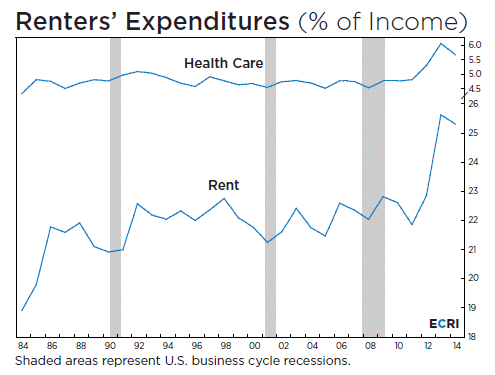
One clue is the extent of the increase in health care spending in recent years. Renters’ expenditures on health care as a percentage of after-tax income – after hovering around 4¾% for over a quarter century through 2011 – rose to 6.1% in 2013 before easing a bit in 2014 (top line). Homeowners also saw an analogous rise in health care spending as a percentage of after-tax income (not shown).
er-2-15-3
Similarly, spending on rent as a percentage of after-tax income – after staying fairly stable around 22% for over a quarter-century through 2012 – soared well above 25% in 2013 before slipping slightly (bottom line).

It follows that, on average in 2013-14, renters spent an extra 4½% of their after-tax incomes on rent and health care combined than in the previous quarter-century or so. Judging by the surge in consumer spending for health care, as well as the steady uptrend in rental inflation, renters’ share of spending on health care and rent would have risen even higher during 2015.

Rent and health care expenses are essentially non discretionary expenditures. Spending more on these items by an extra 5% or so of after-tax incomes puts a serious dent in discretionary spending budgets. This holds especially true given the double-digit declines in real average household income for the lion’s share of households since the turn of the century (USCO Essentials, October 2015).

In the context of this structural squeeze on family budgets, the current cyclical downturn in consumer spending growth is unwelcome news for anyone relying on the U.S. consumer to power economic growth in 2016.

In any event, it should be evident that the case for a full-blown Fed rate hike cycle cannot reasonably rest on the presumption of robust consumer spending, notwithstanding the decline in the unemployment rate to what the Fed considers “full employment.”

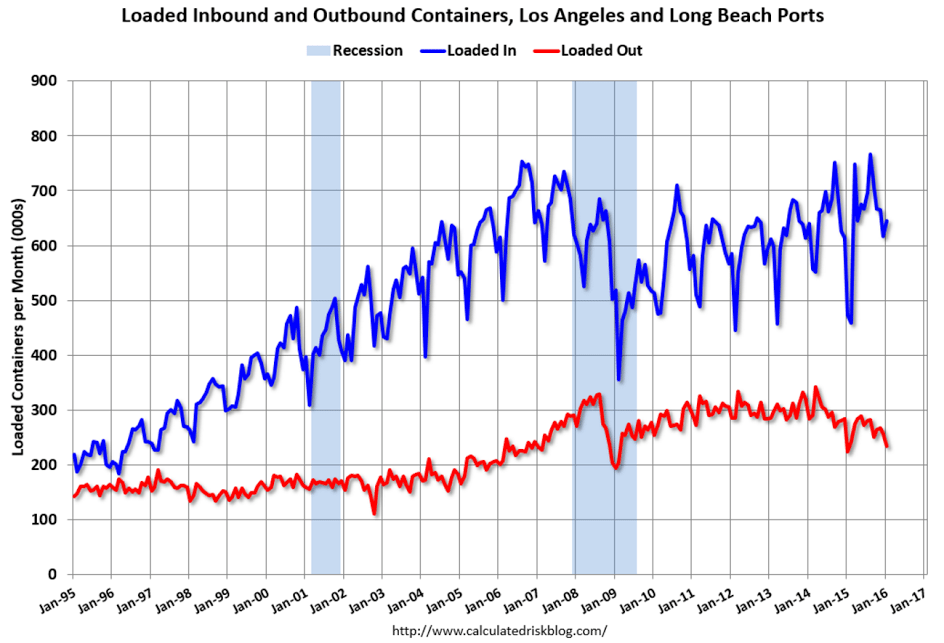
Looks like imports up and exports down- not good for GDP:
er-2-15-4
er-2-15-5

Retail Sales, Import and Export prices, Business inventories, Consumer sentiment, Japan

Retail Sales
er-2-12-1
Highlights
Vehicles are back on top, helping to lift retail sales to a 0.2 percent gain in January. Excluding vehicles and pulled down by falling gas prices, sales inched only 0.1 percent higher. But retail sales excluding gasoline stations — which is a central reading given the price fall — are up 0.4 percent for a very respectable year-on-year gain of 4.5 percent. The reading excluding both autos and gasoline is also up 0.4 percent in the month for a year-on-year rate of plus 3.8 percent.

General merchandise sales, which have been soft reflecting price contraction for imports, rose a sharp 0.8 percent in January. Building materials rose 0.6 percent as did vehicles where the year-on-year rate is at plus 6.9 percent. Non-store retailers, reflecting building strength for e-commerce, are once again a standout, up 1.6 percent for a year-on-year 8.7 percent gain.

But there are soft spots in January including restaurants, down 0.5 percent but following a very strong run in prior months, and also furniture, also down 0.5 percent. Sporting goods, a discretionary but still small component, were also weak though the year-on-year rate is leading all the data at 9.1 percent.

A positive are upward revisions to December, now at plus 0.2 percent overall with ex-auto ex-gas now at plus 0.1 percent. Though many readings are modest, this report — especially the ex-gasoline reading — points to a healthy U.S. consumer and should lift confidence in first-quarter growth.

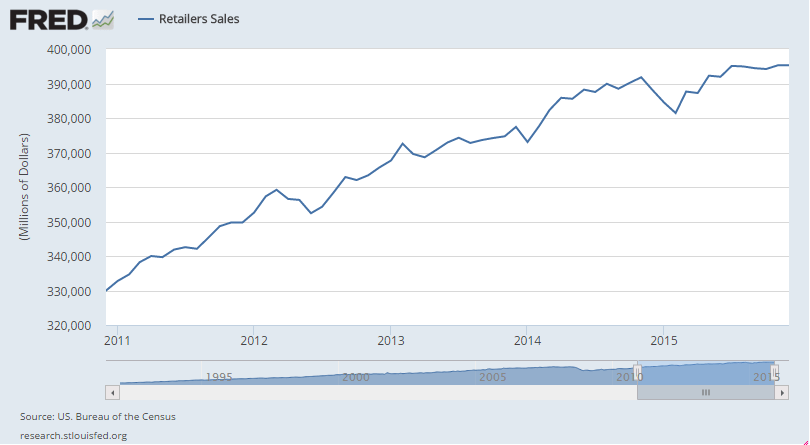
Doesn’t look all that strong to me. And there’s been an conspicuous flattening since July:
er-2-12-2
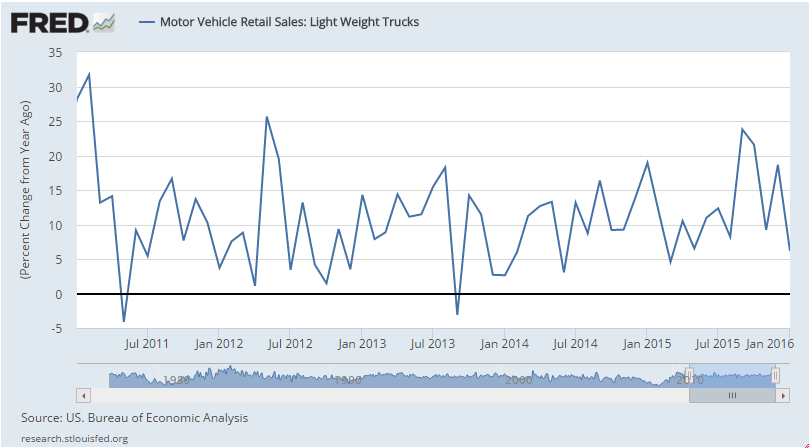
Just an fyi on light weight truck sales- growth has been falling off:
er-2-12-3
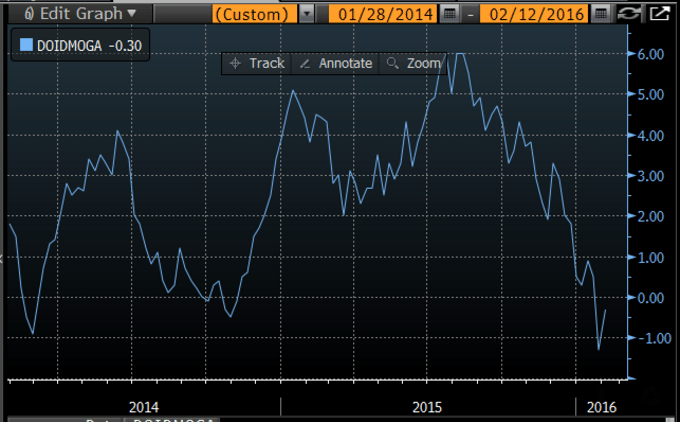
DOE gasoline output implied demand, year over year, 8 week moving average.

Growth rate has gone negative:
er-2-12-4
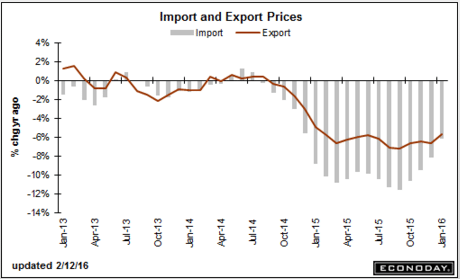
Deflationary bias continues:

Import and Export Prices
er-2-12-5
Highlights
Import price pressures are negative and severe but are increasingly centered in oil-based goods. Import prices fell 1.1 percent in January but fell only 0.2 percent when excluding petroleum imports. Year-on-year, total import prices are down 6.2 percent, which is steep but still an improvement from prior months. When excluding petroleum, import prices are down a year-on-year 3.1 percent (perhaps modest by comparison) which is also an improvement. But petroleum deflation is severe, with import prices down 13.4 percent in January for a year-on-year minus 35.3 percent.

Export prices fell 0.8 percent in January and reflect, in bad news for the farming sector, a 1.1 percent decline in prices of agricultural exports. Year-on-year, export prices are down 5.7 percent with agricultural products down 12.7 percent.

Price contraction for finished goods is easing though only incrementally. Import prices for both vehicles and consumer goods inched higher in the month with contraction in year-on-year rates narrowing, to only minus 0.3 percent for consumer goods. The export side also shows price improvement.

By countries, import prices with Canada, reflecting fuel prices, continue to fall severely, down 2.8 percent in the month for a year-on-year minus 12.6 percent. Latin America is next, down 1.2 percent and 7.8 percent on the year. Other regions are much narrower with China at minus 0.1 percent in the month and minus 1.6 percent on the year.

This report does fit in with FOMC expectations for an easing downward pull from import prices, at least excluding oil with prices for the latter, sooner or later as policy makers argue, certain to firm. An immediate plus is ongoing strength in the dollar which is pointing to easing import-price contraction for the February report.

er-2-12-6
Inventories still too high and climbing as sales continue to fall short of expectations:

Business Inventories
er-2-12-7

er-2-12-8
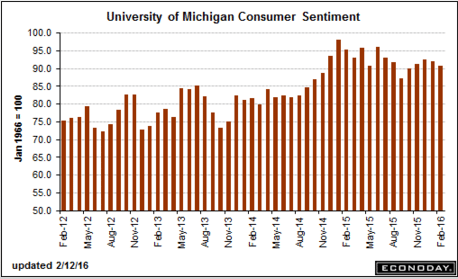
More softening of buying plans:

Consumer Sentiment
er-2-12-9

er-2-12-10

Japan Finance Minister says will take necessary steps to deal with FX volatility

Wholesale inventories, Small business index, Redbook retail sales

And another bad one as sales are falling just as fast as inventories:

Wholesale Trade
er-2-9-1
Highlights
Wholesale inventories fell an as-expected 0.1 percent in December with November revised 1 tenth lower to minus 0.4 percent. Wholesalers have been liquidating inventories as sales have been falling, down 0.3 percent in the latest month following a 1.3 percent sales decline in November. And they’ve been successful, keeping down the stock-to-sales ratio at 1.32 the last two reports which is still however up noticeably from 1.24 in December 2015. The factory sector hasn’t been as successful keeping down inventories, showing a 0.2 percent rise in December. This sets the stage for December retail inventories which will be released with the business inventories report on Friday following the retail sales report.

er-2-9-2
Been heading south ever since oil capex collapsed:
er-2-9-3

Small business optimism index fell back sharply in January, to 93.9 from December’s 95.2 and reflecting deepening pessimism over both the economic outlook and sales expectations. Plans to increase employment also came down but nevertheless remain solidly in the plus column. And two important components remain exceptionally positive, jobs hard to fill and plans to increase capital outlays with the latter pointing to future hiring and belying the negative expectations for the economy. But key negatives also include pessimism over earnings, a trend that doesn’t support hiring or business investment. The details are mixed to downbeat in this report, one that falls in line with the general tenor so far of January’s economic data.

This keeps getting worse even as comps with last year get ‘easier’:
er-2-9-4

Car sales, Redbook retail sales, Bank loans

This is being spun as a positive, when all I see is a chart showing the seasonally adjusted annual rate of sales peaked several months ago and is going down:

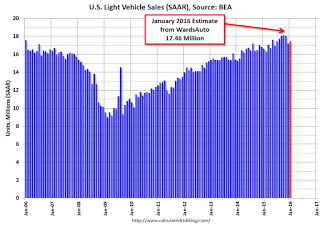
U.S. Light Vehicle Sales at 17.46 million annual rate in January

Based on an estimate from WardsAuto, light vehicle sales were at a 17.46 million SAAR in January.

That is up about 5% from January 2015, and up about 1.4% from the 17.2 million annual sales rate last month.
er-2-3-1
This graph shows the historical light vehicle sales from the BEA (blue) and an estimate for December (red, light vehicle sales of 17.46 million SAAR from WardsAuto).

This close to the consensus forecast of 17.5 million SAAR (seasonally adjusted annual rate).

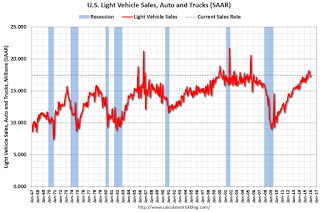
The second graph shows light vehicle sales since the BEA started keeping data in 1967.
er-2-3-2
Vehicle SalesNote: dashed line is current estimated sales rate.

This was at expectations, and vehicle sales in 2016 are off to a solid start.

Highlights
Unit vehicle sales slowed going into year-end but moved higher in January, to a 17.6 million annual pace vs expectations for 17.4 and against December’s 17.3 million. Strength was centered in North American-made vehicles where the annual sales rate rose to 14.2 million vs expectations for only 13.6 million and vs 13.9 million in December. Sales of imports slowed to 3.4 million from 3.5 million. Strength on the domestic side of this report not only points to strength for vehicle manufacturing but also to strength for the motor vehicle component of the monthly retail sales report where results have been uneven. This report is another positive indication for the U.S. consumer.
er-2-3-3

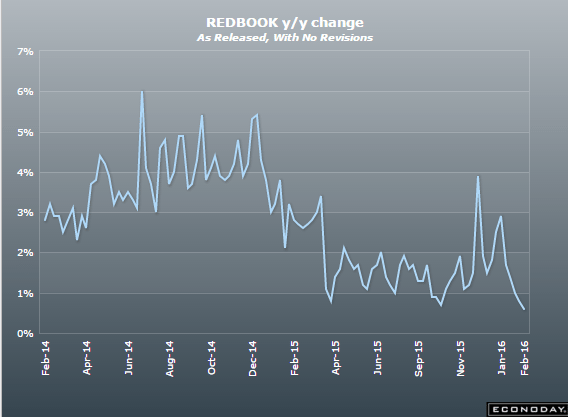
Another bad report being spun as good:

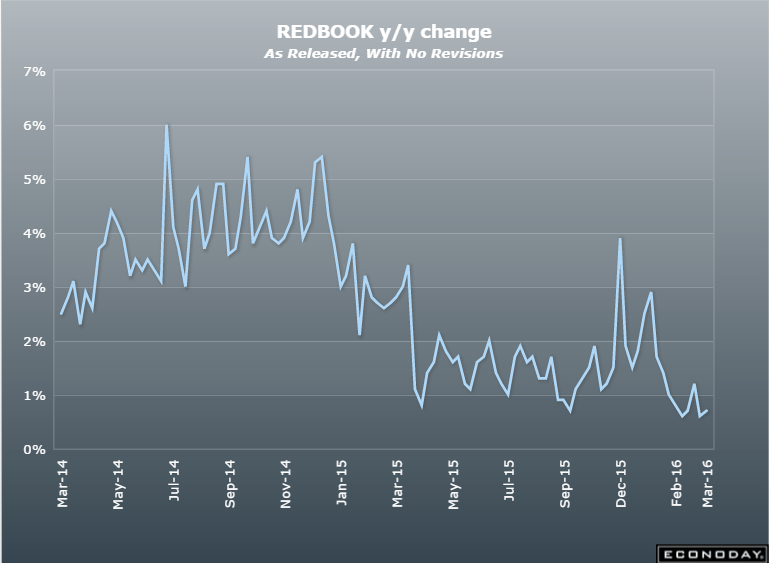
Redbook
er-2-3-4
Highlights
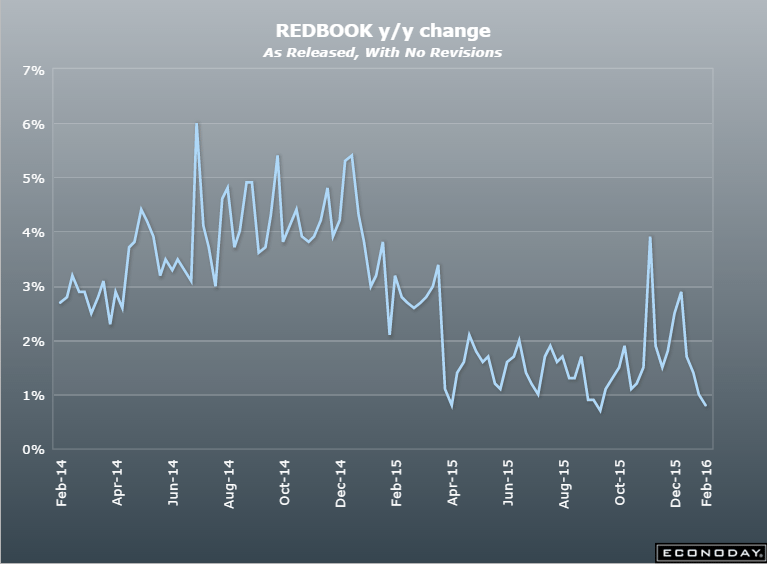
The severe snowstorm that hit the Mid-Atlantic and Northeast held down same-store sales growth in the January 30 week, to plus a year-on-year 0.8 percent. This is the lowest weekly reading since October and, together with the 1.2 percent rate for the whole month, hints at another month of trouble for the government’s retail sales report. But the report focuses not on January but on February where it sees year-on-year sales finishing at a more respectable 1.4 percent. The major events for February are the Super Bowl, Valentine’s Day, and President’s Day.
er-2-3-5

Investors aren’t the only ones running for safety as the market tumbles and the economy wobbles.

Businesses, too, are indicating an unwillingness to take on risk as loan demand declined for the first time in about four years, according to the Federal Reserve’s Senior Loan Officer Survey released this week.

Demand for commercial and industrial loans has plunged in 2016, with declines happening across business sizes. Large- and medium-sized businesses had an 11.1 percent decline, while demand from small businesses fell 12.7 percent.

Maybe stocks aren’t buying the spin any more?
er-2-3-6

Mtg purchase apps, Vehicle sales, Oil capex, Business equipment borrowing, Equipment sales, New home sales

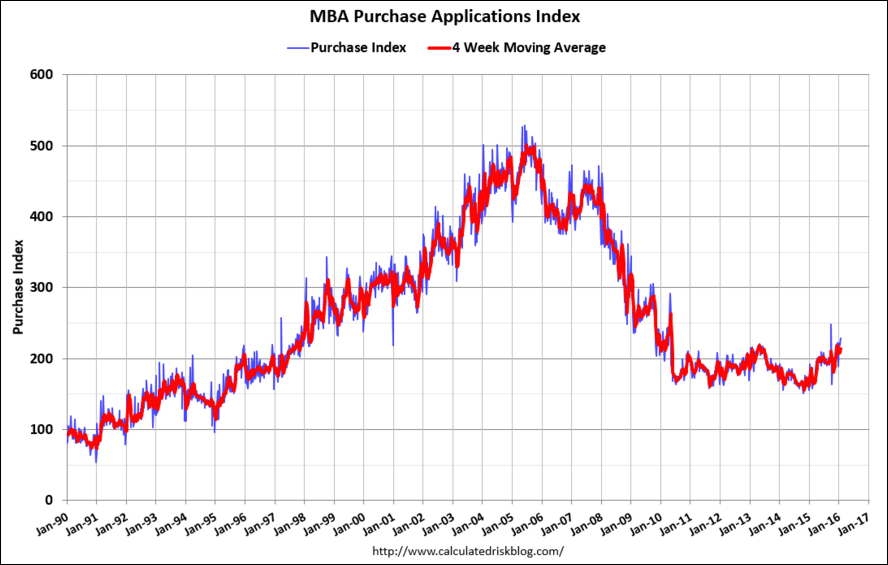
Inching up a bit but still seriously depressed:

MBA Mortgage Applications
er-1-27-1
Highlights
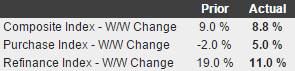
Weekly mortgage applications have been very volatile so far this year but mostly to the upside. Purchase applications jumped 5.0 percent in the January 22 week with refinancing applications up 11.0 percent. Low mortgage rates are driving the activity, down 4 basis points in the week to an average 4.02 percent for 30-year conforming loans ($417,000 or less).
er-1-27-2

Looks like Wards is forecasting no improvement in the annual selling rate that has been decelerating from over 18 million per year for the last several months:

Forecast: January SAAR Set to Reach 10-Year High

A WardsAuto forecast calls for U.S. automakers to deliver 1.13 million light vehicles in January.

The resulting daily sales rate (DSR) of 47,126 units, a 10-year high for the month, over 24 days represents a 6.8% improvement from like-2015 (26 days) and a 19.2% month-to-month decline from December (28 days).

The 5-year average December-to-January decline is 26%, but the traditional pull-ahead of sales in December was not as strong as expected this time. Lighter deliveries allowed dealers to remain well-stocked with vehicles highest in demand going into January.

The report puts the seasonally adjusted annual rate of sales for the month at 17.3 million units, compared with a year-ago’s 16.6 million and December’s 17.2 million.

US shale firms, struggling to profit with US$30 oil, slash spending more

Three major U.S. shale oil companies have slashed their 2016 capital spending plans more than expected in a bid to survive $30 a barrel oil prices, with one of them saying prices would need to rise more than 20 percent just to turn a profit.

The cuts on Monday from Hess Corp, Continental Resources and Noble Energy ranged from 40 percent to 66 percent. This marks the second straight year of pullbacks by a trio of companies normally seen as among the most resilient shale oil producers.

The cuts were steeper than expected. Analysts at Bernstein Energy had forecast an average 2016 spending cut for the sector of 38 percent.

The reductions show budgets may shrink more this year than they did last year, when spending fell between 20 percent and 50 percent. Output at some companies may fall for the first time ever.

“It’s very rare to have spending decline two years in a row,” said Mike Breard, oil company analyst with Hodges Capital Management in Dallas. “Any budget you see published now is going to be much lower than last year.”

But last year many operators managed to lift output as they devised new ways to coax more oil from rock, a feat that seems unlikely to be repeated.

In a sign that a reckoning has come, Continental admitted it will pump about 10 percent less oil this year as it can no longer afford or innovate and sell more oil at depressed prices.

The U.S. government projects domestic crude output to fall by about 700,000 barrels per day (bpd) by the end of this year to around 8.5 million bpd.

Depressed spending typically means fewer drilling rigs. All three companies said they would cut the number of rigs boring new wells in U.S. shale oil fields across Texas, North Dakota and elsewhere.

“If you cut your budget 60 percent, you may drill 40 percent fewer wells and your production is going to drop a considerable amount,” said Breard.

Continental, North Dakota’s second-largest oil producer, said it would slash its 2016 capital budget by 66 percent. The company made the risky move of getting rid of hedges in the fall of 2014. [L2N15A2MB] Led by billionaire wildcatter Harold Hamm, Continental plans to spend $920 million this year, down from $2.7 billion in 2015.

Oklahoma City-based Continental said it will not become profitable until oil prices return to $37 per barrel. U.S. oil prices closed Tuesday at $31.45 per barrel.

Meanwhile, New York-based Hess plans to spend $2.4 billion in 2016, down 40 percent from $4 billion last year.

Noble cut its quarterly dividend 44 percent and said it will cut spending about 50 percent this year.

On the other end of the spectrum, Pioneer Natural Resources, known for its aggressive hedging program, said this month it would spend between $2.4 billion and $2.6 billion this year.

Though Pioneer will fund its 2016 budget in part from a $500 million asset sale, the modest increase from $2.2 billion in 2015 makes the company a relative outlier at a time when most companies are trimming capex by amounts similar to last year’s drastic cutbacks.

U.S. business borrowing for equipment falls in December: ELFA

Borrowing by U.S. companies to spend on capital investment declined 5 percent in December, trade association Equipment Leasing and Finance Association (ELFA) said.

Companies signed up for $12.5 billion in new loans, leases and lines of credit last month, less than a year earlier, but more than double from November, ELFA said.

Cumulative new business volume inched up 0.4 percent for 2015, relatively flat with 2014, ELFA said

Caterpillar warns equipment sales still falling

Caterpillar saw retail sales of machinery fall 16 percent worldwide for the three-month period ended in December, the construction and mining equipment company said on Wednesday.

Caterpillar, which is due to report earnings on Thursday, has been pressured by the global slowdown in the energy and mining industries.

The company said retail sales to resource industries worldwide fell 38 percent over the three-month period, while retail sales to the energy industries fell 32 percent.

The pace of declines is also increasing, the company noted in an SEC filing. The worldwide decline in retail sales of machines had been 11 percent for the three months ended in November.

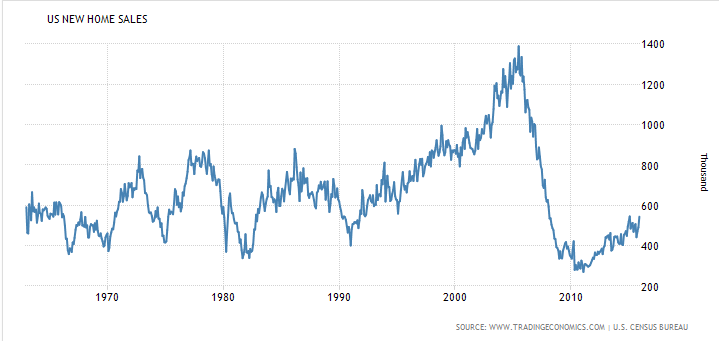
New home sales better than expected, but still near the lows of prior recessions all the way back to the 1960’s when the population was about 60% of what it is now:

New Home Sales
er-1-27-3
er-1-27-4

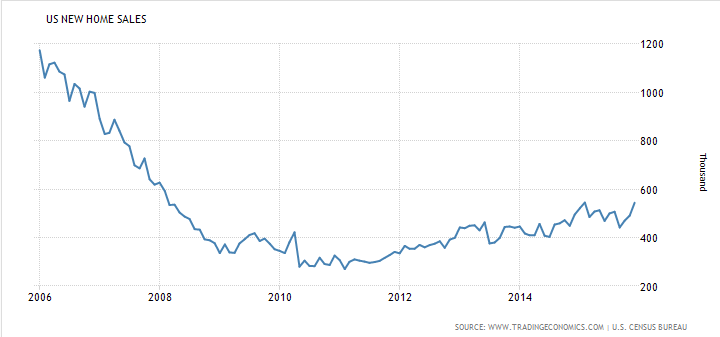
This is just the last 10 years:
er-1-27-5