OPEC cuts production by 1.5 million barrels a day


[Skip to the end]

I take this as a signal that the Saudis (and probably Russians as they just met with the Saudis) have decided to hold or raise prices and let quantity sold adjust.

Fuel prices are low enough to restore growth in demand with any positive economic performance.

Oct. 24, 2008

The Organization of Petroleum Exporting Countries decided to make a deep cut in oil production, taking 1.5 million barrels a day off global markets as it embarks on the task of managing prices amid a potential global recession.

December light, sweet crude oil futures fell $3.34 to $64.50 a barrel in electronic trading on the New York Mercantile Exchange by midday in London.


[top]
Re: Russia/OPEC


[Skip to the end]

(email exchange)

Thanks! it’s all about price setting, as previously suspected.

Warren

>   
>   On Thu, Oct 23, 2008 at 10:09 AM, Scott wrote:
>   
>   Moving on, we note that Russia and OPEC held high level talks
>   yesterday in Moscow as President Dmitry Medvedev met with OPEC’s
>   Secretary-General, Abdallah Salem al-Badri. This is, to the best of our
>   knowledge, the first such “summit” meeting between Russia and OPEC.
>   The talks, apparently, were to discuss the volatile oil market, and it
>   appears that Moscow is pushing for wider and more open co-operation
>   with other world energy producers. Neither the Kremlin nor OPEC
>   released details of the meeting, but before the talks between he and
>   Mr. Medvedev began, Mr. al-Badri dispensed with the idea that he’d
>   come to Moscow to ask for an output reduction. Obviously we do not
>   believe that statement, nor should anyone else. It is in OPEC’s best
>   interest to get Russia, Norway, and any other large… or soon to be
>   large, such as Brazil… to curtail production. Further, the ‘summit’
>   followed an agreement between Russia, Qatar and Iran to consult with
>   one another on the natural gas market, to possibly pursue joint
>   projects and perhaps to create their own nat-gas cartel. Mischief is
>   afoot. We can just sense it.
>   


[top]

OPEC to cut output


[Skip to the end]

Saudis still price setters, this is just a smoke screen to disguise that. The great Mike Master’s sell off that also triggered the last leg of the financial crisis must have run it’s course in the crude markets. Price hikes may return, this time with no excess inventory and very weak world economies. If their motives are the destruction of the Great Satans and Putin is with them it’s going to get very, very ugly.

OPEC’s oil supply must be ‘significant’- Khelil

(Reuters)- OPEC oil producers will cut oil supplies when they meet next week in Vienna and “the reduction must be significant,” the group’s president, Chakib Khelil, was quoted as saying on Saturday.

“There will be a reduction of the output and the reduction must be significant to restore the balance between supply and demand,” Algerian state news agency APS quoted Khelil as telling reporters.

The Organization of the Petroleum Exporting Countries will hold an emergency meeting on Oct. 24 in Vienna to discuss the impact of economic weakness on oil markets.

“If the cut is 1.5 million barrels per day, then it will be 1.5 million barrels. If it is 2.0 million barrels per day, it will be 2.0 million barrels per day,” added Khelil, who is also Algeria’s energy and mining minister.

Saudis will just start raising their posted prices and let their quantity adjust. The fall in demand for their output won’t be all that much as prices rise, suggesting to an unsuspecting world OPEC didn’t cut as much as they proclaimed.

Earlier, Khelil was quoted in Saturday’s edition of Algerian daily El Watan as saying that OPEC saw oil prices bottoming at $70-$90 per barrel.

“Normally, OPEC has no price target. The market decides on prices. But people say that the bottom price, the bottom cost below which we can not step down, is between $70 and $90 per barrel,” El Watan quoted Khelil as telling reporters.

What they are really saying is the Saudis decide the price, and the markets then determine how much they want to buy at that price.

He cited cases of Canada and Brazil, where oil could not pumped if prices were to fall below $70 per barrel.

On Friday, Khelil told Algerian state radio a “decision will be taken to lower oil supply by some OPEC members so that the oil price will not be damaged.

“This decision will not be implemented immediately because there are contracts, but will probably be implemented 40 days after it (the decision) is taken.” He did not say which countries were likely to cut supplies.


[top]

Crude oil demand


[Skip to the end]

World demand still projected to increase.

Crude Oil Rises From 13-Month Low on European Bank Rescue Plan

by Gavin Evans

The International Energy Agency, an adviser to 28 nations, on Oct. 10 cut its forecast for global oil demand for 2008 to 0.5 percent, the lowest since 1993. Demand next year will rise by 700,000 barrels a day to 87.2 million, 440,000 barrels fewer than the Paris-based agency projected a month earlier.


[top]

Saudi Production falls slightly as Opec production falls 425,000 bpd


[Skip to the end]

Production falling some but overall demand probably remains high, as reported inventories remain very low, as the GMIL (Great Master’s Inventory Liquidation) may still be a factor as more pension funds resist adding to passive commodity strategies.

Several months ago a Saudi official said he though $85 was the ‘right’ price, but that doesn’t mean it’s their target.

They are still price setter, until their production is forces down by several million bpd by excess supply.

Meanwhile, lower crude prices both support the $US and help keep a lid on headline inflation.

OPEC September Crude Output Down 425,000 Bbl/Day to 32.19 Million

New York, Oct. 3 (Bloomberg) Crude-oil production from the 13 OPEC members in September declined 425,000 barrels a day from August, the latest Bloomberg survey of producers, oil companies and industry analysts shows. Figures are in the thousands of barrels a day.

Opec Production
September 2008

Opec Country Sept. Est. Aug. Output Monthly Change Nov. 1 Target Est. vs. Target Est. Cap. (@)
Algeria 1,400 1,410 -10 1,357 43 1,450
Angola** 1,800 1,880 -80 1,900 -100 1,930
Ecuador 500 500 0 520 -20 500
Indonesia 865 865 0 865 0 900
Iran 3,950 4,080 -130 3,817 133 4,100
Iraq** 2,135 2,310 -175 2,500
Kuwait# 2,600 2,600 0 2,531 69 2,650r
Libya 1,720 1,630 90 1,712 8 1,750
Nigeria 1,880 1,940r -60 2,163 -283 2,200
Qatar 880 880 0 828 52 900
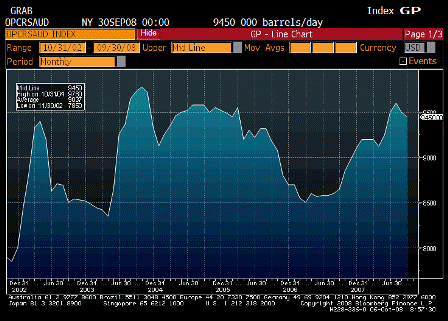
Saudi Arabia# 9,450 9,500 -50 8,943 507 10,800
U.A.E 2,650 2,660 -10 2,567 83 2,800r
Venezuela 2,360 2,360 0 2,470 -110 2,500
Total OPEC-13 32,190 32,165r -425 34,980r
Total OPEC-12* 30,055 30,305r -250 29,673 382 32,480r

**Iraq has no quota. Quotas effective Nov. 1, except for OPEC’s newest members,
Angola and Ecuador, who were formally assigned output targets Dec. 5, 2007.
OPEC announced a quota target of 28.808 million bbls/day at its Sept. 10
meeting but that figure excludes Indonesia who plans to leave the producer formally at year-end.

Totals rounded.

r = revised @ = Capacity attainable within 30 days and sustainable for 90 days.
# Includes Neutral Zone production shared equally between Saudi Arabia & Kuwait.


[top]

Bloomberg: Euro refineries to shut for repairs


[Skip to the end]

This happens when margins get too low: cheaper to shut for repairs than to operate at a loss.

Saudi output should fall a bid due to lack of demand, but crude prices should hold at their levels.

Gasoline prices should increase vs crude prices (crack spreads widen).

Shell, BP to Shut Refineries for Repair, Cut Europe Fuel Supply

by Nidaa Bakhsh

Sept. 25 (Bloomberg) Royal Dutch Shell Plc, BP Plc and Total SA are leading oil companies that will shut at least 6 percent of Europe’s refining for repairs next month, reducing inventories already diminished by U.S. demand after Hurricane Ike.

The outages from Rotterdam to Italy will idle at least 952,000 barrels of crude oil distillation a day in October, double the September figure, according to data compiled by Bloomberg. The total includes plants owned by Shell and BP in the Netherlands, representing a combined 400,000 barrels a day.

Refinery profits in western Europe fell to their lowest level since at least 2004 this year as record prices cut fuel demand. Gasoline inventories fell 18 percent to 612,000 metric tons in the Amsterdam-Rotterdam-Antwerp region last week, according to Dutch consultant PJK International BV, because of rising exports to the U.S. after Hurricane Ike shut Gulf Coast refineries.


[top]

US gasoline demand


[Skip to the end]

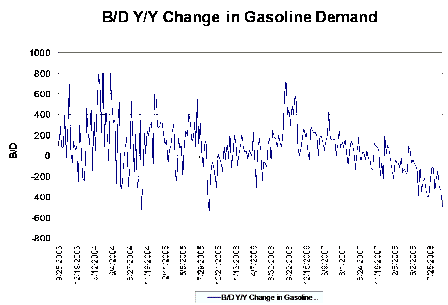
While demand has been falling, it’s only down about 500,000 bpd year over year. World demand is growing faster than that and is still forecast to grow by about 1 million bpd in 2009, last I heard.

This means the demand for Saudi crude will stay more than high enough for them to continue to be swing producer/price setter.

Change in Gasoline Demand


[top]

Re: Comments on Thoughts on Treasury plan


[Skip to the end]

(an interoffice email exchange)

>   
>   On Fri, Sep 19, 2008 at 9:50 AM, David wrote:
>   So creating liquidity for toxic assets RTC style.
>   

maybe, jury is still out on how that might work

>   
>   Make the government a little money and inspire confidence in banks, ok.
>   
>   We are thinking that this is overtly inflationary for financial assets (maybe all
>   assets?)
>   

supports a lot of equity value by removing a large element of risk, but cost to shareholders still unknown

fixed income going higher in yield, prices there going down

>   
>   Should I expect this to re-inflate the commodity asset bubble in the medium
>   term???
>   

not directly. crude price up to the Saudis.

>   
>   Do you think the dollar’s rally will help cap any commodity asset price rise???
>   

yes, in the competitive markets. crude is not a competitive market. saudis merely set price and let quantity adjust

>   
>   PS- I expected to come in today to $110+ crude, $8+ gas, and $900+ gold.
>   

as above. crude up even with dollar up, but gold down.

warren


[top]

MediaCorp: Russia to visit the Caribbean


[Skip to the end]

The last statement is most troubling.

Venezuela expels US ambassador, threatens to halt oil trade

CARACAS: Venezuelan President Hugo Chavez expelled the US envoy to Caracas late Thursday and threatened to halt crude exports to the United States on a day he highlighted the recent arrival of two Russian Tu-160 strategic bombers.

Chavez on Thursday ordered US ambassador Patrick Duddy to leave the country within 72 hours, in a move he described as an act of solidarity with Venezuela’s ally Bolivia, which also expelled its US envoy.

“Starting at this moment the Yankee ambassador in Caracas has 72 hours to leave Venezuela,” Chavez said at a public event in the port city of Puerto Cabello, 120 kilometres west of Caracas.

He said it was “in solidarity” with the leftist government of President Evo Morales in Bolivia, which on Wednesday ordered the US ambassador to La Paz to leave. Washington late Thursday expelled Bolivia’s ambassador to the United States.

Chavez then threatened to halt the supply of oil to the United States, its main client, if Washington attacks his government.

“If there is any aggression towards Venezuela” from Washington, “there would be no oil for the people of the United States,” said Chavez, who used coarse expletives to disparage the US government.

Chavez also announced Thursday that his government had uncovered a coup plot hatched by active and retired military officers, which he said had tacit US approval.

A military prosecutor said two officers — retired general Wilfredo Barroso and retired major Elimides Labarca Soto – will be tried for incitement to rebellion, a charge punishable by five to 10 years in prison.

At least eight other officers were detained in connection with the plot and were being interrogated, the prosecutor said.

Venezuelan public television aired a recorded conversation allegedly between three high-ranking retired military officers discussing plans to storm the presidential palace in Caracas, target Chavez, and blow up the presidential airplane.

“We have already detained several people,” Chavez said.

“Look, pitiyanquis, don’t even think of launching a coup or some madness such as this. I warn you, I am not the Hugo Chavez of 2002,” he said, referring to a failed coup attempt against him in April of that year, when he was briefly ousted for two days before mass protests saw him freed and return to power.

Chavez, a former paratroop officer, headed a failed coup attempt himself in 1992. He was elected president in 1999.

“I have no doubt at all that the United States is behind plans to bomb this palace,” Chavez said, warning that “difficult times” lied ahead for Venezuela.

The anti-US leader frequently alleges assassination and coup plots against him, usually pointing the finger at the United States.

Chavez said those behind the latest plot were part of the country’s “desperate political opposition” and “the American empire” led by US President George W. Bush.

Earlier in the day Chavez said the presence of two Russian Tu-160 strategic bombers in Venezuela is a “warning” to the US “empire,” as he announced another coup plot against him had been foiled and suspects arrested.

“It’s a warning. Russia is with us… we are strategic allies,” said Chavez. “It is a message to the empire. Venezuela is no longer poor and alone.”

Chavez had announced Wednesday that two Russian bombers were in Venezuela for “training flights” and that he would be piloting one of the aircraft himself.

“I hope that stings, ‘pitiyanquis’,” he said, using a derogatory term for Venezuelan opponents who have perceived US sympathies.

“What’s more, I’m going to take the controls of one of these monsters,” boasted the president, a former paratrooper and left-wing politician who has avowed antagonism towards the United States.

The United States said it would monitor the deployment of the two Russian bombers, which it described as “Cold War era assets,” to Venezuela.

The moves came amid soaring tensions between Russia and the United States, including over the presence of US naval vessels sent close to Russian shores to deliver aid to Georgia.

Russia said Monday it was dispatching a nuclear cruiser and other warships and planes to the Caribbean for the joint exercises with Venezuela – the first such manoeuvres in the US vicinity since the Cold War.


[top]