[Skip to the end]
Jan 13, 2009
The Crisis and Policy Response
(Some text omitted)
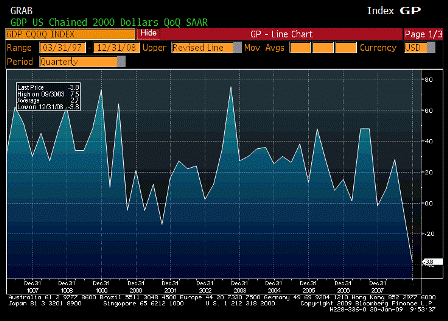
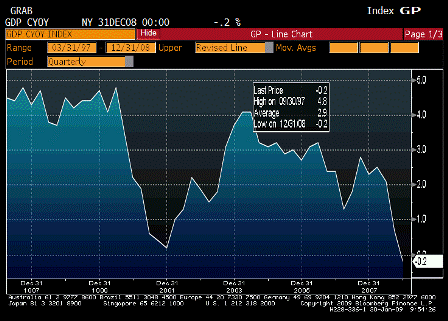
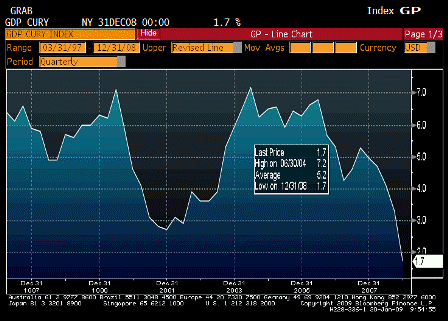
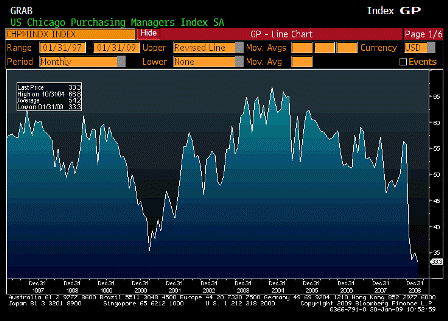
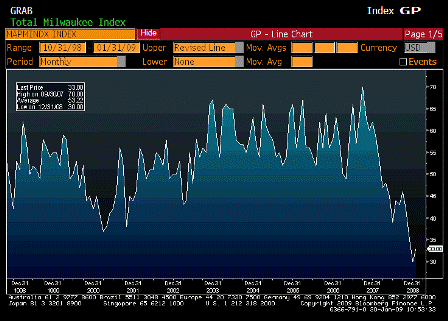
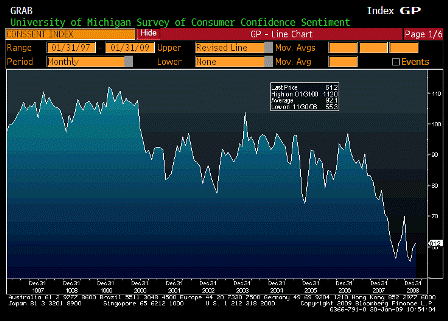
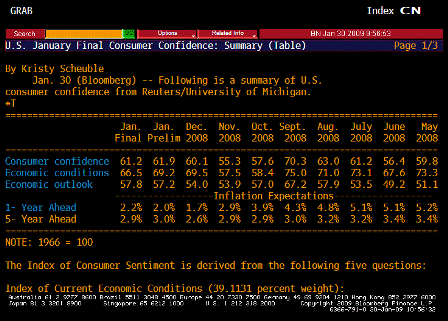
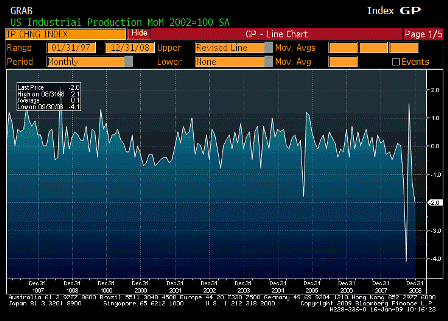
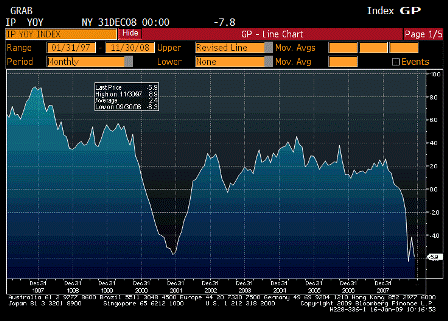
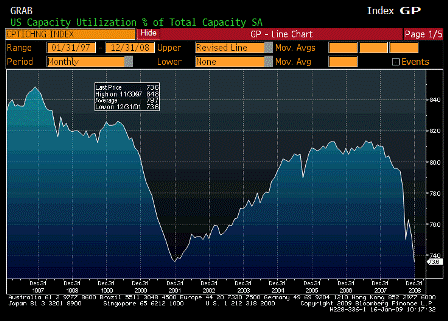
Heightened systemic risks, falling asset values, and tightening credit have in turn taken a heavy toll on business and consumer confidence and precipitated a sharp slowing in global economic activity. The damage, in terms of lost output, lost jobs, and lost wealth, is already substantial.
Yes, they have reduced aggregate demand. The question is what the Fed can do, if anything, to restore demand?
The global economy will recover, but the timing and strength of the recovery are highly uncertain.
Yes, after the federal budget deficit gets large enough to restore aggregate demand.
The Federal Reserve’s Response to the Crisis
The Federal Reserve has responded aggressively to the crisis since its emergence in the summer of 2007. Following a cut in the discount rate (the rate at which the Federal Reserve lends to depository institutions) in August of that year, the Federal Open Market Committee began to ease monetary policy in September 2007, reducing the target for the federal funds rate by 50 basis points.1 As indications of economic weakness proliferated, the Committee continued to respond, bringing down its target for the federal funds rate by a cumulative 325 basis points by the spring of 2008.
Maybe some day the underlying assumption that lower rates adds to aggregate demand will fall by the wayside.
The ‘math’ shows lower rates takes more income from savers than it adds to borrowers, as government is a net payer of interest.
The different propensities to consume between borrower and savers would have to be far wider than ever measured by econometrics to result in lower rates adding to demand.
In other words, there’s a good chance lower rates have made things worse.
In historical comparison, this policy response stands out as exceptionally rapid and proactive. In taking these actions, we aimed both to cushion the direct effects of the financial turbulence on the economy and to reduce the virulence of the so-called adverse feedback loop, in which economic weakness and financial stress become mutually reinforcing.
Lower rates have failed to do this. Maybe their ‘interest rate theory’ is backwards, as all evidence and logic shows???
These policy actions helped to support employment and incomes during the first year of the crisis.
No, incomes suffered from lower interest income. Employment was sustained from what was a temporary boom in exports and government spending.
Unfortunately, the intensification of the financial turbulence last fall led to further deterioration in the economic outlook. The Committee responded by cutting the target for the federal funds rate an additional 100 basis points last October, with half of that reduction coming as part of an unprecedented coordinated interest rate cut by six major central banks on October 8. In December the Committee reduced its target further, setting a range of 0 to 25 basis points for the target federal funds rate.
And all their economies got worse.
The Committee’s aggressive monetary easing was not without risks.
The largest risk was that Congress would believe they might help and not implement large enough fiscal measures, which is exactly what happened.
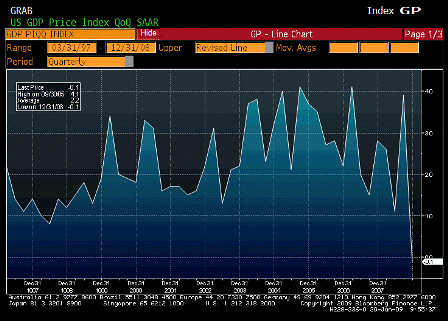
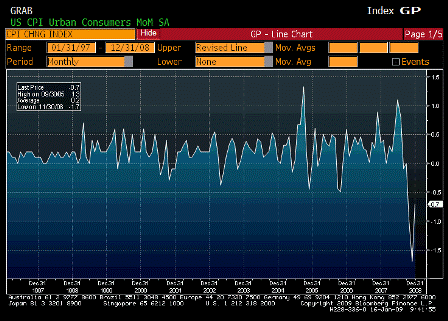
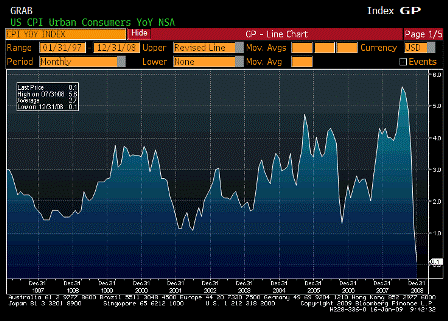
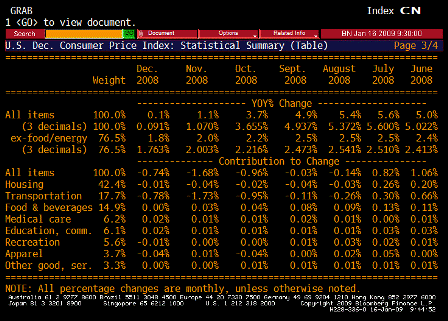
During the early phase of rate reductions, some observers expressed concern that these policy actions would stoke inflation. These concerns intensified as inflation reached high levels in mid-2008, mostly reflecting a surge in the prices of oil and other commodities.
As costs of production, lower interest rate reduce costs of national output.
The Committee takes its responsibility to ensure price stability extremely seriously, and throughout this period it remained closely attuned to developments in inflation and inflation expectations. However, the Committee also maintained the view that the rapid rise in commodity prices in 2008 primarily reflected sharply increased demand for raw materials in emerging market economies,
And pension funds and trend followers- don’t they know about that?
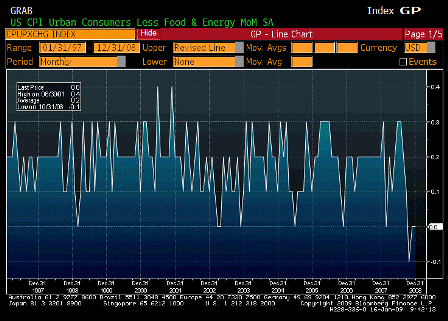
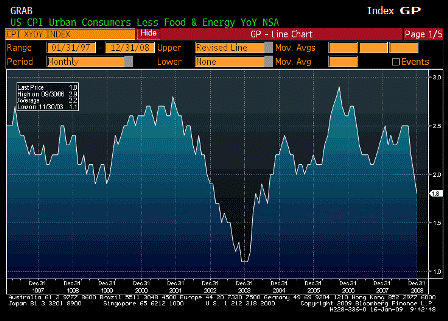
in combination with constraints on the supply of these materials, rather than general inflationary pressures. Committee members expected that, at some point, global economic growth would moderate, resulting in slower increases in the demand for commodities and a leveling out in their prices–as reflected, for example, in the pattern of futures market prices. As you know, commodity prices peaked during the summer and, rather than leveling out, have actually fallen dramatically with the weakening in global economic activity. As a consequence, overall inflation has already declined significantly and appears likely to moderate further.
No talk of the Great Mike Masters Futures Led Inventory Liquidation triggered in July.
It had nothing to do with monetary policy or the economy.
The Fed’s monetary easing has been reflected in significant declines in a number of lending rates, especially shorter-term rates, thus offsetting to some degree the effects of the financial turmoil on financial conditions.
They do control interest rates, whether they know it or not, and whether they know what buttons to push or not.
However, that offset has been incomplete, as widening credit spreads, more restrictive lending standards, and credit market dysfunction have worked against the monetary easing and led to tighter financial conditions overall. In particular, many traditional funding sources for financial institutions and markets have dried up, and banks and other lenders have found their ability to securitize mortgages, auto loans, credit card receivables, student loans, and other forms of credit greatly curtailed. Thus, in addition to easing monetary policy, the Federal Reserve has worked to support the functioning of credit markets and to reduce financial strains by providing liquidity to the private sector. In doing so, as I will discuss shortly, the Fed has deployed a number of additional policy tools, some of which were previously in our toolkit and some of which have been created as the need arose.
Beyond the Federal Funds Rate: The Fed’s Policy Toolkit
Although the federal funds rate is now close to zero, the Federal Reserve retains a number of policy tools that can be deployed against the crisis.
One important tool is policy communication. Even if the overnight rate is close to zero, the Committee should be able to influence longer-term interest rates by informing the public’s expectations about the future course of monetary policy.
It can also directly set risk-free long term rates by intervening in the treasury markets and/or swap markets, targeting rates and letting quantity fall where it may.
To illustrate, in its statement after its December meeting, the Committee expressed the view that economic conditions are likely to warrant an unusually low federal funds rate for some time.2 To the extent that such statements cause the public to lengthen the horizon over which they expect short-term rates to be held at very low levels, they will exert downward pressure on longer-term rates,
Why not just have a bid for long term rates at their target rate of choice?
stimulating aggregate demand.
This assumes aggregate demand is a function of rates, and in the direction they think it is. I would argue they are most likely backwards in that respect.
It is important, however, that statements of this sort be expressed in conditional fashion–that is, that they link policy expectations to the evolving economic outlook. If the public were to perceive a statement about future policy to be unconditional, then long-term rates might fail to respond in the desired fashion should the economic outlook change materially.
Other than policies tied to current and expected future values of the overnight interest rate, the Federal Reserve has–and indeed, has been actively using–a range of policy tools to provide direct support to credit markets and thus to the broader economy. As I will elaborate, I find it useful to divide these tools into three groups. Although these sets of tools differ in important respects, they have one aspect in common: They all make use of the asset side of the Federal Reserve’s balance sheet. That is, each involves the Fed’s authorities to extend credit or purchase securities.
The first set of tools, which are closely tied to the central bank’s traditional role as the lender of last resort, involve the provision of short-term liquidity to sound financial institutions. Over the course of the crisis, the Fed has taken a number of extraordinary actions to ensure that financial institutions have adequate access to short-term credit.
They are actually reversing extraordinary actions taken in the past to obstruct bank access to short term credit.
In particular demanding collateral from member banks when the Fed lends to them. This is both redundant (FDIC already insures bank deposits and regulates assets, etc.) and obstructive.
These actions include creating new facilities for auctioning credit and making primary securities dealers, as well as banks, eligible to borrow at the Fed’s discount window.3 For example, since August 2007 we have lowered the spread between the discount rate and the federal funds rate target from 100 basis points to 25 basis points;
Why is it above the Fed funds rate and not the same rate? The idea of a ‘penalty rate’ is a result of a lack of understanding of monetary operations with a non-convertible currency.
increased the term of discount window loans from overnight to 90 days;
Yes, this hints at what I was saying before- they can set the entire term structure of rates at will.
created the Term Auction Facility, which auctions credit to depository institutions for terms up to three months;
But sets a quantity and lets an auction process determine the rate. This is backwards. They should always set a rate and let the quantity fall where it may.
put into place the Term Securities Lending Facility, which allows primary dealers to borrow Treasury securities from the Fed against less-liquid collateral;
This is better done by having the Fed lend against that collateral directly. Not sure why they do it this way.
and initiated the Primary Dealer Credit Facility as a source of liquidity for those firms, among other actions.
That should have been done via their designated agents, the banks, via qualified guarantees.
Because interbank markets are global in scope, the Federal Reserve has also approved bilateral currency swap agreements with 14 foreign central banks. The swap facilities have allowed these central banks to acquire dollars from the Federal Reserve to lend to banks in their jurisdictions, which has served to ease conditions in dollar funding markets globally. In most cases, the provision of this dollar liquidity abroad was conducted in tight coordination with the Federal Reserve’s own funding auctions.
Yes, this was an act of madness- functionally unsecured loans of over $600 billion to foreign CBs.
Congress has no idea what’s going on, and I suspect they would put quick halt to this if they had any understanding of it.
There are far less risky alternatives to bringing LIBOR down to the Fed’s targets for it..
Importantly, the provision of credit to financial institutions exposes the Federal Reserve to only minimal credit risk; the loans that we make to banks and primary dealers through our various facilities are generally overcollateralized and made with recourse to the borrowing firm.The Federal Reserve has never suffered any losses in the course of its normal lending to banks and, now, to primary dealers. In the case of currency swaps, the foreign central banks are responsible for repayment, not the financial institutions that ultimately receive the funds; moreover, as further security, the Federal Reserve receives an equivalent amount of foreign currency in exchange for the dollars it provides to foreign central banks.
This is no different than the Fed buying foreign ‘dollar bonds’ from the foreign governments, which have repeatedly gone bad in the past.
Is he really thinking foreign governments ‘automatically’ are good credit risks?
The line to Mexico is $30 billion, for example, and the ECB line is actually stated to be ‘unlimited’.
The currency the Fed ‘receives’ is nothing more than a deposit on the foreign central banks own books.
And the outstanding total is over $600 billion!
How does he miss all this???
Liquidity provision by the central bank reduces systemic risk by assuring market participants that, should short-term investors begin to lose confidence, financial institutions will be able to meet the resulting demands for cash without resorting to potentially destabilizing fire sales of assets.
True. It should have been set up years ago to make sure the liability side of banking is not the place of market discipline.
Moreover, backstopping the liquidity needs of financial institutions reduces funding stresses and, all else equal, should increase the willingness of those institutions to lend and make markets.
On the other hand, the provision of ample liquidity to banks and primary dealers is no panacea. Today, concerns about capital, asset quality, and credit risk continue to limit the willingness of many intermediaries to extend credit, even when liquidity is ample. Moreover, providing liquidity to financial institutions does not address directly instability or declining credit availability in critical nonbank markets, such as the commercial paper market or the market for asset-backed securities, both of which normally play major roles in the extension of credit in the United States.
Lending is pro-cyclical, get over it! Only government can be counter cyclical with fiscal policy.
To address these issues, the Federal Reserve has developed a second set of policy tools, which involve the provision of liquidity directly to borrowers and investors in key credit markets.
Actually addresses interest rates.
Notably, we have introduced facilities to purchase highly rated commercial paper
Are these the same guys that were critical of investors relying on ratings agencies???
at a term of three months and to provide backup liquidity for money market mutual funds. In addition, the Federal Reserve and the Treasury have jointly announced a facility that will lend against AAA-rated asset-backed securities collateralized by student loans, auto loans, credit card loans, and loans guaranteed by the Small Business Administration. The Federal Reserve’s credit risk exposure in the latter facility will be minimal, because the collateral will be subject to a “haircut” and the Treasury is providing $20 billion of capital as supplementary loss protection. We expect this facility to be operational next month.
Interesting how he explains how the Fed is safe at least partially because it shifted risk to the treasury.
Seems they are both on the same team in the same game???
The rationales and objectives of our various facilities differ, according to the nature of the problem being addressed. In some cases, as in our programs to backstop money market mutual funds, the purpose of the facility is to serve, once again in classic central bank fashion, as liquidity provider of last resort. Following a prominent fund’s “breaking of the buck”–that is, a decline in its net asset value below par–in September, investors began to withdraw funds in large amounts from money market mutual funds that invest in private instruments such as commercial paper and certificates of deposit. Fund managers responded by liquidating assets and investing at only the shortest of maturities. As the pace of withdrawals increased, both the stability of the money market mutual fund industry and the functioning of the commercial paper market were threatened.
It was part of the ongoing process of shifting funding back to the banking system as risk was being re-priced.
The Federal Reserve responded with several programs, including a facility to finance bank purchases of high-quality asset-backed commercial paper from money market mutual funds. This facility effectively channeled liquidity to the funds, helping them to meet redemption demands without having to sell assets indiscriminately.
This obstructed the process of moving funding back to its own banking system. The assets were moving to spreads wide enough to be held in bank portfolios. The Fed could have facilitated that process rather than obstructing it.
Together with a Treasury program that provided partial insurance to investors in money market mutual funds, these efforts helped stanch the cash outflows from those funds
Outflows to the Fed’s member banks.
and stabilize the industry.
Which can only compete with banks with help from the Fed.
The Federal Reserve’s facility to buy high-quality (A1-P1) commercial paper
Again with the ratings agencies!
at a term of three months was likewise designed to provide a liquidity backstop, in this case for investors and borrowers in the commercial paper market. As I mentioned, the functioning of that market deteriorated significantly in September, with borrowers finding financing difficult to obtain, and then only at high rates and very short (usually overnight) maturities.
The Fed could have facilitated the transition back to the banking system with provisions for banks to obtain Fed funding for the assets moving in their direction. Again, they got it wrong.
By serving as a backup source of liquidity for borrowers, the Fed’s commercial paper facility was aimed at reducing investor and borrower concerns about “rollover risk,” the risk that a borrower could not raise new funds to repay maturing commercial paper. The reduction of rollover risk, in turn, should increase the willingness of private investors to lend, particularly for terms longer than overnight. These various actions appear to have improved the functioning of the commercial paper market, as rates and risk spreads have come down and the average maturities of issuance have increased.
Would have been more constructively accomplished via the banking system.
In contrast, our forthcoming asset-backed securities program, a joint effort with the Treasury, is not purely for liquidity provision. This facility will provide three-year term loans to investors against AAA-rated securities backed by recently originated consumer and small-business loans.
Again, part of the Fed’s position of rate setter, and again, could have been better done via its member banks.
Unlike our other lending programs, this facility combines Federal Reserve liquidity with capital provided by the Treasury, which allows it to accept some credit risk.
You’re on the same team, guys!
By providing a combination of capital and liquidity, this facility will effectively substitute public for private balance sheet capacity, in a period of sharp deleveraging and risk aversion in which such capacity appears very short.
The banking system is already public balance sheet as banks have unlimited access to a variety of federally insured liabilities.
Why not use the banks for the purpose they are designed for? They already have the infrastructure necessary to manage this.
Instead, the Fed hires private managers!!!
If the program works as planned, it should lead to lower rates and greater availability of consumer and small business credit. Over time, by increasing market liquidity and stimulating market activity, this facility should also help to revive private lending. Importantly, if the facility for asset-backed securities proves successful, its basic framework can be expanded to accommodate higher volumes or additional classes of securities as circumstances warrant.
Nothing the banks can’t do given the same guarantees from the Fed.
The Federal Reserve’s third set of policy tools for supporting the functioning of credit markets involves the purchase of longer-term securities for the Fed’s portfolio. For example, we recently announced plans to purchase up to $100 billion in government-sponsored enterprise (GSE) debt and up to $500 billion in GSE mortgage-backed securities over the next few quarters. Notably, mortgage rates dropped significantly on the announcement of this program and have fallen further since it went into operation.
Hopefully no surprise! Again, the Fed is rate setter for the entire term structure as desired.
Lower mortgage rates should support the housing sector. The Committee is also evaluating the possibility of purchasing longer-term Treasury securities.
It would be functionally identical for the treasury simply not to issue them, as proposed by the BOE’s Goodhart today.
In determining whether to proceed with such purchases, the Committee will focus on their potential to improve conditions in private credit markets, such as mortgage markets.
These three sets of policy tools–lending to financial institutions, providing liquidity directly to key credit markets, and buying longer-term securities–have the common feature that each represents a use of the asset side of the Fed’s balance sheet, that is, they all involve lending or the purchase of securities. The virtue of these policies in the current context is that they allow the Federal Reserve to continue to push down interest rates and ease credit conditions in a range of markets, despite the fact that the federal funds rate is close to its zero lower bound.
Yes! It’s about price (interest rates) and not quantity.
Credit Easing versus Quantitative Easing
The Federal Reserve’s approach to supporting credit markets is conceptually distinct from quantitative easing (QE), the policy approach used by the Bank of Japan from 2001 to 2006. Our approach–which could be described as “credit easing”–resembles quantitative easing in one respect: It involves an expansion of the central bank’s balance sheet. However, in a pure QE regime, the focus of policy is the quantity of bank reserves, which are liabilities of the central bank; the composition of loans and securities on the asset side of the central bank’s balance sheet is incidental. Indeed, although the Bank of Japan’s policy approach during the QE period was quite multifaceted, the overall stance of its policy was gauged primarily in terms of its target for bank reserves. In contrast, the Federal Reserve’s credit easing approach focuses on the mix of loans and securities that it holds and on how this composition of assets affects credit conditions for households and businesses. This difference does not reflect any doctrinal disagreement with the Japanese approach, but rather the differences in financial and economic conditions between the two episodes. In particular, credit spreads are much wider and credit markets more dysfunctional in the United States today than was the case during the Japanese experiment with quantitative easing. To stimulate aggregate demand in the current environment, the Federal Reserve must focus its policies on reducing those spreads and improving the functioning of private credit markets more generally.
Another similarity is that neither did much for credit demand.
Note that the Fed’s ‘expanded balance sheet’ means that over $2 trillion of financial assets have been shifted to the Fed in exchange for a like amount of excess reserves and treasury securities being held by the private, non-government sectors.
If the average coupon on the securities the Fed removed (purchased) from the private sector was maybe 2% (more for some securities, less for others) that means this Fed action has removed over $40 billion per year of income from the private sector. This means about that much aggregate demand was removed which can only be ‘replaced’ by private credit expansion.
Seems this policy might not have been all that well thought out.
While I support the lower interest rates, I also recognize they probably do not add to demand and instead require a fiscal adjustment to sustain demand.
The stimulative effect of the Federal Reserve’s credit easing policies depends sensitively on the particular mix of lending programs and securities purchases that it undertakes. When markets are illiquid and private arbitrage is impaired by balance sheet constraints and other factors, as at present, one dollar of longer-term securities purchases is unlikely to have the same impact on financial markets and the economy as a dollar of lending to banks, which has in turn a different effect than a dollar of lending to support the commercial paper market.
Most likely none of them change demand enough to even offset the loss of interest income to the private sector as above.
Because various types of lending have heterogeneous effects, the stance of Fed policy in the current regime–in contrast to a QE regime–is not easily summarized by a single number, such as the quantity of excess reserves or the size of the monetary base. In addition, the usage of Federal Reserve credit is determined in large part by borrower needs and thus will tend to increase when market conditions worsen and decline when market conditions improve. Setting a target for the size of the Federal Reserve’s balance sheet, as in a QE regime, could thus have the perverse effect of forcing the Fed to tighten the terms and availability of its lending at times when market conditions were worsening, and vice versa.
Finally, the Fed setting ‘price’ rather than ‘quantity!’ too bad it hasn’t figured this out for the TAFF and other operations.
The lack of a simple summary measure or policy target poses an important communications challenge. To minimize market uncertainty and achieve the maximum effect of its policies, the Federal Reserve is committed to providing the public as much information as possible about the uses of its balance sheet, plans regarding future uses of its balance sheet, and the criteria on which the relevant decisions are based.
We’ve seen the max effect.
Exit Strategy
Some observers have expressed the concern that, by expanding its balance sheet, the Federal Reserve is effectively printing money,
Only by narrow definitions of ‘money’ as below. Net financial assets held outside of government are always unchanged by Fed operations.
an action that will ultimately be inflationary.
Another questionable theory. But the Fed is worried about inflation expectations, which is yet one more questionable theory.
The Fed’s lending activities have indeed resulted in a large increase in the excess reserves held by banks. Bank reserves, together with currency, make up the narrowest definition of money, the monetary base; as you would expect, this measure of money has risen significantly as the Fed’s balance sheet has expanded. However, banks are choosing to leave the great bulk of their excess reserves idle, in most cases on deposit with the Fed.
There is no other option for the banking system as a whole.
Consequently, the rates of growth of broader monetary aggregates, such as M1 and M2, have been much lower than that of the monetary base. At this point, with global economic activity weak and commodity prices at low levels, we see little risk of inflation in the near term; indeed, we expect inflation to continue to moderate.
Right, as long as commodities keep going down.
However, at some point, when credit markets and the economy have begun to recover, the Federal Reserve will have to unwind its various lending programs. To some extent, this unwinding will happen automatically, as improvements in credit markets should reduce the need to use Fed facilities. Indeed, where possible we have tried to set lending rates and margins at levels that are likely to be increasingly unattractive to borrowers as financial conditions normalize. In addition, some programs–those authorized under the Federal Reserve’s so-called 13(3) authority, which requires a finding that conditions in financial markets are “unusual and exigent”–will by law have to be eliminated once credit market conditions substantially normalize. However, as the unwinding of the Fed’s various programs effectively constitutes a tightening of policy, the principal factor determining the timing and pace of that process will be the Committee’s assessment of the condition of credit markets and the prospects for the economy.
As lending programs are scaled back, the size of the Federal Reserve’s balance sheet will decline, implying a reduction in excess reserves and the monetary base. A significant shrinking of the balance sheet can be accomplished relatively quickly, as a substantial portion of the assets that the Federal Reserve holds–including loans to financial institutions, currency swaps, and purchases of commercial paper–are short-term in nature and can simply be allowed to run off as the various programs and facilities are scaled back or shut down.
It will be interesting to see how the currency swaps run off. In the past governments with that much in dollar loans have not paid them off.
As the size of the balance sheet and the quantity of excess reserves in the system decline, the Federal Reserve will be able to return to its traditional means of making monetary policy–namely, by setting a target for the federal funds rate.
Why would it not continue to set the term structure of rates??? (Though again, personally I’d leave a zero rate policy in place at all times)
Although a large portion of Federal Reserve assets are short-term in nature, we do hold or expect to hold significant quantities of longer-term assets, such as the mortgage-backed securities that we will buy over the next two quarters. Although longer-term securities can also be sold, of course, we would not anticipate disposing of more than a small portion of these assets in the near term, which will slow the rate at which our balance sheet can shrink. We are monitoring the maturity composition of our balance sheet closely and do not expect a significant problem in reducing our balance sheet to the extent necessary at the appropriate time.
Importantly, the management of the Federal Reserve’s balance sheet and the conduct of monetary policy in the future will be made easier by the recent congressional action to give the Fed the authority to pay interest on bank reserves. In principle, the interest rate the Fed pays on bank reserves should set a floor on the overnight interest rate, as banks should be unwilling to lend reserves at a rate lower than they can receive from the Fed. In practice, the federal funds rate has fallen somewhat below the interest rate on reserves in recent months, reflecting the very high volume of excess reserves, the inexperience of banks with the new regime, and other factors.
Yes, like a few institutions that still do not earn interest on reserves.
However, as excess reserves decline, financial conditions normalize, and banks adapt to the new regime, we expect the interest rate paid on reserves to become an effective instrument for controlling the federal funds rate.
Moreover, other tools are available or can be developed to improve control of the federal funds rate during the exit stage. For example, the Treasury could resume its recent practice of issuing supplementary financing bills and placing the funds with the Federal Reserve; the issuance of these bills effectively drains reserves from the banking system, improving monetary control. Longer-term assets can be financed through repurchase agreements and other methods, which also drain reserves from the system. In considering whether to create or expand its programs, the Federal Reserve will carefully weigh the implications for the exit strategy. And we will take all necessary actions to ensure that the unwinding of our programs is accomplished smoothly and in a timely way, consistent with meeting our obligation to foster full employment and price stability.
How about asking Congress for permission to trade Fed funds directly with member banks? Again, requiring collateral is redundant with FDIC insurance and regulation already in place. That way the Fed could simply bid and offer Fed funds at its target rate and the Fed funds rate would be perfectly stable, with little or no interbank trading required.
Stabilizing the Financial System
The Federal Reserve will do its part to promote economic recovery, but other policy measures will be needed as well. The incoming Administration and the Congress are currently discussing a substantial fiscal package that, if enacted, could provide a significant boost to economic activity. In my view, however, fiscal actions are unlikely to promote a lasting recovery unless they are accompanied by strong measures to further stabilize and strengthen the financial system. History demonstrates conclusively that a modern economy cannot grow if its financial system is not operating effectively.
I don’t agree. Ongoing attention to fiscal balance that sustains output and employment will do just that, with or without the financial sector ‘operating efficiently,’ whatever that means.
In the United States, a number of important steps have already been taken to promote financial stability, including the Treasury’s injection of about $250 billion of capital into banking organizations,
Doesn’t hurt but doesn’t address the real problem- banks need borrowers with sufficient income and income prospects to make their payments.
a substantial expansion of guarantees for bank liabilities by the Federal Deposit Insurance Corporation,
Another half measure. They need to remove the cap on the size of FDIC insured deposits at the same time they remove the collateral requirement at the discount window, and drop the discount rate to their target rate.
and the Fed’s various liquidity programs. Those measures, together with analogous actions in many other countries, likely prevented a global financial meltdown in the fall that, had it occurred, would have left the global economy in far worse condition than it is in today.
It didn’t need to happen at all.
However, with the worsening of the economy’s growth prospects, continued credit losses and asset markdowns may maintain for a time the pressure on the capital and balance sheet capacities of financial institutions. Consequently, more capital injections and guarantees may become necessary to ensure stability and the normalization of credit markets. A continuing barrier to private investment in financial institutions is the large quantity of troubled, hard-to-value assets that remain on institutions’ balance sheets. The presence of these assets significantly increases uncertainty about the underlying value of these institutions and may inhibit both new private investment and new lending. Should the Treasury decide to supplement injections of capital by removing troubled assets from institutions’ balance sheets, as was initially proposed for the U.S. financial rescue plan, several approaches might be considered. Public purchases of troubled assets are one possibility.
And highly problematic. They only ‘help’ if prices are above ‘market value,’ which means a direct subsidy.
Another is to provide asset guarantees, under which the government would agree to absorb, presumably in exchange for warrants or some other form of compensation, part of the prospective losses on specified portfolios of troubled assets held by banks.
Government already stands to ‘absorb’ all the losses in excess of bank capital via deposit insurance.
Yet another approach would be to set up and capitalize so-called bad banks, which would purchase assets from financial institutions in exchange for cash and equity in the bad bank.
Same issue as public purchases, above.
These methods are similar from an economic perspective, though they would have somewhat different operational and accounting implications. In addition, efforts to reduce preventable foreclosures, among other benefits, could strengthen the housing market and reduce mortgage losses, thereby increasing financial stability.
Banks need for borrowers to have sufficient income to make their mortgage payments.
Nothing the Fed does address this.
Only a fiscal adjustment can add net financial assets and income to the non-government sectors.
The public in many countries is understandably concerned by the commitment of substantial government resources to aid the financial industry when other industries receive little or no assistance. This disparate treatment, unappealing as it is, appears unavoidable. Our economic system is critically dependent on the free flow of credit, and the consequences for the broader economy of financial instability are thus powerful and quickly felt. Indeed, the destructive effects of financial instability on jobs and growth are already evident worldwide. Responsible policymakers must therefore do what they can to communicate to their constituencies why financial stabilization is essential for economic recovery and is therefore in the broader public interest.
If government understood the role of fiscal policy in sustain aggregate demand and thereby output and employment, with or without the financial sector, this would be mostly moot.
Even as we strive to stabilize financial markets and institutions worldwide, however, we also owe the public near-term, concrete actions to limit the probability and severity of future crises. We need stronger supervisory and regulatory systems under which gaps and unnecessary duplication in coverage are eliminated, lines of supervisory authority and responsibility are clarified, and oversight powers are adequate to curb excessive leverage and risk-taking.
Helpful, but more helpful is to understand the role of fiscal policy.
In light of the multinational character of the largest financial firms and the globalization of financial markets more generally, regulatory oversight should be coordinated internationally to the greatest extent possible. We must continue our ongoing work to strengthen the financial infrastructure–for example, by encouraging the migration of trading in credit default swaps and other derivatives to central counterparties and exchanges.
Right, that will bring back home buyers in droves…
The supervisory authorities should develop the capacity for increased surveillance of the financial system as a whole, rather than focusing excessively on the condition of individual firms in isolation; and we should revisit capital regulations, accounting rules, and other aspects of the regulatory regime to ensure that they do not induce excessive procyclicality in the financial system and the economy. As we proceed with regulatory reform, however, we must take care not to take actions that forfeit the economic benefits of financial innovation and market discipline.
What benefits? In 1972 housing starts were 2.6 million with a population of 215 million, and all we had were a bunch of sleep savings and loan associations taking in deposits and making mortgages, with modestly paid bank officers playing golf at 3:30 every day (I was one of them in 1973-75). A couple of years ago we peaked at 2 million housing starts with over 300 million people and called it ‘gangbusters’ and an unsustainable ‘bubble.’ And let’s just leave it at ‘a much larger and more highly paid’ financial sector dominating housing.
That’s progress?
Particularly pressing is the need to address the problem of financial institutions that are deemed “too big to fail.” It is unacceptable that large firms that the government is now compelled to support to preserve financial stability were among the greatest risk-takers during the boom period. The existence of too-big-to-fail firms also violates the presumption of a level playing field among financial institutions.
Not true. The ‘institution’ might be too big to fail, but not the shareholders, which is what matters regarding risk taking.
In the future, financial firms of any type whose failure would pose a systemic risk must accept especially close regulatory scrutiny of their risk-taking. Also urgently needed in the United States is a new set of procedures for resolving failing nonbank institutions deemed systemically critical,
True!
analogous to the rules and powers that currently exist for resolving banks under the so-called systemic risk exception.
Conclusion
The world today faces both short-term and long-term challenges. In the near term, the highest priority is to promote a global economic recovery. The Federal Reserve retains powerful policy tools and will use them aggressively to help achieve this objective. Fiscal policy can stimulate economic activity, but a sustained recovery will also require a comprehensive plan to stabilize the financial system and restore normal flows of credit.
Despite the understandable focus on the near term, we do not have the luxury of postponing work on longer-term issues. High on the list, in light of recent events, are strengthening regulatory oversight and improving the capacity of both the private sector and regulators to detect and manage risk.
Finally, a clear lesson of the recent period is that the world is too interconnected for nations to go it alone in their economic, financial, and regulatory policies. International cooperation is thus essential if we are to address the crisis successfully and provide the basis for a healthy, sustained recovery.
No, any nation can independently sustain domestic demand, output, and employment with appropriate fiscal policy.
[top]