EU Daily | Europe Economic Confidence Rises as Exports Improve

It’s off to the races for a while in the euro zone as the adjustment that began when the ECB started buying member nation debt continues, and the still large budget deficits support incomes and growth while the still low euro supports exports.

Fears of solvency risks for govts and the banking system are fading fast.

The euro meanwhile will continue to adjust/appreciate with a small lag in response to rising net exports and ultimately keep a lid on them.

If US jobless claims are up it’s good for US stocks, as unemployment is perceived to keep labor costs and interest rates down.
If claims are down it’s good for stocks as it’s evidence of a bit more top line growth, which trumps any fears of damage from interest rate hikes.

China weakness serves to keep a lid on resource costs which is good for stocks.

Earnings season has confirmed that business has figured out how to make money in the current environment, supported by 8%+ federal deficits that is also supporting 4% personal income growth as well as nominal and real GDP growth.

Unemployment working its way lower in tiny increments unfortunately causes politicians and mainstream economists to think their measures are ‘working,’ including revised down deficit projections from the automatic stabilizers, and that it all just need lots of time due to the severity of the downturn.

This is very good for stocks which further supports the political desire to prove themselves right. And it is very bad for people forced to wait years before their lives can begin to recover, as with modest improvement in GDP a fiscal adjustment that could drastically accelerate the move back to full employment is highly unlikely.

At age 60, it’s not looking like I’ll get to experience how good this economy could be for everyone if we understood monetary operations and reserve accounting.

EU Headlines

Europe Economic Confidence Rises as Exports Improve

ECB Puts Bigger Discounts on Low-Quality Collateral

German Unemployment Fell for 13th as Exports Boom

Lagarde Predicts Significant Pickup in World Growth

Berlusconi Survives Confidence Vote to Pass Deficit Reductions

Italian Business Confidence Rises to Two-Year High on Exports

Inflation in Spain at highest point in 18 months

The Political Genius of Supply-Side Economics

Where am I wrong, if at all?

I agree with the political analysis.

I know Bruce Bartlett and he’ll be the first to tell you he does NOT understand monetary operations. Even simple statements like ‘China keeps its dollars in its reserve account at the Fed’ seem to cause him to glass over. He can only repeat headline rhetoric and has no interest in drilling down through it.

Krugman’s column a week ago, however, may have been a major breakthrough. He conceded the issue of long term deficits was inflation and not solvency. And while his maths and graphs disqualified him from participating in the inflation debate, it so far seems to have shifted the deficit dove position to much firmer ground.

A Congressman might vote to cut Social Security due to fear of Federal insolvency, with all ‘noted’ economists arguing only how far down the road it may be, along with dependence on foreign creditors.

However, I doubt most Congressman would vote to cut Social Security based on some economists predicting possible inflation in 20 years.

So even though Krugman’s reasoning was simply ‘they can always print the money’ followed by highly suspect graphs and statements about how someday that could cause hyper inflation, hopefully it did shift the discussion from solvency to inflation, where it belongs.

So now the hawk/dove question is, as it should be, whether long term deficits imply long term run away inflation. And while the correct answer is: depends on the offsetting demand leakages/unspent income like pension contributions and other nominal savings desires. Just the fact that the debate shifts away from solvency should be enough for a change of global political attitude.

And, if so, this opens the door to a new era of prosperity as yet unimagined.


The political genius of supply-side economics

By Martin Wolf

July 25 (FT) – The future of fiscal policy was intensely debated in the FT last week. In this Exchange, I want to examine what is going on in the US and, in particular, what is going on inside the Republican party. This matters for the US and, because the US remains the world’s most important economy, it also matters greatly for the world.

My reading of contemporary Republican thinking is that there is no chance of any attempt to arrest adverse long-term fiscal trends should they return to power. Moreover, since the Republicans have no interest in doing anything sensible, the Democrats will gain nothing from trying to do much either. That is the lesson Democrats have to draw from the Clinton era’s successful frugality, which merely gave George W. Bush the opportunity to make massive (irresponsible and unsustainable) tax cuts. In practice, then, nothing will be done.

Indeed, nothing may be done even if a genuine fiscal crisis were to emerge. According to my friend, Bruce Bartlett, a highly informed, if jaundiced, observer, some “conservatives” (in truth, extreme radicals) think a federal default would be an effective way to bring public spending they detest under control. It should be noted, in passing, that a federal default would surely create the biggest financial crisis in world economic history.

To understand modern Republican thinking on fiscal policy, we need to go back to perhaps the most politically brilliant (albeit economically unconvincing) idea in the history of fiscal policy: “supply-side economics”. Supply-side economics liberated conservatives from any need to insist on fiscal rectitude and balanced budgets. Supply-side economics said that one could cut taxes and balance budgets, because incentive effects would generate new activity and so higher revenue.

The political genius of this idea is evident. Supply-side economics transformed Republicans from a minority party into a majority party. It allowed them to promise lower taxes, lower deficits and, in effect, unchanged spending. Why should people not like this combination? Who does not like a free lunch?

How did supply-side economics bring these benefits? First, it allowed conservatives to ignore deficits. They could argue that, whatever the impact of the tax cuts in the short run, they would bring the budget back into balance, in the longer run. Second, the theory gave an economic justification – the argument from incentives – for lowering taxes on politically important supporters. Finally, if deficits did not, in fact, disappear, conservatives could fall back on the “starve the beast” theory: deficits would create a fiscal crisis that would force the government to cut spending and even destroy the hated welfare state.

In this way, the Republicans were transformed from a balanced-budget party to a tax-cutting party. This innovative stance proved highly politically effective, consistently putting the Democrats at a political disadvantage. It also made the Republicans de facto Keynesians in a de facto Keynesian nation. Whatever the rhetoric, I have long considered the US the advanced world’s most Keynesian nation – the one in which government (including the Federal Reserve) is most expected to generate healthy demand at all times, largely because jobs are, in the US, the only safety net for those of working age.

True, the theory that cuts would pay for themselves has proved altogether wrong. That this might well be the case was evident: cutting tax rates from, say, 30 per cent to zero would unambiguously reduce revenue to zero. This is not to argue there were no incentive effects. But they were not large enough to offset the fiscal impact of the cuts (see, on this, Wikipedia and a nice chart from Paul Krugman).

Indeed, Greg Mankiw, no less, chairman of the Council of Economic Advisers under George W. Bush, has responded to the view that broad-based tax cuts would pay for themselves, as follows: “I did not find such a claim credible, based on the available evidence. I never have, and I still don’t.” Indeed, he has referred to those who believe this as “charlatans and cranks”. Those are his words, not mine, though I agree. They apply, in force, to contemporary Republicans, alas,

Since the fiscal theory of supply-side economics did not work, the tax-cutting eras of Ronald Reagan and George H. Bush and again of George W. Bush saw very substantial rises in ratios of federal debt to gross domestic product. Under Reagan and the first Bush, the ratio of public debt to GDP went from 33 per cent to 64 per cent. It fell to 57 per cent under Bill Clinton. It then rose to 69 per cent under the second George Bush. Equally, tax cuts in the era of George W. Bush, wars and the economic crisis account for almost all the dire fiscal outlook for the next ten years (see the Center on Budget and Policy Priorities).

Today’s extremely high deficits are also an inheritance from Bush-era tax-and-spending policies and the financial crisis, also, of course, inherited by the present administration. Thus, according to the International Monetary Fund, the impact of discretionary stimulus on the US fiscal deficit amounts to a cumulative total of 4.7 per cent of GDP in 2009 and 2010, while the cumulative deficit over these years is forecast at 23.5 per cent of GDP. In any case, the stimulus was certainly too small, not too large.

The evidence shows, then, that contemporary conservatives (unlike those of old) simply do not think deficits matter, as former vice-president Richard Cheney isreported to have told former treasury secretary Paul O’Neill. But this is not because the supply-side theory of self-financing tax cuts, on which Reagan era tax cuts were justified, has worked, but despite the fact it has not. The faith has outlived its economic (though not its political) rationale.

So, when Republicans assail the deficits under President Obama, are they to be taken seriously? Yes and no. Yes, they are politically interested in blaming Mr Obama for deficits, since all is viewed fair in love and partisan politics. And yes, they are, indeed, rhetorically opposed to deficits created by extra spending (although that did not prevent them from enacting the unfunded prescription drug benefit, under President Bush). But no, it is not deficits themselves that worry Republicans, but rather how they are caused: deficits caused by tax cuts are fine; but spending increases brought in by Democrats are diabolical, unless on the military.

Indeed, this is precisely what John Kyl (Arizona), a senior Republican senator,has just said:

“[Y]ou should never raise taxes in order to cut taxes. Surely Congress has the authority, and it would be right to — if we decide we want to cut taxes to spur the economy, not to have to raise taxes in order to offset those costs. You do need to offset the cost of increased spending, and that’s what Republicans object to. But you should never have to offset the cost of a deliberate decision to reduce tax rates on Americans”

What conclusions should outsiders draw about the likely future of US fiscal policy?

First, if Republicans win the mid-terms in November, as seems likely, they are surely going to come up with huge tax cut proposals (probably well beyond extending the already unaffordable Bush-era tax cuts).

Second, the White House will probably veto these cuts, making itself even more politically unpopular.

Third, some additional fiscal stimulus is, in fact, what the US needs, in the short term, even though across-the-board tax cuts are an extremely inefficient way of providing it.

Fourth, the Republican proposals would not, alas, be short term, but dangerously long term, in their impact.

Finally, with one party indifferent to deficits, provided they are brought about by tax cuts, and the other party relatively fiscally responsible (well, everything is relative, after all), but opposed to spending cuts on core programmes, US fiscal policy is paralysed. I may think the policies of the UK government dangerously austere, but at least it can act.

This is extraordinarily dangerous. The danger does not arise from the fiscal deficits of today, but the attitudes to fiscal policy, over the long run, of one of the two main parties. Those radical conservatives (a small minority, I hope) who want to destroy the credit of the US federal government may succeed. If so, that would be the end of the US era of global dominance. The destruction of fiscal credibility could be the outcome of the policies of the party that considers itself the most patriotic.

In sum, a great deal of trouble lies ahead, for the US and the world.

Where am I wrong, if at all?

UK News — GDP Stronger Than Expected

As expected, boom time for now as the massive deficit spending raised savings and incomes, recharging consumer batteries, and supply the financial equity to fuel the subsequent expansion.

Look for rate hikes to add gasoline to the fire as well.

The risk of slowing from fiscal tightening is way down the road.

In fact, it’s usually the automatic stabilizers that tighten things sufficiently to throw the economy into reverse.

Again, years down the road.

Someday they may learn to use proactive fiscal rather than let the automatic stabilizers reverse recessions…

UK Headlines:

U.K. GDP Jumps Most in Four Years as Recovery Ignites

Bank of England Rate Setters Surprised By High Inflation,says Spencer Dale

U.K. BBA June Mortgage Approvals Fall to 34,813 From 36,418

Osborne Tells Cabinet He’s Cautiously Optimistic on Economy

Paul Krugman Blog – NYTimes.com

The way I read it, he’s agreed that it’s about inflation, not solvency.

That is, in ratings agency speak, willingness to pay could be an issue, but not ability to pay.

That’s enough for me to declare victory on that key issue, and move on.

Not that I at all agree with his descriptions of monetary operations or his ‘inflation channels.’ I just see no reason to rehash all that and risk loss of focus on the larger point he’s conceded.

This reads like a true breakthrough. Hopefully this opens the flood gates and the remaining deficit doves pile on, and July 17, 2010 is remembered as the day MMT broke through and turned the tide.

And in the real world it’s all about celebrity status.

With Jamie’s credentials and definitive response to the sustainability commission, Paul finally had a sufficiently ‘worthy’ advocate which gave him the opening to respond and concede.


I Would Do Anything For Stimulus, But I Won’t Do That (Wonkish)

By Paul Krugman

It’s really not relevant to current policy debates, but there’s an issue that’s been nagging at me, so I thought I’d write it up.

Right now, the real policy debate is whether we need fiscal austerity even with the economy deeply depressed. Obviously, I’m very much opposed — my view is that running deficits now is entirely appropriate.

But here’s the thing: there’s a school of thought which says that deficits arenever a problem, as long as a country can issue its own currency. The most prominent advocate of this view is probably Jamie Galbraith, but he’s not alone.

Now, Jamie and I are, I think, in complete agreement about what we should be doing now. So we’re talking theory, not practice. But I can’t go along with his view that

So long as U.S. banks are required to accept U.S. government checks — which is to say so long as the Republic exists — then the government can and does spend without borrowing, if it chooses to do so … Insolvency, bankruptcy, or even higher real interest rates are not among the actual risks to this system.

OK, I don’t think that’s right. To spend, the government must persuade the private sector to release real resources. It can do this by collecting taxes, borrowing, or collecting seignorage by printing money. And there are limits to all three. Even a country with its own fiat currency can go bankrupt, if it tries hard enough.

How does that work? A bit of modeling under the fold.

Let’s think in terms of a two-period model, although I won’t need to say much about the first period. In period 1, the government borrows, issuing indexed bonds (I could make them nominal, but then I’d need to introduce expectations about inflation, and we’ll end up in the same place.) This means that in period 2 the government owes real debt service in the amount D.

The government may meet this debt service requirement, in whole or in part, by running a primary surplus, an excess of revenue over current spending. Let’s suppose, however, that there’s an upper limit S to the feasible primary surplus — a limit imposed by political constraints, administrative issues (if taxes are too high everyone will evade), or the sheer fact that tax collections can’t exceed GDP.

But the government also has a printing press. The real revenue it collects by using this press is [M(t) – M(t-1)]/P(t), where M is the money supply and P the price level.

What determines the price level? Let’s assume a simple quantity theory, with the price level proportional to the money supply:

P(t) = V*M(t)

By assuming this, I’m actually making the most favorable assumption about the power of seignorage, since in practice, running the printing presses leads to a fall in the real demand for money (people start using lumps of coal or whatever as substitutes.)

OK, now let’s ask what happens if the government has run up enough debt that the upper limit on the primary surplus is a binding constraint, and it’s necessary to run the printing presses to make up the difference. In that case,

[M(t) – M(t-1)]/P(t) = D – S

But P is proportional to M, so this becomes

[M(t) – M(t-1)]/VM(t) = D – S

Rearrange a bit, and we have

M(t)/M(t-1) = 1/[1 – V[D-S]]

And what does this imply? Since the price level is, by assumption, proportional to M, this tells us that the higher the debt burden, the higher the required rate of inflation — and, crucially, that as D-S heads toward a critical level, this implied inflation heads off to infinity. That is, it looks like this:

So there is a maximum level of debt you can handle. In practice, if it makes sense to say such a thing with regard to a stylized model, at some point lower than the critical level implied by this model the government would decide that default was a better option than hyperinflation.

And going back to period 1, lenders would take this possibility into account. So there are real limits to deficits, even in countries that can print their own currency.

Now, I’m sure I’m about to get comments and/or responses on other blogs along the lines of “Ha! So now Krugman admits that deficits cause hyperinflation! Peter Schiff roolz” Um, no — in extreme conditions they CAN cause hyperinflation; we’re nowhere near those conditions now. All I’m saying here is that I’m not prepared to go as far as Jamie Galbraith. Deficits can cause a crisis; but that’s no reason to skimp on spending right now.

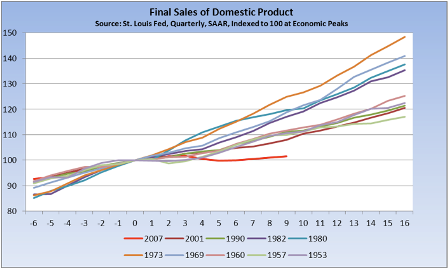
Final sales

Haven’t yet hit the ‘get a job buy a car’ accelerator.

Watch for car sales to be the indicator of more rapid growth.

Meantime, muddling through with modest growth remains an ok equity environment as fear of becoming the next Greece is turning us into the next Japan.

And, of course, we continue to underestimate the deflationary effect of the Fed’s zero rate policy which should be a good thing in that it allows us to have lower taxes for a given size govt.

euro zone issues


Asian players are a worry for eurozone

By Gillian Tett

July 14 (FT)

The saga behind next week’s stress test release is a case in point. During most of the past year, governments of countries such as Germany, Spain and France have resisted the idea of conducting US-style stress tests on their banks, in spite of repeated, entreaties from entities ranging from the International Monetary Fund to the Bank for International Settlements, and the US government.


However, after a meeting of G20 leaders in Busan last month, those same eurozone governments performed a U-turn, by finally agreeing to publish the results of such tests.


Some observers have blamed the volte-face on lobbying inside the senior echelons of the European Central Bank. Others point the finger to American pressure. In particular, Tim Geithner, the US Treasury secretary, had some strongly worded discussions with some of his eurozone counterparts in Busan, where he urged – if not lectured – them to adopt these tests.

However, Europeans who participated in the Busan meeting say it was actually comments from Asian officials that created a tipping point. In the days before and after that G20 gathering, eurozone officials met powerful Asian investment groups and government officials who expressed alarm about Europe’s financial woes. And while those officials did not plan to sell their existing stock of bonds, they specifically said they would reduce or halt future purchases of eurozone bonds unless something was done to allay the fears about Europe’s banks.

That, in turn, sparked a sudden change of heart among officials in places such as Germany and Spain. After all, as one European official notes, the last thing that any debt-laden European government wants now is a situation where it is tough to sell bonds. “It was the Asians that changed the mood, not anything Geithner said,” says one eurozone official.

This raises some fascinating short-term issues about how the bond markets might respond to the stress tests. It is impossible to track bond purchase patterns with any precision in a timely manner in Europe, since there is no central source of consolidated data.

However, bankers say there are signs that Asian investors are returning to buy eurozone bonds. This week, for example, China’s State Administration of Foreign Exchange bid for €1bn (£1.27bn, £835m) of Spanish bonds, helping to produce a very successful auction.

Yes, it’s a two edged sword.

Asian nations want to accumulate euro net financial assets to facilitate exports to the euro zone.

Before the crisis euro nations were concerned that the strong euro, partially due to Asian buying, was hurting euro zone exports

However, as the crisis developed, euro nations got to the point where they were concerned enough about national govt solvency and the precipitous fall of the euro (which was in some ways welcomed by exporters but worrying with regards to a potential inflationary collapse) to agree to measures to support their national govt debt sales which also meant a stronger euro.

So now the pendulum is swinging the other way. Solvency issues have been sufficiently resolved by the ECB to avert default, but at the ‘cost’ of a resumption Asian buying designed to strengthen the euro to support Asian exports to the euro zone.

As before the crisis, however, the euro zone has no tools to keep a lid on the euro (apart from re introducing the solvency issue to scare away buyers, which makes no sense), as buying dollars and other fx is counter to their ideology of having the euro be the world’s reserve currency.

So the same forces remain in place that drove the euro to the 150-160 range, which kept net exports from climbing.

The export driven model is problematic enough without adding in the additionally problematic idiosyncratic financial structure of the euro zone.

As for the stress tests, as long as the ECB is funding bank liabilities and buying national govt debt banks and the national govts can continue to fund themselves with or without Asian buying.

I’d have to say at this point in time the euro zone hasn’t gotten that far in their understanding of their monetary system or they probably would not be making concessions to outside forces.

Fed Minutes

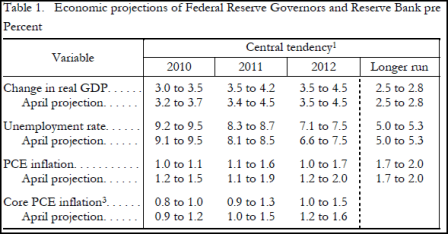
The staff still expected that the pace of economic activity through 2011 would be sufficient to reduce the existing margins of economic slack, although the anticipated decline in the unemployment rate was somewhat slower than in the previous projection.


Karim writes:

Staff still forecasting above trend growth, though not as firm as before. Activity indicators coming in as expected, with financial strains in May and June the cause for the revision.

Table below is average of FOMC members, not staff, but appears to have similar profile. Average expectations for 2011 growth at 3.85% from 3.95% prior..

A few participants cited some risk of deflation. Other participants, however, thought that inflation was unlikely to fall appreciably further given the stability of inflation expectations in recent years and very accommodative monetary policy. Over the medium term, participants saw both upside and downside risks to inflation.


Deflation talk still seems contained to a ‘few’ members.

Members noted that in addition to continuing to develop and test instruments to exit from the period of unusually accommodative monetary policy, the Committee would need to consider whether further policy stimulus might become appropriate if the outlook were to worsen appreciably.


This was only mention of QE2 – not very extensive.

ECB’s Trichet Says European Economy Showing ‘Encouraging’ Signs

The ECB has ‘written the check’ by buying national govt bonds in the secondary market in sufficient size to allow the national govs to fund themselves, and equities are coming back as solvency fears abate.

There is still solvency risk, but now that risk is the risk of the ECB cutting off any nation in question.

And with exports firming the same forces are causing the currency to strengthen to the point where net exports remain relatively stable.

The ECB is also in full control of the banking system liquidity, as it too is dependent on ECB funding, and dictates terms and conditions there as well, where there need be no failures (even a bank with negative capital can be sustained by liquidity provision) unless the ECB decides to let a bank fail.

EU Headlines:

ECB’s Trichet Says European Economy Showing ‘Encouraging’ Signs

Trichet dismisses fears over eurozone

Trichet Says European Capacity to Decide Always Underestimated

Trichet Says Bond Market Developments ‘Going in Right Direction’

Trichet Calls for ‘Appropriate’ Action on Stress Tests

Banks Will Need More Cash After Stress Tests

EU ‘Stress’ Tests Shrouded in Secrecy

EU Commission’s Barroso Says Bank Stress Tests Are ‘Credible’

ECB’s Bini Smaghi Says Greece Must Maintain Consolidation Effort

Bini Smaghi Says Market Rate Increase Won’t Affect Bank Loans

Stark Says ECB’s Monetary Analysis Enforces Discipline

Annual German Inflation Slows in June to 0.9 Per Cent

German Upper House Approves Naked Short-Selling Ban

French Manufacturing Rose in May, Lifted by Exports, Car Output

Italian Production Climbs as Weak Euro, Recovery Lifts Exports

Spain to allow cajas to sell 50% of equity

Greece Approves Austerity Plan Amid Outcry

GE chief gives vent to frustration over China

GE chief gives vent to frustration over China

June 29 (FT) — General Electric chief executive Jeff Immelt told Italian industrialists at a dinner on Wednesday that he was worried about the way Beijing was treating foreign companies. “I am not sure that in the end they want any of us to win or any of us to be successful,” said the man who runs the largest manufacturing company. “After 30 years of progressive market reforms, many foreign businesses in the country feel as though they have run up against an unexpected and impregnable blockade,” Joerg Wuttke, former head of the European Chamber of Commerce, complained in the Financial Times in April. The American Chamber of Commerce in Beijing has made similar statements, while a new survey of European companies released this week by the European Union Chamber of Commerce in China showed that almost half expect even more problems with regulators during the next two years.

GE has moved production out of China.

FDI (foreign direct investment) alters fx reserves and currency levels, as does domestic inflation.

PCE/Personal Income

Very good, looks like continuing muddling through with moderate growth unemployment drifting lower in a few months when there are no more hours to add to the existing labor force.

Welcome to Japan, Mr. US bond market?

Ok market for stocks, especially with Euro zone risk fading. Just China h2 risk left, seems.


Karim writes:

PCE data today was encouraging and showed the positive impact of hours on labor income.

Personal income up 0.4% with wage and salary income up 0.5%.

Personal spending up 0.3% and headline deflator unchanged, so strong advance in real consumption spending.

For all the slowdown fears, real private sector demand will be stronger in Q2 than Q1.

Core deflator up .162%, largest advance in 7mths. Recent divergence from core CPI (PCE data has been firmer) reflective of lower weight of housing in PCE data.

Not saying inflation is picking up, just that deflation fears seem overblown.