Dutch PM Mark Rutte Comments

In this crisis of ignorance
the only thing they all agree on
is austerity:

By Jurjen van de Pol
Dec. 2 (Bloomberg) — The Netherlands isn’t in favor of
monetary financing by the European Central Bank to combat the
region’s debt crisis as it may spur inflation and takes away
pressure to reform, Dutch Prime Minister Mark Rutte said.
“Countries that are now forced to reform may get the idea
that there’s no need to reform because the printing press has
been switched on,” Rutte told reporters after the weekly
council of ministers in The Hague today.

CB announcements

Just looks like the Fed lowered the rate on its swap lines to keep libor down, which had been moving up to its prior swap line rate.

No big deal, apart from the fact the Fed shouldn’t be allowed to lend on an unsecured basis like this without explicit approval of congress.

Lending unsecured on an unlimited basis has the potential to be highly inflationary.

With the currency a public monopoly, the price level is necessarily a function of prices paid at the point of govt spending and or collateral demanded when govt lends.

Allowing unlimited unsecured lending has the potential to vaporize the currency. And while in this case that kind of abuse isn’t likely, the potential is there.

MMT to the ECB- you can’t inflate, even if you wanted to

With the tools currently at their immediate disposal, including providing unlimited member bank liquidity,lowering the interbank rate, and buying euro national govt debt, the ECB has no chance of causing any monetary inflation, no matter how hard it might try. There just are no known channels, direct or indirect, in theory or practice, that connects those policies to the real economy. (Note that this is not to say that removing bank liquidity and national govt credit support wouldn’t be catastrophic. It’s a bit like engine oil. You need a gallon or two for the engine to run correctly, but further increasing the oil in the sump isn’t going to alter the engine’s performance.)

Lower rates sure doesn’t do the trick. Just look to Japan for going on two decades, the US going on 3 years, and the ECB’s low rate policies of recent years. There’s not a hint of monetary inflation/excess aggregate demand or inflationary currency weakness from low rates. If anything, seems to me the depressing effect on savers indicates low rates from the CB might even, ironically, promote deflation through the interest income channels, as the non govt sector is necessarily a net receiver of interest income when the govt is a net payer. (See Bernanke, Reinhart, and Sacks 2004 Fed paper on the fiscal effect of changes in interest rates.)

And if what’s called quantitative easing was inflationary, Japan would be hyperinflating by now, with the US not far behind. Nor is there any sign that the ECB’s buying of euro govt bonds has resulted in any kind of monetary inflation, as nothing but deflationary pressures continue to mount in that ongoing debt implosion. The reason there is no inflation from the ECB bond buying is because all it does is shift investor holdings from national govt debt to ECB balances, which changes nothing in the real economy.

Nor does bank liquidity provision have anything to do with monetary inflation, currency depreciation, or bank lending. As all monetary insiders know, bank lending is never reserve constrained. Constraints on banking come from regulation, including capital requirements and lending standards, and, of course credit worthy entities looking to borrow. With the ECB providing unlimited liquidity for the last several years, wouldn’t you think if there was going to be some kind of monetary problem it would have happened by now?

So the grand irony of the day is, that while there’s nothing the ECB can do to cause monetary inflation, even if it wanted to, the ECB, fearing inflation, holds back on the bond buying that would eliminate the national govt solvency risk but not halt the deflationary monetary forces currently in place.

So where does monetary inflation come from? Fiscal policy. The Weimar inflation was caused by deficit spending on the order of something like 50% of GDP to buy the foreign currencies demanded for war reparations. It was no surprise that selling that many German marks for foreign currencies in the market place drove the mark down as it did. In fact, when that policy finally ended, so did the inflation. And there was nothing the central bank could do with interest rates or buying and selling securities or anything else to stop the inflation caused by the massive deficit spending, just like today there is nothing the ECB can do to reverse the deflationary forces in place from the austerity measures.

So here we are, with the ECB demanding deflationary austerity from the member nations in return for the limited bond buying that has been sustaining some semblance of national govt solvency, not seeming to realize it can’t inflate with its monetary policy tools, even if it wanted to.

Post script:

The only way the ECB could inflate would be to buy dollars or other fx outright, which it doesn’t do even when it might want a weaker euro, as ideologically they want the euro to be the reserve currency, and not themselves build fx reserves that give the appearance of the euro being backed by fx.

ECB’S STARK SAYS DEBT CRISIS SPREADING TO ‘CORE’ COUNTRIES

Seems the logical consequence of hair cutting Greek debt and announcing it may happen to other member nations?

That said, would not surprise me to soon be hearing hints of something like:
‘ECB bond buying not necessarily inflationary if combined with austerity’ coming out of Germany,
triggering a massive ‘relief rally’ that will last until the reality of the austerity part sinks (syncs) in,
as the 10th plague infects the German bonds markets.

*ECB’S STARK SAYS DEBT CRISIS SPREADING TO ‘CORE’ COUNTRIES
*ECB’S STARK SAYS DEBT TOLERANCE IN EUROPE IS DECLINING
*ECB’S STARK SAYS INVESTORS ARE REASSESSING SOVEREIGN DEBT

Germany takes the world down, take 3?

Looks like for the third time in the last 100 years the world fiddles while Germany torches it?

Germany now stands pretty much alone in objecting to the ECB writing the check on the grounds that it’s inflationary, when it’s clearly not.

But, unfortunately, the rest of the world’s political and economic leadership doesn’t have what it takes to get through to them.

And the economic destruction this is causing far exceeds the destruction caused by all the shooting wars in history, as the death toll from the consequent global unrest mounts as well.

On Mon, Nov 21, 2011 at 7:05 AM, wrote:

Subject: BBK AGAIN REJECTS IDEA OF GIVING EFSF A BANK LICENCE

(BBK = Germany’s Bundesbank)

BBK AGAIN REJECTS IDEA OF GIVING EFSF A BANK LICENCE
BBK: RISING CONFLICT POTENTIAL WITH STABILITY-ORIENTED MON POL
BBK SEES GERMANY’S DEFICIT AROUND 1% OF GDP IN 2011, 2012
BBK: GERMANY’S GDP GROWTH TO SLOW TO 0.5-1.0% IN 2012
BBK: DEBT CRISIS IS JEOPARDIZING RECOVERY IN EUROPE
BBK: GERMANY’S INDUSTRY ADJUSTING FOR MILD DOWNTURN
BBK SEES GERMANY’S DEBT DOWN TO 81.1% OF GDP IN 2011

Spanish Voters Set to Throw Out Socialists in Election

As previously discussed, there is virtually no political support to leave the euro,
as it’s not intuitively obvious the euro is the problem.

It is intuitively obvious, however, that the problem was irresponsible govt
and so the move towards responsible govt- aka austerity- continues.

The euro economy can be easily ‘fixed’ and in short order.
The ECB can, one way or another, facilitate all funding needs and end the solvency issue.
And the Stability and Growth Pact (SGP) can be modified to allow deficits sufficient to sustain aggregate demand.

Currently Germany continues to be obstructing the elimination of the solvency issue,
even as market forces are now begining to weaken German bonds.
And there are no member nations yet supporting readjusting the SGP to allow higher deficits.

So my best guess is Germany will soon recognize what most of the financial community has recently been voicing- ECB bond buying combined with austerity is not inflationary- opening the door to the ECB bond buying being an EU sanctioned policy of the institutional structure to ensure solvency.

That will trigger a massive ‘relief rally’ that will fade as the reality of the depressing nature of the
austerity takes over.

It could also sideline the discussion of Greek haircuts and default discussion in general.

Spanish Voters Set to Throw Out Socialists in Election

November 20 (Reuters) — Spaniards are expected to throw out the Socialists they blame for a disastrous economic situation in an election on Sunday and to vote in a center-right party likely to dole out more bitter medicine in the form of public spending cuts.

Opinion polls show the People’s Party (PP), led by Mariano Rajoy, has an unassailable lead over the ruling Socialists, who have led the country from boom to bust in seven years in power.

Voters are angry with the Socialists for failing to act swiftly to prevent the economic slide and then for bringing in austerity measures that have cut wages, benefits and jobs.

Yet people are now resigned to further slashes in spending on health and education in the midst of a European debt crisis that has toppled the governments of Ireland, Portugal, Greece and Italy and pushed Spain’s borrowing costs ever higher.

Goldman- worries about the inflationary impact of debt monetisation are exaggerated

Good to see Dirk at Goldman is pretty much spot on:

German Economic Commentary : Chancellor Merkel not keen on more a proactive ECB stance

Published November 18, 2011

Chancellor Merkel gave a speech in Berlin yesterday where her main message with respect to stabilisation measures was essentially: No! Merkel rejected the introduction of Eurobonds but also any commitment from the ECB’s side to be the lender of last resort for Euro-zone governments.

There are several arguments the German government/Bundesbank are putting forward against a more pro-active stance of the ECB. First, a more pro-active role would not be in accordance with the treaties. Second, it would create moral hazard as it would reduce the incentive for governments to consolidate and reform. Third, debt monetisation, sovereign debt purchases by the ECB, leads to inflation. The latter argument was echoed by the chairman of the council of economic experts Franz, who said in an interview with FAZ newspaper that debt monetisation is a “deadly sin” for a central bank.

These are valid arguments, but only up to a point. In particular the worries about the inflationary impact of debt monetisation are exaggerated. Sovereign debt purchases of a central bank do not necessarily lead to inflation (see the example of Japan, although it can, see the example of Zimbabwe). It can lead to inflation if these purchases are used to finance an expansionary fiscal policy that will lead to strong growth and demand outpacing supply such that price setters will increase their prices. Fiscal policy, however, will be quite restrictive in the Euro-zone in the coming years. Italy, for example, aims at tightening fiscal policy by almost 3% next year on our estimate (we calculate this as the change in the structural primary fiscal balance). And while it remains to be seen whether the fiscal targets will be met, it is a safe bet that fiscal policy will not be expansionary in the Euro-zone for quite some time.

It can also lead to inflation if there is an excessive debt overhang, i.e. the fiscal position of a country is clearly unsustainable. Put differently the expansion of the monetary side is, even in the long run, not backed by a similar expansion of the real side of the economy. As we have argued in the past we see this only as a remote risk.

What the ECB is currently doing under its SMP is essentially swapping one savings instrument (peripheral sovereign debt) for another (cash) as private sector investors, for various reasons, no longer want to hold peripheral debt. But this has no inflationary implications unless one assumes that investors are spending the cash thereby stimulating demand which then leads to inflation. But these investors are not holding cash because they want to increase their spending, but because they think, rightly or wrongly, that cash is more rewarding from an investment point of view.

There are no easy choices and it would have been, no doubt, better if the ECB had never got in the position it is in now. But the current situation demands a careful weighing of the risk involved with any decision taken. The inflationary risk thereby seems to be getting an unduly high weight in the consideration of German policy makers.

Dirk Schumacher

Signs of Disinflation (Hatzius)

And this Fed fears deflation a lot more than inflation:

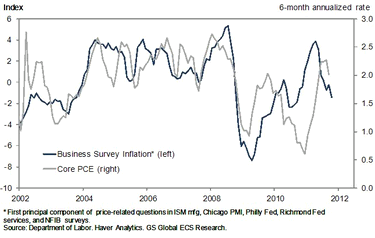
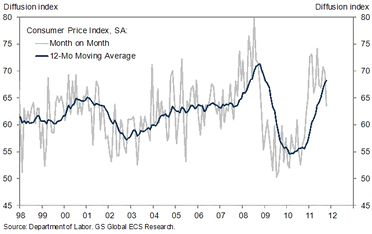
  • We see signs that the upside inflation surprises of 2011 have ended. Our new statistical summary of the price components of business surveys such as the ISM, Philly Fed, and NFIB points to decelerating inflation. In addition, our unweighted CPI diffusion index, which measures the breadth of price changes across 178 detailed price categories, fell to its lowest level since late 2010.

Inflation has been above our expectations in 2011, but we expect a substantial part of this surprise to reverse and see core inflation clearly below the Fed’s “mandate-consistent” level of 2% or a bit less by the end of 2012. The reasons are straightforward. There is still a large amount of slack in the US economy; nominal wage inflation remains very low; and much of the inflation pickup of 2011 can be traced to temporary factors such as short-term commodity price pass-through and upward pressure on motor vehicle prices in the wake of the Japanese earthquake. (We do not expect a full reversal of the core inflation pickup because the increase in rent inflation is likely to be more persistent.)

The recent inflation data have started to look more consistent with our view of moderating core inflation. The consumer price index (CPI) excluding food and energy has risen at an annualized rate of just 1.2% over the past two months, the lowest rate since December 2010 Statistically based measures of core inflation such as the Cleveland Fed’s weighted-median and 16% trimmed-mean CPI send a similar message.

Our unweighted CPI diffusion index is also starting to look a bit more benign again. It is constructed by seasonally adjusting all 178 individual CPI categories for which we have sufficient data, calculating the month-to-month change, and then reporting the percentage of categories showing price increases plus half the percentage showing no change. That is, values above 50 indicate that more categories are seeing price increases than decreases; the higher above 50, the greater the breadth of price increases relative to price decreases. (We perform our own seasonal adjustment because the Labor Department only provides seasonally adjusted CPI data for a subset of product categories.) Exhibit 1 below shows our diffusion index. While it is still clearly above the levels of 2009 and 2010, the October 2011 reading was the lowest since November 2010.

Exhibit 1: CPI Diffusion Index Has Started to Slow

chart


To gain more insight into future inflation trends, we have constructed a new measure that summarizes the inflation signal from various business surveys. Specifically, we calculated the first principal components of the price-related questions in the monthly ISM, Chicago PMI, Philly Fed, NFIB, Kansas City Fed, and Richmond Fed business surveys. These questions refer to prices paid, prices received, or wages and salaries and are generally reported as the difference between the percentage of respondents saying that prices rose in the survey month and the percentage saying that prices fell. (Focusing only on prices paid or prices received indexes does not make a significant difference to the results.)

The results are shown in Exhibit 2 below. In general, our business survey indicator of inflation tracks the ups and downs of the core PCE index–the Fed’s favorite measure of underlying inflation–reasonably well. After a significant acceleration in early 2011, the indicator has declined notably in recent months and is now consistent with a deceleration in core PCE inflation from the recent 2%+ level to somewhere closer to 1.5%. This is also consistent with our forecast that inflation will slow over the next year.

Exhibit 2: Business Survey Inflation Shows Recent Deceleration
chart