feels like time to buy equities in general

I’m thinking it’s about that time for portfolio managers to buy stocks and go play golf for a few years,
with the following very caveats.

1. A serious spike in crude oil/gasoline prices that undermines consumption
2. The euro zone could break down socially under the stress of continued austerity
3. Congress opting for ‘meaningful’ proactive deficit reduction

But apart from that it looks like relatively clear sailing to me

The Republicans are now softening on revenue increases to get past the fiscal cliff.

And in any case the fiscal cliff may already be up to 50% discounted, as business has slowed due to delayed contracts, etc. with top line growth still remaining modestly positive as the cyclical housing ‘recovery’ begins its multi year upward grind, providing a powerful ‘borrowing to spend’ force for growth. I call it a drop in ‘savings desires’ as borrowing is in fact ‘negative savings’.

This is fundamentally supported by continuing federal deficit spending that, while down from the peak, is still looking more than high enough to support a growing credit structure.

And the 4 years of ‘larger than ever’ federal deficits have added exactly (to the penny) that much in dollar net financial assets to the global economy, with much of that being added here domestically. This is evidenced by the full recoveries, and then some, of macro debt service ratios of all types. In short, ‘savings’ has been, for all practical purposes, more than sufficiently restored for a ‘normal’ recovery.

This kind of underlying strength will quickly cause the Fed to reevaluate policy as unemployment drops towards 7%, leading to a ‘normalization’ of policy, which means a fed funds rate at a ‘normal’ premium over ‘inflation’ for a ‘neutral monetary policy.’ In fact, as this happens, the higher rates from the Fed further support the expansion via the interest income channels.

The output gap is wide enough for this to go on for a long time without excess demand issues, again with the caveat of crude oil.

Growth has already caused the federal deficit to come in lower than expected, which is helping put off proactive deficit reduction efforts.

Yes, eventually, the automatic fiscal stabilizers will bring the deficit down too far for it to support the credit structure, and serve to end the cycle. But this is WAY down the road.

The first Obamaboom came from the ‘stimulus’ which wasn’t nothing, but was far too weak to remove the sudden drag on demand from the private sector credit contraction.

The ‘crime against humanity’ was not implementing the likes of my proposed ‘payroll tax holiday’ in mid 2008 to support demand at full employment levels at that time.

Instead, the govt allowed demand to collapse/output gap to widen. This did not have to happen. It was a total failure of govt.

Also, timing is also important, so mind the technicals!

U.K. Economy Surges 1% as Britain Exits Double-Dip Recession

Deficit finally large enough for a bit of stability and growth?

U.K. Economy Surges 1% as Britain Exits Double-Dip Recession

By Scott Hamilton and Jennifer Ryan

October 25 (Bloomberg) — Britain exited a double-dip recession in the third quarter with the strongest growth in five years as Olympic ticket sales and a surge in services helped boost the rebound.

Gross domestic product rose 1 percent from the three months through June, the fastest growth since 2007, the Office for National Statistics said in London today. That exceeded the highest estimate in a Bloomberg News survey for growth of 0.8 percent. The median forecast of 33 economists was 0.6 percent. The pound rose after the data were published.

The growth surge reflects a boost from the Olympics and a rebound from the second quarter, when GDP was affected by an extra public holiday. While the data may give some short-term relief to Prime Minister David Cameron’s struggling government, Bank of England Governor Mervyn King said this week that the recovery is “slow and uncertain.” That suggests the figures mask underlying weakness that could warrant further stimulus from the central bank.

“We’re still concerned the U.K. economy is going to be pretty much flat throughout next year,” James Shugg, an economist at Westpac Banking Corp. (WBC) in London, said on Bloomberg Television’s “The Pulse” with Maryam Nemazee. “It all depends how rigidly determined the government is to stick to its deficit reduction plan.”

Ticket Sales

Services, which make up about three quarters of GDP, surged 1.3 percent in the third quarter from the previous three months, the most in five years, the ONS said. Olympic ticket sales are estimated to have added 0.2 percentage points to GDP. Production rose 1.1 percent, the most in more than two years, while manufacturing increased 1 percent. Construction output fell 2.5 percent, a third straight quarterly decline.

The pound extended its gain against the dollar after the report and was trading at $1.6134 as of 10:52 a.m. in London, up 0.6 percent on the day. Bonds declined, pushing the yield on the 10-year government bond up 8 basis points to 1.93 percent.

From a year earlier, GDP was unchanged in the third quarter, the ONS said. That compared with a decline of 0.5 percent forecast by economists in a separate Bloomberg survey.

While today’s data confirm Britain exited its first double- dip recession since 1975, GDP is still 3.1 percent below its peak in the first quarter of 2008. The report also showed that the economy has grown 0.6 percent since the third quarter of 2010, just after Cameron’s coalition government came to power.

Economy ‘Healing’

Cameron urged caution on the GDP data, saying there is “still much to do.” The opposition Labour Party has accused his government of exacerbating the economic slump by sticking to its fiscal squeeze. Ed Balls, Labour’s finance spokesman, said today the economy “remains weak” and “is only just back to the size it was a year ago.”

“There are always one-off figures in all of these announcements but they do show an underlying picture of good and positive growth,” Cameron said. “We’ve got to stick with the program.”

The data today are an initial estimate and the figures are subject to revision when the ONS gets more information. In the second quarter, the decline in GDP was revised up to 0.4 percent from an initially reported 0.7 percent.

Britain is the first of the Group of Seven nations to report GDP data for the third quarter. U.S. growth probably accelerated to a 1.9 percent annual rate after expanding at a 1.3 percent pace the prior quarter, according to a Bloomberg survey before a Commerce Department report tomorrow. It would be the first back-to-back readings lower than 2 percent since the U.S. was emerging from the recession in 2009.

Deficit Reduction

The U.K. data come two weeks before the Bank of England’s Monetary Policy Committee must decide whether to end its stimulus program or extend it beyond 375 billion pounds ($605 billion). Governor Mervyn King said this week that a “zig-zag” pattern of recovery is likely to persist.

Debenhams Plc (DEB), Britain’s second-largest department-store chain, said today that the U.K. experienced “challenging trading conditions during 2012.” Whitbread Plc (WTB) Chief Executive Officer Andy Harrison said the consumer market is “pretty flat” and generating any growth is “jolly difficult.”

Stripping out one-time distortions, the National Institute of Economic and Social Research said on Oct. 9 that third- quarter growth was closer to between 0.2 percent and 0.3 percent.

Inflation Cools

Still, recent data have shown pressure on consumers easing. Inflation cooled to the slowest in almost three years in September, while retail sales increased more than forecast. Payrolls rose to a record in the quarter through August, pushing the unemployment rate down to 7.9 percent from 8.1 percent.

“At this stage, it is difficult to know whether some of the recent more positive signs will persist,” King said on Oct. 23. “The MPC will think long and hard before it decides whether or not to make further asset purchases. But should those signs fade, the MPC does stand ready.”

Elsewhere in Europe, Sweden’s Riksbank kept benchmark interest rates unchanged at their lowest level since early 2011 and said further easing has become more probable as growth slows in the largest Nordic economy.

Australia cuts spending to preserve surplus as mining boom slows

:(

Australia cuts spending to preserve surplus as mining boom slows

October 22 (Reuters) — Australia’s government announced A$16.4 billion ($17 billion) in new savings and tax measures over four years on Monday to protect a wafer-thin budget surplus for 2012/13, opening the way for the central bank to further cut interest rates as early as next month.

Releasing the government’s mid-year budget update, Treasurer Wayne Swan said GDP growth would be slower in the year to June 30, 2013, and come in at 3.0 percent compared to May’s budget forecast of 3.25 percent, as the country’s mining boom slowed.

Financial markets have priced in up to two more interest rate cuts over the coming months and economists said the extra fiscal tightening could now see the Reserve Bank of Australia ease policy at its policy meeting on November 6.

“The prospect of small budget surpluses means that fiscal policy settings have been tightened a notch. It also means that monetary policy can be further eased without a significant domestic inflation risk,” CBA Economics senior economist Michael Workman said.

A fall in tax revenue, slower economic growth and lower commodity prices led to the downward revision in this financial year’s expected surplus to A$1.1 billion, from May’s budget forecast for a surplus of A$1.5 billion.

Government revenues have also been hit by lower commodity prices, with the controversial mining tax on iron ore and coal mining profits to bring in A$1 billion less this year and A$1.1 billion less the following year compared to the May budget forecasts.

Iron ore prices have fallen around 15 percent, thermal coal 9 percent and coking coal 30 percent since the mining tax started in July, and the government now forecasts the minerals resources rent tax to raise A$9.1 billion over four years, compared to the May budget forecast of A$13.4 billion.

“Global growth has slowed in recent months, with the recession in the euro area and the subdued recovery in the United States weighing on growth in our region,” Swan said.

“The weaker global outlook and lower than expected commodity prices, along with the general easing of price pressures in the economy, are again slowing the recovery in tax revenue.”

Despite the slowdown, Australia remains one of the few developed nations to have forecast a budget surplus for the current year, with net debt peaking at 10 percent of GDP last financial year and well below the average net debt projected to peak at 95 percent of GDP in 2016 for major advanced economies.

The Reserve Bank of Australia has cut official interest rates by 100 basis points in 2012, with the latest 25-point cut in October. Markets are betting on a further rate cut by the end of the year.

The biggest saving in the budget update includes A$8 billion over four years by introducing monthly pay-as-you-go company tax payments for large companies.

It will also raise A$445 million over four years by removing some in-house fringe benefits tax arrangements on salary sacrificing, and raise A$520 million over four years from higher charges for visas to visit and work in Australia.

Australia’s peak business group the Australian Chamber of Commerce and Industry condemned the budget changes and said most of the imposts would be borne by companies.

“Business is again in the firing line when it comes to helping out the budget bottom line,” chamber chief executive Peter Anderson told reporters.

“There is no doubt that many of the decisions in today’s statement will be negative for both households and business, it will be negative for confidence, negative for the economic outlook and negative for economic certainty.”

Swan has delivered consecutive deficit budgets since his first budget in 2008, due to stimulus spending to help Australia avoid recession after the 2008 global financial crisis.

The Labor government, struggling in the polls, is due to face elections in the second half of 2013 and is determined to restore the budget to surplus before it faces the voters, to head off opposition attacks on its economic credentials.

Forbes article: No, the US will not go into a debt crisis, not now, not ever

>   
>   (email exchange)
>   
>   On Fri, Oct 19, 2012 at 1:09 PM, wrote:
>   
>   Author is self-described conservative.
>   

No, The United States Will Not Go Into A Debt Crisis, Not Now, Not Ever

By Pascal-Emmanuel Gobry

October 19 (Forbes) — If there’s one article of faith in Washington (and elsewhere), it’s the idea that the United States might get into a debt crisis if it doesn’t get its fiscal house in order.

This is not true.

The reason why it’s not true is because we live in a fiat currency system, where the United States government can create an infinite number of dollars at no cost to meet its obligations. A Treasury bill is a promise that the government will give you US dollars– something that the United States government can produce infinitely and at no cost.

That’s the reason why interest rates on United States debt have only gone down even as the debt has ballooned. That’s the reason why Great Britain has very low rates on its debt despite having very high debt-to-GDP. That’s the reason why Japan has an astounding debt-to-GDP ratio and still enjoys some of the lowest rates ever. Investors have bet for so long that there would be a run on Japanese debt and have ended up so ruined that in financial circles that trade is called “the Widowmaker”. (Here’s a more detailed analysis by my former colleague Joe Weisenthal at Business Insider.)

Well, what about Argentina? Argentina had to default on its debt because it had pegged its currency to the US dollar. It wasn’t sovereign with regard to its currency since it had to maintain its currency’s peg. It wasn’t Argentina’s debt that caused it to default, it was its currency peg.

What about Greece? Same thing. Greece hasn’t used its own currency for ten years. Of course it’s going bankrupt.

Does it seem that strange that governments can’t run out of money?

You don’t have to take my word for it. How about Alan Greenspan? He said (PDF): ”[A] government cannot become insolvent with respect to obligations in its own currency. A fiat money system, like the ones we have today, can produce such claims without limit.”

But waaaaaaait, you shout, what about inflation? If the government prints money like crazy, won’t that create inflation?

Well, in theory, yes. But probably not. Why is that? Because the US has an even bigger advantage than just being sovereign in its own currency (hi Greece), it also holds the reserve currency. The US dollar is the main currency that is used in most international transactions, it is held by all of the world’s central banks, and so forth.

Why is this important? Well, another way to define inflation is to say that the supply of a currency gets out of whack with its demand: too much currency chasing too few people who want to hold it, and so its value drops. Well, when you have the reserve currency, the demand for your currency is always going to be extremely strong. There’s always going to be tons of people, all around the world, who want to use US dollars, because their transactions are conducted in US dollars. (And it’s highly unlikely that this will change soon–being the reserve currency has a network effect, meaning everyone uses the dollar as the reserve currency because everyone else uses it, creating a self-reinforcing cycle that’s extremely hard to break.)

In other words, while in theory printing tons of money could create inflation, in practice demand for the dollar is so high–and for structural reasons that have very little to do with how the US economy is doing at a particular point in time–that it’s hard to imagine a circumstance under which the US government would have to print so much that it would cause significant inflation.

And even if it did–well, for all the bad memories we have about it, the Stagflation of the 1970s was many things, but it was not Greece. Life in the 1970s was still relatively okay, despite the stagflation. That is to say, even in the extremely unlikely event that the government had to print so much money to get out of its debt that it caused moderate inflation, it still would not be a debt crisis of the kind that Greece and Spain are under right now. (Hyperinflation, meanwhile, is even less of a danger, since in recorded history it only happens in cases of not just reckless money printing, but also extremely serious exogenous shocks such as war, regime change, etc.)

Why am I writing this?

After all it’s already common knowledge among economists, Fed officials, and an increasing number of sophisticated investors.

Maybe so, but it’s still not common knowledge among politicians and among the general public. A lot of people still think that the US is under some risk of one day becoming like Greece, and it’s distorting our public debate.

It’s especially distorting it on the Right, where hysteria about deficits, and debt, and becoming like Greece has reached a fever pitch. Paul Ryan, especially, has framed his entire message on entitlement-cutting on the flawed premise that the US needs to cut its entitlement or it will suffer a debt crisis. This message, in turn, has infected broad swathes of the conservative movement (including very smart people in it), a movement that I consider myself a member of and want to see in strong intellectual health. But very few liberals–certainly no Democratic elected officials that I’m aware of, certainly not the President and the Vice President–are disputing the premise that the US is in any danger of a debt crisis.

In future posts, I will try to look at what the conservative movement can do to move past the idea of the debt crisis, and what it means.

Thaler’s Corner 28th September 2012: Poor Macro Money Data, Eurozone

I like this report.
The overnight data does still look to me like there are signs of it all stabilizing
but it also seems like that will only bring more fiscal tightening to ensure the output gap remains wide.

Poor Macro Money Data, Eurozone
 
First a quick point on our asset allocation biases. We are still Risk OFF, despite the over 3% decline on the Eurostoxx and the 1.70% hike on the Bund since we issued our recommendation. The reasons for this Risk Of remain valid and the presentation of the new Spanish government budget yesterday does not change our opinion. I consider the macroeconomic forecasts on which it is based to be unrealistic. Both the hoped for 3.8% hike in tax receipts and the projection that unemployment has peaked this year appear very optimistic in such a depressive context!
 
The earlier examples of “adjustments” imposed by the Troika in eurozone countries who agreed to these bailout plans only demonstrate that the application of harsh austerity treatment in the midst of a severe recession is counterproductive. The decline in the Debt/GDP denominator accelerates the flight of private capital, thereby making the country’s economy all the more vulnerable to “negative disequilibria”.
 
The repetition last Friday morning by Herr (Darth) Schäuble of the main points made in the letter he signed with the Dutch and Finnish finance ministers (legacy assets, etc) highlights how the reticence of eurozone “creditors” is threatening the hopes raided by the European summit of June 29th.
 
However, let’s take a look at the eurozone macro monetary figures published Thursday and Friday because they show that the ECB must remain on high alert since they show a continuous worsening of monetary conditions, despite the measures already taken.
 
And yet, when I see the alarmist statements by Mr Weidmann on the dangers of inflation created by the OMT or those made by Mr Asmussen warning that the ECB would intervene immediately in case of a spike in inflationary risk, I wonder on what planet they are living!
 
I understand these statements are motivated by domestic political consideration: i.e. the need to reassure savers frightened by a reduction in purchasing power stemming from real negative interest rates, especially since these savers mainly vote for Chancellor Merkel’s party, given that they are made up of retirees and others from comfortable segments of society.
 
But a comparison of this approach with that of the Fed, which instead is doing all it can to revive inflationist expectations by using precisely these expectations to contend with “0% Lower Bound”, is more than a bit worrisome.
 
Here are my favorite two graphs updated to included data from August.
 
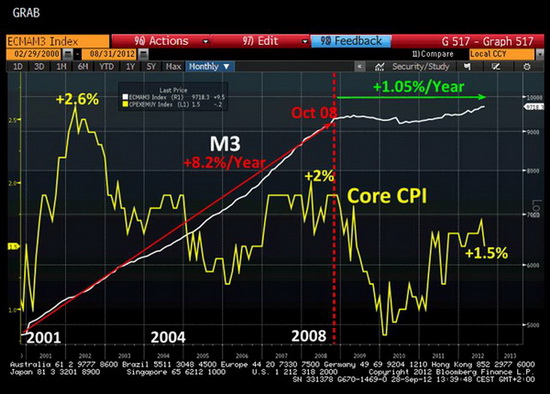
M3 and Core CPI


As readers know, I am anything but a hardcore monetarist, because I consider that the ratio emphasized by the fans of the “Quantity of Money” theory does not account for changes in money velocity (the V in MV=PQ). These monetarists have a “vertical”conception of money in which the central bank is the sole agent of money creation. But M3 is in reality the consequence of the “horizontal” nature of money, i.e. its creation by private-sector banking (Loans make Deposits). The money verticality that does exist is of a totally different nature since it relates to budget deficits whereby the state injects financial assets into the private sector (treasuries) to finance spending. However, the graph above shows just how much the M3 curve has changed since the outbreak of the Great Financial Crisis, with a decline in annual growth from over 8% between 2001 and 2008 to a miserable 1.05% since then.
 
Some people claim that a certain amount of inflation paranoia is validated by the CPI published Friday morning, +2.7% annually, given that the consensus was looking for +2.4%, i.e. higher than the target set by the ECB. Maybe we would be treated to a new hike in key interest rates if Mr Trichet were still head of the ECB. But I think that those currently in charge of monetary policy are conscious of the temporary nature of the effect of indirect tax and commodity price rises and that the inflation index could fall below the ECB target in H2 2013.
 
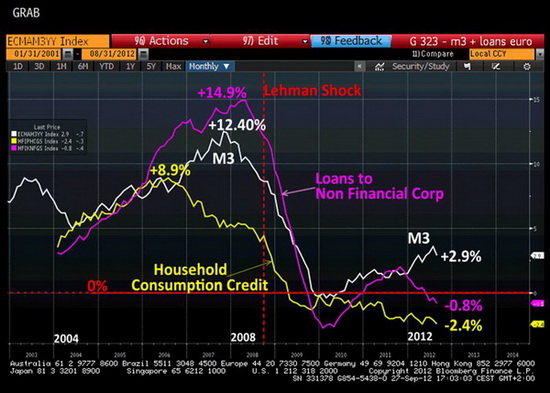
M3, and loans to businesses and households


Much more relevant than M3, and perfectly consistent with our report on money velocity, these two statistics (loans to consumers and non-financial businesses) paint a much grimmer picture of the monetary situation in Europe.
 
Down -2.4% yoy at 31 August, consumer loans are declining at their steepest rate since this figure began publication! The decline has been continuous since the beginning of 2009, which compares to nearly 9% annual growth in mid-2006.
 
No matter how big the interest rate cuts, none of them will persuade people to spend more when they are worried about losing their job and about the possible implosion of the eurozone. In that context, I am utterly baffled when I hear Mr Asmussen declare, as he did just a few minutes ago, that banks are at fault because they are not lending out their surplus reserves!
Remember, banks do not lend their reserves (Loans make Deposits). At best, they can lend to banks short of reserves! In fact, that would reduce the central bank’s balance sheet which continues to play its role as intermediary on the still nonexistent interbank market. This highlights the need to give priority to the recapitalization of struggling banks in the system, even if we have to override the opposition of certain northern country finance ministers.
 
From a qualitative viewpoint, the ECB also released its monthly Euro Money Market Survey Friday morning, i.e. liquidity circulation within the banking system (V).
 
And here too, the picture is frightening.
 
The spot (next day) market has contracted 50% in the past year.
On the unsecured market, transactions in Q2 2012 plunged by about an annual 35%, while the secured market declined 15% !
Moreover, the ratio for these latter transactions, compensated by a counterparty clearinghouse (Cedel, Clearnet, etc.), now stands at 55%.
This highlights the degree of distrust in the interbank system. So I will end this letter today with the ECB staff’s own conclusion!
 
The qualitative part of the survey shows that efficiency in the unsecured market was deemed to have worsened markedly in comparison with 2011. Liquidity conditions were also perceived to have deteriorated. As regards the secured segment, the number of respondents giving a positive assessment of the market’s efficiency increased, although liquidity conditions were perceived as being worse than in 2011. For most other market segments, the perception of efficiency was more positive in 2012, whereas it was generally felt that liquidity conditions had deteriorated.
 
Between monetary verticality in free fall (generalized austerity) and evaporated horzontality (nonexistent interbank market), is there still hope?
Central banks cannot solve these problems all by themselves.

The Concord Coalition Honors Rep. Schwartz’s Leadership on Fiscal Issues

On Sep 22, 2012 8:31 AM, “Art Patten” wrote:

Dear Congresswoman,

As always, we appreciate your hard work and everything you do for your constituents. But I can’t bring myself to congratulate you on the award from the Concord Coalition, an organization that unwittingly works to undermine public purpose.

Like so many organizations, economists, politicians, and citizens, the Coalition fails to recognize that, as one writer recently put it, ‘Everything changed in 1973 [when President Nixon ended the Bretton Woods monetary system], except the economic textbooks.’

We are no longer on the gold standard. The U.S. government doesn’t ‘owe’ anybody, inside or outside the country, anything but U.S. dollars, which it is the monopoly supplier of.

In our current monetary system, the relevance of the federal deficit is its role in supporting aggregate demand. Whether the deficit is large enough is reflected in GDP growth and the unemployment rate. Inflation, although terribly difficult to measure with accuracy (and probably chronically overstated, in my view), indicates when fiscal deficits are too large.

The Coalition and many other groups witness the large budget deficits of recent years and imagine that the federal government faces the same constraints as any household, business, or state or municipal government. But that simply isn’t the case. The monopoly supplier of U.S. dollars can run deficits indefinitely. And if those other sectors of the economy want dollars to save, invest, or spend (and if other countries want to sell us stuff), they all need the U.S. government to run optimally sized deficits.

Unfortunately, the imaginary concept of a real budget constraint is reflected in harmful economic myths such as the inevitability of ‘crowding out’ and higher interest rates, and the inter-temporal government budget constraint; myths that both parties have elevated to high policy dogma. As a result, the Coalition and others urge us to gnash teeth and rend garments in response to large federal deficits, due to the draconian fiscal future we are supposedly imposing on our children and grandchildren. Many very smart people believe in this narrative. However, in our current monetary system, it is nothing more than the collective imagination run wild.

The real burden we are imposing on future generations (and today’s lower and middle classes) is not some future date with the fiscal pied piper, but long-term and completely unnecessary opportunity costs, due in large part to the myth that we must reduce and limit federal deficits. Millions of households are earning less than their combined talents are truly worth as underemployment remains mired at 1930s levels. Our public infrastructure continues to deteriorate. There’s still much more we can do for veterans and the needy. The list goes on. And by any of those metrics, the current federal deficit remains too small. That means either federal tax revenue is too high or spending too low, and the Coalition and other groups like them are misguidedly placing the highest priority on what should be among our least important concerns today.

Sincerely,
Art Patten
Jenkintown, PA

P.S. I’m attaching “Seven Deadly Innocent Frauds” by Warren Mosler. You can also find it online here. It is a quick but powerful read, and one that you could get through in a single train trip to Washington. As a member of a household that has been periodically underemployed since at least 2008, (and overtaxed when we’re fully employed! :)) I implore you to give it a look. Warren is running for Congress in the USVI this fall. He’s a wonderful guy, and if all goes well, perhaps you two can sit down and talk about this stuff next year. Best regards.

QE follow up

It’s been about a week, and the initial reactions are already wearing off and markets settling in.

The lasting effects are those of the income lost to the economy as the Fed earns the interest on the securities it buys instead of the economy. This reduces the federal deficit and is a ‘contractionary’ force. At the same time the Fed removes securities/duration/convexity/vol from the economy which tends to lower the term structure of risk free rates some and further reduce volatility as well.

Initially the long end sold off on the presumption that QE works to lower the output gap/restore growth and employment, which means the Fed would, down the road, be hiking rates in response to the improving economy.

However, as the reality that QE doesn’t work to support aggregate demand sinks in, long end yields can come down on the anticipation that future growth prospects are not good, increasing the odds that the Fed will be keeping rates low that much longer.

Likewise, it’s a mixed bag for stocks, though overall modestly supportive. QE doesn’t improve earnings prospects, and serves to keep growth down, but the lower interest rates help valuations, and high unemployment along with productivity increases work to keep unit labor costs down.

Europe has solved the solvency issue, but it’s all conditional on bringing deficits down, and so far it looks like they are all working to keep doing exactly that, and with no prospects for material private sector credit expansion or export growth,
GDP can continue to be negative.

Then there’s the US fiscal cliff. Everyone agrees deficit reduction slows things down, which is why they say we shouldn’t do it now. But they also therefore know it will slow down things whenever they do it in the future. So how hard should it be to come to recognize that slowing things down is actually the point of deficit reduction, and is appropriate only for that reason? Apparently it’s impossible. And the fiscal cliff is already taking its toll as anticipated contracts for next year along with purchases are being delayed.

So without some kind of fiscal paradigm shift I don’t see much good happening, and even the muddle through scenario is now at risk.

ECB’s Weidmann Says Unlimited Money Creation Risks Inflation

Only with fixed fx, where ‘money creation’ is better described as ‘deficit spending’.

Shame shame shame.

ECB’s Weidmann Says Unlimited Money Creation Risks Inflation

By Jeff Black and Jana Randow

September 18 (Bloomberg) — Bundesbank President Jens Weidmann said central banks that promise to create unlimited amounts of money risk fueling inflation and losing their credibility.

In a ceremonial speech in Frankfurt today, Weidmann, who opposes the European Central Bank’s plan to spend unlimited amounts on government bonds, spoke of the responsibilities that central banks have to preserve the value of money.

“If a central bank can potentially create unlimited money from nothing, how can it ensure that money is sufficiently scarce to retain its value?” he asked. “Is there not a big temptation to misuse this instrument to create short-term room to maneuver even when long-term damage is very likely? Yes, this temptation is very real, and many in the history of money have succumbed to it.”

While Weidmann didn’t directly address ECB policy, he is the only central bank governor from the 17 euro nations to publicly oppose ECB President Mario Draghi’s plan to help curb the borrowing costs of member states engulfed by the region’s debt crisis. Weidmann, who has warned the bond-buying policy is tantamount to financing governments, said today that central banks were given independence to ensure the power to create money couldn’t be abused by politicians.

“If one looks back in history, central banks were often created precisely to give the monarch the freest possible access to seemingly unlimited financial means,” Weidmann said. “The connection between states’ great financial needs and a government controlling the central bank often led to an excessive expansion of the money supply, and the result was devaluation of money through inflation.”

‘Extraordinary Privilege’

The independence of central banks is an “extraordinary privilege” and not an end in itself, he said.

“The independence serves much more to establish with credibility that monetary policy can concentrate without hindrance on keeping the value of money stable,” Weidmann said. “The best protection against the temptations inherent in monetary policy is an enlightened and stability-oriented society.”

Weidmann’s speech forms part of a series of events in Frankfurt on the theme of money in the works of Johann Wolfgang von Goethe.

1996 Washington Post article

This was written by Michael Johns. I saw him on C-Span, contacted him, and have been in touch ever since. Michael is a conservative, and one of the Tea Party founders. As you can see below, however, he too recognized the very wrong and counter agenda turn taken by the Republicans (and then the Tea Party) when they embraced deficit reduction and the balanced budget amendment for its own sake. He wrote this most prescient article in 1996 if I recall correctly, which was published in the Washington Post:

A Balanced Budget Is Not the Answer

by Michael Johns

In its political toughness with the Clinton White House in recent months, the Republican leadership in Congress has elevated balanced-budget proposals to the top of America’s political agenda. Although at least nominal political differences exist over the means to arrive at this objective, the embrace of a seven-year balanced-budget goal by both Republican congressional leaders and President Clinton represents the most significant shift in the economic thinking of the political elite in perhaps two decades. The concept of balanced budgets has long existed as a weapon in mainstream political rhetoric, but only since the 1994 elections has this rhetoric run the significant possibility of becoming political reality.

Yet before such a goal is uniformly embraced and enacted as policy, Congress and Clinton should pause to reflect on whether such an objective deserves its place at the pinnacle of our economic objectives. Upon such reflection, there is good reason to believe that it does not.

There is, for instance, no historical data that would demonstrate that a balanced budget enhances gross domestic product (GDP) or any other indicator of economic productivity. Balanced budget advocates have long contended that the absence of a balanced budget opens the door to a “crowding-out effect? on interest rates, whereby government borrowing actually closes out private borrowing, thus raising interest rates on private credit and slowing the economy. Contrary to this, however, some of the most profound drops in interest rates and expansions in economic growth have occurred at moments when the deficit has been on the rise (witness, for instance, the interest-rate drop and economic growth that largely characterized the eight-year Reagan administration period).

Nor is there any particular evidence demonstrating that our current budget deficit is necessarily at the root of any particular economic problem that a balanced budget would correct. True, the balanced budget is a convenient political means for cutting the substantial waste and even fraud that exists in federal expenditures, but there is no reason to believe that this could not be accomplished short of wedding our nation’s policy leaders to a squarely balanced budget in every fiscal year.

BALANCED BUDGETS BEHIND

DEPRESSIONS

Perhaps most convincingly, America does have some previous experience with balanced-budget efforts, and it is cause not for celebration but considerable alarm. Without exception, on six consecutive occasions from 1817 until 1930 when government cut spending considerably without simultaneously seeking to stimulate the economy with equally deep tax cuts or other fiscal stimuli, depressions arose. The correlation is a shocking 100 percent. Balanced-budget efforts in America have always preceded national depressions.

So why are we doing this? It is reasonably apparent, on close examination, that the balanced-budget debate, rather than seeking the advancement of any specific macroeconomic goal is more a convenient means by advocates for accomplishing other political objectives that otherwise might be less sellable. On one hand, for instance, many congressional Republicans see the balanced budget as a political vehicle for enacting sweeping cuts in federal spending that, without the political cover of a balanced budget, likely would be significantly more difficult to sell to the American people.

On the other hand, many Democrats, including President Clinton, appear to see the balanced budget as a far-off and thus somewhat meaningless objective; even if Clinton were reelected, the current proposals would not force him to balance even one budget in a second term. Perhaps because of this, he has seen little imperative in resisting the plan. In January, one senior Clinton aide conceded that the administration’s endorsement of a balanced budget was just “a public relations game.”

Also not considered by many Republicans is the fact that some Democrats may even see the balanced budget as a means for providing political cover for eventually increasing the tax burden on the American people, even though such fiscal steps have been universally discredited over the past two decades. Nonetheless, if maintaining balance in the federal budget is the nation’s top economic priority, the balanced budget could likely be used over time to justify enhancing federal revenue through larger tax demands on both private citizens and businesses. Short of this, congressional Democrats will almost certainly use the balanced-budget restrictions as justification for resisting any Republican-sponsored tax cuts.

For Republicans and fiscal conservatives, this raises the question of whether the political cover for spending cuts that accompanies a balanced budget is worth the risk of providing Democrats and fiscal liberals with the same level of future political cover for raising taxes. The answer is that it most probably is not.

Of course, the political sentiments that have advanced the balanced budget cannot be thrown aside. Congressional conservatives are largely correct in their bid to eradicate wasteful government spending and to transfer from the public sector to the private sector those responsibilities that would more appropriately be handled outside of government. Yet cutting wasteful spending does not necessarily require embracing a balanced budget. Under a fiscally conservative president, such steps could be taken through enacting a line- item veto. Short of this, Congress could use the widespread support for smaller government to cut spending and taxes simultaneously, without operating on the premise that a precise budget balance is necessarily the most pressing priority.

Perhaps the most compelling reason to resist a balanced budget, however, is the fact that, politics aside, there simply is no reason to believe that a balanced budget will provide any economic stimulus to the economy, and there are at least a few reasons to suspect that it may do great harm. In addition to the absence of any historical data in the United States or elsewhere in the world that demonstrate any connection between balanced budgets and sustained economic growth, there is no reason to believe that America’s budget deficit is necessarily at the root of any current macroeconomic dilemmas. A comparison of budget deficits as a percentage of GDPs reveals that Americas budget deficit is reasonable, even low, compared with that of other industrial nations.

DEFICIT REDUCTION MEANS ECONOMIC DOWNTURNS

Additionally, a close look at the relationship between deficits and economic growth in countries around the world reveals that deficit-reduction measures are often followed by downturns in economic growth. Conversely, increases in deficits often accompany economic upturns. In Great Britain, for instance, a reduction in debt from 1989 to 1991 from roughly 44 percent of GDP to 34 percent also witnessed a reduction in GDP during this period from O percent to negative 4 percent. Since 1991, Britain’s public debt has increased to roughly 52 percent of GDP, and economic growth also has risen dramatically to 5 percent GDP in 1995. What such examples demonstrate is that, contrary to the conventional wisdom of balanced budget advocates, there simply is no reason to believe that a balanced budget will enhance economic growth or prosperity, and there is, in fact, good reason to believe that it may do harm.

All of this raises the question of whether congressional Republicans, in their emphatic embrace of balanced budgets, may now be playing the wrong political card with the Clinton White House. Instead of elevating the balanced budget to the top of the Republican agenda, why not more aggressively challenge Clinton to cut or eliminate the federal tax on capital gains or reduce the marginal rates of federal taxes, two steps that almost unquestionably would spur economic growth?

Of course, congressional Republicans, particularly many freshmen, support such goals enthusiastically. But perhaps surprisingly, the Republican leadership in Congress has not chosen any of these as the primary issue of confrontation with President Clinton; instead they have chosen the balanced budget, even though the president has at least verbally endorsed such an objective.

Responding to this criticism from House Republican freshmen. House Speaker Newt Gingrich has made it clear that the objective of a balanced budget surpasses any other progrowth initiatives. “They have two highly competitive desires: to balance the budget and a tax cut,” Gingrich was quoted as saying about Republican freshmen in January. “At some point, you’ve got to say, ‘O.K., which has precedence?’ And I think in the end, balancing the budget does.”

But just as relevant as the politics that drives the balanced-budget crusade is the fact that, while politically and rhetorically advantageous at the moment, the case for elevating a balanced budget to the top of our economic priorities is also based on a significant oversight or distortion of several critical historical economic facts.

The 100 percent correlation between previous balanced-budget efforts and national depressions, for starters, needs to be explored further by those who would again lead America down this path. It is likely not coincidental, either, that another, opposite correlation also exists. Periods of significant and sustained economic growth in this country have occurred nearly always in times when the deficit was on the rise.

ADJUST ECONOMIC THINKING

Why might this be the case? Warren Mosler, the director of economic analysis at the investment firm Adams, Viner, and Mosler, offers up a possible answer in his book Soft Currency Economics. According to Mosler, American policymakers have not yet adjusted their thinking about monetary and fiscal policy to a post-gold-standard era.

In this new era, the common notion that government requires private money to pursue its spending is no longer true. Under the current fiat currency system it is the economy that needs government money to pay taxes. So under this scenario, if the government taxed American citizens and businesses $1.3 trillion and then, in the extreme case, spent none of it, a depression would inevitably follow in the frantic attempt to liquidate assets.

None of this, of course, is necessarily an endorsement of deficit spending. But Congress and the White House should ponder at what point the benefits of spending cuts exceed the cost. There is good reason to believe that spending cuts can serve a useful purpose in controlling inflation. But with inflation under control, as it is currently, there is equally compelling evidence that further spending cuts without matching tax cuts will prove recessionary and ultimately depressionary in their macroeconomic impact.

“But we need to balance the budget for our children and grandchildren,” comes the reply from the hard-core balanced-budget advocates on the left and right of the political spectrum. Well actually, there is no significant reason to believe that future generations will necessarily be unfairly burdened with a running deficit. The primary obligation of government is to provide future generations with a growing economic climate and sufficient economic infrastructure to compete effectively in an increasingly competitive global market. Surely if a balanced budget proves depressionary, government is not serving this larger purpose.

Nor is there any reason to believe, as some balanced-budget advocates contend, that future generations will be forced to pay back any lingering deficit. For one thing, in real terms, this would be virtually impossible; the GDP of future generations -all the goods and services offered up by that generation-belong to that generation and cannot possibly be passed backward through time to pay past debts. With a gold-standard, there was a price to pay; gold could be removed from the national supply to cover deficits. But under America’s current fiat currency system, a deficit really is nothing more than accounting.

WHAT ABOUT SAVINGS?

How about a deficit’s impact on savings? Some balanced-budget advocates contend that deficits eat into savings, thereby endangering the economic health of the nation. This, for instance, is largely the belief of the current Federal Reserve Board, including its chairman, Alan Greenspan. Yet this thinking overlooks the obvious. Real savings is more properly measured by real invest meet. If the effect of spending cuts without substantial accompanying tax cuts is to depress such investment, a balanced budget actually would impact savings, in a negative manner.

Beyond the economic ramifications, the embrace or rejection of these seldom-mentioned facts by American leaders will also likely have significant political ramifications. A political leader whose message is one of growth, expansion, and opportunity, for instance, will likely have a great chance at winning the hearts and minds of the American people, much like Ronald Reagan did with his powerful promises of economic expansion in 1980. Distressingly for Clinton’s reelection prospects, however, it appears that the White House is largely rejecting such a message.

This past January, for instance, Clinton’s chief economic adviser, Joseph Stiglitz, echoing administration sentiments, warned that the country’s current economic growth average of 2.5 percent is about the best that Washington can expect. He rejected the findings of Jack Kemp’s Commission on Economic Growth and Tax Reform that predicted that flat tax reform would likely double the country’s economic growth. Clinton’s message, as such, appears to be to convince the American people that there are inherent limits to their dreams and possibilitiesthat we ought to adjust ourselves to a less-than-perfect economic climate.

To Clinton’s political benefit, however, it does not appear that congressional Republicans have, at least in the minds of many Americans, clearly defined a progrowth economic agenda for the country either. Of course, many Republicans have championed such policies, but at least in part because of their ongoing obsession with a balanced budget that is based on a message of fear and frugality, this message has not resonated to the extent many Republicans may have hoped.

Yet there exists within some political (mostly Republican) circles great hopes that this message may still win the day. Echoing these sentiments, New York investment banker Felix Rohatyn, a leading candidate to fill a prominent Federal Reserve vacancy, observed in a New York Times op-ed piece last November that “the vast majority of the business community believes [the current economic growth rate] to be far short of our economy’s real capacity for noninflationary growth, as well as being inadequate to meet the nation’s private and public investment needs.”

Spurring growth and rejecting the ill-placed fears of some of our nation’s most hardened balanced-budget advocates represents perhaps the best hope for America’s economic advancement. But getting there will require a new look at some economic facts that, while currently not the focus of our political culture, require pressing attention.

Michael Johns served in the Bush administration as a speechwriter at the White House and U.S. Department of Commerce and previously as a policy aide to former New Jersey Gov. Thomas Kean. He is now a public-policy analyst and consultant based in Arlington, Virginia.