Japan’s ‘bad inflation’

The Next Stage of Abenomics Is Coming – Shinzo Abe

(WSJ) My highest priority as Japan’s prime minister remains the economy… Make no mistake, Japan will emerge from economic contraction and advance into new fields and engage in fresh challenges…Some have said that Japan’s structural reforms—what I call the “third arrow” of Abenomics, alongside the first two “arrows” of monetary and fiscal policy—are at a standstill and that wage increases aren’t keeping up with price increases. But there is no reason for alarm. We remain on the path toward a revitalized Japan we began in December 2012…My cabinet and I will do all we can to implement our growth strategy and economic reforms and press forward with the second stage of Abenomics.

Japan PM say he aims to see pension-fund reform as soon as possible

(Reuters) Japanese Prime Minister Shinzo Abe said on Friday he aims to reform the country’s $1.2 trillion public fund as soon as possible. “I believe GPIF reforms are extremely important …. I would like to review its portfolio as soon as possible,” Abe told business leaders in a speech. Abe also said he aimed to decide on whether to proceed with a plan to raise the sales tax to 10 percent from eight percent by the end of the year, after carefully examining economic conditions. “We just cannot miss the chance of beating deflation. We need to watch carefully how the economy has recovered in July, August and September (before making the decision),” Abe said.

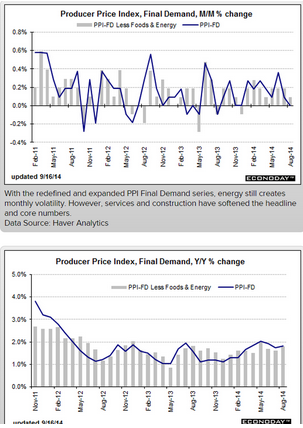
Producer prices chart and other news

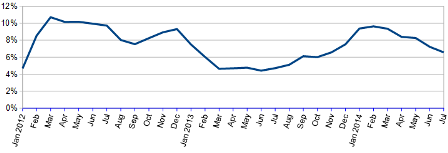
Remember all that ‘hyper inflation’ talk surrounding 0 rates and QE?

No sign of it here. Or anywhere else I’ve looked:

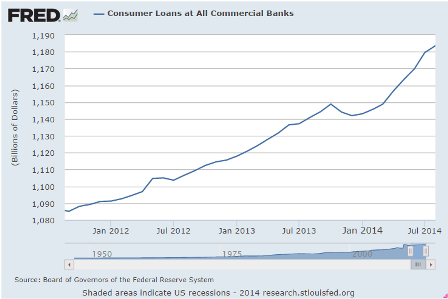
Nor do you hear any more talk about ‘credit acceleration’ since its post winter growth fizzled:

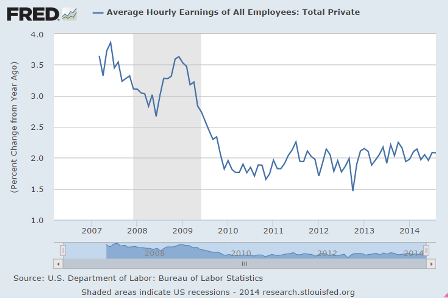
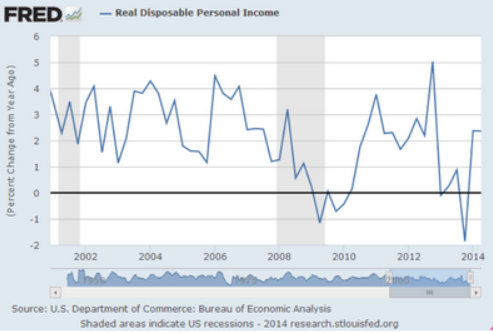
And wage growth (NOT adjusted for inflation) remains next to nothing:

And you only hear about these ‘minor’ reports on retail sales when they go up…

ICSC-Goldman Store Sales


Highlights

Store sales fell back sharply in the September 13 week, down a same-store 2.6 percent from the prior week for a year-on-year rate of plus 3.0 percent vs 4.0 percent in the prior week. But the declines appear to be isolated to the latest week, based on the text of the report which calls the results healthy.

Redbook

Seems the data continues to support my narrative- the deficit is too small given ‘credit conditions’ all of which contributes to a ‘macro constraint’ on the US economy. And the rest of the world is doing same, putting a macro constraint on the global economy.

Furthermore, seems the exporters are in control everywhere, pushing their narrative designed to increase global ‘competitiveness’ by keeping real wages low via low domestic demand and high unemployment.

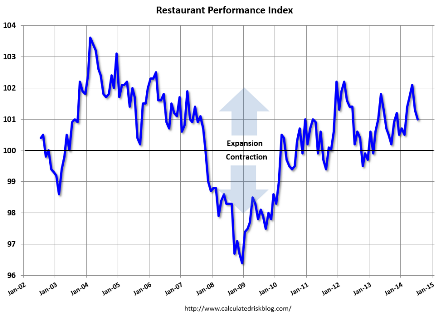
Construction, gasoline prices, manufacturing, state and local contribution to gdp, restaurant performance index, saudi output, sun spots

Headlines sound a lot better than the charts look.

Absolute levels and growth rates continue to fall short of prior cycles:

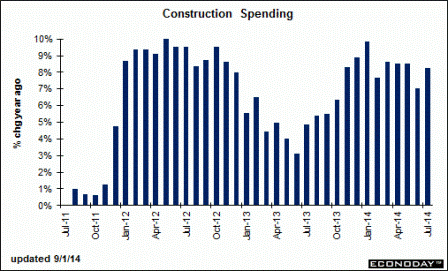
Construction Spending


Highlights
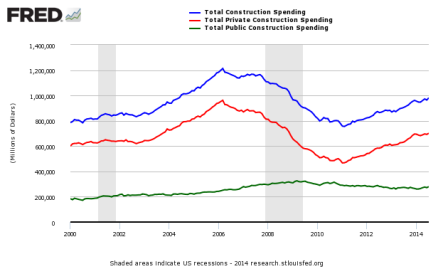
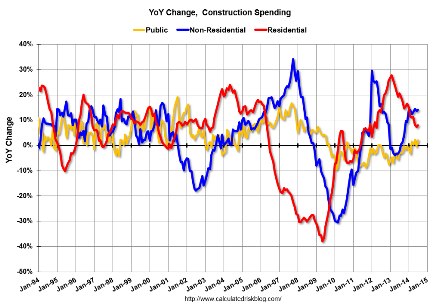
Construction outlays saw a broad-based gain in July. Construction spending rebounded 1.8 percent after a 0.9 percent dip in June. While all broad categories advanced, July’s increase was led by the public sector-up 3.0 percent, following a 1.8 percent decrease in June. Private nonresidential spending rebounded 2.1 percent in July after slipping 0.8 percent the month before. Private residential outlays gained 0.7 percent, following a 0.4 percent dip in June.

On a year-ago basis, total outlays were up 8.2 percent in July, compared to 7.0 percent the month before.

Overall, the latest construction data add to third quarter momentum. Third quarter GDP estimates will likely be nudged up. There is a lot of recent volatility in construction data but the residential gain is encouraging.

Unadjusted Construction Spending – Three Month Rolling Average Compared to the Rolling Average One Year Ago


Full size image


Full size image


Full size image

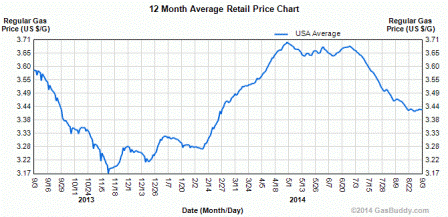
This helps consumers some and also puts downward pressure on ‘inflation’:


Full size image

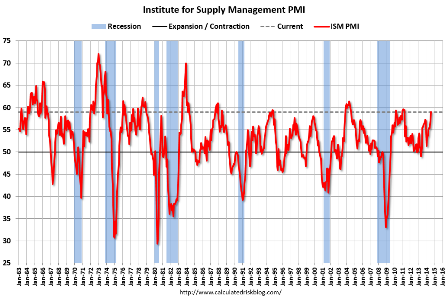
Manufacturing continues to do reasonably well, chugging along about the way it always does until the cycle ends:


Full size image

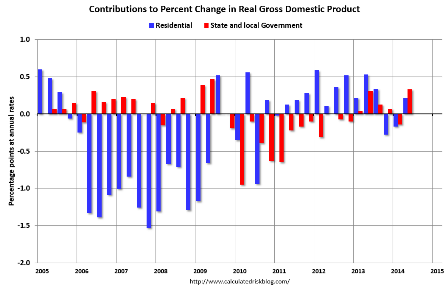
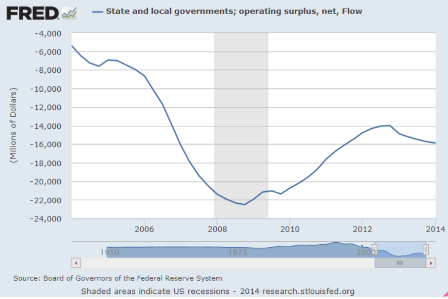
Don’t be misled by the talk of state and local govt contributing to GDP. The spending side is only half the story- they also tax. So you need to look at state and local govt deficits to get an idea of their net contribution:

This is the spending side:


Full size image

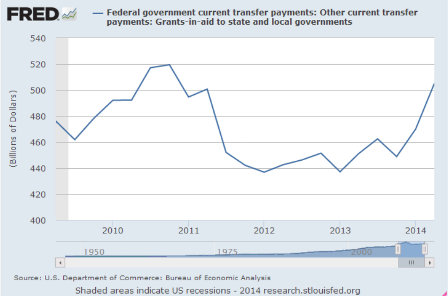
It’s a bit tricky as you don’t want to double count federal $ spent by the states:

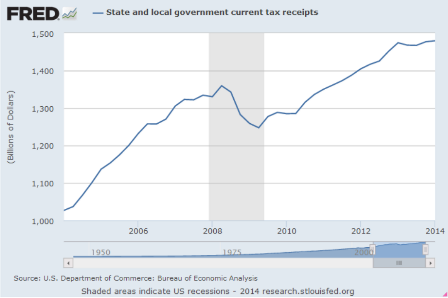
Sure enough, tax receipts which tend to be highly cyclical, going up when the economy does better, seem to have stalled, and state and local deficits have gone up. So is that an indicator of growth?

And it looks like state and local deficits did go up a tad, but not a lot:

And this just came out:


Full size image

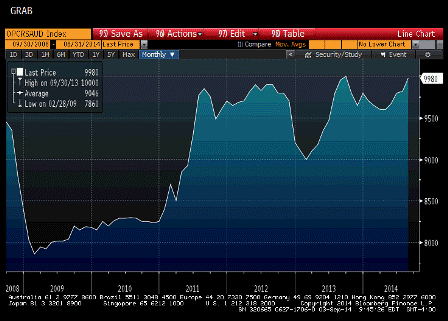
The call on Saudi oil shows no signs of diminishing which they remain as ‘swing producer/price setter’, setting price and letting quantity adjust with demand:


Full size image

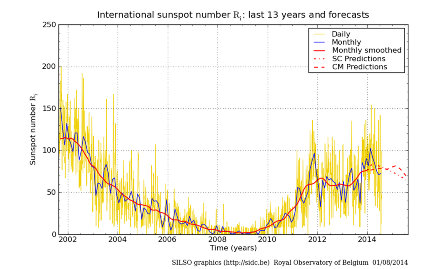
And this:
;)


Full size image

Comments on Professor John Cochrane’s – A Few Things the Fed Has Done Right

A Few Things the Fed Has Done Right

The Fed’s plan to maintain a large balance sheet and pay interest on bank reserves is good for financial stability.

By John H. Cochrane

Aug 21 (WSJ) — As Federal Reserve officials lay the groundwork for raising interest rates, they are doing a few things right. They need a little cheering, and a bit more courage of their convictions.

The Fed now has a huge balance sheet. It owns about $4 trillion of Treasury bonds and mortgage-backed securities. It owes about $2.7 trillion of reserves (accounts banks have at the Fed), and $1.3 trillion of currency. When it is time to raise interest rates, the Fed will simply raise the interest it pays on reserves. It does not need to soak up those trillions of dollars of reserves by selling trillions of dollars of assets.

Correct!

The Fed’s plan to maintain a large balance sheet and pay interest on bank reserves, begun under former Chairman Ben Bernanke and continued under current Chair Janet Yellen, is highly desirable for a number of reasons—the most important of which is financial stability. Short version: Banks holding lots of reserves don’t go under.

Not true.
Confusing reserves with capital to some extent.
Banks can fail via losses that wipe out capital even with plenty of liquidity.

This policy is new and controversial. However, many arguments against it are based on fallacies. People forget that when the Fed creates a dollar of reserves, it buys a dollar of Treasurys or government-guaranteed mortgage-backed securities. A bank gives the Fed a $1 Treasury, the Fed flips a switch and increases the bank’s reserve account by $1. From this simple fact, it follows that:

• Reserves that pay market interest are not inflationary. Period. Now that banks have trillions more reserves than they need to satisfy regulations or service their deposits, banks don’t care if they hold another dollar of interest-paying reserves or another dollar of Treasurys. They are perfect substitutes at the margin. Exchanging red M&Ms for green M&Ms does not help your diet. Commenters have seen the astonishing rise in reserves—from $50 billion in 2007 to $2.7 trillion today—and warned of hyperinflation to come. This is simply wrong as long as reserves pay market interest.

Yes and no.

Yes, the mix of Fed liabilities per se isn’t inflationary.

No, even if they didn’t pay interest it wouldn’t be inflationary. In fact, it would mean a reduction in govt interest payments which is a contractionary bias.

And his point is best stated by stating that both reserves and tsy secs are simply dollar denominated ‘bank accounts’ at the Fed, the difference being the duration and rates, directly or indirectly selected by ‘govt’.

• Large reserves also aren’t deflationary. Reserves are not “soaking up money that could be lent.” The Fed is not “paying banks not to lend out the money” and therefore “starving the economy of investment.”

True.

Every dollar invested in reserves is a dollar that used to be invested in a Treasury bill.

Wrong statement of support. He should state that the causation goes from loans to deposits. ‘Loanable funds’ applies to fixed fx, not floating fx.

A large Fed balance sheet has no effect on funds available for investment.

True, they are infinite in any case. Bank lending is constrained only in the short term by capital, as there is always infinite capital available with time at a price that gets reflected in lending charges.

• The Fed is not “subsidizing banks” by paying interest on reserves.

It is to the extent that paying interest is subsidizing the economy in general, as govt is a net payer of interest.

The interest that the Fed will pay on reserves will come from the interest it receives on its Treasury securities.

Sort of. Better said that the interest received on the tsy’s will equal/exceed/etc. the interest paid on reserves. ‘Come from’ is a poor choice of words.

If the Fed sold its government securities to banks, those banks would be getting the same interest directly from the Treasury.

True.

The Fed has started a “reverse repurchase” program that will allow nonbank financial institutions effectively to have interest-paying reserves. This program was instituted to allow higher interest rates to spread more quickly through the economy.

True.

Again, I see a larger benefit in financial stability. The demand for safe, interest-paying money expressed so far in overnight repurchase agreements, short-term commercial paper, auction-rate securities and other vehicles that exploded in the financial crisis can all be met by interest-paying reserves.

Sort of. The term structure of rates constantly adjusts to indifference levels is how I’d say it.

Encouraging this switch is the keystone to avoiding another crisis. The Treasury should also offer fixed-value floating-rate electronically transferable debt.

Why??? Indexed to what? The one’s they are doing indexed to T bills make no logical sense at all.

This Fed reverse-repo program spawns many unfounded fears, even at the Fed. The July minutes of the Federal Open Market Committee revealed participants worried that “in times of financial stress, the facility’s counterparties could shift investments toward the facility and away from financial and nonfinancial corporations.”

This fear forgets basic accounting.

True.

The Fed controls the quantity of reserves. Reserves can only expand if the Fed chooses to buy assets—which is exactly what the Fed does in financial crises.

Furthermore, this fear forgets that investors who want the safety of Treasurys can buy them directly. Or they can put money in banks that in turn can hold reserves. The existence of the Fed’s program has minuscule effects on investors’ options in a crisis. Interest-paying reserves are just a money-market fund 100% invested in Treasurys with a great electronic payment mechanism.

Available to banks.

That’s exactly what we should encourage for financial stability.

The Open Market Committee minutes also said that, “Participants noted that a relatively large [repurchase] facility had the potential to expand the Federal Reserve’s role in financial intermediation and reshape the financial industry.”

Not really.

It always has been about offsetting operating factors one functionally identical way or another.

Yes, and that’s a feature not a bug. The financial industry failed and the Fed is reshaping it under the 2010 Dodd-Frank financial-reform law. Allowing money previously invested in run-prone shadow banking to be invested in 100%-safe reserves is the best thing the Fed could do to reshape the industry.

They can only do that if they reduce the institutional additions to the bank’s cost of funds/lower risk restrictions to make the banks more competitive with non bank lenders.

Temptations remain. For example, with trillions of reserves in excess of regulatory reserve requirements, the Fed loses what was left of its control over bank lending and deposit creation. The Fed will be tempted to use direct regulation and capital ratios to try to micromanage lending.

That’s all it ever had. Lending was never reserve constrained.

It should not. The big balance sheet is a temptation for the Fed to buy all sorts of assets other than short-term Treasurys, and to meddle in many markets, as it is already supporting the mortgage market. It should not.

I see precious little difference apart from option vol considerations.

The Fed is making no promises about the stability of these arrangements—a large balance sheet and market interest on reserves available to non-banks. It should. In particular, it should clarify whether it will allow its balance sheet to shrink as long-term assets run off, or reinvest the proceeds as I would prefer.

It doesn’t matter for what he’s talking about.

Most of the financial stability benefits only occur if these arrangements are permanent and market participants know it. We can debate whether interest rate policy should follow rules or discretion, be predictable or adapt to each day’s Fed desire. But the basic structures and institutions of monetary policy should be firm rules.

The remaining short-term question is when to raise rates. Ms. Yellen has already made an important decision: The Fed will not, for now, use interest-rate policy for “macroprudential” tinkering. This too is wise. We learned in the last crisis that the Fed is only composed of smart human beings. They are not clairvoyant and cannot tell a “bubble” from a boom in real time any better than the banks and hedge funds betting their own money on the difference. Manipulating interest rates to stabilize inflation is hard enough. Stabilizing inflation and unemployment is harder still.

Especially when they have it backwards.

Additionally chasing will-o-wisp “bubbles,” “imbalances” and “crowded trades” will only lead to greater macroeconomic and financial instability.

Here too a firm commitment would help. Otherwise market participants will be constantly looking over their shoulders for the Fed to start meddling in home and asset prices.

Plenty of uncertainties, challenges and temptations remain. Tomorrow, we can go back to investigating, arguing and complaining. Today let’s cheer a few big things done right.

Mr. Cochrane is a professor of finance at the University of Chicago Booth School of Business, a senior fellow at the Hoover Institution, and an adjunct scholar at the Cato Institute.

Doesn’t mention/forgets that the Fed buying secs is functionally identical to the tsy not selling them in the first place, etc.


ECB relying export driven growth through euro depreciation

Note below that he states it’s the fx channel that the ECB is relying on to support aggregate demand.

Good luck to them, it doesn’t work that way!!!

From the speech by Mario Draghi, President of the ECB, Annual central bank symposium in Jackson Hole, 22 August 2014:

Boosting aggregate demand

On the demand side, monetary policy can and should play a central role, which currently means an accommodative monetary policy for an extended period of time. I am confident that the package of measures we announced in June will indeed provide the intended boost to demand, and we stand ready to adjust our policy stance further.

We have already seen exchange rate movements that should support both aggregate demand and inflation, which we expect to be sustained by the diverging expected paths of policy in the US and the euro area (Figure 7). We will launch our first Targeted Long-Term Refinancing Operation in September, which has so far garnered significant interest from banks. And our preparation for outright purchases in asset-backed security (ABS) markets is fast moving forward and we expect that it should contribute to further credit easing. Indeed, such outright purchases would meaningfully contribute to diversifying the channels for us to generate liquidity.

Housing and CPI

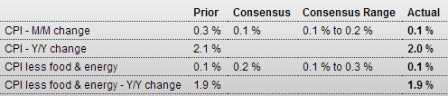
Reinforces the mainstream narrative of the moment:
The Fed will keep rates low, getting ‘behind the curve’ and causing a run away economy.

My narrative remains that the 0 rate policy is deflationary and also keeps a lid on growth.

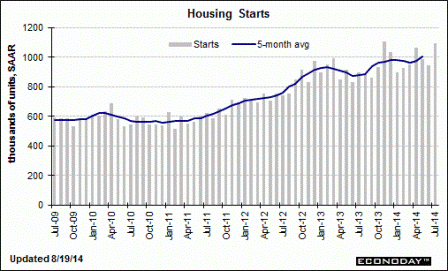
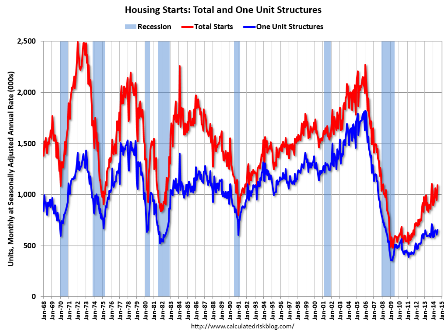
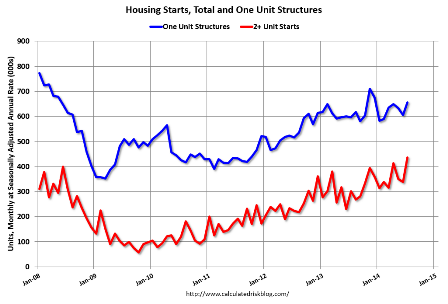
The ‘surge’ in total starts, which remain pretty much at the lows of prior recessions (see charts which are not population adjusted), was in multi family, which is ok, but units tend to be smaller and a lot less expensive than single family, and total expense is what counts for GDP/employement/etc. And it all remains a much lower % of GDP than in prior cycles:

Housing Starts


Highlights
Housing may be making a comeback with the labor market improving and awareness that the Fed is cutting back on mortgage-backed securities-meaning a pending rise in mortgage rates.

Housing starts for July jumped to an annualized pace of 1.093 million units-up from 0.945 million units the prior month. The latest number well topped expectations for 0.963 million units. July was up a sharp 15.7 percent (monthly), after dipping 4.0 percent in June.

Strength was led by the multifamily component which surged 28.9 percent after a 3.1 percent decline in June. But the single-family component showed health with an 8.3 percent rebound after falling 4.4 percent in June.

According to building permits, momentum is building-but largely for the multifamily component. Permits jumped a monthly 8.1 percent to an annualized pace of 1.052 million units. For July, the multifamily component gained 21.5 percent while the single-family component edged up 0.9 percent.


Full size image


Full size image

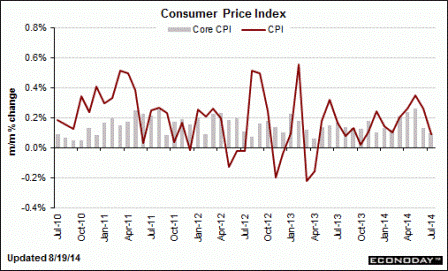
Consumer Price Index

Fed policy comment

So the theme is ‘the Fed is getting behind the curve’

That is, Yellen keeps rates ‘too low’ causing the economy to overheat.

Complete nonsense, of course, but it drives markets until it doesn’t.

Much like QE.

The 0 rate policy, including QE, remains no way supportive of growth and employment, but instead deflationary and contractionary, as evidenced by the anemic private sector credit expansion, low income growth, and ‘low inflation’. And the gaping output gap…

GDP

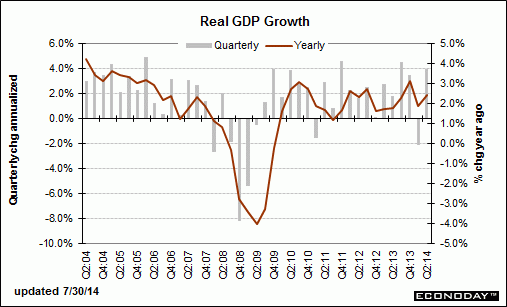
A few charts/comments below. More after the first revision to Q2 come out. Looks to me like the macro constraint narrative is still intact.

Just a word here about state and local govt spending adding to GDP. Yes, there was an increase in spending. But tax receipts also went up, which subtracts from private spending. The thing to watch is net state and local spending, including borrowing to spend. I don’t have any charts, but anecdotally state and local budgets are said to be ‘improving’ which means less net spending.

GDP


Highlights
The second quarter rebounded more than expected from the adverse weather impacted first quarter. While there were a number of strong components, the rebound was led by inventory growth. The advance estimate for the second quarter posted at a healthy 4.0 percent annualized, following an upwardly revised decline of 2.1 percent in the first quarter (previously down 2.9 percent). The median forecast was for 3.1 percent. Today’s release includes annual revisions.

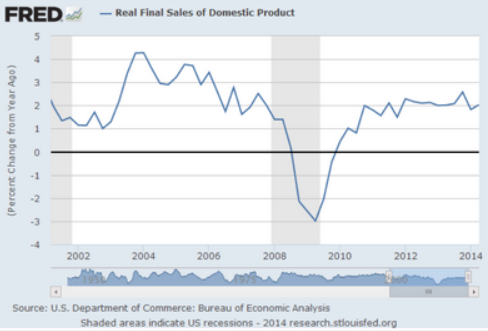
Final sales of domestic product rebounded 2.3 percent after dipping 1.0 percent in the first quarter. Final sales to domestic purchasers gained 2.8 percent in the second quarter, compared to 0.7 percent in the first quarter.

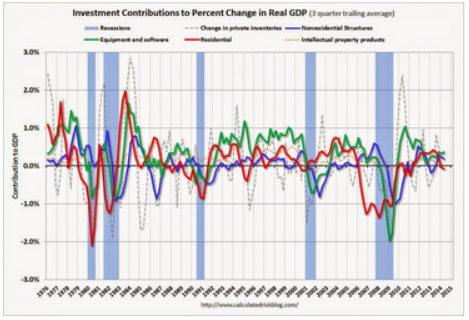
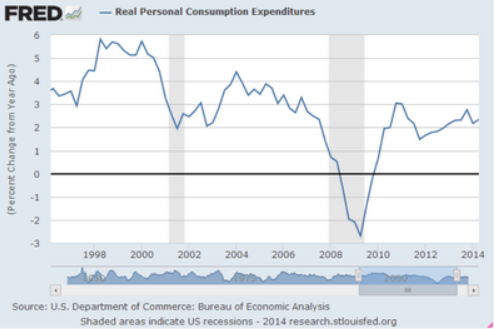
Turning to components, inventory investment jumped $93.4 billion after rising $35.2 billion in the first quarter. Importantly, personal spending posted a robust 6.2 percent gain, following a 1.0 percent rise in the prior quarter. Durables PCEs were particularly strong with nondurables healthy. Services posted on the soft side.

Residential investment rebounded notably in the second quarter and nonresidential investment was healthy. Government purchases were up but soft and net exports worsened notably.

On the price front, the chain-weighted price index firmed to a 2.0 percent increase, up from 1.3 percent in the first quarter. The core chain index increased 1.8 percent in the second quarter from 1.2 percent in the prior quarter.

Turning to annual revisions, 2013 on an annual average basis was revised up to 2.2 percent versus the prior estimate of 1.9 percent; 2012 revised down to 2.3 percent from 2.8 percent; and 2011 revised down to 1.6 percent from 1.8 percent.

Overall, the second quarter numbers point to a return to forward momentum after the deep freeze first quarter. While inventories led second quarter growth, this should not be disconcerting as the lack of production in the first quarter meant that significant inventory rebuilding was needed. Additionally, other GDP components (net exports being the key exception) were healthy.


Full size image

Average basic monthly wage posts 1st gain in June in over 2 years

July 31 (Kyodo) — The average basic monthly salary at companies with at least five employees rose 0.3 percent in June from a year earlier to 243,019 yen, marking the first rise in two years and three months, the labor ministry said Thursday. This year’s “shunto” spring labor offensive resulting in many unions winning a pay-scale increase pushed up the figure, according to the Health, Labor and Welfare Ministry. The total monthly average, including bonuses, increased 0.4 percent to 437,362 yen. Nonscheduled cash earnings, such as overtime compensation, grew 1.9 percent to 19,058 yen. Real wages, adjusted for inflation, decreased 3.8 percent, down over 3 percent for the third consecutive month following the consumption tax hike in April.

Japan- currency depreciation policy ‘bad’ inflation for households, good for exporters

Japan’s household spending falls 3.0% in June

July 29 (Kyodo) — Average Japanese monthly household spending fell a price-adjusted 3.0 percent in June from a year earlier to 272,791 yen. The average monthly income of salaried households came to 710,375 yen, down 6.6 percent in real terms. Household spending rose 1.5 percent in June from the previous month in seasonally adjusted terms, reversing the contractions seen in April and May. Retail sales fell 0.6 percent in June from a year ago, faster than a 0.4 percent decline in the year to May. The pace of decline was slower compared with 1997 when the sales tax was last raised, the trade ministry said.

Abenomics= ‘bad’ inflation

Squeaking By on Abenomics

By Joseph Sternberg

July 2 (WSJ) — Preliminary data show cash earnings, including bonuses, rising by 0.8% year-on-year in May. Base pay increased 0.2%, its first rise in around two years. This looks like the “wage surprise” Japanese workers’ purchasing power fell another 3.6% year-on-year in May, after declines throughout much of Mr. Abe’s tenure. This is partly due to the price effects of the consumption-tax hike, and partly due to the import-price inflation stimulated by Mr. Abe’s weak-yen policy. Because Mr. Abe has yet to generate meaningful economic growth, the consumption tax merely redistributes income away from households and toward other government purposes.