Another look at Kohn’s June 11th speech


[Skip to the end]

This still reads hawkish to me:

The results of such exercises imply that, over recent history, a sharp jump in oil prices appears to have had only modest effects on the future rate of inflation. This result likely reflects two factors. First, commodities like oil represent only a small share of the overall costs of production, implying that the magnitude of the direct pass-through from changes in such prices to other prices should be modest, all else equal. Second, inflation expectations have been well anchored in recent years, contributing to a muted response of inflation to oil price shocks. But the anchoring of expectations cannot be taken as given; indeed, the type of empirical exercises I have outlined reveal a larger effect of the price of oil on inflation prior to the last two decades, a period in which inflation expectations were not as well anchored as they are today.

Nonetheless, repeated increases in energy prices and their effect on overall inflation have contributed to a rise in the year-ahead inflation expectations of households, especially this year. Of greater concern is that some measures of longer-term inflation expectations appear to have edged up since last year. Any tendency for these longer-term inflation expectations to drift higher or even to fail to reverse over time would have troublesome implications for the outlook for inflation.

The central role of inflation expectations implies that policymakers must look beyond this type of reduced-form exercise for guidance. After all, the lags of inflation in reduced-form regressions are a very imperfect proxy for inflation expectations. As emphasized in Robert Lucas’s critique of reduced-form Phillips curves more than 30 years ago, structural models are needed to have confidence in the effect of any shock on the outlook for inflation and economic activity.

This was considered the dovish part:

In particular, an appropriate monetary policy following a jump in the price of oil will allow, on a temporary basis, both some increase in unemployment and some increase in price inflation. By pursuing actions that balance the deleterious effects of oil prices on both employment and inflation over the near term, policymakers are, in essence, attempting to find their preferred point on the activity/inflation variance-tradeoff curve introduced by John Taylor 30 years ago.

So the question is whether that point was realized by a 2% Fed funds rate currently?

Such policy actions promote the efficient adjustment of relative prices: Since real wages need to fall and both prices and wages adjust slowly, the efficient adjustment of relative prices will tend to include a bit of additional price inflation and a bit of additional unemployment for a time, leading to increases in real wages that are temporarily below the trend established by productivity gains.

But it was then qualified by this return to hawkishness regarding the inflation expectations that he previously said showed signs of elevating:

I should emphasize that the course of policy I have just described has taken inflation expectations as given. In practice, it is very important to ensure that policy actions anchor inflation expectations. This anchoring is critical: As demonstrated by historical experiences around the world and in the United States during the 1970s and 1980s, efforts to bring inflation and inflation expectations back to desirable levels after they have risen appreciably involve costly and undesirable changes in resource utilization.11 As a result, the degree to which any deviations of inflation from long-run objectives are tolerated to allow the efficient relative price adjustments that I have described needs to be tempered so as to ensure that longer-term inflation expectations are not affected to a significant extent.

And the FOMC all agree that long term inflation expectations have been affected to some extent already.

Summary
To reiterate, the Phillips curve framework is one important input to my outlook for inflation and provides a framework in which I can analyze the nature of efficient policy choices. In the case of a shock to the relative price of oil or other commodities, this framework suggests that policymakers should ensure that their actions balance the deleterious economic effects of such a shock in the short run on both unemployment and inflation.

Of course, the framework helps to define the short-run goals for policy, but it doesn’t tell you what path for interest rates will accomplish these objectives. That’s what we wrestle with at the FOMC and is perhaps a subject for a future Federal Reserve Bank of Boston conference.

This all could mean a Fed funds rate that causes unemployment to grow and dampen inflation expectations down, but not grow so much as to bring inflation down quickly is in order.

The question then is whether the appropriate Fed funds rate for this ‘balance’ between growth, employment, and inflation expectations is 2% or something higher than that.

[top]
2008-06-19 Canada News Highlights


[Skip to the end]

Highlights

Canada Inflation Rate Rises More Than Forecast in May on Gasoline Costs


Canada Wholesale Sales Rise Twice as Much as Expected


Canadian Dollar Strengthens as Report Shows Inflation Accelerated in May

Gotta love these kinds of headlines. Latin America had the strongest currencies in the world with their past inflations???

Statistics Canada Says Second Straight GDP Decline Won’t Prove Recession


Canada Stock Index Extends Record as Energy Shares Surge; TD Bank Declines


U.S. economy keeps Canada on edge


[top]

2008-06-19 EU News Highlights


[Skip to the end]

Highlights

Italian Unemployment Rate Rises for First Time Since 2003

Euro Central bankers think that’s a good thing for their fight against inflation. Unemployment was getting far too low for comfort.

France’s Woerth Maintains Economic Growth Forecast at 1.7%-2%

More than enough to warrant rate hikes.

French government wants more work hours

Trying to add supply to labor markets to keep wages ‘well contained.’

Zapatero Says Spain Suffering an ‘Abrupt Slowdown’

Spain had been growing too fast for comfort for the inflation hawks


[top]

Bloomberg: U.K. government worker union ‘prepares for battle’ on wages


[Skip to the end]

Here’s how relative value stories ultimately change to inflation stories:

U.K. Government Worker Union ‘Prepares for Battle’ on Wages

By Mark Deen

(Bloomberg) Britain’s largest union for government employees urged members to “prepare for battle” and be ready to strike, stepping up pressure on Prime Minister Gordon Brown to hand out pay awards that meet the rising cost of living.

“Working people, our people, are taking a hit,” said David Prentis, general secretary of Unison, which represents 1.3 million public sector workers. “Our union will organize the most powerful campaign ever seen in support of public services.”

The comments, made in a speech and accompanied by advertisements in U.K. newspapers today, rebuff Chancellor of the Exchequer Alistair Darling’s call for wage restraint as he seeks to combat rising food and energy prices and a slowing economy.


[top]

Bloomberg: Mainstream criticism of FOMC


[Skip to the end]

As mainstream economists, the Fed knows it took a very large risk when it cut aggressively, hoping its forecasts for ‘moderating inflation’ would play out, and knowing the following would happen if ‘inflation’ accelerated.

Bernanke May Regret Interest-Rate Cuts, Lawson Says

by Kim-Mai Cutler

(Bloomberg) Former U.K. Chancellor of the Exchequer Nigel Lawson said Federal Reserve Chairman Ben S. Bernanke may be “regretting” the fastest pace of U.S. interest-rate cuts since 1984 as global inflation accelerates.

The Fed reduced its benchmark rate by 3.25 percentage points to 2 percent between September and April 30 to stave off a recession following the collapse of the U.S. subprime-mortgage market. The Bank of England, also facing a slowdown, cut its key rate by 0.75 percentage point to 5 percent. The European Central Bank left rates unchanged at 4 percent for a year and signaled this month it may raise them in July.

“The Bank of England has been very cautious and careful and it has been much closer to the views of the European Central Bank,” Lawson, 76, who was finance minister from 1983 to 1989 under former Prime Minister Margaret Thatcher, said in a telephone interview. “It has not gone conspicuously the way of the Fed, where I suspect that Mr. Bernanke’s now regretting it.”

U.S. consumer prices rose 0.6 percent in May, the most since November, the Labor Department said June 13. Inflation in the euro area accelerated last month to a 3.7 percent annual rate, the fastest since June 1992, the European Union reported June 16.

Inflation caused by rising commodity prices is the biggest threat to the world economy, eclipsing concern about the seizure in the credit markets, finance ministers from the Group of Eight nations said June 14. The World Bank said on June 10 that global economic growth will probably slow to 2.7 percent this year from 3.7 percent in 2007.

Oil ‘Bubble’
Rising food prices and a “speculative bubble” in oil markets will prompt central banks to lift rates, leading to a “growth recession” where the rate of expansion is lower than historical trends, Lawson said in the interview.

Crude oil rose 95 percent from a year ago and traded at an all-time high of $139.89 a barrel in New York June 16. Corn for December delivery also traded at a record $7.915 in Chicago.

“Most of the central banks are very, very clear on just how dangerous it is to let inflationary expectations get out of hand,” he said.

Traders see a 48 percent chance the Fed will raise its target rate for overnight bank loans from 2 percent as early as August, up from 4.1 percent odds a month ago, futures contracts on the Chicago Board of Trade show. The chances of an increase in October are 99 percent, the contracts show.

Michelle Smith, a Fed spokeswoman in Washington, declined to comment on Lawson’s remarks.

‘Shallow’ Recession
The slowdown in the U.K. is going to last “longer than most people expect,” while remaining “shallow,” Lawson said. The economy, the second-largest in Europe, grew 0.4 percent in the first quarter, its weakest pace since 2005, as higher credit costs hurt construction and business services slowed, according to the Office for National Statistics.

“This is the hangover after the binge,” Lawson said. “It’s going to be very, very difficult for the next two to three years for the global economy.”

The U.K. won’t adopt the euro in place of the pound as a global slowdown heightens tensions between members of the 27- nation European Union, Lawson said. Ireland vetoed the bloc’s new government treaty June 13, sinking an agreement that needed ratification by all EU countries.

“There are going to be considerable strains within the euro area,” Lawson said. “There are going to be a number of countries that found the single currency satisfactory during the benign period, that are now going to hurt much more under these difficult conditions.”


[top]

Central banks trying to limit backup


[Skip to the end]

Karim writes:

ECB-Board Member Bini Smaghi was 4th board member since last week’s press conference to say that one 25bp hike was enough to return inflation back to the 2% target in 2yrs time (Trichet, Stark, Orphanides before him). Whether true or not, market reaction since last Thursday clearly in excess of that expected or desired. This French economist’s website probably works against him but you never know; www.stroptrichet.com

BOE-‘The framework is based on the recognition that the actual inflation rate will on occasions depart from its target as a result of shocks and disturbances.
Attempts to keep inflation at the inflation target in these circumstances may cause undesirable volatility in output”. The Committee believes that, if Bank Rate were set to bring inflation back to the target within the next 12 months, the result would be unnecessary volatility in output and employment.

    ÃƒÆ’ Classic Philips curve trade-off being described here as well as amount of time given to bring inflation back to target

FRB-5 stories since Sunday trying to dampen rate hike expectations seems like a coordinated plant: Page 1 of WSJ today, FT article today citing ‘senior officials’, Market News piece from Beckner from yesterday, Washington Post article yesterday from Novak, and Blinder editorial in New York times on Sunday. Also Lacker was unusually tame yesterday in his remarks on inflation expectations.

Yes, agreed.

In fact, it can be said that this entire cycle has witnessed subdued inflation responses from top CBs. There is probably no precedent for the Fed cutting aggressively into the food/fuel negative supply shocks.

‘SOME’ have suggested this is a baby boomer phenomena – short sighted aversion to ‘pain’ by a bunch of spoiled kids more than willing to eat their seed corn seems to crop up everywhere. Nothing gets addressed until it gets bad enough to be a major crisis. Energy, biofuels, environment, Iran, weak levies, etc. etc. and now inflation.

It does seem to explain a lot.


[top]

Bloomberg: Poole jumps in


[Skip to the end]

The Fed’s mission is to not let a relative value story turn into an inflation story.

When food/fuel prices rise, consumers have less to spend on other things; so, they should moderate to keep it all a relative value story.

But even though core CPI hasn’t gone up as fast as headline (YET), it has gone up to 2.3%. Rather than stay the same or go down; so, the relative value story is slowing turning into an inflation story.

And my guess is that most of Congress isn’t going to like the idea that the Fed’s job is to keep wages ‘behaving’ (suppressed) when food/fuel goes up, as Poole states below:

Poole Says Fed Needs to Help Prevent Wage Increase

by Kathleen Hays and Timothy R. Homan

(Bloomberg) The Federal Reserve needs to prevent the public’s expectation that inflation will accelerate from spurring demands for higher wages, William Poole, former St. Louis Fed President, said today.

“You want to keep wages behaving,” Poole said in an interview on Bloomberg Television. Once the public’s anticipation of rising prices begins to stoke demands for higher wages, “the jig is up” and inflation becomes harder to eradicate.

The public’s outlook for annual inflation over five years stood at 3.4 percent in June, up from 2.9 percent the same month last year, according to the Reuters/University of Michigan Survey.

Comments by Fed Chairman Ben S. Bernanke and other policy makers this month have compelled traders to increase bets the central bank will start to lift the main lending rate later this year to keep rising food and energy costs from influencing labor agreements and other prices.

“We should be moving sooner rather than later,” Poole said, referring to an interest-rate increase.


[top]

RE: BOE letter


[Skip to the end]

(an interoffice email)

>
>   On Tue, Jun 17, 2008 at 7:58 AM, DV wrote:
>
>   Mervyn King was required this morning to write a letter to the
>   Chancellor explaining why inflation was greater then 3% in the UK
>   (released this morning at 3.2% vs. 3% previously). The letter follows
>   and was taken as dovish by the markets as it seemed to have more
>   emphasis on the weakening economy then additional upside inflation
>   risks.
>
>   DV
>

Letter to the Chancellor

The CPI inflation rate for May, to be published at 9:30 am tomorrow by the Office for National Statistics, is 3.1%. That is more than one percentage point above our target of 2%. Under the terms of the remit you have given us, I am, therefore, writing an open letter to you today on behalf of the Monetary Policy Committee. As requested by the National Statistician, in order to avoid conflict with the release of the official statistic, in this case the CPI, the Bank of England will publish this open letter at 10:30am.

Our remit specifies that an open letter should explain why inflation has moved away from the target, the period within which we expect inflation to return to the target, the policy action that the Committee is taking to deal with it, and how this approach meets the Government’s monetary policy objectives.

Why has inflation moved away from the target?
Inflation has risen sharply this year, from 2.1% in December to 3.3% in May. That rise can be accounted for by large and, until recently, unanticipated increases in the prices of food, fuel, gas and electricity. These components alone account for 1.1 percentage points of the 1.2 percentage points increase in the CPI inflation rate since last December. Those sharp price changes reflect developments in the global balance of demand and supply for food and energy.

In the year to May:

  • world agricultural prices increased by 60% and UK retail food prices by 8%.
  • oil prices rose by more than 80% to average USD123 a barrel and UK retail fuel prices increased by 20%.
  • wholesale gas prices increased by 160% and UK household electricity and gas bills by around 10%.

The global nature of these price changes is evident in inflation rates not only in the UK but also overseas, although the timing of their impact on consumer prices differs across countries. In May, HICP inflation in the euro area was 3.7% and US CPI inflation was 4.2%. As described in our May Inflation Report, inflation is likely to rise significantly further above the 2% target in the next six months or so.

The May Report set out three main reasons for this:

  • The increase in oil prices will continue to pass through to the costs faced businesses.
  • Rising wholesale gas prices are expected to lead utility companies to announce further tariff increases. There is considerable uncertainty about their size and timing.
  • The depreciation of sterling, which has fallen some 12% since its peak last July, has boosted the prices of imports and will add to the pressure on consumer prices.

The Committee’s central projection, described in its May Inflation Report, was for CPI inflation to rise to over 3 1/2%% later this year. But in the past month, oil prices have risen by about 15% and wholesale gas futures prices for the coming winter have increased by a similar amount. As things stand, inflation is likely to rise sharply in the second half of the year, to above 4%. I must stress, however, that there are considerable uncertainties, in both directions, around this, and any such projection is particularly sensitive to changes in domestic gas and electricity charges.

There are good reasons to expect the period of above-target inflation we are experiencing now to be temporary. We are seeing a change in commodity, energy and import prices relative to the prices of other goods and services. Although this clearly raises the price level, it is not the same as continuing inflation.

There is not a generalised rise in prices and wages caused by rapid growth in the amount of money spent in the economy. In contrast to past episodes of rising inflation, money spending is increasing at a normal rate. In the year to 2008 Q1, it rose by 5 1/2%, in line with the average rate of increase since 1997 – a period in which inflation has been low and stable. Moreover, in recent months the growth rate of the broad money supply has eased and credit conditions have tightened. This will restrain the growth of money spending in the future.

Over what period does the MPC expect inflation to return to the target?
It is possible that commodity prices will rise further in the coming months – oil prices have now been rising for four years. But in the absence of further unexpected increases in oil and commodity prices, inflation should peak around the end of the year and begin to fall back towards the 2% target. Nevertheless, each monthly rise in food, energy and import prices will, by pushing up the overall price level, affect the official twelve-month measure of inflation for a year. So CPI inflation is likely to remain markedly above the target until well into 2009.

I expect, therefore, that this will be the first of a sequence of open letters over the next year or so. The remit for the Monetary Policy Committee states that:

“The framework takes into account that any economy at some point can suffer from external events or temporary difficulties, often beyond its control. The framework is based on the recognition that the actual inflation rate will on occasions depart from its target as a result of shocks and disturbances. Attempts to keep inflation at the inflation target in these circumstances may cause undesirable volatility in output”.

The Committee believes that, if Bank Rate were set to bring inflation back to the target within the next 12 months, the result would be unnecessary volatility in output and employment. So the MPC is aiming to return inflation to the 2% target within its normal forecast horizon of around two years, when the present sharp rises in energy and food prices will have dropped out of the CPI inflation rate. Nevertheless, the Committee is concerned about the present and prospective period of above-target inflation. It is crucial that prices other than those of commodities, energy and imports do not start to rise at a faster rate.

That would happen if those making decisions about prices and pay began to expect higher inflation in the future and acted on that. It could also happen if employees respond to the loss of real spending power that results from higher commodity prices by bidding for more substantial pay increases. Pay growth has remained moderate. But surveys indicate that higher inflation has already had an impact on the public’s expectations of inflation. For that reason, the Committee believes that, to return inflation to the target, it will be necessary for economic growth to slow this year.

A slowdown is already in train. Moreover, as described in the Committee’s May Inflation Report, the prospective squeeze on real incomes associated with higher inflation, together with the reduced availability of credit, is likely to lead to a further slowing in activity this year. This will reduce pressure on the supply capacity of the economy and dampen increases in prices and wages. What policy action are we taking? Since December, Bank Rate has been reduced three times, to stand at 5%. When setting Bank Rate the Committee has faced a balancing act between two risks. On the upside, the risk that above-target inflation could persist explains why the Committee has not responded more aggressively to signs that the economy is slowing. On the downside, the risk is that the slowdown could be so sharp that inflation did not just return to the target but was pulled below. This explains why Bank Rate has been reduced at a time when inflation is above the target.

The MPC will discuss at its July meeting the implications of the latest inflation and other economic data for the balance of these risks. That analysis will be described in the minutes, published two weeks later, and a fully updated forecast will be presented in the August Inflation Report. The path of Bank Rate that will be necessary to meet the 2% target is uncertain. The MPC will continue to make its judgement about the appropriate level of Bank Rate month by month.

How does this approach meet the Government’s monetary policy objectives?
Over the past decade, inflation has been low and stable. Volatility in commodity, energy and import prices means that inflation will now be less stable but it does not mean that inflation will persist at a higher rate. The Committee will maintain price stability by ensuring that the rise in inflation is temporary and that it returns to the 2% target. In the short term, this commitment should give those setting prices and wages some confidence that inflation will be close to the target in the future. That will minimise the slowdown in economic activity that will be necessary to ensure that inflation does fall back. In the longer term, price stability, as our remit states, is “a precondition for high and stable levls of growth and employment”.

We have seen in the past how the need to reduce inflation from persistently high levels has required prolonged periods of subdued economic growth. The resulting instability in our economy deterred investment and contributed to poor economic performance over a longer period. The Monetary Policy Committee remains determined to set interest rates at the level required to bring inflation back to the 2% target, and I welcome the opportunity to explain our thinking in this open letter.

I am copying this letter to the Chairman of the Treasury Committee, through which we are accountable to Parliament, and will place it on the Bank of England’s website for public dissemination.

Thanks, seems the risk of crude rising continuously due to demand continues to be downplayed by the world’s central bankers even though it has been the case for several years, so they continue to pursue policies that in their models are designed to at least support demand.

I continue to suggest mainstream history will not be kind to them.


[top]

2008-06-13 US Economic Releases


[Skip to the end]


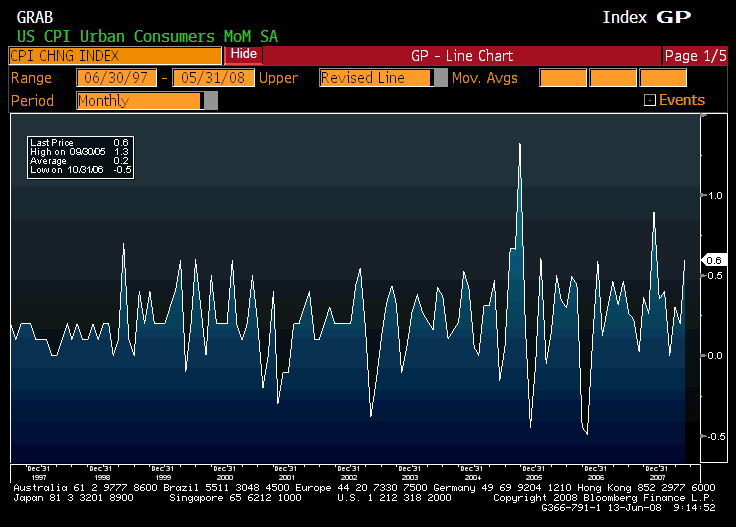
Consumer Price Index MoM (May)

Survey 0.5%
Actual 0.6%
Prior 0.2%
Revised n/a

From Karim:

More divergence between headline and core.

  • Headline up .6498% m/m and 4.2% y/y; 3mth annualized rate of 4.9%
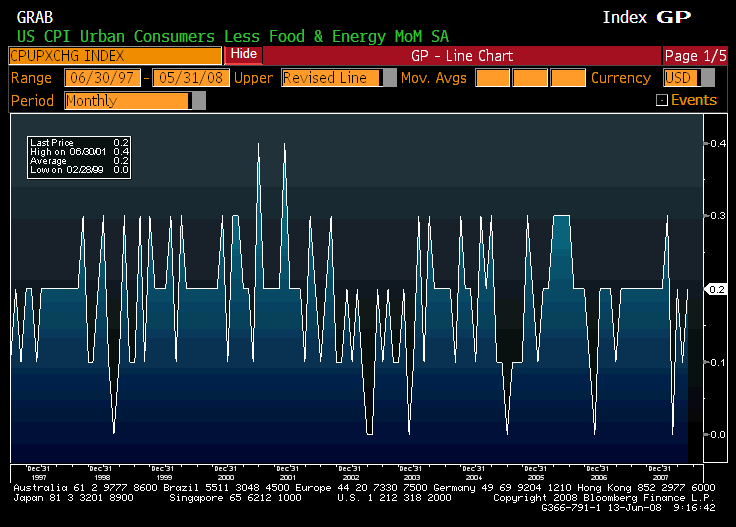
  • Core up .202% and 2.3% y/y; 3mth annualized rate of 1.8%

Trends diverging

  • Gas (up 5.7%) and lodging away from home (+1.3%, but just reversing prior mth’s 1.9% drop) only major outliers
  • Medical (0.2%), oer (0.1%) and education (0.4%) all in line with trend

Kohn defended his inflation forecasting approach on Wednesday (based on ’50yrs’ of analysis). Basically using an ‘expectations augmented’ Philips Curve; meaning slack (which he stated is opening up) is largest determinant of inflation, as long as expectations are stable. He said if ‘over time’ expectations did not recede, it would be ‘troublesome’ for inflation; in the meantime, the Fed would ‘temporarily’ allow a rise in both inflation and joblessness. Some Regional Bank Presidents may feel differently.

[top][end]


CPI Ex Food & Energy MoM (May)

Survey 0.2%
Actual 0.2%
Prior 0.1%
Revised n/a

[top][end]


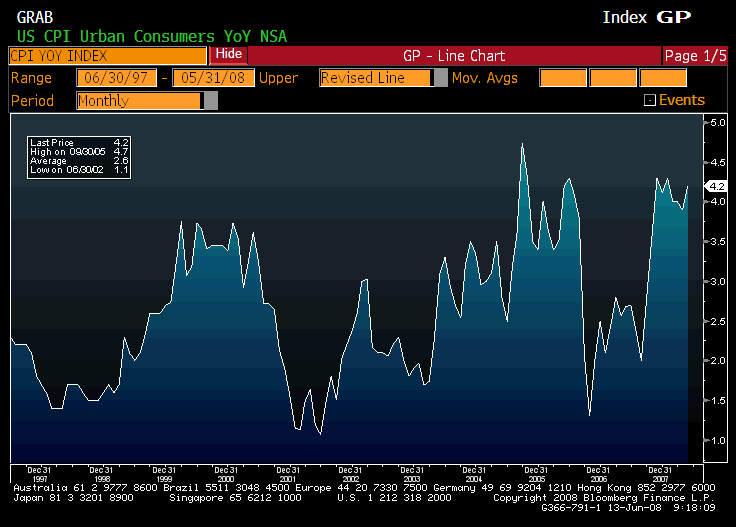
Consumer Price Index YoY (May)

Survey 3.9%
Actual 4.2%
Prior 3.9%
Revised n/a

The dip in the second half of 2006 was entirely due to the Goldman induced commodity sell off when the gasoline weighting in their index was changed.

Prices have now fully recovered and resumed their uptrend.

[top][end]


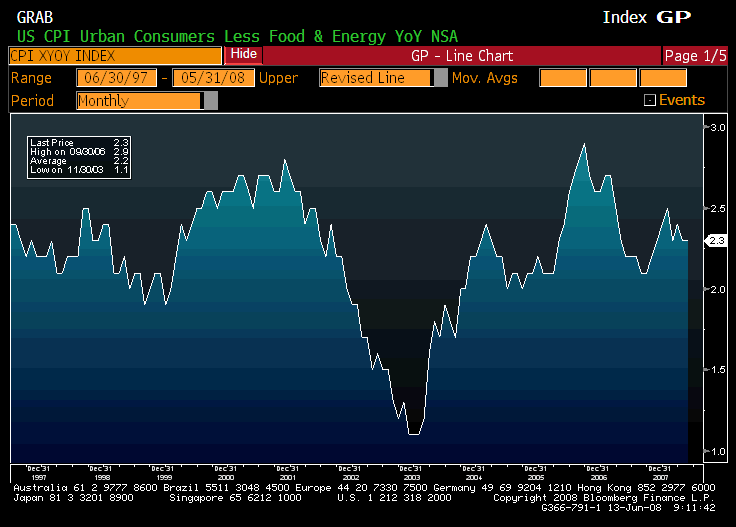
CPI Ex Food & Energy YoY (May)

Survey 2.3%
Actual 2.3%
Prior 2.3%
Revised n/a

Food and energy prices are just beginning to be passed through to core CPI. Everything is composed of food and energy, so it’s just a matter of time before all prices catch up, particularly with GDP now moving up some with the latest fiscal package kicking in.

Because headline CPI is a smaller percentage of GDP than it was in the 70’s, the passthrough will take a bit longer.

[top][end]


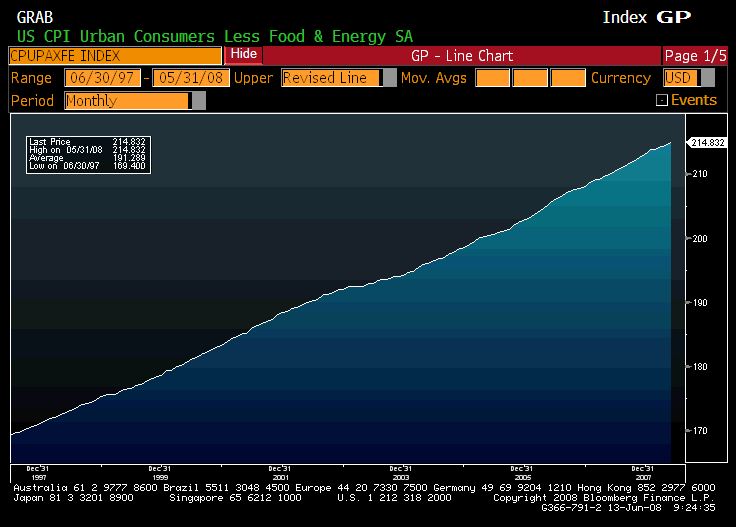
CPI Core Index SA (May)

Survey n/a
Actual 214.832
Prior 214.398
Revised n/a

[top][end]


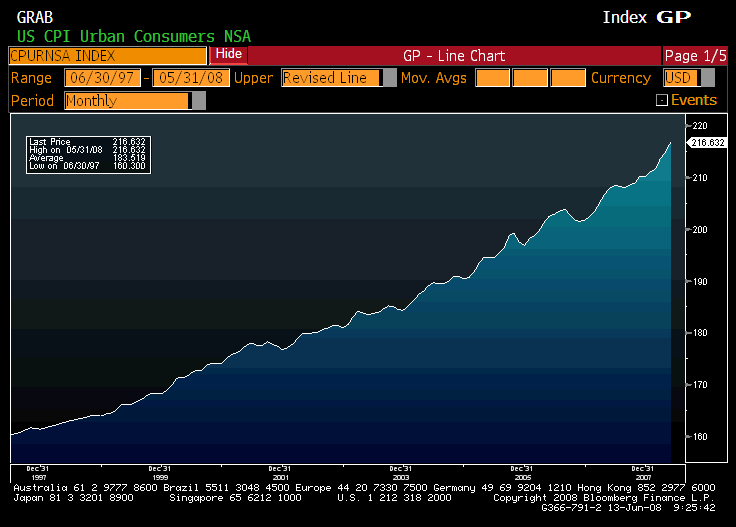
Consumer Price Index NSA (May)

Survey 216.205
Actual 216.632
Prior 214.823
Revised n/a

[top][end]


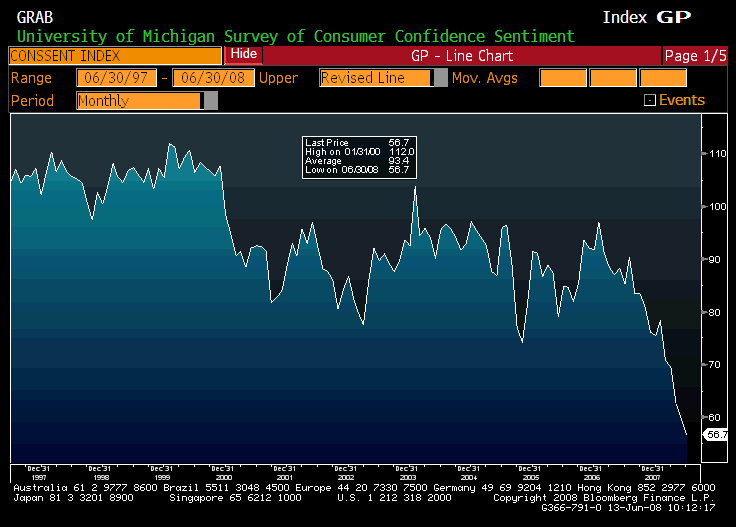
U of Michigan Confidence (Jun P)

Survey 59.0
Actual 56.7
Prior 59.8
Revised n/a

Below expectations, but seems inflation is cutting into confidence, so this doesn’t give the Fed a reason not to hike at the next meeting.

[top][end]


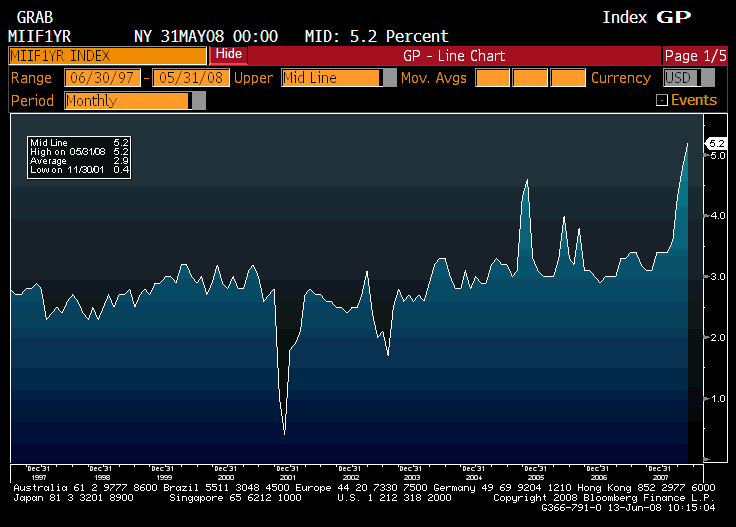
Inflation Expectations 1yr Forward (May)

Survey n/a
Actual 5.1%
Prior 5.2%
Revised n/a

This is persisting at far too high a level for Fed comfort.

[top]

Re: Roach-Stagflation


[Skip to the end]

(an email exchange)

A few of things:

First, the rising wages in the 70’s led to bracket creep that put the budget in surplus in 1979 and resulted in a severe recession soon after.

This time around it is unlikely the inflation takes much of a dent out of the deficit so it’s more likely demand will be sustained to support prices. And, at least so far, Congress has acted to sustain demand and support prices with the latest fiscal package and more seemingly on the way.

Second, last time around the oil producers for the most part didn’t spend all that much of their new found revenues and thereby drained demand from the US economy. This time around they seem to be spending on infrastructure at a rate sufficient to drive our exports and keep gdp muddling through.

Third, I recall it was maybe the deregulation of nat gas that freed up a cheap substitute for electric utilities and unleashed a massive supply response as nat gas was substituted for crude at the elect power producers. After 1980 opec cut production by something like 15 million bpd to hold prices above 30 until they could cut no more without capping all their wells and the price tumbled to about 10 where it stood for a long time. This time around that kind of excess supply is nowhere in sight.

>
>   On Thu, Jun 12, 2008 at 11:59 PM, Russell wrote:
>
>   Stephan Roach is chairman of Morgan Stanley Asia, and pens
>   this missive for the FT, in which he contextualizes why the
>   Fed’s options are limited:
>
>   ”Fears of 1970s-style stagflation are back in the air. Global
>   bond markets are growing ever more nervous over this possibility,
>   and US and European central bankers are talking increasingly
>   tough about the perils of mounting inflation.
>
>   Yet today’s stagflation risks are very different from those that
>   wreaked such havoc 35 years ago. Unlike in that earlier period,
>   wages in the developed economies have been delinked from prices.
>   That all but eliminates the automatic indexation features of the
>   once dreaded wage-price spiral – perhaps the most insidious
>   feature of the “great inflation” of the 1970s. Moreover, as the
>   stunning surge of the US unemployment rate in May suggests,
>   slowing economic growth in the industrial economies is likely to
>   open up further slack in labour markets, thereby putting downward
>   cyclical pressure on wages over the next couple of years.
>
>   But there is a new threat to global inflation that was not present
>   in the 1970s. It is arising from the developing world, especially in
>   Asia, where price pressures are lurching out of control. For
>   developing Asia as a whole, consumer price index inflation hit 7.5
>   per cent in April 2008, close to a 9½-year high and more than double
>   the 3.6 per cent pace of a year ago. Sure, a good portion of the recent
>   acceleration in pricing is a result of food and energy – critically
>   important components of household budgets in poorer countries and
>   yet items that many analysts mistakenly remove to get a cleaner read
>   on underlying inflation. But even the residual, or “core”, inflation rate
>   in developing Asia surged to 3.8 per cent in April, more than double
>   the 1.8 per cent pace of a year ago…”
>
>

[top]