2008-12-12 USER


[Skip to the end]


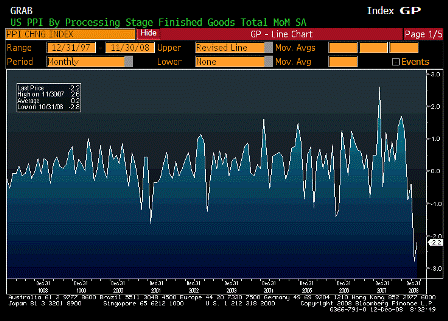
Producer Price Index MoM (Nov)

Survey -2.0%
Actual -2.2%
Prior -2.8%
Revised n/a

[top][end]

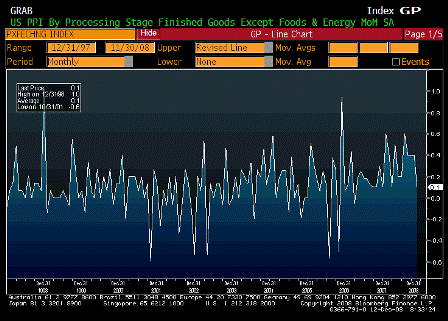
PPI Ex Food and Energy MoM (Nov)

Survey 0.1%
Actual 0.1%
Prior 0.4%
Revised n/a

[top][end]

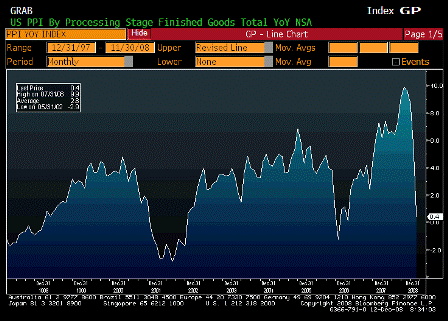
Producer Price Index YoY (Nov)

Survey 0.2%
Actual 0.4%
Prior 5.2%
Revised n/a

[top][end]

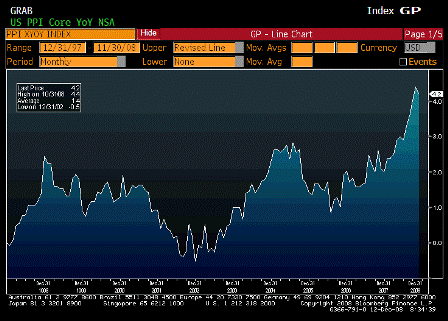
PPI Ex Food and Energy YoY (Nov)

Survey 4.2%
Actual 4.2%
Prior 4.4%
Revised n/a

[top][end]

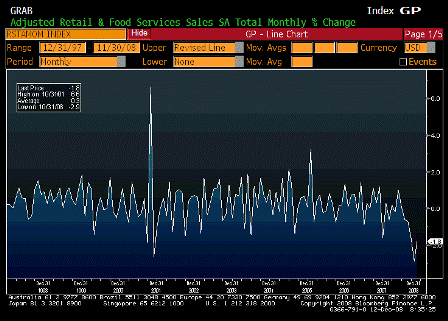
Advance Retail Sales MoM (Nov)

Survey -2.0%
Actual -1.8%
Prior -2.8%
Revised -2.9%

[top][end]

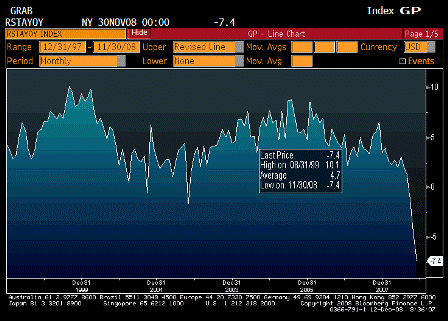
Advance Retail Sales YoY (Nov)

Survey n/a
Actual -7.4%
Prior -4.6%
Revised n/a

[top][end]

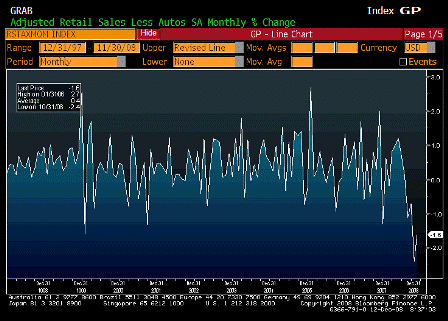
Retail Sales Less Autos MoM (Nov)

Survey -1.8%
Actual -1.6%
Prior -2.2%
Revised -2.4%

[top][end]

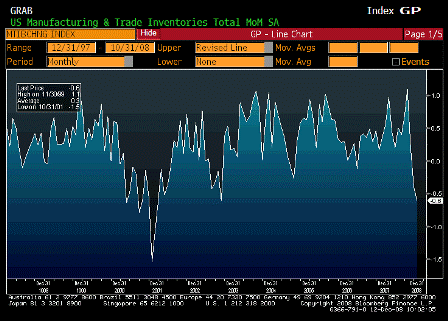
Business Inventories MoM (Oct)

Survey -0.2%
Actual -0.6%
Prior -0.2%
Revised -0.4%

[top][end]

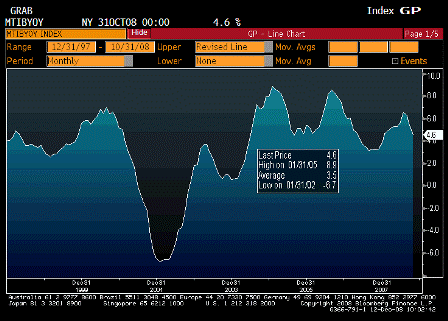
Business Inventories YoY (Oct)

Survey n/a
Actual 4.6%
Prior 5.4%
Revised n/a

[top][end]

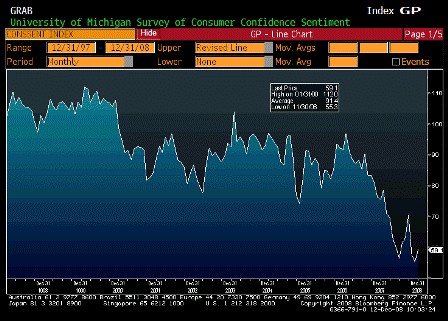
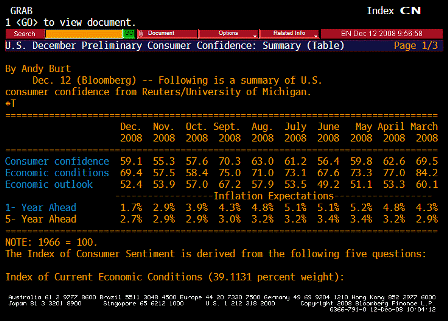
University of Michigan Confidence (Dec P)

Survey 54.5
Actual 59.1
Prior 55.3
Revised n/a

[top][end]

University of Michigan TABLE Inflation Expectations (Dec P)


[top]

Re: Will the Fed Issue Debt?


[Skip to the end]

(email exchange)

Paying interest on reserves is functionally identical to issuing debt.

The difference would just be the different maturities.

This could be used to support higher short term rates, if that’s what they want.

Lots of CB’s have done this.

>   
>   On Thu, Dec 11, 2008 at 12:50 AM, Scott wrote:
>   
>   I hope all is well down under. This is interesting!
>   

BOTTOM LINE: News reports indicate that Fed officials may be considering issuing debt. At this stage, we do not know how credible this is. They certainly do not need this to expand their balance sheet but may be motivated either by perceptions that existing options (reserve expansion) are too inflationary or by plans to acquire longer-term risky assets. The idea is not without risk as the existence of Federal Reserve debt would provide the basis on which markets could then take positions on the solvency of the central bank.

MAIN POINTS:

1. According to news reports, Fed officials are considering issuance of debt as an alternative way of expanding their balance sheet. Apart from the fact that these reports have appeared in several places, which often signals that they have some basis, we do not know if Fed officials are seriously considering this alternative. If they are, we think they would need Congressional authorization before proceeding and suspect they would seek it even if they did not think it necessary from a legal standpoint.

2. The idea is a bit puzzling as the Fed already has an effective means of expanding its balance sheet without limit by creating reserves. For example, if officials want to increase the size of an existing liquidity facility or create a new one, all they have to do is extend a loan in one of these facilities and credit the reserve account of the bank that borrows the funds. (If the counterparty is not a bank, then the Fed can provide the funds as Federal Reserve notes – i.e., “print money”). In normal circumstances this would push the federal funds rate down, which officials might not want to do, but currently the effective funds rate is so close to zero that this would not seem to be a significant consideration.

3. So why consider the alternative of issuing debt? We can think of two motivations:

a) Fed officials are uncomfortable with the speed with which the monetary base (bank reserves plus currency in circulation) has expanded over the past two months, either on their own account or because the public may see this as creating a huge inflation problem down the road. In the week ended December 3, the monetary base was $1.47trn; three months earlier it was $843bn. However, in our view this is a misguided concern for a couple of reasons:

i) At a time when concerns about deflation are mounting, Fed officials should want the public to see its current liquidity program as inflationary, to prevent such concerns from translating into expectations that prices will fall in a broad-based and sustained fashion.

ii) Such concerns usually take as an implied premise that the liquidity will be difficult to remove – in essence that the Fed will find itself on a razor’s edge of having to withdraw massive amounts of liquidity in a very short period once the economy starts to improve. This is highly unlikely in our view. By our reckoning, the output gap is already 4% of GDP (unemployment is about 2 points above the natural rate, and each point is worth 2% of GDP) and likely to go much higher before the economy starts to grow at a trend rate. This should give the Fed plenty of time to put its balance sheet back in order before inflation becomes a genuine risk.

Moreover, as the economy starts to improve, the excess liquidity should unwind on its own, as banks’ needs for liquidity facilities diminish in a natural fashion and the Fed begins to raise the federal funds rate target.

b) The other possible motivation is to lay the financing groundwork for large-scale direct purchases of longer-term risky assets, such as private-label mortgages and corporate bonds (which would also require congressional approval). If this is the motivation, then one implication is that the debt would be long-term in nature (again, we have no way of knowing what officials themselves are thinking in this regard). The idea would be such financing might need to be in place long after the liquidity facilities have been unwound, as the assets thus acquired take time to mature or be sold back into the private markets.

4. If the Fed were to issue debt, some interesting questions and possible unintended consequences arise, which we simply raise at this point for further discussion: (a) how would Fed debt stand relative to Treasury debt of comparable maturity? Would it be senior, junior, or pari passu? (b) would it be subject to some limit, as the Treasury’s debt is, and if not could this facilitate a situation in which some programs currently authorized for the Treasury (like TARP) would effectively be financed by comparable operations undertaken by the Fed? (c) if Fed debt does come into existence and begin to trade in the markets, prices on such debt (and on the inevitable CDS to be based on it) would allow the markets effectively to trade on the credibility of the central bank. It is not obvious to us that Fed officials would really want this to happen.


[top]

Re: Wall St. Journal OpEd piece by Christopher Wood


[Skip to the end]

(email exchange)

Thanks, this is yet another example of the WSJ publishing and thereby promoting authors with no understanding of monetary operations, which means the WSJ editors don’t have any either.

Feel free to send this along the the WSJ with your own introductory comments as well!

>   
>   This is a well written piece, by Mr. Wood of CLSA.
>   

I respectfully don’t agree.

>   
>   He has long maintained a bearish bias which comes through in the
>   article. The points he raises I believe are cogent and logical and ones I
>   have addressed as well over recent days and months.
>   

It doesn’t seem you understand monetary operations either.

>   
>   The end of the article discussing gold I found to be particularly of
>   interest.
>   

The Fed Is Out of Ammunition: A Discredited Dollar Is a Likely Outcome of the Current Crisis

By Christopher Wood

With an estimated $4 trillion in housing wealth and $9 trillion in stock-market wealth destroyed so far in the United States, there is little doubt that we are witnessing a classic debt-deflation bust at work, characterized by falling prices, frozen credit markets and plummeting asset values.

Yes, as well as fiscal automatic stabilizers working their way to the rescue as always.

Those who want to understand the mechanism might ponder Irving Fisher’s comment in 1933: When it comes to booms gone bust, “over-investment and over-speculation are often important; but they would have far less serious results were they not conducted with borrowed money.”

Irv was writing in the context of the gold standard of the time, and that did very well.

But it’s inapplicable with today’s non convertible currency and floating FX.

The growing risk of falling prices raises a challenge for one of the conventional wisdoms of the modern economics profession, and indeed modern central banking: the belief that it is impossible to have deflation in a fiat paper-money system.

You can easily have deflation if the deficit is allowed to get and remain too small.

Yet U.S. core CPI fell by 0.1% month-on-month in October, the first such decline since December 1982.

Pull back in commodity prices mainly, after a long run up, but yes, for now the moment the outlook is deflationary.

The origins of the modern conventional wisdom lies in the simplistic monetarist interpretation of the Great Depression popularized by Milton Friedman and taught to generations of economics students ever since. This argued that the Great Depression could have been avoided if the Federal Reserve had been more proactive about printing money.

On the gold standard this might have worked, though it would have meant the need to rapidly devalue the conversion rate which would have considered a government default. And this did happen.

Today it is inapplicable with non convertible currency and floating FX.

Yet the Japanese experience of the 1990s — persistent deflationary malaise unresponsive to near zero-percent interest rates — shows that it is not so easy to inflate one’s way out of a debt bust.

Doesn’t show that at all. Just shows the depth of their reluctance to use sufficient deficit spending to restore output and employment via increased domestic demand. They want to be export driven and have paid the price for a long time.

In the U.S., the Fed can only control the supply of money;

No, it only can control the term structure of risk free interest rates.

it cannot control the velocity of money or the rate at which it turns over.

True.

The dramatic collapse in securitization over the past 18 months reflects the continuing collapse in velocity as financial engineering goes into reverse.

By identity.

True, this will change one day. But for now, the issuance of nonagency mortgage-backed securities (MBS) in America has plunged by 98% year-on-year to a monthly average of $0.82 billion in the past four months, down from a peak of $136 billion in June 2006. There has been no new issuance in commercial MBS since July. This collapse in securitization is intensely deflationary.

Yes, though offset by increased government deficit spending, increased export revenues (for a while), and increased direct lending by banks to hold in portfolio (which is how it was all done in not so distant past cycles).

It is also true that under Chairman Ben Bernanke, the Federal Reserve balance sheet continues to expand at a frantic rate, as do commercial-bank total reserves in an effort to counter credit contraction.

In an effort to lower rates and thereby counter credit contraction.

Thus, the Federal Reserve banks’ total assets have increased by $1.28 trillion since early September to $2.19 trillion on Nov. 19. Likewise, the aggregate reserves of U.S. depository institutions have surged nearly 14-fold in the past two months to $653 billion in the week ended Nov. 19 from $47 billion at the beginning of September.

So??? Just entries on a government spread sheet with no further ramifications.

But the growth of excess reserves also reflects bank disinterest in lending the money.

So?

This suggests the banks only want to finance existing positions, such as where they have already made credit-line commitments.

Banking is necessarily pro cyclical- get over it!

Monetarist Bernanke and others blame Japan’s postbubble deflationary downturn on policy errors by the Bank of Japan.

Not me. It was the lack of sufficient deficit spending, as above.

But he and others are about to find out that monetary gymnastics are not as effective as they would like to think. So too will the Keynesians who view an aggressive fiscal policy as the best way to counter a deflationary slump. While public-works spending can blunt the downside and provide jobs, it remains the case that FDR’s New Deal did not end the Great Depression.

Mixing metaphors. The New Deal’s deficit spending was far too small to restore output and employment.

There are no easy policy answers to the current credit convulsion and intensifying financial panic — not as long as politicians and central bankers are determined not to let financial institutions fail, and so prevent the market from correcting the excesses.

Yes there is an easy answer- make a sufficiently large fiscal adjustment.

This is why this writer has a certain sympathy for Treasury Secretary Henry Paulson, even if nobody else seems to. The securitized nature of this credit cycle, combined with the nightmare levels of leverage embedded in the products dreamt up by the quantitative geeks, means this is a horribly difficult issue to solve.

Couldn’t be easier. Start with a payroll tax holiday where the treasury makes all FICA payments for employees and employers.

The spread around a few hundred billion in revenue sharing to the states for operations and infrastructure.

Crisis over.

Virtually everybody blames Mr. Paulson for the decision to let Lehman Brothers go. But this decision should be applauded for precipitating the deflationary unwind that was going to come sooner or later anyway.

The Japanese precedent also remains important because the efforts in the West to prevent the market from disciplining excesses will have, as in Japan, unintended, adverse, long-term consequences.

Doesn’t even mention output and employment.

In Japan, one legacy is the continuing existence of a large number of uncompetitive companies which have caused profit margins to fall for their more productive competitors.

Who cares?

Another consequence has been a long-term deflationary malaise, which has kept yen interest rates ridiculously low to the detriment of savers.

Interesting bit of logic!

Meanwhile, the most recent Fed survey of loan officers provides hard evidence of the intensifying credit crunch in America. A net 83.6% of domestic banks reported having tightened lending standards on commercial and industrial loans to large and midsize firms over the past three months, the highest since the data series began in 1990. A net 47% of banks also indicated that they had become less willing to make consumer installment loans over the past three months.

Banks are necessarily pro cyclical- get over it!

Consumers are also more reluctant to borrow. A net 48% of respondents indicated that they had experienced weaker demand for consumer loans of all types over the past quarter, up from 30% in the July survey. This hints at the Japanese outcome of “pushing on a string” — i.e., the banks can make credit available but cannot force people to borrow.

Good! Lower taxes for any given amount of government spending. Bring it on! Now!

The Fed Is Out of Ammunition

With a fed-funds rate at 0.5% or lower in coming months, it is fast becoming time for investors to read again Mr. Bernanke’s speeches in 2002 and 2003 on the subject of combating falling inflation. In these speeches, the Fed chairman outlined how policy could evolve once short-term interest rates get to near zero. A key focus in such an environment will be to bring down long-term interest rates, which help determine the rates of mortgages and other debt instruments. This would likely involve in practice the Fed buying longer-term Treasury bonds.

Yes. And not do a lot for output and employment until fiscal adjustment takes hold.

And do we really want to encourage an increase in private leverage? Been there done that, right?

It would seem fair to conclude that a Bernanke-led Fed will follow through on such policies in coming months if, as is likely, the U.S. economy continues to suffer and if inflationary pressures continue to collapse. Such actions will not solve the problem but will merely compound it, by adding debt to debt.

I think he’s got it right there.

In this respect the present crisis in the West will ultimately end up discrediting mechanical monetarism —

Hope so. It flies in the face of theory and reality.

and with it the fiat paper-money system in general — as the U.S. paper-dollar standard, in place since Richard Nixon broke the link with gold in 1971, finally disintegrates.

Why??? Deflation as above? Deflation is the increase in value of a currency. Disintegration is via inflation???

The catalyst will be foreign creditors fleeing the dollar for gold. That will in turn lead to global recognition of the need for a vastly more disciplined global financial system and one where gold, the “barbarous relic” scorned by most modern central bankers, may well play a part.

Fleeing the dollar for gold means inflation. He’s been preaching deflation for this whole piece. Can’t have it both ways.

Mr. Wood, equity strategist for CLSA Ltd. in Hong Kong, is the author of “The Bubble Economy: Japan’s Extraordinary Speculative Boom of the ’80s and the Dramatic Bust of the ’90s” (Solstice Publishing, 2005).

Aha! Hong Kong has a fixed FX policy, much like a gold standard. He’s applying fixed FX analysis to the us which has a floating FX policy.

The WSJ should have told him this and rejected this op-ed piece.


[top]

EU Inflation Rate Drops to 2.1%


[Skip to the end]

Another tenth and the ECB will hit it’s inflation target for the first time since inception!

That’s why they called this the ‘beneficial recession.’

Just in time for year end performance bonuses…

Highlights

Europe Inflation Rate Drops Most in Almost Two Decades to 2.1%
Trichet Says Stability, Growth Pact Must Be Fully Respected


[top]

Response to former EuroCom staffer


[Skip to the end]

Dear all-

As one of the European Commission staff members responsible for macroeconomic analysis in the late 1970s and the 1980s, I am among the “depositaires de la mémoire collective”. So it may not surprising that the emerging pressure for a huge fiscal stimulus on top of the already comprehensive bail-outs of banks and now automobile producers reminds me of the call for “concerted action” in the 1970s and which lead to one of biggest fiscal boosts in post-war economic history, although unequally implemented by the various OECD countries. As some of you will remember the “concerted action” was followed by the second oil shock leading to a large deterioration of the EU’s current external account.

Yes, there is a similar risk today if there is a return to even moderate levels of growth and employment, if there isn’t a policy that also results in a substantial reduction of crude oil consumption.

And, unfortunately, since the effects on domestic demand of a fiscal stimulus normally take at least a year to come through the concerted action impacted on the economy at the wrong time and can now also be classified as the major economic policy failure of the post-war period.

With respect to the present situation I have three concerns or questions:

What will be the delays with which the huge stimulus package(s) will have effect on the real economy?

I have proposed a ‘payroll tax holiday’ for the US, where the treasury makes all FICA payments for employees and employers for an indefinite period of time.

This will have an immediate, positive effect on aggregate demand and will also move to quickly repair most credit quality from the ‘bottom up.’

What the banks and autos, for example, need most are consumers who can afford their mortgage payments and afford to purchase cars. The current ‘top down’ approaches, while perhaps ‘necessary’ don’t address this issue.

The credit losses of today in many cases were not there a year ago, and are in no trivial way a responsibility of government that did not make sufficient fiscal adjustments to sustain aggregate demand. This has yet to be understood, and so instead the victims are often being blamed and punished, and conditions continue to deteriorate.

Is it now appropriate to neglect the huge body of economic analysis underpinning the findings and arguments of Lucas (and Ricardo)? In particular, since the current problem is in large part a lack of cash is there not now a major risk that the fiscal stimulus will go directly into an increase in household and enterprise saving without any effects on demand?

If that is the case, it means a larger fiscal adjustment is in order.

Tax liabilities reduce aggregate demand, government spending adds to it. The higher the savings desires, the lower the tax liabilities need to be to ‘support’ a given level of government spending.

Spending by central governments (not the national governments in the eurozone, which is a serious, separate matter) with non convertible currencies and floating exchange rate policies is not constrained by revenues. Operationally, said spending is a simple matter of making an entry in the governments own spread sheet.

Yes, ‘over spending’ does carry the (non trivial) risk of ‘inflation,’ but not the risk of solvency or operational sustainability.

Would anybody actually be able to identify and examine the alternatives for public policy in the present situation, as between say:

Further public acquisition of more or less toxic assets, including even acquisition (wholly or in part) of the mortgaged houses and properties in several of the major economies.

A US payroll tax holiday would immediately begin to reduce loan delinquencies which are the root of the credit issue. banking is necessarily pro cyclical and attempting to change that is a counterproductive exercise.

The place for counter cyclical policy is fiscal policy, as the government is the only entity without a solvency issue (again, national governments in the eurozone do have solvency issues due to current eurozone institutional arrangements.)

It is also clear to me that altering interest rates is at best a very weak force for sustaining aggregate demand with growing evidence that lower rates reduce demand through the personal income channel. With governments net payers of interest, the non government sector is a net saver, and cuts in rates necessarily lower interest income of the non govt sector. At the same time, in a downturn credit worthiness of borrowers deteriorates, and the interest rates borrowers pay does not fall as quickly as rates for savers fall. instead, margins for lenders increase to reflect the increased risk.

Also, all the CB studies i have seen show output and inflation responses to interest rate changes are at best relatively small and seem to have maybe a two year lag, which generally takes them across the next fiscal cycle.

Further nationalization of the failed banks and other corporations, with, of course, the options of re-privatizing them once the markets have stabilized.

My first banking job was in the early 70’s, when US housing starts peaked at over 2.5 million per year, with a population of only 215 million people, and all facilitated by sleepy savings banks run by very modestly paid bankers who did nothing more than gather deposits by giving away small kitchen appliances and make mortgage loans with up to 75% loan to value ratios.

In the latest cycle, US housing peaked at 2.1 million annual units, with a population of over 300 million people, and it was termed ‘gang busters’ and an unsustainable bubble.

Banks are agents of government that exist for public purpose. Let me suggest both theory and experience shows that complex finance preys on the real sector, rather than enhances it.

That said, we do have to play the cards we are dealt, so let me continue by saying the eternal lesson of banking is that the liability side is not the place for market discipline. Instead, market discipline is best applied on the asset side, with (strict) regulation and supervision of capital ratios and asset quality. We have again learned that the ugly way, as we watched interbank conditions deteriorate as the fed agonizingly slowly worked towards making sure its member banks have secure sources of funding at the fed’s target rates. And they still aren’t there yet. It yet to be fully recognized that the Fed demanding collateral when it lends to member banks is redundant- the FDIC and OCC already regulate bank capital and asset quality, and the FDIC already allows the banks to fund all their assets with FDIC (govt) insured deposits.

What is also missed by the media, most mainstream economists, and even senior fed officials, is that monetary policy is about price, and not quantity. fed actions do not alter net financial assets of the non govt sector, as a simple matter of accounting. Fed actions do alter various monetary aggregates, but in general this alteration per se has no further economic ramifications. i recall that after the ‘500 billion euro day’ there was a futile search of the ECB’s numbers published the following week to see ‘where the money went’ and no one could find it.
And the us stock market was moving wildly up or down when the size of a Fed repo operation was announced.

Even today the news continues about the fed ‘throwing trillions of liquidity at the markets’ ‘blowing up it’s balance sheet’ as if that mattered beyond the setting of interest rates.

The same media, economists, and officials also miss the fact that with non convertible currency and floating FX causation runs from loans to deposits. Bank lending is (in general) not constrained by ‘available funds’ as it would be with a fixed exchange rate policy. ‘Giving’ banks ‘money’ (reserve balances) to get them to lend is conceptually absurd, for example, as is criticizing banks for ‘hoarding money.’

These are all throw backs to the era of the gold standard, where there were actual supply side constraints on the convertible currency needed for reserves where depositors demanded that convertible currency for withdrawals. And even the treasury had to compete for convertible currency via interest rates when it borrowed to spend. This is still the case today with the odd fixed exchange rate policies that currently are in force.

The problem with the fiscal stimulus is, I think, that it will take time to get adopted and impact on the economy and that, consequently, it is unlikely to prevent a further deterioration of the overall economic prospects during the next twelve months, a period which may be critical for the overall financial and economic stabilization.

A payroll tax holiday would have immediate, substantial results, as they currently remove about $1 trillion annually from us workers and businesses, and are highly regressive.

Additionally, $100 billion of federal revenue sharing for states to use for their operating budgets would immediately reverse the troubling trend towards the reduction of essential public services due to state revenue shortfalls.

When there is undesired excess capacity, as is the case today, government has the option of directing it towards either public or private goods, services, and investment. The payroll tax holiday directs that output towards restoring private sector goods and services, while state revenue sharing results in increased public goods and services.

The choice is purely political. My proposals are based on what I think are politically desired at this time.

Maybe, and as some observers have already suggested, the Swedish experience could provide some lessons for understanding the issues at present.

I would sincerely welcome a debate on these issues.

For the eurozone, under current arrangements the only entity without a solvency issue is the ECB. What is needed is some channel for the ECB to conduct the type of counter cyclical fiscal policy needed to restore eurozone output and employment. Otherwise, the eurozone will continue to perform well below its potential.

Let me last say that the Fed’s swap lines to many of the world’s CB’s are qualitatively very different from its domestic monetary operations. The funds advanced are functionally no different from purchasing ‘$ bonds’ from the various CB’s around the globe, yet have remained far below all radar screens, including Congress’s. Do you think the US congress would approve a $30 billion loan to Mexico? A $350 billion loan to the ECB? Maybe, but I suspect there would be, at a minimum, much debate. Yet the fed has been allowed to do this, and in ‘unlimited quantities’ for the BOJ, BOE, SNB, and ECB’ without any oversight.

Tax liabilities reduce aggregate demand, government spending adds to it. The higher the savings desires, the lower the tax liabilities need to be to ‘support’ that spending.

Sincerely,
Warren Mosler


[top]

2008-11-26 USER


[Skip to the end]


Karim writes:

Lots of numbers today- none of them real good.

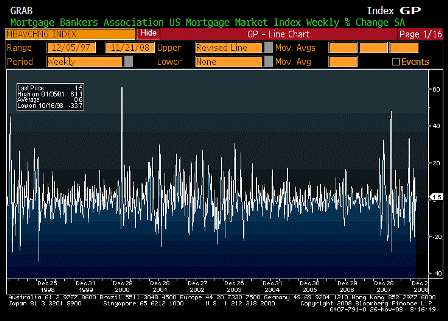
MBA Mortgage Applications (Nov 21)

Survey n/a
Actual 1.5%
Prior -6.2%
Revised -6.2%

[top][end]

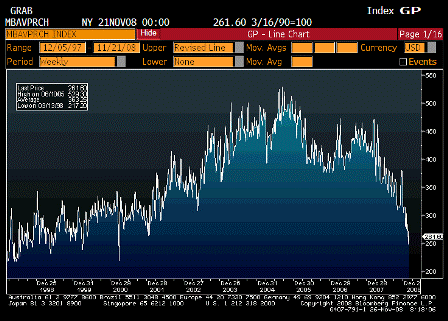
MBA Purchasing Applications (Nov 21)

Survey n/a
Actual 261.60
Prior 248.50
Revised n/a

 
Up a bit from very low levels.

[top][end]

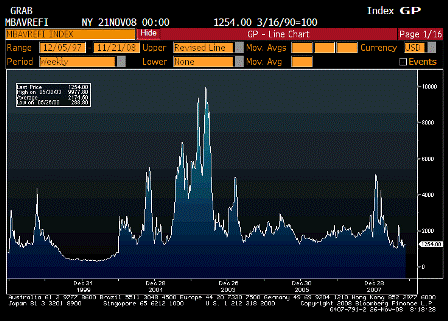
MBA Refinancing Applications (Nov 21)

Survey n/a
Actual 1254.00
Prior 1281.20
Revised n/a

[top][end]


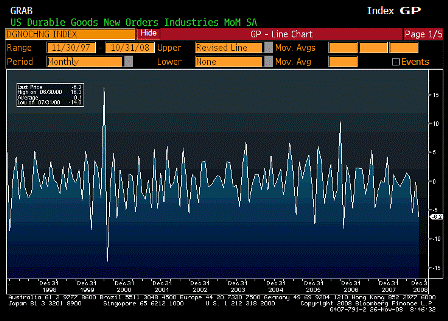
Durable Goods Orders (Oct)

Survey -3.0%
Actual -6.2%
Prior 0.8%
Revised -0.2%

 
Big fall.

Karim writes:

  • -6.2% m/m
  • -4% m/m ex-aircraft and defense (after -3.2% and -2.3% prior two months)

[top][end]

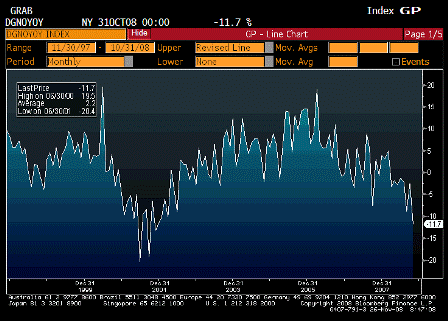
Durable Goods Orders YoY (Oct)

Survey n/a
Actual -11.7%
Prior -2.5%
Revised n/a

 
Big fall in a longer term down trend.

[top][end]

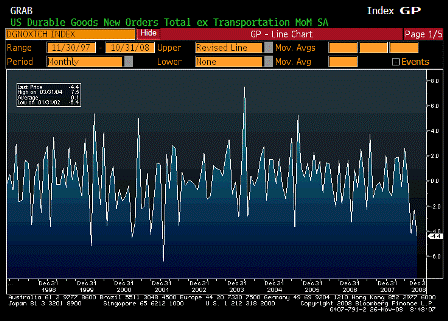
Durables Ex Transportation MoM (Oct)

Survey -1.6%
Actual -4.4%
Prior -1.1%
Revised -2.3%

 
Not good either.

[top][end]

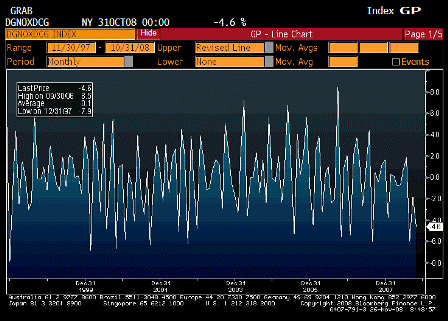
Durables Ex Defense MoM (Oct)

Survey n/a
Actual -4.6%
Prior -1.8%
Revised n/a

[top][end]

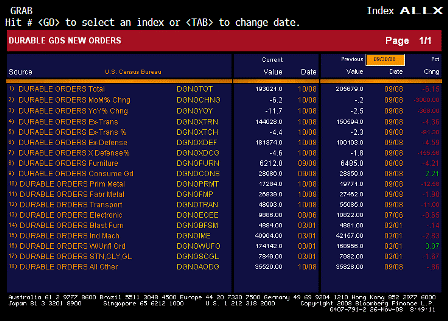
Durable Goods ALLX (Oct)

[top][end]


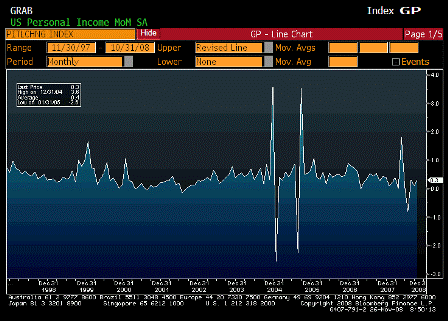
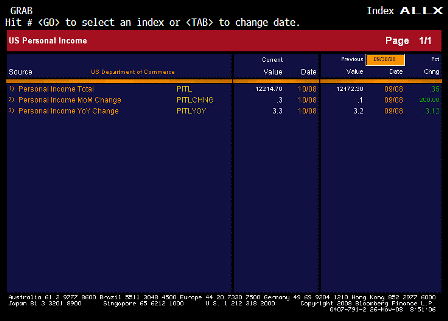
Personal Income MoM (Oct)

Survey 0.1%
Actual 0.3%
Prior 0.2%
Revised 0.1%

 
Income has held up better than expected.

And the consumer has deleveraged substantially.

[top][end]

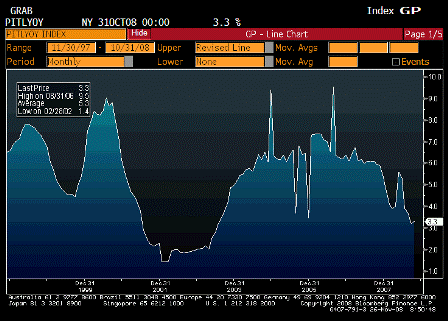
Personal Income YoY (Oct)

Survey n/a
Actual 3.3%
Prior 3.2%
Revised n/a

 
Looking lower.

Will get a nice kick up with the coming fiscal adjustment.

[top][end]

Personal Income ALLX (Oct)

[top][end]

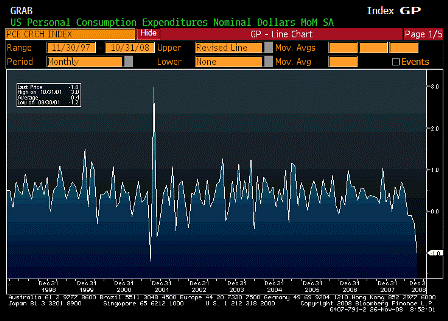
Personal Consumption MoM (Oct)

Survey -1.0%
Actual -1.0%
Prior -0.3%
Revised n/a

 
Consumption falling even as income continues to increase.

The consumer is recharging his batteries.

[top][end]

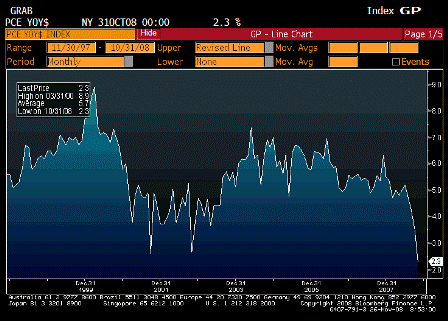
Personal Consumption YoY (Oct)

Survey n/a
Actual 2.3%
Prior 3.5%
Revised n/a

[top][end]


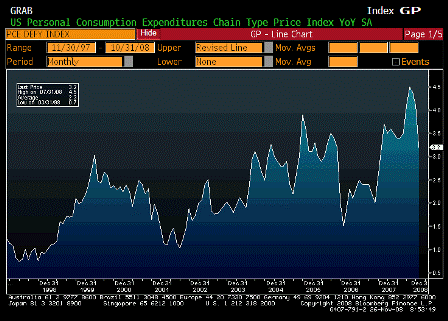
PCE Deflator YoY (Oct)

Survey 3.3%
Actual 3.2%
Prior 4.2%
Revised 4.1%

 
Down some and more weak numbers to come, but the longer term trend still looks up.

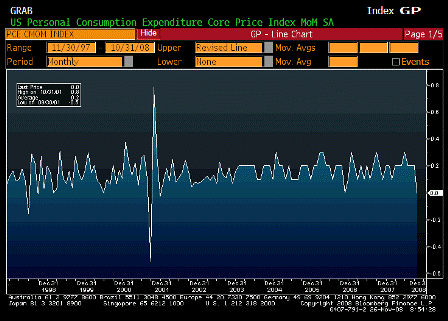
[top][end]

PCE Core MoM (Oct)

Survey 0.0%
Actual 0.0%
Prior 0.2%
Revised n/a

[top][end]

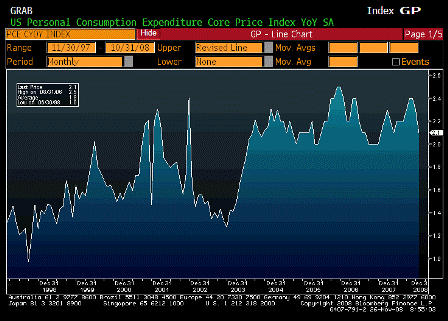
PCE Core YoY (Oct)

Survey 2.2%
Actual 2.1%
Prior 2.4%
Revised 2.3%

 
Higher than expected but down some, and more weak numbers on the way, but still at the high end of the Fed’s comfort zone.

[top][end]


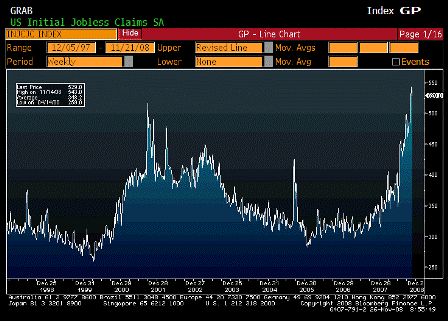
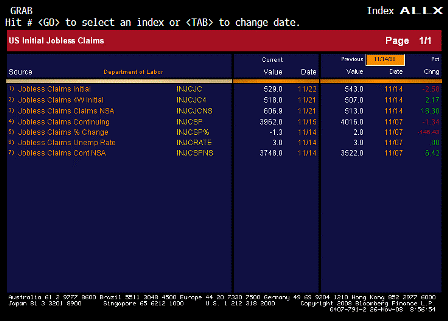
Initial Jobless Claims (Nov 22)

Survey 535K
Actual 529K
Prior 542K
Revised 543K

 
Remains very high.

Karim writes:

  • Initial claims only decline 14k to 529k after 80k rise in prior 4 weeks
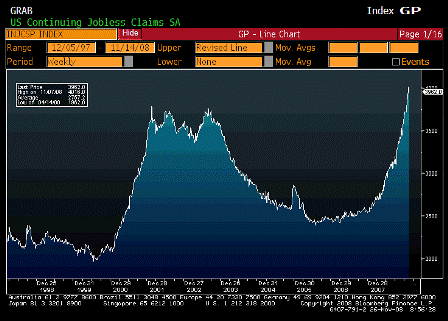
  • Similar bounce with continuing, drop of 54k to 3962k (had risen 295k in prior 3 weeks)

[top][end]

Continuing Claims (Nov 15)

Survey 4080K
Actual 3962K
Prior 4012K
Revised 4016K

 
Off the highs but remain very high.

[top][end]

Jobless Claims ALLX (Nov 22)

[top][end]


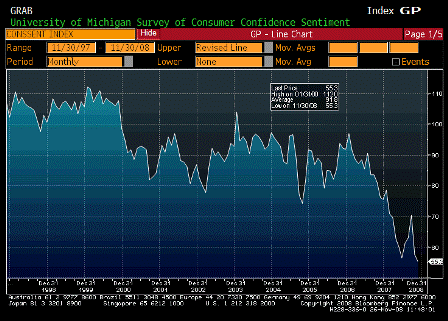
Univ. of Michigan Confidence (Nov F)

Survey 57.5
Actual 55.3
Prior 57.9
Revised n/a

 
Back through the lows.

Karim writes:

  • New low for headline confidence, from 57.9 to 55.3
  • 5yr fwd inflation expectations unchanged at 2.9

[top][end]


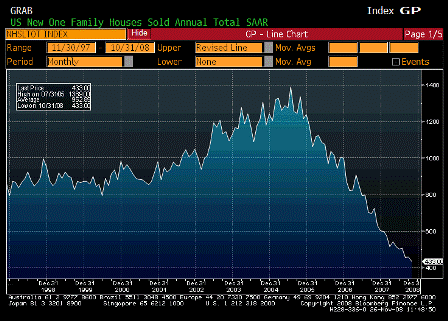
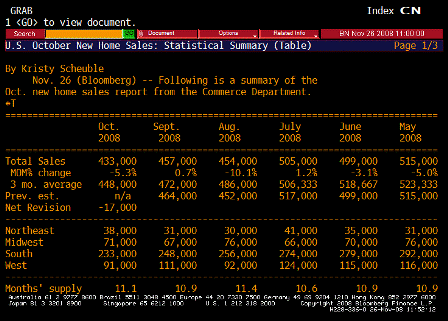
New Home Sales (Oct)

Survey 441K
Actual 433K
Prior 464K
Revised 457K

 
Still sliding.

Karim writes:

  • -5% m/m
  • Mths supply rise from 10.9 to 11.1

[top][end]

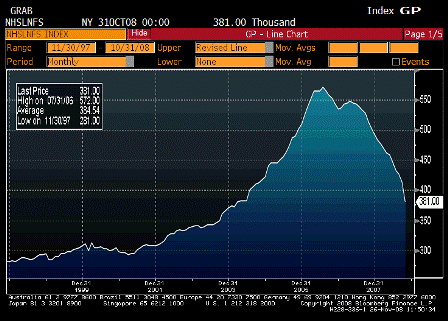
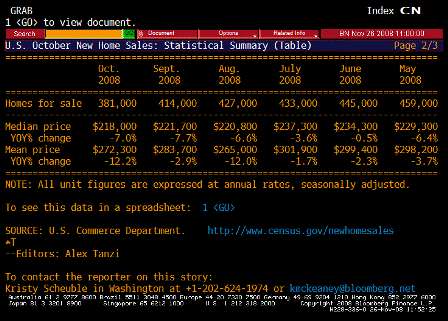
New Home Sales Total for Sale (Oct)

Survey n/a
Actual 381.00
Prior 414.00
Revised n/a

 
Maybe this is why sales are falling- no new homes left for sale!

Falling sharply.

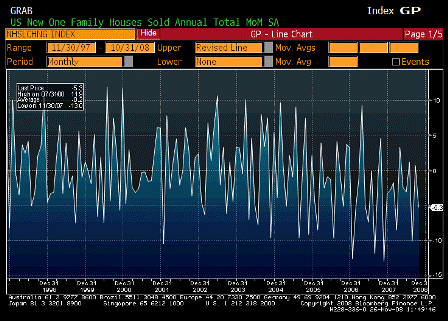
[top][end]

New Home Sales MoM (Oct)

Survey -5.0%
Actual -5.3%
Prior 2.7%
Revised 0.7%

[top][end]

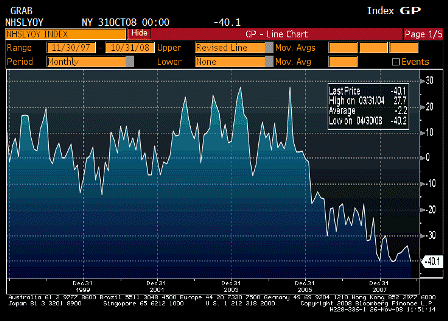
New Home Sales YoY (Oct)

Survey n/a
Actual -40.1%
Prior -34.1%
Revised n/a

 
Might be leveling off at very low levels.

[top][end]

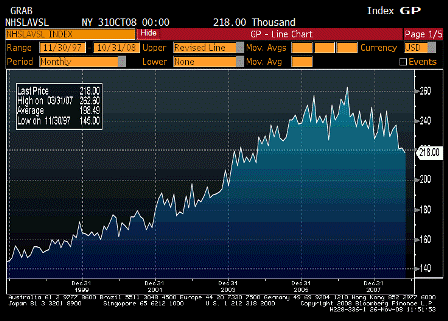
New Home Sales Median Price (Oct)

Survey n/a
Actual 218.00
Prior 221.70
Revised n/a

 
Prices falling but not collapsing.

[top][end]

New Home Sales TABLE 1 (Oct)

[top][end]

New Home Sales TABLE 2 (Oct)


[top]

Re: Heritage Foundation proposal critique


[Skip to the end]

(email exchange)

>   
>   On Tue, Nov 25, 2008 at 2:22 AM, Michael wrote:
>   
>   Warren: If you get a moment, I was wondering what your reaction is to
>   this latest Heritage Foundation analysis below. This is certainly an ideal
>   time for our message–new administration, public looking for new
>   answers, skepticism about the downside of deficits, and hugely
>   challenging economic stagnation that almost certainly requires new
>   thinking. –Michael.
>   

You got it!

See below:

How to Successfully Stimulate the Economy

When the economy is struggling, Congress has a tendency to invoke the same tried and failed policies of the past. Typically, these policies promise hundreds of billions of dollars in government spending while doing little to actually revitalize economic activity. The first round of stimulus checks, like those rebates issued in the 1970s and 2001, were a bust, with only a small portion (perhaps less than 30 cents on every rebate dollar) used for consumption. Furthermore, prior government spending on infrastructure such as highways merely transferred–rather than created–wealth.

The 2001 fiscal adjustment was too small to reverse the negative effect of the surplus years that caused the collapse. The 2003 adjustment was much larger and had a larger effect and did result in reasonable growth, but that growth was allowed to bring the deficit down to where it was too small to continue to support growth and employment.

The sub prime fraud driven credit expansion did help prolong the post 2003 upswing, but that boost ended when the fraud was discovered and demand from housing slowed.

During the current period of slow economic growth, Congress should do what it does best: set broad economic policy. Specifically, Congress should concentrate on signaling to investors and workers alike that its principal focus will be on improving pro-growth economic policy, mainly in the areas of tax, energy, and spending policies. The test for distinguishing good stimulus ideas from bad ones should be this: Is the proposal likely to raise the economy to a sustained, higher level of growth?

The broad choice is whether to foster an increase in the consumption of private or public goods.

Tax cuts, for example promote private consumption, where infrastructure spending, for example, is public consumption.

Public consumption can be for short term private consumption (law enforcement, public ceremonies, etc) or for investment in public goods for long term private consumption (building roads for economic investment, monuments for well being investment, etc)

In any case, a growing economy in general requires spending exceed tax liabilities on a continuous basis.

Tax Policy
What can increase risk for investors and businesses? Many factors, of course, but public policy commonly looms largest. For example, tax increases, especially on capital, increase the cost of capital and lower investment returns. When investors are uncertain about whether taxes will increase or stay the same, they can still act as though taxes have risen if they judge the risk of an increase to be nearly equal to an actual increase. And rising uncertainty can have the effect of driving down investments in riskier undertakings. Congress can take the following actions on tax policy:

  • Make the Tax Reductions of 2001 and 2003 Permanent.
    Among the first actions Congress can take to address the current economic slowdown is to make a definitive statement regarding the tax increases scheduled for 2009 and 2011. There are projects, new businesses, and expansions of existing businesses that would be undertaken today if Congress signaled that taxes would be lower in three years.

Maybe some, but the problem now is lack of sales. Taxes that are only on profits aren’t all that influential when profits and sales are expected to decline. While after tax income is always welcome, I’m sure most businesses would vote for an increase in sales as more beneficial than a decrease in tax rates? For example, the autos have operating losses, so tax rates would not alter investment decisions?

  • Since nearly all major capital undertakings last beyond this three-year period, it is likely that making all or most of the Bush tax reductions permanent would stimulate economic activity today as well as in 2011. If Congress increases taxes, then investors will find more favorable economies to support and business owners will, as much as they can, locate their expanded activities in other countries with more favorable tax regimes.

The lower taxes are needed to increase current output and employment via increasing sales. Countries that have high rates of employment in an environment where business can profit attract investment, as in the US in the late 90’s.

  • Accelerate Tax Depreciation

Past economic slumps have proven that accelerating the tax depreciation of capital equipment and buildings or the one-year expensing of business purchases that would otherwise be depreciated over a longer period of time for tax purposes can help during periods of slow growth.

I would suggest that depreciation attempt to follow the actual useful life of assets to not distort investment decisions.

  • Lower the Corporate Profits Tax.

In one area of tax policy, there is now nearly universal agreement: Our federal business taxes are far too high. The U.S. tax rate on corporate profits is the second highest in the world. Why is it not the firm policy of this country’s government to ensure that the corporate profits tax is always below the average corporate income tax of other industrialized countries? Such a policy would enhance our competitive standing worldwide and significantly reduce the incentive for U.S. firms to relocate to lower tax countries.

There is a valid argument that corporate profits not be taxed at all, as the profits are passed through to investors, who should show the income on their annual earnings, as with sub S- corps and LLC’s.

The current 30% corp tax rate and 15% dividend tax get pretty close to this but are still higher than the highest personal income tax rate.

By making the 2001 and 2003 tax reductions permanent and reducing the corporate profits tax by 1,000 basis points, an annual average of 2.1 million more jobs would be created. Indeed, 3.4 million jobs above a current law baseline would be created in 2018 by newly energetic businesses.

Only if there is an increase in sales (retail and wholesale).

I don’t think that proposed adjustment reduces taxes enough relative to government spending to return us to levels of output coincident with, say, 4% unemployment.

These tax changes dramatically increase the level of national output, and household income rises as the result of a healthier economy and lower taxes. In fact, the average household would have $5,138 more to spend or save after paying their taxes, and by 2018 this amount would jump to $9,750.

The initial adjustment isn’t that high and investment made without a population that has sufficient income to buy the new output will not result in a healthy economy, but instead more of what we have now.

Energy Policy
Rapidly increasing prices for gasoline and petroleum-based energy slowed the economy and helped bring about our current recession. Additionally, the effects of such increased energy prices continue to impede job and income growth. If Congress acts to expand energy supplies, forward-looking prices will fall and economic activity will shed off the drag stemming from this sector.

Without cutting gasoline consumption first, any expansion will help the Saudis (currently the only crude exporter with excess capacity) should they decide to again hike crude prices.

The Heritage Foundation’s Center for Data Analysis analyzed the economic effects if domestically sourced petroleum increased by 2 million barrels per day, and it found that such an increase would expand the nation’s output–as measured by the Gross Domestic Product–by $164 billion and increase employment by 270,000 jobs annually.

Yes, it may eventually (10 years down the road) expand output by that much, but during the next few years the increased employment and income you predict would increase gasoline consumption and support higher prices that would reduce our real terms of trade and siphon off our real wealth via the export channel, thereby reducing our real standard of living.

If Congress were to announce greater access to proven reserves, mining activity would immediately begin, capital and talent would leave other parts of the world and travel to the U.S., forward-pricing markets would feel the downward pressure on prices as the result of impending supply increases, and ordinary Americans’ concerns over their economic future would lessen.

I’d guess supply increases in petroleum of only 2 million barrels a day pending for 10 years in the future will not offset the immediate consumption increase.

The other, more fundamental issue is whether we want economic growth that increases energy consumption via burning things.

(Though with all the geopolitical problems associated fossil fuels I’ve often thought it would be nice to use them all up as quickly as possible and get it over with, behind us, and move on…)

Spending Policy
While the attention of most policymakers will be on immediate responses to the current slowdown, the seeming unwillingness of Congress to seriously address the enormous financial challenges from entitlement spending should not go unnoticed.

Many investors and organizations that play key roles in the future of the U.S. economy are worried about long-term growth given the fiscal challenges posed by Social Security’s and Medicare’s unfunded liabilities.

The challenge is only that of any future inflation that spending might induce. Clearly, however, that is not a concern as no one has ever published an inflation warning from those programs. And no one has expressed concern that the elderly are consuming too many real resources, or that as a nation we should reduce health care services.

At a time when the economy is slowing and the voice of Congress, as well as its actions, can affect economic activity, policymakers should take concrete steps that will announce their intention to address unfunded liabilities in these important programs. While reforms in these programs may be beyond what this Congress can accomplish, it is possible to signal change by reforming the budget rules.

As above, until there is a case to make that those expenditures will cause politically undesired levels of inflation there is no evidence of a ‘problem’.

Additionally, even if it were deemed future inflation was an issue, taking actions that would reduce aggregate demand today and thereby decrease current output and employment is necessarily counter productive.

Currently, the federal budget functions on a pay-as-you-go system, with a very limited forecast of obligations and supporting revenues. It is impossible for the official budget to predict what may happen over the next 30 years; the five- and 10-year budget windows do not permit Members of Congress or the general public to sense the obligations that are coming beyond that 10-year horizon. However, Congress can take two important steps in addressing the long-term entitlement obligations of the U.S.:

  • Show These Obligations in the Annual Budget.
    This could be done by amending the budget process rules to include a present-value measure of long-term entitlements. Such a measure would express in the annual budget the current dollar amount needed today to fund future obligations. Such a measure has been endorsed by a number of accounting professionals, as well as the Federal Accounting Standards Advisory Board.

This would be an interesting exercise that can also include the estimated ‘demand leakages’ that reduce aggregate demand, such as pension fund contribution, insurance reserves, IRA contributions, etc. and add to the need for spending to exceed taxes to sustain output and employment.

I would expect this calculation to show that future government deficits continue to fall short of the projected demand leakages, as has been the case in generally since 1945.

  • Convert Retirement Entitlements into 30-year Budgeted Discretionary Programs.
    Such a move recognizes that mandatory retirement funding programs for millionaires that crowd out discretionary spending programs for homeless war veterans.

Government spending can only be ‘crowded out’ by inflation fears due to lack of real output capacity. With today’s excess capacity, and projections of future excess capacity, we can readily afford any additional desired government spending for homeless war veterans.

  • do not make any sense at all. If we are to contain entitlement spending and reform the programs driving those outlays, then a paradigm shift will likely be required. Recognizing Social Security and Medicare as discretionary programs helps to force attention on changes that will assure their survival well into the 21st century.

We can readily afford any additional spending as long as there is excess real capacity.

Greater Predictability, Greater Productivity
Serious work by the Congress on tax, energy, and spending policy will create greater predictability for investors and business owners and assure workers that they will have a better chance of improving their wages through increased productivity.

Right, and a long term plan by Congress for its expenditures will be the backbone driver of that growth.

Efforts to enhance this nation’s long-term economic health may very well have immediate, short-run benefits as economic decision makers reduce the risk premium they place on starting new businesses or expanding existing enterprises.

Business has a long history of tagging along on the lead taken by Congress from its direct spending and incentives it puts in place.


[top]

2008-11-19 USER


[Skip to the end]


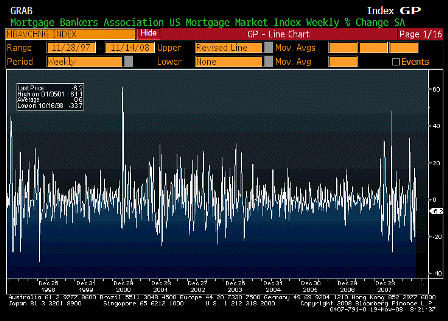
MBA Mortgage Applications (Nov 14)

Survey n/a
Actual -6.2%
Prior 11.9%
Revised n/a

[top][end]

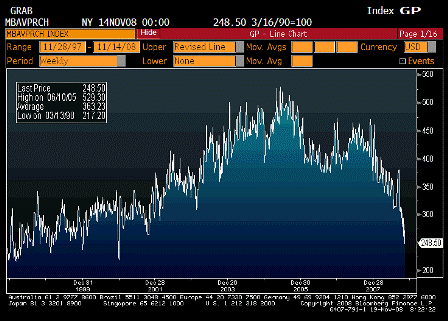
MBA Purchasing Applications (Nov 14)

Survey n/a
Actual 248.50
Prior 284.40
Revised n/a

 
Back down big time.

[top][end]

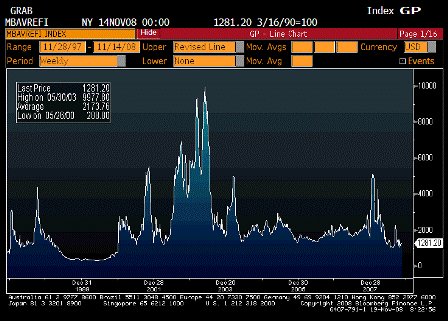
MBA Refinancing Applications (Nov 14)

Survey n/a
Actual 1281.20
Prior 1248.40
Revised n/a

[top][end]


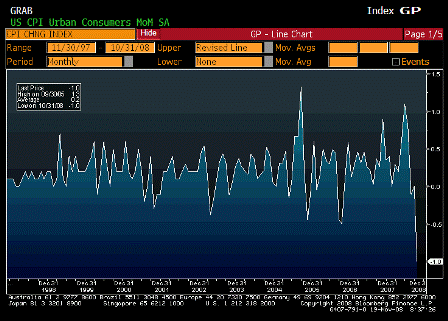
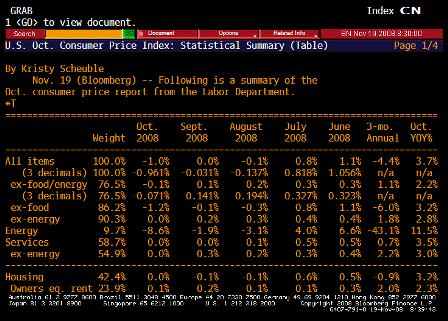
Consumer Price Index MoM (Oct)

Survey -0.8%
Actual -1.0%
Prior 0.0%
Revised n/a

 
Not much of a surprise led by gasoline prices. More to come.

[top][end]

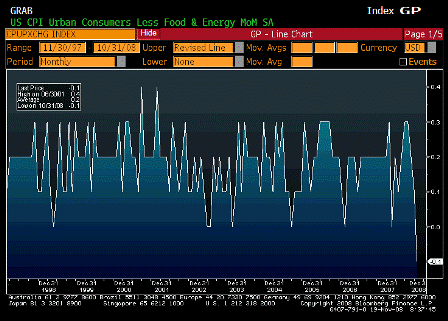
CPI Ex Food and Energy MoM (Oct)

Survey 0.1%
Actual -0.1%
Prior 0.1%
Revised n/a

 
Lower than expected. Owner equivalent remains positive at up 0.1%.

[top][end]

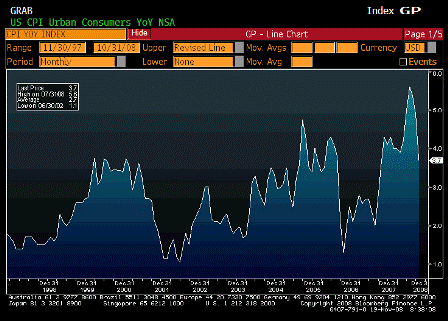
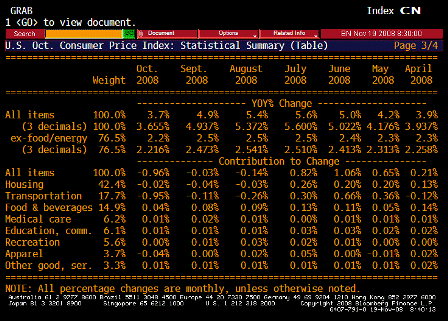
Consumer Price Index YoY (Oct)

Survey 4.0%
Actual 3.7%
Prior 4.9%
Revised n/a

 
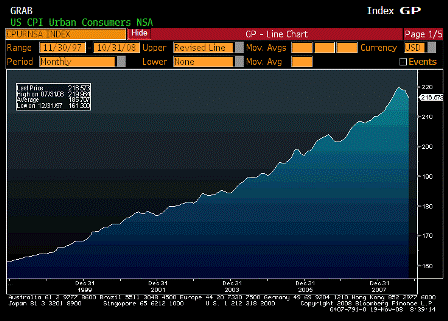
Coming down quickly with the fall in gasoline prices, much like Aug 06 when Goldman changed their commodity index and triggered a liquidation of gasoline inventories.

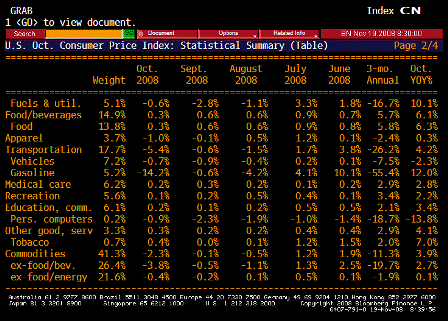
Karim writes:

  • Largest single mthly fall on record in headline CPI: -0.961%
  • Core also falls, by 0.071%
  • Service inflation now unchanged for 2 straight months
  • OER up 0.1%
  • Apparel -1%, vehicles -0.7% (new -0.5%, used -2.4%)
  • Medical care and education each up 0.2%
  • Market strains + output gap + weaker commodities to lead to falling/slowing inflation in period ahead

[top][end]

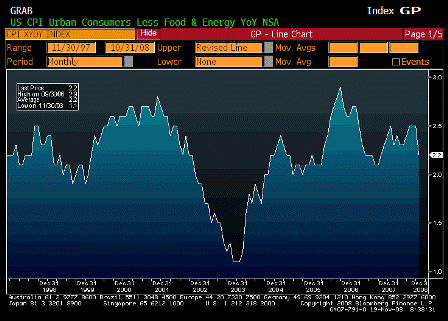
CPI Ex Food and Energy YoY (Oct)

Survey 2.4%
Actual 2.2%
Prior 2.5%
Revised n/a

 
Also moving down.

[top][end]

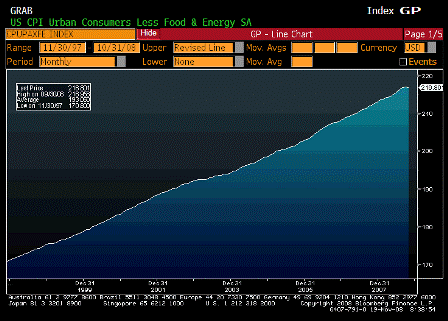
CPI Core Index SA (Oct)

Survey n/a
Actual 216.801
Prior 216.956
Revised n/a

[top][end]

Consumer Price Index NSA (Oct)

Survey 216.700
Actual 216.573
Prior 218.783
Revised n/a

[top][end]

Consumer Price Index TABLE 1 (Oct)

[top][end]

Consumer Price Index TABLE 2 (Oct)

[top][end]

Consumer Price Index TABLE 3 (Oct)

[top][end]


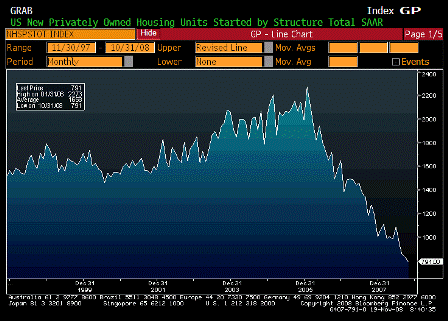
Housing Starts (Oct)

Survey 780K
Actual 791K
Prior 817K
Revised 828K

 
Looking grim again after showing signs of bottoming.

Karim writes:

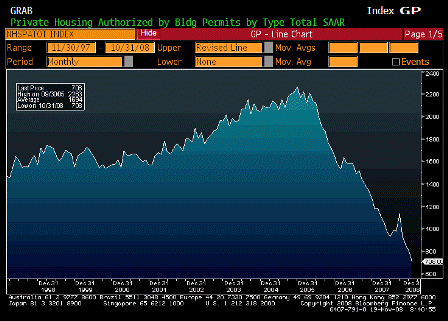
  • October housing starts down another 4.5% and permits down 12%-contribution from housing to GDP will remain a significant drag at least thru Q2 2009 (based on lag from permits to construction).

[top][end]

Building Permits (Oct)

Survey 774K
Actual 708K
Prior 786K
Revised 805K


[top]

Brown says fiscal stimulus in UK will be temporary


[Skip to the end]

Highlights

Brown Says Fiscal Stimulus in U.K. Will Be Temporary

Confirms a lack of understanding of fiscal policy.

Brown sets out anti-recession plan

Gordon Brown on Friday heralded an anti-recession strategy founded on tax cuts for low earners and further cuts in interest rates. People on low incomes had “a higher propensity to spend if their credits are higher”, Mr Brown said, noting that recipients of a wider US fiscal stimulus of $170bn (£113.7bn) approved last February had saved half the money. “In the US, rates have been cut to 1 per cent but the European area has been slower with 3.25 per cent in the euro area and 3 per cent in the UK,” he said in a speech. Mr Brown said he endorsed the views of Mervyn King, BoE governor, that there was scope for further cuts. Mr Brown invoked the memory of John Maynard Keynes, whose plans to reflate the economy in the late 1920s were dismissed by the Treasury chief secretary of the time with three words: “Inflation, extravagance, bankruptcy.”

Brown says fiscal stimulus in UK will be temporary

Prime Minister Gordon Brown said Britain’s financial stimulus package will be “temporary.” Brown’s remark mirrors BOE Governor Mervyn King’s warning that the government must put forward a credible plan to reduce the deficit over time. “In these extraordinary circumstances, it would be perfectly reasonable to see some use of fiscal stimulus, provided two conditions are met,” King said on Nov. 12. “One, that it’s temporary. Secondly, that it would be clear there was a medium-term plan to bring tax and spending into balance.” The U.K. Treasury had a budget gap of 37.6 billion pounds ($57 billion) in the first half of its fiscal year. Since March, Brown’s government delivered tax cuts and spending increases worth 4.8 billion pounds to give relief to low-income earners, delay an increase in fuel duties and to help homeowners with mortgages and stamp-duty taxes.


[top]
Re: Sarkozy Pushes for Abandonment of Dollar as World Reserve Currency


[Skip to the end]
(email exchange)

The dollar is a world reserve currency only because we are the only ones who ‘allow’ a trade deficit.

With a trade deficit, the rest of world is long your currency.

With a trade surplus, like japan, the world is short your currency.

The eurozone wants a trade surplus and to be a reserve currency.

They are either ignorant of how a monetary system works or have the arrogance of demanding the violation of an accounting identity by decree???

>   
>   On Fri, Nov 14, 2008 at 12:15 AM, Russell wrote:
>   
>   If True … hyper inflation in the pipe.
>   

Sarkozy Pushes for Abandonment of Dollar as World Reserve Currency

French President Nicolas Sarkozy said on Thursday ahead of the G20 meeting of world leaders:

“I am leaving tomorrow for Washington to explain that the dollar cannot claim to be the only currency in the world…, that what was true in 1945 can no longer be true today”.

There have been many previous indications that the dollar would not remain the world’s reserve currency for long. But this is a dramatic statement by a close American ally.

Reading between the lines, I am guessing that Sarkozy is pushing for a shift from the dollar to a basket of currencies as a world reserve standard, instead of a change to a single currency such as the Euro or the Yuan.

But we’ll have to wait and see what Sarkozy is really advocating.


[top]