American Dream Eludes With Student Debt Burden: Mortgages

The student loan expansion adds to demand on the way up.
And subtracts when income goes to paying it back instead of spending.

American Dream Eludes With Student Debt Burden: Mortgages

By Kathleen M. Howley

April 12 (Bloomberg) — Luke Nichter of Harker Heights, Texas, said hes not a renter by choice. The Texas A&M University history professors $125,000 of student debt means he has no hope of getting a mortgage.

Nichter, 35, whos paying $1,500 a month on loans for degrees from Bowling Green State University in Ohio, is part of the most debt-laden generation to emerge from college. Two- thirds of student loans are held by people under the age of 40, according to the Federal Reserve Bank of New York, blocking millions of them from taking advantage of the most affordable housing market on record. The number of people in that age group who own homes fell by 4.6 percent in the fourth quarter from the third, the biggest drop in records dating to 1982.

Student debt has a dramatic impact on the ability to buy a house, and to buy the dishwashers and the lawnmowers and all the other purchases that stem from that, said Diane Swonk, chief economist of Mesirow Financial. It has a ripple effect throughout the economy.

The issue is being exacerbated by an explosion in the $150 billion private market for student debt with interest rates for some existing loans surpassing 12 percent. Unlike mortgage holders, borrowers have little hope of refinancing at lower rates. Interest on some new federal loans is set to double to 6.8 percent in July if Congress doesnt extend the current rate, as they did last year.

FICA hike and sequester, cont…

The 2% FICA hike was just over $3 billion per week and the sequesters just over 1 billion per week, for a total of about $5 billion per week.

This is not a sudden catastrophic event, but a permanent reduction in about that much demand over time. Initially consumers may borrow a bit more to sustain consumption, make their payments, etc. but that much less income and savings than otherwise does take it’s toll on sales, output, and employment.

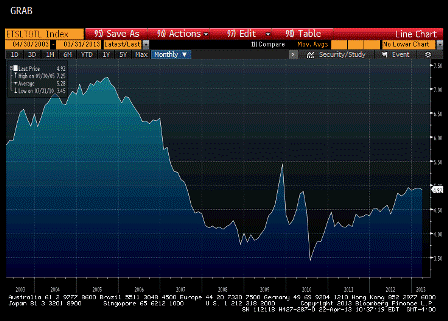
The attached chart is only meant to show how we weren’t doing all that great to begin with, and how dips below current levels tend to deteriorate into something worse when the budget deficit becomes too small to support the credit structure and private sector pro cyclical forces come to ‘bear’.

And while still relatively large by historical standards, the federal deficit is no longer nearly as large as it has been, and is rapidly declining, helped of course by the pro active tax hikes and spending cuts, which means we are that much more dependent on private sector credit expansion to sustain growth and employment.

To that point, it’s said that ‘housing is kicking in’ etc. which is true. But note that it’s the private sector credit expansion aspect of housing ‘replacing’ the decline in govt deficit spending that supports additional growth. That is, it’s not a shift from income spent on one thing shifting to housing, but the additional spending from the ‘borrowing to spend’ aspect of housing that does the trick. And this time around I suspect there won’t be a housing credit expansion like the one that turned out to be sub prime fraud, or the one in the 80’s that turned out to be the savings and loan fraud, etc. And without that kind of ‘bubble’ of some sort we never have had a robust economy that I can recall.

Full size image

Quotes from 60m interview (both interviews about Chinese real estate)

Both interviews are worth watching:

First interview

Zhang Xin (a very large commercial property developer who’s company is worth $10bn)

“Office is the only property sector which is doing well”

“Residential property development in China has really come to and end.”

“Corruption is everywhere in China…whoever has power is in the position to be corrupt.”

“For a Chinese living in China…if you ask one thing everyone pray[s] for, its democracy…8000 miles away [from the US] people [in China] are looking for it [democracy], longing for it.”

From the second interview

60 minutes: “No nation has ever built so much, so fast.”

Question (Leslie Stahl): ‘How important is real estate to the Chinese economy? Is is central?”
Answer (western investment banker): “Yes, its the main driver of growth and has been for the last few years.”

Question (Leslie Stahl): “Who’s left holding the bag?”
Answer (western investment banker): “there are multiple classes of people who are going to be wiped out by this. People who have invested three generations worth of savings…will see their savings evaporate and then of course there are 50mm construction workers…”

Largest Residential Property developer in China (a $53bn real estate empire)

Question: “Are you the biggest home builder in the world?”
Answer (Wang): “Yes, maybe.”

Question (LS): “A typical apartment in Shanghai cost about 45x the average resident’s annual salary.”
Answer (Wang): “Even higher.”
[the US housing bubble price to income ratio peaked at about 6.6x…]

Question (LS): “Are homes in China too expensive today?”
Answer: (Wang): “Yes”

Question (LS): “What does that mean for your economy if its too expensive for the vast majority of people?”
Answer (Wang): “Dangerous…that’s the bubble…that’s the problem.

Question: “Is there a bubble?”
Answer: “Yes, of course…if it bursts its a disaster.”

Cliff notes

Jobless Claims Fell More Than Expected, Down by 25,000 to 370,000

I haven’t written much this week because I haven’t seen much to write about.

Still looks like both the economy and the markets are discounting the cliff. And still looks to me like ex cliff GDP would be growing at about 4% this quarter, with the Sandy-cliff related cutbacks keeping that down to maybe 2.5%. And going over the full cliff is taking off maybe 2% more, leaving GDP modestly positive.

Which is what stocks and bonds seem to be fully discounting.

As previously discussed, the housing cycle seems to have turned up, which looks to be an extended, multi year upturn with a massive ‘housing output gap’ to be filled. And employment is modestly improving as well, also with a large output gap to fill. Car sales are back over 15 million, and also with a large output gap to fill.

The way I see the politics unfolding, the full cliff will be avoided, if not in advance shortly afterwards, as fully discussed to a fault by the media. That means GDP growth head back towards 4% (and maybe more)

Nor do I see anything catastrophic happening in the euro zone. They continue to ‘do what it takes’ to keep everyone funded and away from default. And conditionality means continued weakness. Q3 GDP was down .1%, a modest improvement from down .2% in Q2, and a flat Q4 wouldn’t surprise me. The rising deficits from ‘automatic fiscal stabilizers’ (rising transfer payments and falling revenues) have increased deficits to the point where they can sustain what’s left of demand. And the recent report of German exports to the euro zone rising at 3.5% maybe indicating that the overall support for GDP will continue to come disproportionately from Germany. And rising net exports from the euro zone will continue to cause the euro to firm to the point of ‘rebalance’ which should mean a much firmer euro. And as part of that story, Japan may be buying euro to support it’s exports to the euro zone, as per the prior ‘Trojan Horse’ discussions, and as evidenced by the yen weakening vs the euro, also as previously discussed.

And you’d think with every forecaster telling the politicians that tax hikes and spending cuts- deficit reduction- causing GDP to be revised down and unemployment up, and the reverse- tax cuts and spending hikes causing upward GDP revisions and lower unemployment- they’d finally figure this thing out and act accordingly?

Probably not…

JPM Household wealth report

The unemployment line is the evidence the federal deficit is too small given conditions.
This at least partially explains why the full employment deficit is much larger this time around:

From JP Morgan:

Executive Summary

Households lost $16 trillion worth of wealth during the crisis from late 2007 to early 2009, but they have recovered 70% of the loss since then.

However, the recovery has been uneven across wealth groups. The wealth of the top 10% has fallen back to 2004 levels, but median wealth has fallen back to 1992 levels, in real terms.

As a result wealth inequality has increased sharply after the crisis, which may have some effect on the upcoming elections.

Across age groups, the 25- to 44-year old group has experienced the most significant wealth losses after the crisis. This has been primarily due to house price declines, as younger households are more leveraged in housing.


House prices are not expected to revert back to pre crisis levels in real terms for a very long time. If younger households decide to rebuild their lost housing wealth, this will have long term growth implications.

We estimate that the 25- to 44-year old group has lost $2 trillion housing wealth and rebuilding this lost wealth over 10 years implies that GDP growth will be 1.3 %-pt less than it otherwise would be.

This may explain the slow demand growth we have experienced following the crisis.

Jackson Hole speech

The Chairman seems to be well aware of the upturn in housing, which he mentioned twice. But he was careful to not reveal an upbeat attitude that he knows would cause rates to spike in expectation of the Fed ‘normalizing’ policy with ‘neutral’ being a Fed funds rate maybe 1% over the inflation rate, or something like that.

In other words, he wants longer term rates, and mtg rates in particular, to stay down for now, which causes him to guard any optimism he may have, and then some.

It falls under ‘managing expectations’ and my best guess is he’s waiting for unemployment to fall below 8% before he publicly becomes more optimistic.

“Key sectors such as manufacturing, housing, and international trade have strengthened, firms’ investment in equipment and software has rebounded, and conditions in financial and credit markets have improved.”

“Rather than attributing the slow recovery to longer-term structural factors, I see growth being held back currently by a number of headwinds. First, although the housing sector has shown signs of improvement, housing activity remains at low levels and is contributing much less to the recovery than would normally be expected at this stage of the cycle.”

Housing on a sustainable uptrend?

Looks to me like housing is finally in a very sustainable uptrend, supported by adequate federal deficit spending, modestly improving personal income, relatively high affordability, low consumer debt ratios, very low levels of actual inventory, tightening rental markets, etc. etc.

And looks to me that housing starts could double and still be at relatively low levels, so there’s years of upside with modest growth rates.

It also means GDP could gravitate up to the 3-4% range by year end, and stay above 0% even should we go over the fiscal cliff.

Housing Starts Rise at Fastest Pace in Three Years

July 18 (CNBC) — Groundbreaking on new U.S. homes rose in June to its fastest pace in over three years, lending a helping hand to an economy that has shown worrisome signs of cooling.

Housing still modestly improving?

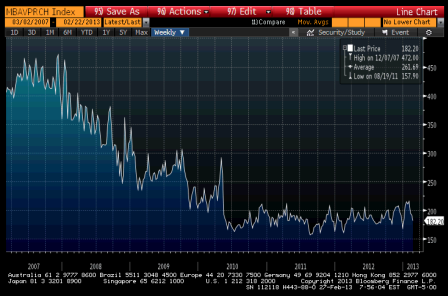
The Mortgage Bankers Association said its seasonally adjusted index of mortgage application activity, which includes both refinancing and home purchase demand, fell 2.1 percent in the week ended July 6. The results were adjusted to account for the July 4 holiday.

The MBA’s seasonally adjusted index of refinancing applications fell 3.4 percent, but the gauge of loan requests for home purchases, a leading indicator of home sales, rose 3.3 percent.