feels like time to buy equities in general

I’m thinking it’s about that time for portfolio managers to buy stocks and go play golf for a few years,
with the following very caveats.

1. A serious spike in crude oil/gasoline prices that undermines consumption
2. The euro zone could break down socially under the stress of continued austerity
3. Congress opting for ‘meaningful’ proactive deficit reduction

But apart from that it looks like relatively clear sailing to me

The Republicans are now softening on revenue increases to get past the fiscal cliff.

And in any case the fiscal cliff may already be up to 50% discounted, as business has slowed due to delayed contracts, etc. with top line growth still remaining modestly positive as the cyclical housing ‘recovery’ begins its multi year upward grind, providing a powerful ‘borrowing to spend’ force for growth. I call it a drop in ‘savings desires’ as borrowing is in fact ‘negative savings’.

This is fundamentally supported by continuing federal deficit spending that, while down from the peak, is still looking more than high enough to support a growing credit structure.

And the 4 years of ‘larger than ever’ federal deficits have added exactly (to the penny) that much in dollar net financial assets to the global economy, with much of that being added here domestically. This is evidenced by the full recoveries, and then some, of macro debt service ratios of all types. In short, ‘savings’ has been, for all practical purposes, more than sufficiently restored for a ‘normal’ recovery.

This kind of underlying strength will quickly cause the Fed to reevaluate policy as unemployment drops towards 7%, leading to a ‘normalization’ of policy, which means a fed funds rate at a ‘normal’ premium over ‘inflation’ for a ‘neutral monetary policy.’ In fact, as this happens, the higher rates from the Fed further support the expansion via the interest income channels.

The output gap is wide enough for this to go on for a long time without excess demand issues, again with the caveat of crude oil.

Growth has already caused the federal deficit to come in lower than expected, which is helping put off proactive deficit reduction efforts.

Yes, eventually, the automatic fiscal stabilizers will bring the deficit down too far for it to support the credit structure, and serve to end the cycle. But this is WAY down the road.

The first Obamaboom came from the ‘stimulus’ which wasn’t nothing, but was far too weak to remove the sudden drag on demand from the private sector credit contraction.

The ‘crime against humanity’ was not implementing the likes of my proposed ‘payroll tax holiday’ in mid 2008 to support demand at full employment levels at that time.

Instead, the govt allowed demand to collapse/output gap to widen. This did not have to happen. It was a total failure of govt.

Also, timing is also important, so mind the technicals!
U.K. Economy Surges 1% as Britain Exits Double-Dip Recession

Deficit finally large enough for a bit of stability and growth?

U.K. Economy Surges 1% as Britain Exits Double-Dip Recession

By Scott Hamilton and Jennifer Ryan

October 25 (Bloomberg) — Britain exited a double-dip recession in the third quarter with the strongest growth in five years as Olympic ticket sales and a surge in services helped boost the rebound.

Gross domestic product rose 1 percent from the three months through June, the fastest growth since 2007, the Office for National Statistics said in London today. That exceeded the highest estimate in a Bloomberg News survey for growth of 0.8 percent. The median forecast of 33 economists was 0.6 percent. The pound rose after the data were published.

The growth surge reflects a boost from the Olympics and a rebound from the second quarter, when GDP was affected by an extra public holiday. While the data may give some short-term relief to Prime Minister David Cameron’s struggling government, Bank of England Governor Mervyn King said this week that the recovery is “slow and uncertain.” That suggests the figures mask underlying weakness that could warrant further stimulus from the central bank.

“We’re still concerned the U.K. economy is going to be pretty much flat throughout next year,” James Shugg, an economist at Westpac Banking Corp. (WBC) in London, said on Bloomberg Television’s “The Pulse” with Maryam Nemazee. “It all depends how rigidly determined the government is to stick to its deficit reduction plan.”

Ticket Sales

Services, which make up about three quarters of GDP, surged 1.3 percent in the third quarter from the previous three months, the most in five years, the ONS said. Olympic ticket sales are estimated to have added 0.2 percentage points to GDP. Production rose 1.1 percent, the most in more than two years, while manufacturing increased 1 percent. Construction output fell 2.5 percent, a third straight quarterly decline.

The pound extended its gain against the dollar after the report and was trading at $1.6134 as of 10:52 a.m. in London, up 0.6 percent on the day. Bonds declined, pushing the yield on the 10-year government bond up 8 basis points to 1.93 percent.

From a year earlier, GDP was unchanged in the third quarter, the ONS said. That compared with a decline of 0.5 percent forecast by economists in a separate Bloomberg survey.

While today’s data confirm Britain exited its first double- dip recession since 1975, GDP is still 3.1 percent below its peak in the first quarter of 2008. The report also showed that the economy has grown 0.6 percent since the third quarter of 2010, just after Cameron’s coalition government came to power.

Economy ‘Healing’

Cameron urged caution on the GDP data, saying there is “still much to do.” The opposition Labour Party has accused his government of exacerbating the economic slump by sticking to its fiscal squeeze. Ed Balls, Labour’s finance spokesman, said today the economy “remains weak” and “is only just back to the size it was a year ago.”

“There are always one-off figures in all of these announcements but they do show an underlying picture of good and positive growth,” Cameron said. “We’ve got to stick with the program.”

The data today are an initial estimate and the figures are subject to revision when the ONS gets more information. In the second quarter, the decline in GDP was revised up to 0.4 percent from an initially reported 0.7 percent.

Britain is the first of the Group of Seven nations to report GDP data for the third quarter. U.S. growth probably accelerated to a 1.9 percent annual rate after expanding at a 1.3 percent pace the prior quarter, according to a Bloomberg survey before a Commerce Department report tomorrow. It would be the first back-to-back readings lower than 2 percent since the U.S. was emerging from the recession in 2009.

Deficit Reduction

The U.K. data come two weeks before the Bank of England’s Monetary Policy Committee must decide whether to end its stimulus program or extend it beyond 375 billion pounds ($605 billion). Governor Mervyn King said this week that a “zig-zag” pattern of recovery is likely to persist.

Debenhams Plc (DEB), Britain’s second-largest department-store chain, said today that the U.K. experienced “challenging trading conditions during 2012.” Whitbread Plc (WTB) Chief Executive Officer Andy Harrison said the consumer market is “pretty flat” and generating any growth is “jolly difficult.”

Stripping out one-time distortions, the National Institute of Economic and Social Research said on Oct. 9 that third- quarter growth was closer to between 0.2 percent and 0.3 percent.

Inflation Cools

Still, recent data have shown pressure on consumers easing. Inflation cooled to the slowest in almost three years in September, while retail sales increased more than forecast. Payrolls rose to a record in the quarter through August, pushing the unemployment rate down to 7.9 percent from 8.1 percent.

“At this stage, it is difficult to know whether some of the recent more positive signs will persist,” King said on Oct. 23. “The MPC will think long and hard before it decides whether or not to make further asset purchases. But should those signs fade, the MPC does stand ready.”

Elsewhere in Europe, Sweden’s Riksbank kept benchmark interest rates unchanged at their lowest level since early 2011 and said further easing has become more probable as growth slows in the largest Nordic economy.

Mosler for Congress update

I sent the following to my international audience looking to a return to prosperity
for all of us, which I now send along to you here in the USVI to keep you well informed!

(note that ‘closing the output gap’ means ‘eliminating unemployment’)

They have known me for a very long time and have been most supportive:

First let me thank all of you who have contributed, and have become part of what could quickly become much more than just another seat in Congress!!!

Donations have exceeded $25,000 and at only $25/minute for radio and TV adds the incremental spending has indeed made a difference- thanks again!

There are three weeks to go an any additional contributions will immediately be used to add to the advertising and promotional efforts.

When I ask our volunteers ‘out of ever 10 people they speak to in their neighborhoods, how many say they are voting for me’ they all say more than half!

Friday in St. Thomas while walking to a UVI event I heard a loud ‘Mosler!’ and looked over to see a patrol car with the window down and the officer looking at me. As soon as I turned his way he said ‘Everyone’s voting for you this time, you’re going to win you know!’

I’ve been in 5 ‘debates’ so far, with the candidates on a panel taking questions from a moderator. I’ve just focused on what I’m going to do about each issue, both for the national economy and the USVI economy, while the other candidates have had no specific agenda apart from promising to work hard (and taking cheap shots at each other, of course!)

More and more the audiences seem to be responding with ‘your the only one who knows what to do’. And the ‘anti incumbent’ feeling in general is actually alarmingly high as conditions here continue to deteriorate. Our cost of electricity, for example, just went up to over 50 cents/kw, while government salaries that were already half the national average were cut 8%, with thousands of lost jobs due to the closing of the Hovensa refinery here on St. Croix and widespread government layoffs of nurses and teachers in an already grossly under served community.

I assure you that if I get in Washington will soon be aware of the hurricane that’s come up from the USVI. The Fed chairman will suddenly face ‘innocent’ questions of profound magnitude, such as, ‘Isn’t true that a $trillion deficit adds exactly that much to global dollar net savings, and not a penny less or a penny more, or these two gentlemen next to me from the CBO would have stay late at work looking for their arithmetic mistake?’ ‘Isn’t it true, that by your own regulatory standards, loans to the ECB collateralized with euro deposits would be classified as unsecured loans?’ ‘Given that you do the actual spending on behalf of Congress simply by crediting accounts, and therefore ability to pay, insolvency, and prior funding for Congress, unlike for Greece, is never an issue, and, again unlike Greece, for all practical purposes the Fed sets US interest rates by voting and not the market, what then, is the short term or long term risk posed by deficit spending? And many more. And with all of these questions serving the agendas of various members of Congress there is every incentive for them to be asked. And not to mention testimony and discussions on banking, budgets, and trade. Looking forward to gettng the job done/close the output gap!!!

If any of you want to contribute to ‘THE CAUSE’ remember the limit is $2,500 per person and checks can be made out to ‘Mosler For Congress 2012’.

You can also click here or paypay and further information.

All the best!!!

Warren

French Industrial Production Unexpectedly Rose 1.5% in August

I know it’s a stretch at this point, but I keep looking for evidence their budget deficits are large enough to support GDP at current (depressed) levels.

And yes, further austerity works against this.

French Industrial Production Unexpectedly Rose 1.5% in August

October 10 (Bloomberg) — French industrial production unexpectedly rose in August, driven by manufacturing of transport equipment. Production gained 1.5 percent in the month from July, Insee said.

Italian Industrial Output Unexpectedly Rises 1.7% in August

October 10 (Bloomberg) — Italian industrial production unexpectedly rose in August. Output rose 1.7 percent from July, when it contracted a revised 0.1 percent, Istat said. Production fell 5.2 percent from a year earlier on a workday-adjusted basis, the 12th annual decline. The euro region’s third-biggest economy will probably contract 2.4 percent this year and 0.2 percent next, the government said last month. Industrial production fell 0.9 percent in the third quarter from the previous three months, employers lobby Confindustria predicted on Oct. 1. Output declined 0.3 percent in September from the previous month, according to the survey. Istat had originally reported a 0.2 percent drop industrial production in July.

Same goes for the UK:

U.K. Third-Quarter GDP Jumps the Most in Five Years, Niesr Says

October 10 (Bloomberg) — The U.K. economy grew at its fastest pace in five years in the third quarter after a rebound from one-off disruptions in the prior three months, the National Institute of Economic and Social Research said. Gross domestic product rose 0.8 percent, compared with 0.1 percent in the quarter through August, Niesr said. Underlying growth was weaker than suggested by the headline number, Niesr said. Stripping out distortions stemming from June’s extra public holiday for Queen Elizabeth II’s Diamond Jubilee, it measured the economy’s pace of expansion as closer to between 0.2 percent and 0.3 percent. “The strength of the figure for the three months to September is largely an artefact of special events,” it said.

September FOMC Preview and fiscal cliff comments


Karim writes:
September FOMC Preview

Its hard to remember going into an FOMC meeting with as wide a range of outcomes and as wide an array of views on those outcomes from markets and economists.

In play:

  • Do nothing
  • Extend forward guidance (to what date?)
  • Cut IOER
  • Unsterilized asset purchases
    • Open-Ended, or defined amount and time period?
    • MBS and/or USTs?

My own, relatively low conviction, view is that they only extend forward guidance, to mid-2015, from the list above. I think there is a 40% probability they announce new LSAPs that would run concurrently with the end of Twist2. If they do additional LSAPs, I think there is a 40% they are open-ended in nature. If they do additional LSAPS (defined amount), I think it will be a 400bn program over 6mths made up of 75% MBS and 25% USTs. The odds of a cut in IOER would around 25% in my view.

Assuming extending forward guidance is a done deal, as hinted in the minutes, here are some of the pro’s and cons in terms of gauging the likelihood of additional asset purchases.

Pros

  • The term ‘monetary’ accommodation used in the last Minutes suggests more than just forward guidance is being considered: Many members judged that additional monetary accommodation would likely be warranted fairly soon unless incoming information pointed to a substantial and sustainable strengthening in the pace of the economic recovery.
  • Bernanke used the term ‘grave concern’ at Jackson Hole to describe the state of the labor market and the last payroll report looked lousy.
  • He defended the use of QE at Jackson Hole, so if the outlook remains weak, why not do more?

Because he doesn’t want to pick a fight with China again, as per my May 2011 post.

Cons

  • The Fed states that policy works through financial channels and with most borrowing rates near record lows, and equity markets near 4yr highs, those channels are working well right now. Why mess with success?


Yes, he knows it’s about rates, not quantities, and that policy has caused the term structure of rates to be where it is. However, the channel that remains elusive is how low rates are transmitted to aggregate demand, claims of creating 3 million jobs not withstanding.

  • The outlook hasn’t changed much since June when they announced Twist2, so why act now?
  • Its 2mths before the election and the Fed is only a side campaign issue now. For an institution that craves it independence, why do anything that may risk that?

Open-ended purchases would likely be tied to the forecast (i.e., ‘the Fed will buy 150bn/mth of MBS and USTs until the Committee is able to forecast meeting its mandate within its forecast horizon’). The issue is the Fed doesn’t have a common forecast (it takes an average of 17 members to produce the SEP). That common forecast is a work in progress (a Committee headed by Yellen). So an open-ended program may take place, but probably not until next year.

Odds of an IOER cut are low just because Bernanke did not mention it at all at Jackson Hole.

About three months ago I suggested the fiscal cliff was too far away for markets to care.
But now it’s a lot closer, and close enough for those to be affected directly by govt spending cuts to be acting accordingly.

But that also means that at least some of that cliff is already being discounted which means:

It won’t be as bad as expected if it happens.
If it’s avoided there will be a boost to the economy not in current forecasts.

August Payrolls-Stall Speed


Karim writes:

Very poor job data with a gain of only 96k and a net revision of -41k. Somewhat offsetting is the 0.2% drop in the unemployment rate from 8.3 to 8.1% (which along with April 2012 is the lowest since January 2009). The biggest swing (and miss) was manufacturing employment, which shifted from a gain of 23k to a fall of 15k, indicating that global economic weakness is affecting U.S. exporters. Indicators of domestic demand fared better as trade swung from a gain of 11k to 29k jobs, finance from -2k to +7k, and leisure/hospitality from 28k to 34k.
 
Though August payroll data is typically revised higher, the data affirms the notion the economy is hovering around or just below trend growth of 2-2.5%.
 
The data increases the chances of QE3, unsterilized and possibly open-ended purchases of Agency MBS and USTs, but I still think later in the year. An open-ended program likely requires a consensus Fed economic forecast, which is still a work-in-progress. Next week’s FOMC meeting will be contentious, and a close call, however.
 
Other data highlights:

  • The drop in the unemployment rate came as a result of a drop in the participation rate from 63.7% to 63.5% (labor force fell by 368k).
  • The U6 measure improved from 15% to 14.7%, but the median duration of unemployment rose from 16.7 weeks to 18 weeks.
  • Average hourly earnings were unchanged and aggregate hours gained 0.1%, a weakish combination for personal income.
  • The diffusion index dropped from 54.3 to 50.2

Some interesting charts from SMR:

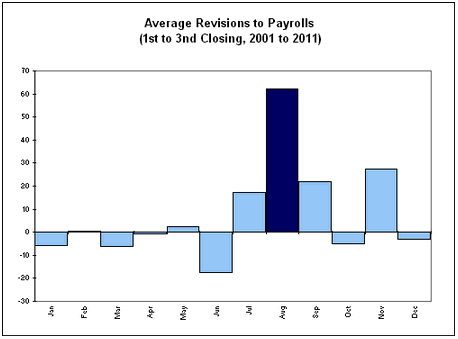
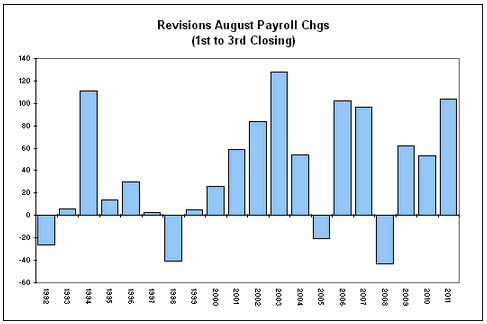
Over the past 20 years August payrolls have been revised upward between the 1st and 3rd release on 16 occasions.

The magnitude of the August payroll revisions over the past 10 years has far exceeded any other month of the year. Over this period the August reading has been revised upward by an average of 62,000, in contrast to the next largest month (November) at +27,600.

My comments on my Jan 2003 ten year outlook

>   
>    Posted By Warren Mosler on January 15, 2003 at 13:04:00:
>   
>   Here’s what’s being set up.
>   
>   1. Bush tax stuff is way too small to turn the economy.
>   
>   2. Over the next 24 months the economy weakens as the deficit grinds its way to the usual
>   5% of gdp or more – $500 billion + – mainly through falling revenue as unemployment
>   rises, corporate earnings wither, etc.
>   

A month or so after this was written I met with Andy Card, Bush’s chief of staff, and told him much the same. He got it and they took immediate action to increase spending and cut taxes. It was shortly after that meeting that Bush was asked about the deficit and said he doesn’t look at numbers on pieces of paper, he looks at jobs, and did all he could to make the deficit as large as possible. It got up to 200 billion for Q3 or about 800 billion annually; enough to turn the economy enough to not lose the election.

>   
>   3. Hillary Clinton wins the Presidency by a landslide promising to increase taxes on the
>   rich to assist the poor and balance the budget.
>   

I forget why she didn’t run and/or lost to Kerry?

>   
>   4. After the innaguration the program gets passed while the federal deficit remains around
>   $600 billion.
>   
>   5. The economy recovers as it always does after a couple of years of 5%+ deficits restore
>   non govt net financial assets/savings/aggregate demand.
>   

This is pretty much what happened under Bush.

>   
>   6. Once again the Clintons ‘prove’ balancing the budget is good for the economy and win
>   two terms.
>   
>   7. Half way into her 2nd term the strong economy drives the budget into surplus further
>   proving Clintonomics.
>   

This happened under Bush as the strong economy driving by private credit expansion took the deficit down to 1% of GDP by mid 2006. Unfortunately the expansion included the sub prime fraud which was seriously unsustainable.

>   
>   8. The next president is Hillary’s VP who gets the votes counted in his favor this time.
>   
>   9. This next president gets clobbered with another economic downturn caused by the
>   previous surplus, and the federal budget goes into deficit.
>   

It happened during the last few months of the Bush administration. And Obama did get clobbered by it.

>   
>   This time they aren’t ‘fooled’ by Bush style tax cuts anymore, and try instead to again raise
>   taxes on the rich to assist the poor and balance the budget, but they do it too soon, before
>   the deficit is large enough to turn the economy, and it gets much worse.
>   

My timing was far from perfect, but not terrible for a 10 year forecast?
Any other 10 year forecasts from back then on record?