Paul Krugman Blog – NYTimes.com

The way I read it, he’s agreed that it’s about inflation, not solvency.

That is, in ratings agency speak, willingness to pay could be an issue, but not ability to pay.

That’s enough for me to declare victory on that key issue, and move on.

Not that I at all agree with his descriptions of monetary operations or his ‘inflation channels.’ I just see no reason to rehash all that and risk loss of focus on the larger point he’s conceded.

This reads like a true breakthrough. Hopefully this opens the flood gates and the remaining deficit doves pile on, and July 17, 2010 is remembered as the day MMT broke through and turned the tide.

And in the real world it’s all about celebrity status.

With Jamie’s credentials and definitive response to the sustainability commission, Paul finally had a sufficiently ‘worthy’ advocate which gave him the opening to respond and concede.


I Would Do Anything For Stimulus, But I Won’t Do That (Wonkish)

By Paul Krugman

It’s really not relevant to current policy debates, but there’s an issue that’s been nagging at me, so I thought I’d write it up.

Right now, the real policy debate is whether we need fiscal austerity even with the economy deeply depressed. Obviously, I’m very much opposed — my view is that running deficits now is entirely appropriate.

But here’s the thing: there’s a school of thought which says that deficits arenever a problem, as long as a country can issue its own currency. The most prominent advocate of this view is probably Jamie Galbraith, but he’s not alone.

Now, Jamie and I are, I think, in complete agreement about what we should be doing now. So we’re talking theory, not practice. But I can’t go along with his view that

So long as U.S. banks are required to accept U.S. government checks — which is to say so long as the Republic exists — then the government can and does spend without borrowing, if it chooses to do so … Insolvency, bankruptcy, or even higher real interest rates are not among the actual risks to this system.

OK, I don’t think that’s right. To spend, the government must persuade the private sector to release real resources. It can do this by collecting taxes, borrowing, or collecting seignorage by printing money. And there are limits to all three. Even a country with its own fiat currency can go bankrupt, if it tries hard enough.

How does that work? A bit of modeling under the fold.

Let’s think in terms of a two-period model, although I won’t need to say much about the first period. In period 1, the government borrows, issuing indexed bonds (I could make them nominal, but then I’d need to introduce expectations about inflation, and we’ll end up in the same place.) This means that in period 2 the government owes real debt service in the amount D.

The government may meet this debt service requirement, in whole or in part, by running a primary surplus, an excess of revenue over current spending. Let’s suppose, however, that there’s an upper limit S to the feasible primary surplus — a limit imposed by political constraints, administrative issues (if taxes are too high everyone will evade), or the sheer fact that tax collections can’t exceed GDP.

But the government also has a printing press. The real revenue it collects by using this press is [M(t) – M(t-1)]/P(t), where M is the money supply and P the price level.

What determines the price level? Let’s assume a simple quantity theory, with the price level proportional to the money supply:

P(t) = V*M(t)

By assuming this, I’m actually making the most favorable assumption about the power of seignorage, since in practice, running the printing presses leads to a fall in the real demand for money (people start using lumps of coal or whatever as substitutes.)

OK, now let’s ask what happens if the government has run up enough debt that the upper limit on the primary surplus is a binding constraint, and it’s necessary to run the printing presses to make up the difference. In that case,

[M(t) – M(t-1)]/P(t) = D – S

But P is proportional to M, so this becomes

[M(t) – M(t-1)]/VM(t) = D – S

Rearrange a bit, and we have

M(t)/M(t-1) = 1/[1 – V[D-S]]

And what does this imply? Since the price level is, by assumption, proportional to M, this tells us that the higher the debt burden, the higher the required rate of inflation — and, crucially, that as D-S heads toward a critical level, this implied inflation heads off to infinity. That is, it looks like this:

So there is a maximum level of debt you can handle. In practice, if it makes sense to say such a thing with regard to a stylized model, at some point lower than the critical level implied by this model the government would decide that default was a better option than hyperinflation.

And going back to period 1, lenders would take this possibility into account. So there are real limits to deficits, even in countries that can print their own currency.

Now, I’m sure I’m about to get comments and/or responses on other blogs along the lines of “Ha! So now Krugman admits that deficits cause hyperinflation! Peter Schiff roolz” Um, no — in extreme conditions they CAN cause hyperinflation; we’re nowhere near those conditions now. All I’m saying here is that I’m not prepared to go as far as Jamie Galbraith. Deficits can cause a crisis; but that’s no reason to skimp on spending right now.

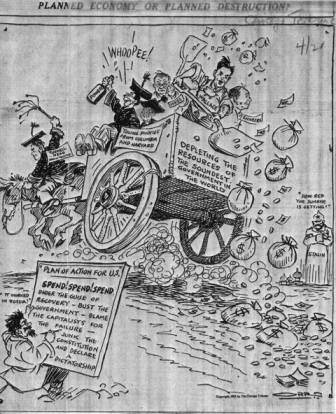
1934 Cartoon

We went off the gold standard in 1934 and solvency was never again an issue for the Federal government.

Those ‘sound money’ people were wrong then and are wrong now as taxes function to regulate aggregate demand and not to raise revenue per se.

This cartoon is claimed to be from the Chicago Tribune in 1934. Look carefully at the plan of action in the lower left corner.

UK Economy Grew Unrevised 0.3% in First Quarter

Still looks to me like the UK budget deficit has been more than sufficient to support at least modest GDP growth.

UK Headlines:

U.K. Economy Grew Unrevised 0.3% in First Quarter

U.K. Consumers Predict Economy Will Worsen, GfK Survey Shows

U.K. Mortgage Approvals Rose 2% in May From April, CML Says

U.K. Profit Warnings to Climb as Deficit Cuts Kick In, E&Y Says

Osborne Says U.K. Budget Cuts Needed to Avoid ‘Downward Spiral’

U.K.’s Budd to Propose More Independent OBR, Telegraph Says

Blanchflower Says Economy May See Long Decade of Slow Growth

Non-Mfg ISM

With deficit spending running at about 7% of gdp modest growth should continue, with the ‘hand off’ coming when private sector credit expansion kicks in, which could be a while.


Karim writes:

Slowing, but still firmly in expansionary mode.
15 industries expand, 2 contract, 4 unch.


What respondents are saying…

  • “The general upswing in the economy, albeit minor, has had a positive effect.” (Arts, Entertainment & Recreation)
  • “Pricing pressures continue to increase as we see the economy begin to improve. Orders are still lagging in our industry.” (Professional, Scientific & Technical Services)
  • “Slow pace, but better than last year at this time.” (Accommodation & Food Services)
  • “Funding issues and cash flow issues continue to affect public sector procurement. Almost all capital acquisitions have been suspended.” (Public Administration)
  • “We have seen a slight improvement in business activity over the past month.” (Wholesale Trade)


June May
Composite 53.8 55.4
Activity 58.1 61.1
Prices Paid 53.8 60.6
New Orders 54.4 57.1
Employment 49.7 50.4
Exports Orders 48.0 53.5
Imports 48.0 56.5

World’s rich got richer amid ’09 recession

They call Obama a ‘socialist’ who’s taking from the rich and giving to the poor, but the facts show that instead he’s presided over the largest transfer of wealth from poor to rich in the history of the world.

GDP has been growing by around 4% for the last two quarters, while the lowest income people suffered through job loss and declining wage growth.

That means someone else got the increase in real wealth:

World’s rich got richer amid ’09 recession: report

By Joseph A. Giannone

June 22 (Reuters) — The rich grew richer last year, even as the world endured the worst recession in decades.

A stock market rebound helped the world’s ranks of millionaires climb 17 percent to 10 million, while their collective wealth surged 19 percent to $39 trillion, nearly recouping losses from the financial crisis, according to the latest Merrill Lynch-Capgemini world wealth report.

Stock values rose by half, while hedge funds recovered most of their 2008 losses, in a year marked by government stimulus spending and central bank easing.

“We are already seeing distinct signs of recovery and, in some areas, a complete return to 2007 levels of wealth and growth,” Bank of America Corp wealth management chief Sallie Krawcheck said.

The fastest growth in wealth took place in India, China and Brazil, some of the hardest hit markets in 2008. Wealth in Latin America and the Asia-Pacific soared to record highs.

Asia’s millionaire ranks rose to 3 million, matching Europe for the first time, paced by a 4.5 percent economic expansion.

Asian millionaires’ combined wealth surged 31 percent to $9.7 trillion, surpassing Europe’s $9.5 trillion.

In North America, the ranks of the rich rose 17 percent and their wealth grew 18 percent to $10.7 trillion.

The United States was home to the most millionaires in 2009 — 2.87 million — followed by Japan with 1.65 million, Germany with 861,000, and China with 477,000.

Switzerland had the highest concentration of millionaires: nearly 35 for every 1,000 adults.

Yet as portfolios bounced back, investors remained wary after a collapse that erased a decade of stock gains, fueled a contraction in the global economy and sent unemployment soaring.

The report, based on surveys with more than 1,100 wealthy investors with 23 firms, found that the rich were well served by holding a broad range of investments, including commodities and real estate.

“The wealthy allocated, as opposed to concentrated, their investments,” Merrill Lynch head of U.S. wealth management Lyle LaMothe said in an interview.

Millionaires poured more of their money into fixed-income investments seeking predictable returns and cash flow. The challenge ahead for brokers is convincing clients to move off the sidelines and pursue riskier, more fruitful investments.

“There is still a hesitancy,” LaMothe said. “Liquidity is incredibly important and people need cash flow to preserve their lifestyle — but they want to replace that cash flow in a way that does not increase their risk profile.”

The report found that investor confidence in advisers and regulators remains shaken. The rich are actively managing their investments, seeking customized advice and demanding full disclosure about the securities they buy.

There were signs that investors were shaking off their concerns. Families that kept money closer to home during the crisis began shifting money to foreign markets, particularly the developing nations.

North American and European investors are expected to increase their exposure to Asian markets, which are projected to lead the world in economic expansion. Europe’s wealthy are seen increasing their U.S. and Canadian holdings.

More wealthy clients also are taking a harder look at large companies that pay healthy dividends, as an alternative to bonds and their razor-thin yields.

“Investors are open to areas they hadn’t thought about before as they try to preserve their ability to be philanthropic, to preserve their lifestyle,” LaMothe said. “To me, the report underscored clients are involved and they’re not inclined to stay in 1 percent savings accounts.”

Clegg Says U.K. Deficit Cuts Intended to Avert ‘Market Panic’

Just in case you thought the new Deputy Prime Minister knows anything about monetary operations.

To avoid the non existent probability of becoming the next Greece they can take action to increase the real probability they become the next Japan:

Clegg Says U.K. Deficit Cuts Intended to Avert ‘Market Panic’

June 24 (Bloomberg) — Deputy Prime Minister Nick Clegg said the U.K. could have been the next victim of a “market panic” sweeping Europe if the government had not raised valued-added tax.

Defending Chancellor of the Exchequer George Osborne’s June 22 decision to raise the tax to 20 percent from 17.5 percent, which Clegg’s Liberal Democrats had campaigned against during for last month’s election, the deputy prime minister said the government faces a “black hole” in the public finances that is “even bigger than we thought.”

“The truth is that the world had changed very dramatically in recent weeks,” Clegg told BBC News today. “We’ve got this sort of economic firestorm on our doorstep in Europe, where the markets are putting huge pressure on one country after the next, knocking on the door in Greece, in Spain, in Portgual, and so on.”

“There’s a real worry that if we don’t take action now, that we will be the next victim, if you like, of that kind of market panic,” he said.

Claims/DGO

Still feels like modest GDP growth, positive but not enough to make much of a dent in unemployment, until the ‘hand off’ to growth from credit expansion from some other sector, which could be a while.

Risks remain external.

China has been a strong first half weak second half story for a while, and a weak second half after an only ok first half this year can be a problem.

Fiscal tightening around the world can also keep a lid on things.

And I still have that nagging feeling that a 0 rate policy requires higher budget deficits to sustain full employment than a policy of higher rates. That should be a good thing- means taxes can be that much lower- but with a govt that doesn’t understand its own monetary system and keeps fiscal too tight it’s a bad thing.

All seems to point to more of an L shaped, Japan like recovery than a V.


Karim writes:

Constructive data:

* Initial claims down 19k to 457k; Labor dept cited processing issues around Memorial Day holiday for elevated readings past couple of weeks

MKT NEWS:”A Labor analyst said the surge in the previous two weeks was apparently due to technical factors relating to the way new claims were distributed over the holiday and post-holiday weeks and to a pattern that departed from what the seasonal factors were prepared for.”

* Number receiving extended benefits at lowest since last December, suggesting some easing in ability to find a job

Durable goods orders ex-aircraft and defense up 2.1% last month and up 29% past 3mths at an annualized rate; Capex was the sector was the Fed was most upbeat on in their statement yesterday

Shipments ex-aircraft and defense up 1.6% m/m and 16.7% on a 3mth annualized rate