Boehner falls for Obama’s trap

In a bold move to the right, President Obama proposed a series of Republican type business tax cuts that would not have been the first choice of anyone on the left, in addition to a tax cut for workers earning less than $250,000 per year.

Boehner’s best move would have been to embrace the business tax cuts as well as the personal tax cuts, declare victory, and claim it was voter rejection of the ‘liberal agenda’ that caused the President to break ranks with the left and join the conservative cause, etc. And I’m sure he could have spun it far better than my feeble attempt.

Instead, Boehner fell into the trap, as he rejected the entire pro Republican agenda proposal, and opened himself and the Republican party up to a crushing condemnation of his position by a President who was back to his teleprompter led candidate form.

Looks like a major political blunder to me. While Obama’s proposals can be said to fall short of the mark, there was precious little the Republicans should have been objecting to. Now Boehner is stranded in no man’s land, regrouping and groping for a position that makes sense. (Reminds me of the Arafat’s public relations disaster when he rejected a far more than generous offer from the Israelis.)

Unfortunately, Obama took advantage of and reinforced the anti deficit fear mongering and added to that fear mongering, claiming he didn’t extend tax cuts to the rich because the govt. needs those dollars for deficit reduction. This further sets us up for higher unemployment down the road and has already limited any fiscal response to levels that will keep US unemployment ‘high for long.’

Now the Democrats are hoping that the numbers between now and the election show a double dip is not in the cards, and that things have slowly turned, which is very possible.

Even so, there’s a good chance it’s too late to stem the anti incumbent tide.

Obama Blasts GOP, Boehner on Economy and Taxes

September 8 (AP) — President Barack Obama strongly defended his opposition to extending Bush-era tax breaks for the wealthiest Americans on Wednesday and delivered a searing attack on Republicans and their House leader for advocating “the same philosophy that led to this mess in the first place.”

Obama said the struggling U.S. economy can’t afford to spend $700 billion to keep lower tax rates in place for the nation’s highest earners despite a call by House Minority Leader John Boehner and other GOP leaders to do just that.

Speaking in the same city where Boehner, an Ohio Republican, recently ridiculed Obama’s economic stewardship, Obama said Boehner’s policies amount to no more than “cut more taxes for millionaires and cut more rules for corporations.”

Obama’s comments came as the administration rolled out new proposals designed to re-ignite a sputtering recovery, including new tax breaks for businesses and $50 billion for U.S. roads, rails and airports.

“Let me be clear to Mr. Boehner and everyone else. We should not hold middle class tax cuts hostage any longer,” the president said. The administration “is ready this week to give tax cuts to every American making $250,000 or less,” he said.

Actually, Obama and other Democratic leaders want to extend the tax cuts except for individuals making over $200,000 a year—or families earning over $250,000. The sweeping series of Bush tax cuts expires at the end of this year unless Congress renews them.

Obama went after Boehner—who would probably become House speaker if Republicans win control of the House in November’s midterm elections—directly by name.

In Boehner’s remarks on Aug. 24, Obama said, the Republican leader offered “no new ideas. There was just the same philosophy we already tried for the last decade, the same philosophy that led to this mess in the first place.”

Ahead of Obama’s speech, Boehner offered his own proposals on Wednesday, saying in a morning broadcast interview that Congress should freeze all tax rates for two years and should cut federal spending to the levels of 2008, before the deep recession took hold.

“People are asking, ‘Where are the jobs?”‘ Boehner said, calling the White House “out of touch” with the American public.

Obama gave one of his strongest pitches yet on allowing the Bush tax cuts to expire at the end of this year for wealthy Americans but allowing them to remain in place for everybody else.

Republicans, and even some Democrats, have suggested that it was no time to raise taxes on anybody, given the fragile state of the economy.

The debate is an unwelcome one for dozens of vulnerable Democratic incumbents just weeks before Election Day. Already, a handful of Democrats in conservative or swing districts, such as Reps. Gerry Connolly in the northern Virginia suburbs of Washington, D.C., and Bobby Bright in southeastern Alabama, have come out publicly for extending all the cuts—at least temporarily.

Still other embattled Democrats, wary of alienating middle-class voters, are siding with Obama. In central Ohio, for example, Rep. Mary Jo Kilroy has said the tax cuts for higher earners should be repealed, but middle-income people should see no tax increases.

Obama acknowledged that the recovery that began in late 2009 had slowed considerably.

“And so people are frustrated and angry and anxious about the future. I understand that. I also understand that in a political campaign, the easiest thing for the other side to do is ride this fear and anger all the way to Election Day,” he said.

“The middle class is still treading water, while those aspiring to reach the middle class are doing everything they can to keep from drowning,” Obama said.

Polls have shown a steady slippage in Obama’s approval ratings and an accompanying rise in Republican prospects for winning House and Senate seats in November.

In his speech, Obama outlined plans to expand and permanently extend a research and development tax credit that lapsed in 2009, to allow businesses to write 100 percent of their investments in equipment and plants off their taxes through 2011 and to pump $50 billion into the economy for highway, rail, airport and other infrastructure projects.

He also renewed a pitch for a small business package that has been stalled in the Senate because of Republican delaying tactics.

Of the debate over the expiring Bush tax cuts, Obama said, “I believe we ought to make the tax cuts for the middle class permanent. These families are the ones who saw their wages and incomes flatline over the last decade—and they deserve a break. And because they are more likely to spend on basic necessities, this will strengthen the economy as a whole.”

“But the Republican leader of the House doesn’t want to stop there. … He and his party believe we should also give a permanent tax curt to the wealthiest 2 percent of Americans.” Obama said these taxpayers were “folks who are less likely to spend the money” to help the economy grow, a notion disputed by Republicans and conservative economists.

Even Obama’s former budget director, Peter Orszag, has said that while he prefers Obama’s proposal to impose the higher taxes on the wealthy, getting such a formulation through Congress in this politically charged time might be extremely difficult. Orszag suggested a compromise—extend all the tax cuts, but just for two years, and then let them all expire.

Obama is strongly opposed to such a deal, White House officials said.
Fears Grow over the Fate of Irish Economy, Banks

The two external shocks of the summer were China, which historically has had second half slowdowns due to State lending front loaded to the first half, and the euro zone which became a ward of the ECB. China’s growth has slowed some, but not collapsed, and the ECB has continued its support of euro member solvency and funding capability in the short term markets.

There was no credible deposit insurance for the euro zone banks until the ECB ‘wrote the check’ by buying national govt debt in the secondary markets. It’s not the most efficient way to do things, but it does work to facilitate national govts being able to fund themselves, though mainly in the very short term markets (I still see my per capita distribution proposal as the better policy response). And that ability of the member nations to fund themselves means they can write the check for deposit insurance as needed.

The ECB also imposed ‘terms and conditions’ along with funding assistance, and as long as Ireland is in compliance, the ECB is for the most part responsible for the outcomes, so it seems logical the ECB will continue its support, perhaps changing its terms and conditions if not pleased with the outcomes. Additionally, the ECB will continue to supply liquidity directly to the banks, again, as with Ireland complying with the terms and conditions the ECB is now responsible for the outcomes.

But there is no question it is all a precarious brew, and there is no telling what might result in the ECB withdrawing support, so at this time steep yield curves for euro member nations due to credit risk make perfect sense.

Also, Europe and the rest of the world would like nothing more than to increase net exports to the US.

It’s all a golden opportunity for a decade or more of unparalleled US prosperity if we knew enough to again become the ‘engine of growth’ and implement the likes of a full payroll tax (FICA) holiday to provide Americans working for a living enough spending power to buy both everything we could produce at full employment and all the rest of the world wants to net sell us.

Unfortunately the deficit myths continue to cast a wet blanket over domestic demand as our leaders continue to let us down.

And with maybe 100 new Congressmen on the way, with most supporting a balanced budget and a balanced budget amendment which already has maybe 125 votes, there’s more than enough fiscal responsibility looming to create a true depression.

Hopefully their tax cutting agenda outweighs their balanced budget agenda.

And hopefully we get some kind of energy policy to decouple GDP growth from a spike in energy consumption.

Fears Grow over the Fate of Irish Economy, Banks

By Patrick Allen

September 8(CNBC) — The fate of the Irish economy is back in focus for investors across the world, after the former Celtic Tiger extended guarantees to its banking industry and depositors and with the spread on Irish bonds hitting record highs.

The country is also waiting for a decision from the European Commission on the fate of Anglo Irish, the troubled bank that was nationalized two years ago; uncertainty on whether Anglo Irish will be wound down or allowed to survive has weighed on sentiment towards the country.

Ireland is an example of a Western economy adjusting to both the banking crisis and, crucially, the emergence of Asia, Amit Kara, an economist at Morgan Stanley, said.

“Ireland has taken steps to overcome the hangover from the credit boom, but a successful outcome requires the economy to become more competitive and also, and more crucially, a global economic recovery,” Kara said.

He is confident the Irish economy will be able to roll over debt in the coming weeks and sees the chance for Irish debt to outperform the likes of Spain.

“Though Ireland faces serious long-term challenges, its liquidity position is healthy and its banks should have sufficient ECB-eligible collateral to significantly offset the funding impact of upcoming debt redemptions,” Kara explained.

“Given the underperformance of recent weeks, we see scope for Irish bonds to regain some ground against Portugal and Spain in particular, once the initial round of government-guaranteed bond redemptions has taken place over the first two weeks of September,” he added.

What is on Ireland’s Books?

The Irish banking system remains hooked on European Central Bank funding and investors are also worried about the risks posed by the scale of liabilities following Ireland’s decision to guarantee the country’s lenders.

GS Skinny: The Administration’s New Fiscal Proposals

The President’s proposal is now looking anemic at best.

Like I think Woody Allen once said, the food was bad and the portions were small.

This will cost the Dems even more seats in November.

Fortunately the federal deficit is already large enough to support a bit of modest growth.

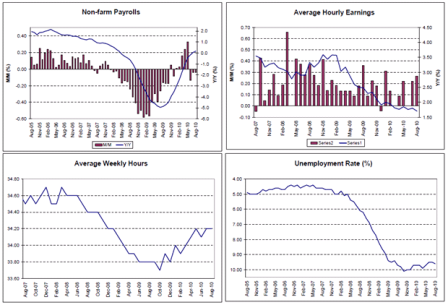
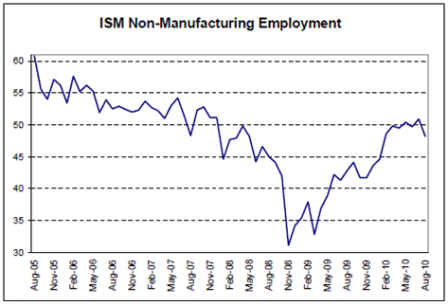
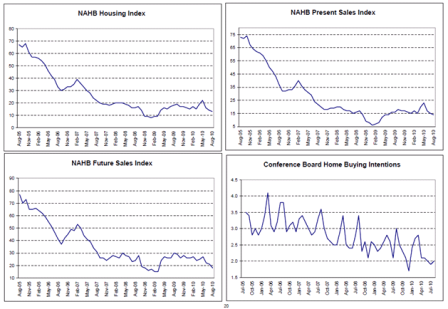
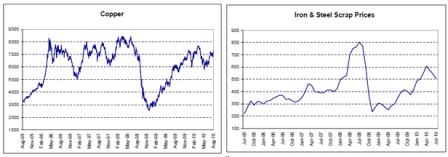
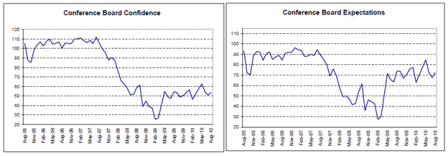
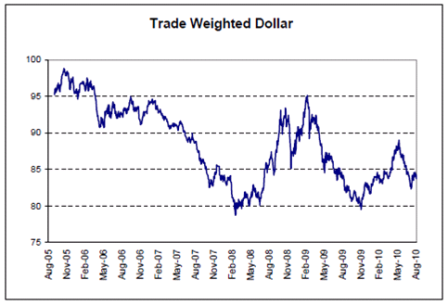
All looking very L shaped to me, with a hint of growth.

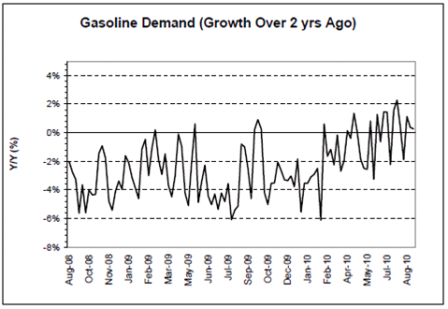
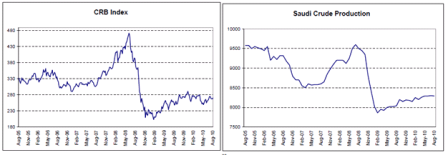
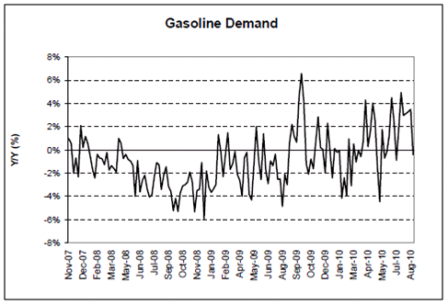
Gasoline consumption has recovered and showing signs of growth year over year, but very modest.

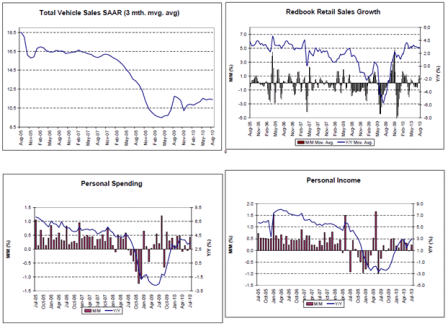
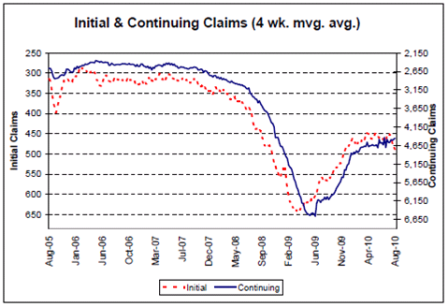
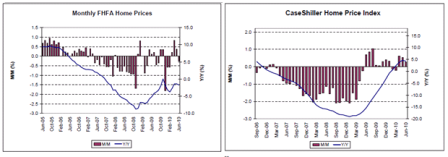
Modest recoveries from the lows and leveling off.

Continued modest improvement from the lows

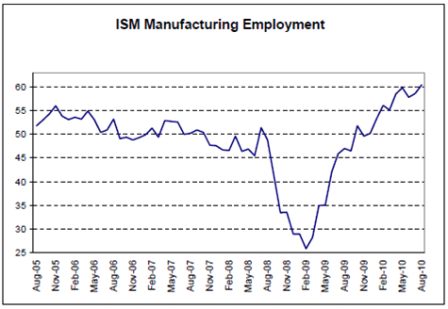
Manufacturing, the smaller component of GDP, led from very low levels

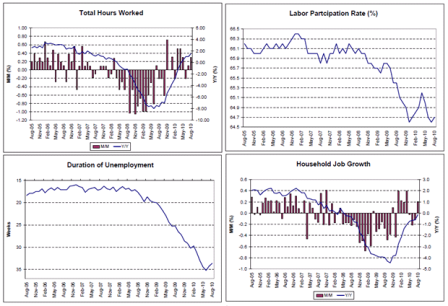
Looking very L shaped.

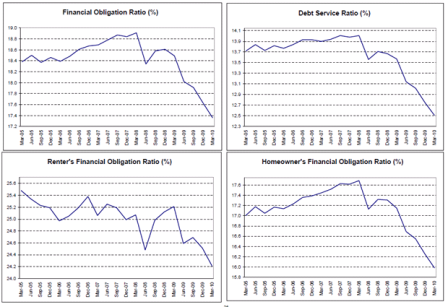
These are March numbers, June should be out soon and show further balance sheet repair as deficit spending continues are relatively high levels, adding income and net financial assets to the non govt. sectors.

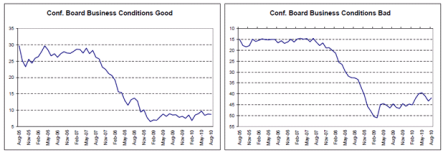
Lots of signs of leveling off at modest levels of top line growth.

Waiting for the handoff to private sector credit expansion as balance sheets repair, or another fiscal adjustment.

GS Skinny: The Administration’s New Fiscal Proposals
(CLEARED FOR EXTERNAL USE)

September 7, 2010

The White House has announced three new measures to stimulate growth: 100% up-front depreciation of capital investments; a permanent and slightly expanded R&D tax credit; and $50 bn in infrastructure spending. They could be helpful but are unlikely to have a large effect on growth for four reasons: (1) some of them cover multiple years, spreading out the fiscal impulse; (2) the incremental effect is smaller than the headline numbers imply, as some are modifications of existing proposals or policies and one is essentially an interest free loan; (3) the president proposes offsetting the cost of some of the proposals with targeted corporate tax increases of an equal amount; and (4) the likelihood of enactment of some of these proposals is low.

Key points:

1. Bonus depreciation. The president proposes to allow companies to deduct 100% of the cost of capital investments (not including real estate) made in 2010 and 2011. Press reports cite White House estimates that the proposal would lower corporate tax receipts by $200bn. However, almost all of this revenue loss would be temporary, since the additional deductions taken now would lower deductions in future years, effectively making this an interest free loan. Given current low levels of capacity utilization, the benefit of additional investment is low to begin with. Our previous analysis indicated that the 50% bonus depreciation provision effective for 2008 and 2009 had a relatively small effect on investment. To the extent it does have an effect, it is likely to pull forward demand into the quarter just before expiration (in this case Q4 2011) so the near term effect should be even more modest (and indeed the effect in early 2012 would be negative). Whatever effect the provision would have would also be weakened somewhat by the proposal to raise corporate tax revenues (through closing of “loopholes”) to offset the proposal’s cost.

2. R&D Tax credit. The president is expected to propose to increase and make permanent the research and development tax credit, at a cost of $100bn over ten years. This proposal is somewhat less than meets the eye, since the president has already proposed to make the credit permanent at a cost of $80bn. This leaves an incremental proposal worth around $20bn, or $2bn per year. Nevertheless, enactment of this proposal would be helpful on the margin, since the existing R&D credit lapsed at the end of last year and has yet to be renewed by Congress.

3. Infrastructure. The president proposes to spend $50bn on transportation infrastructure projects, as part of a six-year plan. We take this to mean a front-loading or incremental investment on top of the six-year reauthorization of surface transportation spending programs that has been pending in Congress for most of the year. For context, a $50bn addition to infrastructure spending is roughly on par with the investments made in that sector in the 2009 Recovery Act. If enacted, this could provide an important boost to growth, particularly in 2011. However, the likelihood of enactment in the near term appears low. Also, offsetting the otherwise positive effect is the proposal to offset the entire cost with the repeal of tax incentives for oil and gas companies.

4. Process from here. There are two likely scenarios for consideration of the tax-based measures. First, the Senate will vote on small business legislation next week, which already includes a 50% depreciation bonus for 2010. This provision could simply be modified, to bring it into line with the president’s depreciation proposal, in which case it could be enacted in the next few weeks. The second scenario is that the tax measures could be added to upcoming legislation to extend the expiring 2001/2003 tax cuts, which will be debated in late September. Adding corporate tax cuts to that legislation might allow Democratic leaders to attract enough votes for passage without extending the upper-income tax rates that most Republicans support. However, given that legislation’s uncertain prospects, adding these measures to it could also risk delaying enactment until after the November election. Infrastructure spending would be dealt with separately from the tax measures; the most likely scenario is that it could be considered after the election as part of the next stop-gap extension of the highway program, which expires December 31.

1938 in 2010

1938 in 2010

By Paul Krugman

September 5 (Bloomberg) — Here’s the situation: The U.S. economy has been crippled by a financial crisis. The president’s policies have limited the damage, but they were too cautious, and unemployment remains disastrously high. More action is clearly needed. Yet the public has soured on government activism, and seems poised to deal Democrats a severe defeat in the midterm elections.

The president in question is Franklin Delano Roosevelt; the year is 1938. Within a few years, of course, the Great Depression was over. But it’s both instructive and discouraging to look at the state of America circa 1938 — instructive because the nature of the recovery that followed refutes the arguments dominating today’s public debate, discouraging because it’s hard to see anything like the miracle of the 1940s happening again.

Now, we weren’t supposed to find ourselves replaying the late 1930s. President Obama’s economists promised not to repeat the mistakes of 1937, when F.D.R. pulled back fiscal stimulus too soon. But by making his program too small and too short-lived, Mr. Obama did just that: the stimulus raised growth while it lasted, but it made only a small dent in unemployment — and now it’s fading out.

And just as some of us feared, the inadequacy of the administration’s initial economic plan has landed it — and the nation — in a political trap. More stimulus is desperately needed, but in the public’s eyes the failure of the initial program to deliver a convincing recovery has discredited government action to create jobs.

In short, welcome to 1938.

The story of 1937, of F.D.R.’s disastrous decision to heed those who said that it was time to slash the deficit, is well known. What’s less well known is the extent to which the public drew the wrong conclusions from the recession that followed: far from calling for a resumption of New Deal programs, voters lost faith in fiscal expansion.

Consider Gallup polling from March 1938. Asked whether government spending should be increased to fight the slump, 63 percent of those polled said no. Asked whether it would be better to increase spending or to cut business taxes, only 15 percent favored spending; 63 percent favored tax cuts. And the 1938 election was a disaster for the Democrats, who lost 70 seats in the House and seven in the Senate.

Most interesting!

Then came the war.

From an economic point of view World War II was, above all, a burst of deficit-financed government spending, on a scale that would never have been approved otherwise. Over the course of the war the federal government borrowed an amount equal to roughly twice the value of G.D.P. in 1940 — the equivalent of roughly $30 trillion today.

Had anyone proposed spending even a fraction that much before the war, people would have said the same things they’re saying today. They would have warned about crushing debt and runaway inflation. They would also have said, rightly, that the Depression was in large part caused by excess debt — and then have declared that it was impossible to fix this problem by issuing even more debt.

Agreed! The deficit per se was of no consequence. The risks were and remain inflation from excess demand, which is not an easy channel to use to generate what we call inflation in today’s world. Our CPI problems have tended to come in through the cost channel and propagated by govt indexation of one form or another.

But guess what? Deficit spending created an economic boom — and the boom laid the foundation for long-run prosperity.

Agreed. Though the way I say it, for a given size govt. and given set of credit conditions there is a level of taxes that coincides with full employment, and that level is generally well below the level of govt spending.

Overall debt in the economy — public plus private — actually fell as a percentage of G.D.P., thanks to economic growth and, yes, some inflation, which reduced the real value of outstanding debts. And after the war, thanks to the improved financial position of the private sector, the economy was able to thrive without continuing deficits.

What??? Here, sadly, Paul’s implication that the actual level of the govt debt per se matters, and that his bent that lower deficits are somehow ‘better’ shines through, keeping him in the camp of being part of the problem rather than part of the answer.

(Good article for MMT’s to earn some hearts!)

Obama to Push Tax Break

Hard to believe that a Democratic administration is proposing only support for business and none for consumption.

While it might be an election ploy the fact that it’s been a pattern all along just adds more weight to the notion that this administration is a tool of big business as it works to keep unemployment high and domestic consumption down along the lines of the classic gold standard export model of growth. This notion is further supported by the official goal of doubling exports, and Bernanke stated before Congress a couple of years ago that he prefers exports to domestic consumption (not that anything he does actually matters for that purpose).

News Alert from The Wall Street Journal

President Barack Obama, in one of his most dramatic gestures to business, will propose that companies be allowed to write off 100% of their new investment in plant and equipment through 2011, a plan that White House economists say would cut business taxes by nearly $200 billion over two years.

The proposal, to be laid out Wednesday in a speech in Cleveland, tops a raft of announcements, from a proposed expansion of the research and experimentation tax credit to $50 billion in additional spending on roads, railways and runways.

Reinhart and Reinhart paper

This paper should provide very useful information for those of you trying to determine whether the data shows fiscal policy is effective. (This shows it is)

Carmen and Vince decided only to use govt spending rather than net spending so keep that in mind.

My take is that exiting the gold standard per se does nothing if all nations do it together. Export advantages gained by doing it first are reversed when the rest join in. What exiting the gold standard did do is allow for fiscal expansion otherwise not possible.

Warren,

I don’t know if I ever sent this to you. But I’ve attached an article that Carmen and I published in the Brookings Papers on Economic Activity last year about the Great Depression. The bottom line is that inconsistent fiscal stimulus lengthened the adjustment.

Vincent

From the abstract:

Fiscal policy was also active—most countries sharply increased government spending—but was prone to reversals that may have undermined confidence. Countries that more consistently kept spending high tended to recover more quickly.

And later under fiscal policy:

Although fiscal impetus was forceful in some countries, in almost all it was also erratic. Figure 4 further reveals that each of the three large increases in spending in the United States and Canada was followed by some retrenchment. The impetus from government spending in the United States in 1932, 1934, and 1936 appeared on track to provide considerable lift to the economy, but after each of those years real spending dropped off, imparting an arithmetic drag on expansion. The fact that fiscal expansion has been aggressive in many countries in 2009 works to help contain the contraction in the global economy. That it will continue to do so is far from assured, if history is any guide.

Press Release

MOSLER FOR SENATE

Tea Party’s Economic Agenda Would Cause Next Great Depression
Says Former Tea Party Democrat


Waterbury, CT – August 30, 2010, Warren Mosler, Independent candidate for US Senate, former Tea Party Democrat, and frequent speaker at Tea Party rallies, lashed out today at the political movement for its ill-thought demands to balance the budget which he contends is based on abject ignorance and counter to true Tea Party values. “The Tea Party’s demands to balance the budget and reduce the Federal deficit aren’t merely misguided, but dangerous, and would cause the worst depression in history,” stated Mosler, a financial expert with 37 years of experience in monetary operations. “I have been, and continue to be, a strong supporter of the core Tea Party values of lower taxes, limited government, competitive market solutions, and a return to personal responsibility. However, their proposals to balance the budget are the same suicidal policies that caused the 6 horrible depressions in the U.S. over the past 200 years. At the worst possible time to take money out of the economy, the Tea Party’s proposals would remove an estimated $1 trillion and cause the worst depression in world history, destroying tens of millions of jobs and ruining our children’s future.”

Explanation of the Modern Monetary System
Modern money, after the demise of the gold standard, is akin to a spreadsheet that simply works by computer. As Fed Chairman Bernanke explained on national television on 60 minutes, when the government spends or lends, it does so by adding numbers to private bank accounts. When it taxes, it marks those same accounts down. When it borrows, it simply shifts funds from a demand deposit (called a reserve account) at the Fed to a savings account (called a securities account) at the Fed. The money government spends doesn’t come from anywhere, and it doesn’t cost anything to produce. The government therefore cannot run out of money, nor does it need to borrow from the likes of China to finance anything. To better understand this, think about when a football team kicks a field goal; the number on the scoreboard goes from 0 to 3. Does anyone wonder where the stadium got those 3 points, or demand that the stadium keep a reserve of points in a “lock box”?

Moreover, government deficits ADD to our savings – to the penny – as a fact of accounting, not theory or philosophy. This means the Mosler payroll tax (FICA) holiday will directly increase incomes and savings, thus fixing the economy from the bottom up. For example, if the Mosler tax cut amounts to $20 billion per week, that will be the exact increase in income and savings for the rest of us as anyone in the Congressional Budget Office will confirm. For the Federal government, taxes don’t serve to collect revenue but are more like a thermostat that controls the temperature of the economy. When it is too hot, raising taxes will cool it down. And in this ice-cold economy, a very large tax cut is needed to warm the economy back up to operating temperature.

While Mosler fully supports the Tea Party desire to cut taxes, and recognizes the need to cut wasteful and unnecessary spending – in fact, his economic proposals will save the government hundreds of billions of dollars of unnecessary interest expense – he also recognizes that tax cuts have to be much larger than spending cuts in order to ensure that less money is taken out of the economy, and not more as the Tea Party is currently demanding.

About Warren Mosler
Warren Mosler is running as an Independent. His populist economic message features: 1) a full payroll tax (FICA) holiday so that people working for a living can afford to buy the goods and services they produce. 2) $500 per capita Federal revenue distribution for the states 3) An $8/hr federally funded job to anyone willing and able to work to facilitate the transition from unemployment to private sector employment. He has also pledged never to vote for cuts in Social Security payments or benefits. Warren is a native of Manchester, Conn., where his father worked in a small insurance office and his mother was a night-shift nurse. After graduating from the University of Connecticut (BA Economics, 1971), and working on financial trading desks in NYC and Chicago, Warren started his current investment firm in 1982. For the last twenty years, Warren has also been involved in the academic community, publishing numerous journal articles, and giving conference presentations around the globe. Mosler’s new book “The 7 Deadly Innocent Frauds of Economic Policy” is a non technical guide to the actual workings of the monetary system and exposes the most commonly held misconceptions. He also founded Mosler Automotive, which builds the Mosler MT900, the world’s top performance car that also gets 30 mpg at 55 mph.
Learn more at www.moslerforsenate.com


Media Contact:
Will Thompson
(267) 221-6056
will@hedgefundpr.net

Bernanke speech


Karim writes:

  • Very substantive speech from Bernanke
  • Message is basically, ‘growth has slowed more than we expected’ BUT ‘conditions are ALREADY in place for a pick-up’ and if we are wrong, we are ready to take action, which contrary to some perceptions, will be effective


Yes, contrary to my opinion. This about managing expectations. With falling inflation and unemployment this high it makes no sense that they would be holding back something that could make a material difference.

  • To me, they lay out very credible factors for a pick-up in growth.


Agreed.

  • The risk of either an undesirable rise in inflation or of significant further disinflation seems low-THIS LINE ARGUES AGAINST ANY NEAR-TERM ACTION


Again, if they did have anything that would substantially increase agg demand they’d have done it.

  • When listing available options for further action if needed, he clearly favors further ‘credit easing’ relative to the other choices. He states why they reinvested in USTs vs MBS.


Yes, and, again, it’s doubtful lower credit spreads will do much for the macro economy but would shift a lot of credit risks to the Fed for very little gain.

  • Selected excerpts in italics, with key comments in bold.

FRB: Bernanke, The Economic Outlook and Monetary Policy

At best, though, fiscal impetus and the inventory cycle can drive recovery only temporarily.

That is not correct. Fiscal adjustment can sustain demand at any politically desired level.

For a sustained expansion to take hold, growth in private final demand–notably, consumer spending and business fixed investment–must ultimately take the lead. On the whole, in the United States, that critical handoff appears to be under way.

Agreed that hand off is slowly materializing and private sector debt expansion will then drive additional growth. But sustained expansion could come immediately from a fiscal adjustment as well.

However,although private final demand, output, and employment have indeed been growing for more than a year, the pace of that growth recently appears somewhat less vigorous than we expected.

Agreed.


Among the most notable results to emerge from the recent revision of the U.S. national income data is that, in recent quarters, household saving has been higher than we thought–averaging near 6 percent of disposable income rather than 4 percent, as the earlier data showed.

Non govt net savings of financial assets = govt deficit spending by identity, and with foreign sector savings relatively constant, the majority of the increase is in the domestic economy, either businesses or households.

That means in general household savings goes up with the deficit regardless of the level of consumer spending.

However, when household savings does start to fall, it’s due to household credit expansion, at which time, if the deficit is unchanged, the savings of financial assets is shifted to either the business or the foreign sector.

And, as growth accelerates, the automatic fiscal stabilizers- increased federal revenues and falling transfer payments- reduce the deficit and therefore reduce the growth in the total net savings of the other sectors.

So the hand off process is usually characterized by the federal deficit falling as private sector debt expands to ‘replace it.’

This continues until the private sector again necessarily gets over leveraged, ending the expansion.

3 On the one hand, this finding suggests that households, collectively, are even more cautious about the economic outlook and their own prospects than we previously believed.

At best his means that he thinks with this much savings households would start leveraging more.


But on the other hand, the upward revision to the saving rate also implies greater progress in the repair of household balance sheets. Stronger balance sheets should in turn allow households to increase their spending more rapidly as credit conditions ease and the overall economy improves.

Yes, as I explained. He seems to understand the sequence of the data but doesn’t seem to be quite there on the causation.

Going forward, improved affordability–the result of lower house prices and record-low mortgage rates–should boost the demand for housing. However, the overhang of foreclosed-upon and vacant housing and the difficulties of many households in obtaining mortgage financing are likely to continue to weigh on the pace of residential investment for some time yet

Yes, which is a traditional source of private sector credit expansion, along with cars, that drives the process.

Generally speaking, large firms in good financial condition can obtain credit easily and on favorable terms; moreover, many large firms are holding exceptionally large amounts of cash on their balance sheets. For these firms, willingness to expand–and, in particular, to add permanent employees–depends primarily on expected increases in demand for their products, not on financing costs.

I couldn’t agree more!
Employment is primarily a function of sales as discussed in prior posts.

Bank-dependent smaller firms, by contrast, have faced significantly greater problems obtaining credit, according to surveys and anecdotes. The Federal Reserve, together with other regulators, has been engaged in significant efforts to improve the credit environment for small businesses. For example, through the provision of specific guidance and extensive examiner training, we are working to help banks strike a good balance between appropriate prudence and reasonable willingness to make loans to creditworthy borrowers. We have also engaged in extensive outreach efforts to banks and small businesses. There is some hopeful news on this front: For the most part, bank lending terms and conditions appear to be stabilizing and are even beginning to ease in some cases, and banks reportedly have become more proactive in seeking out creditworthy borrowers.

Another problem is that the regulators are forcing small banks to reduce what’s called ‘non core funding’ in a confused strategy to enhance small bank ‘deposit stability.’ Unfortunately, at the local level the regulators have interpreted the rules to mean, for example, it’s better for a small bank’s financial stability to fund, for example, a 3 year business loan with 1 year local deposits, vs funding it with a 5 year advance from the Federal Home loan bank. It’s also a fallacy of composition, as at the macro level there aren’t enough core deposits to fund local small businesses, as many larger corporations and individuals use money center banks and leave their deposits with them. The regulatory insistence on small banks using ‘core deposits’ rather than ‘wholesale funding’ recycled from the larger banks causes a shortage of local deposits and forces the small banks to pay substantially higher rates as they compete with each other for funding artificially limited by regulation.

In lieu of adding permanent workers, some firms have increased labor input by increasing workweeks, offering full-time work to part-time workers, and making extensive use of temporary workers.

Yes, and when you include this growth in employment the economy is doing better than most analysts seem to think.

Like others, we were surprised by the sharp deterioration in the U.S. trade balance in the second quarter. However, that deterioration seems to have reflected a number of temporary and special factors. Generally, the arithmetic contribution of net exports to growth in the gross domestic product tends to be much closer to zero, and that is likely to be the case in coming quarters.

Also, part of the hand off will be US consumers going into debt (reducing savings) to buy foreign goods and services, which increases foreign sector savings of financial assets.

Overall, the incoming data suggest that the recovery of output and employment in the United States has slowed in recent months, to a pace somewhat weaker than most FOMC participants projected earlier this year. Much of the unexpected slowing is attributable to the household sector, where consumer spending and the demand for housing have both grown less quickly than was anticipated. Consumer spending may continue to grow relatively slowly in the near term as households focus on repairing their balance sheets. I expect the economy to continue to expand in the second half of this year, albeit at a relatively modest pace.

Agreed.

Despite the weaker data seen recently, the preconditions for a pickup in growth in 2011 appear to remain in place.

Agreed.

Monetary policy remains very accommodative,

Yes, for many borrowers, but the lower rates have also net reduced incomes. QE alone resulted in some $50 billion of ‘profits’ transfered to the Treasury from the Fed that would have been private sector income, for example.

and financial conditions have become more supportive of growth, in part because a concerted effort by policymakers in Europe has reduced fears related to sovereign debts and the banking system there.

Agreed.

Banks are improving their balance sheets and appear more willing to lend.

Agreed, though via a reduction in interest earned by savers that’s gone to increased net interest margins for banks.

Consumers are reducing their debt and building savings, returning household wealth-to-income ratios near to longer-term historical norms.

Yes, ‘funded’ by the federal deficit spending.

Stronger household finances, rising incomes, and some easing of credit conditions will provide the basis for more-rapid growth in household spending next year.

Yes, and that basis is credit expansion.

On the fiscal front, state and local governments continue to be under pressure; but with tax receipts showing signs of recovery, their spending should decline less rapidly than it has in the past few years. Federal fiscal stimulus seems set to continue to fade but likely not so quickly as to derail growth in coming quarters.

Yes, and traditionally matched or exceeded by private sector credit expansion as above.

Recently, inflation has declined to a level that is slightly below that which FOMC participants view as most conducive to a healthy economy in the long run. With inflation expectations reasonably stable and the economy growing, inflation should remain near current readings for some time before rising slowly toward levels more consistent with the Committee’s objectives. At this juncture, the risk of either an undesirable rise in inflation or of significant further disinflation seems low. Of course, the Federal Reserve will monitor price developments closely.

The channels through which the Fed’s purchases affect longer-term interest rates and financial conditions more generally have been subject to debate.

With the debate subsiding as more FOMC participants, but far from all of them, seem to be coming to understand the quantity of the reserves per se has no consequences.

I see the evidence as most favorable to the view that such purchases work primarily through the so-called portfolio balance channel, which holds that once short-term interest rates have reached zero, the Federal Reserve’s purchases of longer-term securities affect financial conditions by changing the quantity and mix of financial assets held by the public. Specifically, the Fed’s strategy relies on the presumption that different financial assets are not perfect substitutes in investors’ portfolios, so that changes in the net supply of an asset available to investors affect its yield and those of broadly similar assets. Thus, our purchases of Treasury, agency debt, and agency MBS likely both reduced the yields on those securities and also pushed investors into holding other assets with similar characteristics, such as credit risk and duration. For example, some investors who sold MBS to the Fed may have replaced them in their portfolios with longer-term, high-quality corporate bonds, depressing the yields on those assets as well.

This is evidence Bernanke himself has come around to the understanding that the quantity of reserves at the Fed per se is of no further economic consequence.

We decided to reinvest in Treasury securities rather than agency securities because the Federal Reserve already owns a very large share of available agency securities, suggesting that reinvestment in Treasury securities might be more effective in reducing longer-term interest rates and improving financial conditions with less chance of adverse effects on market functioning.

Again, it shows the understanding that QE channel is price (interest rates) and not quantities.
This is a very constructive move from understanding indicated in prior statements.

Also, as I already noted, reinvestment in Treasury securities is more consistent with the Committee’s longer-term objective of a portfolio made up principally of Treasury securities. We do not rule out changing the reinvestment strategy if circumstances warrant, however.

In particular, the Committee is prepared to provide additional monetary accommodation through unconventional measures if it proves necessary, especially if the outlook were to deteriorate significantly. The issue at this stage is not whether we have the tools to help support economic activity and guard against disinflation. We do. As I will discuss next, the issue is instead whether, at any given juncture, the benefits of each tool, in terms of additional stimulus, outweigh the associated costs or risks of using the tool.

Notwithstanding the fact that the policy rate is near its zero lower bound, the Federal Reserve retains a number of tools and strategies for providing additional stimulus. I will focus here on three that have been part of recent staff analyses and discussion at FOMC meetings: (1) conducting additional purchases of longer-term securities, (2) modifying the Committee’s communication, and (3) reducing the interest paid on excess reserves. I will also comment on a fourth strategy, proposed by several economists–namely, that the FOMC increase its inflation goals.

In my humble opinion those tools carry no risk and provide no reward to the macro economy.

NPR explains where govt spending comes from

How To Spend $1.25 Trillion

By David Kestenbaum and Chana Joffe-Walt

Aug 26 (NPR) — In the face of the financial crisis, the Federal Reserve decided to buy $1.25 trillion of mortgage-backed bonds as part of its effort to prop up the economy.

It was a huge departure from ordinary policy — such an extraordinary departure, in fact, that it was easy to forget that somebody had to actually go out and buy all those mortgages.

This week, we visited the New York Fed to learn the story of how the central bank spent so much money, so fast.

In late 2008, Julie Remache got a call from her former employer, the New York Fed. She was working in the private sector, and the call came while she was at the office. She recognized the extension, and knew someone from the Fed was calling her. So she took the call in a conference room.

The guy on the other end of the phone was Richard Dzina, a senior VP at the New York Fed. His offer: Your job, should you choose to accept it, is to spend hundreds of billions of dollars and try to save the economy

“How could I say no?” Remache says.

The New York Fed is a big, fancy place — lots of marble, a vault full of gold in the basement. But Remache and her team worked in a plain room with four small cubicles. There were no marble floors or oak tables. Just a Nerf football net, a table-tennis trophy, and two yoga balls.

The team spent six weeks coming up with a plan of attack, and 15 months actually buying mortgage-backed bonds, all of which came with a government guarantee that they’d be paid back even if the borrowers defaulted.

The program’s intent was to keep interest rates low, and slow the decline in housing prices. The team ended up buying more than a fifth of all of the government-backed bonds on the market.

“It’s possible I was buying the mortgage on my own house,” says Nathaniel Wuerffel. “Very possible.”

In the end, they came very, very close to their target: They told us they were just 61 cents short. (In other words, they bought $1,249,999,999,999.39 worth of mortgage-backed bonds.)

The Fed was able to spend so much money so quickly because it has a unique power: It can create money out of thin air, whenever it decides to do so. So, Dzina explains, the mortgage team would decide to buy a bond, they’d push a button on the computer — “and voila, money is created.”

The thing about bonds, of course, is that people pay them back. So that $1.25 trillion in mortgage bonds will shrink over time, as they get repaid. Earlier this month, the Fed announced that it will use the proceeds from the mortgage bonds to buy Treasury bonds — essentially keeping all that newly created money in circulation.

The decision was a sign that the Fed thinks the economy still needs to be propped up with extraordinary measures. More clues about what the Fed may do next could come Friday, when Ben Bernanke is scheduled to address a big annual meeting of central bankers in Jackson Hole.

U.K. Economy Grows Most Since 2001 on Construction

Right, how can it not with a 12% type deficit?

U.K. Economy Grows Most Since 2001 on Construction

By Scott Hamilton

Aug. 27 (Bloomberg) — The U.K. economy expanded faster
than previously estimated in the second quarter in the biggest
growth spurt since 2001 as companies rebuilt stocks and
construction work surged.
Gross domestic product rose 1.2 percent from the previous
three months, the Office for National Statistics said today in
London. That was higher than the 1.1 percent initial estimate,
which was the median forecast of 25 economists in a Bloomberg
News survey. On the year, the economy expanded 1.7 percent.
Britain’s growth pickup may deepen the divide among policy
makers as the Bank of England considers whether the economy
faces a greater threat from inflation or needs more stimulus to
avert a further recession. The pound declined after the report,
which showed slower services growth than previously estimated
and a drop in fixed investment.
“The third quarter looks like it’s started pretty well,”
James Knightley, an economist at ING Financial Markets, said in
a telephone interview. “Momentum can be continued into the next
few months,” though “we should be looking at growth being
subdued over the coming years and that could raise the prospect
of further stimulus rather than a withdrawal.”
The pound fell more than 0.2 percent against the dollar
after the data were published. The currency traded at $1.5504 as
of 9:47 a.m. in London. The yield on the benchmark two-year
government bond was down 2 basis points today at 0.618 percent.

Budget Squeeze

The U.K. faces the biggest budget squeeze since World War
II, which has undermined consumer confidence. Ed Balls, a
candidate for the leadership of the U.K.’s opposition Labour
Party, said today that the government’s plans to cut the budget
deficit immediately risk pushing Britain back into recession.
At the same time, a debt crisis threatens the recovery in
the euro region, the U.K.’s largest trading partner, and there
are signs the global recovery is cooling.
The U.S. economy probably grew at a 1.4 percent annualized
pace in the second quarter, slower than the 2.4 percent rate
projected last month, according to the median forecast of 81
economists surveyed by Bloomberg. That would be the slowest
growth since the second quarter of 2009 when the economy was
still contracting. That data will be released later today.

Construction Surge

The U.K. GDP figure was revised up after construction
expanded faster than previously estimated, rising 8.5 percent on
the quarter, the most since 1982. Inventories rose by 983
million pounds ($1.5 billion) in the first evidence of stock-
building by companies for seven quarters, the statistics
office’s report showed.
Consumer spending rose 0.7 percent and government
expenditure increased by 0.3 percent, the statistics office
said. That offset a 2.4 percent drop in fixed investment.
Growth in services, which account for about three quarters
of the economy, was revised down to 0.7 percent from 0.9
percent, the statistics office said. Faster expansion in
business services was outweighed by a drop in air transport
during a quarter when European airspace was disrupted by an ash
cloud caused by volcanic activity in Iceland.
The “breakdown of GDP shows that the recovery is built on
very fragile foundations,” said Samuel Tombs, an economist at
Capital Economics Ltd. in London. “Household and government
spending did both post solid rises, but both sectors are very
unlikely to maintain such growth rates as the fiscal squeeze
kicks in over the coming quarters.”
In a separate report, the statistics office said that
business investment fell by 1.6 percent from the previous
quarter. On the year, it increased by 1.9 percent.