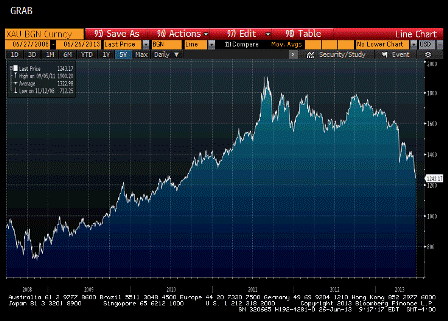
Steve Moore’s WSJ piece

My old buddy Stevie still up to making a nice living by spewing propaganda he knows is at best misleading and subversive.

Yes, the year end tax hikes (where was anti tax Stephen when FICA was let to expire? Wasn’t his guys getting taxed, maybe?) and spring sequesters reduced the deficit.

But I know Stevie knows the federal deficit = the net $ financial assets of the (global) economy, to the penny, as per our extensive discussion in the 1990’s, when he was earning his ‘conservative’ spin stripes at CATO. In fact, he agreed with all I stated, including the fact that privatization of Social Security is at best a ‘wheel spin’ that changes nothing in the macro economy, apart from ‘redistributing’ govt liabilities and equity ownership. But that’s another story. Point here is, he’s shamelessly intellectually dishonest, and proud of it, all the way to the bank.

Anyway, he knows full well the fall off in the federal deficit represents an equal reduction in the addition to the stock of savings of $ net financial assets and income to the economy, and has been responsible for removing maybe 2% of real output from GDP, and all the ‘negative externalities’ as they are politely called that goes with suppressing aggregate demand in the face of mass unemployment.

And he knows, if pressed, that if deficit reduction exceeds the economy’s ‘borrowing to spend’ it all goes into reverse. He even knows full well how the automatic fiscal stabilizers work to reverse an expanding economy via their reduction of the federal deficit. And, of course, he knows the entire federal debt is nothing more than a glorified ‘reserve drain’ that functions to support interest rates, and operationally has nothing to do with ‘funding’, and that ‘paying it off’ just means switching the same dollar balances at the Fed from what are called ‘securities accounts’ (tsy secs) to reserve accounts, with no grandchildren or taxpayers in sight.

This is not ‘innocent fraud.’
It’s subversion for profit.

And that’s my story and I’m sticking to it.

:(
(feel free to distribute)

The Budget Sequester Is a Success

By Stephan Moore

August 11 (WSJ) — The biggest underreported story out of Washington this year is that the federal budget is shrinking and much more than anyone in either party expected.

Consider the numbers: According to the Congressional Budget Office, annual outlays peaked at $3.598 trillion in fiscal 2011. After President Obama’s first two years in office, many in Washington expected that number to hit $4 trillion by 2014. Instead, spending fell to $3.537 trillion in fiscal 2012, and is on pace to fall below $3.45 trillion by the end of this fiscal year (Sept. 30). The $150 billion budget decline of 4% is the first time federal expenditures have fallen for two consecutive years since the end of the Korean War.

This reversal from the spending binge in 2009 and 2010 began with the debt-ceiling agreement between Mr. Obama and House Speaker John Boehner in 2011. The agreement set $2 trillion in tight caps on spending over a decade and created this year’s budget sequester, which will save more than $50 billion in fiscal 2013.

As long as Republicans don’t foolishly undo this amazing progress by agreeing to Mr. Obama’s demands for a “balanced approach” to the 2014 budget in exchange for calling off the sequester, additional expenditure cuts will continue automatically. Those cuts are built into the current budget law.

In other words, Mr. Obama has inadvertently chained himself to fiscal restraints that could flatten federal spending for the rest of his presidency. If the country sees any normal acceleration of economic growth (from the anemic 1.4% growth rate so far this year), the deficit is on a path to drop steadily at least through 2015. Already the deficit has fallen from its Mount Everest peak of 10.2% of gross domestic product in 2009, to about 4% this year. That’s a bullish six percentage points less of the GDP of new federal debt each year.

Admittedly, this fiscal progress follows the gigantic budget blowout that began with the last year of George W. Bush’s presidency and the first two years of Mr. Obama’s. In fiscal 2009 alone, federal spending surged by $600 billion. That same year, outlays as a share of GDP reached a post-World War II high of 25.2%. But by the end of this fiscal year, outlays as a share of GDP could fall to as low as 21.5%. At least for now, the great Washington spending blitz of the Obama first term is over.

Some $80 billion of the outlay savings have come from one-time partial repayments back to the government for the hundreds of billions spent on the bailouts of banks and of Fannie Mae and Freddie Mac. And defense hawks won’t be happy that at least half of the fiscal retrenchment has been due to cuts in military spending. The defense budget is on a pace to hit its lowest level (as a share of GDP) since the days of the post-Cold War “peace dividend” during the Clinton years. These deep cutbacks could be dangerous to national security, but as the wars in Afghanistan and Iraq were winding down, defense would have been cut under any scenario. To their credit, at least Speaker Boehner and House Republicans have made sure that the defense drawdown has gone toward deficit reduction—instead of being spent on domestic social-welfare programs, as happened after the Vietnam War.

The sequester cuts in annual budgets for the military, education, transportation and other discretionary programs have also been an underappreciated success, with none of the anticipated negative consequences.

Discretionary spending soared to $1.347 billion in fiscal 2011, according to the CBO, but was then cut by $62 billion in 2012 and another $72 billion this year. That’s an impressive 10% shrinkage. And these are real cuts, not pixie-dust reductions off some sham baseline. Discretionary spending as a share of the economy hit 9.4% of GDP in fiscal 2010 but fell to 7.6% this year and is scheduled to slide to 6.4% in Mr. Obama’s last year in office.

The sequester is squeezing the very programs liberals care most about—including the National Endowment for the Arts, green-energy subsidies, the Environmental Protection Agency and National Public Radio. Outside Washington, the sequester is forcing a fiscal retrenchment for such liberal special-interest groups as Planned Parenthood and the National Council of La Raza, which have grown dependent on government largess.

But the fiscal story isn’t all rosy. The major entitlements remain on autopilot and are roaring toward insolvency. Thanks in large part to Mr. Obama’s aversion to practical fixes, the Congressional Budget Office calculates that through July of this year Social Security, Medicare and Medicaid spending are up $73 billion from just last year. This doesn’t include ObamaCare, which is scheduled to add $1 trillion of new costs over the next decade.

So the fiscal progress reported here is no excuse for complacency. But it does call into question the wisdom of a government-shutdown confrontation over the budget this fall or a debt-default showdown that runs the risk of suspending the spending caps and sequester and revitalizing an increasingly irrelevant president.

Liberals had hoped that re-electing Mr. Obama, the most pro-spending president since LBJ, would unleash another four years of Great Society government expansion. Instead, spending caps and the sequester are squashing these progressive dreams. Welcome to the new fiscal reality in Washington. All Republicans need to do is enforce the budget laws Mr. Obama has already agreed to. Entitlement reforms will come when liberals realize that the unhappy alternative is to allow every program they cherish to keep shrinking.
Bernanke


Karim writes:

Something for everyone (even uses on the other hand in his remarks); base case remains in place for tapering in September. First mention Ive seen on nature of rate hike cycle: will be gradual. Seems to be looking past the first hike!

Sequencing in these paragraphs is telling. Base case first; risks second(bold). Same pattern appeared in the Minutes. Effective way to stick to your forecast but to try and keep rates in check.

  • substantial increases in home prices are bolstering household finances and consumer spending while reducing the number of homeowners with underwater mortgages. Housing activity and prices seem likely to continue to recover, notwithstanding the recent increases in mortgage rates, but it will be important to monitor developments in this sector carefully.
  • The price index for personal consumption expenditures rose only 1 percent over the year ending in May. This softness reflects in part some factors that are likely to be transitory. Moreover, measures of longer-term inflation expectations have generally remained stable, which should help move inflation back up toward 2 percent. However, the Committee is certainly aware that very low inflation poses risks to economic performance–for example, by raising the real cost of capital investment–and increases the risk of outright deflation. Consequently, we will monitor this situation closely as well, and we will act as needed to ensure that inflation moves back toward our 2 percent objective over time.
  • The pickup in economic growth projected by most Committee participants partly reflects their view that federal fiscal policy will exert somewhat less drag over time, as the effects of the tax increases and the spending sequestration diminish. The Committee also believes that risks to the economy have diminished since the fall, reflecting some easing of financial stresses in Europe, the gains in housing and labor markets that I mentioned earlier, the better budgetary positions of state and local governments, and stronger household and business balance sheets. That said, the risks remain that tight federal fiscal policy will restrain economic growth over the next few quarters by more than we currently expect, or that the debate concerning other fiscal policy issues, such as the status of the debt ceiling, will evolve in a way that could hamper the recovery. More generally, with the recovery still proceeding at only a moderate pace, the economy remains vulnerable to unanticipated shocks, including the possibility that global economic growth may be slower than currently anticipated.

Same for Tapering:

  • If the incoming data were to be broadly consistent with these projections, we anticipated that it would be appropriate to begin to moderate the monthly pace of purchases later this year. And if the subsequent data continued to confirm this pattern of ongoing economic improvement and normalizing inflation, we expected to continue to reduce the pace of purchases in measured steps through the first half of next year, ending them around midyear. At that point, if the economy had evolved along the lines we anticipated, the recovery would have gained further momentum, unemployment would be in the vicinity of 7 percent, and inflation would be moving toward our 2 percent objective. Such outcomes would be fully consistent with the goals of the asset purchase program that we established in September.
  • I emphasize that, because our asset purchases depend on economic and financial developments, they are by no means on a preset course. On the one hand, if economic conditions were to improve faster than expected, and inflation appeared to be rising decisively back toward our objective, the pace of asset purchases could be reduced somewhat more quickly. On the other hand, if the outlook for employment were to become relatively less favorable, if inflation did not appear to be moving back toward 2 percent, or if financial conditions–which have tightened recently–were judged to be insufficiently accommodative to allow us to attain our mandated objectives, the current pace of purchases could be maintained for longer. Indeed, if needed, the Committee would be prepared to employ all of its tools, including an increase the pace of purchases for a time, to promote a return to maximum employment in a context of price stability.
  • 6.5% threshold and first mention (that Ive seen) on the pace of rate hikes

  • if a substantial part of the reductions in measured unemployment were judged to reflect cyclical declines in labor force participation rather than gains in employment, the Committee would be unlikely to view a decline in unemployment to 6-1/2 percent as a sufficient reason to raise its target for the federal funds rate. Likewise, the Committee would be unlikely to raise the funds rate if inflation remained persistently below our longer-run objective. Moreover, so long as the economy remains short of maximum employment, inflation remains near our longer-run objective, and inflation expectations remain well anchored, increases in the target for the federal funds rate, once they begin, are likely to be gradual.

stocks bonds qe dynamics

Until markets recognize QE for the tax that it actually is, the QE policy is stabilizing for stocks, destabilizing for bonds.

For example, good economic news is fundamentally good for stocks, but means QE may end, so the effects are offsetting.

Same with bad economic news. Fundamentally bad, but means QE continues, so offsetting.

Bonds are different. Good econ news is fundamentally bad for bonds and means QE may end, both negatives. And bad econ news is fundamentally good for bonds, and means QE continues, also good.

GDP Revision

And Q1 was the bounce back from the 0.4% Q4 print?

So now seems the govt deficit reduction happened in the face of even lower levels than previously thought?

And so the question remains of which agents are going to step up and fill that spending gap, as the ‘demand leakages’ are continuous?


Karim writes:

  • The downward revision was due to PCE services; commercial real estate was revised lower but the contribution from residential real estate was revised higher.
  • The ‘surprise’ was due to the fact that details on PCE services don’t come out until tomorrow
  • Of the 20bn downward revision in PCE services, 15bn was from housing services

From SMR:

We wonder whether the downward revision to the PCE for Housing Services was in the “imputed services rendered by owner occupied housing”. If so such may speak to Chairman Bernanke’s comment during the Q&A following the FOMC meeting wherein he said that the deflator for the imputed portions of the PCE may be too low. We will have a better handle on this tomorrow.

Away from the PCE for Services, there were only minor offsetting revisions, not really worthy of comment

What does the downward revision to Q1 GDP and Q1 PCE for Services imply for Q2 GDP?

Bill Gross – Fed tapering plan may be hasty:

I agree with a lot of this

‘Mortgage originations have plummeted by 39% since early May.’

The Fed’s financial obligations ratios have turned up as well.

But it’s not about QE in any case

It takes private credit expansion or net exports to overcome fiscal drag.

Bill Gross: Fed tapering plan may be hasty

By William H. Gross

June 25 (Bloomberg) — “June Gloom,” as the fog and clouds that often linger over the Southern California coast this time of year are known, appears to have spread to the Federal Reserve. At his press conference last week, Fed Chairman Ben Bernanke said the central bank may begin to let up on the gas pedal of monetary stimulus by tapering its asset purchases later this year and ending them in 2014.

We agree that QE must end. It has distorted incentives and inflated asset prices to artificial levels. But we think the Fed’s plan may be too hasty.

Fog may be obscuring the Fed’s view of the economy—in particular, the structural impediments that will inhibit its ability to achieve higher growth and inflation. Bernanke said the Fed expects the unemployment rate to fall to about 7% by the middle of next year. However, we think this is a long shot.

Bernanke’s remarks indicated that the Fed is taking a cyclical view of the economy. He blamed lower growth on fiscal austerity, for example, suggesting that should it be removed from the equation the economy would suddenly be growing at 3%. He similarly attributed rising housing prices to homeowners who simply like or anticipate higher home prices, as opposed to emphasizing the mortgage rate, which is really what provided the lift in the first place.

Our view of the economy places greater emphasis on structural factors. Wages continue to be dampened by globalization. Demographic trends, notably the aging of our society and the retirement of the Baby Boomers, will lead to a lower level of consumer demand. And then there’s the race against the machine; technology continues to eliminate jobs as opposed to provide them.

Bernanke made no mention of these factors, which we think are significant forces that will prevent unemployment from reaching the 7% threshold during the next year. Falling below “NAIRU” (the non-accelerating inflation rate of unemployment—usually estimated between 5% and 6%) is an even more distant goal.

Indeed, the Fed’s views on inflation may be the foggiest of all. Bernanke said the Fed sees inflation progressing toward its 2% objective “over time.” At the moment, we’re nowhere near that.

The Fed’s plan strikes us as a bit ironic, in fact, because Bernanke has long-standing and deep concerns about deflation. We’ve witnessed this in speeches going back five or 10 years—the “helicopter speech,” the references not only to the Depression but to the lost decades in Japan. He badly wants to avoid the mistake of premature tightening, as occurred disastrously in the 1930s. Indeed, on several occasions during his press conference, Bernanke conditioned his expectations of tapering on inflation moving back toward the Fed’s 2% objective.

The chairman, of course, may be equally concerned about the market effects of tapering and determined to signal its moves early. However, as the spike in interest rates shows, this path is fraught with danger, too.

We’re in a highly levered economy where households can’t afford to pay much more in interest expense. Monthly payments for a 30-year mortgage have jumped 20% to 25% since January. Mortgage originations have plummeted by 39% since early May.

High levels of leverage, both here and abroad, have made the global economy far more sensitive to interest rates. Whereas a decade or two ago the Fed could raise the fed funds rate by 500 basis points and expect the economy to slow, today if the Fed were to hike rates or taper suddenly, the economy couldn’t handle it.

All this suggests that investors who are selling Treasurys in anticipation that the Fed will ease out of the market might be disappointed. If inflation meanders back and forth around the 1% level, Bernanke may guide the Committee towards achieving not only an unemployment rate but also a higher inflation target.

It’s reasonable, of course, for Bernanke to try to prepare markets for the inevitable and necessary wind down of QE. But if he has to wave a white flag three months from now and say, “Sorry, we miscalculated,” the trust of markets and dampened volatility that has driven markets over the past two or three years could probably never be fully regained. It would take even longer for the fog over the economy to lift.

last update from Rome, home tomorrow

Markets remain in ‘QE off’ mode, with stocks down and longer term rates up.

‘QE on’ was a misguided speculative bubble in any case, as QE is, at best, a placebo, and in fact somewhat of a tax as it removes a bit of interest income.

But obviously global markets view it as a massive stimulus, as per the various market responses.

The real economy, however, continues to suffocate from a too small US federal budget made even smaller by the proactive tax hikes and spending cuts.

Yes, there is some private sector credit expansion trying to fill the ‘spending gap’ caused by the fiscal tightening, but all that and more is needed to keep it all growing in the face of the ongoing automatic fiscal stabilizers that make it an ‘uphill’ battle for the forces of non govt credit expansion.

So seems to me this all leads to lower equity prices as prospects for earnings and growth fade, and, at some point, lower bond yields as expectations for Fed rate hikes are pushed further into the future by the economic reality.

I also look for confidence readings, one of the few ‘bright spots’, to fade with the equity sell off as well.

And, at some point, ‘QE on’ ceases to matter, under the ‘fool me once…’ theory???

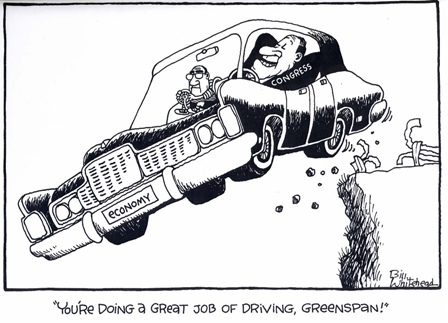
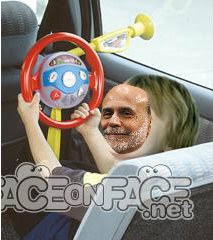
And should that happen, and the Fed be exposed as ‘the kid in the car seat with the toy steering wheel who everyone thinks is driving’, no telling what happens…

ADP

Continuing evidence of deceleration.

A 150,000 jobs print Friday puts the 3 month average back to around where it was when the Fed expanded QE due last year due to cliff fears, etc.

So with CPI also weak, at least for now the Fed continues to fail on both its mandate targets. Seems the FOMC doesn’t yet appreciate the power of the interest income channels, as expanded QE means that much more interest income is being removed from the economy.

And the ‘government getting out of the way’ means less ‘free income’ for the economy, meaning increased domestic ‘borrowing to spend’/’dipping into savings’ for all practical purposes is the only way to ‘jump the gap’ of reduced govt deficit spending and sustain output and employment.

In other words, the risk is that the already narrowing govt deficit was proactively made too small to support the current domestic credit structure.

And if so, market forces work to increase govt deficit spending/restore required private sector net financial assets the ugly way- falling revenues and increased transfer payments, aka the automatic fiscal stabilizers.

Much like we’ve seen in the euro zone, the UK, Japan, etc. etc. etc. etc. etc.

ADP graph

ADP reports 135,000 private-sector jobs created in May, vs. estimate of 165,000

By Jeff Cox

June 5 (CNBC) — Private-sector job creation was weaker than expected in May, as the economy struggled to break free of what appears to be a summer slowdown on the horizon.

ADP and Moody’s Analytics reported just 135,000 new positions for the month, below expectations of 165,000.

Services were responsible for all the new jobs, adding 138,000, while the goods-producing sector lost 3,000 positions.

Construction added 5,000 workers, but that was offset by a loss of 6,000 manufacturing jobs.

The poor showing sets the stage for a possibly weak nonfarm payrolls report on Friday, when the Labor Department had been expected to show 169,000 new jobs.

Economists sometimes will use the ADP numbers to adjust their estimates for the government account, even though the private-sector count has been a historically unreliable gauge.

“The job market continues to expand, but growth has slowed since the beginning of the year,” Moody’s economist Mark Zandi said in a statement.

Financial markets offered muted reaction to the report, with stock market futures off their lows. Investors have been using the weak economic reports to fuel hopes that the Federal Reserve will continue with its aggressive easing program.

The Fed is creating money to buy $85 billion in Treasurys and mortgage-backed securities each month.

Recently, some members have suggested that the central bank begin easing its purchases, and markets in turn have been unsettled as interest rates have climbed and equities have been volatile.

A weak payrolls number Friday could go a long way toward squelching talk that the Fed will begin tapering purchases as soon as this month.

“As far as the tapering debate goes, the report does nothing to bolster expectations that the Fed will ease its foot off the pedal over the summer,” Andrew Wilkinson, chief market economist at Miller Tabak, said in a note.