20 billion euro ECB weekly buy isn’t nothing

While not my first choice for public policy,
the 20 billion euro ECB bond buying isn’t nothing.
It’s something over $1.3 trillion per year at current exchange rates.

At the macro level it sort of funds the entire euro zone deficit spending.
And deficits are currently reasonable high.

So, even while recognizing that timing is everything,
the solvency issue could be in the process of stabilizing as the various ‘new’
‘E’ funding proposals and IMF come closer to fruition.

Not that the euro economy will boom anytime soon
as austerity measures take their toll,
but that ‘leg 2’ of the relief rally could be in progress.

The ‘fiscal compact’ details?

As expected, it’s all about fiscal responsibility which they believe is the cure for their funding issues.

Their actual economic problem is a shortage of aggregate demand and their response continues to be measures to reduce
aggregate demand further.

All efforts are focused on funding being conditional on further austerity.

As previously suggested, it’s better thought of as the Sarcophagus plan:

The letter attached signed by Sarkozy and Merkel appears to contain the details of the new measures addressed to EU President Herman van Rompuy.

“Mr President,

To overcome the current crisis, all necessary measures to stabilize the euro area
as a whole will have to be taken. We are confident that we will succeed.

We are convinced that we need to reinforce the architecture of Economic and
Monetary Union going beyond the indispensable measures which are urgently
needed to cope with immediate crisis resolution. Those steps need to be taken
now without further delay. We consider this as a matter of necessity, credibility and
confidence in the future of Economic and Monetary Union.

The current crisis has uncovered the deficiencies in the construction of EMU
mercilessly. We need to remedy those deficiencies. To build a lasting Stability and
Growth Union which allows us to preserve our unique European model combining
economic success and social responsibility, we have to substantially reinforce
the foundations of EMU. Alongside the single currency, a strong economic pillar
is indispensable, building on enhanced governance to foster fiscal discipline as
well as stronger growth and enhanced competitiveness. In order to achieve these
objectives, we need a renewed contract between the Euro area Member States.
This conviction is the driving-force behind our proposal.

We need more binding and more ambitious rules and commitments for the Euro
area Member States. They should reflect that sharing a single currency means
sharing responsibility for the Euro area as a whole. They should pave the way for
a new quality of cooperation and integration within the Euro area.

We propose that those new rules and commitments should be enshrined in the
European Treaties as. Alternatively , the Member States whose currency is the
Euro will have to go ahead. In that case, we would ensure that those Member
States willing and able to do so would be able to join and the European institutions
would play an important role. We would also work towards bringing this new
agreement into the framework of the European Union as soon as possible.

The main building blocks of the new Stability and Growth Union are:

A strengthened institutional architecture

Euro area governance needs to be substantially reinforced. We should provide for
a more integrated and more efficient institutional set-up without duplicating existing
European structures or institutions. This set-up should be based on:

•Regular summits – at least twice a year – of the Euro area heads of State
and Government with a permanent president. These summits will provide
strategic orientations on the economic and fiscal policies in the euro area.
The impact of our domestic economic and fiscal policies on the euro area
should be considered as a matter of common interest, while safeguarding
national responsibility.
• During the crisis, the Eurosummit should meet on a monthly basis: each
meeting should focus on a precise agenda regarding governance and
policies to foster growth, competitiveness and fiscal stability. Member
States having signed the Euro Plus Pact will be invited to participate to the
discussions on issues related to it.

• A ministerial Eurogroup and a reinforced preparatory structure to prepare
and implement the decisions taken by the summit and ensuring the current
functioning.

This framework will be fully consistent with the EU institutional architecture. We
strongly reaffirm our willingness to fully associate the European Commission.
The European Parliament and national Parliaments should also be involved in an
adequate way.

A comprehensive framework of prevention

It is undoubtedly in the interest of all members of the Stability and Growth Union to
detect and correct departures from sound economic and fiscal policies long before
they become a threat to the stability of the Euro area as a whole. Therefore, we
need a comprehensive framework on prevention consisting of strengthened co-
ordination, surveillance and enforcement as well as positive incentives, building
on current arrangements (new macroeconomic imbalances procedure, EU 2020-
Strategy, Euro Plus Pact, a greater focus of structural- and cohesion funds on
competitiveness etc.) and developing them further.

This framework should comprise in particular:

the adoption by each euro area member state of rules on a balanced
budget translating the objectives and requirements of the Stability and
Growth Pact into national legislation at constitutional or equivalent level.
A new legal provison should set minimum requirements for the national
rules on balanced budgets. The European Court of Justice, on request of
the European Commission or a Euro area Member State, should have the
possibility to verify the transposition in the national legislation.

Commitment of national Parliaments to take into account recommendations
adopted at the European level on the conduct of economic and budgetary
policies.

We need to foster growth through greater competitiveness as well as greater
convergence of economic policies at least amongst Euro Area Member States.
To these aims, building on Article 136 and/or on enhanced cooperation, a new
common legal framework, fully consistent with the internal market, should be
established to allowing for faster progress in specific areas such as :
– Financial regulation;

24
…24

-3-

Labor markets;
Convergence and harmonisation of corporate tax base and creation of a
financial transaction tax;
Growth supporting policies and more efficient use of European funds in the
euro area.


A reinforced procedure to enforce sound fiscal policies

To complement the preventive arm of the Stability and Growth Pact and in
particular the goal to achieve a structurally balanced budget and ex-ante
examination of draft budgets, a new procedure should be established to correct
breaches of the 3 % deficit of GDP ceiling.

As soon as a Member State is recognized to be in breach with the 3 % ceiling
by the European Commission, there should be automatic consequences unless
the Eurogroup, acting by qualified majority, decides otherwise. Exceptional
circumstances should be taken into account:

The obligation for the Member State to conclude with the Commission and
approved by the Eurogroup by reversed qualified majority on behalf of the
other Member States, a „European Reform Partnership“ specifying the
concerned Euro area Member States’ fiscal and structural policy measures
to overcome its difficulties and assisting them in those efforts.

A sequence of interventions of increasing intensity into Euro area Member
States’ rights should be allowed as a focussed response to continued
infringement. Steps and sanctions proposed or recommended by the
Commission should be adopted by the Council unless a qualified majority of
the Euro area Member States decides otherwise.

Buiding on the provisions for a numerical benchmark for debt reduction in the “six-
pack” (1/20 rule), the procedure for debt reduction by Euro area Member States
with a public debt of more than 60 % of GDP needs to be enshrined in the new
treaty provisions.

A permanent crisis resolution mechanism

We will accelerate the setting of the permanent intergovernmental European
Stability Mechanism which should be effective in 2012 to better address any future
threats to the stability of the Eurozone as a whole, including through the risk of
contagion for other Euro area Member States, thus assisting them in situations of
emergency.

In order to maximize the efficiency of the ESM and its capacity to take decisions,
specific super majority rules (85 % of signed ECB-Capital) should be implemented.

As far as the private-sector involvement is concerned, the ESM treaty should be
revised to make clear that Greece required a unique and exceptional solution. We

34
…34

-4-

recall that all other Euro area Member States reaffirm their inflexible determination
to honour fully their own individual sovereign signature. A recital in the preamble
should clarify that the euro area will apply the IMF practice. As agreed, common
terms of reference on CACs shall be introduced in national legislations.

***

On the occasion of the 50th anniversary of the Treaties of Rome we reiterated
solemnly together with all Member States of the European Union our resolve
to protect the achievements of European unification for the good of future
generations. To this end, we committed ourselves to always renewing the political
shape of Europe in keeping with the times. It is in this spirit that we submit our
proposal to our European partners.

We are convinced that we need to act without delay. We need to take a decision
at our next European Council meeting in order to have the new treaty provisions
ready by march 2012.

Angela MERKEL

Nicolas SARKOZY”

Why the EU won’t fix anything this weekend

Yes, the Germans are concerned that ECB bond buying and direct funding might be inflationary,
but there is something even more fundamental supporting their to objection to ECB support.

The problem is,
the EU leaders believe the high rates, failed auctions, and related funding and liquidity issues
are caused by the national government budget deficits being too high.

And therefore the fundamental solution is deficit reduction.
That is, only by reducing deficits,
will the ability to independently fund return to where it was before the 2008 financial crisis hit.

So while they recognize that ECB funding can keep them muddling through,
though with some perceived inflation risk,
they firmly believe it is deficit reduction that will allow them to return to pre 2008 funding dynamics,
where each member nation could independently fund itself in the market place at reasonable rates.

Unfortunately, that’s a bit like saying that by adjusting his financial ratios,
Bernie Madoff’s fund could return to pre crisis business as usual.

And just like Bernie could only be back in business if somehow he got
the Fed to guarantee his investors against loss,
the way I see it (but, unfortunately, not the way they see it),
the euro member nations now require ECB backing, directly or indirectly,
to be back in business.

As previously discussed, spending and deficits for currency issuers like the US, Japan, UK,
and the euro members when they had their own currencies are not constrained by income or
market forces. Observed debt to GDP levels for currency issuers can be anywhere from
50% to maybe 200%, as they serve to provide the net financial assets demanded by the
various institutional structures of those nations. And regardless of debt ratios, interest rates
are necessarily set by the Central Banks, and not market forces.

Spending and deficits for currency users, including the US states, businesses, households, and the euro member nations since
adopting the euro, are, however, necessarily constrained by income and market forces.
That’s why observed deficits for currency users are far lower than currency issuers.
California, for example, has seen its financing difficulties even though it’s debt to GDP ratio is under 5%.

Luxembourg’s debt to GDP ratio of about 15% when it adopted the euro was by far the lowest of the euro member nations.
And that’s because Luxembourg never did have it’s own currency. It was always a currency user,
and so market forces never let it’s debt get any higher than that. And even with the current financial crisis
Luxembourg’s debt is only about 20% of GDP.

So what happened about 13 lucky years ago is that the currency issuers of mainland Europe decided to turn themselves into currency users.
And at the same time, now as currency users rather than currency issuers,
simply waltz into the euro zone with their suddenly/absurdly too high existing debt ratios they incurred as currency issuers.

The ‘right’ way to do it back then would have been to have the ECB guarantee their debt from the inception of the euro,
and use the Growth and Stability Pact to avoid moral hazard issues and enforce compliance.
But that would not have worked politically.
The only way they would all come together is the way they did all come together.
The priority was union first, and work out subsequent problems as needed.

So now they have two problems-
a solvency problem where they can’t fund themselves without ECB support,
and a bad economy, now further deteriorating as evidenced by negative growth and rising unemployment.

And while the Germans aren’t entirely wrong in their belief that lower deficits would restore funding capacity,
I don’t think they recognize that as currency users debt to GDP ratios may need to be under 30% to get to that point.

Nor do they recognize that given current private sector credit conditions, deficits and debt ratios need to be higher
to offset the demand leakages (unspent income) inherent in their institutional structures. These include pension contributions,
insurance reserves, corporate reserves, individual retirement plans, and the demand for actual cash in circulation.
This means that what they call austerity- pro active tax increases and spending cuts- will slow the economy and therefore cause
tax revenue to fall and transfer payments to rise to the point where deficits increase rather than decrease.
The only remaining hope for growth is exports, but with all the world doing much the same that channel is not currently open.

So back to the present.

(And yes, without the 2008 financial crisis all of this may not yet have happened.
But it all did happen, and here we are.)

The firm belief is that deficit reduction is what is needed to return to independent funding.
And while funding by the ECB can allow things to muddle through, and hopefully not prove inflationary,
there is no exit from ECB funding and the inherent inflation risk it carries apart from deficit reduction.

Therefore I expect the upcoming discussions to focus entirely around deficit reduction, with little if any discussion of funding.
And, as is currently the case, funding assistance will only come conditionally with accelerated austerity.

That is, all options on the table will only cause a bad economy to get worse.
And all options on the table will tend to drive deficits higher,
which both makes matters worse, and,
as recent history has shown,
triggers demands for more austerity.

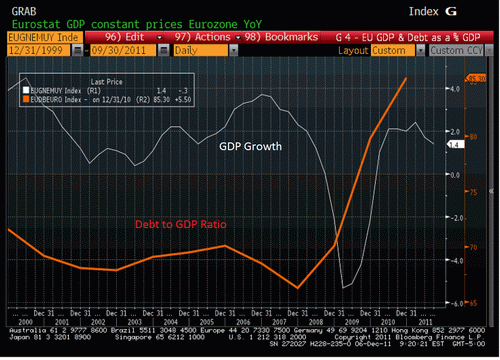
The chart, below, shows how the financial crisis of 2008 caused what seemed to be working just fine on the way up
to come apart when private sector credit expansion faltered, and the economy took a dive, driving up national government
debt to GDP ratios, and causing it all to go bad in typical ponzi fashion.

eu debt gdp

France, Germany to Propose New EU Treaty

They seriously believe that the crisis is all about deficits being too high,
and it all will be and can only be remedied by bringing deficits down.

Therefore they see ECB funding as not solving anything if it doesn’t serve the further purpose of deficit reduction.

Good luck to them, and good luck to us as we’re trying to do the same thing.

:(

France, Germany to Propose New EU Treaty

Published: Monday, 5 Dec 2011 | 10:55 AM ET
By: Reuters with CNBC.com

 
France and Germany have agreed on a series of reforms to address the euro zone sovereign debt crisis that will be presented to EU President Herman Van Rompuy on Wednesday, French President Nicolas Sarkozy said after a meeting with German Chancellor Angela Merkel on Monday.

 
“Things cannot continue as they have done up until today. Our preference is for a treaty among the 27 (EU members), so that nobody feels excluded, but we are open to a treaty among the 17 (euro members), open to any state that wants to join us,” Sarkozy told a press conference following the meeting.

 
“This treaty would contain the following things: We want automatic sanctions in the event of a breach of the rule on deficits below 3 percent (of GDP),” he said.

 
“We want a golden rule that is reinforced and harmonized on the European level so that the budgets of all 17 (euro zone states) have a constitutional rule to ensure that national budgets move toward a return to equilibrium,” Sarkozy added.

 
The French President said the Franco-German agreement would be written up in a letter and presented to (European Council President) Herman Van Rompuy on Wednesday.

 
“We want to make sure that the imbalances which led to the situation in the euro zone today cannot happen again,” he said.

 
Angela Merkel stressed the leaders wanted structural changes which go beyond agreements.

 
“We need binding debt brakes, which can be verified by the European court of Justice … in order for the Stability and Growth Pact to hold,” she said.

 
The Stability and Growth pact lays out the budgetary rules that member states must follow.

 
Berlin and Paris are under unprecedented pressure to see eye to eye in a crisis that has split them on issues such as the role of the European Central Bank in lending to troubled states and on whether the bloc should issue joint euro bonds.

 
“Regarding what we have said about the ECB, nothing has changed. We reject the idea of euro bonds,” Merkel said.

“This package shows that we are absolutely determined to keep the euro as a stable currency and as an important contributor to European stability.”
Top ECB policymakers have been reluctant to buy up debt from distressed euro zone states, as this would take the pressure off governments to get their financial houses in order.

 
But ECB chief Mario Draghi has signaled that a “fiscal compact” produced by the euro zone governments could nudge the bank to act more decisively on the crisis.

 
The hope is that private bondholders will be assured that they are not being singled out by European policymakers for losses, bolstering their confidence in buying euro zone bonds.

 
On Monday, an ECB policymaker described a plan for holders of Greek government debt to take heavy losses had led to a big rise in borrowing costs for other euro zone countries.

 
“It was a terrible mistake,” said ECB Governing Council member Athanasios Orphanides, who is also the Cyprus central bank chief.

 
Cyprus banks are big holders of Greek government debt, the value of which is due to be halved under a new 130 billion euro bailout deal for Athens.

 
In Dublin, Ireland’s government will unveil what it hopes will be the toughest budget of its five-year term, but as it tries to keep the public onside economists are warning that a global downturn means the worst may be yet to come.

 
On Tuesday, the Greek parliament is due to give final approval to a draconian 2012 austerity budget that is a condition for a second bailout package still under negotiation with private creditors, euro zone governments and the IMF.

eu leaders lunching at Élysée Palace

From the NY Times:

The leaders met over lunch at the Élysée Palace to prepare joint proposals to
offer the full membership the European Union in Brussels on Thursday night. They
agreed to propose automatic penalties for countries that exceed European deficit
limits as well as the creation of a monetary fund for Europe. They also backed
monthly meetings of European leaders.

Supporting suspicions it’s all for the further purpose of supporting their lifestyle…

Posted in EU

merkel and fektar on bondholder loss discussions

Forwarded Message

From the WSJ:

“Ms. Merkel signalled on Friday that she is having second thoughts about the wisdom of emphasizing bondholder losses. “We have a draft for the ESM, which must be changed in the light of developments” in financial markets since the Greek-restructuring decision in July, she said after meeting Austria’s chancellor in Berlin.


Austrian Finance Minister Maria Fekter, speaking at a conference in Hamburg on Friday, was more direct. “Trust in government treasuries was so thoroughly destroyed by involving private sector investors in the debt relief that you have to wonder why anyone still buys government bonds at all,” Ms. Fekter said.”

Posted in EU

Dutch PM Mark Rutte Comments

In this crisis of ignorance
the only thing they all agree on
is austerity:

By Jurjen van de Pol
Dec. 2 (Bloomberg) — The Netherlands isn’t in favor of
monetary financing by the European Central Bank to combat the
region’s debt crisis as it may spur inflation and takes away
pressure to reform, Dutch Prime Minister Mark Rutte said.
“Countries that are now forced to reform may get the idea
that there’s no need to reform because the printing press has
been switched on,” Rutte told reporters after the weekly
council of ministers in The Hague today.

MMT to the ECB- you can’t inflate, even if you wanted to

With the tools currently at their immediate disposal, including providing unlimited member bank liquidity,lowering the interbank rate, and buying euro national govt debt, the ECB has no chance of causing any monetary inflation, no matter how hard it might try. There just are no known channels, direct or indirect, in theory or practice, that connects those policies to the real economy. (Note that this is not to say that removing bank liquidity and national govt credit support wouldn’t be catastrophic. It’s a bit like engine oil. You need a gallon or two for the engine to run correctly, but further increasing the oil in the sump isn’t going to alter the engine’s performance.)

Lower rates sure doesn’t do the trick. Just look to Japan for going on two decades, the US going on 3 years, and the ECB’s low rate policies of recent years. There’s not a hint of monetary inflation/excess aggregate demand or inflationary currency weakness from low rates. If anything, seems to me the depressing effect on savers indicates low rates from the CB might even, ironically, promote deflation through the interest income channels, as the non govt sector is necessarily a net receiver of interest income when the govt is a net payer. (See Bernanke, Reinhart, and Sacks 2004 Fed paper on the fiscal effect of changes in interest rates.)

And if what’s called quantitative easing was inflationary, Japan would be hyperinflating by now, with the US not far behind. Nor is there any sign that the ECB’s buying of euro govt bonds has resulted in any kind of monetary inflation, as nothing but deflationary pressures continue to mount in that ongoing debt implosion. The reason there is no inflation from the ECB bond buying is because all it does is shift investor holdings from national govt debt to ECB balances, which changes nothing in the real economy.

Nor does bank liquidity provision have anything to do with monetary inflation, currency depreciation, or bank lending. As all monetary insiders know, bank lending is never reserve constrained. Constraints on banking come from regulation, including capital requirements and lending standards, and, of course credit worthy entities looking to borrow. With the ECB providing unlimited liquidity for the last several years, wouldn’t you think if there was going to be some kind of monetary problem it would have happened by now?

So the grand irony of the day is, that while there’s nothing the ECB can do to cause monetary inflation, even if it wanted to, the ECB, fearing inflation, holds back on the bond buying that would eliminate the national govt solvency risk but not halt the deflationary monetary forces currently in place.

So where does monetary inflation come from? Fiscal policy. The Weimar inflation was caused by deficit spending on the order of something like 50% of GDP to buy the foreign currencies demanded for war reparations. It was no surprise that selling that many German marks for foreign currencies in the market place drove the mark down as it did. In fact, when that policy finally ended, so did the inflation. And there was nothing the central bank could do with interest rates or buying and selling securities or anything else to stop the inflation caused by the massive deficit spending, just like today there is nothing the ECB can do to reverse the deflationary forces in place from the austerity measures.

So here we are, with the ECB demanding deflationary austerity from the member nations in return for the limited bond buying that has been sustaining some semblance of national govt solvency, not seeming to realize it can’t inflate with its monetary policy tools, even if it wanted to.

Post script:

The only way the ECB could inflate would be to buy dollars or other fx outright, which it doesn’t do even when it might want a weaker euro, as ideologically they want the euro to be the reserve currency, and not themselves build fx reserves that give the appearance of the euro being backed by fx.

relief rally musings

The German 10 year just traded above 1.9%.
The 10th plague is now beginning to threaten the Pharaoh.

If I were cynical I’d think it would go down something like this:

First, German insiders give the nod to their cronies.
The Great European Relief Rally begins.
The euro begins to firm, stocks start to rally, etc.
Then, noises start coming out of Germany to the effect that
they might consider ECB support if austerity could be guaranteed,
causing prices to suddenly gap higher as shorts try to cover with no sellers in sight.

Spanish Voters Set to Throw Out Socialists in Election

As previously discussed, there is virtually no political support to leave the euro,
as it’s not intuitively obvious the euro is the problem.

It is intuitively obvious, however, that the problem was irresponsible govt
and so the move towards responsible govt- aka austerity- continues.

The euro economy can be easily ‘fixed’ and in short order.
The ECB can, one way or another, facilitate all funding needs and end the solvency issue.
And the Stability and Growth Pact (SGP) can be modified to allow deficits sufficient to sustain aggregate demand.

Currently Germany continues to be obstructing the elimination of the solvency issue,
even as market forces are now begining to weaken German bonds.
And there are no member nations yet supporting readjusting the SGP to allow higher deficits.

So my best guess is Germany will soon recognize what most of the financial community has recently been voicing- ECB bond buying combined with austerity is not inflationary- opening the door to the ECB bond buying being an EU sanctioned policy of the institutional structure to ensure solvency.

That will trigger a massive ‘relief rally’ that will fade as the reality of the depressing nature of the
austerity takes over.

It could also sideline the discussion of Greek haircuts and default discussion in general.

Spanish Voters Set to Throw Out Socialists in Election

November 20 (Reuters) — Spaniards are expected to throw out the Socialists they blame for a disastrous economic situation in an election on Sunday and to vote in a center-right party likely to dole out more bitter medicine in the form of public spending cuts.

Opinion polls show the People’s Party (PP), led by Mariano Rajoy, has an unassailable lead over the ruling Socialists, who have led the country from boom to bust in seven years in power.

Voters are angry with the Socialists for failing to act swiftly to prevent the economic slide and then for bringing in austerity measures that have cut wages, benefits and jobs.

Yet people are now resigned to further slashes in spending on health and education in the midst of a European debt crisis that has toppled the governments of Ireland, Portugal, Greece and Italy and pushed Spain’s borrowing costs ever higher.