
Why I’m a Deficit Owl
By Chris Barrero
Category Archives: Employment
Huffington Post article
The Certainty of Debt and Taxes – The Fiscal Cliff Burden of Proof
By Warren Mosler
June Employment Data (U.S. and Canada)
Good for stocks and bonds,
Not so good for people, apart from the lower gasoline prices.
Karim writes:
June Employment Data (U.S. and Canada)
U.S.
- Headline payroll growth of 80k in line with other Q2 employment readings and a clear loss of momentum in job gains from Q1.
- The report was a positive from a personal income standpoint, however, as the components of the income equation, Hourly Earnings (+0.3%) and Aggregate Hours (0.4%) were both strong.
- The hours data in particular suggests demand was running at reasonable levels but forward uncertainty may have restrained hiring.
- Weather related sectors did bounce back: Net change in construction of +33k in particular. There may have been some seasonal issues in education as that sector had a net change of -55k.
- Other key metrics were generally stable: The unemployment rate was unchanged at 8.2%, the labor force participation rate was unchanged, the median duration of unemployment fell from 20.1 weeks to 19.8 weeks, and the Diffusion Index dropped from 59.8 to 57.9
- This is the last payroll number before the next Fed meeting. In what should be a close call, Twist 2 will likely be maintained.
Canada
- Very modest growth in employment in June (7.3k). Equivalent to about 75k in the U.S., population-adjusted.
- Y/Y growth in Canadian employment is exactly 1%. Combined with modest productivity growth, current GDP trends appear similar to the U.S., about 1.5-2.0%.
Demand leakages- the 800lb economist in the room
I can’t say I’ve seen anyone in the deficit debates talking about the demand leakages? Not a mention in the mainstream press, financial news media, or any of the thousands of economic reports?
That’s like discussing the right horsepower for a truck or an airplane without any consideration of the weight of the vehicle.
Demand leakages are unspent income. And if any agent doesn’t spend his income, some other agent has to spend more than his income or that much output doesn’t get sold.
And if the non govt sectors collectively don’t spend all of their income, it’s up to the govt to make sure its income is less than its spending, or that much output does’t get sold, which translates into what’s commonly called the ‘output gap’. Which is largely a sanitized way of saying unemployment.
And with the private sector necessarily pro cyclical, the (whopping) private sector spending gap in this economy can only be filled with by govt via either a (whopping) tax cut and/or spending increase, depending on your politics.
So why the ‘demand leakages’? The lion’s share is due to tax advantages for not spending your income, including pension contributions, IRA’s, and all kinds of corporate reserves. Then there’s foreign hoards accumulated to support foreign exporters. And it all should be a very good thing- net unspent income like that means that for a given size govt our taxes can be that much lower. Personally, I’d rather have a tax cut than a policy to get other people to spend their unspent income. But that’s just me…
And then there’s the fear mongering about the likes of the $200 trillion present value of US govt unfunded liabilities. But 0 mention of the present value of all demand leakages- that future income that will be unspent as it’s squirreled away in the likes of retirement plans, corporate reserves, and foreign central banks.
If history is any guide, the demand leakages will probably continue to outstrip even the so called ‘runaway spending of our irresponsible government,’ like they’ve always done in the past, as evidenced by nearly continuous output gaps/excess unemployment.
Worse, every mainstream economist learned that it’s the demand leakages that create the ‘need’ for govt deficits. But somehow fail to even mention it, even casually.
If anything, they voice no objections to the popular misconception that we need more savings to have funds for investment, thereby tacitly supporting the call for higher levels of demand leaks and the need for even higher levels of govt deficit spending.
And all you hear are calls for deficit reduction, both public and private, all in the face of geometrically expanding demand leakages.
Am I missing something?
Greece after math
Looking like it was another ‘buy the rumor sell the news’ near term.
After you do the maths it still doesn’t add up.
It can’t add up.
Ever.
Given today’s institutional structures- pension funds, insurance reserves, etc.- that include massive, tax advantaged, demand leakages where private sector credit expansion is bound to periodically fall short full employment levels. And with the private sector necessarily pro cyclical, counter cyclical fiscal adjustments are, for all practical purposes, entirely in the realm of the issuer of the currency- the ECB, and not the users of the currency- the euro member nations.
In other words, as previously discussed, the maths can’t add up without the ECB, directly or indirectly, writing the check.
And that includes the banking system, which, to serve public purpose, requires credible deposit insurance, again meaning support from the issuer of the currency.
The last few weeks have demonstrated that the ECB does ‘write the check’ for bank liquidity even though it’s not legally required to do that,(and even though some think it’s not acting within legal limits) but it won’t just come out and say it.
And, apart perhaps from the Greek PSI (100 billion euro bond tax), which they still call ‘voluntary’, no government has missed a payment, also with indirect ECB support either through bond buying or via the banking system, but, again, it won’t just come out and say it’s an ongoing policy.
So while the ECB can and has ‘written the check’ as needed, there has been no formal proclamation of any sort that it will continue to do so. Nor does it look like there will be any such over policy announcement for a considerable period of time.
This means any manager of ‘other people’s money’ with any fiduciary responsibility will continue to remain on the sidelines.
And even as markets fluctuate, and then some, underneath it all payments are met on a timely basis and the banking system continues to function to service deposits and loans.
And budget deficits will continue to be deemed too large, (at least until private sector credit expansion exceeds the ‘savings desires’/demand leakages) ensuring the maths don’t ever add up without the assumption of the ECB writing the check.
One last thing.
Publicly, at least, they all still think the problem in the euro zone is that the public debts/deficits are too high. And to reduce debt the member nations need to cut spending and/or hike taxes, either immediately or down the road.
A good economy with rising debt and ECB support to keep it all going isn’t even a consideration.
They’ve painted themselves into an ideological corner.
And deficit spending, exacerbated by austerity, may nonetheless be high enough for it all to muddle through at current (deplorable) levels of economic performance.
This economic ‘torture chamber’ of mass unemployment can, operationally, persist indefinitely, even as, politically, it’s showing signs of coming apart.
The founders of the euro believed a single currency would work to prevent a third great war. So they did what it took politically to get the consensus needed to create the euro. Ironically not realizing what they created to promote unity has turned out to be the instrument of social disintegration.
Pre/post fiscal stimulus chartbook
FYI:
Deficit spending adds that much to non govt income as well as net financial assets, to the penny.
Mike Norman’s pre/post fiscal stimulus chartbook
Output gap update
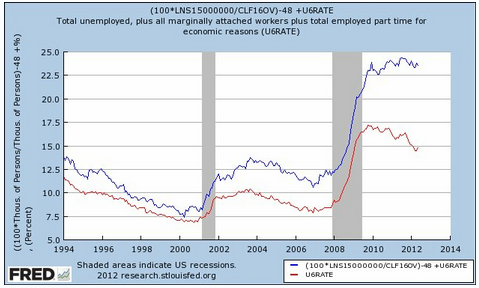
Payrolls: Bleak with 1 Silver Lining
Karim writes:
Payrolls: Bleak with 1 Silver Lining
Highlights
- Most of the key headlines of the survey were weak
- Payrolls up only 69k with net revisions of -49k (April now +77k not 115k)
- Unemployment rate up from 8.1% to 8.2% (labor force up 622k and household survey up 422k)
- Average hourly earnings up 0.1% and index of aggregate hours -0.2%
- Median duration of unemployment up from 19.4 weeks to 20.1 weeks and U6 unemployment rate up from 14.5% to 14.8%
- The silver lining is that the Diffusion Index (# of industries adding jobs less those cutting jobs, indexed on a 0-100 scale) rose from 56 to 59.4
- Downside shifts were heavily concentrated in 3 sectors (Construction -5k to -28k; Retail 27k to 2k; and Business services 37k to -1k)
- Construction and retail (which includes leisure and hospitality) likely reflect the weather payback that Bernanke has highlighted; business services cuts likely reflect the late nature of tax season this year and some of those layoffs may not have taken place until May.
Conclusion
- The diffusion index improvement implies the underlying state of the labor market is somewhat better than the headline; probably in the 125-150k range
- Purely based on the economic data, additional Fed easing is unlikely
- But the worsening of financial conditions via Europe have increased the odds of a continuation of Twist (in its current form) for at least 2-3mths
Not to overlook the increase in the labor force participation rate from 63.6 to 63.8!
And Q2 gdp talk still about 2%.
Still looks to me good for stocks, not so good for people, though lower gasoline prices good for consumers as is weak consumption overseas.
Quick update
US economy muddling through, growing modestly, particularly given the output gap, but growing nonetheless.
Lower crude prices should also help some.
I had guessed the Saudis would hold prices at the $120 Brent level, given their output of just over 10 million bpd showed strong demand
and their capacity to increase to their stated 12.5 million bpd capacity remains suspect. And so with the Seaway pipeline now open (last I heard)
to take crude from Cushing to Brent priced markets I’d guessed WTI would trade up to Brent.
But what has happened is the Saudi oil minister started making noises about lower prices and when ‘market prices’ started selling off the Saudis ‘followed’ by lowering their posted prices, sustaining the myth that they are ‘price takers’ when in reality they are price setters.
So to date, contrary to my prior guess, both wti and brent have sold off quite a bit, and cheaper imported crude is a plus for the US economy. Which is also a plus for the $US, as a lower import bill makes $US ‘harder to get’ for foreigners.
But the trade for quite a while has been strong dollar = weak US stocks due to export pricing/foreign earnings translations, and also because US stocks have weakened on signs of euro zone stress, which has been associated with a weaker euro. So when things seem to be looking up for the euro zone, the euro tends to go up vs the dollar, with US stocks doing better with any sign of ‘improvement’ in the euro zone.
It’s all a tangled case of cross currents, which makes forecasting anything particularly difficult.
Not to mention possible dislocations from the whale, which may or may not have run their course, etc.
And then there’s the news from Greece.
First, they made a full bond payment yesterday of nearly 500 million euro to bond holders who did not accept the PSI discounts. This is confounding for the obvious reasons, signals it sends, moral hazard, credibility, etc. etc. But it’s also a sign the politicians are doing what they think it takes to keep the euro going as the currency of the euro zone. Same goes for the decision to fund Greece as per prior agreements even when there is no Greek govt to talk to, and lots of signs any new govt may not honor the arrangements.
Even if that means tricking private investors out of 100 billion, rewarding those who defy them, whatever. Tactics may be continuously reaching new lows but all for the end of keeping the euro as the single currency.
It also means that while, for example, 10 year Spanish yields may go up or down, the intention is for Spain, one way or another, to fund itself, even if short term. Doesn’t matter.
And more EFSF type discussions. The plan may be to start using those types of funds as needed, keeping the ECB out of it for that much longer, regardless of where longer term bonds happen to trade.
As for the euro zone economy, yes, growth is probably negative, but if they hold off on further fiscal adjustments, the 6%+ deficit they currently are running for the region is probably, at this point, enough to muddle through around the 0 growth neighborhood. The upside isn’t much from there, as with limited private sector credit growth opportunities, and substantial net export growth unlikely, and strong ‘automatic stabilizers’ any growth could be limited by those automatic fiscal stabilizers. Not to mention that this type of optimistic scenario likely strengthens the euro and keeps a lid on net exports as well.
And sad that this ‘bullish scenario’ for the euro zone means their massive output gap doesn’t even begin to close any time soon.
For the US, this bullish scenario has similar limitations, but not quite as severe, so the output gap could start to narrow some and employment as a percentage of the population begin to improve. But only modestly.
The US fiscal cliff is for real, but still far enough away to not be a day to day factor. And it at least does show that fiscal policy does work, at least according to every known forecaster with any credibility, which might open the door to proactive fiscal? Note the increasing chatter about how deficits don’t seem to drive up interest rates? And the increasing chatter about how the US, Japan, UK, etc. aren’t like the euro zone members with regards to interest rates?
Same in the euro zone, where discussion is now common regarding how austerity doesn’t work to grow their economies, with the reason to maintain it now down to the need to restore solvency. This is beginning to mean that if they solved the solvency riddle some other way they might back off on the austerity. And now there is a political imperative to do just that, so things could move in that direction, meaning ECB support for member nation funding, directly or indirectly, which removes the ‘ponzi’ aspect.
Disabled Americans Shrink Size of U.S. Labor Force
And then there’s this:
Disabled Americans Shrink Size of U.S. Labor Force
By Alex Kowalski
May 3 (Bloomberg) — Michael White says he wishes he still could pluck the bass line to Hank Williams Jr.’s “Born to Boogie” and pay bills with money he earns himself. High unemployment — along with ailments that he says render his fingers inoperative and make him cough up blood — have dashed his hopes.
White is among the 1.6 million Americans who’ve claimed Social Security Disability Insurance, or SSDI, since the 18- month recession began in 2007. When the slump reduced demand for tow-truck drivers, the 60-year-old Fort Myers, Florida, resident, who has also worked as a musician, lost the job he’d held for five years and started collecting unemployment benefits.
Complications from chronic obstructive pulmonary disease, or COPD, diabetes and other medical problems then made it impossible for him to return to a labor market that lacks opportunities for people with health problems and those in better shape.
“I can’t stress enough that I’d rather be working, but my health has gotten the worst of me, and any place I would have applied wouldn’t have hired me,” White says.
The number of workers receiving SSDI jumped 22 percent to 8.7 million in April from 7.1 million in December 2007, Social Security data show. That helps explain as much as one quarter of the decline in the U.S. labor-force participation rate during the period, according to economists at JPMorgan Chase & Co. and Morgan Stanley.
Expiring Benefits
The participation rate — the share of working-age people holding a job or seeking one — was 63.8 percent in March after falling to a three-decade low of 63.7 percent in January. Disability recipients may account for as much as 0.5 percentage point of the more than 2 point drop since the end of 2007, the economists calculate, and that contribution could grow when some extended unemployment benefits expire at the end of this year.
“How we measure and understand what’s going on in the economy can be influenced by the degree to which various public- support programs are available and being used,” said Michael Feroli, chief U.S. economist at JPMorgan in New York. “With a rising number of disability beneficiaries, there are both lower unemployment rates and lower participation rates.”
More light may be shed tomorrow on the participation rate, when the Labor Department releases its April payroll report. Employers probably added 160,000 new workers last month, while the jobless rate held at 8.2 percent, according to the median forecasts of economists in Bloomberg News surveys.
Nearing Exhaustion
The White House argued in December that emergency unemployment insurance should be continued, partly because some recipients probably would apply for SSDI as their benefits neared exhaustion. Congress extended the payments in February.
“Workers on SSDI rarely return to the labor force, resulting in a loss to society of the economic contribution those workers could have made,” said the report, which was written by the National Economic Council, Domestic Policy Council, Labor Department and President’s Council of Economic Advisers. “Thus, keeping the long-term unemployed in the labor force should be a priority.”
More than 99 percent of all SSDI beneficiaries remain in the program until retirement age, David Greenlaw, a managing director in New York at Morgan Stanley, wrote in a March research note, citing government data. The program provides an average of $1,111 in monthly income to eligible workers with a physical or mental impairment that will last at least 12 months or result in death, according to Social Security.
Record Applications
The number of people collecting disability surged as the economy contracted, with the share of the U.S. population between the ages of 25 and 64 on SSDI climbing to a record-high 5.3 percent in March from 4.5 percent in 2007. Applications per 1,000 working-age people rose to 18 last year from 8 in 1990.
The gain follows a pattern typical of recessions because Social Security requires that claimants be unable to “engage in any substantial gainful activity,” a stipulation more easily satisfied when jobs are scarce and wages get cut, according to Virginia Reno, vice-president for income security policy at the National Academy of Social Insurance in Washington.
“Impediments to work are compounded for people with disabilities when the economy turns sour and there are simply fewer jobs and greater competition for the jobs that remain,” Reno said. Her group researches the impact of social insurance on economic security.
Unemployment Among Disabled
Unemployment among the disabled rose by 7.6 percentage points to 16.9 percent — in August 2009 and June 2011 — from 9.3 percent in June 2008, when the government began tracking the data. The comparable measure for healthy people climbed 4.8 points to a peak of 10.4 percent in January 2010.
White’s weekly income fell to about $800 as the recession struck, even though he often worked every day, from as much as $2,000 when the towing business was booming, he says. As towing jobs contracted nationally to 48,300 in 2010 from a peak of 52,800 in 2008, he was laid off and filed for unemployment insurance in September 2009, receiving about $1,200 a month.
Meanwhile, White says his health deteriorated: His COPD morphed into emphysema, he was diagnosed with diabetes, his fingers began to ache from neuropathy and he obtained a breathing device to combat sleep apnea. The former bass player for cover band Boston Post Road no longer could hold his guitar.
White says he routinely searched for eight to 10 jobs a week, more than required to keep his unemployment benefits, and would have taken any available position so long as his health permitted. No opportunities came up in the tight labor market, and anticipating his unemployment would run out, he applied for SSDI. He says he was approved in about five months.
Difficult Decision
The decision to go on disability can be difficult for people who’ve lost their job and then realize their health prevents them from working, said Sean Libby, vice president of corporate development at Freedom Disability, the advocacy company that helped White obtain SSDI. Unemployment insurance requires that applicants search for job opportunities, while disability insurance requires they be unable to work.
“You’re trying to make something gray into something black and white by saying, ‘On this date I woke up and I could no longer work,’” Libby said.
That gray area may be working to the advantage of some unemployed, according to economists David Autor at the Massachusetts Institute of Technology in Cambridge and Mark Duggan at the University of Pennsylvania’s Wharton School in Philadelphia. Because SSDI awards have soared even as the health of Americans has improved, SSDI “appears in practice to function like a nonemployability insurance program for a subset of beneficiaries,” they wrote in a 2006 research paper.
Lax Screening Procedures
Less-stringent screening procedures, more attractive benefits and a waning need for less-skilled workers have bolstered SSDI rolls, they said. In addition, “difficult-to- verify disorders,” including muscle pain and mental illness, more easily qualify for SSDI under program reforms, Autor wrote in a 2011 paper. The aging baby-boom population, changes in Americans’ health conditions and the entry of women into the workforce weren’t the driving forces behind the gain in SSDI, Autor wrote.
Kia Green, a Social Security spokeswoman, hadn’t responded to an e-mail request for comments as of 7:30 p.m. yesterday.
Based on current trends, 7 percent of the nonelderly adult population could be receiving disability benefits by 2018, Richard Burkhauser and Mary Daly wrote in the spring issue of the Journal of Policy Analysis and Management. That’s two years after the SSDI program will run through its trust fund, according to an April report by the Social Security trustees.
Costs Increase
Costs have increased with the rolls: The program spent $132 billion last year, more than twice as much as in 2000. Once the trust fund dries up, the program’s incoming revenue will be enough to cover only about 80 percent of scheduled benefits, the trustees said.
To help reduce the strain on the system and make it possible for more disabled people to remain in the labor force, Burkhauser, a policy professor at Cornell University in Ithaca, New York, and Daly, associate research director at the Federal Reserve Bank of San Francisco, argued SSDI should be modified. They said raising taxes on businesses with a larger share of employees on SSDI would provide an incentive for these companies to offer the employees better accommodations and rehabilitation programs that prolong their ability to work.
The current program, which assumes that disability and employment are “mutually exclusive” is “both archaic and fiscally unsustainable,” they said. “Fundamental reforms, if done well, can lower projected long-term costs for taxpayers, make the evaluative tasks of disability administrators less difficult and, importantly, improve the short- and long-run opportunities of people with disabilities.”