Mosler for Congress update

I sent the following to my international audience looking to a return to prosperity
for all of us, which I now send along to you here in the USVI to keep you well informed!

(note that ‘closing the output gap’ means ‘eliminating unemployment’)

They have known me for a very long time and have been most supportive:

First let me thank all of you who have contributed, and have become part of what could quickly become much more than just another seat in Congress!!!

Donations have exceeded $25,000 and at only $25/minute for radio and TV adds the incremental spending has indeed made a difference- thanks again!

There are three weeks to go an any additional contributions will immediately be used to add to the advertising and promotional efforts.

When I ask our volunteers ‘out of ever 10 people they speak to in their neighborhoods, how many say they are voting for me’ they all say more than half!

Friday in St. Thomas while walking to a UVI event I heard a loud ‘Mosler!’ and looked over to see a patrol car with the window down and the officer looking at me. As soon as I turned his way he said ‘Everyone’s voting for you this time, you’re going to win you know!’

I’ve been in 5 ‘debates’ so far, with the candidates on a panel taking questions from a moderator. I’ve just focused on what I’m going to do about each issue, both for the national economy and the USVI economy, while the other candidates have had no specific agenda apart from promising to work hard (and taking cheap shots at each other, of course!)

More and more the audiences seem to be responding with ‘your the only one who knows what to do’. And the ‘anti incumbent’ feeling in general is actually alarmingly high as conditions here continue to deteriorate. Our cost of electricity, for example, just went up to over 50 cents/kw, while government salaries that were already half the national average were cut 8%, with thousands of lost jobs due to the closing of the Hovensa refinery here on St. Croix and widespread government layoffs of nurses and teachers in an already grossly under served community.

I assure you that if I get in Washington will soon be aware of the hurricane that’s come up from the USVI. The Fed chairman will suddenly face ‘innocent’ questions of profound magnitude, such as, ‘Isn’t true that a $trillion deficit adds exactly that much to global dollar net savings, and not a penny less or a penny more, or these two gentlemen next to me from the CBO would have stay late at work looking for their arithmetic mistake?’ ‘Isn’t it true, that by your own regulatory standards, loans to the ECB collateralized with euro deposits would be classified as unsecured loans?’ ‘Given that you do the actual spending on behalf of Congress simply by crediting accounts, and therefore ability to pay, insolvency, and prior funding for Congress, unlike for Greece, is never an issue, and, again unlike Greece, for all practical purposes the Fed sets US interest rates by voting and not the market, what then, is the short term or long term risk posed by deficit spending? And many more. And with all of these questions serving the agendas of various members of Congress there is every incentive for them to be asked. And not to mention testimony and discussions on banking, budgets, and trade. Looking forward to gettng the job done/close the output gap!!!

If any of you want to contribute to ‘THE CAUSE’ remember the limit is $2,500 per person and checks can be made out to ‘Mosler For Congress 2012’.

You can also click here or paypay and further information.

All the best!!!

Warren
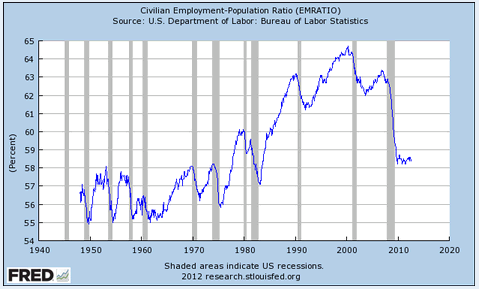
employment report


Karim writes:

In the FAQ section of the BLS website:
Why are there two monthly measures of employment?

The household survey and establishment survey both produce sample-based estimates of employment and both have strengths and limitations. The establishment survey employment series has a smaller margin of error on the measurement of month-to-month change than the household survey because of its much larger sample size. An over-the-month employment change of about 100,000 is statistically significant in the establishment survey, while the threshold for a statistically significant change in the household survey is about 400,000. However, the household survey has a more expansive scope than the establishment survey because it includes the self-employed, unpaid family workers, agricultural workers, and private household workers, who are excluded by the establishment survey. The household survey also provides estimates of employment for demographic groups

Other features of the HH survey are that it is MUCH more volatile and it is also never revised.

Last 3mths of data:         Jul   Aug      Sep       Avg
HH Survey                     -195k  -119k  +873k +186k
Establishment Survey +181k  +142k +114k +145k

So despite often showing opposite signs month to month, over time these series tend to send the same message.

In terms of the data yesterday, a big chunk of the gains in the HH Survey came in part-time employment and in the 16-24 age group. One explanation is many students who went back to school also picked up jobs.

Fed Impact
First, count me as among those who think there is 0 chance these numbers were manipulated. For the Fed, for the reasons the BLS explains above, they look at both indicators, though they favor the payroll survey due to its greater sample size. Bigger picture the two indicators both tell a story of modest improvement in the labor market. Not the ‘significant’ improvement the Fed is looking for. The quirkiness of the monthly data is also why they have a tough time with specific numerical objectives on the unemployment rate, instead favoring the ‘we’ll tell you when we get there’ approach. So full steam ahead for QE3, especially as we journey closer to the edge of the fiscal cliff.

The Concord Coalition Honors Rep. Schwartz’s Leadership on Fiscal Issues

On Sep 22, 2012 8:31 AM, “Art Patten” wrote:

Dear Congresswoman,

As always, we appreciate your hard work and everything you do for your constituents. But I can’t bring myself to congratulate you on the award from the Concord Coalition, an organization that unwittingly works to undermine public purpose.

Like so many organizations, economists, politicians, and citizens, the Coalition fails to recognize that, as one writer recently put it, ‘Everything changed in 1973 [when President Nixon ended the Bretton Woods monetary system], except the economic textbooks.’

We are no longer on the gold standard. The U.S. government doesn’t ‘owe’ anybody, inside or outside the country, anything but U.S. dollars, which it is the monopoly supplier of.

In our current monetary system, the relevance of the federal deficit is its role in supporting aggregate demand. Whether the deficit is large enough is reflected in GDP growth and the unemployment rate. Inflation, although terribly difficult to measure with accuracy (and probably chronically overstated, in my view), indicates when fiscal deficits are too large.

The Coalition and many other groups witness the large budget deficits of recent years and imagine that the federal government faces the same constraints as any household, business, or state or municipal government. But that simply isn’t the case. The monopoly supplier of U.S. dollars can run deficits indefinitely. And if those other sectors of the economy want dollars to save, invest, or spend (and if other countries want to sell us stuff), they all need the U.S. government to run optimally sized deficits.

Unfortunately, the imaginary concept of a real budget constraint is reflected in harmful economic myths such as the inevitability of ‘crowding out’ and higher interest rates, and the inter-temporal government budget constraint; myths that both parties have elevated to high policy dogma. As a result, the Coalition and others urge us to gnash teeth and rend garments in response to large federal deficits, due to the draconian fiscal future we are supposedly imposing on our children and grandchildren. Many very smart people believe in this narrative. However, in our current monetary system, it is nothing more than the collective imagination run wild.

The real burden we are imposing on future generations (and today’s lower and middle classes) is not some future date with the fiscal pied piper, but long-term and completely unnecessary opportunity costs, due in large part to the myth that we must reduce and limit federal deficits. Millions of households are earning less than their combined talents are truly worth as underemployment remains mired at 1930s levels. Our public infrastructure continues to deteriorate. There’s still much more we can do for veterans and the needy. The list goes on. And by any of those metrics, the current federal deficit remains too small. That means either federal tax revenue is too high or spending too low, and the Coalition and other groups like them are misguidedly placing the highest priority on what should be among our least important concerns today.

Sincerely,
Art Patten
Jenkintown, PA

P.S. I’m attaching “Seven Deadly Innocent Frauds” by Warren Mosler. You can also find it online here. It is a quick but powerful read, and one that you could get through in a single train trip to Washington. As a member of a household that has been periodically underemployed since at least 2008, (and overtaxed when we’re fully employed! :)) I implore you to give it a look. Warren is running for Congress in the USVI this fall. He’s a wonderful guy, and if all goes well, perhaps you two can sit down and talk about this stuff next year. Best regards.

Mafin 2012 Genova, Italy presentation

Very good!
One suggestion, in caps:

In reality, BECAUSE AN OVERDRAFT AT A CENTRAL BANK *IS* A LOAN FROM THAT CENTRAL BANK, central banks have no option other than supplying the amount of reserves banks require to settle payments through standard operations, bilateral lending, or intra-day overdrafts.

Yet, it can unilaterally set the interest rate on reserves borrowing and reserves holding.

Revising the quantity theory of money in a financial balance approach

JPM Household wealth report

The unemployment line is the evidence the federal deficit is too small given conditions.
This at least partially explains why the full employment deficit is much larger this time around:

From JP Morgan:

Executive Summary

Households lost $16 trillion worth of wealth during the crisis from late 2007 to early 2009, but they have recovered 70% of the loss since then.

However, the recovery has been uneven across wealth groups. The wealth of the top 10% has fallen back to 2004 levels, but median wealth has fallen back to 1992 levels, in real terms.

As a result wealth inequality has increased sharply after the crisis, which may have some effect on the upcoming elections.

Across age groups, the 25- to 44-year old group has experienced the most significant wealth losses after the crisis. This has been primarily due to house price declines, as younger households are more leveraged in housing.


House prices are not expected to revert back to pre crisis levels in real terms for a very long time. If younger households decide to rebuild their lost housing wealth, this will have long term growth implications.

We estimate that the 25- to 44-year old group has lost $2 trillion housing wealth and rebuilding this lost wealth over 10 years implies that GDP growth will be 1.3 %-pt less than it otherwise would be.

This may explain the slow demand growth we have experienced following the crisis.

September FOMC Preview and fiscal cliff comments


Karim writes:
September FOMC Preview

Its hard to remember going into an FOMC meeting with as wide a range of outcomes and as wide an array of views on those outcomes from markets and economists.

In play:

  • Do nothing
  • Extend forward guidance (to what date?)
  • Cut IOER
  • Unsterilized asset purchases
    • Open-Ended, or defined amount and time period?
    • MBS and/or USTs?

My own, relatively low conviction, view is that they only extend forward guidance, to mid-2015, from the list above. I think there is a 40% probability they announce new LSAPs that would run concurrently with the end of Twist2. If they do additional LSAPs, I think there is a 40% they are open-ended in nature. If they do additional LSAPS (defined amount), I think it will be a 400bn program over 6mths made up of 75% MBS and 25% USTs. The odds of a cut in IOER would around 25% in my view.

Assuming extending forward guidance is a done deal, as hinted in the minutes, here are some of the pro’s and cons in terms of gauging the likelihood of additional asset purchases.

Pros

  • The term ‘monetary’ accommodation used in the last Minutes suggests more than just forward guidance is being considered: Many members judged that additional monetary accommodation would likely be warranted fairly soon unless incoming information pointed to a substantial and sustainable strengthening in the pace of the economic recovery.
  • Bernanke used the term ‘grave concern’ at Jackson Hole to describe the state of the labor market and the last payroll report looked lousy.
  • He defended the use of QE at Jackson Hole, so if the outlook remains weak, why not do more?

Because he doesn’t want to pick a fight with China again, as per my May 2011 post.

Cons

  • The Fed states that policy works through financial channels and with most borrowing rates near record lows, and equity markets near 4yr highs, those channels are working well right now. Why mess with success?


Yes, he knows it’s about rates, not quantities, and that policy has caused the term structure of rates to be where it is. However, the channel that remains elusive is how low rates are transmitted to aggregate demand, claims of creating 3 million jobs not withstanding.

  • The outlook hasn’t changed much since June when they announced Twist2, so why act now?
  • Its 2mths before the election and the Fed is only a side campaign issue now. For an institution that craves it independence, why do anything that may risk that?

Open-ended purchases would likely be tied to the forecast (i.e., ‘the Fed will buy 150bn/mth of MBS and USTs until the Committee is able to forecast meeting its mandate within its forecast horizon’). The issue is the Fed doesn’t have a common forecast (it takes an average of 17 members to produce the SEP). That common forecast is a work in progress (a Committee headed by Yellen). So an open-ended program may take place, but probably not until next year.

Odds of an IOER cut are low just because Bernanke did not mention it at all at Jackson Hole.

About three months ago I suggested the fiscal cliff was too far away for markets to care.
But now it’s a lot closer, and close enough for those to be affected directly by govt spending cuts to be acting accordingly.

But that also means that at least some of that cliff is already being discounted which means:

It won’t be as bad as expected if it happens.
If it’s avoided there will be a boost to the economy not in current forecasts.

August Payrolls-Stall Speed


Karim writes:

Very poor job data with a gain of only 96k and a net revision of -41k. Somewhat offsetting is the 0.2% drop in the unemployment rate from 8.3 to 8.1% (which along with April 2012 is the lowest since January 2009). The biggest swing (and miss) was manufacturing employment, which shifted from a gain of 23k to a fall of 15k, indicating that global economic weakness is affecting U.S. exporters. Indicators of domestic demand fared better as trade swung from a gain of 11k to 29k jobs, finance from -2k to +7k, and leisure/hospitality from 28k to 34k.
 
Though August payroll data is typically revised higher, the data affirms the notion the economy is hovering around or just below trend growth of 2-2.5%.
 
The data increases the chances of QE3, unsterilized and possibly open-ended purchases of Agency MBS and USTs, but I still think later in the year. An open-ended program likely requires a consensus Fed economic forecast, which is still a work-in-progress. Next week’s FOMC meeting will be contentious, and a close call, however.
 
Other data highlights:

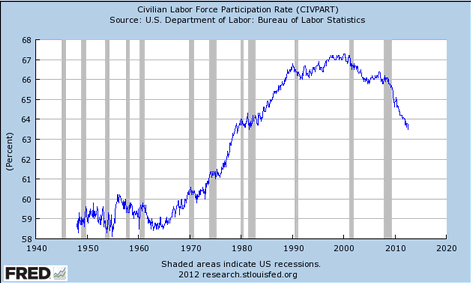
  • The drop in the unemployment rate came as a result of a drop in the participation rate from 63.7% to 63.5% (labor force fell by 368k).
  • The U6 measure improved from 15% to 14.7%, but the median duration of unemployment rose from 16.7 weeks to 18 weeks.
  • Average hourly earnings were unchanged and aggregate hours gained 0.1%, a weakish combination for personal income.
  • The diffusion index dropped from 54.3 to 50.2

Some interesting charts from SMR:

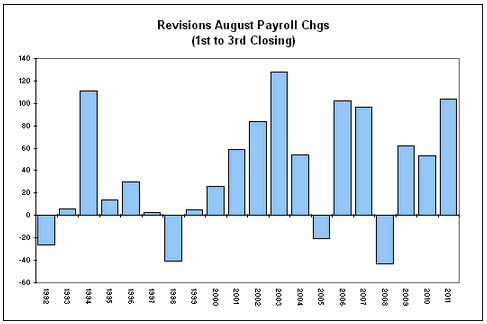
Over the past 20 years August payrolls have been revised upward between the 1st and 3rd release on 16 occasions.

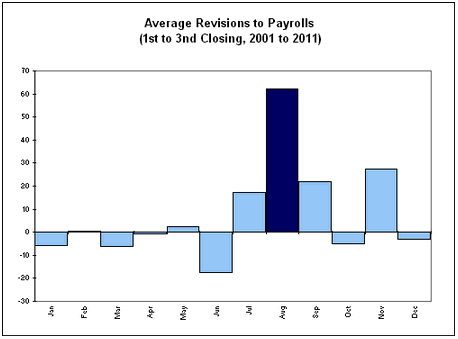
The magnitude of the August payroll revisions over the past 10 years has far exceeded any other month of the year. Over this period the August reading has been revised upward by an average of 62,000, in contrast to the next largest month (November) at +27,600.