US Jobless Claims Jump Above Forecasts; Prices Still Tame

The data continues to support the narrative:

Proactive deficit reduction, aka ‘austerity’, slows an economy and can throw it into reverse if some other agent’s deficit spending/savings reduction doesn’t rise to the occasion.

And add to that the growing headwind of the now highly aggressive ‘automatic fiscal stabilizers’ with a deficit now probably running at a pace well under 3% of GDP.

As you know I’ve been looking for any sign of credit expansion and so far I see nothing but deceleration. Mortgage credit outstanding continues to contract, housing starts have gone sideways, and most recently mtg apps have actually turned down. Unemployment claims seem to have bottomed earlier this year and the 3 month moving average has turned up as well. Year over year consumer credit growth is flat, and bank lending in general remains only very modestly positive, with no sign of a recent increase needed to fill the ‘spending gap’ left by a retreating govt sector.

Furthermore, GDP has been revised down to be consistent with my narrative, with Q1 now down to 1.8% and Q2 estimates in the 1%- 1.5% range. And, as discussed yesterday, with long term productivity somewhere around that level, jobs should go from up 200,000 to flat, with a lag of course. In other words, the upturn in claims that leads jobs is offering more support for that narrative.

Additionally, the risk of it all going into reverse is mounting as well. This happens when the deficit- the net financial equity of the economy- isn’t sufficient to support the credit structure that’s supporting growth. And the way the deficit gets higher is via the automatic fiscal stabilizers going into reverse- the slowing economy increases transfer payments and reduces revenues.

Also note the evidence of global disinflation including commodity prices, a general fade of the emerging market sector, and Europe at best getting modestly less worse. Only Japan has had some growth, but none of it is about growing imports, so it’s no help to anyone else, and their 25% real wage pay cut and increased exports/lower prices is reducing domestic demand abroad and deflating prices and margins abroad.

For more data, scroll down through www.moslereconomics.com where I’ve been posting charts with the data releases. Hint: they all show a general deceleration.

Conclusion- we are in the midst of a global, broad based fiscally induced set of contractionary/deflationary forces.

Supporting optimism is the notion that ‘yes the fiscal drag from the tax hikes is subtracting from growth, but when it ends growth will return as the underlying private sector is growing at over 3%”

Yes, that’s possible, but again, it means private sector credit growth has to be there offering ever increasing support to offset the ‘demand leakages’ and to overcome the fiscal headwinds of the automatic fiscal stabilizers. And note that the automatic fiscal stabilizers are just that. They work to reverse declines by automatically increasing the deficit, and work to end expansions by automatically decreasing the deficit. So they will end the up leg in any case, and pro active deficit reduction only hastens that outcome in any case.

So after the tax hikes and sequesters have ratcheted down growth and lowered the deficit as well, the question is whether the economy will grow from that point.

I agree it’s not theoretically impossible, but it takes ever expanding private sector credit expansion, which is asking a lot from our current institutional structure.

And, of course, the portfolio shifting in reaction to the QE placebo is it’s own can of worms…

US Jobless Claims Jump Above Forecasts; Prices Still Tame

The number of Americans filing new claims for unemployment benefits rose last week, although the level still appeared to point to healing in the nation’s job market. Meanwhile, prices for U.S. imports and exports fell in June for the fourth straight month.

Initial claims for state unemployment benefits increased by 16,000 to a seasonally adjusted 360,000, the Labor Department said on Thursday.
Jobless About to Take a Big Hit From the Sequester

Jobless About to Take a Big Hit From the Sequester

By Jeff Cox

July 6 (CNBC) — The 11.7 million Americans still unemployed are finding their wallets getting even lighter as the sequester federal spending cuts kick in.

While the mandated decreases have been slow to trickle into the real economy, the unemployed are feeling perhaps the first big jolt.

As of July 1, the average weekly benefit of $289 will fall by $43 a week, adding pressure at a time when the labor market is trying to find its bearings but has yet to generate the kind of employment that would indicate a strong recovery.

Jobs, one more time

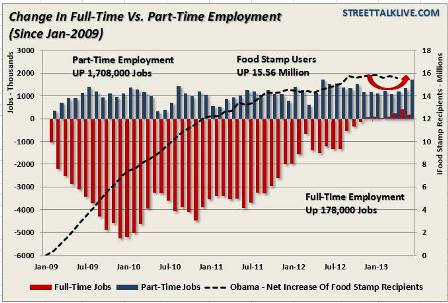
Does anyone see anything other than jobs going sideways, and personal consumption expenditures and GDP, if anything decelerating?

Including cars and housing, which look to have flattened this year, and need to steepen to keep it all going. And employment does tend to lag some?

And same with most indicators, apart from some ‘confidence’ indicators?
Nor do the credit aggregates show any expansion that would change things?

Except for govt, which is going backwards with tax hikes and spending cuts, and automatic stabilizers offering front line resistance to even modest levels of growth? Exports going backwards, imports up, and recent oil price hikes are GDP/employment negatives as well?

I’m not saying the Fed doesn’t like what’s happening. They do, and odds are that with another two sideways months they will be tapering in Sept. As if that matter for anything fundamental.

And take another look at this chart. Can you detect the influence of $85 billion/mo of QE? No, because there isn’t any, and don’t tell me it would have been worse otherwise.

Jobs

Hopefully employment, historically a lagging indicator, somehow leads consumption and GDPthis time.

(As always, I could be wrong, but I wouldn’t bet even your money on it…)

;)

But seems more than enough for the Fed to ‘taper’ which of course is of no further economic consequence of substance.

Of more concern is rising gasoline prices, for example.
And this latest Egyptian drama has only just begun.
Seems the revenge of the Brotherhood is inevitable.

JOBS DECELERATING!

3 mo moving average decelerating and now back to levels about where they were when the Fed expanded QE.

As expected, QE has failed again, and seems there’s no understanding that QE is in fact a tax that removes interest income from the economy.

Furthermore, the deceleration in jobs is consistent with the narrative that the FICA hikes and sequesters function to reduce aggregate demand, which, for all practical purposes, can only be overcome by an increased rate of private sector credit expansion, which the data tells me isn’t happening.

So after a weak Q4 due to cliff fears, a weak Q1 rebound to only 2.4% due to the tax increases, and now a weak and decelerating Q3 with GDP of about 1.5%, the 3 month average decelerates to only about 1.5% with a non trivial chance of going down from there.

In fact, if the govt deficit is too small and private sector credit expansion too weak to close the ‘spending gap’ it all goes into reverse until the automatic fiscal stabilizers increase the govt. deficit sufficiently to stabilize aggregate demand.

Just like in the Euro zone. And Japan, And the UK.

:(

Graph

ADP

Continuing evidence of deceleration.

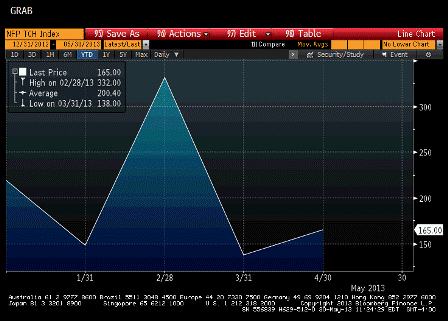
A 150,000 jobs print Friday puts the 3 month average back to around where it was when the Fed expanded QE due last year due to cliff fears, etc.

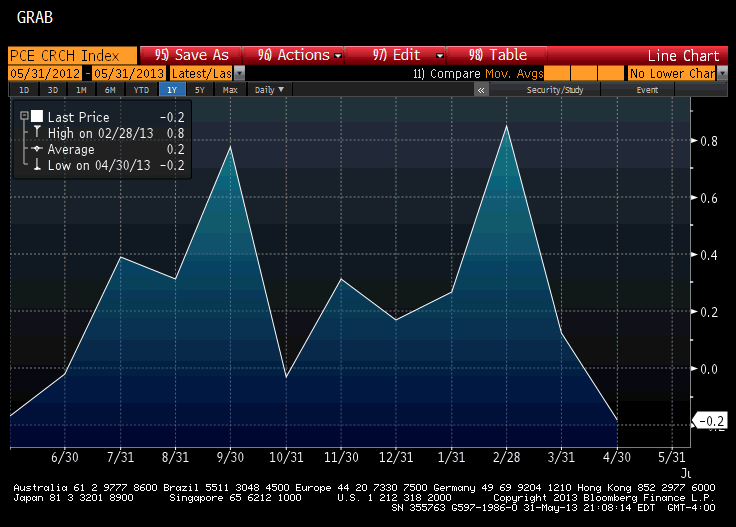
So with CPI also weak, at least for now the Fed continues to fail on both its mandate targets. Seems the FOMC doesn’t yet appreciate the power of the interest income channels, as expanded QE means that much more interest income is being removed from the economy.

And the ‘government getting out of the way’ means less ‘free income’ for the economy, meaning increased domestic ‘borrowing to spend’/’dipping into savings’ for all practical purposes is the only way to ‘jump the gap’ of reduced govt deficit spending and sustain output and employment.

In other words, the risk is that the already narrowing govt deficit was proactively made too small to support the current domestic credit structure.

And if so, market forces work to increase govt deficit spending/restore required private sector net financial assets the ugly way- falling revenues and increased transfer payments, aka the automatic fiscal stabilizers.

Much like we’ve seen in the euro zone, the UK, Japan, etc. etc. etc. etc. etc.

ADP graph

ADP reports 135,000 private-sector jobs created in May, vs. estimate of 165,000

By Jeff Cox

June 5 (CNBC) — Private-sector job creation was weaker than expected in May, as the economy struggled to break free of what appears to be a summer slowdown on the horizon.

ADP and Moody’s Analytics reported just 135,000 new positions for the month, below expectations of 165,000.

Services were responsible for all the new jobs, adding 138,000, while the goods-producing sector lost 3,000 positions.

Construction added 5,000 workers, but that was offset by a loss of 6,000 manufacturing jobs.

The poor showing sets the stage for a possibly weak nonfarm payrolls report on Friday, when the Labor Department had been expected to show 169,000 new jobs.

Economists sometimes will use the ADP numbers to adjust their estimates for the government account, even though the private-sector count has been a historically unreliable gauge.

“The job market continues to expand, but growth has slowed since the beginning of the year,” Moody’s economist Mark Zandi said in a statement.

Financial markets offered muted reaction to the report, with stock market futures off their lows. Investors have been using the weak economic reports to fuel hopes that the Federal Reserve will continue with its aggressive easing program.

The Fed is creating money to buy $85 billion in Treasurys and mortgage-backed securities each month.

Recently, some members have suggested that the central bank begin easing its purchases, and markets in turn have been unsettled as interest rates have climbed and equities have been volatile.

A weak payrolls number Friday could go a long way toward squelching talk that the Fed will begin tapering purchases as soon as this month.

“As far as the tapering debate goes, the report does nothing to bolster expectations that the Fed will ease its foot off the pedal over the summer,” Andrew Wilkinson, chief market economist at Miller Tabak, said in a note.

ISM


Karim writes:

Weak, with employment holding steady and orders and shipments lower. At odds with much of the recent hard data for other sectors and other surveys (consumer surveys, NFIB,etc).

As mentioned, manufacturing hasn’t contributed to job growth for the past 2mths.

Should receive a boost from the automakers not shutting down as usual this summer.

ISM graph


May April
Index 49.0 50.7
New Orders 48.8 52.3
Production 48.6 52.3
Employment 50.1 50.2
Supplier Delvs 48.7 50.9
Inventories 49.0 46.5
Prices 49.5 50.0
Backlog orders 48.0 53.0
Exports 51.0 54.0
Imports 54.5 55.0

Initial claims,GDP, Italy


Karim writes:

    Q1 Real GDP was revised down just 0.1% to 2.4% but the underlying changes were more volatile:

  • Real Consumer Spending up to 3.4% from 3.2%
  • Capex up from 3% to 4.6%
  • Government consumption down to -4.9% from -4.1%
  • Inventory contribution down to 0.6% from 1%

Takeaway is underlying private demand was stronger than initially reported, government was more of a drag and inventories have more room to expand.

Yes, but note this:

The drag from government and inventories was partially offset by an upward revision to consumer spending, which rose at a 3.4 percent annual rate, up two tenths of a point from the government’s previous estimate. However, a cloud hung over that category, as most of the upward revision was due to higher sales of gasoline. Higher prices at the pump are a burden on consumers, leaving them less money to spend on other things.

And:

After-tax corporate profits fell at a 1.9 percent annual rate in the quarter, the first decline in a year.


Optimism on late 2013 and 2014 growth (Rosengren speech yesterday) stems from government consumption turning from being a drag to neutral sometime in Q3 or Q4, leaving in place the underlying pace of private demand growth of about 3%.

Yes, the question being ‘leaving in place’, as govt spending feeds private sector sales, etc.

So the assumption is the private sector spending that’s been taking place will continue at that pace post tax hikes and sequesters. And note that growth in the credit driven spending (cars, appliances, housing) is showing at least hints of slowing.

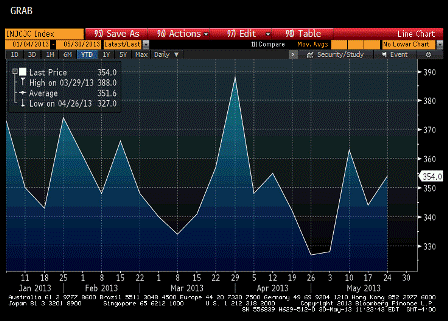
Department of Labor reported 5 states didn’t complete their claims count last week due to the holiday, so the rise in claims to 354k to be taken with a grain of salt.

Yes, but here too are at least hints that claims bottomed a few weeks ago and have edged a bit higher since then, and that Non Farm Payrolls peaked in Feb, and if next weeks number prints at 150,000 the three month average is back down to around that level.

And, again, it’s the year end tax hikes and subsequent sequesters that are causing me to look for evidence of subsequent slowing.

This is notable for Italian (and European) growth. Eur10bn (mid-point of estimates below) is worth about a 0.5% add to GDP growth:

EU Recommends Removing Italy From Excessive-Deficit Procedure (Bloomberg) The European Commission recommended today lifting an excessive-deficit procedure against Italy after the government brought its budget shortfall within the European Union limit. “Our task is to respect our commitments with Europe and implement the program the parliament has given its vote of confidence on,” Italian Prime Minister Enrico Letta said. Ending the strict EU monitoring of Italian public spending may free up resources of as much as 12 billion euros, Regional Affairs Minister Graziano Delrio said in an interview with daily La Stampa May 27. “The closing of the procedure alone allows us to boost spending by between 7 and 10 billion euros, 12 billion euros in the most optimistic forecast,” Delrio said in the La Stampa interview.

Yes, this would be helpful, but a deceleration in expected US growth hurts Europe as well.

Initial Claims YTD:


Full size image

Nonfarm Payroll Change YTD:


Full size image

Bernanke


Karim writes:

Question: On timing of tapering
Answer:
If the labor market continues to improve at the current pace, could taper in the next few meetings.
Asked if he expected this to occur before Labor Day; depends on the data.
Did not answer question about how much warning he would give the market before tapering.

Question: Exit principles
Answer:
First have to wind down purchases. He emphasized that the outlook for the labor market is the key driver (not inflation) for whether to taper. And he emphasized that buying at a lesser pace is still easing.
Says no need to sell securities at this point. Makes case for letting securities roll-off in terms of market impact and remittances to Treasury. And he also expresses a desire to return to a Treasury only balance sheet at some point, though also says MBS likely to just roll off the balance sheet.

Text Excerpts Below

  • A key adjective between some and improvement in the labor market is still missing!
  • Removing policy accommodation and policy tightening not appropriate at this juncture (no guidance).
  • Also notes that buying assets at a lower pace (tapering) is still providing accommodation.
  • Many focusing on removing policy accommodation phrase thus has nothing to with tapering (that it is referring to ending QE altogether).
  • Rest of text is largely a rehash of defense of cost/benefit analysis of low rates, headwinds from fiscal policy, and scarring effects of long-term unemployment.


Good report, thanks!

Some interesting language here:

Conditions in the job market have shown some improvement recently. The unemployment rate, at 7.5 percent in April, has declined more than 1/2 percentage point since last summer. Moreover, gains in total nonfarm payroll employment have averaged more than 200,000 jobs per month over the past six months, compared with average monthly gains of less than 140,000 during the prior six months. In all, payroll employment has now expanded by about 6 million jobs since its low point, and the unemployment rate has fallen 2-1/2 percentage points since its peak.

Despite this improvement, the job market remains weak overall: The unemployment rate is still well above its longer-run normal level, rates of long-term unemployment are historically high, and the labor force participation rate has continued to move down.


Over the nearly four years since the recovery began, the economy has been held back by a number of headwinds. Some of these headwinds have begun to dissipate recently, in part because of the Federal Reserve’s highly accommodative monetary policy. Notably, the housing market has strengthened over the past year, supported by low mortgage rates and improved sentiment on the part of potential buyers. Increased housing activity is fostering job creation in construction and related industries, such as real estate brokerage and home furnishings, while higher home prices are bolstering household finances, which helps support the growth of private consumption.

Recognizing the drawbacks of persistently low rates, the FOMC actively seeks economic conditions consistent with sustainably higher interest rates. Unfortunately, withdrawing policy accommodation at this juncture would be highly unlikely to produce such conditions. A premature tightening of monetary policy could lead interest rates to rise temporarily but would also carry a substantial risk of slowing or ending the economic recovery and causing inflation to fall further.

The Chairman has previously indicated that inflation risks are asymmetrical, as they feel reasonably secure about being able to deal with higher inflation via rate hikes, vs feeling reasonably insecure about addressing deflationary forces given the 0% lower bound on rates.

Such outcomes tend to be associated with extended periods of lower, not higher, interest rates, as well as poor returns on other assets.

Japan, for example

Moreover, renewed economic weakness would pose its own risks to financial stability.

Euro zone?

In the current economic environment, monetary policy is providing significant benefits. Low real interest rates have helped support spending on durable goods, such as automobiles, and also contributed significantly to the recovery in housing sales, construction, and prices. Higher prices of houses and other assets, in turn, have increased household wealth and consumer confidence, spurring consumer spending and contributing to gains in production and employment. Importantly, accommodative monetary policy has also helped to offset incipient deflationary pressures and kept inflation from falling even further below the Committee’s 2 percent longer-run objective.

Again, deflation concerns

That said, the Committee is aware that a long period of low interest rates has costs and risks. For example, even as low interest rates have helped create jobs and supported the prices of homes and other assets, savers who rely on interest income from savings accounts or government bonds are receiving very low returns. Another cost, one that we take very seriously, is the possibility that very low interest rates, if maintained too long, could undermine financial stability. For example, investors or portfolio managers dissatisfied with low returns may “reach for yield” by taking on more credit risk, duration risk, or leverage. The Federal Reserve is working to address financial stability concerns through increased monitoring, a more systemic approach to supervising financial firms, and the ongoing implementation of reforms to make the financial system more resilient.