Orszag attending Obama Afghan meetings


[Skip to the end]

Yes, the deficit reduction polls are likely having a lot of influence on policy going into the 2010 elections and are a major obstacle to any kind of meaningful recovery.

And, worst of all, it was reported that Budget Director Peter Orszag was also sitting in on these discussions:

Obama to Give Afghan Strategy Decision on Dec. 1, Official Says

By Tony Capaccio and Roger Runningen

Nov. 24 (Bloomberg) — President Barack Obama will announce his decision on the next steps in the war in Afghanistan on or about Dec. 1, according to a U.S. official familiar with the issue.

Defense Secretary Robert Gates, Secretary of State Hillary Clinton and Admiral Michael Mullen, chairman of the Joint Chiefs of Staff, are expected to discuss the decision before Congress that same week, and General Stanley McChrystal, the top U.S. commander in Afghanistan, would testify the following week, the official said.

White House Budget Director Peter Orszag has estimated that each additional soldier in Afghanistan could cost $1 million, for a total that could reach $40 billion if 40,000 more troops are added.

This is clear evidence that budget myths are, indeed, influencing national security issues, and therefore posing a security risk. I’d go so far as to say the deficit terrorists are currently the greatest risk to both national security and national prosperity.

Voters Continue to See Deficit Reduction as Top Priority (Rasmussen) While official Washington has seen many twists and turns in the legislative process this year, voter priorities have remained unchanged. Deficit reduction has remained number one for voters ever since President Obama listed his four top budget priorities in a speech to Congress in February. Forty-two percent (42%) say cutting the deficit in half by the end of the president’s first term is most important, followed by 24% who say health care reform should be the top priority. Fifteen percent (15%) say the emphasis should be on the development of new energy sources, while 13% say the same about education.

1 in 4 Borrowers Under Water (WSJ) The proportion of U.S. homeowners who owe more on their mortgages than the properties are worth has swelled to about 23%. Nearly 10.7 million households had negative equity in their homes in the third quarter, according to First American CoreLogic. Home prices have fallen so far that 5.3 million U.S. households are tied to mortgages that are at least 20% higher than their home’s value, the First American report said. More than 520,000 of these borrowers have received a notice of default, according to First American. Most U.S. homeowners still have some equity, and nearly 24 million owner-occupied homes don’t have any mortgage, according to the Census Bureau. More than 40% of borrowers who took out a mortgage in 2006 are under water. Even recent bargain hunters have been hit: 11% of borrowers who took out mortgages in 2009 already owe more than their home’s value.


AP-GfK Poll: Debt turning shoppers into Scrooges (AP) 93 percent of Americans say they’ll spend less or about the same as last year, according to an Associated Press-GfK poll. Half of all those polled say they’re suffering at least some debt-related stress, and 22 percent say they’re feeling it greatly or quite a bit. That second figure is up from 17 percent just last spring. 80 percent say they’ll use mostly cash to pay for their holiday shopping.


PC shipment forecast raised as 3Q sales pick up (AP) A rebound in purchases of personal computers worldwide will lead to a 2.8 percent increase in shipments this year. Gartner Inc. sees worldwide PC shipments topping 298.9 million in 2009, a reversal from its prior forecast of a 2 percent decline. PC shipments fell in the first half of this year. Gartner sees shipments for 2010 rising 12.6 percent to 336.6 million. But the value of computer sales is expected to drop by 10.7 percent to $217 billion this year because manufacturers are cutting prices to move product.

Businesses still cautious on borrowing (Reuters) The Equipment Leasing and Finance Association’s capex financing index fell to $4.3 billion in October, down 32.8 percent from last October and down 8.5 percent from September. The group said the percentage of borrowers delinquent 30 days or more on their capex loans, leases or lines of credit rose to 4.2 percent last month, up from 3.6 percent last year but down from 5.6 percent in September. Charge-offs as a percentage of all receivables rose to 1.7 percent in October, from 1.36 percent last year but down from 3.01 percent in September. Only 66.2 percent of applicants got the green light from lenders in October, down from 71.7 percent last year and 67.9 percent in September. More than half the money invested in plants, equipment and software in the United States in any given year is financed with loans, leases and lines of credit.


[top]
Richard Koo: a personal view of the macroeconomy


[Skip to the end]

I agree, and the deficit of consequence isn’t that high as I think that figure includes the TARP funds
which were a form of regulatory forbearance and not spending.

Unfortunately, elsewhere he falls short in explaining why deficit spending doesn’t have the downside risks the mainstream attributes to it.

Send him a copy of the 7 deadly innocent frauds draft for comment? (attached)

Richard Koo: a personal view of the macroeconomy

US a mirror image of Japan 15 years ago

In the last two weeks, I made my annual fact-finding mission to
Washington and also spent time in Boston and San Francisco. What I
witnessed was very reminiscent of the situation in Japan 15 years ago:
people were latching on to isolated fragments of good economic news as
evidence of recovery while ignoring the steady deterioration in the real
economy.

In addition to meetings with officials from the Federal Reserve and the
White House, I had the opportunity to talk with various groups at the
Hill including two Congresspersons over lunch.

Although there have been signs of improvement in the real economy,
particularly in production, the problems in the jobs picture are
underscored by the unemployment rate’s rise into double digits.

And on a personal level, the San Francisco bank that my parents
patronized for many years was shut down by the FDIC last Friday. To
prevent panic, the bank opened for business as usual on Saturday under
the name of another lender. This event added a personal dimension to the
crisis for me.

Budget deficit concerns make new fiscal stimulus all but impossible

One issue of particular concern on this trip was that people seem to be
paying little attention to the economic impact of the Obama
administration’s fiscal stimulus and instead are focusing entirely on
the size of the resulting budget deficit.

With the government running a deficit equal to 10% of nominal GDP, more
people are looking at the continued weakness in the economy:
particularly in employment: and drawing the conclusion that the
administration’s policies are ineffective and should be discontinued as
soon as possible. This view is so strong that additional fiscal stimulus
is seen as being almost impossible to implement today.

This pattern mirrors events in Japan 15 years ago. The more the
government draws on fiscal stimulus to avert a crisis, the more
criticism it receives.

People are giving no thought to the economic consequences if the
government had not responded to the $10trn loss in national wealth (in
the form of housing and stock portfolios) with fiscal stimulus. Instead,
they focus entirely on the fact that the economy has yet to improve
despite $787bn in expenditures.

In Japan, fiscal spending succeeded in keeping GDP above bubble-peak
levels despite the loss of Y1,500trn in national wealth, or three years
of GDP, from real estate and stocks alone. But because disaster was
averted, people forgot they were in the midst of a crisis and rushed to
criticize the size of the resulting fiscal deficits.

Their criticism prevented the Japanese government from providing a
steady stream of stimulus. Instead, it was forced to adopt a stop-and-go
policy of intermittent stimulus: each time a spending package expired,
the economy would weaken, forcing the government to quickly implement
the next round of stimulus. That is the main reason why the recession
lasted 15 years. And the mood in Washington today is very similar.

R. Koo


[top]

Rasmussen Poll and deficit reduction


[Skip to the end]

Don’t underestimate the power of public opinion on Congress.

Deficit myths remain public enemy number one.

Daily Presidential Tracking Poll
Saturday, October 24, 2009

The Rasmussen Reports daily Presidential Tracking Poll for Saturday shows that 30% of the nation’s voters Strongly Approve of the way that Barack Obama is performing his role as President. Forty percent (40%) Strongly Disapprove giving Obama a Presidential Approval Index rating of -10 (see trends).

Thirty-eight percent (38%) of voters say deficit reduction is the top priority for Washington to obtain while 23% say health care is most important. Among Democrats, health care is most important. Among Republicans and unaffiliated voters, health care is fourth on the priority list.

Check out our review of last week’s key polls to see “What They Told Us.”

The Presidential Approval Index is calculated by subtracting the number who Strongly Disapprove from the number who Strongly Approve. It is updated daily at 9:30 a.m. Eastern (sign up for free daily e-mail update). Updates also available onTwitter and Facebook.

Overall, 47% of voters say they at least somewhat approve of the President’s performance. Fifty-one percent (51%) disapprove.

Tracking poll data shows that just 56% of conservatives consider themselves Republicans. Separate polling shows that 73% of GOP voters say Congressional Republicans have lost touch with the party’s base.


[top]

Moody’s – The Aaa rating of the U.S. is not guaranteed


[Skip to the end]

The ratings agencies rate high on the deficit terrorist list.
If you know Hess send him a copy of the 7 deadly innocent frauds draft, thanks.

Unfortunately, policy makers don’t know any better and actually respond to this nonsense:

Reducing deficit key to U.S. rating-Moody’s

Oct. 21 (Reuters) — The United States, which posted a record deficit in the last fiscal year, may lose its Aaa-rating if it does not reduce the gap to manageable levels, in the next 3-4 years, Moody’s Investors Service said on Thursday.

The U.S. government posted a deficit of $1.417 trillion in the year ended September 30 as the deep recession and a series of bank rescues cut a gaping hole in its public finances. The White House has forecast deficits of more than $1 trillion through fiscal 2011.

“The Aaa rating of the U.S. is not guaranteed,” said Steven Hess, Moody’s lead analyst for the United States said in an interview with Reuters Television.

“So if they don’t get the deficit down in the next 3-4 years to a sustainable level, then the rating will be in jeopardy.”

Moody’s has a stable outlook on the U.S. rating, which indicates a change is not expected over the next 18 months.

Earlier this year, financial markets were spooked by concerns about the risk of the United States losing its top rating after Standard & Poor’s revised its outlook on Britain to negative from stable, indicating the risk of a downgrade.

Hess said that reducing the budget deficit would be a challenge.

“Raising taxes is never popular and difficult politically so we have to see if the government can do that or cut expenditure,” he said while adding it would be tough to reduce expenditure.


[top]

latest Bernanke remarks


[Skip to the end]

Like depository institutions in the United States, foreign banks with large dollar-funding needs have also experienced powerful liquidity pressures over the course of the crisis. This unmet demand from foreign institutions for dollars was spilling over into U.S. funding markets, including the federal funds market, leading to increased volatility and liquidity concerns. As part of its program to stabilize short-term dollar-funding markets, the Federal Reserve worked with foreign central banks–14 in all–to establish what are known as reciprocal currency arrangements, or liquidity swap lines. In exchange for foreign currency, the Federal Reserve provides dollars to foreign central banks that they, in turn, lend to financial institutions in their jurisdictions. This lending by foreign central banks has been helpful in reducing spreads and volatility in a number of dollar-funding markets and in other closely related markets, like the foreign exchange swap market. Once again, the Federal Reserve’s credit risk is minimal, as the foreign central bank is the Federal Reserve’s counterparty and is responsible for repayment, rather than the institutions that ultimately receive the funds; in addition, as I noted, the Federal Reserve receives foreign currency from its central bank partner of equal value to the dollars swapped.

Looks like they still fail to recognize these dollar loans are functionally unsecured.

The principal goals of our recent security purchases are to lower the cost and improve the availability of credit for households and businesses. As best we can tell, the programs appear to be having their intended effect. Most notably, 30-year fixed mortgage rates, which responded very little to our cuts in the target federal funds rate, have declined about 1-1/2 percentage points since we first announced MBS purchases in November, helping to support the housing market.

Correct on this count. Treasury purchases are about interest rates and not quantity.

Currency and bank reserves together are known as the monetary base; as reserves have grown, therefore, the monetary base has grown as well. However, because banks are reluctant to lend in current economic and financial circumstances, growth in broader measures of money has not picked up by anything remotely like the growth in the base. For example, M2, which comprises currency, checking accounts, savings deposits, small time deposits, and retail money fund shares, is estimated to have been roughly flat over the past six months.

Correct here as well, where he seems to recognize the ‘base’ is not causal. Lending is demand determined within a bank’s lending criteria.

The idea behind quantitative easing is to provide banks with substantial excess liquidity in the hope that they will choose to use some part of that liquidity to make loans or buy other assets.

Here, however, there is an implied direction of causation from excess reserves to lending. This is a very different presumed transmission mechanism than the interest rate channel previously described.

Such purchases should in principle both raise asset prices and increase the growth of broad measures of money, which may in turn induce households and businesses to buy nonmoney assets or to spend more on goods and services.

Raising asset prices is another way to say lowering interest rates, which is the same interest rate channel previously described.

In a quantitative-easing regime, the quantity of central bank liabilities (or the quantity of bank reserves, which should vary closely with total liabilities) is sufficient to describe the degree of policy accommodation.

The degree of policy accommodation is the extent to which interest rates are lower than without that accommodation, if one is referring to the interest rate channel, which at least does exist.

The quantity of central bank liabilities would measure the effect of the additional quantity of reserves, which has no transmission mechanism per se to lending or anything else, apart from interest rates.

However, the chairman is only defining his terms, and he’s free to define ‘accommodation’ as he does, though I would suggest that definition is purely academic and of no further analytic purpose.

Although the Federal Reserve’s approach also entails substantial increases in bank liquidity, it is motivated less by the desire to increase the liabilities of the Federal Reserve than by the need to address dysfunction in specific credit markets through the types of programs I have discussed. For lack of a better term, I have called this approach “credit easing.”11 In a credit-easing regime, policies are tied more closely to the asset side of the balance sheet than the liability side, and the effectiveness of policy support is measured by indicators of market functioning, such as interest rate spreads, volatility, and market liquidity. In particular, the Federal Reserve has not attempted to achieve a smooth growth path for the size of its balance sheet, a common feature of the quantitative-easing approach.

Here he goes back to his interest rate transmission mechanism which does exist. But the implication is still there that the quantity of reserves does matter to some unspecified degree.

As we just saw in slide 6, banks currently hold large amounts of excess reserves at the Federal Reserve. As the economy recovers, banks could find it profitable to be more aggressive in lending out their reserves, which in turn would produce faster growth in broader money and credit measures and, ultimately, lead to inflation pressures.

When he turns to the ‘exit strategy’ it all goes bad again. Banks don’t ‘lend out their reserves.’ in fact, lending does not diminish the total reserves in the banking system. Loans ‘create’ their own deposits as a matter of accounting. If the banks made $2 trillion in loans tomorrow total reserves would remain at $2 trillion, until the Fed acted to reduce its portfolio.

Yes, lending can ‘ultimately lead to inflation pressures’ but reserve positions are not constraints on bank lending. Lending is restricted by capital and by lending standards.

Under a gold standard loans are constrained by reserves. Perhaps that notion has been somehow carried over to this analysis of our non convertible currency regime?

As such, when the time comes to tighten monetary policy, we must either substantially reduce excess reserve balances or, if they remain, neutralize their potential effects on broader measures of money and credit and thus on aggregate demand and inflation.

Again, altering reserve balances will not alter lending practices. The Fed’s tool is interest rates, not reserve quantities.

Although, in principle, the ability to pay interest on reserves should be sufficient to allow the Federal Reserve to raise interest rates and control money growth, this approach is likely to be more effective if combined with steps to reduce excess reserves. I will mention three options for achieving such an outcome.

More of the same confusion. Yes, paying interest will be sufficient to raise rates. However a different concept is introduced, raising interest rates to control ‘money growth’ rather than, as previously mentioned, raising rates to attempt to reduce aggregate demand. Last I read and observed the Fed has long abandoned the notion of attempting control ‘money growth’ as a means of controlling aggregate demand. The ‘modern’ approach to monetarism that prescribes interest rate manipulation to control aggregate demand does not presume the transmission mechanism works through ‘money supply’ growth, but instead through other channels.

First, the Federal Reserve could drain bank reserves and reduce the excess liquidity at other institutions by arranging large-scale reverse repurchase agreements (reverse repos) with financial market participants, including banks, the GSEs, and other institutions.

Reverse repos are functionally nothing more than another way to pay interest on reserves.

Second, using the authority the Congress gave us to pay interest on banks’ balances at the Federal Reserve, we can offer term deposits to banks, roughly analogous to the certificates of deposit that banks offer to their customers. Bank funds held in term deposits at the Federal Reserve would not be available to be supplied to the federal funds market.

This is also just another way to pay interest on reserves, this time for a term longer than one day.

Third, the Federal Reserve could reduce reserves by selling a portion of its holdings of long-term securities in the open market.

Back to the confusion. The purpose of the purchase of long term securities was to lower long term rates and thereby help the real economy. Selling those securities does the opposite- it increases long term rates, and will presumably slow things down in the real economy.

However, below, he seems to miss that point, and returns to assigning significance to ‘money supply’ measures.

Each of these policy options would help to raise short-term interest rates and limit the growth of broad measures of money and credit, thereby tightening monetary policy.


[top]

Godley letter to FT


[Skip to the end]

Thanks, will distribute and post on my blog.

Known Wynne for quite a while.

He’s been doing sector analysis for maybe 50 years and has often been the UK’s top forecaster because of it.


Immediate cuts to budget deficit will worsen recession

Oct. 9 (FT) — Sir, George Osborne is committing himself unconditionally to making very large cuts in the budget deficit. I think he may be very seriously mistaken.

If these cuts were all to be made immediately he would obviously make the present recession very much worse than it already is.

To make sense of his proposed cuts it must be assumed that there is a rise in private expenditure relative to income (ie, a fall in net private saving) that roughly matches them in both scale and timing. But it is quite likely that private saving will not fall nearly enough. If, as I foresee, it does not do so, then Mr Osborne’s cuts will be much too large.

Wynne Godley,
King’s College,
Cambridge University, UK


[top]

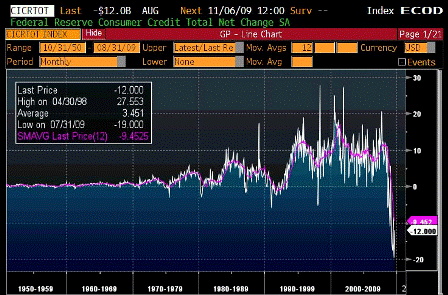
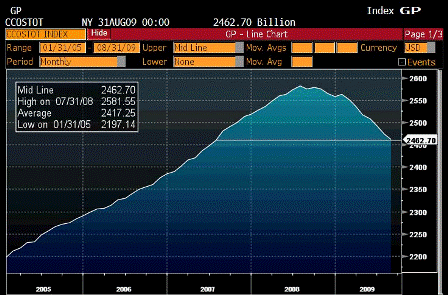
Total Credit decline from $2,475 billion to $2,463


[Skip to the end]

Two things:

1. Sales remain soft.
2. The federal deficit spending facilitates the same amount of sales with less credit.

>   
>   (email exchange)
>   
>   On Sun, Jul 12, 2009 at 9:20 AM, Dave wrote:
>   
>   Yet another month where the decline in consumer credit comes in worse than
>   expected: Total Credit decline from $2,475 billion to $2,463, with the bulk
>   of the $12 billion decline consisting of Revolving Credit reduction, or $10
>   billion, to $900 billion. Total consumer credit is now back to July 2007
>   levels… and the decline has yet to decelerate. This is the seventh straight
>   month of consumer credit declines.
>   


[top]

WSJ/Plan U.S Saving more,China less reliant on exports


[Skip to the end]

These proposals present what is perhaps the most serious macro risk to the US standard of living in our history.

It is truly the blind leading the blind.

Seems they’ve all forgotten none of us are on a gold standard,

That exports are real costs, and imports real benefits, and that taxes function to regulate aggregate demand, and not to ‘raise revenue’ per se.

While this has never been understood by the mainstream, but it has never mattered as much as it does today:

# [ The focus is on a U.S. proposal, called the “Framework for
Sustainable and Balanced Growth,” whose details haven’t been previously
disclosed. If implemented, the framework would involve measures such as
the U.S. saving more and cutting its budget deficit, China relying less
on exports,
and Europe making structural changes to boost business
investment.]

# [ But U.S. and European officials say that this time China is on board
because it recognizes that its export-driven model won’t deliver
sufficient growth in the future, and because the new framework would
potentially spread the political pain to trading partners too.]

Nations Ready Big Changes to Global Economic Policy

By Bob Davis and Stephen Fidler

Sept. 22 (WSJ) — The Group of 20 nations is scrambling to finalize a plan before this
week’s Pittsburgh summit that would commit the U.S., Europe and China to
make big changes in national economic policies to produce lasting growth
as the world recovers from the worst recession in decades.

The G-20 summit, the third such gathering in a year, is shaping up as a
test of whether industrialized and developing nations can function as a
board of directors for the global economy.


The focus is on a U.S. proposal, called the “Framework for Sustainable
and Balanced Growth,” whose details haven’t been previously disclosed.
If implemented, the framework would involve measures such as the U.S.
saving more and cutting its budget deficit, China relying less on
exports, and Europe making structural changes to boost business
investment.

“As private and public saving rises,” in the U.S. and other countries,
“the world will face lower growth unless other G-20 countries undertake
policies that support a shift towards greater domestic, demand-led
growth,” senior White House aide Michael Froman wrote
to his G-20
colleagues in a letter dated Sept. 3. In the missive, which has not been
made public, he called the framework “a pledge on the part of G-20
leaders” to press new policies.

The proposal has set off political wrangling among the G-20, with
European countries arguing that the U.S. may be unrealistic about how
rapidly the global economy can grow and with China only reluctantly
agreeing to participate. The U.S. helped bring along the Chinese by
endorsing Beijing’s view that developing countries deserve a bigger
stake in international institutions such as the International Monetary
Fund.

The G-20 countries have yet to decide how detailed to make their pledges
to change. And the U.S. and Europe have different ideas on how to
enforce them. “Implementation is always the issue,” says Timothy Adams,
a former senior Bush Treasury official. “If we wait even one more year,
it may be too late.”
The sense of urgency will have faded, he says.

Past efforts to remedy these issues have collapsed, especially after a
sense of crisis had passed. In the 1980s and early 1990s, the Reagan,
Bush and Clinton administrations regularly pushed for rebalancing —
although Japan was the target then — and never made much headway. Once
Japan plunged into a decade-long slump, the U.S. eased off.

In the days leading up to the Pittsburgh summit, representatives of the
G-20 nations have agreed how to dodge one big issue: devising an “exit
strategy”
to withdraw the monetary and fiscal stimulus deployed to fight
the global recession. The solution is to promote such a strategy as
necessary, while stopping short of articulating specifics.
Any
prescription to phase out various economic programs could spook markets
into anticipating a quick pullback, G-20 officials say.

A compromise is emerging on another, two-pronged issue: How best to keep
financial excess and corporate compensation in check. The summit is
likely to produce support for new limits on compensation, a theme bing
pushed by the Europeans. The G-20 is also expected to approve new
requirements sought by the U.S. that banks hold more capital to
discourage risk-taking and absorb big losses.

G-20 officials say they are counting on sense of camaraderie to keep
them working together rather than pursuing conflicting national goals.

“In this age of deeper globalization, international coordination is
critical,” says Il SaKong, a prominent South Korean economist who
oversees that country’s G-20 effort. “The leaders learned this lesson;
they felt it.”

China, meanwhile, has pressed for more voting power for developing
countries at the IMF. In response, the U.S. is pushing the G-20 to agree
to change IMF voting, so that it’s split nearly 50-50 among
industrialized and developing countries, rather than the current 57% to
43% lineup. Although much of the lost power would come at the expense of
Europe, the European Union leaders said at a recent meeting that they
are willing to support some degree of change.

The move to give developing countries a bigger voice has built a degree
of trust within the G-20 and helped give impetus to make the framework
for growth a central focus. If approved, the framework would require
countries to make specific proposals promising significant change.

Those countries running current account deficits, most notably the U.S.,
would have to define ways to boost savings. Nations running surpluses —
China, Germany and Japan, among others — would detail how they propose
to reduce any reliance on exports. The U.S. would likely need to commit
to a sharp deficit reduction by government.


Europe would need to commit to improving competitiveness. That could
mean passing investment-friendly tax measures and reopening the debate
about making it easier to fire workers — viewed as one way to encourage
employers to hire more freely.

China would face perhaps the biggest challenge: remaking its economy so
it relies far less on exports to the U.S., thereby running up huge
foreign exchange reserves. In the past, China has shied away from such
“rebalancing” efforts
because of the magnitude of the changes and
because it believes it’s being singled out for the world economic woes,
which it feels were caused by regulatory lapses and other failings in
the U.S. and Europe. “They don’t want fingers pointed at them,” says
Nicholas Lardy, a China expert at the Peterson Institute for
International Economics, a Washington D.C., think tank. “It comes up
over and over again.”

But U.S. and European officials say that this time China is on board
because it recognizes that its export-driven model won’t deliver
sufficient growth in the future, and because the new framework would
potentially spread the political pain to trading partners too.

In 2006, the IMF tried its hand at rebalancing by convening talks among
the U.S., euro-zone nations, Japan, China and Saudi Arabia. Specific
proposals were made, but nothing was implemented, as Treasury Secretary
Henry Paulson figured he’d have better luck bargaining bilaterally with
China. He didn’t, especially when each country’s economy was expanding.

“The really hard part is getting an agreement of what the rules should
be and what the penalty is” for breaking them, said Anne Krueger, a
former IMF deputy managing director. G-20 officials argue that if they
don’t succeed this time, the world will remain stuck in economic
patterns that could reduce potential growth and perhaps produce another
crisis down the line.

Any new framework hinges on proper enforcement. To that end, European
sherpas, including the British, are pushing for a “trigger” mechanism.
If country’s current account surplus or deficit goes over a certain
limit, for instance, that would require negotiations to get the country
back in line.

The U.S. is pressing for what it calls a “peer review” process, by which
G-20 countries, with the help of the IMF, would assess whether each
other’s policies are working.

None of the countries, though, are calling for specific redress, such as
trade sanctions or foreign-exchange penalties for countries that don’t
live up to their promises. Threats of penalties have frightened off
Asian nations in the past and would likely sour any deal.

Instead, the G-20 officials point to how they have dealt with
protectionism as a model. Each country regularly pledges it won’t take
any protectionist action. The World Trade Organization calls out
countries that violate their pledge. Generally, G-20 officials believe
the pledges have had a restraining effect on governments.


[top]

Krugman: Mission Not Accomplished


[Skip to the end]

Too bad he doesn’t understand monetary operations and writes this out of paradigm stuff that undoes him in further discussion with the mainstream:

Mission Not Accomplished

By Paul Krugman

What is true is that spending more on recovery and reconstruction would worsen the government’s own fiscal position. But even there, conventional wisdom greatly overstates the case. The true fiscal costs of supporting the economy are surprisingly small.

You see, spending money now means a stronger economy, both in the short run and in the long run. And a stronger economy means more revenues, which offset a large fraction of the upfront cost. Back-of-the-envelope calculations suggest that the offset falls short of 100 percent, so that fiscal stimulus isn’t a complete free lunch. But it costs far less than you’d think from listening to what passes for informed discussion.


[top]