UK News — GDP Stronger Than Expected

As expected, boom time for now as the massive deficit spending raised savings and incomes, recharging consumer batteries, and supply the financial equity to fuel the subsequent expansion.

Look for rate hikes to add gasoline to the fire as well.

The risk of slowing from fiscal tightening is way down the road.

In fact, it’s usually the automatic stabilizers that tighten things sufficiently to throw the economy into reverse.

Again, years down the road.

Someday they may learn to use proactive fiscal rather than let the automatic stabilizers reverse recessions…

UK Headlines:

U.K. GDP Jumps Most in Four Years as Recovery Ignites

Bank of England Rate Setters Surprised By High Inflation,says Spencer Dale

U.K. BBA June Mortgage Approvals Fall to 34,813 From 36,418

Osborne Tells Cabinet He’s Cautiously Optimistic on Economy

Paul Krugman Blog – NYTimes.com

The way I read it, he’s agreed that it’s about inflation, not solvency.

That is, in ratings agency speak, willingness to pay could be an issue, but not ability to pay.

That’s enough for me to declare victory on that key issue, and move on.

Not that I at all agree with his descriptions of monetary operations or his ‘inflation channels.’ I just see no reason to rehash all that and risk loss of focus on the larger point he’s conceded.

This reads like a true breakthrough. Hopefully this opens the flood gates and the remaining deficit doves pile on, and July 17, 2010 is remembered as the day MMT broke through and turned the tide.

And in the real world it’s all about celebrity status.

With Jamie’s credentials and definitive response to the sustainability commission, Paul finally had a sufficiently ‘worthy’ advocate which gave him the opening to respond and concede.


I Would Do Anything For Stimulus, But I Won’t Do That (Wonkish)

By Paul Krugman

It’s really not relevant to current policy debates, but there’s an issue that’s been nagging at me, so I thought I’d write it up.

Right now, the real policy debate is whether we need fiscal austerity even with the economy deeply depressed. Obviously, I’m very much opposed — my view is that running deficits now is entirely appropriate.

But here’s the thing: there’s a school of thought which says that deficits arenever a problem, as long as a country can issue its own currency. The most prominent advocate of this view is probably Jamie Galbraith, but he’s not alone.

Now, Jamie and I are, I think, in complete agreement about what we should be doing now. So we’re talking theory, not practice. But I can’t go along with his view that

So long as U.S. banks are required to accept U.S. government checks — which is to say so long as the Republic exists — then the government can and does spend without borrowing, if it chooses to do so … Insolvency, bankruptcy, or even higher real interest rates are not among the actual risks to this system.

OK, I don’t think that’s right. To spend, the government must persuade the private sector to release real resources. It can do this by collecting taxes, borrowing, or collecting seignorage by printing money. And there are limits to all three. Even a country with its own fiat currency can go bankrupt, if it tries hard enough.

How does that work? A bit of modeling under the fold.

Let’s think in terms of a two-period model, although I won’t need to say much about the first period. In period 1, the government borrows, issuing indexed bonds (I could make them nominal, but then I’d need to introduce expectations about inflation, and we’ll end up in the same place.) This means that in period 2 the government owes real debt service in the amount D.

The government may meet this debt service requirement, in whole or in part, by running a primary surplus, an excess of revenue over current spending. Let’s suppose, however, that there’s an upper limit S to the feasible primary surplus — a limit imposed by political constraints, administrative issues (if taxes are too high everyone will evade), or the sheer fact that tax collections can’t exceed GDP.

But the government also has a printing press. The real revenue it collects by using this press is [M(t) – M(t-1)]/P(t), where M is the money supply and P the price level.

What determines the price level? Let’s assume a simple quantity theory, with the price level proportional to the money supply:

P(t) = V*M(t)

By assuming this, I’m actually making the most favorable assumption about the power of seignorage, since in practice, running the printing presses leads to a fall in the real demand for money (people start using lumps of coal or whatever as substitutes.)

OK, now let’s ask what happens if the government has run up enough debt that the upper limit on the primary surplus is a binding constraint, and it’s necessary to run the printing presses to make up the difference. In that case,

[M(t) – M(t-1)]/P(t) = D – S

But P is proportional to M, so this becomes

[M(t) – M(t-1)]/VM(t) = D – S

Rearrange a bit, and we have

M(t)/M(t-1) = 1/[1 – V[D-S]]

And what does this imply? Since the price level is, by assumption, proportional to M, this tells us that the higher the debt burden, the higher the required rate of inflation — and, crucially, that as D-S heads toward a critical level, this implied inflation heads off to infinity. That is, it looks like this:

So there is a maximum level of debt you can handle. In practice, if it makes sense to say such a thing with regard to a stylized model, at some point lower than the critical level implied by this model the government would decide that default was a better option than hyperinflation.

And going back to period 1, lenders would take this possibility into account. So there are real limits to deficits, even in countries that can print their own currency.

Now, I’m sure I’m about to get comments and/or responses on other blogs along the lines of “Ha! So now Krugman admits that deficits cause hyperinflation! Peter Schiff roolz” Um, no — in extreme conditions they CAN cause hyperinflation; we’re nowhere near those conditions now. All I’m saying here is that I’m not prepared to go as far as Jamie Galbraith. Deficits can cause a crisis; but that’s no reason to skimp on spending right now.

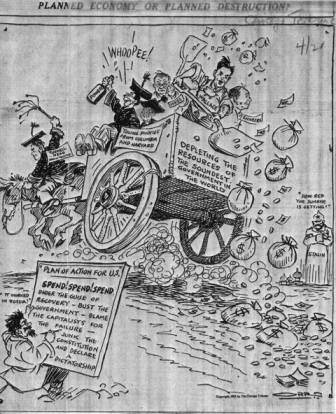
1934 Cartoon

We went off the gold standard in 1934 and solvency was never again an issue for the Federal government.

Those ‘sound money’ people were wrong then and are wrong now as taxes function to regulate aggregate demand and not to raise revenue per se.

This cartoon is claimed to be from the Chicago Tribune in 1934. Look carefully at the plan of action in the lower left corner.

UK Economy Grew Unrevised 0.3% in First Quarter

Still looks to me like the UK budget deficit has been more than sufficient to support at least modest GDP growth.

UK Headlines:

U.K. Economy Grew Unrevised 0.3% in First Quarter

U.K. Consumers Predict Economy Will Worsen, GfK Survey Shows

U.K. Mortgage Approvals Rose 2% in May From April, CML Says

U.K. Profit Warnings to Climb as Deficit Cuts Kick In, E&Y Says

Osborne Says U.K. Budget Cuts Needed to Avoid ‘Downward Spiral’

U.K.’s Budd to Propose More Independent OBR, Telegraph Says

Blanchflower Says Economy May See Long Decade of Slow Growth

DPJ Suffers Crushing Defeat; LDP Wins Most Seats

The loss seems to have been over the proposed sales tax increase, which would have been a strong negative for GDP, so this result is equity friendly:

“Public support for the DPJ rebounded when Kan took, but tumbled quickly after he floated a rise in the sales tax from 5 percent to help rein in debt.”

“Critics blame Kan’s eagerness to hike the rate for causing the DPJ’s major defeat in Sunday’s Upper House election.”

Japan Headlines:

DPJ Suffers Crushing Defeat; LDP Wins Most Seats

Corp Goods Prices Up 0.5% On Year In June

Japan’s used vehicle sales in Jan.-June fall to 2nd-lowest level

IMF Shinohara: Japan Must Be Cautious Discussing Taxes; No Sharp Yuan Rise

Edano: Won’t Rigidly Stick To Drafting Sales Tax Hike This Fiscal Year

LEAD: Tokyo stocks edge lower as post-election uncertainty weighs+

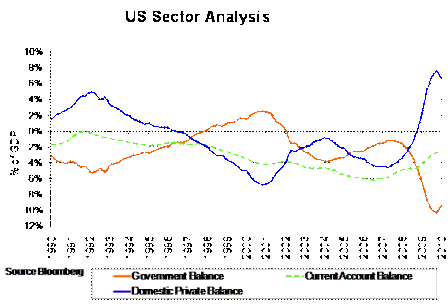
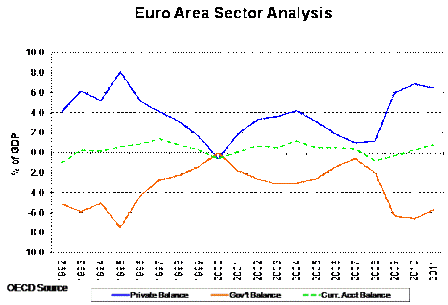
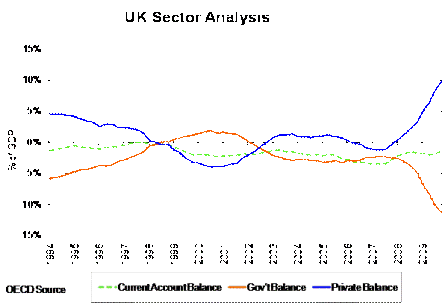
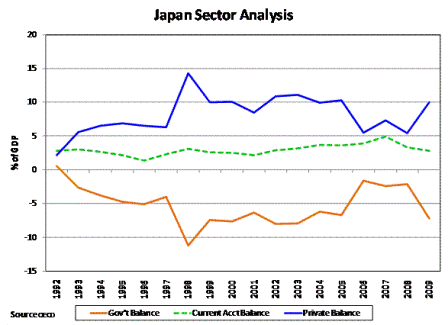
Sector Analysis Update

Looks like the deficits got high enough in the US and Euro zone to reverse things, and I’d guess UK and Japan as well even though the charts don’t yet show the reversal because past deficits of this magnitude would have been more than sufficient and there recent data is showing signs of a turn.

This is all usually indicative of a multi year upturn, who magnitude depends on the extent private credit expansion kicks in.
In the past the ‘borrow to spend’ private credit expansions have been helped by a variety of ‘peculiar’ events, including the credit expansion due to sub prime and other housing frauds most recently, the dot com era’s borrowing to fund impossible business plans, the credit expansion driven by the S and L frauds in the 80’s, emerging market credit expansion before that, etc. etc.

This time might be different/less robust if credit expansion channels are kept honest and fiscal policy tightened.

Non-Mfg ISM

With deficit spending running at about 7% of gdp modest growth should continue, with the ‘hand off’ coming when private sector credit expansion kicks in, which could be a while.


Karim writes:

Slowing, but still firmly in expansionary mode.
15 industries expand, 2 contract, 4 unch.


What respondents are saying…

  • “The general upswing in the economy, albeit minor, has had a positive effect.” (Arts, Entertainment & Recreation)
  • “Pricing pressures continue to increase as we see the economy begin to improve. Orders are still lagging in our industry.” (Professional, Scientific & Technical Services)
  • “Slow pace, but better than last year at this time.” (Accommodation & Food Services)
  • “Funding issues and cash flow issues continue to affect public sector procurement. Almost all capital acquisitions have been suspended.” (Public Administration)
  • “We have seen a slight improvement in business activity over the past month.” (Wholesale Trade)


June May
Composite 53.8 55.4
Activity 58.1 61.1
Prices Paid 53.8 60.6
New Orders 54.4 57.1
Employment 49.7 50.4
Exports Orders 48.0 53.5
Imports 48.0 56.5

Comment on EU Daily

On Thu, Jun 24, 2010 at 7:37 AM, wrote:

you seem to be arguing that the fix is in for the eurozone. is that a correct read?

Yes, looks like it to me.

if so, then your expected rise in the euro could occur sooner rather than later.

Yes.

seems to me that it will be difficult for the euro to rally anytime soon as central banks / portfolio managers trim their euro exposure on any strength.

Right, the portfolio shifting may not have run its course yet. That’s the risk. I’m thinking a sell off in gold, which went up this last bit due to euro fears, will signal the turn in psychology/reduction in euro fear.

With restructuring risk already on the table, seems it has to be mainly discounted in that anyone who can readily shift out of euro already have, and for those still holding euro financial assets they probably have euro liabilities and don’t want to add currency risk by shifting out of euro?

I suppose the real test will be the next mini funding crisis to see how the euro handles that stress.

Makes sense.

i’m getting fixated on the whole monetarists vs keynesian showdown that seems to be unfolding. in my mind the Greenspan era conditioned traders to believe that monetary policy was all powerful and the solution to every bump in the road. with rates near zero almost everywhere that impression will certainly fade.

And rightly so. The reality is sinking in that the Fed has no more meaningful tools, and the ones they thought they had can only help liquidity, and not support aggregate demand beyond keeping it from getting worse due to liquidity issues.

at the same time, the magnitude of the financial crisis and now the Greek crisis has seriously damaged the credibility of deficit spending.

Yes, for the wrong reasons, but I agree that’s the perception that’s driving policy.

so here we are with little faith in either concept and no clear sign anywhere of the handoff from public sector to private sector demand growth.

Right, that hand off traditionally comes from a return of private sector credit expansion, mainly housing and cars, which still hasn’t taken hold in this cycle. With all the demand leakages of unspent income due to pension funds, corp reserves, etc, some entity has to spend more than its income to make up for that.

I see a big test of theory coming in the next few years with little ammunition to proactively fight.

interesting times for sure.

Depressing, too.

I’d like to live during at least one period of true prosperity that’s ours for the taking in this time of abundant resources and geometrically expanding technology.