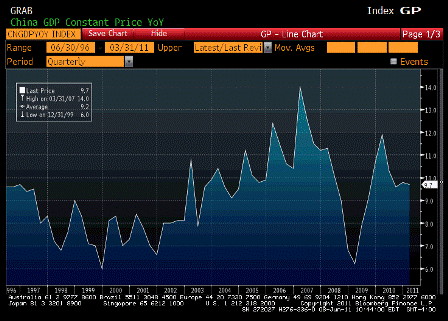
China GDP history

This is year over year ‘real’ GDP growth.

Note the recurring first quarter spikes followed by dips, presumably due to front loading annual state spending and lending.

Not much of a spike this year, due to cutbacks in state spending/lending, but the reduced spending/lending that resulted in the reported growth was likewise front loaded for 2011.

Question now is what the traditional second half dip will look like.
Seems to me it could get pretty ugly.

Also, Japan’s earthquake looks to have weakened world growth more than originally expected. And it’s all probably path dependent, meaning growth simply resumes from the lower, post quake base, especially in light of their reluctance to increase their deficit spending.

Europe is also weakening due to self imposed austerity.

And the US is heck bent on doing same as both parties agree on the need for multi trillions of deficit reduction, while Fed policies continue to work to reduce govt. interest payments to the economy and continue to shift income from savers to bank net interest margins.

H2 is still looking hopeless to me, and also looking like we’re flying without a net.
Rogoff on CNN

>   
>   (email exchange)
>   
>   On Jun 2, 2011, Pavlina wrote:
>   
>   Talk about not-so-innocent fraud, Rogoff on CNNs Fareed Zakaria GPS on right now:

>   

“You can’t really say the US can never pay its debts, since so much depends on politics and willingness to pay, but the debt to GDP ratio is so high that it will be difficult to dig ourselves out of this hole.”

>   
>   Hmmm? I don’t remember seeing the “politics and willingness to pay” argument in their book.
>   

the euro zone in transition

As previously discussed since inception, operationally the euro zone, much like every other nation with its own currency, will, one way or another, wind up with the ECB, the issuer of the currency,
‘funding’ fiscal deficits sufficient to meet any net savings desires in that currency, as well as funding the banking system’s liabilities.

The open question has always been is how it gets from here to there, and the answer to that has never been clear.

So far it’s doing it with great reluctance, with the ECB funding the banking system and select national govts only as a last resort, and not yet in the normal course of business.

A weakening global economy now seems to be forcing the next move towards the ultimate expected outcome.

We may have reached that point where their austerity measures, rather than bringing national govt deficits down, will instead make those deficit go up, as they induce macro economic weakness which ‘automatically’ increases transfer payments and decreases tax revenues.

This is a highly unstable equilibrium condition that can accelerate into a variety of forms of oblivion, which ultimately reaches the core as default risk premiums move down the line, much like a multi car pile up as one car after another crashes into the lead pack of wrecked cars.

And as the core is threatened, holders of euro financial assets, including foreign govts that hold various forms of euro financial assets as foreign currency reserves, feel the walls closing in, as one credit after another falls by the wayside.

Only a sudden increase in world aggregate demand, or a sudden change of policy that includes pro active ECB funding, is likely to be able to reverse what’s been happening

What Happens When the Government Tightens its Belt?

What Happens When the Government Tightens its Belt?

By Stephanie Kelton

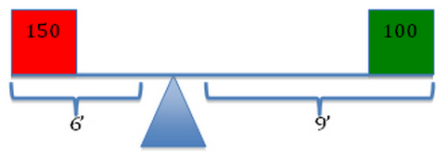
May 27 — Imagine two people sitting on opposite ends of a 15-foot teeter-totter. The laws of physics dictate that the seesaw will balance if the product of the first mass (w1) and its distance (d1) from the fulcrum (i.e. the balancing point) is equal to the product of the other mass (w2) and its distance (d2) from the fulcrum. Thus, the physicist can show that the teeter-totter will be in balance when the fulcrum is placed 6 feet from the end holding a 150lb person and 9 feet from the end holding a 100lb person. Moreover, the laws of physics ensure that an imbalance will arise if the mass or the relative position of one of the people is changed.


The laws of accounting allow us to demonstrate that similarly powerful concepts apply to the science of economics. Beginning with the simple identity for GDP in a closed economy, we have:

[1] Y = C + I + G, where:

   Y = GDP = National Income
   C = Aggregate Consumption Expenditure
   I = Aggregate Investment Expenditure
   G = Aggregate Government Expenditure

For economists, this is as obvious as stating that a linear foot is the sum of 12 sequential inches. It simply recognizes that the total amount of money spent buying newly produced goods and services will yield an equivalent income to the sellers of these products. Thus, it demonstrates that expenditures are a source of income.

Once earned, income can be allocated in one of three ways. At the end of the day, all income (Y) will be spent (C), saved (S) or used in payment of taxes (T):

[2] Y = C + S + T

Since they are equivalent expressions for Y, we can set equation [1] equal to equation [2], giving us:

C + I + G = C + S + T

Or, after canceling (C) from both sides and moving terms around:

[3] (S – I) = (G – T)

Equation [3] shows that there is a direct relationship between what’s happening in the private sector (S – I) and what’s happening in the public sector (G – T). But it is not the one that Pete Peterson, Erskin Bowles, or President Obama would have you believe. And I want you to understand why they are wrong.

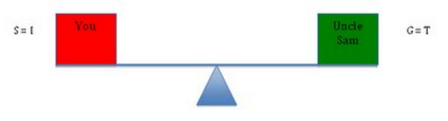
To understand the argument, imagine that you and Uncle Sam are sitting on opposite ends of a teeter-totter. You represent the private sector, and your financial status is given by (S – I). Your budget can be in balance (S = I), in deficit (S < I) or in surplus (S > I). When your financial status is positive (S > I), you are net saving. When your financial status is negative (S < I), you are net borrowing. Uncle Sam’s financial status is equal to (G – T), and, like yours, his budget may be balanced (G = T), in deficit (G > T) or in surplus (G < T). When you interact, only three outcomes are possible.
First, it is conceivable that (S = I) and (G = T) so that (S – I) = 0 and (G – T) = 0. When this condition holds, the teeter-totter will level off with each of you experiencing a balanced budget.

In the above scenario, the government is balancing its receipts (T) and expenditures (G), and you are balancing your savings and investment spending. There is no net gain/loss.

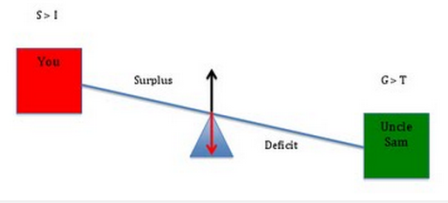
But suppose the government begins to spend more than it collects in taxes (i.e. G > T). How will Uncle Sam’s deficit affect your position on the teeter-totter? The answer is as straightforward as increasing the mass of the person on the right-hand side of the seesaw. As Uncle Sam’s financial position turns negative, your financial position turns positive.

This should make intuitive as well as mathematical sense, because when Uncle Sam runs a deficit, you receive more financial assets than you lose through taxation. Put simply, Uncle Sam’s deficit lifts you into a surplus position. Moreover, bigger deficits mean bigger surpluses for you.

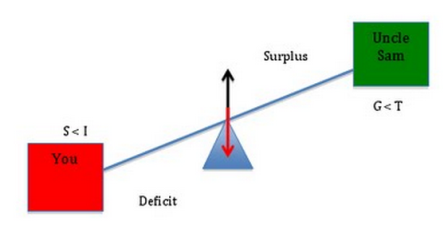
Finally, let’s see what happens when Uncle Sam tightens his belt. Suppose, for example, that we were able to duplicate the much-coveted surpluses of 1999-2001. What would (and did!) happen to the private sector’s financial position?

Because the economy’s financial flows are a closed system – every payment must come from somewhere and end up somewhere – one sector’s surplus is always the other sector’s deficit. As the government “tightens” its belt, it “lightens” its load on the teeter-totter, shifting the relative burden onto you.

This is not rocket science, but it appears to befuddle scores of educated people, including President Obama, who said, “small businesses and families are tightening their belts. Their government should, too.” This kind of rhetoric may temporarily boost his approval ratings, but the policy itself will undermine the efforts of the very families and small businesses that are trying to improve their financial positions.

* I’ll be back with a second installment that shows what happens when we ‘open’ the economy to take into account the foreign sector (and the relevant financial flows). Many of us have been working with financial balance equations for years (see herefor references), so the current effort is nothing new. I am merely trying to make the arguments more accessible by changing the way they are presented.

G8: Deficit Terrorism Leads Agenda

In the land of the blind, the one eyed man gets his good eye poked out.

While the statement regarding the US is perhaps a tad on the soft side, globally, political will and public support appears firmly in place for further stagnation and a too large output gap for the foreseeable future.

World Recovery Is Gaining Strength, Watch Debt: G8

May 27 (Reuters) — The Group of Eight leaders agreed on Friday that the global economy recovery was becoming more “self-sustained,” although higher commodity prices were hampering further growth.

In a communique to be issued at the end of a two-day summit in France, a copy of which was obtained by Reuters, European nations, the United States and Japan all agreed to ensure their public finances were sustainable.

“The global recovery is gaining strength and is becoming more self-sustained. However, downside risks remain, and internal and external imbalances are still a concern,” the communique said.

“The sharp increase in commodity prices and their excessive volatility pose a significant headwind to the recovery. In this context, we agreed to remain focused on the action required to enhance the sustainability of public finances, to strengthen the recovery and foster employment, to reduce risks and ensure strong, sustainable and balanced growth, including through structural reforms.

Europe has adopted a broad package of measures to deal with the sovereign debt crisis faced by a few countries, and it will continue to address the situation with determination and to pursue rigorous fiscal consolidation alongside structural reforms to support growth.

The United States will put in place a clear and credible medium-term fiscal consolidation framework, consistent with considerations of job creation and economic growth.

In Japan, while providing resources for the reconstruction after the disaster, the authorities will also address the issue of sustainability of public finances.”

Consumer Spending Cools More Than Estimated, Wages Gain Less, Profits and Manufacturing Decelerate

Not good for this part of the cycle, as we remain grossly overtaxed for the size govt we have

Consumer Spending Cools More Than Estimated

By Shobhana Chandra

May 26 (Bloomberg) — Consumer spending cooled in the first quarter more than previously estimated as the jump in food and fuel costs held back the biggest part of the U.S. economy.

Household purchases rose at a 2.2 percent annual pace from January through March, less than the 2.7 percent calculated last month and short of the 2.8 percent median forecast of economists surveyed by Bloomberg News, according to Commerce Department figures issued today in Washington. The economy grew at a 1.8 percent pace last quarter, the same as previously calculated.

The number of workers filing applications for unemployment insurance benefits increased by 10,000 to 424,000 in the week ended May 21, according to data from the Labor Department. The median forecast of economists surveyed by Bloomberg projected claims would decrease to 404,000.

A monthlong slide in consumer confidence ended last week as gasoline prices retreated, another report showed. The Bloomberg Consumer Comfort Index rose to minus 48.4 in the period to May 22 from a nine-month low of minus 49.4 the prior week. Readings of minus 40 or less are generally associated with recessions and their aftermaths, the report said.

The economy last quarter maintained the previously reported pace of growth as bigger gains in inventories and a smaller decline in commercial construction compensated for the slowdown in spending.

The gain in consumer purchases, which account for about 70 percent of the economy, followed a 4 percent increase in the fourth quarter was the biggest since the end of 2006. Cuts in spending on gasoline and utilities, combined with a smaller increase in demand for autos, contributed to the slowdown in the first three months of the year.

The price gauge tied to spending increased at a 3.8 percent pace in the first quarter, the biggest advance since the third quarter of 2008. Excluding food and fuel, the numbers tracked by Federal Reserve policy makers, prices climbed at a 1.4 percent rate.

Smaller Wage Gain

The GDP report also showed wages and salaries climbed by $27.9 billion from October through December, down from a prior estimate of $52.5 billion. Real disposable income, or after-tax earnings adjusted for inflation, climbed 1.1 percent in the fourth quarter, rather than the 1.9 percent gain previously estimated. They rose 0.8 percent in the first three months of the year, less than the 2.9 percent prior calculation.

The smaller gain in pay dwarfed the slowdown in spending, pushing the savings rate down to 5.1 percent in the first quarter from a prior estimate of 5.7 percent.

Today’s report also offered a first look at profits. Earnings before taxes were up 1.3 percent from the prior quarter, the smallest gain in more than two years, after rising 2.3 percent in the prior period. They climbed 8.5 percent from the same time last year.

Manufacturing, which accounts for 12 percent of the economy, is slowing this quarter as disruptions in the supply of components temporarily weigh on production until Japanese factories recover from the fallout of the March disaster.

Growth Forecasts

Economists at Goldman Sachs Group Inc. and JPMorgan Chase & Co. in New York each cut second-quarter growth forecasts by half a percentage point this week, citing setbacks in vehicle output caused by supply disruptions. Goldman trimmed its projection to 3 percent, while JPMorgan lowered it to 2.5 percent.

former President Clinton on the debt ceiling issue

Just in case you thought former President Clinton ever understood the monetary system:

Bill Clinton: Brief Debt Default ‘Might Not Be Calamitous’

“We regret if there has been a misinterpretation of a comment President Clinton made about raising the debt limit. President Clinton did not in any way mean to suggest that a default would not be highly damaging for the economy even for a very short period of time. He inadvertently misspoke. What he meant to say was that if a vote to extend the debt limit failed in advance of a default, that might not be harmful for a couple of days, but that if people thought that we might actually default, that in his words ‘we were literally not going to pay our bills anymore, then they would stop buying our debt.'”

Beware of ‘Debt Bomb’ and $70-$80 crude : Prince Alwaleed

So how would the fact that even the world’s largest investors don’t even begin to understand the monetary system
fit into the various theories about markets efficiently allocating capital, etc?

And note that he also did just say on CNBC the Saudi’s objective is $70-80 for crude.
So even though he’s probably not the decision maker, seems he does understand how a monopolist sets price.

Raise Ceiling but Beware of ‘Debt Bomb’: Prince Alwaleed

By Jeff Cox

May 20 (CNBC) &#8212 Saudi Prince Alwaleed bin Talal called on US lawmakers to raise the debt ceiling, while also warning that steps must be taken to control government spending.

The renowned investor and philanthropist, and nephew of King Abdullah, also rejected the notion that the US could delay payments on its bonds for several days as has been suggested by Rep. Paul Ryan and hedge fund manager Stanley Druckenmiller.

“We in the outside world, outside the United States, believe the United States is not giving much care and attention to this time bomb that you have right now here,” bin Talal said in a CNBC interview.

“You need some structural changes in the United States,” he added. “You can’t go forever with $1 trillion in arrears. That’s the thing.”