Clinton thanks China for buying US Treasury Securities


[Skip to the end]

US, China Agree to Broaden Strategic Dialogue, Clinton Says

by Indira A.R. Lakshmanan and Eugene Tang

Feb 22 (Bloomberg) — Clinton thanked China for its continued purchases of U.S. Treasury notes, demand for which is needed to pay for Obama’s $787 billion stimulus plan.

No it isn’t. It will be a very different world when our leaders somehow come to realize how the monetary system works.

Yang said China, the world’s largest holder of Treasuries, will invest its almost $2 trillion in foreign-currency reserves based on the principles of ensuring liquidity and protecting value.

‘Appreciate Greatly’

“I appreciate greatly the Chinese government’s continuing confidence in U.S. Treasuries,” Clinton said. “I think that’s a well-grounded confidence.”

At an earlier meeting, State Councilor Dai Bingguo told Clinton that she looked “younger and more beautiful” than she appears on television.

Chuckling heartily, Clinton said, “Well, we will get along very well.”

Glad to see the US not saying anything negative about China’s new export subsidies announced last week.


[top]

Re: Martin Wolf spot on


[Skip to the end]

(email exchange)

Cliff,

Martin Wolf is spot on below. Our biggest risk is the reluctance of our leaders to implement the fiscal adjustments on an as needed, size no object, basis to reverse shortfalls in aggregate demand.

>   
>   On Fri, Feb 20, 2009 at 11:11 AM, Cliff wrote:
>   
>   Warren,
>   
>   Many people ask me why Japan did not have large
>   inflation with their large deficits,
>   

They weren’t even large enough to fully offset the deflationary forces.

>   
>   and they ask will the U.S. be like Japan or will
>   inflation recur in the next few years.
>   

Depends on crude prices. If they go up inflation as we know it comes back. This is very likely.

We need a hard policy to cut our imported fuel consumption to prevent ‘inflation’ and declining real terms of trade.

>   
>   Please see the article below, and can you
>   comment on the article and the related two
>   questions posed above.
>   
>   Thanks, Cliff
>   

Japan’s lessons for a world of balance-sheet deflation

by Martin Wolf

Feb 17 (Financial Times) — What has Japan’s “lost decade” to teach us? Even a year ago, this seemed an absurd question. The general consensus of informed opinion was that the U.S., the U.K. and other heavily indebted western economies could not suffer as Japan had done. Now the question is changing to whether these countries will manage as well as Japan did. Welcome to the world of balance-sheet deflation.

As I have noted before , the best analysis of what happened to Japan is by Richard Koo of the Nomura Research Institute.* His big point, though simple, is ignored by conventional economics: balance sheets matter. Threatened with bankruptcy, the overborrowed will struggle to pay down their debts. A collapse in asset prices purchased through debt will have a far more devastating impact than the same collapse accompanied by little debt.

Most of the decline in Japanese private spending and borrowing in the 1990s was, argues Mr Koo, due not to the state of the banks, but to that of their borrowers. This was a situation in which, in the words of John Maynard Keynes, low interest rates – and Japan’s were, for years, as low as could be – were “pushing on a string”. Debtors kept paying down their loans.

How far, then, does this viewpoint inform us of the plight we are now in? A great deal, is the answer.

First, comparisons between today and the deep recessions of the early 1980s are utterly misguided. In 1981, U.S. private debt was 123 per cent of gross domestic product; by the third quarter of 2008, it was 290 per cent. In 1981, household debt was 48 per cent of GDP; in 2007, it was 100 per cent. In 1980, the Federal Reserve’s intervention rate reached 19-20 per cent. Today, it is nearly zero.

When interest rates fell in the early 1980s, borrowing jumped. The chances of igniting a surge in borrowing now are close to zero. A recession caused by the central bank’s determination to squeeze out inflation is quite different from one caused by excessive debt and collapsing net worth. In the former case, the central bank causes the recession. In the latter, it is trying hard to prevent it.

Second, those who argue that the Japanese government’s fiscal expansion failed are, again, mistaken. When the private sector tries to repay debt over many years, a country has three options: let the government do the borrowing; expand net exports; or let the economy collapse in a downward spiral of mass bankruptcy.

Despite a loss in wealth of three times GDP and a shift of 20 per cent of GDP in the financial balance of the corporate sector, from deficits into surpluses, Japan did not suffer a depression. This was a triumph. The explanation was the big fiscal deficits. When, in 1997, the Hashimoto government tried to reduce the fiscal deficits, the economy collapsed and actual fiscal deficits rose.

Third, recognising losses and recapitalising the financial system are vital, even if, as Mr Koo argues, the unwillingness to borrow was even more important. The Japanese lived with zombie banks for nearly a decade. The explanation was a political stand-off: public hostility to bankers rendered it impossible to inject government money on a large scale, and the power of bankers made it impossible to nationalise insolvent institutions. For years, people pretended that the problem was downward overshooting of asset price. In the end, a financial implosion forced the Japanese government’s hand. The same was true in the U.S. last autumn, but the opportunity for a full restructuring and recapitalisation of the system was lost.

In the U.S., the state of the financial sector may well be far more important than it was in Japan. The big US debt accumulations were not by non-financial corporations but by households and the financial sector. The gross debt of the financial sector rose from 22 per cent of GDP in 1981 to 117 per cent in the third quarter of 2008, while the debt of non-financial corporations rose only from 53 per cent to 76 per cent of GDP. Thus, the desire of financial institutions to shrink balance sheets may be an even bigger cause of recession in the US.

How far, then, is Japan’s overall experience relevant to today?

The good news is that the asset price bubbles themselves were far smaller in the US than in Japan. Furthermore, the U.S. central bank has been swifter in recognising reality, cutting interest rates quickly to close to zero and moving towards “unconventional” monetary policy.

The bad news is that the debate over fiscal policy in the U.S. seems even more neanderthal than in Japan: it cannot be stressed too strongly that in a balance-sheet deflation, with zero official interest rates, fiscal policy is all we have. The big danger is that an attempt will be made to close the fiscal deficit prematurely, with dire results. Again, the U.S. administration’s proposals for a public/private partnership, to purchase toxic assets, look hopeless. Even if it can be made to work operationally, the prices are likely to be too low to encourage banks to sell or to represent a big taxpayer subsidy to buyers, sellers, or both. Far more important, it is unlikely that modestly raising prices of a range of bad assets will recapitalise damaged institutions. In the end, reality will come out. But that may follow a lengthy pretence.

Yet what is happening inside the US is far from the worst news. That is the global reach of the crisis. Japan was able to rely on exports to a buoyant world economy. This crisis is global: the bubbles and associated spending booms spread across much of the western world, as did the financial mania and purchases of bad assets. Economies directly affected account for close to half of the world economy. Economies indirectly affected, via falling external demand and collapsing finance, account for the rest. The US, it is clear, remains the core of the world economy.

As a result, we confront a balance-sheet deflation that, albeit far shallower than that in Japan in the 1990s, has a far wider reach. It is, for this reason, fanciful to imagine a swift and strong return to global growth. Where is the demand to come from? From over-indebted western consumers? Hardly. From emerging country consumers? Unlikely. From fiscal expansion? Up to a point. But this still looks too weak and too unbalanced, with much coming from the US. China is helping, but the eurozone and Japan seem paralysed, while most emerging economies cannot now risk aggressive action.

Last year marked the end of a hopeful era. Today, it is impossible to rule out a lost decade for the world economy. This has to be prevented. Posterity will not forgive leaders who fail to rise to this great challenge.


[top]

Paying off China for Dummies


[Skip to the end]

So how do we pay off those Treasury securities held by China?

Treasury securities are held in accounts at the US Federal Reserve.

Let’s assume $1 billion of Treasury securities held by China comes due tomorrow.

Here’s what would happen tomorrow:

  1. The US Federal Reserve would lower the amount of Treasury securities still held by China by $1 billion.
  2. The US Federal Reserve would increase the number of dollars in China’s bank account at the US Federal Reserve by $1 billion plus interest.

The US Federal Reserve keeps the books and increases and decreases these balances just by changing the numbers on its books.

That’s how it is and has always been.

Paying off the Federal debt is nothing more than debiting a securities account and crediting a member bank account at the Fed.


[top]

Chery Unveils Plug-in Hybrid, Trumps GM Volt’s Range


[Skip to the end]

Good news for cutting crude consumption some day, bad news for GM.

Chery Unveils Plug-in Hybrid, Trumps GM Volt’s Range

by Tian Ying

Feb 20 (Bloomberg) — Chery Automobile Co., China’s largest maker of own-brand cars, unveiled its first plug-in hybrid, touting a range more than twice as far as General Motors Corp.’s planned Volt.

The S18 can travel as much as 150 kilometers (93 miles) using just its batteries, Chery said in a statement posted on its Web site yesterday. GM’s Volt, due to go on sale next year, has a range of 64 kilometers. Chery has no timetable as yet on when the S18 will go on sale, spokesman Jin Yibo said in an interview by phone today.

China has encouraged domestic automakers to develop alternative-energy vehicles to curb oil imports and pollution, as well as to help the local industry challenge GM and Toyota Motor Corp. overseas. BYD Co., the Chinese automaker backed by billionaire Warren Buffett, started selling the world’s first mass-produced plug-in hybrid in December.

The Chinese government plans to support domestic automakers’ research into alternative-energy vehicles in a bid to have 60,000 on the roads of 10 cities by 2012, Science Minister Wan Gang said in November.

Automobiles account for about half of the total oil consumption in China, the world’s largest vehicle market behind the U.S. That may rise to 60 percent by 2020, according to the Development Research Center of the State Council.

Plug-in cars can be recharged from standard household powerpoints. The S18 can be fully charged in as little as four hours and be 80 percent powered via a quick charge at a specialist station in 30 minutes, Chery said.

Subsidies

BYD’s F3 DM can run for 100 kilometers using only batteries. It takes as little as seven hours to fully charge and can be 50 percent powered via a quick charge at a specialist station in 10 minutes.

To help support the development of alternative-energy technologies, the Chinese government plans to give out subsidies of as much as 600,000 yuan ($88,000) per vehicle to public- transport operators and government agencies to help fund purchases of electric, hybrid and fuel-cell automobiles.

Chrysler LLC, the third-largest U.S. automaker, is forecasting sales of battery-powered cars exceeding 100,000 a year by 2013 and GM is counting on selling 60,000 of its first such model in the year after it goes on sale in 2010.

Gasoline-electric hybrids and other electric vehicles made up 2.2 percent of the U.S. market in 2007, according to J.D. Power & Associates, which expects that share to expand to 7 percent by 2015.


[top]

2009-02-18 USER


[Skip to the end]


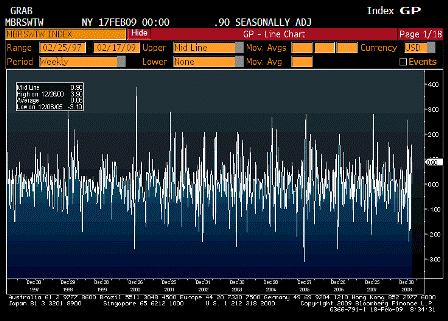
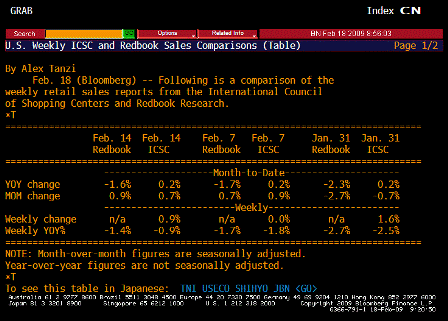
ICSC UBS Store Sales WoW (Feb 10)

Survey n/a
Actual 0.90%
Prior 0.00%
Revised n/a

[top][end]

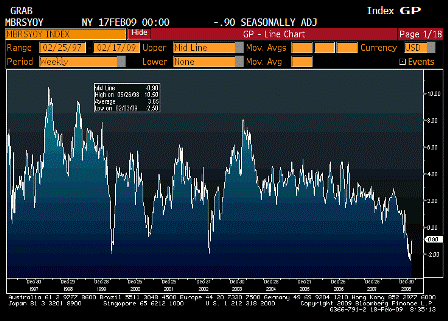
ICSC UBS Store Sales YoY (Feb 10)

Survey n/a
Actual -0.90%
Prior -1.80%
Revised n/a

[top][end]

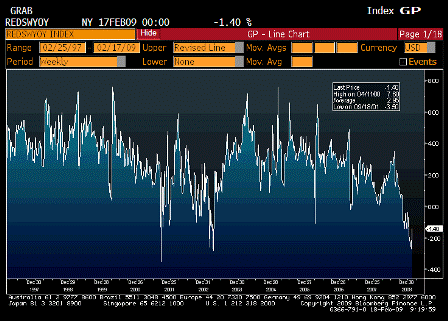
Redbook Store Sales Weekly YoY (Feb 10)

Survey n/a
Actual -1.40%
Prior -1.70%
Revised n/a

[top][end]

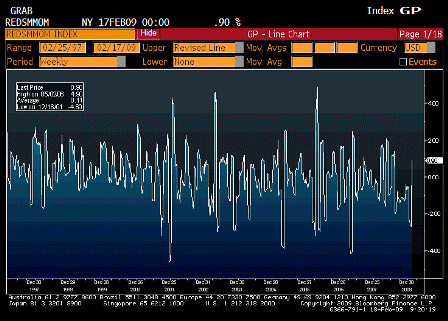
Redbook Store Sales MoM (Feb 10)

Survey n/a
Actual 0.90%
Prior 0.70%
Revised n/a

[top][end]

ICSC UBS Redbook Comparison TABLE (Feb 10)

[top][end]


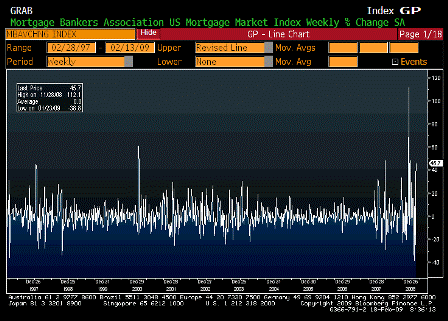
MBA Mortgage Applications (Feb 13)

Survey n/a
Actual 45.7%
Prior -24.5%
Revised n/a

[top][end]

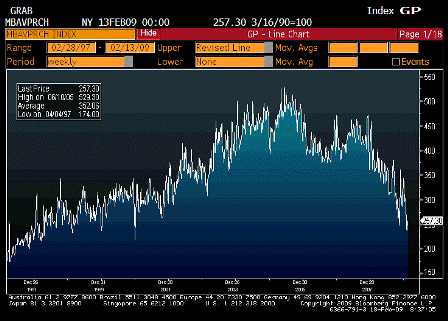
MBA Purchasing Applications (Feb 13)

Survey n/a
Actual 257.30
Prior 235.90
Revised n/a

[top][end]

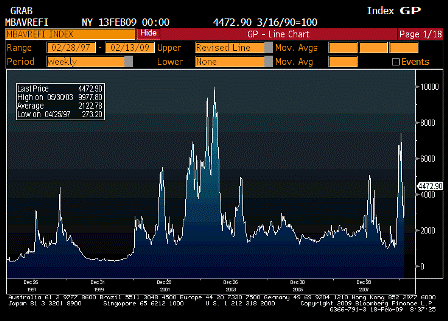
MBA Refinancing Applications (Feb 13)

Survey n/a
Actual 4472.90
Prior 2722.70
Revised n/a

[top][end]


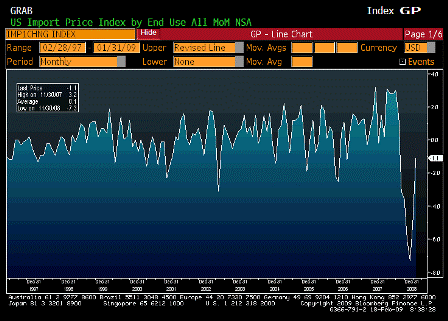
Import Price Index MoM (Jan)

Survey -1.2%
Actual -1.1%
Prior -4.2%
Revised -5.0%

 
Karim writes:

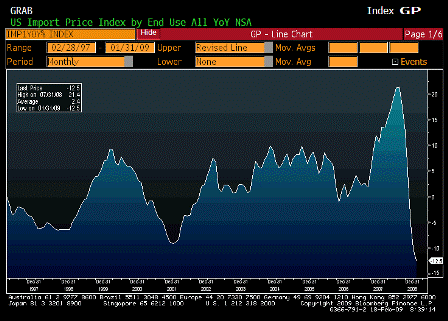
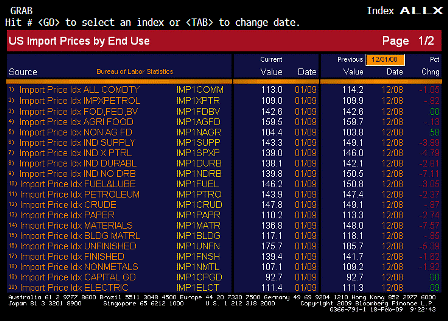
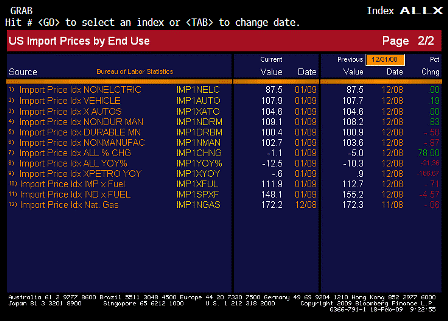
  • Import prices -1.1% m/m and -12.5% y/y; -0.8% m/m ex-petroleum; imports from China -0.7% m/m (-0.5% and -0.7% prior 2mths)
  • [top][end]

    Import Price Index YoY (Jan)

    Survey -11.2%
    Actual -12.5%
    Prior -9.3%
    Revised -10.3%

    [top][end]

    Import Price Index ALLX 1 (Jan)

    [top][end]

    Import Price Index ALLX 2 (Jan)

    [top][end]


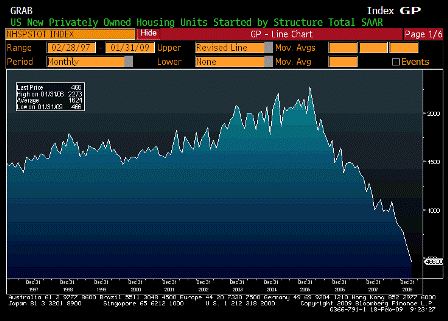
    Housing Starts (Jan)

    Survey 529K
    Actual 466K
    Prior 550K
    Revised 560K

     
    Karim writes:

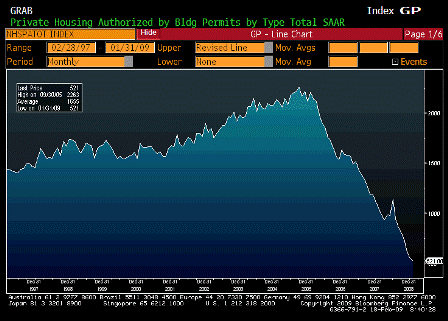
    Housing starts and building permits fall to all-time lows.

    • Starts -16.8% m/m (all 4 regions down) and -56.2% y/y; 3rd consecutive double digit m/m decline
    • Permits -4.8% m/m (all 4 regions down)
    • When adding the supply of vacant homes (over 1mm) to starts, excess supply (relative to new household formation and obsolesence) still exists and in turn downward pressure on home prices

    [top][end]

    Building Permits (Jan)

    Survey 525K
    Actual 521K
    Prior 549K
    Revised 547K

    [top][end]


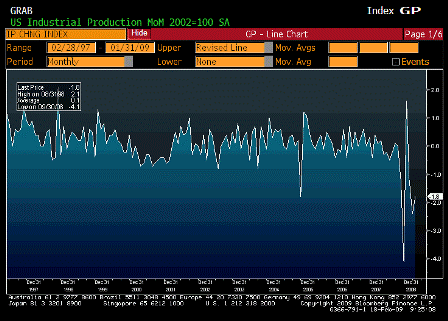
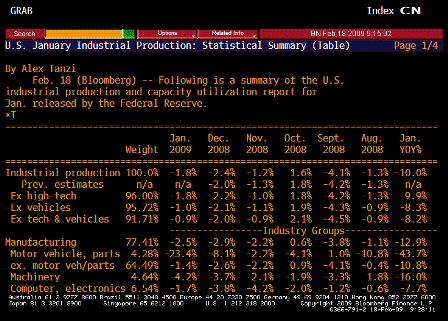
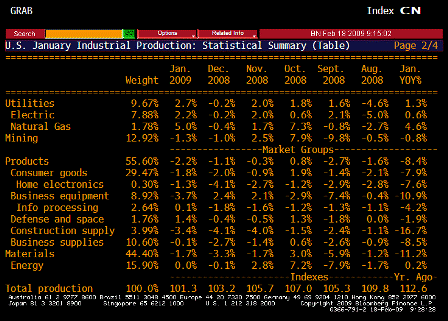
    Industrial Production MoM (Jan)

    Survey -1.5%
    Actual -1.8%
    Prior -2.0%
    Revised -2.4%

    [top][end]

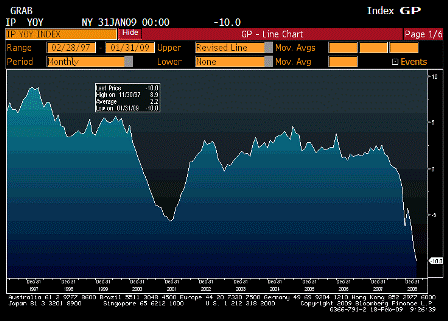
    Industrial Production YoY (Jan)

    Survey n/a
    Actual -10.0%
    Prior -8.2%
    Revised n/a

    [top][end]

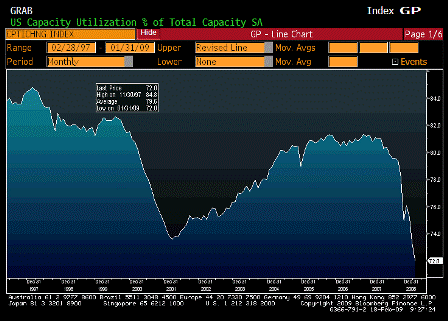
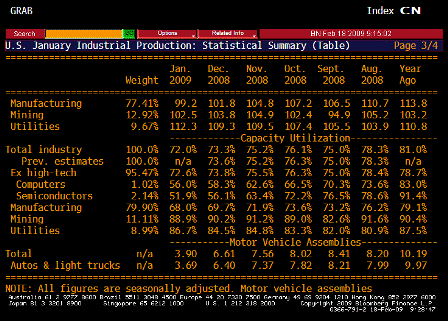
    Capacity Utilization (Jan)

    Survey 72.4%
    Actual 72.0%
    Prior 73.6%
    Revised 73.3%

    [top][end]

    Capacity Utilization TABLE 1 (Jan)

    [top][end]

    Capacity Utilization TABLE 2 (Jan)

    [top][end]

    Capacity Utilization TABLE 3 (Jan)


    [top]

    Clinton in Japan


    [Skip to the end]

    Isn’t this sweet???

    Clinton, in Japan, talks of ‘harmony’ in US policy

    by Arshad Mohammed

    Feb 17 (Reuters) — U.S. Secretary of State Hillary Clinton spoke on Tuesday of promoting “balance and harmony” in U.S. foreign policy as she visited Japan, drawing an implicit contrast to the administration of former President George W. Bush.

    Clinton began her first full day in Asia with a visit to Tokyo’s Meiji shrine, where she took part in a purification ceremony at the Shinto shrine dedicated to Emperor Meiji, considered the father of modern Japan.

    Yes, a US democrat honoring emperors and royalty.

    Making her first trip as secretary of state, Clinton plans to consult Japanese officials on how to deal with the global financial crisis,

    If she has any ideas why hasn’t she told us?

    North Korea’s nuclear programs and the war in Afghanistan, a legacy of the Bush administration.

    “I started this morning at the Meiji shrine and was talking to the head priest there who told me about the importance of balance and harmony,” Clinton told about 200 U.S. diplomats and their families at the U.S. embassy.

    “It’s not only a good concept for religious shrines, it’s a good concept for America’s role in the world,” she added, without citing Bush by name or the U.S.-led invasion of Iraq, which polarized global opinion. “We need to be looking to create more balance, more harmony.”

    Reads like she’s broadening her religious beliefs???

    “We’re going to be listening but we’re also going to be asking for more partnerships to come together to try to work with us to handle the problems that none of us can handle alone,” Clinton added, referring partly to the global financial crisis.

    Partnerships to do what? No secrets, please!

    Japan has been especially hit hard by the economic slowdown. Its economy shrank in the final quarter of 2008 at the fastest rate since the first oil crisis in 1974, and economists bet on another big contraction in January-March.

    “These are hard times economically for the Japanese people, just as it is in many places around the world,” Clinton said. “I am absolutely confident we will navigate our way through these difficulties.”

    The blind leading the blind, but this time holding hands?

    China next…


    [top]

    Commodities bottoming as the great Mike Masters inventory liquidation runs its course


    [Skip to the end]

    It all came to a near halt with the world wide inventory liquidation. Now flows are resuming but will be at lower levels than before, reflecting lower demand.

    Prices should recover over time to something above replacement costs.

    Look for deteriorating real terms of trade for the US as the modest fiscal adjustment adds to demand, and import prices grow faster than export prices, led by Saudi crude pricing.

    Shipping Index Surge Signals Commodity Currency Gains

    by Ye Xie and Candice Zachariahs

    Feb 17 (Bloomberg) — Shipping costs have more than doubled this year, so it may be time to buy kroner, Aussies and loonies.

    The 147 percent jump in ocean-transport prices is evidence that China’s $580 billion stimulus plan will lift raw materials, said Ihab Salib, who oversees $3 billion at Federated Investments Inc. in Pittsburgh. That would benefit countries exporting them, so Salib is “actively trading” Norway’s krone and Australian and Canadian dollars, nicknamed Aussies and loonies.

    Salib and other currency traders have started using the Baltic Dry Index’s global gauge of raw-material shipping costs to help make such decisions. The index and the value of a basket of those three resource-rich countries’ currencies are increasingly moving in tandem — 96 percent of the time in the past year, up from 84 percent in the past decade, data compiled by Bloomberg show.

    “Historically, the Baltic Dry Index is a good leading indicator for commodity prices,” said Salib, who declined to detail his investments. “Commodities are very depressed right now, and they offer good long-term value. Once they come back, these currencies should do well.”

    The shipping gauge is a sign that China’s stimulus spending on housing, highways, airports and power grids will have impact beyond its borders. By Feb. 28, it will have spent 25 percent of its stimulus budget, Deutsche Bank AG said Jan. 20, predicting the country’s economy will grow at a 12 percent annual rate between the fourth and first quarter, after shrinking 2.3 percent between the third and fourth.

    Oil Rebound

    China is the world’s biggest consumer of copper and iron ore and has helped each rally this year by about 10 percent, benefiting Australia and Canada, which account for 10 percent of world production of the two metals. Oil,Norway’s top export, will average $66 a barrel in the fourth quarter, up from an average of $40.62 since Jan. 1, according to the median forecast of 34 analysts surveyed by Bloomberg. China is the world’s second-biggest energy user.


    [top]

    Domestic demand picking up in China?


    [Skip to the end]

    China’s Economy Shows Signs of Recovery on Stimulus

    by Kevin Hamlin

    Feb 13 (Bloomberg) — “China looks set to be the first major economy to recover from the current global meltdown,” said Lu Ting, an economist with Merrill Lynch & Co. in Hong Kong. “China is the only economy in the world to see significant growth in credit to corporate and household sectors after September 2008, when the financial crisis worsened to a near collapse.”

    State owned banks lending without all that much regard to credit quality functions like a fiscal transfer.

    The government’s stimulus plan, announced in November, is beginning to gather momentum. Projects such as the building of 3.5 billion yuan of public houses in Shaanxi province and Shanghai began in December, while Shandong province started work on three new railway lines the same month.

    China is committing about 1.2 trillion yuan of central government funds to the plan, which means banks’ willingness to fund projects is crucial. So far they are responding.

    Housing construction is real investment.

    Growth will accelerate from the current pace to 7.2 percent for the full year, according to Wang Qian, an economist with JPMorgan Chase & Co. in Hong Kong. Her calculation is that consumption will contribute 4.4 percentage points and investment 4 percentage points. The collapse in exports will slice off 1.2 percentage points.

    Stimulus spending will contribute up to 3 percentage points of the total, she estimates.

    Still low growth for China.

    China’s imported iron ore has climbed 28 percent to 690 yuan per metric ton since the end of October. Hot-rolled steel has surged 41 percent from Nov. 13 to 4,027 yuan per metric ton. The Baltic Dry Index, a measure of shipping costs for commodities, has more than doubled since Jan. 28.

    “You are starting to see the underlying demand of the Chinese economy,” BHP Billiton Ltd. Chief Executive Officer Marius Kloppers said Feb. 4. “We have seen in the steel business in China that the de-stocking cycle is almost complete and that means people are coming back into the market and buying.”

    BHP Billiton is the world’s third-largest producer of iron ore. China is its largest consumer.

    The post-Olympic lull is over?


    [top]

    Re: China’s new loans rise by record on stimulus efforts


    [Skip to the end]

    (email exchange)

    Yes, they use lending from their state owned banks as a fiscal adjustment, by lending with little concern about getting paid back.

    The question is how much is going to domestic demand and how much is going to subsidize exports. Probably mainly the latter.

    >   
    >   On Wed, Feb 11, 2009 at 11:48 PM, EDWARD wrote:
    >   
    >   The government mandates the lending, hence the concerns about loan
    >   quality and writedowns…but the government is also providing money and
    >   the rules are not necessarily the same as in the West…they may be
    >   effective to a point as the net aggregate demand lost from failure in the
    >   export sector needs to be replaced.
    >   

    China’s New Loans Rise by Record on Stimulus Efforts (Update 1)

    by Kevin Hamlin and Luo Jin

    Feb 12 (Bloomberg) — China’s new loans rose by a record in January and money supply expanded more quickly as the government implemented a 4 trillion yuan ($585 billion) stimulus package to revive the world’s third-largest economy.


    Banks extended 1.62 trillion yuan ($237 billion) of new local-currency loans and M2, the broadest measure of money supply, climbed 18.8 percent from a year earlier, the fastest pace in more than a year, the People’s Bank of China said today on its Web site.

    China’s government has put pressure on banks to boost lending as the government rolls out a stimulus package to reverse the nation’s economic slide. Loan default risk is the biggest single threat to Chinese lenders, which face “a choppy 2009” because the potential for credit losses is rising, Fitch Ratings said last month.


    [top]

    China crude drop only 8%


    [Skip to the end]

    Not nearly enough to dislodge the Saudis from being the swing producer and price setter now that the Great Mike Masters Inventory Liquidation has run its course.

    Beware an even modest recovery that increased crude consumption.

    China’s Net Crude Imports Decline to Lowest in a Year

    by Wang Ying

    Feb 11 (Bloomberg) — Crude-oil imports dropped by 8 percent to 12.82 million tons from a year earlier while overseas shipments of the fuel more than doubled, rising 156 percent to 450,000 tons, the customs said today.


    [top]