Broad-based slowdown in Eurozone manufacturing as domestic markets weaken

Broad-based slowdown in Eurozone manufacturing as growth hits 18-month low

(Markit) The final Markit Eurozone Manufacturing PMI fell to a one-and-a-half year low of 52.0 in June, down from 54.6 in May and unchanged from the earlier flash estimate. Incoming new orders fell for the first time since July 2009. Weakening domestic markets – especially at the periphery – was a major factor underlying lower order book inflows. June saw new export orders increase at the slowest pace since September 2009, led down by a decrease at intermediate goods producers. Production continued to rise at a robust pace in the investment goods sector in June, but lower output was seen at consumer and intermediate goods producers. Meanwhile, new order inflows stagnated at consumer and investment goods companies, and dropped at the steepest rate in over two years at intermediate goods producers.

This is not good. The hope is it reverses with lower crude and recovery in Japan.

Risks include China weakening, US austerity, and further austerity induced weakening in Europe.
Global indicators not so good this am

The hope is that the entire soft spot is a temporary consequence of the earthquake, and that China holds together, and that global austerity isn’t sufficient to slow overall growth:

Headlines:

Bank of England warns against quick fix to crisis (AP)
U.K. Services Drop Most Since January 2010 on Extra Holiday (Bloomberg)
U.K. Mortgage Approvals Increased Less Than Forecast in May (Bloomberg)
Bank of England Split on Interest Rate Policy as Consumers Struggle (Telegraph)
PBOC Adviser Sees China ‘Chronic’ Inflation Lasting Decade
Why China’s Heading for a Hard Landing, Part 3: A. Gary Shilling
Sweden: Slowdown After Strong Growth
Europe June Economic Confidence Drops to Lowest in 8 Months
Trichet Urges New Vision of Europe as Greeks Protest Austerity
Up to 15 EU banks to fail stress test
ECB’s Stark Rejects Brady-Bond Solution for Greece, Zeit Reports
French Greek Rollover Plan Depends on No Default Rating
French Output Grew Less Than Estimated on Consumer Spending
Growth of German retail sales maintained in June
French Jobless Claims Increase for First Time in Five Months
Spanish premier proposes new economic measures
Portugal plans tougher austerity measures
Spanish Existing Home Prices Decline 1.8% in Second Quarter
Mortgage Applications Dipped Last Week

China real estate comments

Yes, China understands it’s unlimited ability to support demand through deficit spending that includes funding through state owned banks.

The limits are their tolerance of inflation.

The question remains whether they can deliver a soft landing, rather than a hard landing, in their efforts to dampen inflation.

While theory says it’s possible, I’ve never seen it.

Other analysts say there are far more leveraged purchases of real estate than recognized in the official statistics.

To fight the effects of the global downturn, Chinese state-owned banks, on government orders, loaned about $3 trillion, mostly to giant state-owned enterprises. The money was reported to have largely financed infrastructure projects, such as China’s ambitious high-speed railway network.

But many of the loans wound up financing real-estate purchases instead, said Deng Yongheng, director of the Institute of Real Estate Studies at the National University of Singapore.

Prices at auctions for residential land in eight major cities doubled in 2009, largely because of highly leveraged purchases by state-owned companies, he and three co-authors calculate. In March 2010, state-owned companies bid up the price of one piece of Beijing land to 10 times the asking price, according to one analyst.

The magnitude of the leveraged purchases is hard to gauge.

One indication: Shortly after the Beijing land sale, the Chinese agency that oversees state-owned companies, ordered 78 firms–whose charters had nothing to do with real estate–to cease buying and selling property. Nearly a year later, in Feb. 2011, state-owned Xinhua news agency reported that just 14 firms had left the business and another 20 were expected to get out later in the year.

A spokesman for the agency said that the firms needed time to finish their projects, but added that there isn’t any prohibition against companies owned by provinces or municipalities to continue to invest in real estate.

quick update

First, a few of today’s headlines to set the mood:

China factory sector close to stalling – Flash PMI
Europe Services, Manufacturing Weaken More Than Forecast
France’s Manufacturing, Services Growth Slows More Than Forecast
Trichet Says Risk Signals ‘Red’ as Crisis Threatens Banks
Italian Household Confidence Falls Amid Concerns on Growth, Jobs
U.K. Retail-Sales Index Declines to Lowest in a Year, CBI Says

Deficit-Cut Talks Hit Roadblock, Cantor Exits
Jobs Picture Grows Worse as Weekly Claims Post Jump
New US Home Sales Fall 2.1 Percent in May
Fed Slashes Growth Forecast, Sees High Unemployment
Oil Prices Plunge

It’s all unfolding like a slow motion train wreck.
The underlying deflationary forces were temporarily masked when QE2, under the misconception that it was somehow inflationary, caused global portfolio managers to exit the dollar, both directly and indirectly.

But now that psychology is fading, as the global lack of aggregate demand revealing the actual spending power just isn’t there to support things at the prices managers paid to place their bets.
And the next ‘really big shoe’ (as Ed Sullivan used to say) to fall could be China, as they move into their traditionally weaker second half.

Which looks to be closely followed by the US as some kind of austerity is passed by Congress, further supported by continuing austerity in the UK and the euro zone, and the setback in Japan and much of the rest of the world from the earthquake, and not to mention Brazil and India attempting to fight inflation.

Yes, the lower crude and product prices will help the consumer, but prices were lowered in reaction to a weakening consumer, so seems more likely they will slow the decline some rather than reverse it.

Bernanke’s press conference

First, the Chairman’s comments along the lines of ‘addressing our long term deficit problem will lower the risk of interest rates spiking’ yet again clearly demonstrated our Fed Chairman remains lost in some kind of fixed exchange rate paradigm, and is steering things accordingly, both directly with Fed policy and indirectly with his advice to Congress, all of which continues to work to keep the output gap as high as it is.

Anyway, here’s my take on what’s happening, as per the Chairman:

Things have changed since QE2.

Job growth has increased, and unemployment is forecast to come down over time.

And inflation indicators have bottomed and turned up some, perhaps a bit too high short term, but are forecast to come back down to desired levels, given, as always assumed in Fed forecasts, appropriate monetary policy. And right now appropriate monetary policy means no more qe.

in other words, the room for further ‘monetary stimulus’ isn’t there.
it might interfere with the hoped for transient nature of recent cpi increases and not allow the cpi to come back in line with desired levels

that is, the Fed doesn’t see the risk/reward suggesting pushing any harder.

Which is exactly what China wanted to hear, but that’s another story.

Lastly, it was again stated the Fed hasn’t run out of bullets (as if it ever had any bullets), yet open options mentioned didn’t seem at all meaningful. And the Chairman maintained that because inflation is a monetary phenomena the Fed can always create inflation. Nice slogan, but talk is cheap, and so far the only inflation they’ve created is that of scaring portfolio managers out the dollar, which works until they cover their shorts in the broad sense, and that transitory inflation, as the Fed calls it, reverses.

None of this bodes well for aggregate demand.

My macro view remains the same-

because we fear becoming the next Greece, we continue to work turn ourselves into the next Japan.

CH News – China says willing to help economic growth in Europe

‘So what will you do for us if we buy your bonds instead of US bonds’ said the spider to the fly, as China continues to play us all off against each other.

(And it seems they have gotten ‘assurances’ regarding default risk.)

China says willing to help economic growth in Europe

June 21 (Reuters) — China is willing to help European countries realise stable economic growth, China’s Foreign Ministry said on Tuesday ahead of a visit by Chinese Premier Wen Jiabao to Hungary, Britain and Germany this week.

“The Chinese government has already taken a series of proactive measures to push Sino-Europe trade and economic cooperation, such as buying euro bonds,” ministry spokesman Hong Lei told a regular news briefing when asked about China’s view of the Greek debt crisis.

“China is willing to continue helping European countries realise economic growth in a stable manner through cooperation with relevant countries,” he added, without elaborating.

Wen’s latest visit to Europe from June 24 to 28 will come months after he visited France, Portugal and Spain, and offered to help European economies overcome their debt-driven crises.

The debt crisis afflicting Greece and weighing on the euro is likely to overshadow his visit.

Markets will watch keenly for how Wen handles economic expectations this time, especially with Greece’s woes deepening. Last week, China’s central bank urged European governments to contain debt levels or risk worsening the region’s unfolding debt crisis.

China signalled in April that it could buy more debt from the euro zone’s weaker states. There are no precise figures, but China has said it has bought billions of euros of debt.

Since euro-zone debt worries first rippled through markets last year, China has repeatedly said that it has confidence in the single-currency region and pledged to buy debt issued by some of its troubled member states.

China’s interest in a smooth resolution to the European debt troubles has been clear. Of its $3 trillion or more in foreign exchange reserves, about a quarter are estimated to be invested in euro-denominated assets.

EU trade deficit widened to 2.9 billion euros ($4.1 billion) from 2.2 billion euros

Note the actual headline and how deep in the article the fact that the trade deficit actually widened is buried.

It’s almost like a US headline that might have reported, for example, the Texas trade surplus grew, when the overall US trade deficit widened and only got a minor mention.

European April Exports Rose on China, Defying Strong Euro

By Gabi Thesing

June 17 (Bloomberg) — European exports rose in April on greater demand from the U.S. and China, shrugging off the effects of a stronger euro.

Exports from the economy of the 17 nations that use the euro rose a seasonally adjusted 0.6 percent from March, when they increased by the same amount, the European Union’s statistics office in Luxembourg said today. Euro-region construction output rose 0.7 percent from the previous month, when it declined 0.1 percent, a separate report showed.

The European Central Bank revised up its growth forecast for this year on June 9, predicting expansion of 1.9 percent after a previous estimate of 1.7 percent on “the ongoing expansion in the world economy.” Even so, the recovery may struggle to maintain momentum as the 15 percent appreciation of the euro against the dollar makes goods manufactured in the euro region more expensive and higher oil prices boost companies’ input prices.

“Exports are particularly driven by Germany, which doesn’t compete solely on price but on highly specialized products,” said Carsten Brzeski, an economist at ING Group in Brussels. “At the same time, the stronger euro will start to bite in the coming months, damping growth, even though it won’t slide back into recession.”

The euro was little changed after the data were released, trading at $1.4168 at 11:03 a.m. in Brussels, down 0.3 percent.

‘Strong Global Demand’

The German economy, the main driver of the European economy, will expand at the fastest pace since the country’s reunification as domestic demand picks up, the RWI economic institute said yesterday.

German carmakers are hiring because of booming demand in China for high-end vehicles. Bayerische Motoren Werke AG Chief Executive Officer Norbert Reithofer said on May 12 that the Munich-based company will hire about 2,000 workers over the course of the year, more than half of them in Germany, “in light of strong global demand for BMW, Mini and Rolls-Royce brand vehicles.”

Euro-area imports rose a seasonally adjusted 1.1 percent in April and the trade deficit widened to 2.9 billion euros ($4.1 billion) from 2.2 billion euros in the previous month, today’s report showed.

Euro-area exports to the U.S. rose 20 percent in the year through March from the year-earlier period, while shipments to the U.K., the euro area’s largest market, increased 14 percent. Exports to China surged 31 percent.

China’s Customs General Administration reported on June 10 that imports from the European Union rose 28.5 percent in April.

China’s ‘vital’ interests at stake over Greek crisis

It’s more than China’s ‘vital interests’ as over their a loss of public funds from a Greek default could mean heads roll- literally- as there is a history of actual execution for failure and disgrace.

And note the past tense- China had helped by buying their debt.

Also, note the anecdotal signs of weakness, highlighted below:

Headlines:
China President Hu: Global Economic Recovery ‘Slow And Fragile’
China’s ‘vital’ interests at stake over Greek crisis
China Yuan Band Widening Would Have ‘Political’ Meaning Only
Consumer Spending Fades in China Economy After ‘Peak Days’
China economy faces over-tightening risk – government economist

China President Hu: Global Economic Recovery ‘Slow And Fragile’

June 17 (Dow Jones) — Chinese President Hu Jintao said Friday that the global economic recovery is still “slow and fragile” and is threatened by a resurgence of protectionism in various forms.

“There still exist some lagging effects of the financial crisis,” he said at a keynote speech at an investment forum in Russia.

Despite failing to agree on a landmark deal for gas supplies from Siberia, Hu was upbeat on the outlook for bilateral trade with Russia, which is rich in other natural resources crucial to China’s economic development.

Hu said he hopes to raise the level of annual bilateral trade between the two countries to $100 billion by 2015, and $200 billion by 2020, compared with $60 billion in 2010.

In 2009, Russia and China agreed in principle to construct two pipelines that would export natural gas from Siberia to China, but a final agreement has been held up due to persistent differences on gas pricing.

Late Thursday, the two sides failed to reach an agreement during last-minute talks at Gazprom headquarters in Moscow.

China’s ‘vital’ interests at stake over Greek crisis

June 17 (Guardian) — China’s “vital” interests are at stake if Europe cannot resolve its debt crisis, the Chinese foreign ministry said on Friday as it voiced concern about the economic problems of its biggest trading partner.

At a media briefing ahead of Chinese premier Wen Jiabao’s visit to Europe next week, vice foreign minister Fu Ying made plain that China had tried to help Europe overcome its troubles by buying more European debt and encouraging bilateral trade.

“Whether the European economy can recover and whether some European economies can overcome their hardships and escape crisis, is vitally important for us,” she said.

“China has consistently been quite concerned with the state of the European economy.”

Wen is due to visit Hungary, Britain and Germany late next week, just months after he visited France, Portugal and Spain and offered to help Europe overcome its debt woes.

With Greece on the verge of a debt default, investors will focus on whether China promises to buy even more debt from beleaguered European nations including Greece, and increase its investment in the region.

China is a natural prospective investor in European assets and government debt because it has $3.05 trillion (£1.9tn) in foreign currency reserves, the world’s largest.

With a quarter of the reserves estimated to be invested in euro-denominated assets, it is clearly in Beijing’s interest to help Europe survive its debt turmoil.

“We have supported other countries, especially European countries, in their efforts to surmount the financial crisis,” Fu said. “We have, for example, increased holdings of euro debt and promoted China-European Union trade.”

Beijing has said in the past that it has bought Greek debt, but has never revealed the size of its investment.

Since eurozone debt worries first rippled through markets last year, China has repeatedly said that it has confidence in the single-currency region.

“We have hoped to help eurozone countries in overcoming the crisis, and this is also a measure that is beneficial to China’s own economic development,” Fu said.

But mirroring deteriorating market confidence on Europe, China’s central bank published a report this week saying the economic bloc risked worsening its problems if it did not contain debt levels.

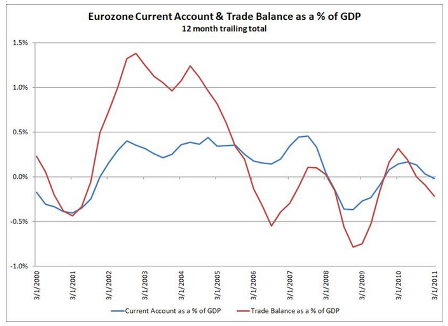
Euro trade data

So looks to me that China shifted to buying more euro just as the trade flows were turning the other way and might have otherwise been weakening the euro.

This means that when they stop buying there could be serious gap down until it gets to where it would have gotten had China not been buying. (Kind of like taking your finger out of the hole in the dam.)

Which is maybe what happened when it peaked a few weeks ago at the time of Bernanke’s first strong dollar speech?

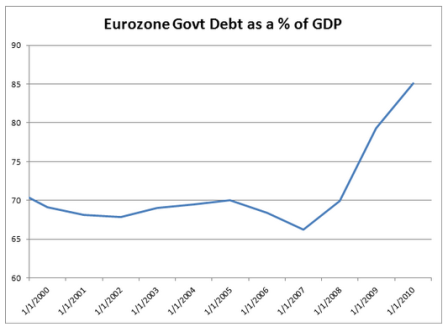
And the rising euro zone debt to GDP ratio (which is only through 2010 on the below chart) though falling some this year with austerity, may now be rising again due to new weakness created by that same austerity.

It’s all starting to look a lot like the beginnings of the traditional banana republic model- high unemployment, high ‘bad’ deficits from weak economies, and a falling currency that keeps debt to gdp ratios capped as ‘inflation’ floods in through the fx window.

WSJ on China buying Tsy secs

A bit of support in the Wall Street Journal for my suspicions about an understanding being reached between China and the Fed, and Fed Chairman Bernanke’s timing on his strong dollar speeches:

“A report this week showed foreigners were net buyers of long-term U.S. financial assets in April. China bought U.S. Treasuries after five straight months of net selling, and remained the top holder of those government securities.”