Fed Governor Mishkin on monetary policy


[Skip to the end]

In case there was any doubt things have changed.

from his July 28 speech:

Policymakers, academic economists, and the general public broadly agree that maintaining a low and stable inflation rate significantly benefits the economy. For example, low and predictable inflation simplifies the savings and retirement planning of households, facilitates firms’ production and investment decisions, and minimizes distortions that arise because the tax system is not completely indexed to inflation. Moreover, I interpret the available economic theory and empirical evidence as indicating that a long-run average inflation rate of about 2 percent, or perhaps a bit lower, is low enough to facilitate the everyday decisions of households and businesses while also alleviating the risk of debt deflation and other pitfalls of excessively low inflation.

The rationale for promoting maximum sustainable employment is also fairly obvious: Recessions weaken household income and business production, and unemployment hurts workers and their families.

No mention of lost real output. Must have been an oversight.

As I have outlined elsewhere, these two objectives are typically complementary and mutually reinforcing: that is, done properly, stabilizing inflation contributes to stabilizing economic activity around its sustainable level, and vice versa.

Hence the dual mandate is met by sustaining low and stable inflation rates.

Nevertheless, it’s important to note a fundamental difference between the objectives of price stability and maximum sustainable employment. On the one hand, the long-run average rate of inflation is solely determined by the actions of the Federal Reserve.

And they do believe that. They believe it’s all a function of the interest rates they select.

On the other hand, the level of maximum sustainable employment is not something that can be chosen by the Federal Reserve, because no central bank can control the level of real economic activity or employment over the longer run.

And they are not responsible for the level of economic activity, only the rate of inflation.

In fact, any attempt to use stimulative monetary policy to maintain employment above its long-run sustainable level would inevitably lead to an upward spiral of inflation with severe adverse consequences for household income and employment.


[top]
Re: Fed study on TAF


[Skip to the end]

>    
>    On Tue, Jul 29, 2008 at 4:05 AM, Andrea wrote:
>    
>    In case you haven’t seen this yet: A Fed study that finds that
>    Taf has lowered Libor.
>    
>    http://www.newyorkfed.org/research/staff_reports/sr335.html
>    
>    

right, thanks, as if they needed to fund a study to figure that out!

It’s like doing a study that shows the repo rate goes down when the fed lowers its ‘stop’ on repo.

(Too bad they didn’t use this study to show they should set a rate for the TAF and let quantity float, instead of setting a quantity and having an auction.)

It’s this kind of expense that gives govt. a govt. spending negative connotation.

all the best!

warren


[top]

2008-07-29 US Economic Releases


[Skip to the end]


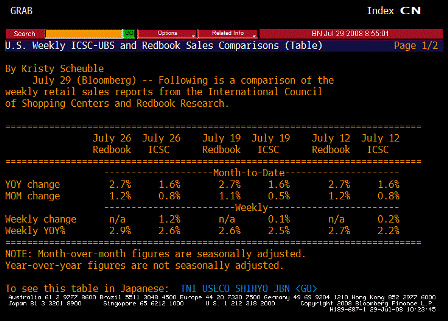
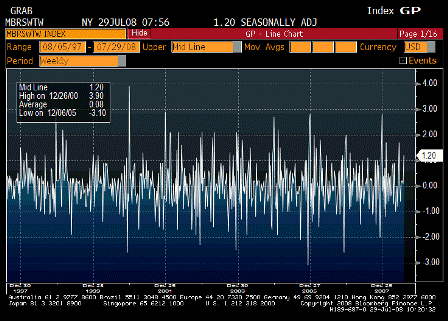
ICSC-UBS Store Sales WoW (Jul 29)

Survey n/a
Actual 1.2%
Prior 0.1%
Revised n/a

[top][end]

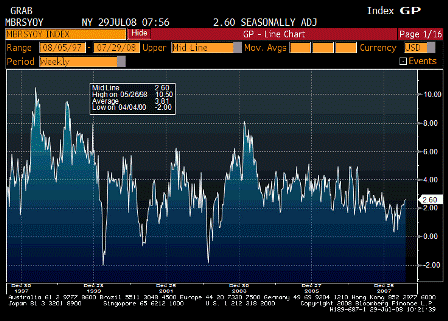
ICSC-UBS Store Sales YoY (Jul 29)

Survey n/a
Actual 2.6%
Prior 2.5%
Revised n/a

Still inching higher.

[top][end]

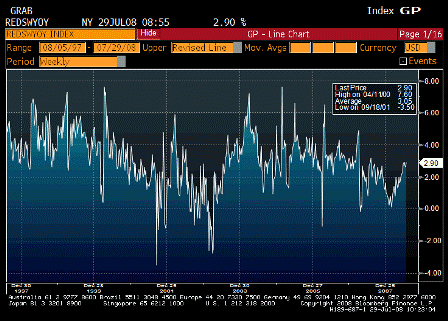
Redbook Store Sales Weekly YoY (Jul 29)

Survey n/a
Actual 2.9%
Prior 2.6%
Revised n/a

No let up here yet either.

[top][end]

ICSC-UBS Redbook Comparison TABLE (Jul 29)

[top][end]


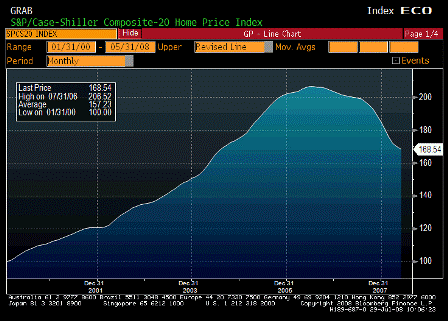
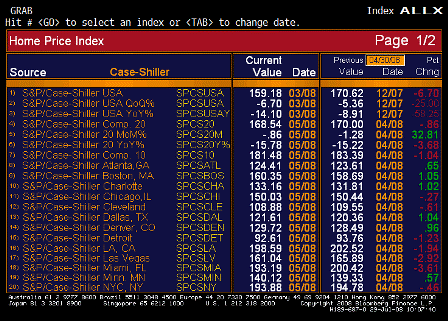
S&P-Case Shiller Home Price Index (May)

Survey n/a
Actual 168.54
Prior 169.85
Revised 170.00

[top][end]

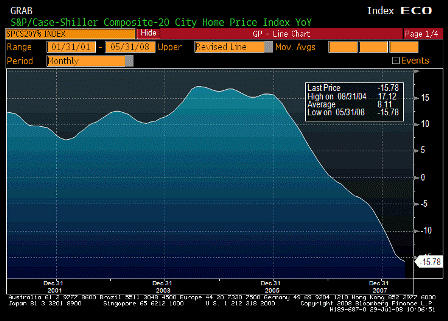
S&P-CS Composite-20 YoY (May)

Survey -16.00%
Actual -15.78%
Prior -15.30%
Revised -15.22%

[top][end]

Case Shiller ALLX 1 (May)

[top][end]

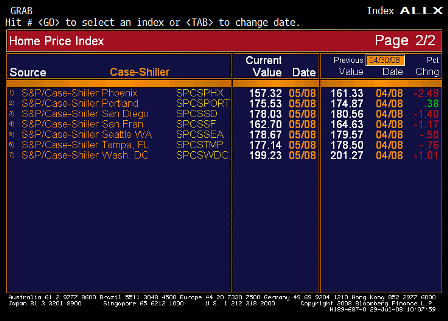
Case Shiller ALLX 2 (May)

Still declining but the rate of decline is quickly diminishing,

In line with other housing indicators that are appear to have bottomed.

[top][end]


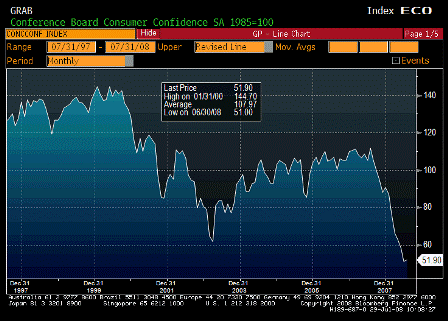
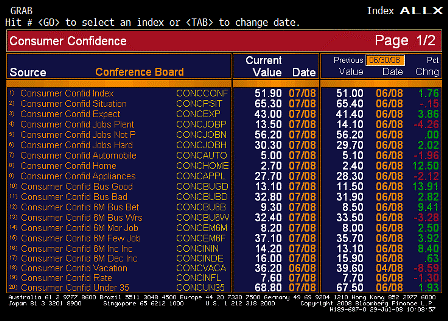
Consumer Confidence (Jul)

Survey 50.1
Actual 51.9
Prior 50.4
Revised 51.0

[top][end]

Consumer Confidence ALLX 1 (Jul)

[top][end]

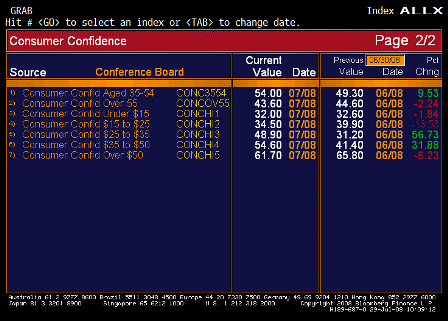
Consumer Confidence ALLX 2 (Jul)

Survey
Actual
Prior
Revised

Karim writes:

  • Headline confidence rises from 51 to 51.9 (first gain since Dec)
  • Jobs Plentiful less jobs hard to get falls from -15.6 to -16.8 (new cycle low); with initial claims back above 400k now, payrolls on Friday have downside risk to -75k consensus. As important, increasing jobs hard to get is correlated to increasing duration of unemployment.
  • Plans to buy an auto fall to new cycle low of 5.0 from 5.1
  • Plans to buy a home increases from cycle low of 2.4 to 2.7
  • Plans to buy a major appliance fall to new cycle low of 27.7 from 28.3

[top][end]


ABC Consumer Confidence (Jul 27)

Survey
Actual
Prior -41
Revised

[top][end]

ABC Consumer Confidence ALLX (Jul 27)


[top]

2008-07-28 UK News Highlights


[Skip to the end]

Highlights:

U.K. Hometrack House Prices Fall the Most Since 2001
Brown Says He Won’t Turn to ’70s Agenda After Defeat
Darling Considers Expanding Mortgage Bond-Swap Scheme, FT Says


U.K. Hometrack House Prices Fall the Most Since 2001

by Brian Swint

(Bloomberg) The average cost of a residential property in England and Wales slipped 4.4 % in July from a year earlier to 168,500 pounds ($336,000), Hometrack Ltd. said. Prices fell 1.2 % from June. “With no immediate end in sight to the current uncertainty, activity levels are likely to remain suppressed with prices remaining under pressure into the autumn,” said Richard Donnell, director of research at Hometrack. Prices “are now back to levels last seen in October 2006.” Demand for housing has declined 20 % in the past three months, Hometrack said.

Note how much higher prices are vs the US.

It’s another case of going up very fast and now working its way down towards a more historically normal trend line.

But as in the US, they never come down quite that far before turning up on a new path from a higher base as much of past ‘inflation’ remains indefinitely.


[top]

2008-07-25 Weekly Credit Graph Packet


[Skip to the end]

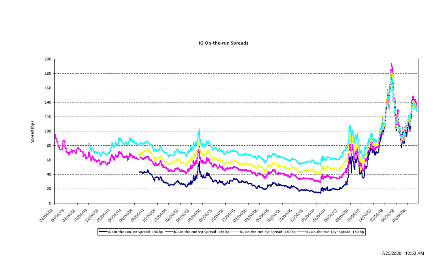
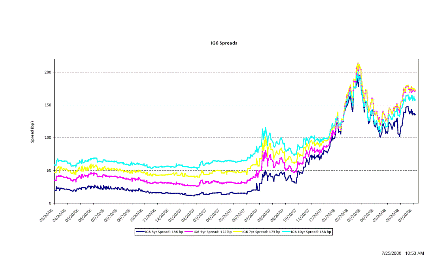
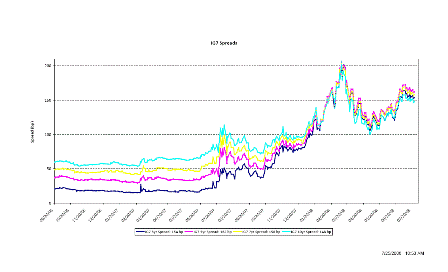
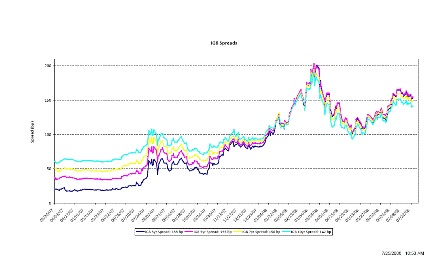
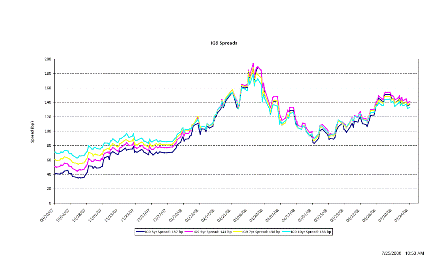
A touch higher last week, but still seems to be working its way lower.


IG On-the-run Spreads (Jul 25)

[top][end]

IG6 Spreads (Jul 25)

[top][end]

IG7 Spreads (Jul 25)

[top][end]

IG8 Spreads (Jul 25)

[top][end]

IG9 Spreads (Jul 25)


[top]

Nat gas


[Skip to the end]

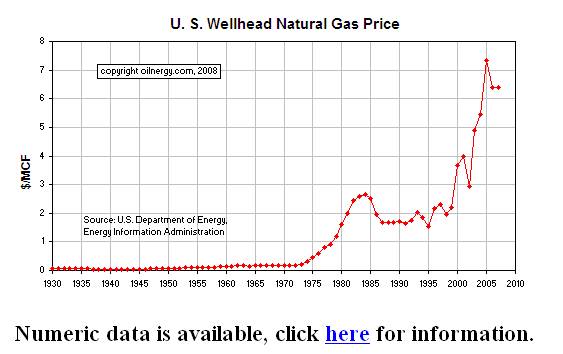
It was deregulated back in the 1970s, which brought out vast supplies causing utilities to substitute gas for oil and eventually break OPEC.

I don’t see that kind of supply response lurking today.

The Natural Gas Policy Act of 1978

In November of 1978, at the peak of the natural gas supply shortages, Congress enacted legislation known as the Natural Gas Policy Act (NGPA), as part of broader legislation known as the National Energy Act (NEA). Realizing that those price controls that had been put in place to protect consumers from potential monopoly pricing had now come full circle to hurt consumers in the form of natural gas shortages, the federal government sought through the NGPA to revise the federal regulation of the sale of natural gas. Essentially, this act had three main goals:

  • Creating a single national natural gas market
  • Equalizing supply with demand
  • Allowing market forces to establish the wellhead price of natural gas


[top]

A surge of a different type


[Skip to the end]

Government spending kicking in with 2007 spending that was delayed to 2008:

Topical article: The GOP’s December Surprise by James K. Galbraith

Durable Goods Orders Rise Unexpectedly

by Michael M. Grynbaum

A separate report showed that orders for big-ticket items rose last month, beating economists’ expectations. A surge in export orders and *investment in military-related products* sent durable goods orders up 0.8 percent in June from a revised 0.1 percent in May, the Commerce Department said. Excluding orders for military-related goods, orders were up only 0.1 percent.


[top]

Japan CPI


[Skip to the end]

from Dave:

Japan core CPI last night came out at 1.9% as expected

Petrol products were up +23.9% y/y

Non fresh food products were up +3.5% y/y

Core-Core CPI (ex energy and ex fresh food) rose +0.1% vs -0.1% in the previous month indicating some signs of higher energy and food prices filtering through the economy to other products and services

Price pressures continue to grow at the corporate level (see graph of Corporate Services Price Index CSPI and Corporate Goods Price Index CGPI)

Expectations from many dealers and BOJ’s Mizuno is that CPI could reach as high as 2.5% by the fall


[top]

CNBC: Housing bottom story


[Skip to the end]

His monetary analysis is ridiculous but we agree on this point:

The Media Are Missing the Housing Bottom

by Larry Kudlow

Media reports painted a pessimistic picture of today’s release on existing home sales, which fell 15 percent from a year ago and recorded higher inventories. But inside the report was an awful lot of very good new news, which appear to be pointing to a bottom in the housing problem; in fact, maybe the tiniest beginnings of a recovery.

For example, the median existing home price has increased four consecutive months and is up 10 percent since February. Yes, it’s down 6 percent over the past year. But the monthly numbers show a gradual rebound. Actually, this median home price is $215,000 in June, compared to $196,000 last winter.

And there’s more. One of the hardest hit regions is the West, including California, Arizona, and Nevada. The other two bad states are Florida and Michigan. However, existing home sales in the western region are up four straight months, and are 17 percent above the low in October. At the same time, prices in the West have increased three straight months.

Meanwhile, overall national existing home sales are basically stabilizing at just under five million. And in the first and second quarters of 2008, these sales dropped slightly by 3 percent in each case, which is a whole lot better than the roughly 30 percent sales drops of the prior three quarters.

It’s a pity the mainstream media keeps searching for more and more pessimism. The reality is a possible upturn in the housing trend, and at the very least we are getting a bottom. Stocks sold off 165 points largely on media reports of terrible home sales and prices. But I am hoping the market comes to its senses and realizes the data are a whole lot better.

related content
Senate Set to Vote Saturday On Housing Rescue Bill
Existing Home Sales: A Look At Numbers That Weren’t There

And on top of all that, just as housing may be on the mend, Congress is about to ratify a huge FHA-based bailout that could total $42 billion. Congressional solons are putting up $300 billion to refinance and insure distressed loans through the Federal Housing Administration. But this dubious government agency, with a whole history of bad portfolio management, may wind up taking in the very worst loans on the books.


[top]