Obama on the auto industry


[Skip to the end]

How about restoring aggregate demand and car sales with a full payroll tax holiday and $300 billion for the states on a per capita basis?

What good will financial support for the autos do if car sales keep falling due to overly tight fiscal policy???

Obama to appoint panel for auto recovery

by Ken Thomas and Tom Krisher

Feb 15 (AP) — President Barack Obama will form a government task force for restructuring the struggling U.S. auto industry instead of naming a “car czar” with sweeping powers, a senior administration official said.


[top]

Clinton trying to get Asians to increase demand


[Skip to the end]

A once in a lifetime opportunity to increase the US standard of living squandered.

Increasing domestic demand unilaterally and letting the rest of the world grow via net exports to the US is in our best interest.

Clinton begins Asia trip, calls for Global Economic Cooperation

by Indira A.R. Lakshmanan

Feb 16 (Bloomberg) — Secretary of State Hillary Clinton kicked off the start of a weeklong trip to East Asia by calling for more cooperation from the region in alleviating the worldwide recession.


[top]

Re: Proposals for the eurozone


[Skip to the end]

(email exchange)

>   
>   On Mon, Feb 16, 2009 at 8:12 AM, Morris wrote:
>   
>   What would you do for Europe?
>   

For Europe:

  1. The European Parliament or ECB has to be given fiscal authority and give the national governments a check for maybe 1,000 euro per capita to be used for general purposes.
  2. This new fiscal authority would also provide deposit insurance for all the euro banks and lend to member banks on an unsecured basis.
  3. It would also regulate and supervise the banks.
  4. I would have the new fiscal authority fund jobs for anyone willing and able to work at a fixed wage, which, via market forces, would become the minimum wage.


[top]

Deficit myths are the problem


[Skip to the end]

Yes, that’s the problem, output and employment can be restored relatively quickly with the right fiscal adjustment, but deficit myths are in the way.

A full payroll tax holiday and $300 billion to the states on a per capita basis with no strings attached would very quickly restore demand, including retail sales and home sales, which would be quickly followed by continuing employment and output gains.

No Ordinary Recession

by Axel Leijonhufvud

Feb 13 (Voxeu) — “Fiscal stimulus will not have much effect as long as the financial system is deleveraging. Even if that problem were to be more or less solved, the government deficit would have to offset both the decline in industry investment and the rise in household saving – a gap that is rising as the recession deepens. Here, too, the public is sceptical and prone to conclude that a program that only slows or stops the decline but fails to “jump start” the economy must have been a waste of tax payers’ money. The most effective composition of such a program is also a problem.”


[top]

Eurozone going the wrong way


[Skip to the end]

This has been making the rounds and is not impossible:

But European banks may be in far worse shape. Bruno Waterfield of the London Daily Telegraph reports to have seen an eyes-only document prepared by the European Commission for the finance ministers of the various EU member countries. The problem revealed in the report is an estimated write-down by European banks in the range of 16 trillion pounds, or about $25 trillion dollars! The concern is that bailing out the various national banks for such an unbelievable amount would push the cost of government borrowing to much higher levels than we see today.

As my kids would say, “Really, Dad, you think so?” Europe is somewhat larger than the US, so think what my gold-bug friends would say if the US decided to borrow $25 trillion to bail out US banks. The dollar would be crucified! The euro is going to get a lot weaker if bank problems are even half of what the report says they are. The British pound sterling is already off almost 30% and, depending on what the real damage is to their banking system, it could get worse.

Waterfield reports, “National leaders and EU officials share fears that a second bank bail-out in Europe will raise government borrowing at a time when investors — particularly those who lend money to European governments — have growing doubts over the ability of countries such as Spain, Greece, Portugal, Ireland, Italy and Britain to pay it back.

I’m not too worried about the UK. but the eurozone banks and national governments are at risk.

In fact, they may have failed last fall when the Fed stepped in with unlimited USD swap lines (could turn out to be fiscal transfers?) to the ECB to buy them some time.

Unfortunately it all gets a lot worse as the eurozone GDPs melt down.

“The Commission figure is significant because of the role EU officials will play in devising rules to evaluate ‘toxic’ bank assets later this month. New moves to bail out banks will be discussed at an emergency EU summit at the end of February. The EU is deeply worried at widening spreads on bonds sold by different European countries.”

Part of the problem is that European banks were far more highly leveraged than US banks. Some banks were reportedly leveraged 50:1. And they lent money to Eastern European projects and businesses which are now facing severe financial strain and plummeting local currencies.

Let that number rattle around in your head for a moment: $25 trillion. Even $5 trillion would be daunting. But the problem is that Europe does not have a central bank that can step in and selectively save banks from one country without taking on all euro zone member-country banks. Yet, as noted above, some countries may not have the wherewithal to save their own banks. It is reported that some Austrian banks are hoping that Germany will step in and help them. Given Germany’s problems, they may have a long wait.


[top]

Summers says Obama to address mortgage payments


[Skip to the end]

But not a full payroll tax holiday to stop removing $230 billion a week of income.

From people and businesses struggling to meet their payments?

Summers Says Obama Mortgage Plan to Focus on Lowering Payments

by Rich Miller and Matthew Benjamin

Feb 14 (Bloomberg) — The White House is willing to spend more than the $50 billion already pledged to stem home foreclosures and intends to focus its efforts on reducing monthly mortgage payments, rather than principal, saidLawrence Summers, the president’s top economic adviser.

“We’re prepared to do what is necessary,” Summers said in an interview on Bloomberg Television’s “Political Capital with Al Hunt” yesterday. “Going directly at the problem means addressing affordability by addressing payments.”


[top]

Commodities bottoming as the great Mike Masters inventory liquidation runs its course


[Skip to the end]

It all came to a near halt with the world wide inventory liquidation. Now flows are resuming but will be at lower levels than before, reflecting lower demand.

Prices should recover over time to something above replacement costs.

Look for deteriorating real terms of trade for the US as the modest fiscal adjustment adds to demand, and import prices grow faster than export prices, led by Saudi crude pricing.

Shipping Index Surge Signals Commodity Currency Gains

by Ye Xie and Candice Zachariahs

Feb 17 (Bloomberg) — Shipping costs have more than doubled this year, so it may be time to buy kroner, Aussies and loonies.

The 147 percent jump in ocean-transport prices is evidence that China’s $580 billion stimulus plan will lift raw materials, said Ihab Salib, who oversees $3 billion at Federated Investments Inc. in Pittsburgh. That would benefit countries exporting them, so Salib is “actively trading” Norway’s krone and Australian and Canadian dollars, nicknamed Aussies and loonies.

Salib and other currency traders have started using the Baltic Dry Index’s global gauge of raw-material shipping costs to help make such decisions. The index and the value of a basket of those three resource-rich countries’ currencies are increasingly moving in tandem — 96 percent of the time in the past year, up from 84 percent in the past decade, data compiled by Bloomberg show.

“Historically, the Baltic Dry Index is a good leading indicator for commodity prices,” said Salib, who declined to detail his investments. “Commodities are very depressed right now, and they offer good long-term value. Once they come back, these currencies should do well.”

The shipping gauge is a sign that China’s stimulus spending on housing, highways, airports and power grids will have impact beyond its borders. By Feb. 28, it will have spent 25 percent of its stimulus budget, Deutsche Bank AG said Jan. 20, predicting the country’s economy will grow at a 12 percent annual rate between the fourth and first quarter, after shrinking 2.3 percent between the third and fourth.

Oil Rebound

China is the world’s biggest consumer of copper and iron ore and has helped each rally this year by about 10 percent, benefiting Australia and Canada, which account for 10 percent of world production of the two metals. Oil,Norway’s top export, will average $66 a barrel in the fourth quarter, up from an average of $40.62 since Jan. 1, according to the median forecast of 34 analysts surveyed by Bloomberg. China is the world’s second-biggest energy user.


[top]

2009-02-17 USER


[Skip to the end]


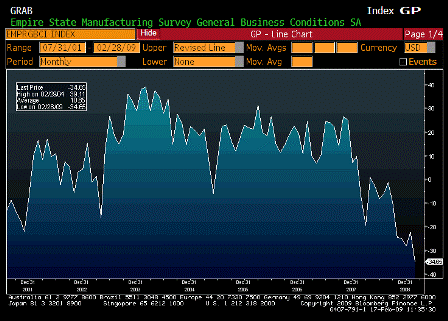
Empire State Manufacturing Survey (Feb)

Survey -23.75
Actual -34.65
Prior -22.20
Revised n/a

[top][end]

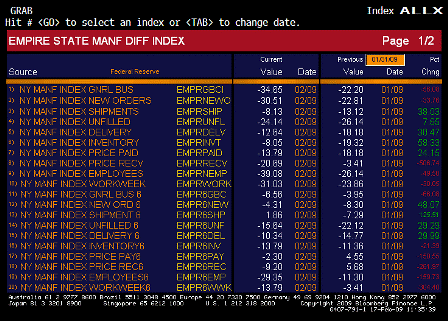
Empire State Manufacturing Survey ALLX 1 (Feb)

[top][end]

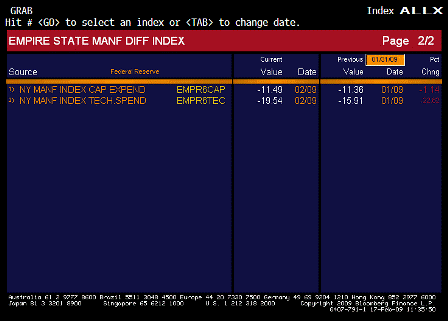
Empire State Manufacturing Survey ALLX 2 (Feb)

[top][end]


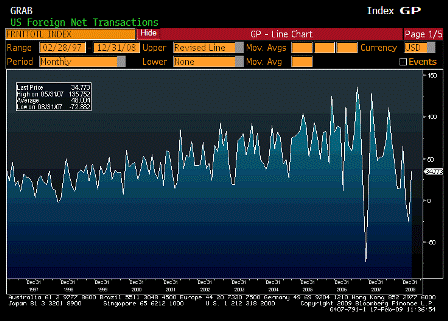
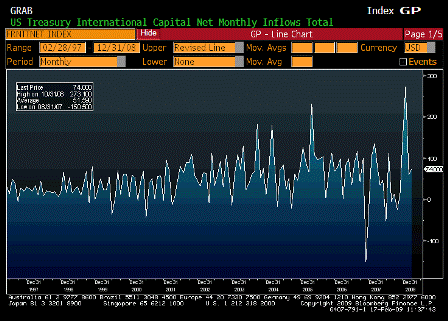
Net Long Term TIC Flows (Dec)

Survey $20.0B
Actual $34.8B
Prior -$21.7B
Revised -$25.6B

[top][end]

Total Net TIC Flows (Dec)

Survey n/a
Actual $74.0B
Prior $56.8B
Revised $61.3B

[top][end]


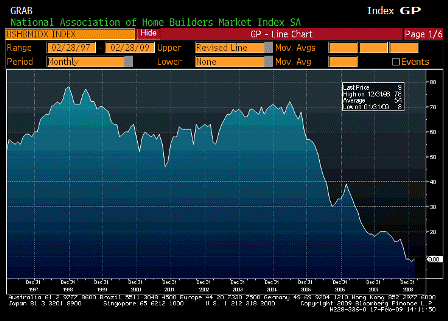
NAHB Housing Market Index (Feb)

Survey 8
Actual 9
Prior 8
Revised n/a

[top][end]

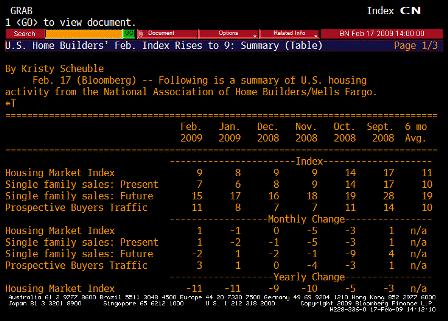
NAHB Housing Market Index TABLE 1 (Feb)

[top][end]

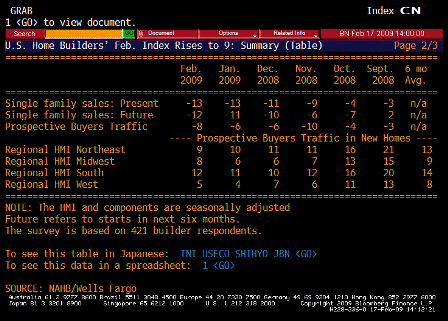
NAHB Housing Market Index TABLE 2 (Feb)


[top]

2009-02-16 CREDIT


[Skip to the end]

 
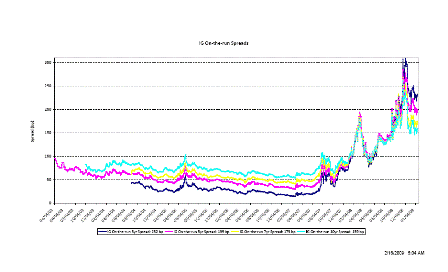
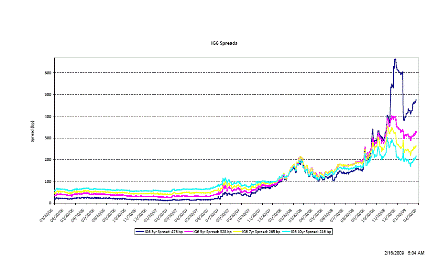
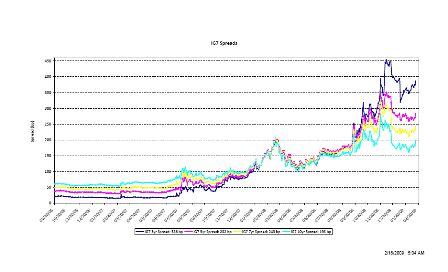
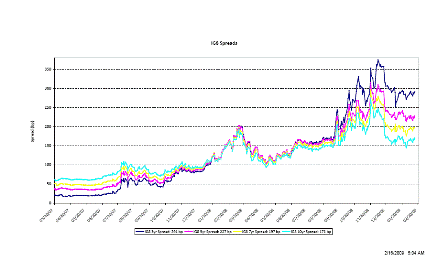
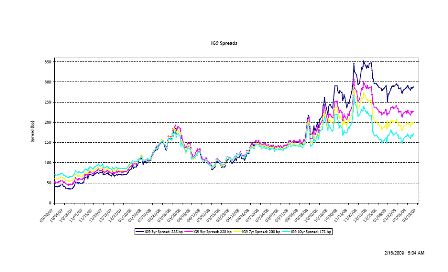
Some recent widening with the deteriorating economy.

IG On-the-run Spreads (Feb 17)

[top][end]

IG6 Spreads (Feb 17)

[top][end]

IG7 Spreads (Feb 17)

[top][end]

IG8 Spreads (Feb 17)

[top][end]

IG9 Spreads (Feb 17)


[top]