Existing home sales

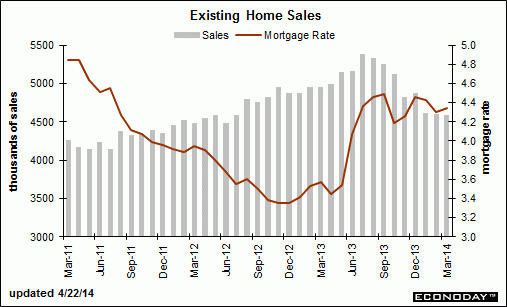
Recalls my suspicion of the Bernanke legacy- “just as the recovery was gaining traction he let mtg rates rise and cratered the housing market, etc.”

Full size image

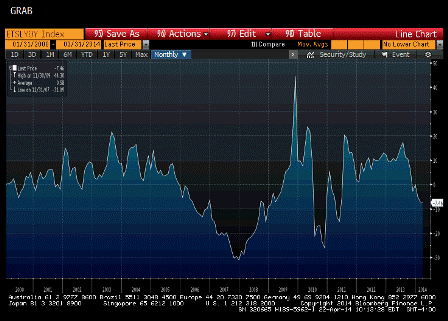
Y/Y:
Full size image

Existing Home Sales


Highlights
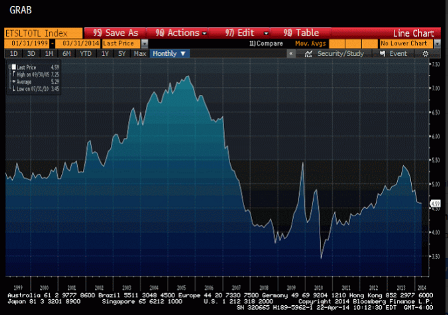
Sales of existing homes have yet to recover from the Federal Reserve’s decision, way back last year, to begin withdrawing stimulus. For the seventh time in eight month, sales of existing homes contracted, at minus -0.2 percent in March to a slightly lower-than-expected annual rate of 4.59 million. Year-on-year, sales are down 7.5 percent which is the steepest rate of contraction since May 2011.

Unattractive mortgage rates are only one reason for the sales weakness. Another is high prices which, in stark contrast to the contraction in sales, are up, not down, 7.9 percent year-on-year. The median price soared in March, up 5.4 percent to $198,000.

Low supply is another reason for the sales trouble, though the weakness in sales during March did lift supply relative to sales slightly, at 5.2 months vs 5.0 months in February.

Regional data show March weakness in the South and West and monthly strength in the Northeast and Midwest. Year-on-year, all four regions show declines.

The housing sector remains the weak link in the economy and the weather isn’t to blame, at least not in March. The Dow is showing little initial reaction to today’s results.

French spending cuts outlined

French Prime Minister Manuel Valls Outlines Spending Cuts

(WSJ) French Prime Minister Manuel Valls unveiled some details as to how the government aims to extract €50 billion ($69 billion) in savings between 2015 and 2017.

Almost reads like he knows savings comes from deficit spending!
;)

Mr. Valls indicated for the first time that the government is prepared to take aim at politically sensitive areas of France’s welfare state to achieve the savings, including freezing benefit and pension payments at current levels for the next year. He also said a freeze in the basic pay of civil servants would continue.

Since the price level is ultimately a function of prices paid by govt, this type of thing is a highly disinflationary force.

“I am obliged to tell the truth to French people. Our public spending represents 57% of our national wealth. We can’t live beyond our means,” Mr. Valls said.

Which is true under their current institutional arrangements. So seemes no move to ‘change the rules’

Mr. Valls said the central state would account for €18 billion of the savings; local authorities €11 billion; health care €10 billion; and social security €11 billion.

housing starts and manufacturing

Another anemic ‘bounce’- down 5.9% from last year. And more reason to believe the much touted November/Dec ‘spike’ had something to with expiring tax credits. And with mtg purchase applications still running almost 20% lower year over year the housing contribution to GDP in general is so far looking lower than last year.

Housing Starts

Highlights
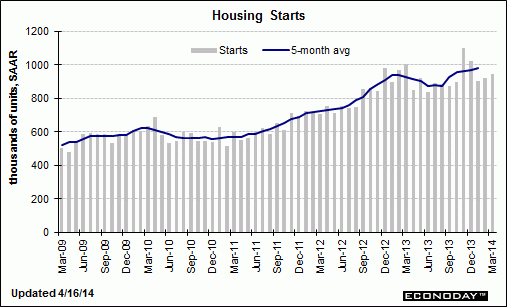
Housing starts picked up in March but not as much as expected. However, strength was in the single-family component while it was expected to be in the multifamily component. So, the expectations shortage really is not bad. Overall starts rose 2.8 percent after a 1.9 percent increase in February. The March annualized pace of 946,000 fell short of analysts’ forecast for 965,000 and was down 5.9 percent on a year-ago basis.

Single-family starts jumped 6.0 percent, following a 2.9 percent rise the month before. Multifamily starts slipped 3.1 percent in March after no change the month before.

Overall permits dipped 2.4 percent in March after surging 7.3 percent the prior month. The annualized rate of 990,000 was up 11.2 percent on a year-ago basis. The median market forecast was for 1.010 million. The softness came from the multifamily component which declined 6.4 percent after a 22.8 percent spike in February. The single-family component rebounded 0.5 percent, following a 1.7 percent dip in February.

Overall, the headline number was below expectations but the fact that moderate strength was in the single-family component is encouraging. Last month’s data in permits suggested more strength in the multifamily component. But the multifamily component is volatile and based on recent permits, there still is strength in that component. The gain in the single-family component is a bonus.

Somewhat volatile but over time just chugs along at a steady pace.

It’s generally the rest of gdp that’s does the moving and shaking:

Housing Market Index

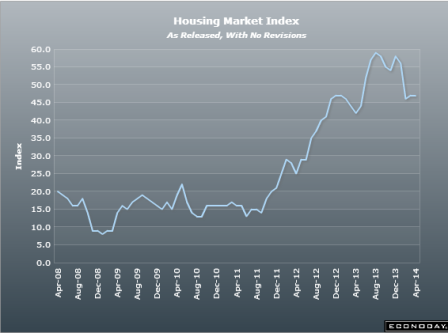
Not much of an April bounce here either:

Housing Market Index


Highlights
The new home market is showing no spring lift whatsoever at least based on the housing market index which, at a lower-than-expected 47, remains below breakeven 50 for a third straight month. The weakness is centered in traffic which remains far below 50 at 32. Weakness in traffic points to lack of participation by first-time homebuyers and the importance of all-cash buyers who have been holding up the housing market.

But other readings are positive led by strength among prospective buyers where the index is at 57 for a 4 point gain in the month. Present sales show marginal growth, unchanged for a third month at 51. Regional data show the West, Midwest, and South clumped near 50 with the Northeast, by far the smallest region for new home sales, far back at 33.

The housing market index posted a record 10-point loss to 46 in the heavy weather of February and hasn’t yet recovered, in what is a bad omen for the housing sector where many are banking on spring strength. Expectations for tomorrow’s housing starts & permit data are no better than flat. The Dow is moving down from opening highs in early reaction to today’s report.

Empire State Manufacturing Survey

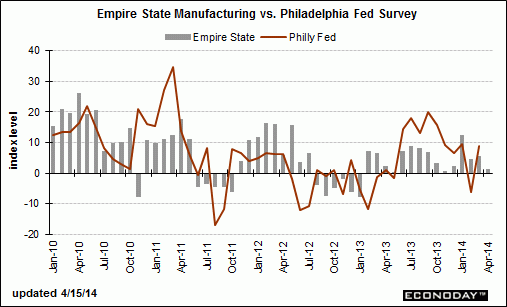
Another non bounce, this time an April survey:

Empire State Mfg Survey

Highlights
The first look at the manufacturing sector this month is flat with the Empire State index barely over zero, at 1.29 vs 5.61 in March and 4.48 in February. New orders, the most important of all readings, is in the negative column at minus 2.77. Shipments show some growth, at plus 3.15, while employment shows better growth, at 8.16 vs March’s 5.88. On the negative side are unfilled orders, at minus 13.27. Inventories show a draw while price data do show some upward pressure. A positive is a more than 5 point uptick in the 6-month outlook to a very solid 38.23. This report, held back by the dip in new orders, is no better than mixed suggesting that the beginning of the spring, at least in the New York manufacturing economy, didn’t make for much of a bounce.


Full size image

Draghi on the euro

Draghi says a stronger euro would trigger looser ECB policy (Reuters)

Except by my calculations he has it backwards, as lower rates make a currency like the euro stronger, not weaker, via the interest income channels, etc.

ECB President Mario Draghi said that euro appreciation over the last year was an important factor in bringing euro zone inflation down to its current low levels, accounting for 0.4-0.5 percentage point of decline in the annual rate, which stood at 0.5 percent year-on-year in March. “I have always said that the exchange rate is not a policy target, but it is important for price stability and growth. And now, what has happened over the last few months is that is has become more and more important for price stability,” Draghi said at a news conference. “So the strengthening of the exchange rate would require further monetary policy accommodation.

As above.

If you want policy to remain accommodative as now, a further strengthening of the exchange rate would require further stimulus,” he said.

I agree, except I’d propose leaving rates at 0 fiscal relaxation to the point of domestic full employment, etc.

Furthermore, their policy of depressing domestic demand to drive exports/competitiveness has successfully resulted in growing net exports. However, unless combined with buying fx reserves of the targeted market areas, the euro appreciates until the net exports reverse, regardless of ‘monetary policy.’

CBO estimates lower deficits as health subsidies fall

As suspected Obamacare doesn’t add to the deficit, otherwise the Republicans would have let us know for sure!

However, it also means it’s a pro active contractionary bias that will make it that much harder for GDP growth to meet expectations this year.

CBO estimates slightly lower deficits as health subsidies fall

April 14 (Reuters) — U.S. budget deficits over the next decade will be $286 billion less than previously estimated, the Congressional Budget Office said on Monday, attributing much of the decline to lower estimates of subsidy costs under President Barack Obama’s health insurance reform law.

The non-partisan CBO, in revisions to its annual budget estimates, said the fiscal 2014 deficit would fall to $492 billion from $514 billion estimated in February. The forecasts assume no changes to current tax and spending laws.

The agency attributed the current year’s decline to technical revisions to the way it estimates spending on discretionary programs. But from fiscal 2015 onwards, it estimates a $186 billion decline in outlays for health insurance subsidies under the Affordable Care Act, commonly known as Obamacare.

This reflects a lower projection of premiums charged for health care plans offered through government-run exchanges, CBO said, based on an updated analysis of plans now being offered.

Overall, the budget referee agency now projects cumulative 10-year deficits at $7.62 trillion compared to its previous forecast of $7.9 trillion.

In addition to the lower health insurance subsidy costs, CBO also estimated a $98 billion 10-year reduction in Medicare outlays due to lower spending on prescription drugs and hospital insurance. Medicaid, the health care program for the poor, would see a $29 billion reduction, CBO said.

CBO lowered its 10-year cost estimate for the federal food stamps program by $24 billion, based on new data from the Department of Agriculture on monthly average benefits.

But the CBO left intact its previous economic projections, which envision rising deficits after 2015 as more of the massive “baby boom” generation retires or drops out of the workforce.

Deficits will reach a low point of $469 billion, or 2.6 percent of U.S. economic output, in 2015, then gradually start to rise, topping $1 trillion again in 2023 and 2024.

U.S. deficits exceeded that dollar amount during each of the first four years of Obama’s administration as the economy recovered slowly from the worst recession since the 1930s, falling to $680 billion in fiscal 2013.

retail sales charts

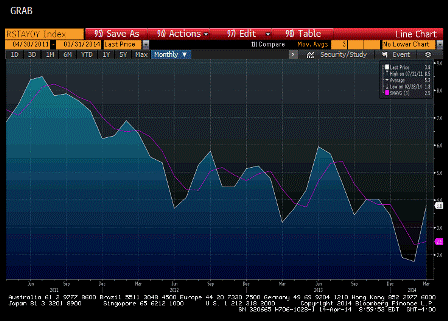
Headline retail sales y/y with 3 mma:


Full size image

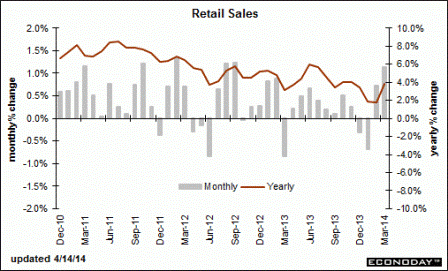
3 month moving average nudged up to 2.5% which is a relished move as sales catch up from losses due to weather. But it’s going to take more months like this one to reverse what looks like a longer term trend towards lower levels.

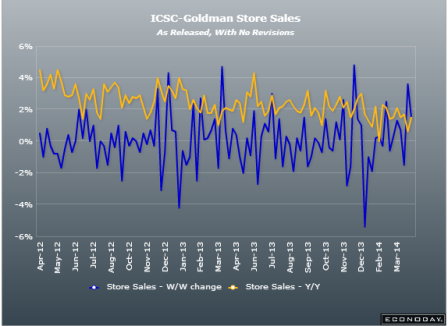
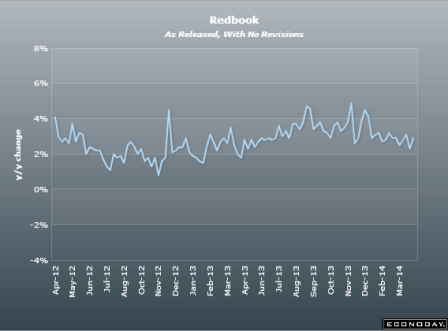
Note however that Red Book and Goldman retail sales reports, though ‘minor’ indicators, haven’t shown much strength.

You can see the dip and recovery of the monthly prints on this graph: