Fed labor market index, ISM non manufacturing index, Bank lending, Greece

Prior month revised lower and this month lower
so Fed that much less likely to raise rates:

Labor Market Conditions Index
er-7-6-1
Highlights
Growth in the nation’s labor market remains subdued with the labor market conditions index at plus 0.8 in June vs a revised plus 0.9 in May. The reading is barely over zero and underscores last week’s soft employment report. The Fed won’t be any hurry to begin raising its overnight policy rate based on June’s employment data.

Ok, number but less than Q1, with export orders and employment growth slowing:

ISM Non-Mfg Index
er-7-6-2
Highlights
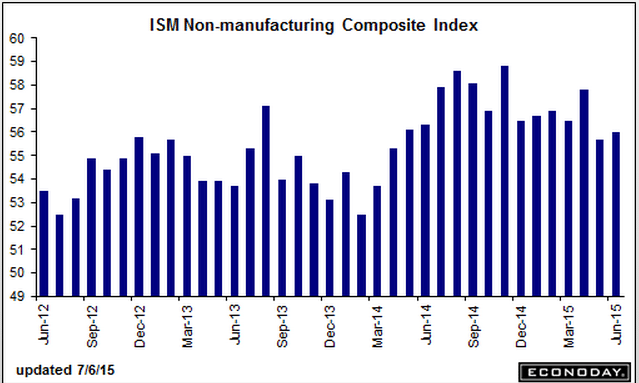
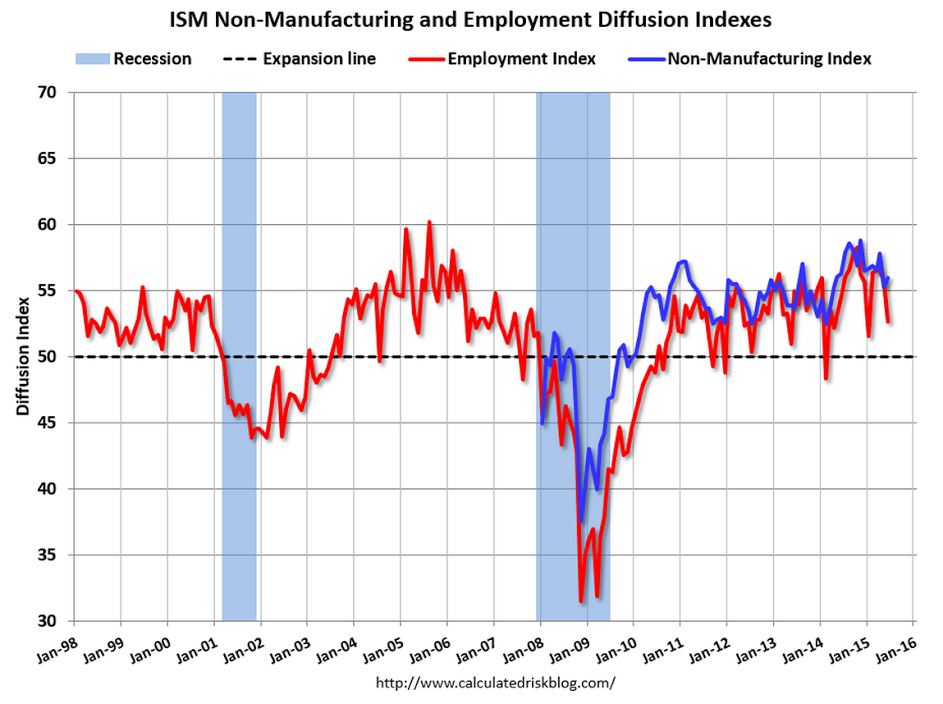
Rates of growth in ISM’s non-manufacturing report held steady and solid in June, at a composite index of 56.0 for a 3 tenths gain from May. New orders are strong, at 58.3 for a 4 tenths gain with backlogs back over 50 at 50.5 for a 2 point gain. Growth in export orders slowed but still held over 50 at 52.0 in a reminder that services exports, unlike goods exports, are in surplus.

Other readings include a strong reading for business activity, up 2.0 points to 61.5, a gain offset by slowing in employment to 52.7 from a strong four-month streak over the 55 level. The report’s price reading slowed slightly to 53.0, a soft level contrasting with inflationary signals in this morning’s PMI service report.

A strong signal in this report is wide breadth among 18 industries with 15 showing growth with two of the exceptions, however, including mining and construction. Contraction in the latter is a surprise given wide indications of growth in housing.

This report is solid but, together with the PMI services index, point to a lack of acceleration for the end of the second quarter.
er-7-6-3
er-7-6-4

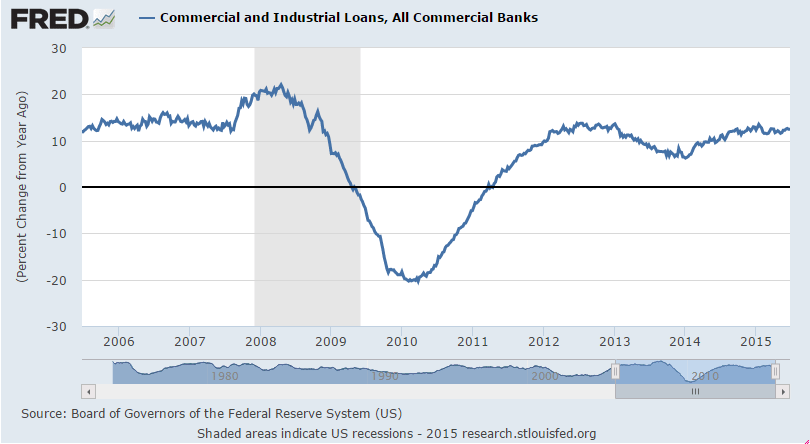
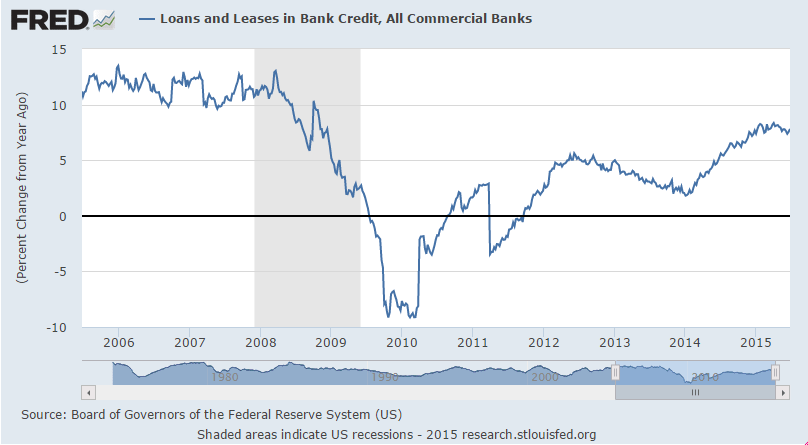
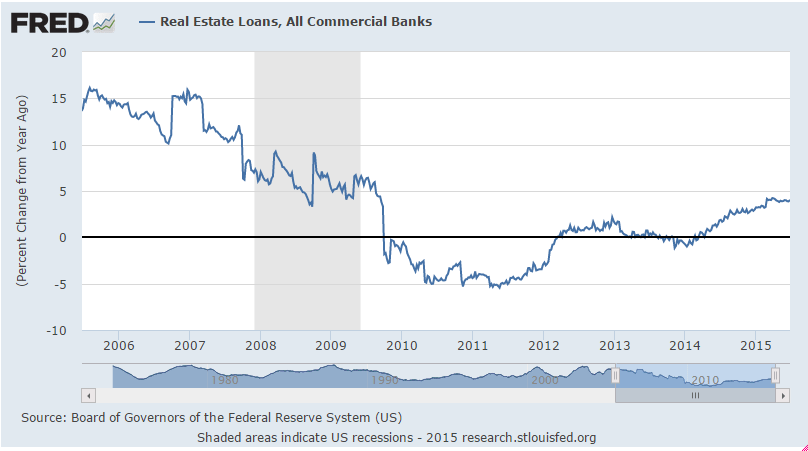
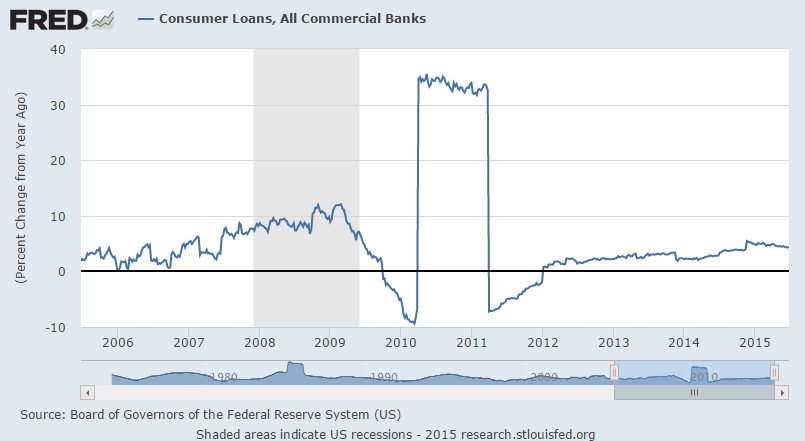
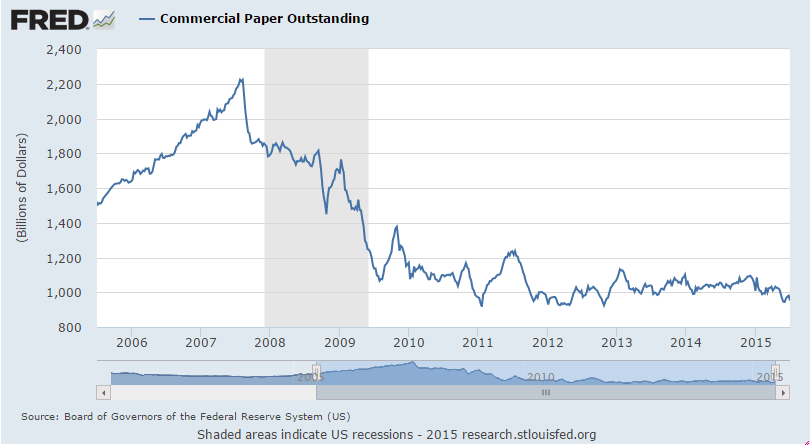
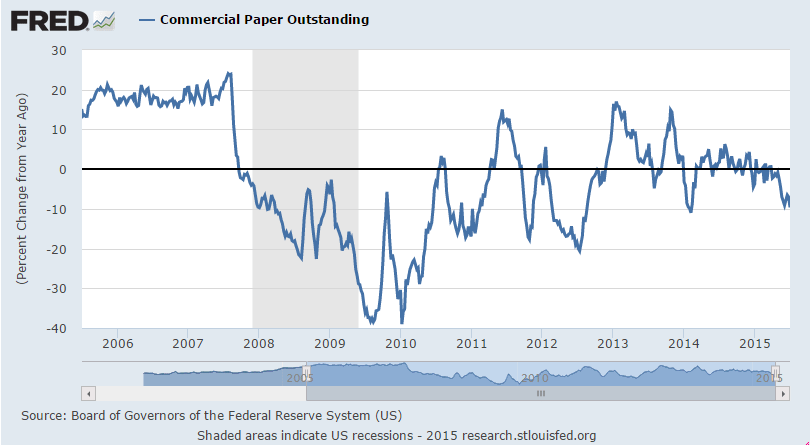
To my point right after oil prices fell- banks will see large declines in the value of collateral backing their loans which could lead to capital write downs and institution specific lending restrictions, further dampening sales, output, and employment:

Banks Face Curbs on Oil, Gas Lending

By Gillian Tan, Ryan Tracy and Ryan Dezember

July 3 (WSJ) — U.S. regulators are sounding the alarm about banks’ exposure to oil-and-gas producers, a move that could limit their ability to lend to companies battered by a yearlong slump in prices.


The Federal Reserve, Office of the Comptroller of the Currency and Federal Deposit Insurance Corp. are telling banks that a large number of loans they have issued to these companies are substandard, said people familiar with the matter, as they issue preliminary results of a joint national examination of major loan portfolios.

The substandard designation indicates regulators doubt a borrower’s ability to repay or question the value of the assets that back a loan. The designation typically limits banks’ ability to extend additional credit to the borrowers.


The move could add an extra obstacle to companies struggling with high debt loads amid lower prices for the oil and natural gas they produce. Banks have been flexible with troubled energy companies to avoid triggering a flood of defaults and bankruptcy filings, but regulatory pressure could force them to tighten the purse strings.


This year’s Shared National Credit review process contrasts with those in prior years, when regulators didn’t broadly disagree with the banks’ own ratings of credit facilities known as reserve-based loans, the people said. But regulators are paying closer attention to these loans amid worries that a sustained slump in energy prices could lead to big losses for banks, they added.

Twice a year, banks themselves review the value of oil and gas deposits that companies have the right to extract and use as collateral for bank loans. Declines in commodity prices can prompt lenders to reduce their commitments to companies. The effects of such reductions can cascade through energy companies’ capital structures and require them to look elsewhere for funds.

Earlier this year, a number of energy producers sold bonds, took out term loans or sold new shares to replace shrinking reserve-based loans. While some of those moves were forced, others were pre-emptive.

Large energy lenders include Wells Fargo & Co., J.P. Morgan Chase & Co. and Bank of America Corp.

Regulators declined to discuss their conversations with specific banks but have been raising concerns about energy loans. On Tuesday, the OCC, in a semiannual report on emerging risks, said it is monitoring oil-and-gas production loans and said the “significant decline in oil prices in 2014 could put pressure on loan portfolios.” The report didn’t detail the examination of reserve-based loans.

The latest effort comes amid a broader crackdown on lending that regulators consider risky. In 2013, the Fed, OCC and FDIC issued guidance to deter banks from issuing leveraged loans that would increase the companies’ debt loads to levels they consider too high.

Bankers said they are concerned that this latest effort could push some struggling borrowers over the edge, which could, in turn, create more pain for the banks.

“They’re taking a broad brush to the entire sector and not really differentiating between secured and unsecured loans,” one senior leveraged-finance banker said of regulators’ treatment of reserve-based loans.

A number of energy companies already have filed for bankruptcy protection, and others are exploring options to raise capital or restructure their debt loads.

So far, the suffering hasn’t been as widespread as was initially feared when prices plummeted last year.

Bankers are selectively appealing some substandard ratings, especially for companies that can reduce spending and pay down some debt, said people familiar with the matter.


But for the companies that retain the negative rating, any issuance of new debt will likely need to reflect an improvement in creditworthiness, the people said. Options include the addition of loan terms known as covenants, which protect lenders but can increase a company’s risk of default.


Banks may turn to equity or bonds to supply additional financing to borrowers with the substandard designation, some of the people said, though both are costlier for companies than loans.

Analysts expect the oil slump to begin taking a greater toll on companies this fall, when banks review their reserve-based loans. In a note to clients this week, Wells Fargo Securities analysts said that only 30% of the expected oil output in 2016 from the companies they track has been presold at above-market prices, versus 56% of crude production that was hedged this year.


The analysts also said the prolonged period of lower revenue could push more companies closer to violating agreements with creditors to maintain certain profitability levels, and that they expect stock investors to be “more discerning” when offered new shares from heavily indebted companies.

The ECB has begun the move to remove the eligibility of Greek debt as collateral for ECB loans:

ECB maintains emergency assistance for Greek banks, but adjusts haircut on collateral

By Everett Rosenfeld and Matt Clinch

Now that the EU realizes it doesn’t need Greece, the terms are unlikely to be altered. With Greek leadership still committed to staying with the euro and the EU, they take on the role of beggars.

“Even if it came to a collapse of some individual banks, the risk of contagion is relatively small,” Schaeuble told Bild. “The markets have reacted with restraint in the last few days. That shows that the problem is manageable.”

Greek Leaders Says Goal Is to Secure Country’s Financing

By By Eleni Chrepa and Constantine Courcoulas

July 5 (Bloomberg) — Greek party leaders seek solution that secures country’s financing needs, reforms, growth plan and talks on Greek debt sustainability, according to joint statement sent by the Greek president’s office.
Immediate priority is to restore liquidity for Greek economy in cooperation with the ECB
Joint statement signed by Greek PM Alexis Tsipras, acting New Democracy leader Evangelos Meimarakis, Potami party leader Stavros Theodorakis and Pasok party leader Fofi Gennimata
NOTE: Earlier, Greek Showdown Looms With Europe Demanding Tsipras Make Move Link


*GREEK LEADERS: REFERENDUM GIVES NO MANDATE FOR RUPTURE

The call for humanitarian aide puts Greece in a category with other depressed nations seeing that kind of assistance, as Greece turns into a footnote:

European Parliament president: Need to urgently discuss humanitarian aid for Greece

July 5 (CNBC) — European institutions need to urgently discuss a humanitarian aid program for Greece, the …
Credit check, rail traffic

Outright contraction here:
cc-7-6-1

cc-7-6-2

No sign in a pick up in growth from Q1 to Q2:
cc-7-6-3
cc-7-6-4
cc-7-6-5
Looks like the very small pickup in the rate of growth has at least moderated:
cc-7-6-6
cc-7-6-7

Rail Week Ending 27 June 2015: Just Another Bad Month for Rail

(Econintersect) — Week 25 of 2015 shows same week and same month total rail traffic (from same week and month one year ago) contracted according to the Association of American Railroads (AAR) traffic data. Intermodal traffic expanded year-over-year, which accounts for half of movements – but weekly railcar counts continues in contraction. It should be noted that the level of contraction worsened from the previous week.

Greece loses the gambit

It now looks to me like Greece has lost the wrestling match.
gw

The other EU members are very sensitive to market reactions.

The question was whether the EU economy needed Greece, and the answer is now looking more and more like ‘no’.

Not a good position for Greece to find itself after posturing as if it is needed.

That is, Greece forced a test of that question and appears to have the leverage the possibility that they were needed gave them.

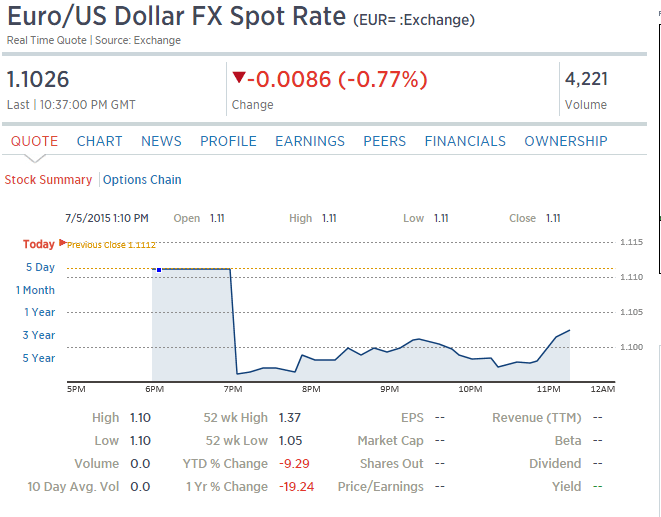
The euro did fall, which was extremely worrisome even though it did help exports. There is always the fear, particularly in Germany, of a currency collapse that brings inflation with it. At least so far, that hasn’t happened, with the euro holding about 5% above the lows and recovering from the initial knee jerk reaction from today’s referendum.
eur-usd-2
Real GDP forecasts remain positive, helped quite bit by the lower euro, and while high, unemployment has stabilized.

The camp claiming that Greece has been dragging down the entire EU economy is getting more support from the same data.

And so now while Greece isn’t being formally ousted, it will see it’s economy continue to deteriorate if it doesn’t agree to troika terms and return to ‘normal funding’ via securities sales at low rates under the ECB’s ‘do what it takes’ umbrella, and rejoin the rest of the members.

If the govt starts paying in IOU’s payments get made for a while, however they will be discounted ever more heavily with time, raising the cost of re entry to ‘normal’ funding, and the EU counts those as additions to deficit spending which could cause the terms of re entry to be that much steeper.

And any movement by Greece to use alternative funding will be taken as reason not to return Greece to ‘normal’ funding under the ECB umbrella.

Greece

Not much to say that hasn’t already been said.

I saw nothing good coming out of a yes or no vote and I still see it that way.

And watch for the follow up polls on the demographics of the vote- who voted, what they say they knew about what they voted for, etc. etc.

The no vote along with the payment past due to the IMF give cause to the ECB to no longer consider Greek govt obligations as ‘eligible collateral’ for ECB loans, and maybe not count as assets for purposes of determining a bank’s equity capital. These measure could cause banks to not be able to attract euro deposits and loans, and therefore those banks would not allow their depositors to withdraw euros or transfer balances to other banks until the deposits could be replaced.

Varoufakis stated an agreement with the troika would be reached within 24 of a no vote. If so, since both what the troika offered and what Greece countered with are negatives for the Greek economy the chances of any material improvement are not good.

For all practical purposes debt relief- the write down of Greek debt- does next to nothing positive for the Greek economy, since the existing debt is already long term and at very low interest rates.

The EU has a general problem of low aggregate demand and both the troika’s and the Greek govt’s proposals are likely to further reduce public and private sector spending.

The Greek govt resorted to nationalism to promote it’s desired ‘no’ vote. Success with this tactic will only promote more of same across the EU, where in many places it’s already taken root. And let’s just say nationalism isn’t generally a force for ‘peace on earth and good will towards men’ etc.

All of this remains supportive for euro exchange rates. Unlike govt debt crises of the past which were about debt in foreign currencies, this time there won’t, for example, be any selling of euro to get the currency needed to make debt payments, as the debt is of course already in euro. So good luck to whoever is doing the selling on this news:
eur-usd

NFIB employment, BOJ solvency, Non Farm Payrolls, Claims, Factory Orders

The cheer leaders didn’t bother to report on this they way they did when employment was increasing:

U.S. small business hiring takes a breather in June: NFIB

July 1 (Reuters) — The National Federation of Independent Business said its monthly survey of members found hiring was little changed last month. Fifty-two percent of small business owners reported hiring or trying to hire, with 44 percent of those reporting few or no qualified applicants for the positions they were trying to fill. Twenty-four percent reported job openings they could not fill, down from 29 percent in May, the NFIB said. The share of business owners looking to increase employment dropped six points, to 16 percent, while those planning reductions was up two points, at 6 percent.

Too stupid an article for me to pass up:

Is quantitative easing putting the Bank of Japan’s solvency at risk?

July 2 (Nikkei) — The BOJ’s holdings of long-term Japanese government bonds rose by 80 trillion yen a year, and its total assets expanded to 324 trillion yen at the end of fiscal 2014. The bank’s return on assets, that is, net profit divided by total assets, stood at 0.31%. If the interest rate goes up by 1 percentage point the bank’s unrealized losses are estimated to jump from 3.3 trillion yen at the end of March 2013 to 13.8 trillion yen at the end of March 2015. With the BOJ’s assets now equal to 64.7% of Japan’s GDP the credibility of the central bank is tied to the Japanese government’s fiscal discipline.

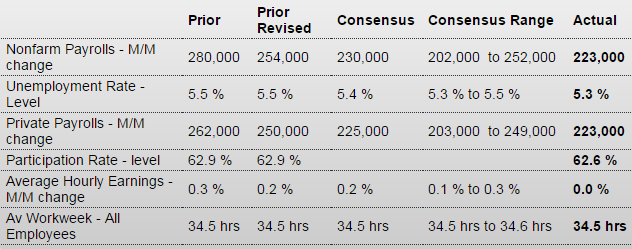
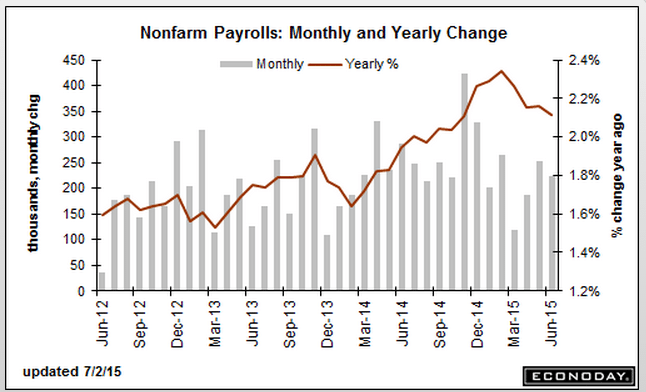
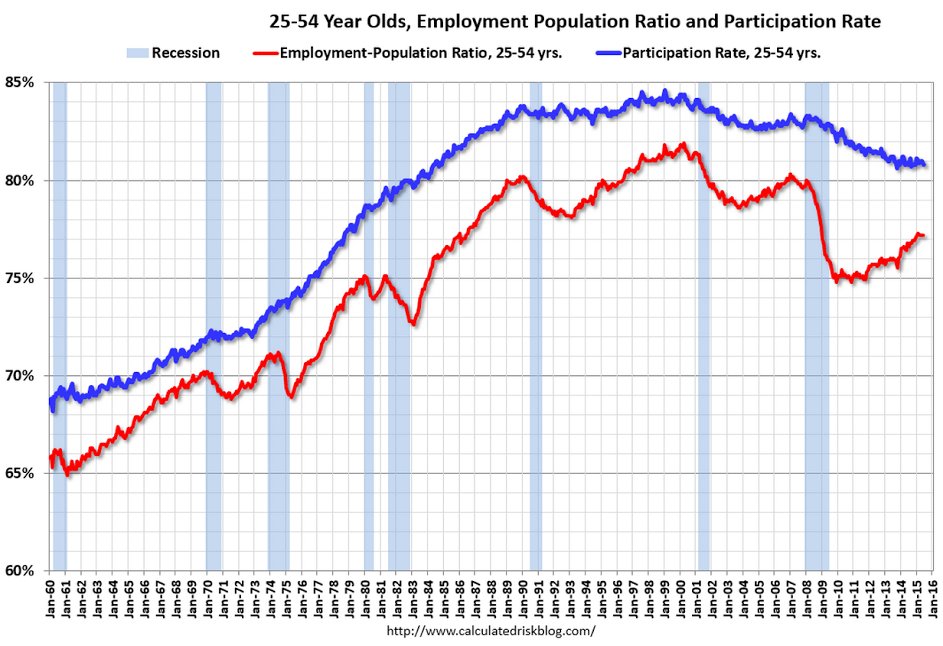
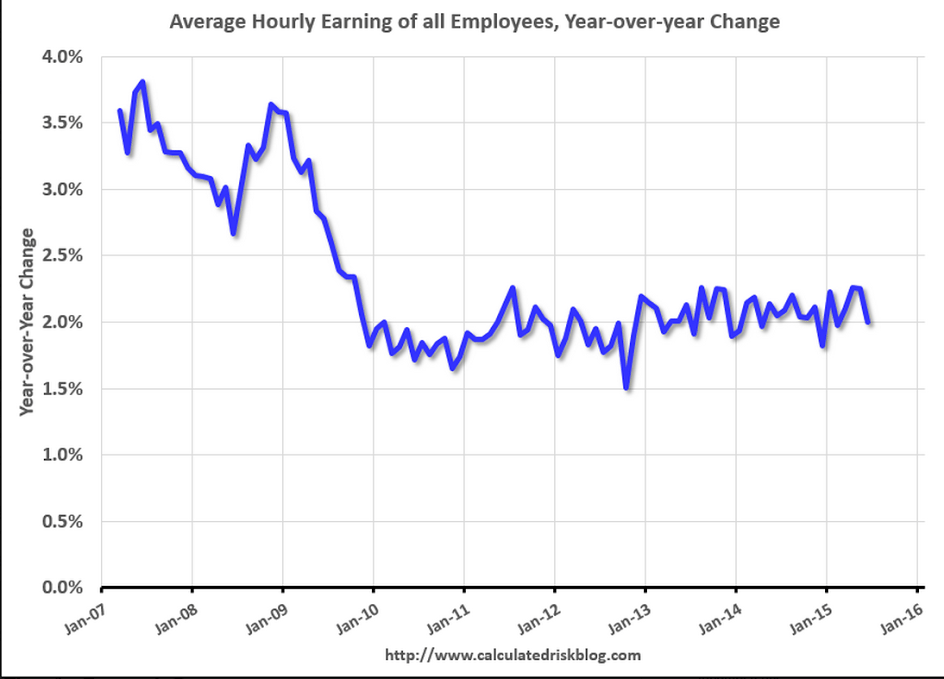
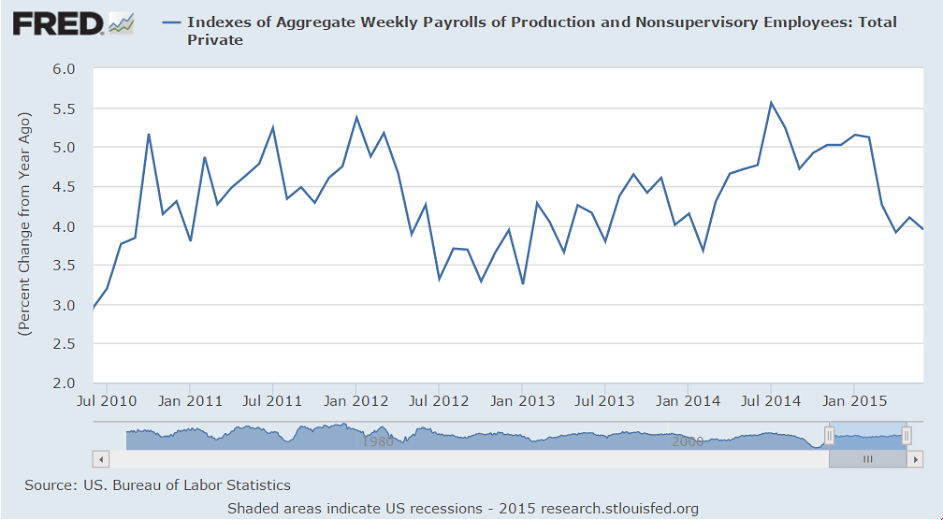
Not good, remember how they cheered the 280,000 new jobs in May, and downplayed the rise in unemployment and the increase in the participation rate? Now May is down to 254,000 and the participation rate fell way back, so they are playing up the drop in unemployment. And note the lack of comments over the deceleration of the year over year growth of employment since oil prices fell. And watch how they cling to their ‘wage inflation’ story even as growth rates again fall back:

NFP
er-7-2-1
Highlights
Push back that rate hike, at least that will be the initial reaction to June’s softer-than-expected employment report where nonfarm payroll growth came in at 223,000 vs Econoday expectations for 230,000 and include downward revisions totaling 60,000 to the two prior months (May revised to 254,000 from 280,000 and April to 187,000 from 221,000). Softness in payroll growth combines with softness in wage pressures with average hourly earnings unchanged in the month and the year-on-year rate moving down to 2.0 percent from 2.3 percent.

Timing distortions tied to the end of the school year, specifically new entrants to the labor market, appear to have pulled down the unemployment rate to 5.3 percent from 5.5 percent as the labor force in the household part of the report shrunk sharply, in turn pulling down the labor force participation rate by 3 tenths to an unusually low 62.6 percent. The U-6 unemployment rate, a favorite of Fed Chair Janet Yellen’s, fell 3 tenths to 10.5 percent.

Turning back to the establishment part of the report, private payrolls rose 223,000 vs a revised 250,000 in May. The average workweek was unchanged at 34.5 hours. Industries of note include a solid 33,000 rise in retail jobs and a 64,000 rise in professional & business service jobs. The latter reading includes a solid 20,000 rise in temporary help that hints at gains for permanent hiring ahead. Manufacturing and construction jobs were flat.

Focusing on trends, nonfarm payroll growth averaged 221,000 in the second quarter vs 195,000 in the first quarter which, despite the disappointment in today’s report, is solid improvement. The employment side of the labor market isn’t gangbusters but it is moving in the right direction while the unemployment side is increasingly favorable. This is a mixed report with special factors and isn’t likely to shake up the markets.
er-7-2-2

No demographics here- just a big fat lack of aggregate demand:
er-7-2-3
They call every zig up the start of ‘wage inflation’ even as they are all followed by zigs down:
er-7-2-4
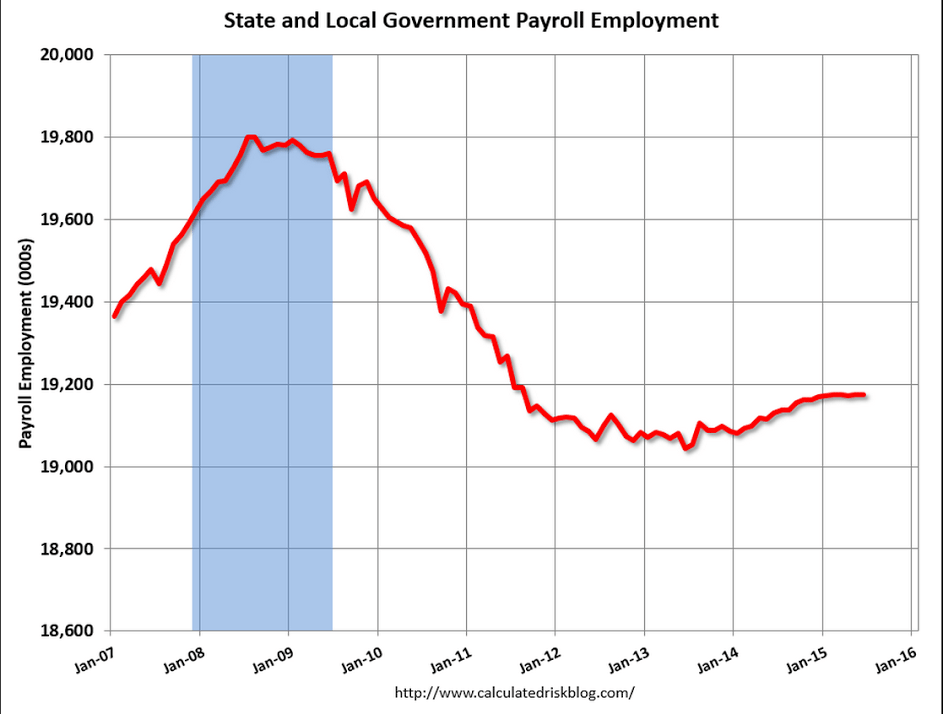
This too has leveled off after being touted for ‘lift off’ when it turned up a bit. And state and local deficits keep falling as tax revenues increase, which is an increase of fiscal drag:
er-7-2-5
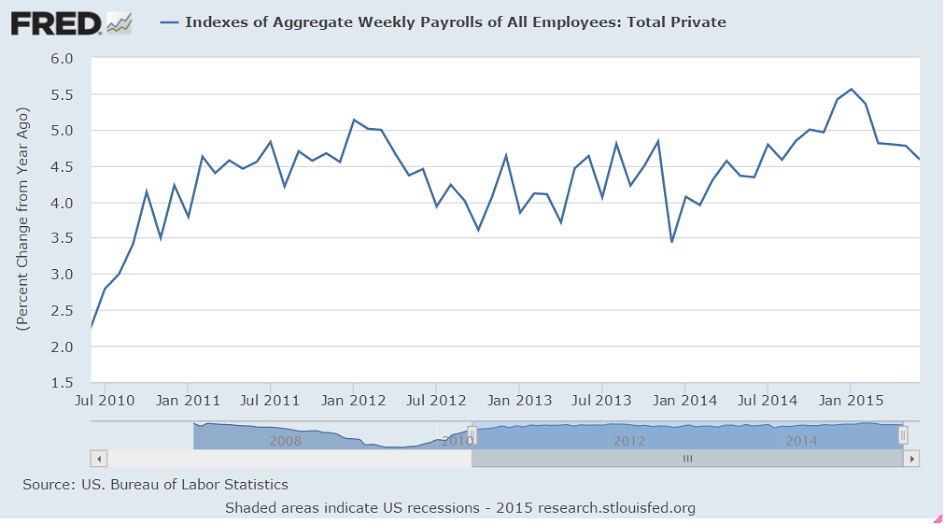
The rate of growth here had be on the rise but more recently has reversed:
er-7-2-6
er-7-2-7
Up a tad but still low historically:

United States : Jobless Claims
er-7-2-8
Highlights
Unemployment is very low right now, underscored by today’s 2 tenths drop in the unemployment rate to 5.3 percent and by the latest in jobless claims data where initial claims came in at 281,000 in the June 27 week. This is up 10,000 from the prior week but remains very low. The 4-week average inched 1,000 higher to a 274,750 level that is little changed from the month-ago comparison.

Continuing claims, where data lag by a week, rose 15,000 to 2.264 million in the June 20 week. The 4-week average is up 15,000 to 2.253 million. These readings, like those for initial claims, are also very low. The unemployment rate for insured workers is unchanged at 1.7 percent in another reading that is very low.

Another big negative ‘surprise’, and note the weak export comment, and how autos were weak despite higher May sales. Might be because of the high import content of those sales?

United States : Factory Orders
er-7-2-9
Highlights
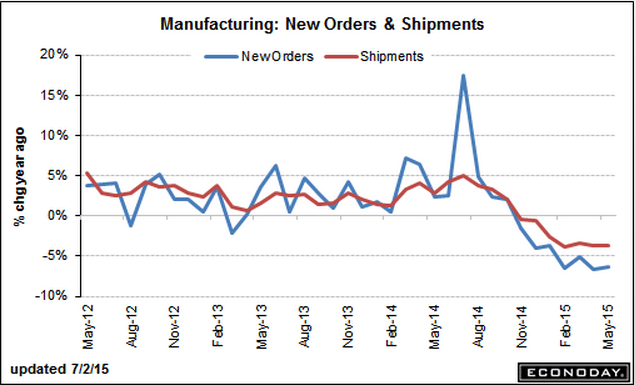
The factory sector, hit by weak exports, continues to stumble with factory orders down 1.0 percent in May. This compares with Econoday expectations for minus 0.3 percent and is near the low-end estimate for minus 1.2 percent.

The durables component of the report, initially released last week, is now revised lower, to minus 2.2 percent from minus 1.8 percent. Durables in April have also been revised lower to minus 1.7 percent from minus 1.5 percent. The nondurables component, released with today’s report, helped limit the damage but not by much, up 0.2 percent on gains for petroleum and coal following a 0.3 percent gain for April.

But aircraft orders, always volatile, are to blame for much of the durables weakness, falling 49.4 percent in the month. Excluding transportation equipment, which is where aircraft orders are tracked, factory orders were unchanged in May which isn’t great but is much better than the minus 0.6 percent print for April.

Weakness in energy equipment is also a negative factor of the factory sector, down 22.2 percent in May following a 2.1 percent decline in April. Motor vehicle orders are also surprisingly weak, down 1.3 percent in May despite very strong sales. Orders for defense aircraft were also weak, down 6.4 percent.

Capital goods data had been showing some life but not much anymore with nondefense orders excluding aircraft down 0.4 percent following a 0.7 percent decline in April. These are especially disappointing readings. And core shipments of capital goods are dead flat, at minus 0.1 percent following only a 0.2 percent gain in April. These readings will likely pull down second-quarter GDP estimates.

Other disappointments include a steep 0.5 percent decline in total unfilled orders following April’s 0.2 percent decline. Declines in unfilled orders are not a good omen for employment. Total shipments fell 0.1 percent in the month. Inventories at least are stable, unchanged in the month as is the inventory-to-shipments ratio at 1.35.

First there was the unemployment report this morning and now this report, both of which may raise concern among the doves at the Fed that the second-quarter bounce back is not much of a bounce back at all.
er-7-2-10

Comments on Greece

So the euro is down a % or 2 because of the Greek debt drama. Generally currencies go down on debt drama when the debt is in a foreign currency and it’s feared the govt will have to sell local currency to get the fx to make the payments. For example, the peso might go down should there be concern over Mexico paying the IMF in dollars. But with Greece this isn’t the case, as there’s no fear they will sell euro to get euro to make payments. But the players sell euro anyway, because that’s what you do when there is a debt crisis. Then they have to buy them back, with no state selling to help them cover.

What’s been exposed yet again is a world that doesn’t understand its monetary systems, including central bankers who don’t understand banking, as well as the mainstream media and all of the politicians and their finance ministers talking and doing the big stupid at the expense of their electorate, which also doesn’t understand it enough to have any awareness whatsoever of the total lack of expertise at the highest levels.

Meanwhile, at the macro level, deflationary policy continues including negative rates, QE, tight fiscal, structural reforms, and all that goes with it. And debt defaults, should they happen are also deflationary. And all of this deflationary bias is also evidenced by most all market prices.

Greece reading IOU’s to pay public sector workers

Yes, this is viable operationally, as it going back to drachma.

However, there’s a lot that can go wrong, as demonstrated by prior episodes of inflation, high interest rates, high unemployment, and currency depreciation.

Not to mention the temptation of the channels of mass corruption also too often employed in the past by local leaders, which will be an immediate consideration at the referendum.

Greek pension funds ration payouts

(FT) — Haris Theoharis, formerly the head of Greece’s independent revenue collection office, said the government was preparing to issue IOUs next month to pay more than 600,000 public sector workers as a first step towards readopting the drachma.

He said a team from the national accounts office at the finance ministry was working on a “drachma plan” at the office of prime minister Alexis Tsipras.

“The first stage is to replace euros with IOUs that could be sold at a discount, for example, and used to pay taxes,” Mr Theoharis told the FT. “It would take several months to implement the return of the drachma.”

A government spokesman denied the existence of such a team.

Redbook retail sales, Chicago PMI, CS house price index, consumer confidence

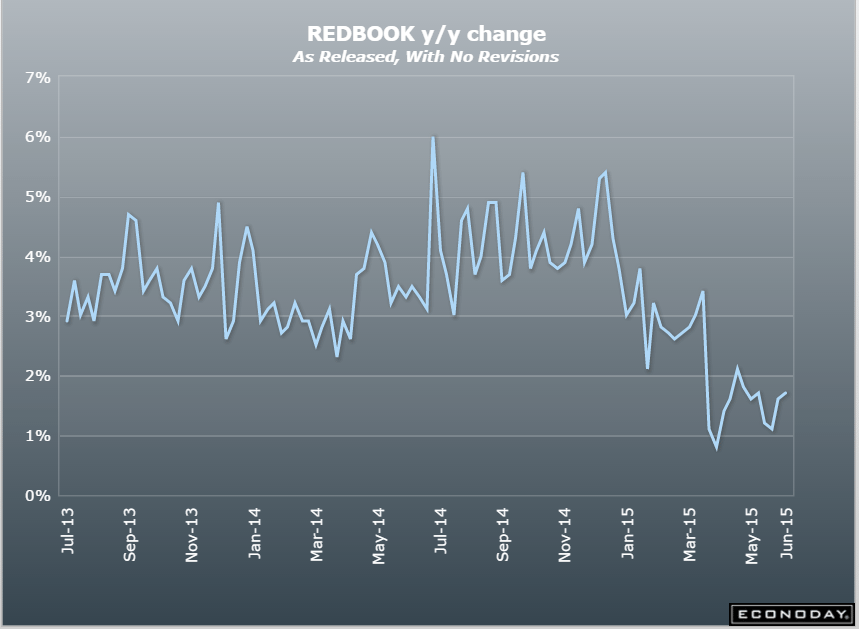
This measure of retail sales remains surprising depressed, even to me:

United States : Redbook
er-6-30-1
Highlights
Redbook’s sample continues to report stubbornly low sales rates, at a same-store year-on-year plus 1.7 percent in the June 27 week. Month-over-month, Redbook’s call is a sharp 1.5 percent contraction for June in what is a negative signal for the government’s core ex-auto ex-gas reading. The report says sales following Father’s Day were depressed though retailers expect to see strength going into the July 4 holiday. This report, which first swung lower in March, did not pick up the strength in May and is not likely to shape forecasts for June.
er-6-30-2

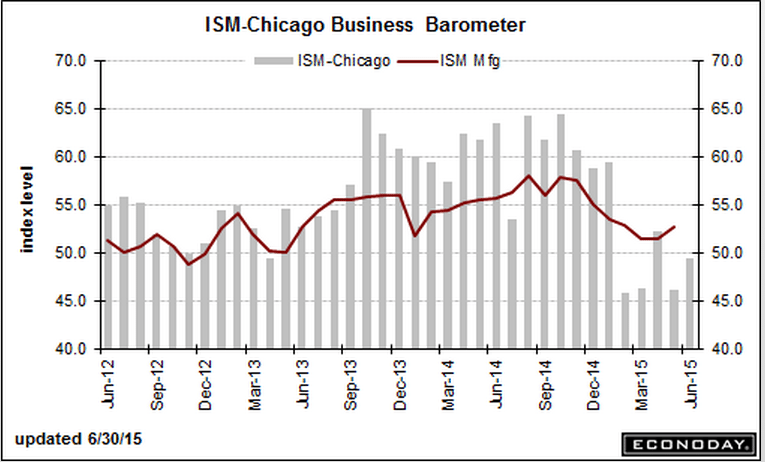
And another bad one:

Chicago PMI
er-6-30-3
Highlights
Chicago’s PMI sample remains surprisingly depressed, at a June index of 49.4 which is noticeably below the Econoday consensus for 50.6. June is the 4th contractionary reading (sub-50) of the last five months.

The sample’s employment is the lowest since November 2009 with backlog orders the lowest since September 2009. Note that weakness in backlogs is a clear negative for future employment. Production, like the main index, is in contraction for the 4th time in five months.

But leading the positive side of the report are new orders which are now back above 50. And in a special question, respondents are cautiously optimistic that new orders will begin to pick up in the third quarter
er-6-30-4

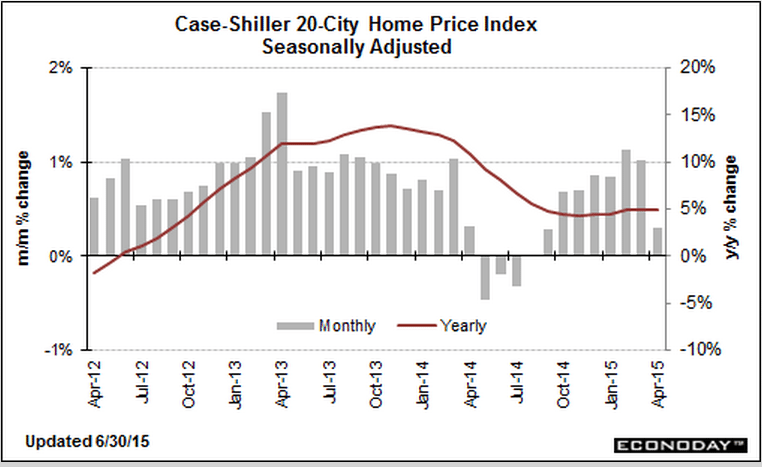
Also below expectations and decelerating:

S&P Case-Shiller HPI
er-6-30-5
Highlights
Growth in home prices slowed sharply in April, up only 0.3 percent for Case-Shiller’s 20-city index which is 5 tenths below Econoday’s consensus and 2 tenths below the low forecast. The year-on-year rate, at plus 4.9 percent, is 5 tenths below the consensus and 1 tenth above the low end.

For the first time since all the way back in September, minus signs suddenly appear on the city breakdown list with 8 of 20 cities showing contraction in April. Cleveland shows the sharpest monthly contraction at minus 0.5 percent followed by Atlanta and Chicago at minus 0.4 percent each.

But several on the plus side show significant strength led by Minneapolis at a monthly plus 1.0 percent followed by Denver, Detroit and Las Vegas at plus 0.9 percent. Year-on-year, Denver and San Francisco lead the list at plus 10.3 and 10.0 percent with Dallas in third at plus 8.8 percent. Those showing the least year-on-year growth are Washington DC at plus 1.1 percent, Cleveland at plus 1.3 percent, and Boston at plus 1.8 percent.

But weakness in this report, where monthly readings are actually 3-month averages, reflects the weak sales conditions in the early part of the year, conditions which reversed strongly in May and which point to price strength for the May edition of this report. The next hard data on housing will be construction spending on tomorrow’s calendar.
er-6-30-6

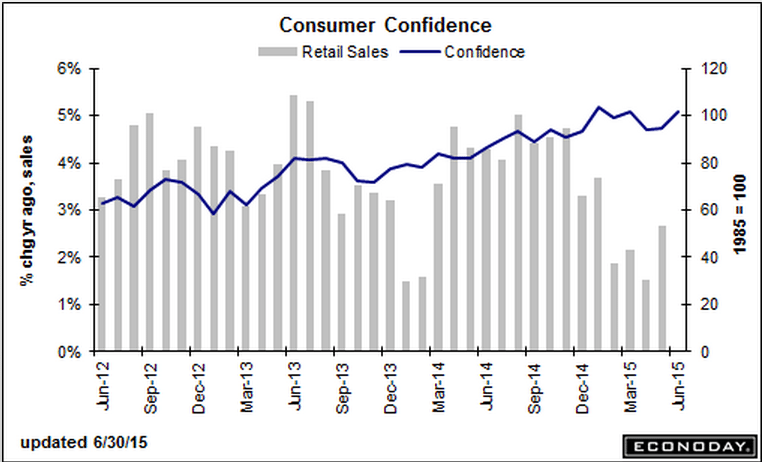
Nice pick up in confidence to get back towards Q1 levels:
er-6-30-7

Euro area trade, Greece comment

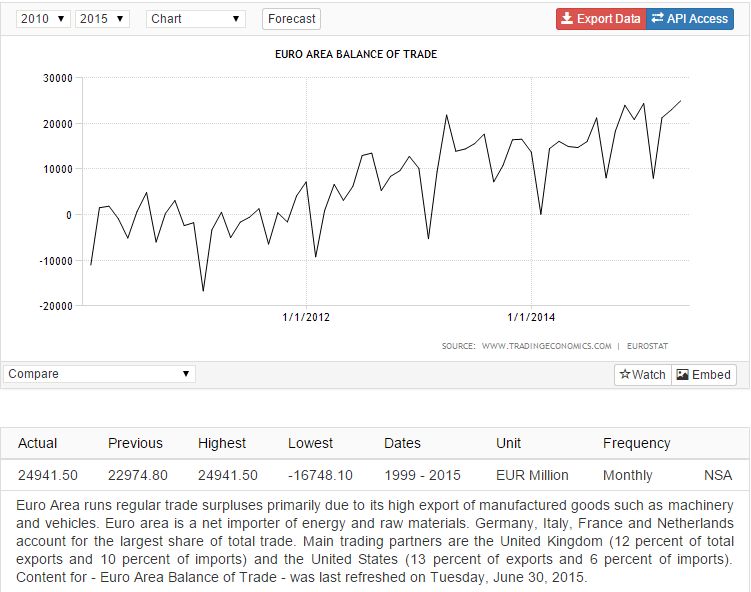
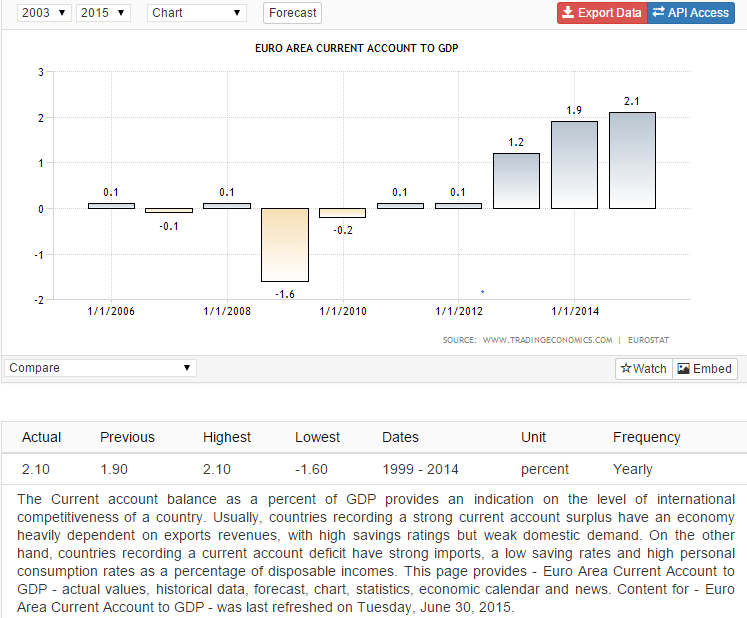
The latest trade release is very euro friendly. The lower euro, forced down by selling and not by trade, has increased the euro area trade surplus and with sellers largely exhausted, the euro goes up until the trade surplus goes away..
er-trade-1

er-trade-2

So Tsipras rejected this latest offer which, based on his earlier offer, indicates he wouldn’t even accept his own offer if the troika agreed to it, but would put it to a popular vote next week.

Note the restructure terms, for all practical purposes, are functionally equal to what could be called the debt forgiveness Tsipras wanted.

Juncker makes last-minute offer to Greece: Sources

By

June 30 (Reuters) — “The offer published on Sunday incorporated a proposal from Greece that would set value-added tax rates on hotels at 13 percent, rather than at 23 percent as originally planned in the lenders’ proposals. It was not immediately clear whether there would be any additional changes.

If the offer were accepted, the euro zone finance ministers could adopt a statement saying that a 2012 pledge to consider stretching out loan maturities, lowering interest rates and extending an interest payment moratorium on euro zone loans to Greece would be implemented in October.”

Dallas Fed

They even tried to spin this positively:

United States : Dallas Fed Mfg Survey
er-6-29-5
Highlights
The Texas manufacturing sector is still falling but not falling as fast as prior months. The general activity index improved but to a still very weak minus 7.0 from a deeply negative minus 20.8 percent in May. The production index improved to minus 6.5 from minus 13.5 percent in the May report.

New orders, however, remain very weak, still in the double-digit negative column at minus 10.3. Shipments are in the high single-digit negative column at minus 8.8. Nearing the plus column, however, is employment, at minus 1.2 vs May’s minus 8.2. Price data show upward pressure for inputs, moderating downward pressure for finished goods, and steady upward pressure for wages.

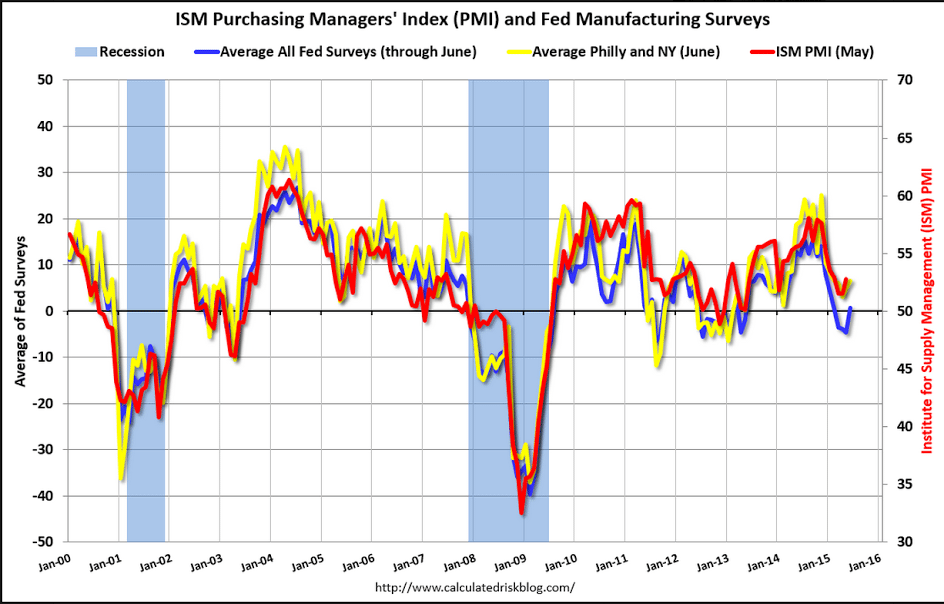
This is the last of the regional manufacturing surveys from the Fed and the bulk, with the exception of the Philly Fed, pointing to another month of weakness for the sector which continues to get hit with a one-two punch: weakness in exports and also, as especially evidenced in this report, weakness in energy equipment.

Check out the individual indicators, where only the ‘activity index’ was up:
er-6-29-6
And none of this indicates Q2 improved from Q1, just maybe got worse less fast:

er-6-29-7