Mtg Purchase Apps, Arch. Billings, Japan Exports, Bernie Article

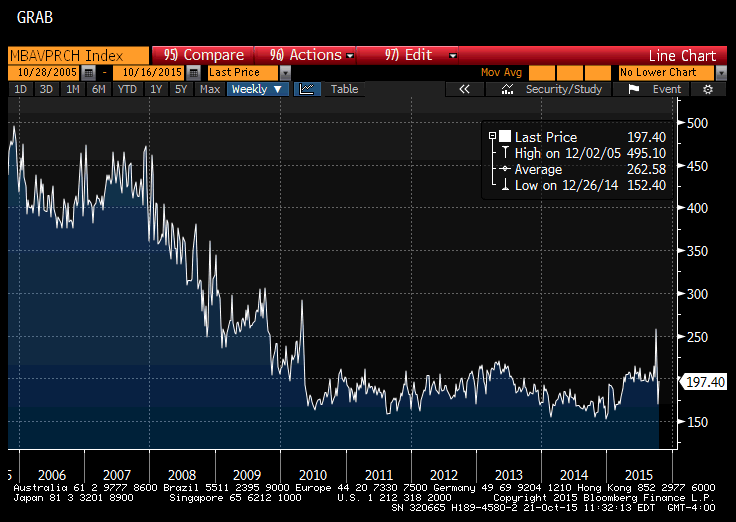
After the up and down in front of the change in regulations new purchase apps are, so far, lower than before:
sg2015102141533 (1)

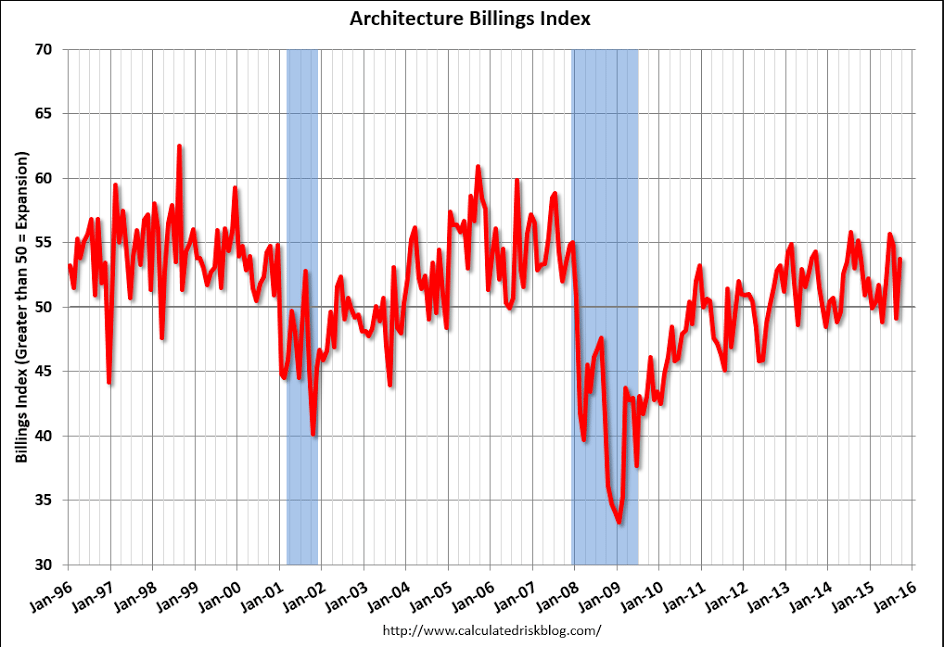
Fits with the permit spike/decline story, and there was also this note:

The multi-family residential market was negative for the eighth consecutive month – and this might be indicating a slowdown for apartments – or at least less growth.
er-10-21-5

Japan export growth slows sharply, raising fears of recession

By Tetsushi Kajimoto

Oct 21 (Reuters) — Japan’s annual export growth slowed for the third straight month in September, a worrying sign that overseas sales continued to drag on growth last quarter, adding to fears of a recession.

Ministry of Finance data showed exports rose just 0.6 percent in the year to September, against a 3.4 percent gain expected by economists in a Reuters poll.

That was the slowest growth since August last year and followed a 3.1 percent gain in August 2015. Compared with last month seasonally-adjusted shipments declined 1.7 percent.

Wednesday’s data is the first major indicator for September and is part of the calculation of third quarter gross domestic product. A third quarter contraction would put Japan into recession, given the second quarter’s negative GDP data.

China’s slowdown and soft domestic demand weighed on factory output and the broader economy, although the Bank of Japan saw the effects of China’s slowdown were limited for now, as it sticks to its rosy growth outlook, but that may change at the BOJ’s monetary policy review on Oct. 30.
The author is on the right track- it’s about aggregate demand and ‘inflation’ from excess demand.

But it’s not about rates per se, which are about the Fed’s reaction function, which does happen to include inflation, so to that extent it’s sort of ok…

Bernie Sanders doesn’t need to pay for his socialist utopia

By Jeff Spross

Without a doubt, presidential contender Bernie Sanders boasts the most ambitious policy proposals of anyone on the Democratic side. And sooner or later, the same question always comes up:

“Yeah, those are lovely ideas, but how’s he gonna pay for all this?”

For people who oppose Sanders’ program, it makes for a nice “gotcha.” But Sanders’ supporters bring it up sometimes too. Comedian Bill Maher pressed the senator on this last Friday, and Sanders dutifully listed off various ideas. They might bring in enough revenue or they might not; like his fellow candidates, Sanders’ proposals are still in their protean stage. What’s interesting is that Sanders and his fans are implicitly conceding that, yes, we would need to pay for this stuff.

May I humbly suggest this is wrong?

Not only do we not need to pay for Sanders’ programs, we shouldn’t pay for them. In fact, the federal government’s budget deficit is much too low.

How could I possibly suggest anything so loony? Contrary to popular belief, smaller deficits are not always better. How big or small the deficit should be is determined by how it interacts with the rest of the U.S. economy and other international economies. And there are two key metrics to look for there: interest rates and inflation.

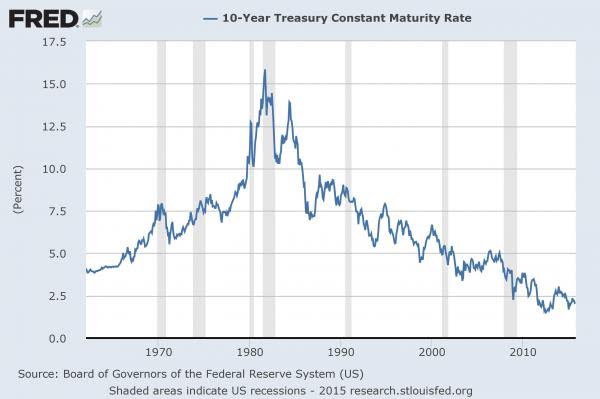
Like you or me or any company, when the U.S. government borrows money, it pays its lenders interest. This is an investment by the lender based on how much risk they want to take. So if they consider you a safe investment, they’ll demand low interest rates, and if they consider you a risky investment, they’ll demand higher rates. And interest rates on U.S. debt are currently the lowest they’ve been in at least half a century:
er-10-21-6
Equally important is why. If investors consider government debt unusually safe, it’s because they aren’t seeing lots of other places in the economy worth investing in. This shouldn’t be surprising: Our economic growth and job creation remain sluggish, there are no signs of wage growth, work force participation isdown, and economic insecurity remains high. There’s just not a lot of exciting economic ferment going on out there.

One big reason for this is that the government itself has pulled way back from spending money in the economy and hiring people. Economic ferment breeds economic ferment. More government aid, investment and hiring would mean more people with incomes to spend, creating more jobs in the private sector. So there should be a natural corrective here: Interest rates on government debt fall because it’s the only safe investment, so government borrows more and spends it, the economy picks up, and interest rates on the debt rise as investors find other places to park their cash.

But American policymakers moralize debt and deficits and think they should always be smaller, so that doesn’t happen.

Which brings us to the other key metric: inflation. Unlike you or me or any company, the U.S. government can print (or, in the digital age, create) money. At the end of the day, if you’re worried that government borrowing will drive up interest rates, you can always just have your central bank print more money and buy up government debt. One of the big reasons investors view the debt of advanced governments as safe is because, at the end of the day, they can always pay you back with money creation. And the central bank buying debt raises the demand for it, which brings interest rates back down.

But it also adds to the money supply, which threatens inflation — except that, as with interest rates, inflation is only going to rise once we’ve attained full employment. That’s when the new money stops being soaked up by new economic activity, and starts going into price increases instead. But the Federal Reserve has actually been creating a ton of new money recently, and it hasn’t really goosed the economy. That’s probably because the normal ways the Fed injects money into the economy don’t work as well as going in via government hiring and state aid.

So at the highest conceptual level, money printing and borrowing — monetary policy and fiscal policy — collapse into one another. This makes inflation, even more than interest rates, the key upper limit to government borrowing.

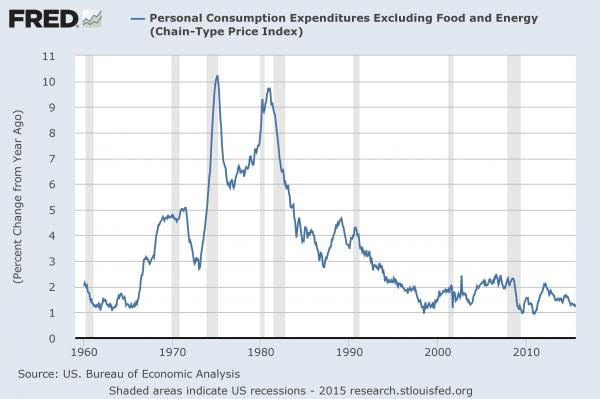
And the inflation rate is, well, about as low as it’s been in half a century:
er-10-21-7
The conclusion, by now, should be obvious: Government deficits are too low, and have been too low for agood long while.

Once you realize all this, it actually upends a lot of conventional wisdom. People usually talk about taxes and spending as being in balance with one another, but they’re actually both in balance with two other forces: the money supply and the overall health of the economy. You really can’t think of the government as just another economic actor, like an individual person or a business. It’s a unique thing unto itself: a hub or ballast tank for the overall flow of money and activity through the economy. No, its capacities to borrow and print money aren’t infinitely elastic. But it’s perfectly plausible that we could enter periods, like the current global doldrums, where government should run really big deficits and print lots of money for extended periods.

Take Bernie Sanders’ own favored example of Denmark: The Danes run a very generous welfare state, and have taxes high enough to pay for it. But Denmark is also facing a sluggish economy and rock-bottom inflation. So it’s actually being much too fiscally responsible. Denmark should expand its deficit — in this case, given the size of its deficit, by cutting its tax rates — and loosen up its monetary policy to buy up all that new debt. Taxes, under this logic, aren’t really about bringing in revenue — rather, they’re just another dial for managing this flow. And it’s conceivable that they would never need to balance with spending.

What’s funny is that Sanders might be gearing up to make this very argument. His chief economic adviser, University of Missouri-Kansas City economist Stephanie Kelton, is a fan of something called modern monetary theory: a batch of ideas that sketches out a very similar case to the one above.

Of course, Sanders hasn’t done this yet. And maybe he won’t.

But if he ever chose to throw down in favor of bigger deficits and more money-printing — on the national stage of a presidential election, no less — he’d be doing the country a tremendous service.
Housing Starts, Redbook Sales

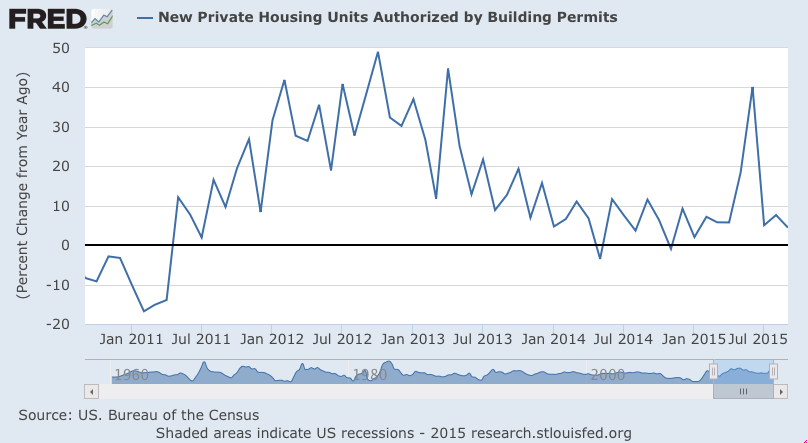
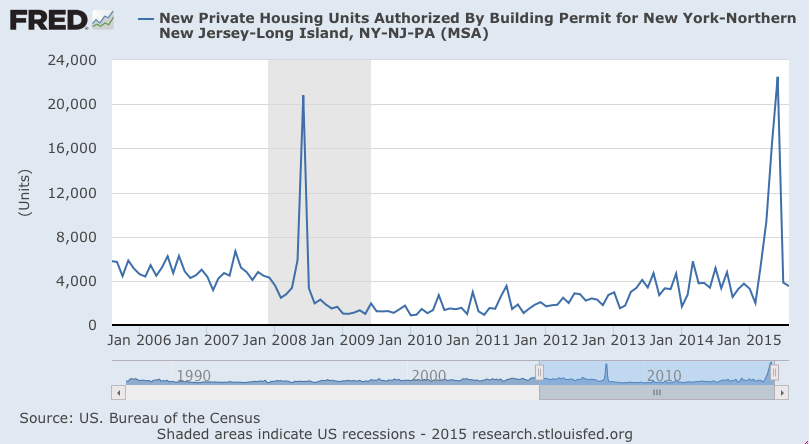
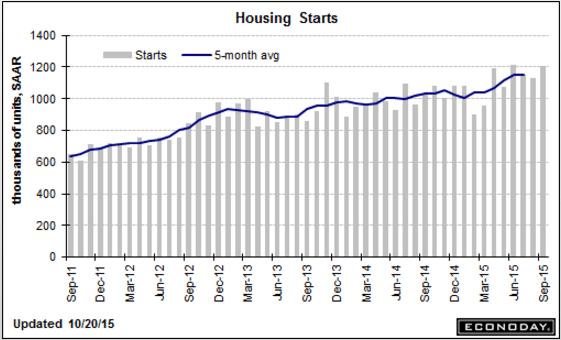
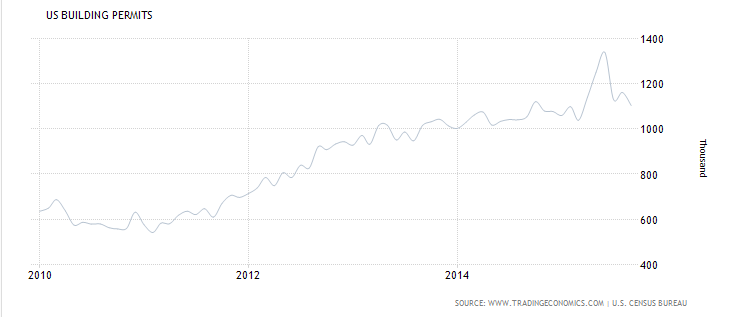
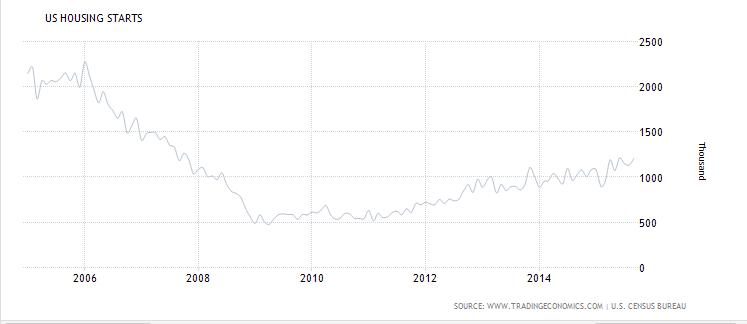
The spike in permits in front of the June 15 expiration of a NY tax break is running it’s course, as permits continue to fall. Starts follow permits and will soon be tapering off as well:

Housing Starts
er-10-20-1
Highlights
Starts, driven by a spike in multi-family units, came in much stronger than expected in September, news offset however by a significant decline in permits. Starts jumped 6.5 percent to a 1.206 million annual rate which is just outside Econoday’s high estimate. Multi-family starts surged 18.3 percent to 466,000 which follows large spikes in related permits in May and June. Single-family starts rose very slightly, up 0.3 percent to 740,000.
But it’s the permit side of the report that’s weak, down 5.0 percent to only 1.103 million which is well below Econoday’s low estimate. And it’s the multi-family component that’s especially weak, down 12.1 percent to 406,000 which is the lowest reading since March. Permits of single-family units are flat, down 0.3 percent to a 697,000 rate.

The West, a closely watched region for new homes, shows particular strength for starts with a monthly 25.4 percent surge and a 27.5 percent year-on-year gain. Starts have also been very strong in the South, which is the largest housing region, though permits here are lagging.

Taking the ups and downs all together, this report is probably in trend, pointing to an extended upward trend for construction though the abrupt downturn in permits does hint at slowing in the months ahead. Year-on-year, starts are up a very striking 17.5 percent with permits, however, up only 4.7 percent.

er-10-20-2
er-10-20-3
er-10-20-4
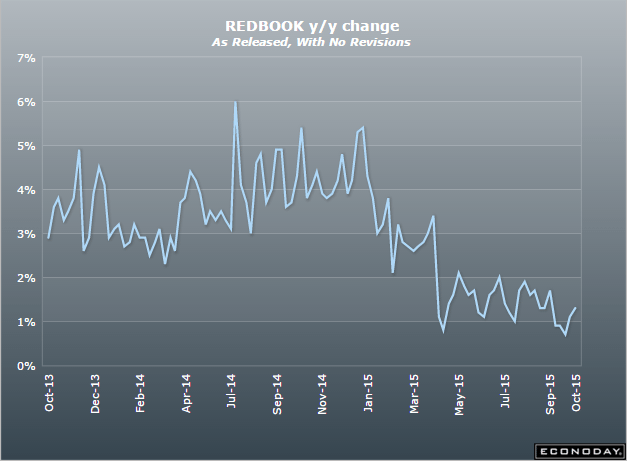
Still down, probably until the comparisons get ‘easier’ in January:
er-10-20-5

Home Buyer Index, China GDP

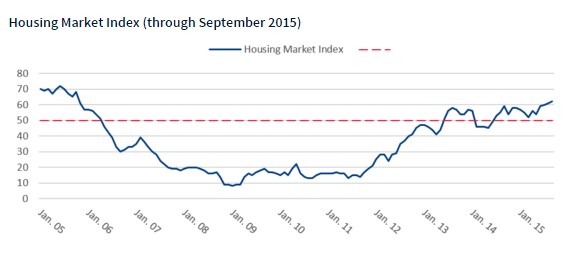
Builders are expecting improvement, but seems actual buyers walking in the door remains depressed:

Housing Market Index
er-10-19-1

Sales expectations in the next six months rose 7 points to 75, while current sales conditions rose 3 points to 70. Buyer traffic, however, didn’t move, sitting at 47— the only component still in negative territory.

Regionally, on a three-month moving average, the West registered a 5-point gain to 69, and the Northeast, Midwest and South each rose 1 point to 47, 60 and 65, respectively.

er-10-19-2
er-10-19-3

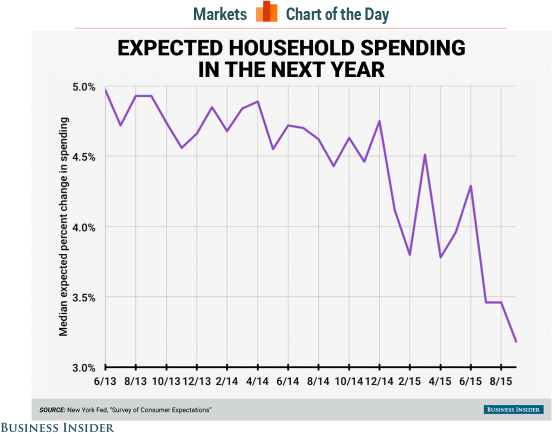
Proverb, Expected Household Spending, my RT interview

Paradox of thrift goes way back!
It’s always an unspent income story…
;)

There is that scattereth, and yet increaseth; and there is that withholdeth more than is meet, but it tendeth to poverty.

The liberal soul shall be made fat: and he that watereth shall be watered also himself.

—Proverbs 11:24–25

er-10-17-1

My RT interview:

US Manufacturing Production slows as doubts over rate hike grow

Credit check, ECRI WLI Growth Index, Rail Week

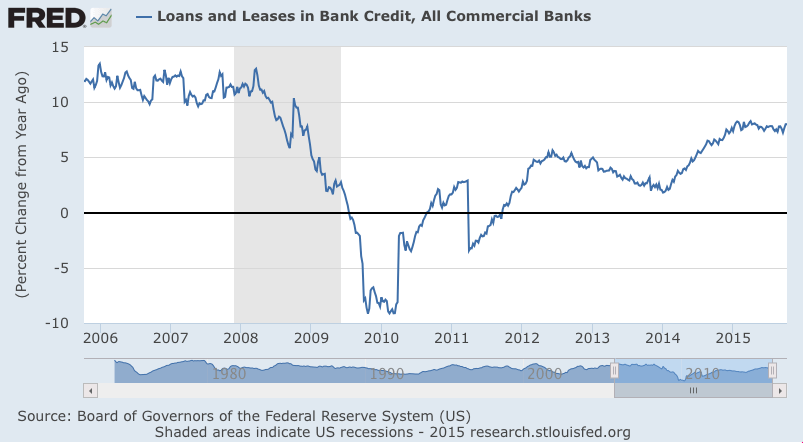
Still no sign of acceleration:
cc-10-17-1
cc-10-17-2
cc-10-17-3
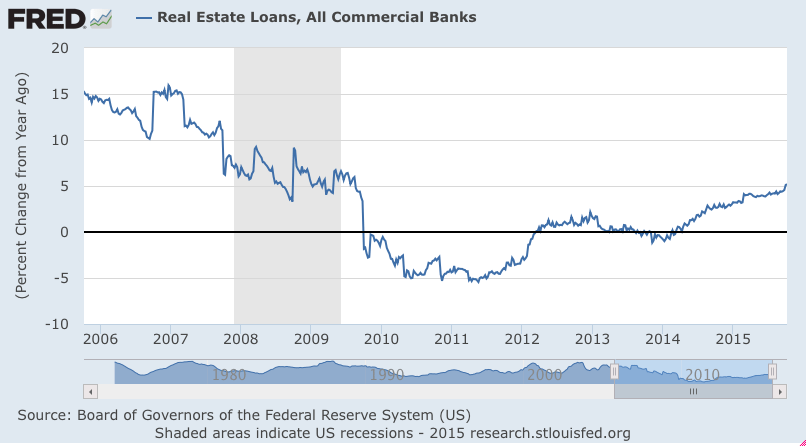
Though still how historically, the growth rate in real estate secured lending has picked up some, probably reflecting fewer cash buyers and the modest increases in sales:
cc-10-17-4
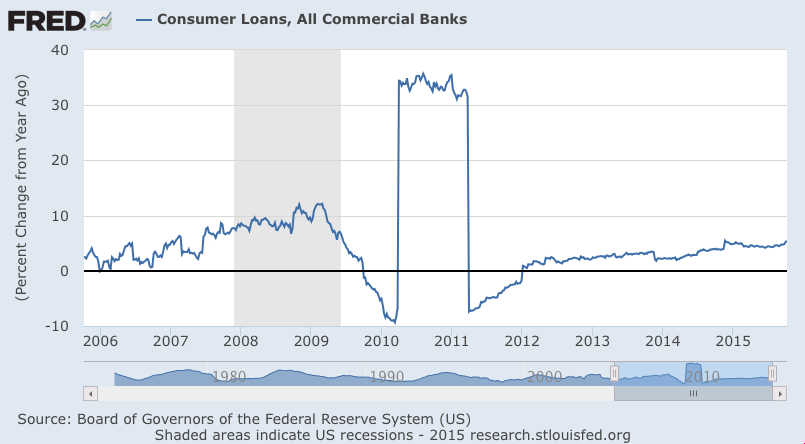
This is up some as well. Note that it went up gradually into the last recession, probably because when things go bad people borrow for a while before cutting back:
cc-10-17-5
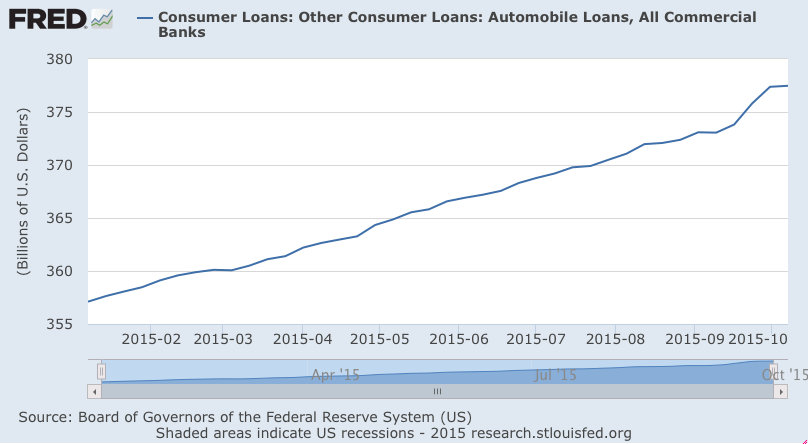
This is a new series. The latest leveling off might be an indication that the mini surge in car sales is over?
cc-10-17-6

ECRI’s WLI Growth Index Declines and Remains In Contraction

Oct 16 — ECRI’s WLI Growth Index which forecasts economic growth six months forward – declined and remains in negative territory. This index had spent 28 weeks in negative territory, then 15 weeks in positive territory – and now is in its ninth week in negative territory.

Rail Week Ending 10 October 2015: Recession In Rail Continues

Oct 16 — Week 40 of 2015 shows same week total rail traffic (from same week one year ago) and monthly total rail traffic (from same month one year ago) declined according to the Association of American Railroads (AAR) traffic data. Intermodal traffic moderately expanded year-over-year, which accounts for approximately half of movements. but weekly railcar counts continued in contraction.

Industrial Production, JOLTS, Consumer Sentiment

The chart says it all.
Not good!

Industrial Production
er-10-16-5
Highlights
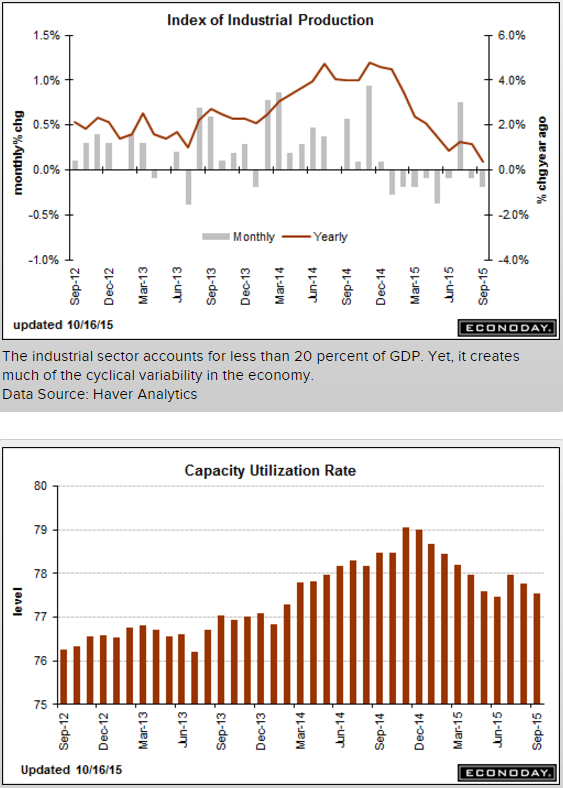
Industrial production continues to sink, down 0.2 percent in September which is slightly better than the Econoday consensus for minus 0.3 percent. The manufacturing component continues to sink, down 0.1 percent for a second straight decline and the fourth decline in five months. Industrial production was revised sharply upward for August, from an initial decline of minus 0.4 percent to only minus 0.1 percent. But the improvement is due to sharp upward revisions to the utility and mining components, less so for manufacturing where the revised decrease now stands at minus 0.4 percent for only a 1 tenth improvement from the initial reading.

Motor vehicle production, which swung up and down through the summer, settled in with a 0.2 percent gain for September. Looking at the long-term trend, vehicle production is at the top of the report with a year-on-year gain of 9.4 percent in strength underscoring that demand right now is domestically based. Business equipment production, which is closely tied to exports, slipped 1 tenth in September for a year-on-year increase of only 1.8 percent. Consumer goods, which are centered for the domestic market, gained 0.2 percent for a year-on-year rate of plus 2.6 percent.

Overall capacity utilization slipped 3 tenths to 77.5 percent with manufacturing utilization down 2 tenths to 75.9 percent. Note that excess capacity in the manufacturing sector is a factor that is holding down the costs of goods.

Turning quickly to the other components, utility production, driven by September’s unseasonable cooling needs, jumped 1.3 percent and also now 1.3 percent in August as well, up from an initial reading of plus 0.6 percent. Mining production, which has been pulled lower by commodity prices, fell 2.0 percent in the month with year-on-year contraction standing at minus 5.7 percent. Mining production in August is now revised to unchanged from an initial decline of minus 0.6 percent.

The industrial sector, specifically the manufacturing sector, continues to struggle, largely the result of weak exports. This report plays into the hands of the doves who can argue that the factory sector, also underscored by yesterday’s contraction in the Empire State and Philly Fed reports, is facing serious risks going into the New Year.
er-10-16-6

A bit of a zig down:

JOLTS
er-10-16-7
Highlights
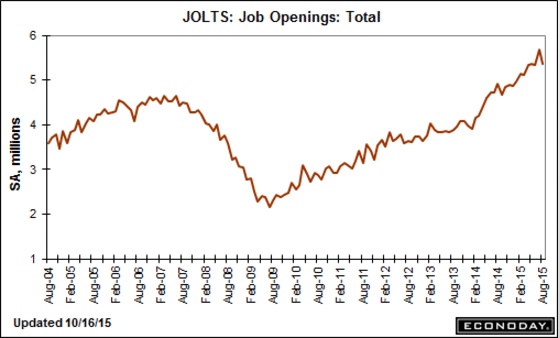
Job openings fell back in August, to 5.370 million from 5.668 million in July. Though revised downward from an initial 5.753 million, July remains a standout and a recovery best for job openings. The August rate, though down 5.3 percent from July, is still respectable and above June’s 5.323 million rate.

However, the quit rates, which is watched as an indication of worker confidence, does remain stubbornly low, unchanged for a fifth month at 1.9 percent.

This report had been big news but much less so with the September report. Still, openings are solid and consistent with strong demand in the labor market.

er-10-16-8
A hopeful move up, but low historically and still trending lower:

er-10-16-9

Euro Trade Surplus, Euro Inflation

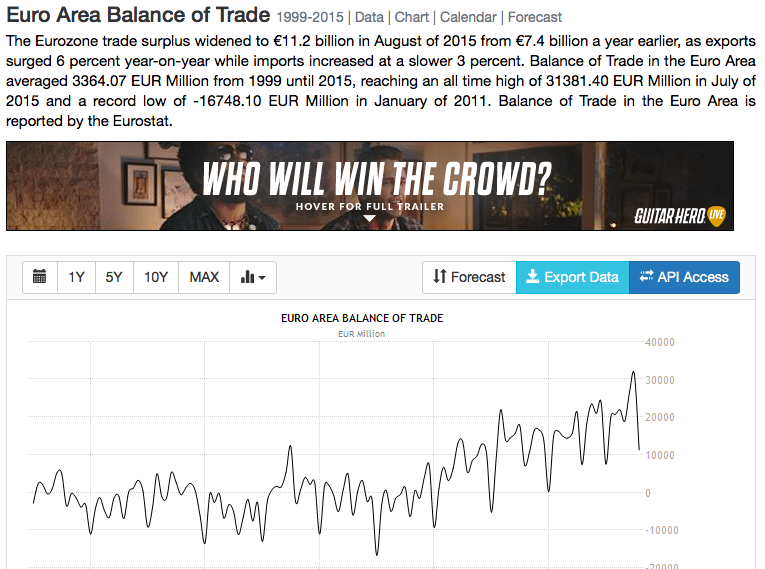
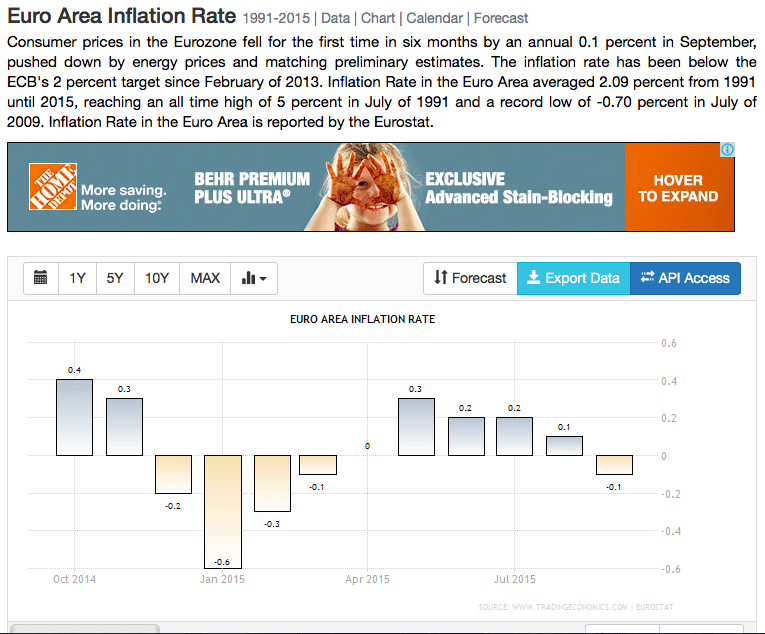
Trade surplus still trending higher along with deflation both make the euro ‘harder to get’ and ‘more valuable’:

European Union : Merchandise Trade
er-10-16-1
Highlights
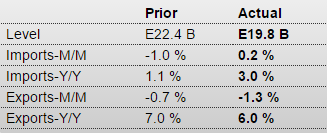
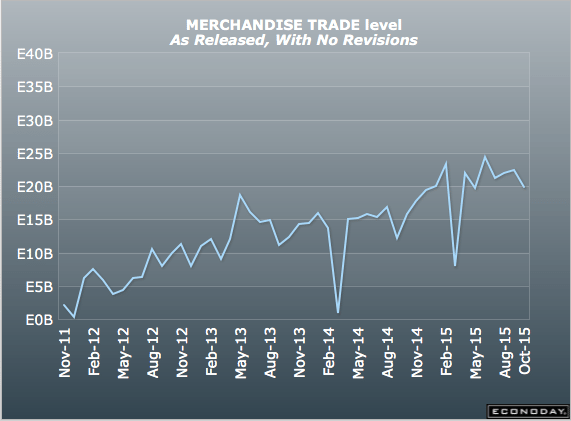
The seasonally adjusted merchandise trade balance returned a E19.8 billion surplus in August after an unrevised E22.4 billion excess in July. This was the least black ink since March. The unadjusted surplus was E11.2 billion, up from E7.4 billion in August 2014.

The headline reduction reflected mainly a 1.3 percent monthly fall in exports to E169.5 billion, their second successive decline and their lowest level since February. Imports were up 0.2 percent at E149.7 billion, only partially reversing July’s fall. Compared with a year ago, exports now show an unadjusted gain of 6.0 percent and imports a rise of 3.0 percent.

The average surplus in July/August was E21.1B, a drop of only 1.4 percent from the second quarter average. This is probably indicative of, at best, a much smaller contribution from total net exports to third quarter real GDP growth than the 0.3 percentage point boost provided in April-June. Further reason for being cautious about the speed of the Eurozone’s economic recovery.
er-10-16-2
er-10-16-3
er-10-16-4

Sea Container Counts, LA Port Traffic

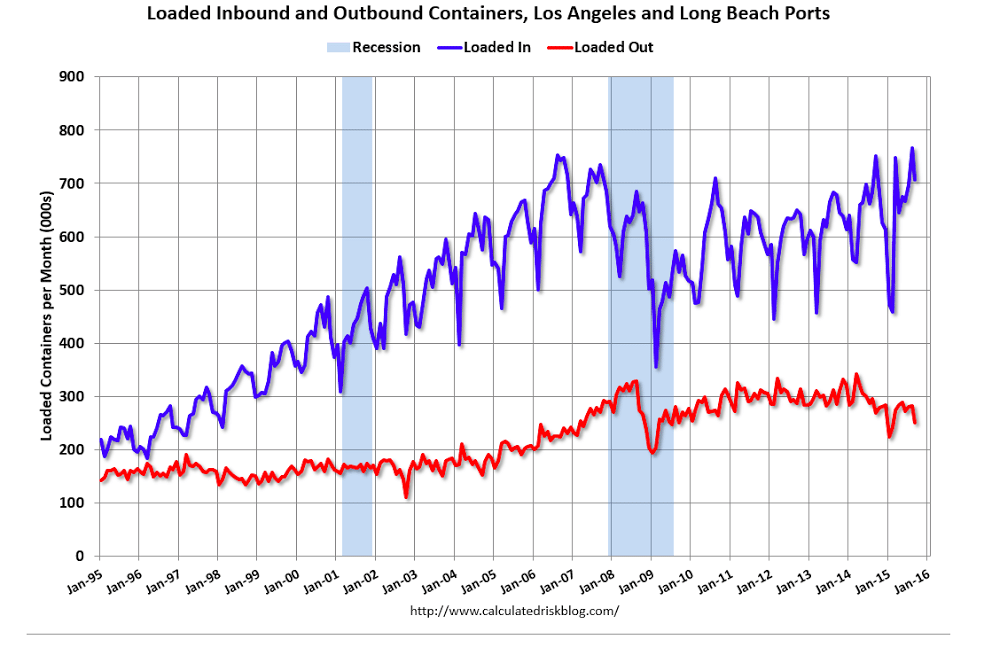
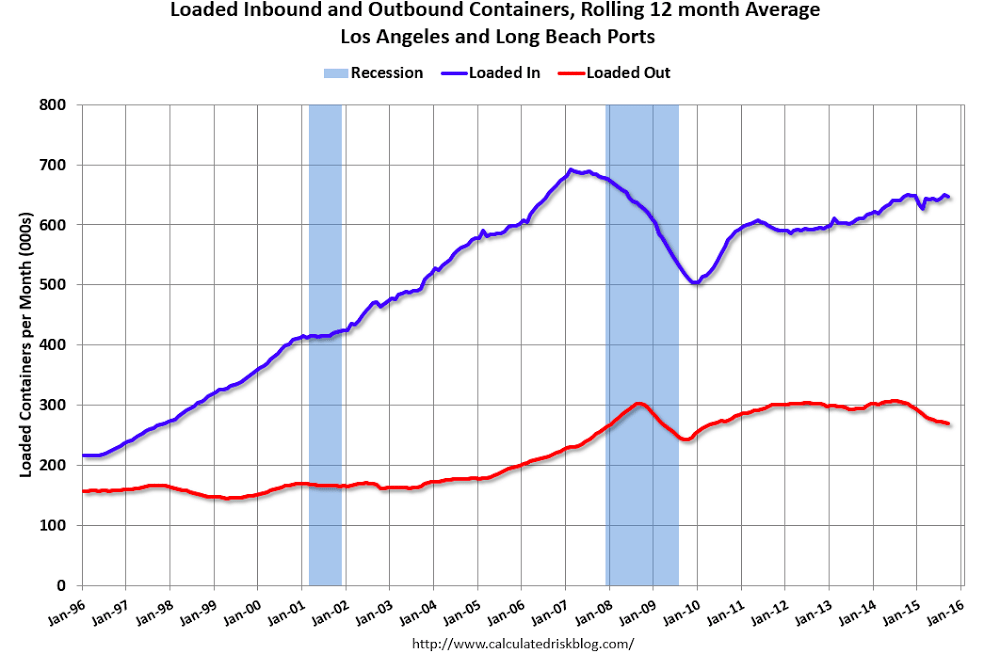
September 2015 Sea Container Counts Show Trade Recession Continues

By Steve Hansen

Oct 15 — The data for this series continues to be less than spectacular – and both imports and exports are in contraction. The year-to-date volumes are contracting for both exports and imports. We can safely say trade is in a recession.

sc-1

sc-2
Usually imports peak in the July to October period as retailers import goods for the Christmas holiday, and then decline sharply and bottom in February or March (depending on the timing of the Chinese New Year).

Imports were down 6% year-over-year in September; exports were down 7% year-over-year.

CPI, Empire State Survey, Philly Fed, Brent Crude Price, Previous Banking Post

CPI, Empire State Survey, Philly Fed, Brent Crude Price, Previous Banking Post

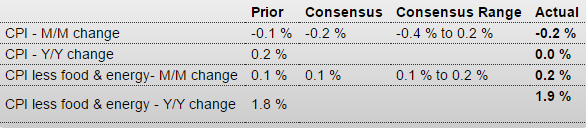
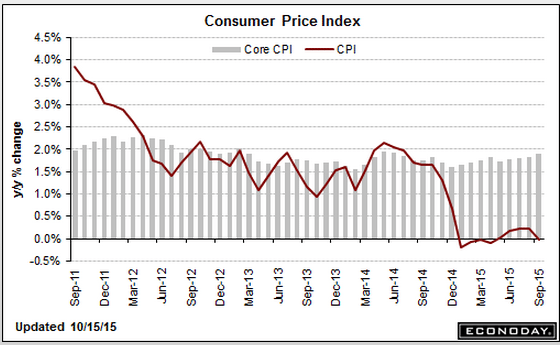
Consumer Price Index
er-10-15-1
er-10-15-2
Empire State Mfg Survey

er-10-15-3
Highlights
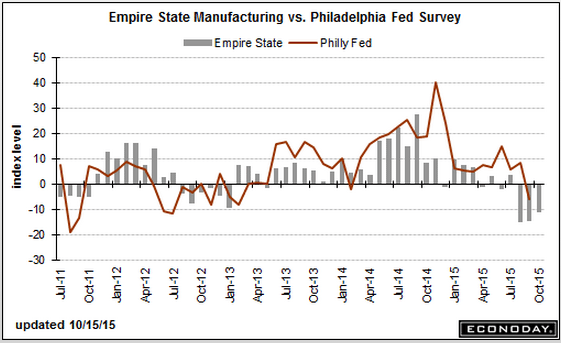
Minus signs sweep the Empire State report with the headline at minus 11.36 which is more than 1 point below Econoday’s low end estimate. Looking at individual readings, new orders are in very deep trouble at minus 18.92 for a fifth straight month of contraction. And manufacturers in the region are not going to be able to turn to unfilled orders to keep busy with this reading extending a long string of contraction at minus 15.09 in September.

Lack of orders is showing up in shipments, which are at minus 13.61 for a third straight contraction, and in employment which is in a second month of contraction at minus 8.49. The workweek is down and delivery times are shortening, both consistent with weakening conditions. Price data show a second month of contraction for finished goods, which is another negative signal, and a narrowing and only marginal rise for prices of raw materials.

This report opens up the October look at manufacturing, and the results will raise talk that weak export markets may be taking an increasing toll on the sector. Watch later this morning for the Philly Fed report at 10:00 a.m. ET where contraction is also expected.

er-10-15-4
Philadelphia Fed Business Outlook Survey

er-10-15-5
Highlights
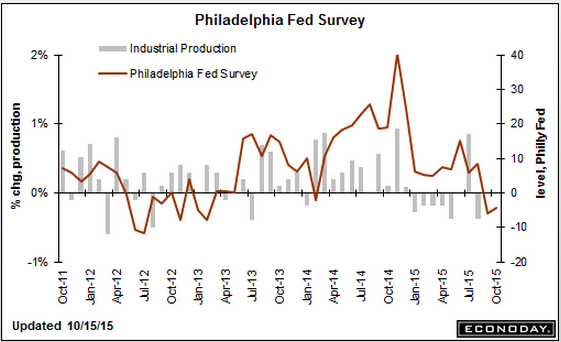
Contraction is seeping into the Mid-Atlantic manufacturing sector. The Philly Fed’s index for October, at minus 4.5, came in just below Econoday’s low-end estimate. This is the second drop in a row but, more importantly, contraction is now appearing in many of the report’s specific indexes including new orders which, at minus 10.6, fell 20.0 points from September. Unfilled orders, at minus 11.7, are extending their long contraction while shipments, at minus 6.1, are down 19.9 points from September. Employment, at minus 1.7, is now in contraction and down 11.9 points in the month. This report confirms the Empire State report released earlier this morning and points to accelerating declines for manufacturing, a sector that appears to be getting hit harder and harder by weak foreign markets.

And look when it peaked:
er-10-15-6
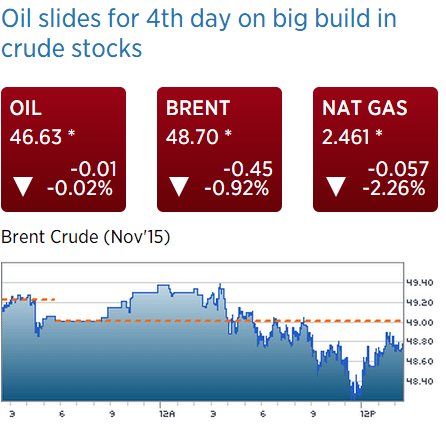
Brent still going lower. Probably keeps going down until Saudis alter their discounts:
er-10-15-7
I posted this Dec 14, 2014, and seems it’s coming into play:

Banking

Deflation is highly problematic for banks. Here’s what happened at my bank to illustrate the principle:

We had a $6.5 million loan on the books with $11 million of collateral backing it. Then, in 2009 the properties were appraised at only $8 million. This caused the regulators to ‘classify’ the loan and give it only $4 million in value for purposes of calculating our assets and capital. So our stated capital was reduced by $2.5 million, even though the borrower was still paying and there was more than enough market value left to cover us.

So the point is, even with conservative loan to value ratios of the collateral, a drop in collateral values nonetheless reduces a banks reported capital. In theory, that means if the banking system needs an 8% capital ratio, and is comfortably ahead at 10%, with conservative loan to value ratios, a 10% across the board drop in assets prices introduces the next ‘financial crisis’. It’s only a crisis because the regulators make it one, of course, but that’s today’s reality.

Additionally, making new loans in a deflationary environment is highly problematic in general for similar reasons. And the reduction in ‘borrowing to spend’ on energy and related capital goods and services is also a strong contractionary bias.