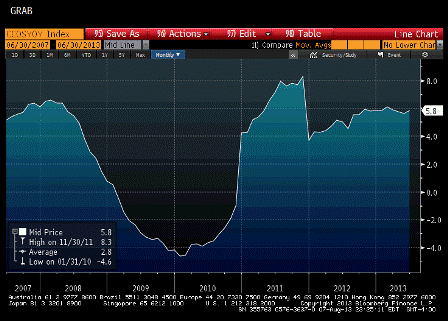
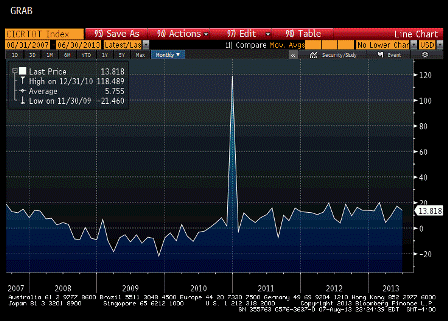
My old buddy Stevie still up to making a nice living by spewing propaganda he knows is at best misleading and subversive.
Yes, the year end tax hikes (where was anti tax Stephen when FICA was let to expire? Wasn’t his guys getting taxed, maybe?) and spring sequesters reduced the deficit.
But I know Stevie knows the federal deficit = the net $ financial assets of the (global) economy, to the penny, as per our extensive discussion in the 1990’s, when he was earning his ‘conservative’ spin stripes at CATO. In fact, he agreed with all I stated, including the fact that privatization of Social Security is at best a ‘wheel spin’ that changes nothing in the macro economy, apart from ‘redistributing’ govt liabilities and equity ownership. But that’s another story. Point here is, he’s shamelessly intellectually dishonest, and proud of it, all the way to the bank.
Anyway, he knows full well the fall off in the federal deficit represents an equal reduction in the addition to the stock of savings of $ net financial assets and income to the economy, and has been responsible for removing maybe 2% of real output from GDP, and all the ‘negative externalities’ as they are politely called that goes with suppressing aggregate demand in the face of mass unemployment.
And he knows, if pressed, that if deficit reduction exceeds the economy’s ‘borrowing to spend’ it all goes into reverse. He even knows full well how the automatic fiscal stabilizers work to reverse an expanding economy via their reduction of the federal deficit. And, of course, he knows the entire federal debt is nothing more than a glorified ‘reserve drain’ that functions to support interest rates, and operationally has nothing to do with ‘funding’, and that ‘paying it off’ just means switching the same dollar balances at the Fed from what are called ‘securities accounts’ (tsy secs) to reserve accounts, with no grandchildren or taxpayers in sight.
This is not ‘innocent fraud.’
It’s subversion for profit.
And that’s my story and I’m sticking to it.
:(
(feel free to distribute)
By Stephan Moore
August 11 (WSJ) — The biggest underreported story out of Washington this year is that the federal budget is shrinking and much more than anyone in either party expected.
Consider the numbers: According to the Congressional Budget Office, annual outlays peaked at $3.598 trillion in fiscal 2011. After President Obama’s first two years in office, many in Washington expected that number to hit $4 trillion by 2014. Instead, spending fell to $3.537 trillion in fiscal 2012, and is on pace to fall below $3.45 trillion by the end of this fiscal year (Sept. 30). The $150 billion budget decline of 4% is the first time federal expenditures have fallen for two consecutive years since the end of the Korean War.
This reversal from the spending binge in 2009 and 2010 began with the debt-ceiling agreement between Mr. Obama and House Speaker John Boehner in 2011. The agreement set $2 trillion in tight caps on spending over a decade and created this year’s budget sequester, which will save more than $50 billion in fiscal 2013.
As long as Republicans don’t foolishly undo this amazing progress by agreeing to Mr. Obama’s demands for a “balanced approach” to the 2014 budget in exchange for calling off the sequester, additional expenditure cuts will continue automatically. Those cuts are built into the current budget law.
In other words, Mr. Obama has inadvertently chained himself to fiscal restraints that could flatten federal spending for the rest of his presidency. If the country sees any normal acceleration of economic growth (from the anemic 1.4% growth rate so far this year), the deficit is on a path to drop steadily at least through 2015. Already the deficit has fallen from its Mount Everest peak of 10.2% of gross domestic product in 2009, to about 4% this year. That’s a bullish six percentage points less of the GDP of new federal debt each year.
Admittedly, this fiscal progress follows the gigantic budget blowout that began with the last year of George W. Bush’s presidency and the first two years of Mr. Obama’s. In fiscal 2009 alone, federal spending surged by $600 billion. That same year, outlays as a share of GDP reached a post-World War II high of 25.2%. But by the end of this fiscal year, outlays as a share of GDP could fall to as low as 21.5%. At least for now, the great Washington spending blitz of the Obama first term is over.
Some $80 billion of the outlay savings have come from one-time partial repayments back to the government for the hundreds of billions spent on the bailouts of banks and of Fannie Mae and Freddie Mac. And defense hawks won’t be happy that at least half of the fiscal retrenchment has been due to cuts in military spending. The defense budget is on a pace to hit its lowest level (as a share of GDP) since the days of the post-Cold War “peace dividend” during the Clinton years. These deep cutbacks could be dangerous to national security, but as the wars in Afghanistan and Iraq were winding down, defense would have been cut under any scenario. To their credit, at least Speaker Boehner and House Republicans have made sure that the defense drawdown has gone toward deficit reduction—instead of being spent on domestic social-welfare programs, as happened after the Vietnam War.
The sequester cuts in annual budgets for the military, education, transportation and other discretionary programs have also been an underappreciated success, with none of the anticipated negative consequences.
Discretionary spending soared to $1.347 billion in fiscal 2011, according to the CBO, but was then cut by $62 billion in 2012 and another $72 billion this year. That’s an impressive 10% shrinkage. And these are real cuts, not pixie-dust reductions off some sham baseline. Discretionary spending as a share of the economy hit 9.4% of GDP in fiscal 2010 but fell to 7.6% this year and is scheduled to slide to 6.4% in Mr. Obama’s last year in office.
The sequester is squeezing the very programs liberals care most about—including the National Endowment for the Arts, green-energy subsidies, the Environmental Protection Agency and National Public Radio. Outside Washington, the sequester is forcing a fiscal retrenchment for such liberal special-interest groups as Planned Parenthood and the National Council of La Raza, which have grown dependent on government largess.
But the fiscal story isn’t all rosy. The major entitlements remain on autopilot and are roaring toward insolvency. Thanks in large part to Mr. Obama’s aversion to practical fixes, the Congressional Budget Office calculates that through July of this year Social Security, Medicare and Medicaid spending are up $73 billion from just last year. This doesn’t include ObamaCare, which is scheduled to add $1 trillion of new costs over the next decade.
So the fiscal progress reported here is no excuse for complacency. But it does call into question the wisdom of a government-shutdown confrontation over the budget this fall or a debt-default showdown that runs the risk of suspending the spending caps and sequester and revitalizing an increasingly irrelevant president.
Liberals had hoped that re-electing Mr. Obama, the most pro-spending president since LBJ, would unleash another four years of Great Society government expansion. Instead, spending caps and the sequester are squashing these progressive dreams. Welcome to the new fiscal reality in Washington. All Republicans need to do is enforce the budget laws Mr. Obama has already agreed to. Entitlement reforms will come when liberals realize that the unhappy alternative is to allow every program they cherish to keep shrinking.