The Center of the Universe

St Croix, United States Virgin Islands

MOSLER'S LAW: There is no financial crisis so deep that a sufficiently large tax cut or spending increase cannot deal with it.

Archive for August 20th, 2009

Claims/Philly Fed

Posted by WARREN MOSLER on 20th August 2009


[Skip to the end]


Karim writes:

Data tug-of-war continues as manufacturing rebounding under inventory rebuild, but labor market stays weak and indicating that underlying demand not improving all that much

  • Claims weaker than expected
  • Initial up 15k to 576k with prior week revised +3k
  • Continuing claims up 2k (prior week revised up 37k), extended benefits down 48k and emergency benefits up 92k
  • Overall, weak labor market data
  • Philly Fed firmer than expected in keeping with inventory rebuild that is driving manufacturing
  • National ISM may exceed 50 in next 2-3mths, consistent with inventories adding about 2% to GDP gwth in H2


August July
Activity 4.2 -7.5
Prices paid 10.0 -7.5
New Orders 4.2 -2.2
Shipments 0.6 -9.5
# of Employees -12.9 -25.3


[top]

http://moslereconomics.com/wp-content/plugins/sociofluid/images/digg_48.png http://moslereconomics.com/wp-content/plugins/sociofluid/images/stumbleupon_48.png http://moslereconomics.com/wp-content/plugins/sociofluid/images/delicious_48.png http://moslereconomics.com/wp-content/plugins/sociofluid/images/newsvine_48.png http://moslereconomics.com/wp-content/plugins/sociofluid/images/technorati_48.png http://moslereconomics.com/wp-content/plugins/sociofluid/images/facebook_48.png http://moslereconomics.com/wp-content/plugins/sociofluid/images/twitter_48.png

Posted in Economic Releases | No Comments »

FT: Bank Struggles to gauge if QE is taking effect

Posted by WARREN MOSLER on 20th August 2009


[Skip to the end]

>   
>   On Thu, Aug 20, 2009 at 4:11 AM, Marshall wrote:
>   
>   Maybe the BofE is having problems because it is looking at this through the wrong
>   monetary paradigm. All QE is doing is switching one form of debt term structure
>   for another, not actually contributing to aggregate demand. If they figured that
>   out, they wouldn’t be “struggling” here.
>   

True, hopefully this is what it takes, globally, to finally recognize with a non convertible currency the direction of causation is from loans to deposits and reserves, and that at the macro level banking is in no case reserve constrained, for all practical purposes.

And from there it hopefully follows that govt. spending is in no case inherently revenue constrained. But I suppose that could take another hundred years at the current pace of discovery.

>   >   
>   >   I would make it even simpler. QE per se does NOTHING to contribute to aggregate
>   >   demand and should therefore be stopped and replaced by fiscal policy which does
>   >   contribute to aggregate demand. Ironically, the last BOE minutes showed King
>   >   voted for increasing QE purchases beyond what most other MPC members were
>   >   prepared to support, yet this is the same guy who has railed against the
>   >   government’s “excessive” spending.
>   >   
>   >   But, you’re right. At the current pace of discovery, we might not get there until
>   >   our grandchildren are 6 feet under.
>   >   

Bank struggles to gauge if QE is taking effect

By Norma Cohen

August 20 (FT) — The Bank of England’s monetary policy committee appears united in the conviction that its unconventional approach to boosting Britain’s economy has -further to run.

But by how much, for how longand, crucially, knowing when enough is enoughare much thornier questions, judging by the debate revealed in the minutes of its latest meeting this month.

After the Bank announced its surprise move to increase the gilts purchase programme to £175bn – raising the authorised amount by a further £25bn – most analysts chalked it up as an “insurance” measure, an added fillip just in case the massive cash injections to date fell short of what was needed.

But now it emerges that the MPC is deeply concerned about whether the nascent recovery suggested by a range of recent economic indicators is sustainable – particularly since there is little evidence that the £125bn spent between March and the end of July has delivered additional lending.

“The aim of the MPC’s programme of asset purchases was to boost nominal spending to ensure that it was consistent with meeting the inflation target in the medium term,” the minutes noted. That is another way of saying that the MPC wants to offset the collapse in demand by making money cheaply and easily available, hoping that households and businesses will spend it and ward off a deflationary spiral.

Yes, not realizing funding is always easily available to the banking system at the policy rate.

However, just how the gilts purchases would achieve that is the subject of much debate. Judging the efficacy of the programme is equally problematic. After all, the MPC is engaged in a policy untested in the UK, or indeed in almost any other developed economy.

By one key measure, there is little sign that the purchases, known as quantitative easing, are having any effect. There is little sign that the M4 money supply – the broadest measure of money flowing through the economy – is expanding.

Brian Hilliard, an economist at Société Générale, said that in theory QE ought to be effective. “If you are a monetarist, a deficiency of nominal spending can be righted by injecting a given sum,” he said. Through various channels, that money should work its way through the economy and help boost demand for goods and services.

If anyone knows him, please send this along. There are no ‘various channels.’

The minutes note that an expansion in money supply would help the MPC determine when or whether QE was working. However, the committee acknowledges that there is “unlikely to be a simple, straightforward mapping between asset purchases, monetary growth and nominal spending”. That may be one way of explaining the fact that, despite huge cash injections, M4 showed only insipid growth between the first and second quarters of 2009.

Not true either. That can come from increased borrowing due to govt. deficit spending, technical shifts in liabilities, and other things unrelated to QE.

Michael Saunders, an economist at Citigroup, noted the reference in the minutes to a pick-up in broad money growth in the second quarter – to a 3.7 per cent annualised rate from a 3.3 per cent rate in the first quarter. The growth, he said, amounted to a quarterly expansion in M4 of roughly £1.8bn. “So £125bn of QE has caused broad money growth to accelerate by £1.8bn. That’s a pretty poor rate of return,” he argued.

He could use an email as well.

It didn’t even cause that. And it’s not a ‘rate of return’ because it isn’t an investment.

Equally, it is not clear how the MPC is deciding how much money it should inject into the economy. In the minutes of its March meeting, the MPC estimated that since the UK’s output gap – the shortfall between what the economy could produce and what it is actually producing – was about 5 per cent of gross domestic product, an equivalent amount should be injected through QE. In round numbers, that amounted to £75bn, the sum initially authorised.

As if there was some channel for that to actually happen.

One disclosure that emerges from the minutes of this month’s meeting is that the MPC has abandoned that numerical equation. There is no discussion within them on how to judge the additional sums needed for QE. The impact of a cash injection of £175bn, compared with the £200bn favoured by Mr King, is not spelt out.

Mr. King needs this emailed to him as well. He seems further off the mark than any of the others.

There is general agreement that looking at money supply alone to gauge the success of QE may produce too narrow a perspective. A recent analysis of the Bank’s QE programme by the International Monetary Fund concluded that, by many measures, it was having beneficial effects, but it also noted that there was uncertainty on how to judge such success.

“The significant uncertainty surrounding the transmission of QE – explicitly acknowledged by the MPC – would seem to caution against relying too much on any such numerical assumptions,” the IMF concluded.

And another email to the IMF, thanks!

Bernanke seems to at least recognize that the channel of consequence is the adjustment of long term interest rates, and not the quantity of reserves, though the FOMC hesitates to fully go there by setting a target term structure of rates and letting the quantity of reserves adjust.


[top]

http://moslereconomics.com/wp-content/plugins/sociofluid/images/digg_48.png http://moslereconomics.com/wp-content/plugins/sociofluid/images/stumbleupon_48.png http://moslereconomics.com/wp-content/plugins/sociofluid/images/delicious_48.png http://moslereconomics.com/wp-content/plugins/sociofluid/images/newsvine_48.png http://moslereconomics.com/wp-content/plugins/sociofluid/images/technorati_48.png http://moslereconomics.com/wp-content/plugins/sociofluid/images/facebook_48.png http://moslereconomics.com/wp-content/plugins/sociofluid/images/twitter_48.png

Posted in CBs, ECB, Fed, GDP, Inflation | 2 Comments »

capital regs

Posted by WARREN MOSLER on 20th August 2009


[Skip to the end]

>   
>   (email exchange)
>   
>   On Wed, Aug 19, 2009 at 11:58 PM, Roger wrote:
>   
>   this is fascinating – any sense whether the implementers were aware of the disparate
>   consequences of this approach, as opposed to completely unaware of the
>   consequences for different size banks?
>   

They are aware but it might not be their job to care about the consequences.

>   
>   Warren,
>   
>   I have copied two links, the first is the letter from the director of the ABA discussing
>   the issue. Inside that letter is another link (the second one I have below) which is
>   the instructions for the Call Report. These issues are not regulations, but inter-agency
>   directions for reporting in the Call Report. If you want anything else, let us know.
>   

Letter

Directions for reporting


[top]

http://moslereconomics.com/wp-content/plugins/sociofluid/images/digg_48.png http://moslereconomics.com/wp-content/plugins/sociofluid/images/stumbleupon_48.png http://moslereconomics.com/wp-content/plugins/sociofluid/images/delicious_48.png http://moslereconomics.com/wp-content/plugins/sociofluid/images/newsvine_48.png http://moslereconomics.com/wp-content/plugins/sociofluid/images/technorati_48.png http://moslereconomics.com/wp-content/plugins/sociofluid/images/facebook_48.png http://moslereconomics.com/wp-content/plugins/sociofluid/images/twitter_48.png

Posted in Banking | 2 Comments »

current storage situation for both petroleum and clean products

Posted by WARREN MOSLER on 20th August 2009


[Skip to the end]

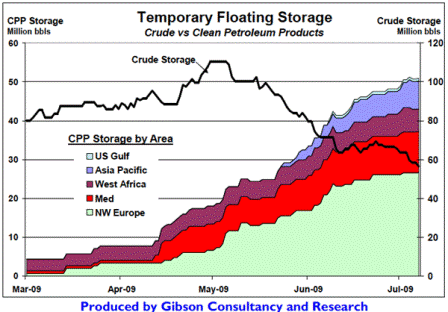
Looks like the temporary storage is moving into likely cheaper land based storage.

And much is probably already sold forward into the contango, as forward buying causes spreads to widen to the point where someone buys it spot and sells it forward for enough of a markup to cover storage costs and provide a desired return on capital.

By setting price and letting quantity pumped adjust, the Saudis/OPEC provide an incentive not to store crude and over time that policy should cause the contango to move to backwardation.

On the other side, passive commodity strategies by investors do the reverse, so at the moment it looks like they are in control.

There is a kind of oceanic traffic jam out there among very large crude carriers (VLCCs), with something like 7% (according to Lloyd’s) of them storing crude oil off the coast of Europe, Asia, or North America in anticipation of higher prices later this year. Such are the joys of contango — higher forward prices making it profitable to store petroleum for future sale — but it is a huge gamble. If the people contracting for such VLCCs are wrong, their carrying costs mount and it becomes likely that they just dumb the product on the markets, further depressing prices.

Check the following figure (from EA Gibson) of the current storage situation for both petroleum and clean products, like gasoil:. While crude sea storage has declined from its peak earlier this year, clean products are floating out there is ever larger amounts.


[top]

http://moslereconomics.com/wp-content/plugins/sociofluid/images/digg_48.png http://moslereconomics.com/wp-content/plugins/sociofluid/images/stumbleupon_48.png http://moslereconomics.com/wp-content/plugins/sociofluid/images/delicious_48.png http://moslereconomics.com/wp-content/plugins/sociofluid/images/newsvine_48.png http://moslereconomics.com/wp-content/plugins/sociofluid/images/technorati_48.png http://moslereconomics.com/wp-content/plugins/sociofluid/images/facebook_48.png http://moslereconomics.com/wp-content/plugins/sociofluid/images/twitter_48.png

Posted in Comodities, Oil | No Comments »

Coal is dead……

Posted by WARREN MOSLER on 20th August 2009


[Skip to the end]

Looks like it, unless there is another side of this story we don’t know about, but seems highly doubtful

The only legal place you can store mercury is in your mouth, by the way.

Mercury Found in Every Fish Tested, Scientists Say

By Cornelia Dean

August 19 (NYT) — When government scientists went looking for mercury contamination in fish in 291 streams around the nation, they found it in every fish they tested, the Interior Department said, even in isolated rural waterways. In a statement, the department said that some of the streams tested were affected by mining operations, which can be a source of mercury pollution, so the findings, by scientists at the United States Geological Survey, do not necessarily reflect contamination levels nationwide. But Interior Secretary Ken Salazar said the findings underlined the need to act against mercury pollution. Emissions from coal-fired power plants are the largest source of mercury contamination in the United States. A quarter of the fish studied had mercury levels above safety levels set by the Environmental Protection Agency for people who eat the fish regularly, the Interior Department said.


[top]

http://moslereconomics.com/wp-content/plugins/sociofluid/images/digg_48.png http://moslereconomics.com/wp-content/plugins/sociofluid/images/stumbleupon_48.png http://moslereconomics.com/wp-content/plugins/sociofluid/images/delicious_48.png http://moslereconomics.com/wp-content/plugins/sociofluid/images/newsvine_48.png http://moslereconomics.com/wp-content/plugins/sociofluid/images/technorati_48.png http://moslereconomics.com/wp-content/plugins/sociofluid/images/facebook_48.png http://moslereconomics.com/wp-content/plugins/sociofluid/images/twitter_48.png

Posted in Comodities, Energy | No Comments »