FT: Fed’s first foray into unsecured lending


[Skip to the end]

Fed’s first foray into unsecured loans.

As per my proposal over a year ago.

Fed’s first foray into unsecured lending

by Krishna Guha
Oct. 6- The Federal Reserve is working with the US Treasury on plans for a dramatic move into unsecured lending in the hope that this extreme step could help bring credit markets back to life.

As well as unsecured lending to banks, this could lead to the Fed directly purchasing commercial paper or funding a special purpose vehicle set up to do this.

Any unsecured lending would be a radical departure for the Fed. Central banks the world over almost never make unsecured loans, and the Fed has never done so in its history.

Wrong, the swap lines to foreign commercial banks seem to me to functionally unsecured lending.

The Fed has loaned over $400 billion on this basis to the ECB so far.

It would allow the Fed to address two key problems in the financial system directly: the freezing of the term interbank money market, which covers all but overnight borrowing, and the rapid contraction of the commercial paper market.

However, the US central bank does not believe it has the legal mandate to make unsecured loans on which there is a reasonable likelihood of some loss. So it needs the Treasury to guarantee losses on the loans, probably under new authorities granted by Congress last week with the passage of the $700bn (€518bn, £402bn) Paulson plan.

The Fed and Treasury are working together on how that might work but were not ready to announce it ­on Monday.

It is awkward for the Treasury to pivot to supporting a big unsecured lending programme when the core of its pitch to Congress was the plan to purchase troubled mortgage-related assets.

There remains some chance that the US authorities are not be able to reach agreement. But the urgency of the situation – and the fact that the Fed referred to unsecured lending in a press release on Monday – suggests that it will happen.

The core of the problem in the interbank market is the lack of availability of term unsecured loans. Banks can get some term funding, but only on a collateralised basis, which helps explain the extreme demand for Treasury securities used for collateral purposes. Unsecured borrowing rates for any significant period of time – such as the three-month Libor (London interbank offered rate) – are sky high. In practice, most financial institutions are now unable to get term loans without collateral, and are funding themselves heavily in the overnight market.

This reliance on overnight money is dangerous for the financial system. It makes banks vulnerable to short-term market dislocations or loss of confidence, increasing the likelihood of failures and firesales of assets.

There are two reasons why banks cannot obtain term unsecured loans from the private market. There is a classic financial-crisis co-ordination problem, characterised as: “I won’t lend you money for a month if I think that everyone else will only lend you money for a day, allowing them to pull out tomorrow and leave me stranded.” This “roll-over” risk is a form of liquidity risk. The second reason is the credit risk of lending to banks, which has been elevated by the financial and economic turmoil .

The Fed’s existing liquidity operations – ramped up again on Monday – reduce liquidity risk by providing a large backstop source of funds. But they are imperfect substitutes for unsecured borrowing, as they are only available on a secured basis. Unsecured term loans – for instance at 100 or 150 basis points over the federal funds rate for three-month money – would provide a near-perfect substitute.

The unsecured Fed term loan rate would act as a ceiling for Libor. Banks would be able to use these loans to reduce their reliance on overnight borrowing, making the system more stable.

Moreover, banks would in theory become more willing to lend spare funds to each other, reviving the private interbank market, since the borrower or lender could turn to the Fed for unsecured loans if it suddenly needed additional liquidity.

The Fed is also actively considering using unsecured lending to shore up the collapsing commercial paper market, in which many corporations as well as financial institutions raise funds.

The US central bank could either buy commercial paper (a form of unsecured debt), or support a special purpose vehicle that would buy this debt with a liquidity line from the Fed and credit support from Treasury.

Another option under consideration is for the Fed to loan money to money market mutual funds to finance their holdings of commercial paper. The Fed is exploring this, but most money funds are wary of leveraging up and worry that this could lead to investors remaining in a fund being exposed to increasing risk. That is why the authorities are having to explore the radical option of buying commercial paper themselves.


[top]
ECB


[Skip to the end]

(email exchange)

Yes, but the inflation risks of the weak Euro may scare them.

>   
>   On Tue, Oct 7, 2008 at 7:11 AM, Karim wrote:
>   
>   Bini Smaghi is quite influential. Here he has a clear easing bias
>   and is saying they may cut intermeeting.
>   
>   Yesterday, the Austrian CB Governor said the ECB needed to do
>   ’everything necessary’ to promote growth, similar to the
>   Bernanke comment earlier this week on using ‘all the tools we
>   have’. Even Fisher was dovish yesterday.
>   

ECB’s Bini Smaghi Says Price Pressures Waning, Reuters Reports

Oct. 7 (Bloomberg) — European Central Bank Executive Board member Lorenzo Bini Smaghi said inflation pressures have become “less important” and the bank will make monetary-policy decisions when needed, Reuters reported, citing Italian radio.

“The economic situation has got worse, the inflationary pressures are always there but they are less important than in the past and we will take decisions at the appropriate time,” Bini Smaghi was quoted as saying.

While European countries have responded with different strategies to the financial crisis, the important thing is to restore confidence and Europe is “ready to do anything” to maintain stability, Bini Smaghi said, according to Reuters.


[top]

2008-10-07 USER


[Skip to the end]


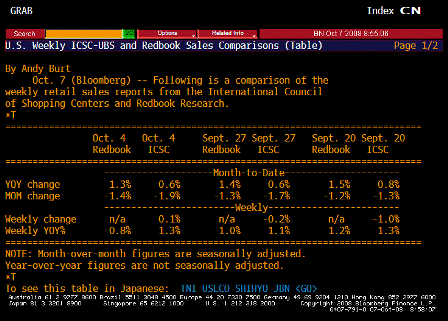
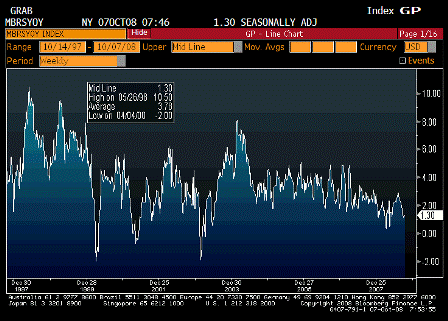
ICSC UBS Store Sales YoY (Oct 7)

Survey n/a
Actual 1.30%
Prior 1.10%
Revised n/a

 
No collapse here yet.

[top][end]

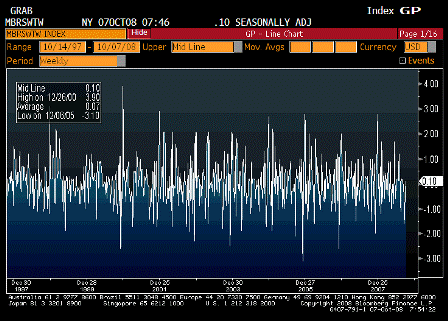
ICSC UBS Store Sales WoW (Oct 7)

Survey n/a
Actual 0.10%
Prior -0.20%
Revised n/a

 
Muddling through here as well.

[top][end]


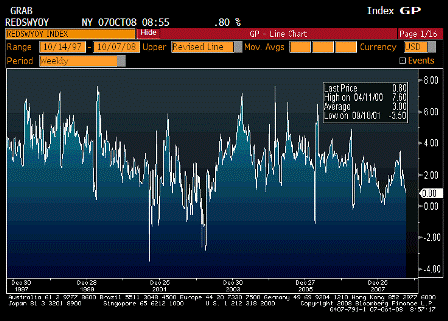
Redbook Store Sales Weekly YoY (Oct 7)

Survey n/a
Actual 0.80%
Prior 1.00%
Revised n/a

 
Still weak, but not yet a collapse.

[top][end]

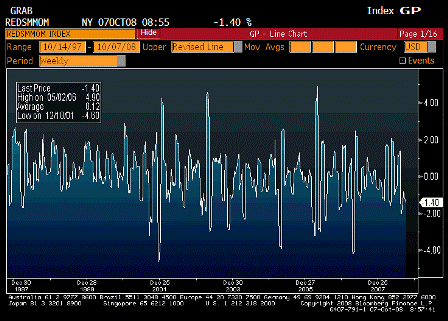
Redbook Store Sales MoM (Oct 7)

Survey n/a
Actual -1.40%
Prior -1.30%
Revised n/a

 
Also weakening.

[top][end]

ICSC UBS Redbook Comparison TABLE (Oct 7)

[top][end]


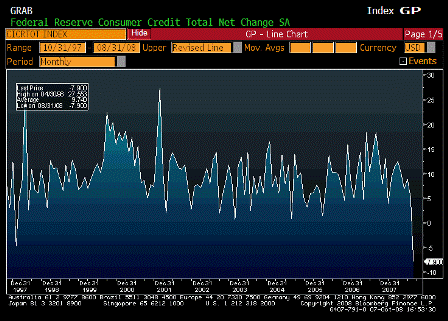
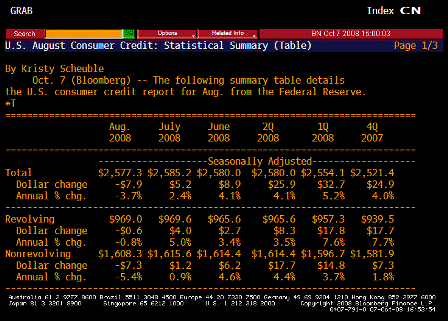
Consumer Credit (Aug)

Survey $5.0B
Actual -$7.9B
Prior $4.6B
Revised $5.2B

 
This is a collapse!

Consumers petrified from daily drubbing of the stock market and news media.

Payroll tax holiday now!

[top][end]

Consumer Credit TABLE 1 (Aug)

[top][end]

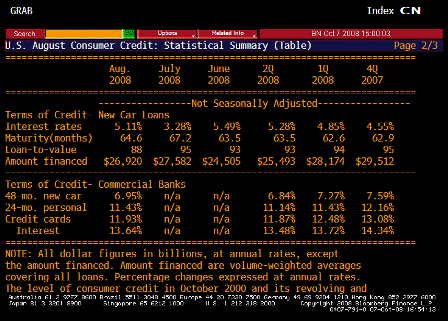
Consumer Credit TABLE 2 (Aug)


[top]

2008-10-06 China News Highlights


[Skip to the end]

Looks like our loss is going to be their gain due to our leaders being in this way over their heads.

Highlights

Premier: China’s steady growth can help
China May Move to Revive Sagging Property Market, JPMorgan Says
China May Maintain Fast Growth Amid Crisis, Premier Wen Says
China Should Prepare for Dollar Fall, Securities Journal Says
UBS Cuts Economic Growth Forecast for Asia, China
China’s Retail Sales Rise During Week Holiday, China Daily Says

Premier: China’s steady growth can help

Oct 6. (China Daily) Maintaining “steady and fast” growth is the largest contribution China can make to help the world overcome the current financial crisis stemming from the United States, Premier Wen Jiabao said Sunday.

“It will be the biggest contribution to the world for a huge country with 1.3 billion people to maintain steady and fast growth in the long term,” Wen said during an inspection to the Guangxi Zhuang autonomous region.


[top]

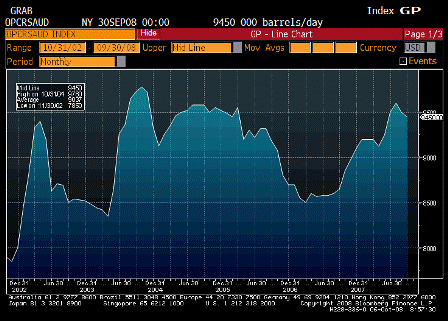
Saudi Production falls slightly as Opec production falls 425,000 bpd


[Skip to the end]

Production falling some but overall demand probably remains high, as reported inventories remain very low, as the GMIL (Great Master’s Inventory Liquidation) may still be a factor as more pension funds resist adding to passive commodity strategies.

Several months ago a Saudi official said he though $85 was the ‘right’ price, but that doesn’t mean it’s their target.

They are still price setter, until their production is forces down by several million bpd by excess supply.

Meanwhile, lower crude prices both support the $US and help keep a lid on headline inflation.

OPEC September Crude Output Down 425,000 Bbl/Day to 32.19 Million

New York, Oct. 3 (Bloomberg) Crude-oil production from the 13 OPEC members in September declined 425,000 barrels a day from August, the latest Bloomberg survey of producers, oil companies and industry analysts shows. Figures are in the thousands of barrels a day.

Opec Production
September 2008

Opec Country Sept. Est. Aug. Output Monthly Change Nov. 1 Target Est. vs. Target Est. Cap. (@)
Algeria 1,400 1,410 -10 1,357 43 1,450
Angola** 1,800 1,880 -80 1,900 -100 1,930
Ecuador 500 500 0 520 -20 500
Indonesia 865 865 0 865 0 900
Iran 3,950 4,080 -130 3,817 133 4,100
Iraq** 2,135 2,310 -175 2,500
Kuwait# 2,600 2,600 0 2,531 69 2,650r
Libya 1,720 1,630 90 1,712 8 1,750
Nigeria 1,880 1,940r -60 2,163 -283 2,200
Qatar 880 880 0 828 52 900
Saudi Arabia# 9,450 9,500 -50 8,943 507 10,800
U.A.E 2,650 2,660 -10 2,567 83 2,800r
Venezuela 2,360 2,360 0 2,470 -110 2,500
Total OPEC-13 32,190 32,165r -425 34,980r
Total OPEC-12* 30,055 30,305r -250 29,673 382 32,480r

**Iraq has no quota. Quotas effective Nov. 1, except for OPEC’s newest members,
Angola and Ecuador, who were formally assigned output targets Dec. 5, 2007.
OPEC announced a quota target of 28.808 million bbls/day at its Sept. 10
meeting but that figure excludes Indonesia who plans to leave the producer formally at year-end.

Totals rounded.

r = revised @ = Capacity attainable within 30 days and sustainable for 90 days.
# Includes Neutral Zone production shared equally between Saudi Arabia & Kuwait.


[top]

2008-10-06 Weekly Credit Graphs


[Skip to the end]

 
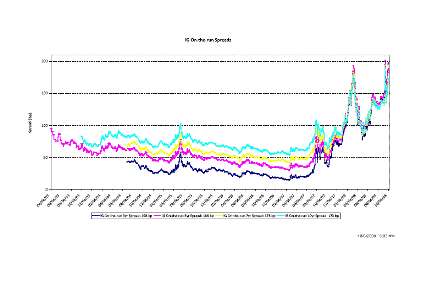
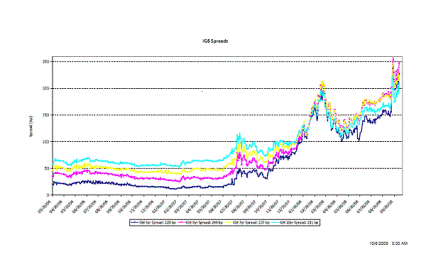
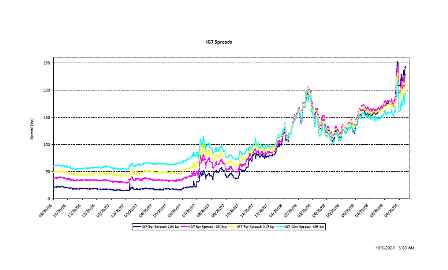
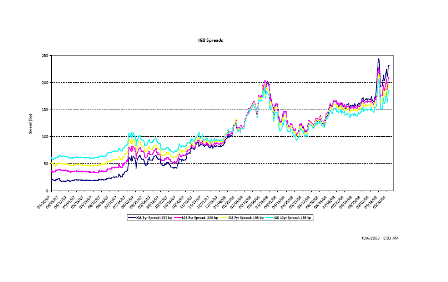
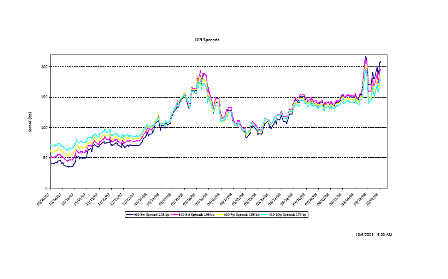
Probably worse after today.

IG On-the-run Spreads (Oct 06)

[top][end]

IG6 Spreads (Oct 06)

[top][end]

IG7 Spreads (Oct 06)

[top][end]

IG8 Spreads (Oct 06)

[top][end]

IG9 Spreads (Oct 06)


[top]

EU leaders to agree to relax stability rules


[Skip to the end]

This will only move them closer to brink of investors refusing to buy their debt.

EU leaders agree to relax Stability Pact rules (Roundup)

by Siegfried Mortkowitz

Paris – To help prop up their banking systems, European leaders meeting Saturday in Paris agreed to loosen the requirements of the European Union’s Stability and Growth Pact, which imposes rules on member states regarding their public spending.

French President Nicolas Sarkozy, German Chancellor Angela Merkel, British Prime Minister Gordon Brown and Italian Prime Minister Silvio Berlusconi also called for an international conference of the 14 largest industrial nations to ‘rebuild the international finance system,’ as Sarkozy phrased it.

Also attending the mini-summit of the EU’s four members of the G8 group of industrial nations were European Commission head Jose Manuel Barroso, European Central Bank (ECB) president Jean-Claude Trichet and the head of the Eurogroup, Luxembourg Prime Minister Jean-Claude Juncker.

The meeting was called by Sarkozy, currently president of the EU, to formulate a common European position to surmount the finance crisis.

A statement released after the talks said, ‘The application of the Stability and Growth Pact should also reflect the current exceptional circumstances.’

This was a victory for Sarkozy, whose closest advisor, Henry Guaino, earlier this week had declared: ‘Temporarily, (the Stability Pact) is not the priority of priorities. The priority is to save the world banking system and therefore save citizens’ savings.’

The criteria, set out in the Treaty of Maastricht, include a national budget deficit totalling less than 3 per cent of gross domestic product (GDP) and public debt not exceeding 60 per cent of GDP.

The leaders at the meeting also called for an international conference on the financial crisis that would include the G8 countries and large developing economies such as China, India, Brazil and South Africa.

‘We will work with all major economies to rebuild the international banking system,’ Berlusconi told journalists when asked about the purpose of the meeting of the so-called G14.

Sarkozy said the aim of the international conference would be to construct ‘the foundation of an entrepreneurial capitalism instead of a speculative capitalism. We want to build the beginning of a new financial world as they did in Bretton Woods.’

The 1944 international meeting in Bretton Woods established the rules for commercial and financial relations among the world’s major industrial states.

The EU leaders also agreed to work to change European accounting rules, increase regulation of credit rating agencies and hedge funds and alter the way executives are rewarded, in order to prevent the payment of ‘golden handshakes’ – that is, exorbitant severance payments – to executives who have created risk for their companies.

‘Executives who failed must be penalized,’ Sarkozy said.

The summit was preceded by a controversy over a proposal to create a 300-billion-euro (413-billion-dollar) fund to bail out struggling financial insitutions, similar to the plan passed by the US House of Representatives and signed into law by President George W Bush late Friday.

Reportedly supported by the Dutch and the French, the idea was summarily rejected by Germany and Britain, and was not on the summit’s agenda.

Sarkozy told journalists that the idea was not his.

‘I never assumed it, I never proposed it, I never imagined it,’ Sarkozy said.

Instead, in line with German and British wishes, each EU member state is to aid its troubled banks with its own funds, but after discussions with other countries, a reference to the unilateral decision by the Irish government to establish a 100-per-cent guarantee for depositors in the six largest Irish-owned banks.

The move, made without consultation with the European Commission, has already attracted investors away from British banks, and has put pressure on the Brown government government to match it.

Merkel said that the European Commission and the ECB would talk to the Irish about their move, which contravenes the EU’s state aid and competition requirements.

‘But my satisfaction about (this solution) is limited,’ the German chancellor said.

Decisions taken at Saturday’s mini-summit are to be further elaborated at Tuesday’s meeting of EU finance ministers and at the October 15-16 EU summit in Brussels.


[top]

Game over in the eurozone?


[Skip to the end]

In addition to the financial drag on the governments needed to keep their banks and their payments system functioning, they now face an indirect but more potent force:

Falling tax revenues as incomes and assets fall.

Unlike nations with fiscal authorities (most everyone- US, UK, Japan, Russia, etc.) at the federal level who can write ANY size check (in local currency) that won’t bounce, the eurozone national governments are subject to constraint by market forces much like that faced by the US states.

When the risk of growing national deficits scares away investors from buying their debt it’s ‘game over’.

The payments system gets shut down and stays shut until it’s reorganized with expanded (fiscal) powers probably for the European Parliament and the ECB.

They need to grant these institutions with the operational capability to run unlimited budget deficits the authority to guarantee bank deposits and to deficit spend in general.

For the US my remedy remains:

  1. The Fed needs to lend unsecured in unlimited quantities to its member banks.
  1. Congress needs to declare a ‘payroll tax holiday’.

 
Yes, it’s still that simple for America to ‘save itself and the world’.

Write your Congressman and other political leaders ASAP!


[top]