ECB tenders


[Skip to the end]

The ECB raised its day tender rate to 2.75% today and got far fewer tenders, as USD market rates had gone below that in anticipation of lower rates.

But that should just mean the USD ‘market rates’ will rise to over that level and the USD borrowers will come back to the ECB in big size as it’s just a game of musical chairs


[top]

UK’s Brown- Right action for wrong reasons


[Skip to the end]

Brown set to borrow more (FT)

By George Parker and Norma Cohen

Gordon Brown on Monday insisted the government would spend its way through the downturn. Mr Brown said Britain’s debt-to-gross domestic product ratio of 37.6 per cent was lower than main competitors – the eurozone average is 56.4 per cent – and could sustain higher borrowing. “It is because we cut the national debt over the past few years that we are able to do what is the right thing.” The £37.6bn half-year borrowing figure is the highest since the second world war in nominal terms, although relative to the size of the economy it is below that of the 1993/4 fiscal year, when John Major’s Tory government was fighting a recession. Treasury estimates of growth in tax receipts are far short of those forecast at the start of the fiscal year, rising at only 1.9 per cent year-on-year instead of the 5 per cent rate that had been expected.


[top]

Eurozone coming apart


[Skip to the end]

RLPC- European secondary loan prices breach 70 pct

By Zaina Espana

The low secondary loan prices reflect heavy forced selling by stressed investors that has also weighed on the battered LevX index of leveraged loan credit default swaps.

Around three billion euros of forced sales have flooded the thin and illiquid European secondary loan market in the last two weeks, several traders said.

The sales started with Icelandic banks’ portfolio sales and other European banks followed, but a portfolio sale from Sankaty last week marked a new phase of the selloff as managers of credit-driven collateralised loan obligation (CLO) vehicles started to throw in the towel, traders said.

Traders said Sankaty, the credit affiliate of private equity firm Bain Capital, put a $342 million portfolio of leveraged loans up for sale last Wednesday and fund manager Highland Capital followed in the United States with a $641 million portfolio of U.S. and European names.

Average bids on Europe’s top 40 leveraged loans have lost 225 basis points from last Friday’s level of 71.01 percent of face value to 68.76 on Monday, RLPC data shows.

While this madness continues, watch for results due out soon:

ECB Offers Banks Unlimited Dollars to Boost Lending (Update1)

By Christian Vits

(Bloomberg)- The European Central Bank offered banks unlimited amounts of dollars in two new tenders today as it steps up efforts to get financial institutions lending to each other again.

The Frankfurt-based central bank offered banks funds for 28 days via a currency swap in which it lends dollars against euros. In a separate tender with the same maturity, the ECB offered dollars against collateral at a fixed rate of 2.11 percent. In both cases it will fill all bids. Results will be published at 11 a.m. The loans start on Oct. 23 and mature Nov. 20.


[top]

France injects €10.5bn in the six largest banks


[Skip to the end]

If growth continues to slow down this won’t be nearly enough to cover capital yet to be lost.

Also, with more slowing, the French deficit widens threatening their solvency and ability to fund:

France injects €10.5bn in the six largest banks; doubts about the 2009 GDP growth forecast

The French Finance Ministry said Monday night that the French government will inject E10.5 billion worth of fresh capital into the country’s six largest banks between now and the end of the year by purchasing subordinated debt securities.

Credit Agricole will get €3 billion, followed by BNP Paribas with €2.55 billion, Societe Generale with $1.7 billion and Credit Mutuel with €1.2 billion. Les Caisses d’Epargne will get €1.1 billion and Banques Populaires €950 million.

The banks have agreed to sell subordinated debt securities in those amounts, and they will carry a risk premium of about 400 basis points.


[top]

2008-10-21 USER


[Skip to the end]


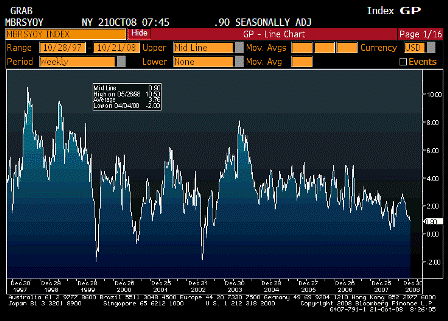
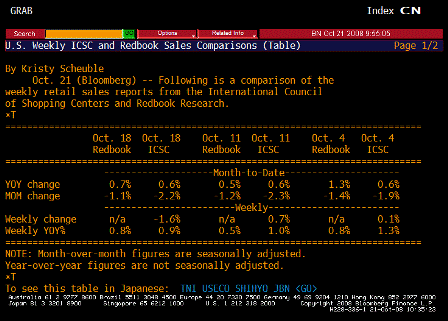
ICSC UBS Store Sales YoY (Oct 21)

Survey n/a
Actual .90
Prior 1.00
Revised n/a

 
Slipping, but no collapse yet. Should be doing better with lower gas prices.

[top][end]

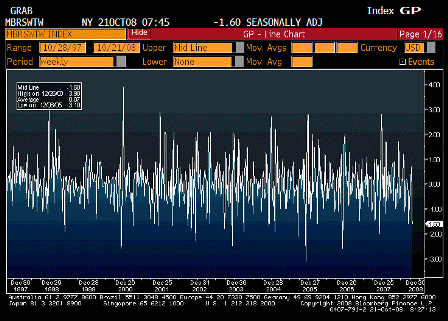
ICSC UBS Store Sales WoW (Oct 21)

Survey n/a
Actual -1.60
Prior .70
Revised n/a

[top][end]

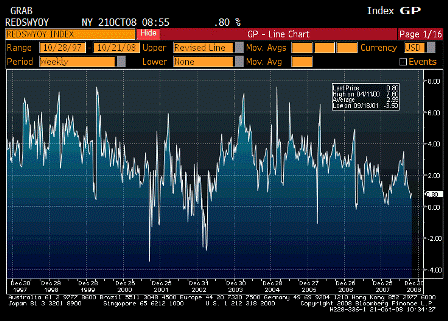
Redbook Store Sales Weekly YoY (Oct 21)

Survey n/a
Actual .80
Prior .50
Revised n/a

 
Low but steady.

[top][end]

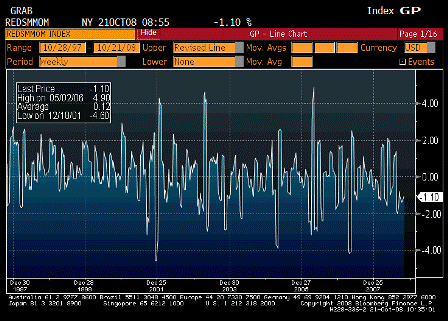
Redbook Store Sales MoM (Oct 21)

Survey n/a
Actual -1.10
Prior -1.20
Revised n/a

[top][end]

ICSC UBS Redbook Comparison TABLE (Oct 21)


[top]

ECB taking lower quality collateral vs USD lending


[Skip to the end

Trichet urges banks to lend after recovery begins (Update2)

By Simon Kennedy and Anne-Sylvaine Chassany

Trichet acknowledged his own central bank had taken on risk by boosting liquidity and accepting lower-rated securities as collateral for loans.

“We’re taking risks and we’ve made decisions that increased our risks, because we were facing a systemic liquidity crisis of first importance,” he said. The ECB is an “inspirer of confidence,” Trichet said.

Yes, and now with the Fed’s money via the swap lines, and into a slowing economy.


[top]

2008-10-20 CREDIT


[Skip to the end]

 
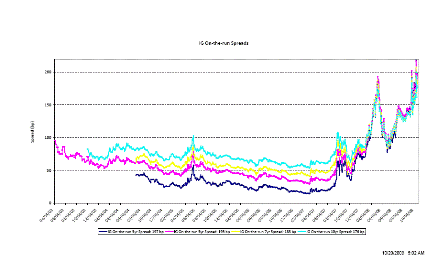
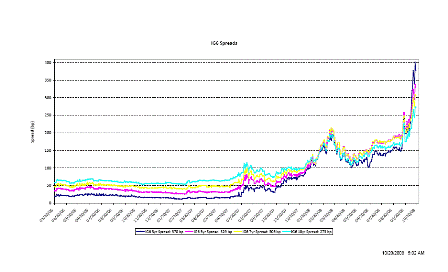
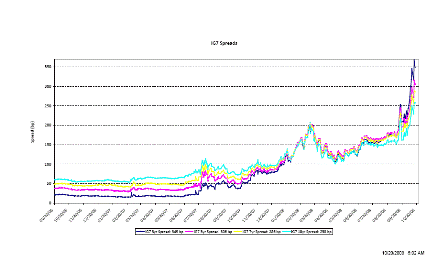
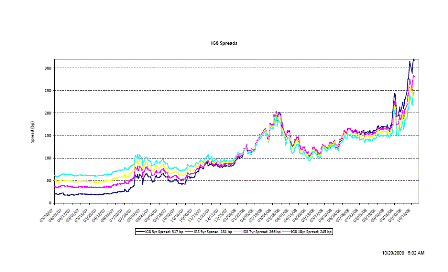
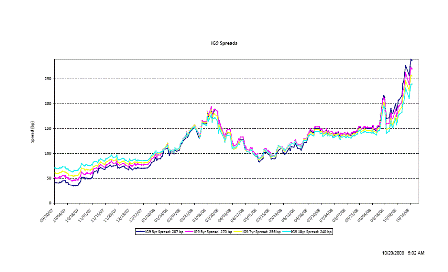
Spreads remain wide but did come in a bit with the equity rally.

Hard to say if credit spreads will drive an equity rally or vice versa.

IG On-the-run Spreads (Oct 20)

[top][end]

IG6 Spreads (Oct 20)

[top][end]

IG7 Spreads (Oct 20)

[top][end]

IG8 Spreads (Oct 20)

[top][end]

IG9 Spreads (Oct 20)


[top]

UK Daily News Highlights


[Skip to the end]

Highlights

U.K. Home Prices Drop as Economy Nears `Abyss,’ Rightmove Says
U.K. Mortgage Lending Declines to Lowest Since 2005, CML Says
Economy in recession, says E&Y
Darling to ‘reprioritise’ spending
U.K. Deposit Fund Pays 3 Billion Pounds for ING Iceland Savers

 
Very constructive move here- front loading future public sector capital expenditures.

Darling to ‘reprioritise’ spending (FT)

Alistair Darling evoked the spirit of John Maynard Keynes on Sunday as he signalled a “reprioritising” of spending plans towards capital infrastructure, housing and energy. The chancellor of the exchequer will call on departments to bring forward billions of pounds of capital expenditure to invigorate the economy ahead of an expected recession. The government is limited in its ability to step up overall spending for the current three-year period, set at the last comprehensive spending review. But it can bring forward money from planned budgets in 2010-11 – after the next general election. The government has already announced the front-loading of money to build more social housing as part of its autumn relaunch. It has also allowed the Ministry of Defence to sign off its £4bn aircraft carrier contracts by juggling its budget.


[top]

OPEC to cut output


[Skip to the end]

Saudis still price setters, this is just a smoke screen to disguise that. The great Mike Master’s sell off that also triggered the last leg of the financial crisis must have run it’s course in the crude markets. Price hikes may return, this time with no excess inventory and very weak world economies. If their motives are the destruction of the Great Satans and Putin is with them it’s going to get very, very ugly.

OPEC’s oil supply must be ‘significant’- Khelil

(Reuters)- OPEC oil producers will cut oil supplies when they meet next week in Vienna and “the reduction must be significant,” the group’s president, Chakib Khelil, was quoted as saying on Saturday.

“There will be a reduction of the output and the reduction must be significant to restore the balance between supply and demand,” Algerian state news agency APS quoted Khelil as telling reporters.

The Organization of the Petroleum Exporting Countries will hold an emergency meeting on Oct. 24 in Vienna to discuss the impact of economic weakness on oil markets.

“If the cut is 1.5 million barrels per day, then it will be 1.5 million barrels. If it is 2.0 million barrels per day, it will be 2.0 million barrels per day,” added Khelil, who is also Algeria’s energy and mining minister.

Saudis will just start raising their posted prices and let their quantity adjust. The fall in demand for their output won’t be all that much as prices rise, suggesting to an unsuspecting world OPEC didn’t cut as much as they proclaimed.

Earlier, Khelil was quoted in Saturday’s edition of Algerian daily El Watan as saying that OPEC saw oil prices bottoming at $70-$90 per barrel.

“Normally, OPEC has no price target. The market decides on prices. But people say that the bottom price, the bottom cost below which we can not step down, is between $70 and $90 per barrel,” El Watan quoted Khelil as telling reporters.

What they are really saying is the Saudis decide the price, and the markets then determine how much they want to buy at that price.

He cited cases of Canada and Brazil, where oil could not pumped if prices were to fall below $70 per barrel.

On Friday, Khelil told Algerian state radio a “decision will be taken to lower oil supply by some OPEC members so that the oil price will not be damaged.

“This decision will not be implemented immediately because there are contracts, but will probably be implemented 40 days after it (the decision) is taken.” He did not say which countries were likely to cut supplies.


[top]