Greece: Largest firms to be hit with tax surcharge


[Skip to the end]

tightening up—not good.

NEWS FROM GREECE: LARGEST FIRMS TO BE HIT WITH TAX SURCHARGE
*GREECE ONE-TIME COMPANY CHARGE ON 2008 PROFITS
*GREECE TO IMPOSE 10% CHARGE ON COMPANIES WITH OVER 25 MLN PRFIT
*GREECE PLANS TO RAISE EU870 MLN FROM COMPANY ONE-TIME CHARGE
*GREECE TO IMPOSE 7% CHARGE ON COMPANIES WITH PROFIT 10-25MLN
*GREECE TO IMPOSE 5% CHARGE ON COMPANIES WITH PROFIT 5MLN -10MLN
*GREECE TO FINANCE SOLIDARITY PAYMENT WITH ONE-OFF MEASURES
*GREECE’S PAPACONSTANTINOU SPEAKS IN ATHENS
*GREECE TO IMPOSE ONE-OFF CHARGE ON 300 BIGGEST COMPANIES
*GREEK FINANCE MINISTER SPEAKS TO REPORTERS IN ATHENS
*GREECE PLANS TO PAY EU1BLN IN SOLIDARITY PAYMENT TO 2.5 MLN
*GREECE PLANS ONE-OFF MEASURES TO RAISE FUNDS


[top]

NY-23


[Skip to the end]

I view this as a populist revolt against the power elite in Washington that’s seen as a conspiracy between govt, big business, labor leaders (at the expense of union members) that enriches itself at the expense of people working for a living. The saw their local party nominate what they considered a Pelosi friendly candidate who would not have won in a primary over Hoffman, who would have won and ran as member of the Conservative party. With Scorzzafava not only dropping out but supporting the Democrat after a meeting with Pelosi representatives and presumably cutting some kind of deal, and Hoffman moving into the lead in some polls, the national conspiracy suspicions appear to have been confirmed, which should further support this ‘national uprising.’
Last I saw what’s called the Tea Party (anti tax) movement is about 20% Democrat, 30% independent, and 50% Republican. And it looks like they reject all party leadership (including the Newt, see below) and seem unresponsive to leadership in general. There are a few organizers who work from the bottom up to organize turn outs, an effort they proudly refer to as akin to ‘herding cats.’

The national media, for the most part, is dismissive, insulting, and in general does not get it and misrepresents what’s happening. All of which increases the support and participation of this rising revolt.

Sarah Palin, for example, commands 45% of voters in national polls (last I checked). The media, which is necessarily composed of ‘intellectuals,’ attacked her (and President Bush) largely on the grounds of not being smart enough to deserve any votes, contrasting her with the highly intelligent and well spoken President Obama. However, this is also perceived as bullying by the large segment of the population who either share some of her views, or simply don’t like bullying in general, and particularly from the media. When the ‘intellectuals’ in leadership positions act like this and see their power threatened by what they make clear they consider ‘inferiors’ they can quickly get in a battle they can’t win and can take all of us to a very bad place.

Gingrich Condemns Conservative Leaders For Driving Moderate GOPer Out Of NY Race

The Plum LineGreg Sargent’s blog

Sign of the times. Newt Gingrich, himself long considered a leader of the GOP’s conservative wing, is now condemning conservative leaders for driving moderate GOPer Dede Scozzafava out of the race for NY-23, warning that if national conservatives keep bigfooting local races the GOP will continue to wander the wilderness around the country:

“This makes life more complicated from the standpoint of this: If we get into a cycle where every time one side loses, they run a third-party candidate, we’ll make Pelosi speaker for life and guarantee Obama’s re-election,” said Mr. Gingrich, who had endorsed Ms. Scozzafava…

“I think we are going to get into a very difficult environment around the country if suddenly conservative leaders decide they are going to anoint people without regard to local primaries and local choices.”

Gingrich had endorsed Scozzafava, so this was in some ways to be expected. But it’s interesting that someone once considered a spokesman for the fire-breathing right is now condemning conservative leaders for mounting ideological purges.

And right on cue, DNC spokesman Brad Woodhouse sends over a statement using Scozzafava’s decision to drop from the race to elevate Glenn Beck and Sarah Palin, who endorsed conservative Doug Hoffman, as the face of the harsh, uncompromising opposition:

What this says — emphatically — is that the true leaders of the Republican Party like Sarah Palin, Glenn Beck and Tim Pawlenty have said to all moderates and independents — when it comes to being part of our party you need not apply. The only acceptable Republicans these days are those who subscribe to division, obstruction and a rigid far right wing ideology.

The NRCC and the House GOP leadership, meanwhile, put out a joint statement backing the conservative: “We look forward to welcoming Doug Hoffman into the House Republican Conference as we work together for the good of our nation.”


[top]

Food Stamps Will Feed Half Of US Kids


[Skip to the end]

Food Stamps Will Feed Half Of US Kids, Study Says

We are going in a direction that is dark and ominous.

It’s part of the brewing populist revolt the media is dismissing.

The majority of Americans believe the nation is going in the wrong direction.

And now the administration is saying unemployment will stay high for a long time and is not even attempting to even propose any decisive remedial action.

Fiscal adjustment is off the table because they think they are ‘out of money’ while they wait for the Fed not knowing its tools are incapable of restoring demand.


[top]

Obama Says U.S. Must Reduce Debt, Spur Job Growth


[Skip to the end]

This is a ridiculous notion that further shows there is no understanding of the monetary system at the highest levels, or the ‘debt’ per se would not be a concern. They obviously don’t understand taxes function to regulate aggregate demand (spending) and not to raise revenue per se.

Reminds me of a story Phil Harvey used to tell about sending 100 dogs into a room with 95 bones in it.
5 dogs don’t get bones.
The sociologists and micro economists examine them, and find that the 5 least intelligent, least aggressive etc. dogs didn’t get bones.
So they train those 5 dogs and repeat the experiment, and this time those dogs do get bones.
Of course, 5 others don’t, because the bone shortage is a macro problem.

Same with unemployment.
The problem is a lack of funding for paid jobs because people would rather save their incomes than spend them on goods and services that require labor to produce.
Short of trying to figure out how to get the population to spend by going deeper into debt (reduce savings) which is about as impossible as it is undesirable, the only solution is to cut taxes or increase govt. spending to provide the needed funding.

If this misunderstanding continues, look for high unemployment, a deflationary backdrop, and the Fed on hold until something changes to reduce the output gap.

Obama Says U.S. Must Reduce Debt, Spur Job Growth

By Kate Andersen Brower

Nov. 2 (Bloomberg) — President Barack Obama said the U.S. economy has pulled “back from the brink” and the government must now “get serious” about reducing debt and helping spur job growth.

Addressing a panel of business and labor leaders and economists, the president said it will require “bold, innovative action” on the part of the government and private industry to bring the unemployment rate down and lay the foundation for future growth.

“We just are not where we need to be yet,” Obama told his Economic Recovery Advisory Board, headed by former Federal Reserve Chairman Paul Volcker. Along with helping spur job growth, “The government is going to have to get serious about reducing our debt levels.”

This was the second time the full board has met to brief the president on ways to create jobs and encourage economic growth. Obama formed the advisory panel in February to provide an “independent voice on economic issues.” Today’s meeting is focusing on creating jobs through innovation.

Along with Volcker, board members include former Securities and Exchange Commission Chairman William Donaldson; Robert Wolf, chairman and chief executive officer of UBS Americas; Penny Pritzker, who led Obama’s campaign fundraising effort and is chairman of Pritzker Realty Group; Jeffrey Immelt the chief executive of General Electric Co.; Caterpillar Inc. Chief Executive OfficerJim Owens; and AFL-CIO President Richard Trumka.


[top]

ISM


[Skip to the end]


Karim writes:

Orders-Inventories spread down 6.7pts to 11.6 (down from 30.5 peak 2mths ago and 18-20 range of past few months); signals slower production gains in months ahead

Biggest surprise is near 7pt jump in employment to 53.1; appears at odds with other surveys (Conf Board) and Claims

Anecdotes mixed


Oct Sept
Index 55.7 63.5
Prices paid 65.0 63.5
Production 63.3 55.7
New Orders 58.5 60.8
Inventories 46.9 42.5
Employment 53.1 46.2
Export Orders 55.5 55.0
Imports 51.0 52.0
  • “We are beginning to be affected greatly by lead-time increases on semiconductor components.” (Computer & Electronic Products)
  • “Still a very difficult environment — commodity increases threaten recovery and don’t seem to correlate with any supply/demand fundamentals.” (Food, Beverage & Tobacco Products)
  • “Automotive demand still remains strong even after ‘cash for clunkers.'” (Fabricated Metal Products) [indicated for the second month]
  • “After several rather busy months, we are seeing the order intake for early next year soften.” (Transportation Equipment)
  • “The improvement seen earlier is not holding.” (Primary Metals)


[top]

Posted in GDP

Goldman- Excess Reserves Irrelevant and the FED does not need to execute Reverse Repos with Non-Primary Dealers


[Skip to the end]
Hopefully, when Goldman talks, people listen:
Clarification from author Franesco Cafagna: Views expressed in this piece are his own and are not necessarily reflect the view of Goldman Sachs

1. Do excess reserves really matter and does the FED really need to drain them?

The short answer is: I don’t think so. The total amount of reserves currently in the banking system is the sum of all Required Reserves (including a certain amount that banks hold for precautionary reasons) and Excess Reserves. The FED HAS to provide the banking system with the amount of Required Reserves it needs otherwise rates spike higher (potentially to infinity if the discount window or other forms of “marginal lending facilities” did not exist): the amount required is the result of banks’ individual credit decisions (how many loans they make) and the FED’s job is to estimate that amount and provide it to the system. But the FED does not control this number. When it comes to Excess Reserves, lots of people worry about the potential long-term inflationary impact they may have. The truth is that they don’t matter because they bear no weight in banks’ credit decisions (how many new loans they make). They simply appear on banks’ balance sheets as an Asset that gets “invested” every night in the form of a deposit that they leave at the FED and on which they currently get a 25bps remuneration. If the FED decided to drain excess reserves via Reverse Repo the impact on the system as a whole would be zero because the system as a whole is “self contained”. To understand this let’s think of the most extreme case: the FED drains all excess reserves via one giant Overnight Reverse Repo executed with all the
banks in the banking system. At a macro level all that’s happened is that each bank has changed its Excess Reserve asset (which is effectively an O/N asset) into and O/N Reverse Repo and the two are virtually identical. Another way to think of this is that Excess Reserves are ALREADY being drained every night because banks leave them on their account at the FED every night. The only thing that will change is the liquidity profile of banks IF the FED decided to execute Reverse Repos longer than 1 day: in that case a 1-day assets (excess reserve) would be transformed into a longer asset (Reverse Repo longer than 1 day). Whilst this may affect individual institutions, the system as a whole is unaffected because this amount “extra cash” in the system (excess reserves) is NOT being used for anything. It just sits at the FED every night. So effectively it’s being “drained” already every night. So all this talk about excess reserves and their potential inflationary impact seems misplaced: they are just irrelevant and the FED simply does not need to drain them because they are “self-drained” every night anyway.

2. Does the FED really need to execute Reverse Repos with Non-Primary dealers?

This item has gained press coverage following the Fed’s release of the last Fomc minutes in which it was clear that it debated the possibility of executing large scale reverse repo operations with non-primary dealers: the motivation behind this discussion is the perceived balance-sheet capacity constraint that the 16 Primary dealers might face (a Reverse Repo increases the assets of the broker-dealer entity facing the Fed). This statement by the Fed has created all kind of debate across the street with various dealers coming up with all kinds of estimates of the overall size that the Primary dealers can handle (with some estimates being as low as 100-150bn out of a total of over 800bn that the Fed might want to execute). Leaving aside the actual need to execute Reverse Repo in the first place (point 1 above) and assuming that the Fed will, in fact, choose to execute these operations because it has stated that they are part of the exit strategy policy, I think the alleged Primary Dealers’ balance sheet capacity constraint has been VASTLY exaggerated. It’s true that a Reverse Repo increases the assets of a broker-dealer entity, but this is an issue only for stand-alone broker-dealers (Jeffreys and alike). For Primary Dealers with big commercial banks operations (JPM, Citi, BOA) I don’t believe that this is an issue at all: since they are already sitting on big amounts of Excess Reserves and because 23A (which regulates the activity between a bank entity and its affiliates) does not impose any restriction on the amount of UST, Agencies and Agencies MBS repos that a bank can execute with an affiliate broker-dealer entity, this means that the JPMs of the world could potentially execute reverse repo operations with the Fed up to the amount of excess reserves they are already sitting on without increasing their balance sheet by 1 single cent: it would simply be a transformation of an asset (excess reserves of the bank entity) into another (reverse repo of the broker-dealer entity). So, in my view, the conclusion has to be that the Primary Dealers can in fact absorb a much bigger amount of Reverse Repo than originally thought even by the Fed itself and that realistically the only other counterparties that the Fed might engage directly for these kind of operations are the GSEs: but in this case the reason would not be balance sheet driven but would be driven by the distortion that the GSEs’ participation in the fed funds mkt creates (call me if you would like to discuss this further).

By Franesco Cafagna


[top]

gold supply comments


[Skip to the end]

Nadler: The gold market is made up of five pillars. On the supply side, you have mine supply, scrap gold supply and occasionally central bank sales or purchases (that’s kind of a swing factor). On the demand side, you have fabrication demand for jewelry and so on, and investment demand, which is a cyclical, emotional phenomenon—people go into stages of panic, fear, greed, and bubbles are formed, and so on.

On the supply side, lately you’ve started to hear people say supply is running into oblivion, that it’s “peak gold.” Well, the reality is that GFMS’ latest computations (which run through midyear) show an actual 7 percent increase in mine output, of 1,212 tons. Miners went on hiatus only because the credit crunch prevented those who had found all this gold from actually coming to market with it.

Crigger: Sounds like we won’t be hitting “peak gold” anytime soon.

Nadler: No. Maybe we’re not finding huge discoveries like we used to, but some $40 billion has been sunk into the ground to find new gold, and nobody goes out and spends $40 billion figuring it’s wasted money and nothing else will be found. And miners are eager to find new gold, because the average cost of production is in the low-$400s. So at $1,000/oz, it’s a party.

So now that some of that gold is starting to show in the pipeline, we better have eager takers for it all, because when you look at incremental mine additions over the next five to six years, we could have as much as 400 tons’ worth of additional mined supply coming into the market year-on-year. That’s significant—that’s almost 25 percent higher yearly output in mining than people thought was coming.


[top]

Valance Weekly Economic Chart Book


[Skip to the end]

Valance Weekly Economic Chart Book

A bit disorganized, but these are my impressions as of month end.
(Look for the usual couple of days or so of month end allocations driving the technicals.)

I don’t see much to get encouraged about on almost all of these charts.

In general, demand was trending lower since maybe mid 2006, took a sharp dip in mid 2008 with the great Mike Masters Inventory Liquidation that ended in late Dec 2008, after which the rate of decline stopped accelerating (second derivative change), and now were are, for the most part, back on the ‘trend line’ of the slow decline in demand that started in mid 2006.

Personal income looks very weak, hurt by falling interest income as previously discussed. The clunker lift has reversed, and housing remains very week with no real signs of recovery yet. (about 2% of GDP was clunkers and inventories)

The deficit got large enough due to the automatic stabilizers around year end, market functioning returned as the Fed eventually accepted enough different kinds of collateral from its banks to adequately fund them. (should have been lending unsecured to its member banks all along, etc.)

But while the Obama fiscal package added some demand, and GDP stabilized, the zero interest rate policy continued to shift savings incomes to widening bank net interest margins, and the Fed’s $2 T portfolio began draining another maybe 60 billion a year in private sector interest income. Additionally, interest rates on tsy secs have declined sharply with the Fed rate cuts. (While I fully support a zero rate policy I also recognize the need to sustain demand with a payroll tax holiday, per capita revenue sharing, and an $8/hr fed funded job for anyone willing and able to work.)

And now with productivity higher than real GDP growth, employment continues to fall, though at a lower rate, and capacity utilization in general remains at very low levels. Prices remain very weak, apart from gold, which could be a bubble driven by the misconception that the Fed’s ‘quantitative easing’ policy is inflationary. In fact, it’s nothing but an asset shift that modestly reduces term interest rates at the cost of draining billions in interest income from the private sector.

If gold does turn out to have been a bubble and collapse, it could be highly demoralizing as it would reveal the Fed does not have the tools to ‘reflate’ at will. Dollar shorts could start covering, further taking away the bid from stocks (also as previously discussed). And if the Saudis have left the prices to their refiners below current levels, crude and products will fall as well.

All major foreign govts. seem to be continuing to favor export led growth, which will also keep US domestic demand in check.

And, in general, it looks like most of the world is looking to tighten up fiscal policy, believing in the like of the ‘debt trap’ and also that monetary policy is expansionary and inflationary.


[top]

Restaurant Index Shows Contraction, Less Capital Spending


[Skip to the end]

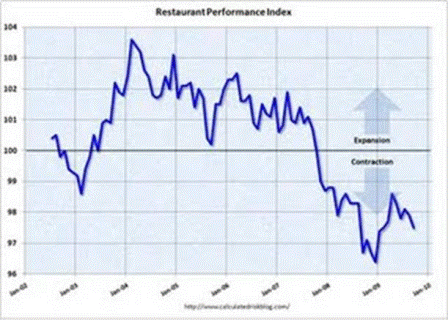
Unfortunately the data for this index only goes back to 2002.

The restaurant business is still contracting …

Note: Any reading below 100 shows contraction for this index. The index is a year-over-year index, so the headline index might be slow to recognize a pickup in business, but the underlying details suggests ongoing weakness.

From the National Restaurant Association (NRA): Restaurant Industry Outlook Remained Uncertain as Restaurant Performance Index Declined in September for Second Consecutive Month

[T]he National Restaurant Association’s … Restaurant Performance Index (RPI) – a monthly composite index that tracks the health of and outlook for the U.S. restaurant industry – stood at 97.5 in September, down 0.4 percent from August and its 23rd consecutive month below 100.

The Current Situation Index, which measures current trends in four industry indicators (same-store sales, traffic, labor and capital expenditures), stood at 96.0 in September – unchanged from August and tied for the second-lowest level on record. In addition, September represented the 25th consecutive month below 100, which signifies contraction in the current situation indicators.

The outlook for capital spending fell considerably from recent months. Thirty-seven percent of restaurant operators plan to make a capital expenditure for equipment, expansion or remodeling in the next six months, down sharply from 45 percent who reported similarly last month.


[top]

gasoline demand vs 2 yrs ago


[Skip to the end]

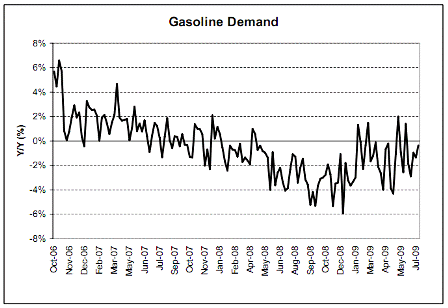
I use comps from two years ago as last year was unusually choppy.

No sign of gasoline demand picking up that I can detect.

Starting to look like the Saudis decided to give themselves maybe a $10 per barrel price increase,
but too soon to tell.

GDP up some from last quarter but still below last year’s levels.

Inventories contributed .9% after being a drag previously, and motor vehicles contributed 1% to the 3.5% total GDP increase in this initial report.


[top]