
Osborne Says Moody’s Warning on Debt Shows U.K. Can’t Waver on Austerity

One more for the scrap book.
This stuff is now way beyond comment.

Osborne Says Moody’s Warning on Debt Shows U.K. Can’t Waver on Austerity

By Robert Hutton and Gonzalo Vina

February 14 (Bloomberg) — Chancellor of the Exchequer George Osborne fended off accusations that he’s not doing enough to boost growth and said a warning by Moody’s Investors Service that Britain may lose its Aaa credit ratingshowed he’s right to focus on reducing borrowing.

“For me it was a reality check,” Osborne told BBC Radio 4’s “Today” show this morning. “It’s yet another reminder that Britain doesn’t have an easy way out of its economic problems. Of course the weaker growth prospects of Britain and just about every other economy is a challenge. People have a choice about where to put their money. If they don’t see Britain dealing with its problems, they will take their money elsewhere.”

The driver behind the change to a “negative outlook” for Britain’s Aaa rated debt is a “weaker macroeconomic environment,” Moody’s said in a statement in London late yesterday. Shocks from the euro area’s sovereign debt crisis are also weighing on the U.K., it said.

Osborne rejected criticism from the opposition Labour Party that he’s too focused on retaining Britain’s top-grade credit rating, arguing that keeping borrowing costs low is the best way to deliver growth. Ed Balls, Labour’s Treasury spokesman, said today that Osborne’s austerity program is getting in the way of economic expansion and risks tipping the U.K. into its second recession in less than three years.

‘Waking Up’

“I fear the world is making the 1930s mistake, and the ratings agencies are partners in this,” Balls told the BBC. “Today is the first evidence that even the ratings agencies are waking up.”

U.K. 10-year gilt yields were little changed at 2.12 percent at 9:41 a.m. in London after inflationslowed to the least in 14 months in January. The pound fell 0.3 percent to $1.5724, after earlier declining to $1.5686, a two-week low.

“The U.K.’s outstanding debt places it amongst the most heavily indebted of its Aaa rated peers, alongside the United States and France, whose Aaa ratings also carry a negative outlook,” Moody’s said.

Spending cuts that helped the U.K. preserve its top credit rating last year and bolstered the pound are now weighing on the currency as investors lose confidence. Sterling had its worst January since 2008 against a basket of nine developed-market peers, falling 0.6 percent, after a 3.1 percent advance in the second half of 2011, according to data compiled by Bloomberg. Gilts are lagging behind lower-rated Treasuries, after world- beating gains of almost 17 percent last year.
China says January lending down 28% from year ago

Looks like China is still in ‘inflation fighting’ mode as state lending over there is functionally like federal deficit spending here.

As previously discussed, while China may successfully engineer a soft landing in their fight against inflation, I’ve never seen anything but hard landings elsewhere when fighting inflation. And with China a ‘first half/second half’ story, a weak first half generally means an even weaker second half.

China says January lending down 28% from year ago

February 12 (AFP) — Chinese bank lending fell 28 percent in January from a year earlier, official data showed, suggesting Beijing is reluctant to open the credit valves too quickly for fear of reigniting inflation.

State-owned lenders issued 738.1 billion yuan ($117.26 billion) in new loans in January, down 288.2 billion yuan from the same month last year and well short of analyst forecasts for one trillion yuan, the central bank said Friday.

Banks handed out 640.5 billion yuan in loans in December.

Chinese banks typically ramp up lending at the beginning of the year to avoid losing quotas issued by regulators and the effects of changes in monetary policy. Analysts said the weaker-than-expected data partly reflected the earlier than usual Chinese Lunar New Year holiday, which fell in January, and the government’s still tight restrictions on credit.

Mark Williams, an economist at Capital Economics in London, said it was the lowest December to January increase since 2007.

“It is hard to escape the feeling that the weakness of lending was at least partly a reflection of the slow pace at which policy is being eased,” he said.

Late last year the central bank eased lending restrictions on banks and analysts expect similar moves this year as authorities try to spur economic activity and prevent a collapse in the property market.

But most experts had forecast another easing of bank reserve requirements before the week-long Lunar New Holiday and the government’s failure to act suggests it does not expect a sharp slowdown in economic growth.

There is growing evidence that the world’s second largest economy is slowing as turmoil in eurozone countries and weakness in the United States hurts demand for Chinese exports, a key driver of the Asian giant.

The International Monetary Fund this week warned that an escalation of Europe’s fiscal woes could slash China’s economic growth by half this year, and it urged Beijing to prepare stimulus measures in response.

But Chinese leaders, worried about reigniting politically sensitive inflation, have signalled their intention to move cautiously and fine-tune policy as needed.

euro zone update- markets yet to discount the discounts

The issues I’ve been discussing over the last year or two while now crystallizing, remain highly problematic.

The idea of Greek default transformed from being a Greek punishment to a gift, with the pending question: ‘If Greece doesn’t have to pay, why do I?’- threatening a far more disruptive outcome that is yet to be fully discounted.

That is, should Greek bonds be formally discounted, the consequences of merely the political discussion of that question will be all it takes to trigger a financial crisis rivaling anything yet seen.

And note, also as previously discussed, that there has yet to be an actual Greek default, and that all Greek bonds have continued to mature at par, as there has yet to be an acceptable alternative.

So what are the alternatives?

1. Continue to fund Greece with terms and conditions.
2. Don’t fund Greece which forces:
  a. Greece is forced to limit spending to actual tax revenues
  b. Greece moves back to the drachma

And what are the ‘terms and conditions’?

Austerity is always the lead demand, which slows both the Greek economy and to some extent the euro zone in general.

Additional demands currently include discounting Greek bonds to bring down their debt to GDP ratio to ‘sustainable’ levels. However, after 8 months of negotiations, this has proven highly problematic, probably for reasons yet to be fully disclosed. And, as just discussed, there may be a growing awareness that discounting opens Pandora’s box with the politically attractive question ‘if Greece doesn’t have to pay, why do we?’

So what actually happens?

My best guess, and not with a lot of conviction, is that nothing is concluded before the coming maturity dates, and the ECB winds up writing the check to support short term Greek funding to buy more time for more inconclusive discussion. So, again as previously discussed, seems like this is the solution- death by 1,000 cuts and reluctant ECB bond buying when push comes to shove to keep it all going.

And, currently, the catastrophic risk I’d highly recommend immediately hedging is the risk that Greek bonds are formally discounted, rapidly followed by a global discussion of ‘so why should we have to pay?’ Possible immediate consequences of that discussion include a sharp spike in gold, silver, and other commodities in a flight from currency, falling equity and debt valuations, a banking crisis, and a tightening of ‘financial conditions’ in general from portfolio shifting, even as it’s fundamentally highly deflationary. And while it probably won’t last all that long, it will be long enough to seriously shake things up.

Irish want debt concession if ECB aids Greece

As previously discussed, once Greece does it, it’s compelling for everyone else to do it.

It’s the classic fallacy of composition.
When someone stands up at a football game to get a better view,
it quickly makes sense for everyone else to stand up as well.

Yes, you can say they all are better off if everyone stays seated,
but once one goes, all go.

So expect a serious shock wave to quickly depreciate all euro debt.

Irish want debt concession if ECB aids Greece

Feb 8 (Reuters) — Ireland would see any European Central Bank contribution to the restructuring of Greek debt as a precedent that would boost Dublin’s efforts to ease the burden of its own sovereign debt, the country’s finance minister said on Wednesday…

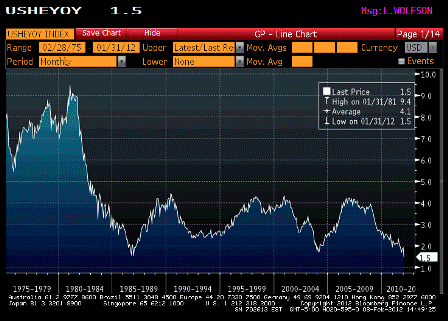
Overlooked in last week’s employment report


Karim writes:

Average hourly earnings reached a new all-time low on a y/y basis of 1.5%.
One of the strongest historical arguments as to why deflation is unlikely is downward nominal wage rigidity.
i.e., its easier to negotiate wage growth from say 4% to 3%, then 1% to 0%, or certainly a wage cut.
But, high unemployment and high duration of unemployment will test that theory.
A move much lower from here will stoke the fears of those Fed members worried about deflation.
Of course the flip side is that this is quite likely a positive for corporate profits.

participation

Consumer borrowing rose $19.3 billion in December

With the federal deficit coming down it takes more consumer and business borrowing to keep GDP (modestly) growing.

And note that student loans are reportedly responsible for half the gain.

Looks to me like it’s going to take a lot more consumer debt growth just to start lowering the output gap.

The largest gains are traditionally to be had in housing, but still no sign of that sector materially improving.

Nor is a proactive fiscal relaxation in the cards.

If anything there’s risk of taxes going up and more spending being cut.

Consumer borrowing rose $19.3 billion in December

Feb 25 (AP) — Americans accelerated their borrowing in December for the second straight month, running up more credit card debt and taking out loans to buy cars and attend school.

Consumer borrowing rose by $19.3 billion in December after a $20.4 billion gain in November, the Federal Reserve said Tuesday. The two increases were the biggest monthly gains in a decade.

Total consumer borrowing is now at a seasonally adjusted $2.5 trillion. That nearly matches the pre-recession borrowing level. And it is up 4.4 percent from the September 2010 post-recession low.

The rise in borrowing could be a sign that Americans are more confident in the economy. But consumers are also borrowing more at a time when their wages haven’t kept pace with inflation.

The outlook for hiring has improved, which could help boost consumer spending.

In January, companies added 243,000 net jobs, and the unemployment rate fell to 8.3 percent, the lowest in three years.

Still, without higher pay, many could pull back further on spending. Consumer spending was flat in December, and the savings rate fell. Consumer spending is important because it accounts for 70 percent of economic activity.

Americans borrowed more on their credit cards in December, likely to buy holiday gifts. A measure of that debt increased by $2.8 billion.

But the bulk of December’s increase was because consumers took out more auto loans and student loans. The category that includes both rose by $16.6 billion.

Ellen Zentner, an economist at Nomura Securities in New York, said that half the gain in that category came from higher student loans. That suggests the weak economy is persuading more people to go back to school.

China Should Weigh Fiscal Boost if Euro Crisis Deepens

Must be a student of MMT?

China Should Weigh Fiscal Boost if Euro Crisis Deepens

Feb 8 (Bloomberg) — China should consider fiscal stimulus if Europe’s sovereign-debt crisis sparks a recession there that affects the U.S., Asian Development Bank Managing Director-General Rajat Nag said.

“The European crisis is a major cloud on the horizon,” Nag said in an interview at the ADB’s Tokyo office today. “Countries, particularly China, have to consider the possibility of coming in with necessary fiscal stimulus if the euro zone crisis becomes more serious and if the effects of that spillover into the U.S.”

The International Monetary Fund said two days ago that a worsening of Europe’s debt turmoil could almost halve China’s growth rate, which the lender projects at 8.2 percent in 2012. Fitch Ratings said yesterday that a “hard landing” for the nation was a key risk for the global economy.

“Our assessment is that the situation will probably not be a hard landing,” Nag said. “If the euro zone crisis resolves itself in an orderly fashion, China could still grow at over 8 percent in this calendar year.

Greek options

There is probably not much voter support for returning to the drachma.

The voters would probably rather have the Germans run their finances than their own leaders.

They’ve seen past drachma financial dramas, with interest rates spiking for everyone, not just the govt, rampant inflation, and a collapsing currency as well as high unemployment.

With the euro none of that happened, so it’s not obvious the currency is the problem.

What does seem obvious to them is that their leaders are the problem.

So I expect the austerity measures to pass, as the alternative is 0 deficit spending.

And if discounts are ‘granted’ the politics quickly move towards same for the rest of the euro member nations.

Portugal Union Leader Wants Debt Renegotiation

Yes, as previously discussed, the obvious political move is to demand the same discounts as Greece.

Especially with the pending Greek ‘restructure’ and ECB check writing to support the banking system seemingly making the euro stronger and not causing inflation.

And the ‘sustainability maths’ is just about the same for all of them as well, particularly given the current slowdown.

Once the markets realize the politics are moving in that direction, all euro member nation bonds again become suspect and the crisis enters the next stage, resulting in the ECB pretty much funding everything, one way or another.

It’s just a question of how it all gets from here to there.

Portugal Union Leader Wants Debt Renegotiation

By Axel Bugge and Daniel Alvarenga

Feb 7 (Reuters) — Portugal must renegotiate its debts rather than impose harsh austerity measures to overcome its economic crisis, the head of the country’s largest trade union said on Wednesday, threatening to step up strikes if the government pushed on with cuts.

Armenio Carlos, head of the CGTP union, told Reuters Portuguese workers would take a stand against attacks on labor rights, which he said were part of the government’s sweeping economic reforms promised under a 78 billion euro ($103.29 billion) bailout.

“What we defend is the renegotiation of debts, in terms of deadlines, in terms of interest and in terms of the amount,” Carlos said in an interview, adding that the country’s bailout had made it impossible to meet its obligations.

Portugal’s debt currently equals about 105 percent of gross domestic product.

“We are being confronted with a neo-liberal attack on workers’ rights,” he added, saying the government’s recent labor reform, making it easier to hire and fire, could spark a growing wave of protests.

The union leader, a former electrician and an ex-Communist lawmaker who took over as head of the CGTP a week ago, warned that with the austerity policies demanded by the bailout, Portugal was heading down the same road to ruin as Greece.