Bitter Money Fights Shaped U.S History (Part 1): Johnson & Kwak

The authors are making fools of themselves with this statement:

As a nation, we will have to make a choice, one way or another. If the national debt grows faster than the economy for long enough, investors could lose their appetite for Treasury bonds, making it impossible for the government to borrow money at any price — as almost happened in 1813.

New Home Sales Unexpectedly Slip 1.6% in February

Seems low interest rates aren’t all the tool they’re cracked up to be?
But they’ve only been low for a bit over 3 years.
Monetary policy works with a lag and all that.
Much like Japan.
Again like the carpenter said of his piece of wood, no matter how much cut off it’s still too short?

Along the same lines, next thing they’ll be doing is increasing savings incentives to help investment.

And note the slight twist on the same theme, increasing bank capital requirements to support confidence.

It’s about aggregate demand, and how you can’t drain yourself to prosperity.

How hard is that?

New Home Sales Unexpectedly Slip 1.6% in February

March 23 (Reuters) — New U.S. single-family home sales fell in February, but a jump in prices to their highest level in eight months kept hopes alive of a recovery in the housing market.

The Commerce Department said on Friday sales slipped 1.6 percent to a seasonally adjusted 313,000-unit annual rate. January’s sales pace was revised down to 318,000 units from the previously reported 321,000 units.

Sales for November and December were revised up a bit.

Economists polled by Reuters had forecast sales at a 325,000-unit rate in February. Compared to February last year, new home sales were up 11.4 percent.

The median price for a new home rose 8.3 percent to $233,700, the highest level since June. Compared to February last year, the median price was up 6.2 percent.

The report, which rounded off a week of mixed housing data, followed a similar pattern seen in the market for used homes. Home resales fell in February, but prices rose from a year earlier. Housing starts slipped, while permits for home building approached a 3-1/2 year high in February.

Bank of America tests Alternative to Foreclosure

Must be reading my blog

BofA Tests an Option to Foreclosure

Bank of America is launching a pilot program that will allow homeowners at risk of foreclosure to hand over deeds to their houses and sign leases that will let them rent the houses back from the bank at a market rate.

While the initial scope of the “Mortgage to Lease” program is small—the bank began sending letters Thursday offering leases to 1,000 homeowners in Arizona, Nevada and New York—it represents a big change in the way banks deal with borrowers who can’t afford their mortgages.

Spanish rates

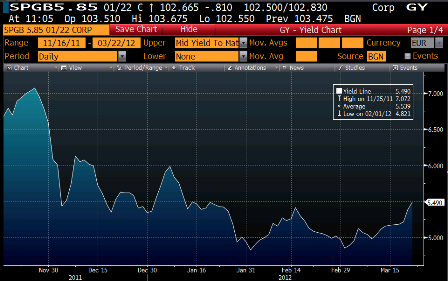
LTRO’s and bank liquidity not withstanding, Spanish rates reversed and began moving higher immediately after they thumbed their noses at the markets and announced they had decided not to take additional austerity measures to meet their immediate deficit targets.

Not being the issuer of the euro, like all the euro member nations, they are fully exposed to a Greek like liquidity crisis, as they can not spend without prior funding, much like the US states.

Click here for larger version

EUR PMIs-Big GDP Implications

And not only no change in fiscal policy, but more of same. As the carpenter said about his piece of wood, ‘no matter how much I cut off it’s still too short.’

Fertile ground for the ‘bond tax’ (PSI) for the next round of austerity, to reduce the need to further cut public services and raise domestic taxes.


Karim writes:

As mentioned before, PMI surveys in Europe are the most timely and important economic data point for the ECB; they have the greatest weight in the ECB’s model of estimating current quarter and quarter ahead growth.

Today’s data was weaker across the board, with Germany surprisingly weak in particular.

  • Euro composite PMI fell for the second month in a row, from 49.3 to 48.7
  • Weakness was led by manufacturing, down from 49 to 47.7
  • German manufacturing was especially weak, falling from 50.2 to 48.1
  • French PMI slipped back below 50, from 50.2 to 49

The impact on GDP according to NowCasting (which uses a similar framework as the ECB) was a downward revision to Q2 real GDP growth from +0.6% (annualized) to -0.6% (annualized) for the EuroZone, and from 0.1% (annualized) to -1.2% (annualized) for Germany.

This data should certainly push up the probability of an ECB policy rate cut in May or June.

Hints of Portugal PSI?

From Morgan Stanley
Note the talk of a PSI (bond tax):

5. Portugal: Portugal’s five-year bonds are trading at ~16%, right around the level where Greek bonds traded last April when Eurozone officials began to turn their attention to forcing losses on private sector creditors. The key area of concern in the market is a €9.7B bond maturing in September 2013 that is not covered by the country’s €78B bailout. Portugal needs ~€25B-€30B to fund itself through 2015. Portuguese officials hope that a pickup in market confidence will allow it to return to the bond market in time to refinance the 2013 bond. The Portuguese funding concerns have been widely discussed in the press. While there has been speculation that the country could be next in line for a debt restructuring, this outcome has been disputed by both Portuguese and troika officials.