Claims/Trade Data


Karim writes:

Claims:
Initial claims was unambiguously weak, rising to 380k, the highest level since January. The prior week was also revised higher, from 357k to 367k.

The labor department cited no special factors despite it being Easter week; the USVI was the only locale where claims were estimated for the holiday.

Trade Balance:
The trade deficit fell to its lowest level since October, largely due to an 18% drop in imports from China (Lunar New Year effect) and a drop in oil imports.

The data may push Q1 GDP estimates to as high as 3% but that should not be confused with a pick-up in the underlying strength of the economy.

The stalling out in the claims data last month did a good job of predicting the slowdown in payrolls. Today’s data throws further job market improvement into greater question.

BOJ Easing Would Trump Intervention in Weakening Yen, Okubo Says

Wrong wrong wrong

BOJ Easing Would Trump Intervention in Weakening Yen, Okubo Says

By Mayumi Otsuma and Kyoko Shimodoi

April 11 (Bloomberg) — Further stimulus by the Bank of Japan would be more effective in weakening the yen than currency intervention, a ruling party lawmaker said, a sign politicians will continue to press the BOJ to do more.

“It’s obvious that the central bank’s policies have more influence over the currency than intervention,” Tsutomu Okubo, a Democratic Party of Japan lawmaker, said in an interview in Tokyo yesterday, citing the yen’s depreciation of more than 4 percent against the dollar since the BOJ added stimulus Feb. 14.

The BOJ refrained from easing policy at a meeting on April 10, spurring calls from DPJ lawmakers including Takeshi Miyazaki for them to undertake “bold and large-scale” action when they gather on April 27. The BOJ’s February decision to increase its asset-purchase fund helped weaken the yen close to an 11-month low against the dollar on March 15.

“Interventions are effective in correcting extraordinary and speculative currency moves, but they aren’t very good at addressing structural and long-term problems,” said Okubo, who’s the deputy head of the DPJ’s policy research council and a former managing director at Morgan Stanley. “It’s obvious what kind of actions the Bank of Japan (8301) should be taking.”

Spanish Banks Face Bond Losses in LTRO Aftermath: David Powell

Looks like it was at least the Spanish banks that got the nod to buy their govt’s bonds when the LTRO was announced.

Problem is they can only buy them to the extent their capital allows, and as raising more capital isn’t happening, it was probably a one time buying binge.

That’s why subsequent LTRO’s won’t do much for banks whose capital is already fully extended.

And losses serve to weaken their capital positions.

Spanish Banks Face Bond Losses in LTRO Aftermath: David Powell

By David Powell

April 11 (Bloomberg) — The European Central Bank may have pushed the Spanish banking system closer to collapse through its three-year longer-term refinancing operations.

Banks in Spain have been saddled with losses of about 1.6 billion euros as a result of the liquidity operation conducted in December, according to Bloomberg Brief estimates. Spanish lenders purchased 45.7 billion euros of government bonds during the months of December, January and February, according to monthly data from the ECB, and the average of the current prices of two-, six- and 10-year government bonds of Spain is 3.5 percent below the average of the average of those prices from Dec. 22 to March 1. [Note: The prices for six-year bonds are used instead of those for five-year bonds because the price history for the current five-year generic government bond of Italy starts only in January.]

International assistance will probably be needed to break the cycle. Spanish sovereign yields surged last year as investors worried about the solvency of the state given unrecognized losses in the banking system linked to the real estate bubble. Interest rates later declined after Spanish lenders purchased government debt during those three months, probably with the proceeds of the first three-year longer-term refinancing operation. Those purchases are now creating additional losses for the banking system.

The losses stemming from those bonds were essentially transferred to the domestic banking system from private bondholders with the assistance of the central bank.

The damage may be mitigated by low levels of margin calls from the ECB. Deposits related to margin calls at the central bank totaled only 0.3 billion in the week ended April 4, according to the Eurosystem’s weekly financial statement.

That suggests commercial lenders posted assets as collateral that have maintained their values. Those probably consisted primarily of the “residential mortgages and loans to small and medium-sized enterprises (SMEs)”, which the central bank said were eligible for use in its Dec. 8 statement. Those illiquid assets may be unaffected by the mark-to-market process because there are no developed markets for them. The deposits related to margin calls probably would have risen if banks had posted government bonds as collateral.

The situation for financial institutions in Italy is less dire than for those in Spain. Italian government bond prices on average are 2.1 percent above the distressed levels at which they traded from Dec. 22 to March 1. That suggests Italian banks may be sitting on profits of about 425 million euros after they purchased 20.3 billion euros of government bonds during that period.

Losses for both banking systems would probably have been created if they purchased government bonds with the proceeds of the second three-year longerterm refinancing operation. The funds from the second auction are excluded from this analysis because it settled on March 1 and the latest data from the ECB on government bond purchases of euro-area banks runs through the end of February. The data for March will be released on April 30.

As Ronald Reagan quipped, “The nine most terrifying words in the English language are: ‘I’m from the government and I’m here to help.'”

EU Daily | Monti under fire as crisis deepens

It’s now not over until the ECB writes the check, the whole check, and nothing but the check.

Monti under fire as crisis deepens

(FT) — “We are not standing down,” said Susanna Camusso, leader of the leftwing CGIL. Workers are to down tools next Friday over pension reforms passed in December and will strike again when parliament debates Mario Monti’s controversial labour reform legislation. Rather than feeling mollified by concessions made by Mr Monti over changes to rules on the firing of workers for economic reasons, Ms Camusso made it clear the union felt emboldened by its mobilisation. “The text is very bad,” Emma Marcegaglia, head of Confindustria, told the Financial Times, saying it would be better to scrap the entire labour reform legislation if it were not amended in parliament. A senate committee will start examining the bill on Wednesday.

Shaken Spain seeks to restore confidence

(FT) — Luis de Guindos, the economy minister, has said in interviews with local and foreign media that Spain does not need a bailout of the kind provided to Greece, Ireland and Portugal by the European Union and the International Monetary Fund. Mr de Guindos told Germany’s Frankfurter Allgemeine Zeitung that the government’s next step would be a reform of the health and education systems “that is, a rationalisation of spending in the autonomous regions”. Spain needs to cut more than 3 percentage points of gross domestic product from its public sector deficit, reducing it from 8.5 per cent of GDP in 2011 to 5.3 per cent this year in line with EU targets. In 2013, the deficit is supposed to fall further to 3 per cent of GDP.

Spain Economy to Start Growing From 2013, de Guindos Tells Ser

(Bloomberg) — Spain’s economy will start growing next year, Economy Minister Luis de Guindos says in interview with Cadena Ser radio station today.

Labor situation to stabilize from final quarter of this year, de Guindos says.

Italy Fights Spain for Investors as ECB Boost Fades: Euro Credit

(Bloomberg) — Competition between Italy and Spain for international investors’ funds will heat up this quarter as domestic buying stoked by the European Central Bank fades.

Italian and Spanish bonds slumped last week after demand dropped at a Spanish bond sale and Prime Minister Mariano Rajoy said his country is in “extreme difficulty.” The decline reversed a first-quarter rally sparked by more than 1 trillion euros ($1.3 trillion) of ECB loans to the region’s banks via its longer-term refinancing operation. Spain’s 10-year yield spread to German bunds widened to the most in four months, while Italy’s reached a six-week high.

“Spain and Italy are coming back down to earth after an incredible first quarter,” said Luca Jellinek, head of European interest-rate strategy at Credit Agricole SA in London. “The LTRO bought some time, but not a massive amount of time. Now the second quarter will be harder than the first unless policy moves convince foreign investors to come back in.”

Italian 10-year bonds fell for a fourth week, with the yield advancing 40 basis points to 5.51 percent. The yield difference over bunds widened to 378 basis points, compared with an average of 381 basis points in the first quarter. Spain’s 10- year yield spread to Germany reached 410 basis points last week after averaging 333 basis points in the first three months.

Swan Says Australian Budget Surplus Goal Is Correct Strategy

Let’s hope ‘better lucky than good’ keeps working for them:

Swan Says Australian Budget Surplus Goal Is Correct Strategy

By Elisabeth Behrmann

April 8 (Bloomberg) — Australia’s low unemployment compared with other industrialized nations and record investment make returning the budget to surplus the right strategy, Treasurer Wayne Swan said.

“With solid growth, contained inflation, very low public debt, low unemployment and a record pipeline of investment, we are the envy of virtually every advanced economy,” Swan said in his economic note today. Returning the budget to a surplus during fiscal 2012-13 is “the right strategy for an economy returning toward trend growth.”

Swan, who is preparing Australia’s budget for release on May 8, faces the challenge of balancing a drop in revenue against a government pledge to deliver a surplus in the 12 months through June next year. While the resources boom is benefiting Western Australia and Queensland, retailers and manufacturers are facing tough conditions in other states.

In the past month, Australian government reports have shown fourth-quarter gross domestic product expanded at half the pace economists forecast, and the weakest exports in almost three years led to Australia’s first trade deficit in 11 months in January.

Mining investment in Australia, the world’s biggest exporter of iron ore and coal, is estimated to reach A$120 billion ($124 billion) next year, an increase of around 155 percent in two years, Swan said last month.

‘Best Defense’

“Claims that the return to surplus is putting growth at risk overlook the fact that the government’s budget strategy has been clear and consistent for a long time,” Swan said. “Returning the budget to surplus is our best defense and is a key sign of our strong economy.”

The Reserve Bank of Australia held interest rates unchanged on April 3, while signaling it may resume cutting rates as soon as next month if weaker-than-forecast growth slows inflation.

Returning the budget to surplus is “the right thing to do,” Prime Minister Julia Gillard said April 1, while pledging to support jobs. Australia has battled natural disasters, including record floods in Queensland last year, that have hampered economic activity, including tourism as well as export of coal.

China is Australia’s biggest trading partner, and the RBA has said it expects Chinese demand for commodities to remain strong even as recent data painted a mixed picture of the world’s second-largest economy.

Australia has grown more dependent on resources as employment in manufacturing dropped by about 30 percent since 2007, while mining and government payrolls rose by more than 50 percent, HSBC Holdings Plc estimates.

“Maintaining our credible fiscal policy also sends a strong message of confidence to investors across the world in uncertain times,” Swan said.

FOX News: Boy in China reportedly sells kidney to purchase iPhone and iPad

Boy in China reportedly sells kidney to purchase iPhone and iPad

April 6 — A teenage high-school student in China sold his kidney for an illicit transplant operation and used the proceeds to buy an Apple iPhone and iPad, state press said on Friday.

The 17-year-old boy, who was paid $3,500, was recruited from an online chat room and is now suffering from kidney failure and in deteriorating health, the Xinhua news agency said.

A surgeon and four others have been arrested and are facing charges of illegal organ trading and intentional injury.

The kidney donor, only identified by his surname Wang, agreed to the April 2011 operation in the central province of Hunan without his parents’ consent, the report said.

One of those detained was a hard-up gambler identified as He Wei, who acted as a middle-man between a hospital worker and the teenager.

Health ministry statistics show that about 1.5 million people in China need transplants, but only around 10,000 transplants are performed annually.

The huge gap has led to a thriving illegal market for organs.

Employers Added 120,000 Jobs in March, Fewest in Five Months

Looking for a very bad opening and subsequent sell off in Asia and especially the euro zone as hopes of exports to the US fade leaving them no escape from their deteriorating domestic demand.

This is now the beginning of the endgame for the Euro zone, as they discover the firewall is another Maginot line that markets go through like a knife through butter.

Employers Added 120,000 Jobs in March

By Timothy R. Homan

April 6 (Bloomberg) — Hiring by American employers trailed forecasts in March, casting doubt on the vigor of the more than two-year-old economic expansion.

The 120,000 increase in payrolls reported by the Labor Department in Washington today was the smallest in five months and less than the most pessimistic estimate in a Bloomberg News survey of economists. The unemployment rate fell to 8.2 percent from 8.3 percent as people left the labor force.

Stock futures, the dollar and Treasury yields all fell as the report highlighted Federal Reserve Chairman Ben S. Bernanke’s concern that stronger economic growth is needed to keep the nation’s jobs engine humming. Today’s data also showed that Americans worked fewer hours and earned less on average per week, boding ill for the consumer spending that makes up 70 percent of the world’s largest economy.

“We see a lack of sustainability in terms of strong job growth,” Tony Crescenzi, a strategist at Pacific Investment Management Co. in Newport Beach, California, said in a radio interview on “Bloomberg Surveillance” with Tom Keene and Ken Prewitt. “This is still not strong enough to create escape velocity, which is to say an economy strong enough to make it on its own without additional monetary stimulus from the Federal Reserve.”

Among those having trouble finding work is Xander Piper, 30, who has been looking for a full-time job since September, when he completed a master’s program in social science at the University of Chicago. He decided to go to graduate school in 2010 to improve his employment prospects after losing his position at an advertising agency.

Expected Work Sooner
“When I graduated, I assumed I was going to get a job within the first couple of months,” said Piper, a San Francisco resident who said he’s looking for work in education and sometimes sends out 10 resumes a day.

“Now I work for a temp company, but even they’re having trouble staffing me,” he said. “I recently had a two to three month break at my temp company. What I have gotten recently is call center work, which is just brutal.”

A separate report today from the Fed showed consumer borrowing rose less than forecast in February, restrained by a drop in credit-card debt. Credit increased $8.7 billion, the least in four months, after an $18.6 billion gain in January.

Employment Forecasts
Employment in March was forecast to increase by 205,000, according to the median projection of 80 economists in the Bloomberg survey. Estimates ranged from increases of 175,000 to 250,000 after an initially estimated 227,000 gain the prior month.

S&P 500 futures expiring in June slumped 1.1 percent to 1,374.90 following the benchmark index’s 0.7 percent weekly loss. U.S. stock exchanges were shut for the Good Friday holiday. The dollar weakened 1 percent to 81.57 yen at 12:14 p.m. in New York, touching the lowest level since March 8. The yield on the benchmark 10-year Treasury note fell to 2.06 percent from 2.18 percent.

“We see modest growth inside the U.S. and demand for labor,” Carl Camden, president and chief executive officer of Kelly Services Inc. (KELYA) (KELYA), a Troy, Michigan-based staffing agency, said March 12 during a conference. The expansion is “a nice steady, not robust, not rock-and-roll, but a steady recovery, capable of producing a steady stream of jobs.”

Temporary Hiring
Employment at service providers increased 89,000 after a 211,000 gain in February. Professional and business service payrolls rose 31,000 last month, restrained by a 7,500 drop in temporary hiring.

J.C. Penney Co., the fourth-largest U.S. department-store company, is among employers cutting jobs. The company said today it notified about 1,000 workers, primarily in its headquarters in Plano, Texas, and its Pittsburgh customer call center, that their jobs will be cut as part of a restructuring plan.

Part of the slowdown in March may have reflected a warmer winter, which prompted some employers to hire more or retain workers in previous months than they otherwise would have, Paul Ashworth, chief U.S. economist at Capital Economics Ltd., said in an e-mail to clients. The average gain in payrolls from December through February was 246,000.

“We had mild weather, which basically had consumers in the marketplace earlier,” said Jack Kleinhenz, chief economist of the National Retail Federation, a Washington-based trade group. As a result, retailers postponed headcount reductions that typically follow the holiday shopping season, he said.

Retailers Cut Back
The March data showed a 34,000 decrease in retail employment, the biggest decline since October 2009. The Labor Department said today that the number of people unable to work due to inclement weather was 360,000 below average from December through February.

Temperatures in December through February averaged 36.8 degrees Fahrenheit (2.7 degrees Celsius), 3.9 degrees above the average in the 20th century, representing the fourth-warmest winter on record for the 48 contiguous U.S. states, according to the National Oceanic and Atmospheric Administration.

Some economists saw similarities with early 2011, when the economy slowed amid rising energy prices, a disruption of supplies caused by the tsunami in Japan and political gridlock in the U.S. over the debt ceiling.

This year, rising gasoline prices and the European debt crisis are taking a toll, said Mark Zandi, chief economist at Moody’s Analytics Inc. in West Chester, Pennsylvania.

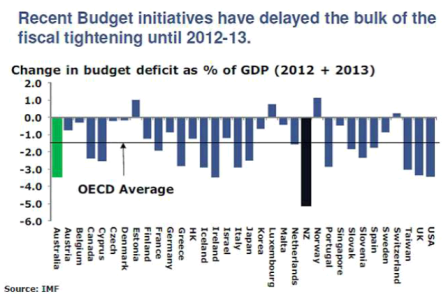
Impact of expected fiscal consolication measures on GDP

Below is a wonderful chart of fiscal initiatives and their expected impact on GDP. The chart highlights –

a) the two largest fiscal consolidations are expected to occur in NZ and Australia.

   the planned consolidation in Australia is the biggest 1y fiscal consolidation on
   record for Australia – this is expected to be formally introduced in their May
   budget

b) number of initiatives are by the Eurozone countries (both core and peripheral) as they impose fiscal austerity to reduce debt burdens

c) significant negative impact on US GDP should tax cuts etc. that are currently in place are not extended at the end of the year.

Click here for larger version

Euro zone update

The joke used to be: ‘what’s the difference between bonds and bond traders?
Bonds eventually mature.

Except in the euro zone, post the Greek PSI ‘bond tax’, markets are starting to trade like maybe the don’t.

Yes, the ECB can come in and buy again, and probably will with more deterioration, but now it’s known that merely increases the risk of holding the remaining outstanding bonds, as the ECB’s bonds become ‘senior’and don’t get taxed.

So with deficits looking higher due to economic weakness due to mandatory austerity, the sustainability maths pointing to the bond tax route, and the ECB buying further adding to risk of loss, something has to give.

And it all remains potentially catastrophic for the global financial infrastructure, with aggregate demand remaining on the weak side globally and fiscal consolidation pending in most places.