Hi Warren,
Just published the program as per your suggestions.
Thank you for supporting me and Bulgarian people, currently living and dying in misery. Hopefully they will show better judgment than the American ones.
Regards,
Ryan
Bulgaria MMT
Friday update
So just like Japan, as soon as the economy starts doing a bit better we hike taxes. Still too early to say how the FICA hike will impact sales and profits, but it will. And spending cuts are on the way, though they may be delayed.
Not to forget the debt ceiling thing about to be kicked 3 months down the road as it stands guard to ensure ‘meaningful’ spending cuts.

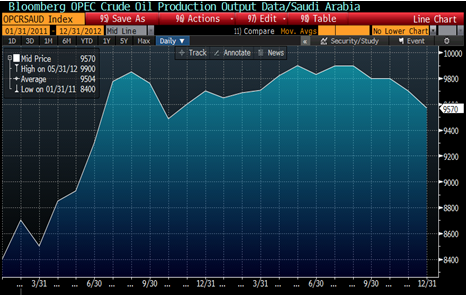
Oil firm, but can still go either way. WTI converging to Brent indicates the seaway pipeline capacity increase may be enough to drain the surplus at pad 2, bringing wti up to brent, but too soon to tell for sure. And looks like the demand for saudi crude is dropping some, but not enough to dislodge them from being
swing producer/price setter.
Looks to me like the whole world is becoming ‘more competitive’ so it all cancels out. Bad for people, ok for stocks, with profits running at record highs as a % of GDP. Meaning the federal deficit has to be that much higher, all else equal, to fill the output gap.
The yen keeps going down. Looking more and more to me it’s off the radar screen intervention by the likes of insurance co’s, pension funds, and other quasi govt agencies got the note to buy fx denominated bonds in size. Not sure how far they will take it, but they have a serious herd instinct that has formed serious multi year bubbles in the past.
Europe? They fixed the solvency issue, sort of, and now just have the economy thing to deal with. Problem is the ECB grants solvency only with conditionality. Good luck to them.
Oil Settles Higher After Saudi Arabia Cuts Output
As the article states, production fell because demand fell. If anything that would be oil unfriendly as the Saudis can only cut maybe another 5 million bpd without ‘permanent’ cutbacks, at which point they lose control of price on the downside.
Market price action, however, might be telling us the cutbacks were due to production issues in which case the risk is loss of control of price on the upside.
Oil Settles Higher After Saudi Arabia Cuts Output
January 10 (Rueters) — Oil futures rose on Thursday on news that top world oil exporter Saudi Arabia had cut back production in response to flagging demand, and after China reported strong demand for its exports.
U.S. light, sweet crude rose to a 14-week high of $94.70 a barrel before settling at $93.82, up 72 cents on the day. Brent crude futures rose as high as $113.29 a barrel before settling at $111.89, up 13 cents.
OPEC’s top producer slashed oil production by 700,000 barrels per day (bpd) to 9 million bpd during the last two months of 2012, according to industry sources. Major customers for Saudi crude said the cuts were driven by lower demand.
News of the Saudi supply curbs helped briefly push Brent over $113 a barrel for the first time since mid-October, well above the $100 a barrel price Riyadh has said it favors.
Oil and other markets also got a boost from Chinese trade data that showed strong export growth rebound in December, raising expectations of revived growth in the world’s No. 2 economy that could drive more fuel demand.
Crude pared some gains after the Philadelphia Federal Reserve Bank said its annual revisions showed that factory activity in the U.S. mid-Atlantic region grew at a lower pace in December than originally reported.
“The strong data from China indicates demand might be improving there and the Saudis have cut back production, but the downward revisions by the Philly Fed gave the market a little pause,” said Phil Flynn, analyst at Price Futures Group in Chicago.
Gains in U.S. crude pushed the benchmark to a level of 67 on the 14-day relative strength index. That is close to the 70 mark that, according to traders who follow technical charts, can indicate a commodity has been overbought.
U.S gasoline futures rose along with crude, but heating oil futures in the New York Harbor fell by 0.6 percent to around $3.05 per gallon.
Traders attributed the fall to speculation that cargoes of Russian gas oil may come to the Harbor. Physical oil traders told Reuters that up to six cargoes may be headed for New York.
Also helping oil’s advance on Thursday was news of a pipeline explosion in Yemen that halted most of the country’s oil exports.
Flows of oil through Yemen’s main crude export pipeline stopped on Thursday after it was blown up by unknown attackers, government and oil industry officials said.
“These three factors – Saudi Arabia, Yemen and the China data – are all helping to push up the market,” said Tamas Varga, an oil analyst at broker PVM Oil Associates in London.
Saudi Arabia says it favors an oil price of about $100 a barrel, but recent reports have suggested that the market is well supplied and that output from some regions, particularly North America, will grow rapidly over the next two years. U.S. government data showed that domestic oil output rose above 7 million barrels a day last week for the first time since 1993.
“Short term, the Saudi output figures are bullish, but longer term they are more bearish, because they suggest Saudi Arabia sees the need to cut to balance the market,” Varga said.
Comments
Check this Insanity – they want that 2% inflation
Yes!
New Govt Office To Advise Small Firms On Consumption Tax
January 16 (Nikkei) — The government plans to set up a new office to provide advice to small businesses that wish to transfer consumption tax increases to the prices of their products and services, prior to the introduction of the 8% tax rate in April 2014, The Nikkei has learned.
Subcontractors are becoming concerned that they may be pressured into not passing tax increases over to their product and service prices, as many of them do not have the advantage in price negotiations.
The new office will address such concerns by helping firms to avoid taking on excessive costs. It will accept inquiries and complaints from throughout Japan by telephone and e-mail.
The Japan Fair Trade Commission will work closely with relevant ministries to inspect companies that are suspected of having rejected requests for price increases from their suppliers. The government also plans to come up with new legislation to impose strict controls on such companies.
More Americans 75 and Older Keep Working
As previously discussed, the real answer to the ‘dependency ratio’ is in fact happening?
The trick is to let seniors collect full social security and their paychecks:
More Americans 75 and Older Keep Working
By Christine Dugas
January 1 (USA Today) — Sixty-five is the normal retirement age, but many Americans are working much later in life, and it’s not just because they need the money.
The number of workers who are 75 and older has skyrocketed by 76.7 percent in the past two decades, according to research by the AARP Public Policy Institute. “We are living longer, healthier lives,” says Kerry Hannon, author of Great Jobs for Everyone 50+. “And the types of work that people do is not as labor intensive as it was in our parents’ generation.”
Platinum Coin Idea Is Rejected by White House
This is far more problematic than markets realize.
The President had a choice. The debt ceiling thing expresses ‘the will of Congress’ where Congress makes laws for the executive branch to execute. The President has also sworn to uphold the Constitution which says the President has to pay the nation’s bills. The President has so far decided to abide by the will of Congress.
And, in any case, the Republican leadership says the fight is going to be about modifying the already in place sequestrations.
So seems it’s now ‘advantage Republicans’ on the spending cuts issue.
The economy hitting the debt ceiling and going cold turkey to a balanced budget is a far more catastrophic event than even going over the full cliff would have been, as it disables the ‘automatic fiscal stabilizers’ and instead triggers a pro cyclical downward spiral in output and employment. That is, when the $25 billion/week spending cuts kick in and the economy slows, the falling tax revenues mean spending has to be cut more, nor can total spending on unemployment ‘automatically’ go up, etc.
And don’t forget about the Jan 1 FICA hike now beginning to kick in which also seems markets are not discounting.
Platinum Coin Idea Is Rejected by White House
January 12 (Reuters) — The White House on Wednesday sees little profit in the notion of minting $1 trillion platinum coin as an escape hatch to avoid a debt default if Congress balks at raising the U.S. debt limit.
Stephanie Kelton appears on UP with Chris Hayes
Stephanie Kelton will be appearing on UP with Chris Hayes on MSNBC this Saturday January 12, 2013 at 8:00 AM Eastern.
Meet the Genius Behind the Trillion-Dollar Coin
Japan should buy the platinum coin?
Abe revived this panel. Lots of cross pressures as to whether to increase deficit spending or not. If not, they could continue to be the land of the rising yen, as ‘monetary policy’ short of actual fx purchases doesn’t cut it.
As previously discussed, while reported reserves have remained flat since the last announced intervention, there are signs actual fx reserves have been rising from what is functionally intervention not counted as official intervention, but I can’t yet say for sure.
And note that the purchase of a US Treasury $1 trillion platinum coin would weaken the yen and put off the US debt ceiling issue…
;)
Govt Starts Talks On Fiscal Reform At Revived Key Policy Panel
TOKYO (Kyodo) — A revived Japanese government economic policy panel started discussions Wednesday on how to rehabilitate the nation’s finances in the longer term, with the government’s plan to issue more debt to fund a stimulus package stirring concern over the nation’s fiscal health.
The meeting of the Council on Economic and Fiscal Policy was the first in three and a half years. The panel had played a leading role in putting together economic and fiscal policy under the government of Prime Minister Junichiro Koizumi of the Liberal Democratic Party.
During Wednesday’s meeting of the panel revived by Prime Minister Shinzo Abe, who took office on Dec. 26, participants exchanged views on an emergency economic stimulus package slated to be approved by the Cabinet on Friday.
The government led by the LDP, which returned to power in the Dec. 16 general election after three years in opposition, also began discussions on mapping out the basic policy for an initial budget for the next fiscal year starting April and medium-to-long term economic and fiscal policy blueprints.
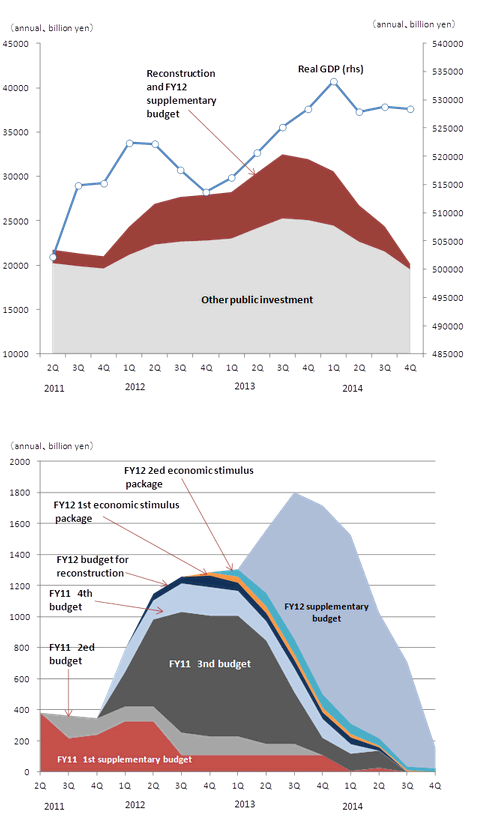
Abe’s government is considering approving an emergency stimulus package of over 20 trillion yen ($228.7 billion) to boost Japan’s slowing export-reliant economy, and compiling a 13.1 trillion yen extra budget for the current fiscal year to finance it, sources close to the matter said Tuesday.
To cover the shortfall in revenue needed to pay for the supplementary budget, Tokyo is making arrangements to issue an additional 5.2 trillion yen in construction bonds for fiscal 2012, the sources said.
The move has focused attention on how the LDP-led government will show a commitment to restoring Japan’s precarious fiscal health, the worst among major developed countries.
If fears intensify that progress on fiscal reform has stalled, long-term interest rates could spike as investors become reluctant to buy government bonds due to fears of default, dampening corporate and private investment and dragging down the broader economy, some analysts have warned.
The previous government led by the Democratic Party of Japan had set as its fiscal reform target halving Japan’s primary balance deficit — total expenditures in excess of total revenues, excluding interest payments on debt — by the end of fiscal 2015.
Abe is eager to finalize by June the basic fiscal policy, which could include a plan to put Japan on a path toward fiscal restoration, the sources said.
The Council on Economic and Fiscal Policy, first established in 2001 but put on ice after the DPJ took power in 2009, would function as the “control tower” of Japan’s macroeconomic policies, Abe has said.
The Bank of Japan governor is requested to join the council’s meetings along with business leaders and academics, with Abe saying he wants to deepen communication with the central bank chief there.
Abe has pledged to beat the nation’s chronic deflation, urging the BOJ to aggressively ease monetary policy until a 2 percent inflation rate is achieved.
Financial market participants said they are paying attention to whether Abe will put additional pressure on current BOJ Governor Masaaki Shirakawa to do more during the meeting late Wednesday, ahead of the BOJ’s Policy Board meeting on Jan. 21 and 22, at which the central bank is expected to introduce a 2 percent inflation target, as requested by Abe.